

D7 Lead Finder vs SalesIntel: Which One Fits Your Workflow?
Comparing D7 Lead Finder vs SalesIntel feels awkward because they aren't built for the same job. They solve different problems, fail in different ways, and attract different buyers. The real question isn't "which has better features?" - it's which failure mode you can afford. Empty lists, or bounced emails? If you're a local agency owner pulling plumber leads in Phoenix, you need a fundamentally different tool than a mid-market AE building an outbound list of VP-level contacts at SaaS companies.
30-Second Verdict
Pick D7 if you need local business lists fast and cheap. It's ~$29-$120/mo, monthly billing, cancel anytime. No procurement hoops.
Pick SalesIntel if you need verified decision-maker contacts with enrichment, CRM integrations, and a research team on call. Budget starts around $10k/yr, typically on annual contracts.
Skip both if you want verified emails and mobiles without annual lock-in or manual cleanup. Prospeo covers 300M+ profiles with 98% email accuracy, a 7-day refresh cycle, and credits starting at ~$0.01/email. Free tier available, no contracts.
D7 vs SalesIntel at a Glance
| Dimension | D7 Lead Finder | SalesIntel |
|---|---|---|
| Category | Local lead extractor | Sales intelligence platform |
| Verification | Email verification (method not published) | Human / Email / Machine Verified tiers |
| Refresh cadence | Not published | 90-day re-verification (Human Verified) |
| Pricing model | Monthly self-serve | Annual, quote-based |
| G2 rating | 3.7/5 | 4.3/5 (538 reviews) |
| Key integrations | CSV/Excel/PDF export | Salesforce, HubSpot, Outreach, Salesloft, Marketo, Dynamics 365, Zoho |
| Setup time | Minutes (self-serve) | ~1 month |
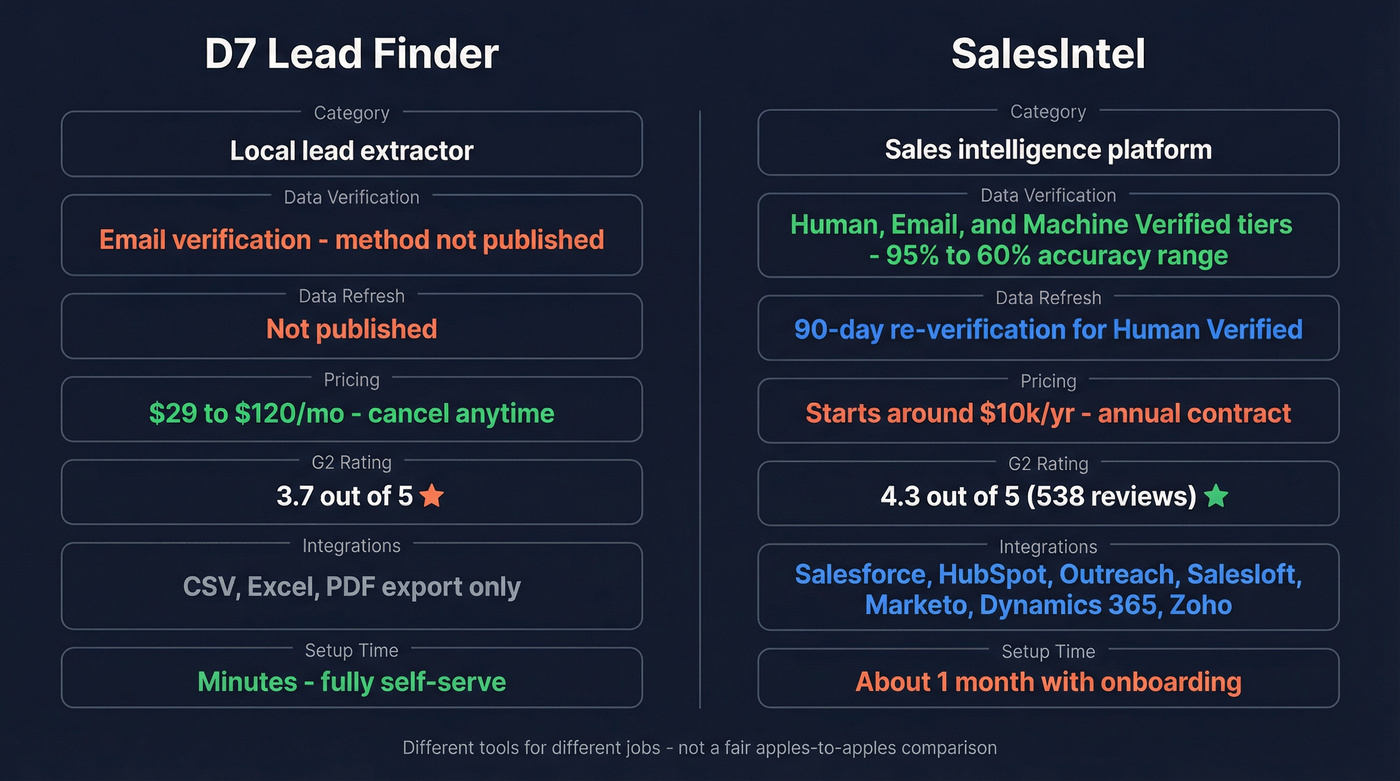
These tools occupy different weight classes. D7 is a scraper with a clean UI. SalesIntel is a platform with a research team behind it. Comparing them on features alone misses the point - the real gap is in verification depth and workflow integration.
Data Quality and Verification
SalesIntel runs three verification tiers with meaningfully different accuracy levels. Human Verified contacts hit ~95% accuracy and get reverified every 90 days. Email Verified sits at ~90%, refreshed every six months. Machine Verified drops to ~60%.
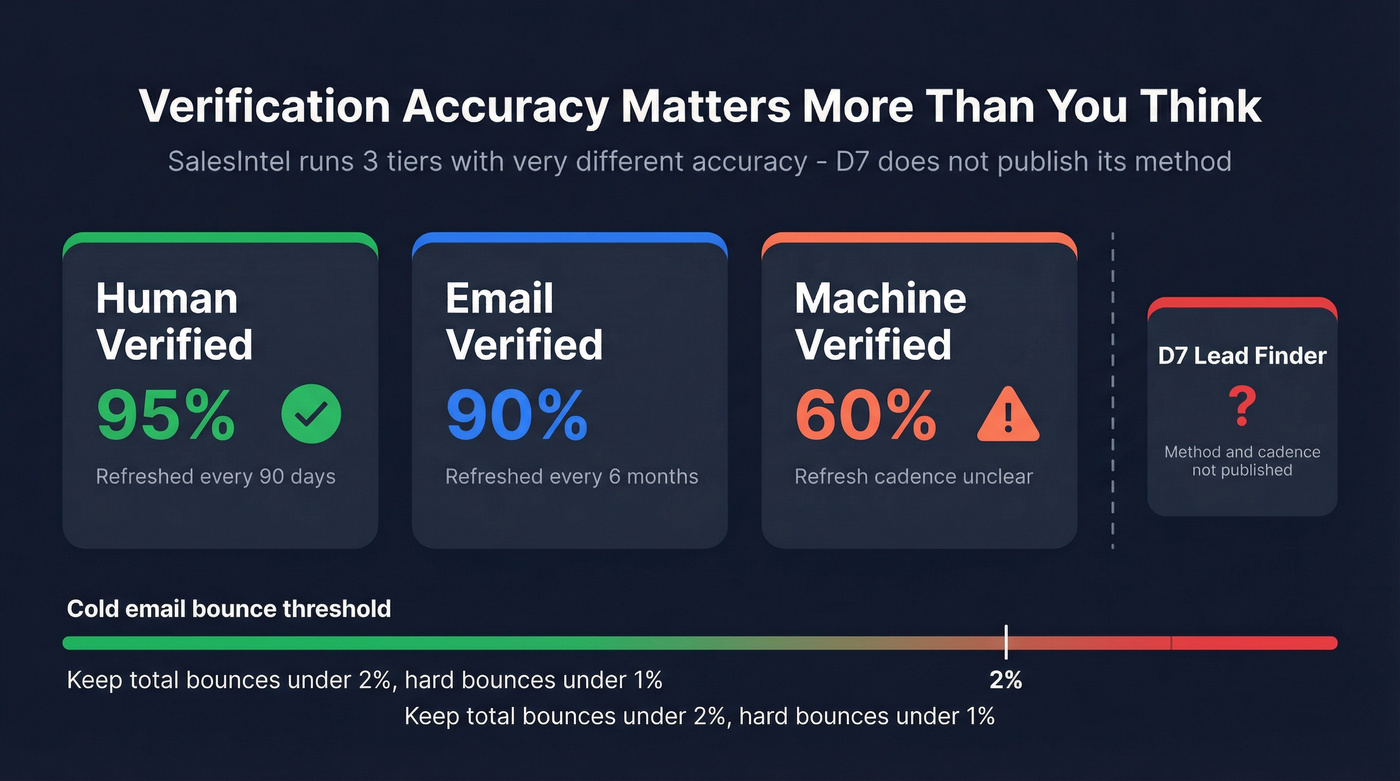
That tier distinction matters more than most buyers realize. If you're sending cold email at scale, exporting the wrong tier is one of the fastest ways to tank your sender reputation - especially if you assume everything you download is "human verified" by default. (If you want the deeper mechanics, see our Email Deliverability Guide and Email Bounce Rate breakdowns.)
D7 takes a fundamentally different approach. It extracts business data via keyword + location local lead searches, the same general use case people associate with web scraping lead generation. D7 includes email verification, but doesn't publish the exact method.
Here's the thing: bounces need to stay under 2%, with hard bounces under 1%. If your list hygiene can't hit that, you'll pay for it in deliverability. Reddit discussions around D7 consistently bring up issues like non-existent emails and spam traps when people try to scale outreach off scraped lists. That gap between "found an email" and "email actually delivers" is the core reason these tools aren't interchangeable.

D7's unpublished verification and SalesIntel's 90-day refresh both leave gaps that kill deliverability. Prospeo refreshes every 7 days, verifies emails through a 5-step proprietary process, and delivers 98% accuracy - keeping your bounce rate well under that 2% threshold.
Stop guessing which tier is safe to export. Get verified data from day one.
Coverage and Use Cases
D7 excels at one specific job: pulling local business lists. You enter a keyword and location, and it returns emails, websites, addresses, social profiles, review scores, and ad indicators. If you're an agency building prospect lists for local service businesses, it's fast and purpose-built. D7 even accepts Bitcoin and PerfectMoney, which tells you something about its freelancer-friendly positioning.
SalesIntel plays in a completely different arena - finding decision-maker contacts by title, department, and company, with technographics, intent add-ons, and a Research on Demand workflow. Research on Demand is included at 10 credits per user per month, designed for requesting verification on records that aren't immediately available in your filtered results. The platform is SOC 2 Type II and GDPR/CCPA compliant, which matters if your procurement team cares about vendor security posture. Mid-market and enterprise outbound teams are the sweet spot. (If you're building a repeatable outbound motion, pair this with sales prospecting techniques and a tighter lead generation workflow.)
Let's be honest: if your average deal size is under $5k, SalesIntel's $10k/yr minimum makes zero economic sense. D7 or a self-serve data platform will get you 80% of the way there at 5% of the cost.
Pricing Reality
D7's plan page shows a monthly, cancel-anytime structure with Starter, Agency, and Professional tiers. Usage limits scale from 10 daily searches (~3,500 daily leads) to 100 daily searches (~30,000 daily leads). Across third-party pricing writeups, D7 commonly lands in the ~$29-$120/mo range.
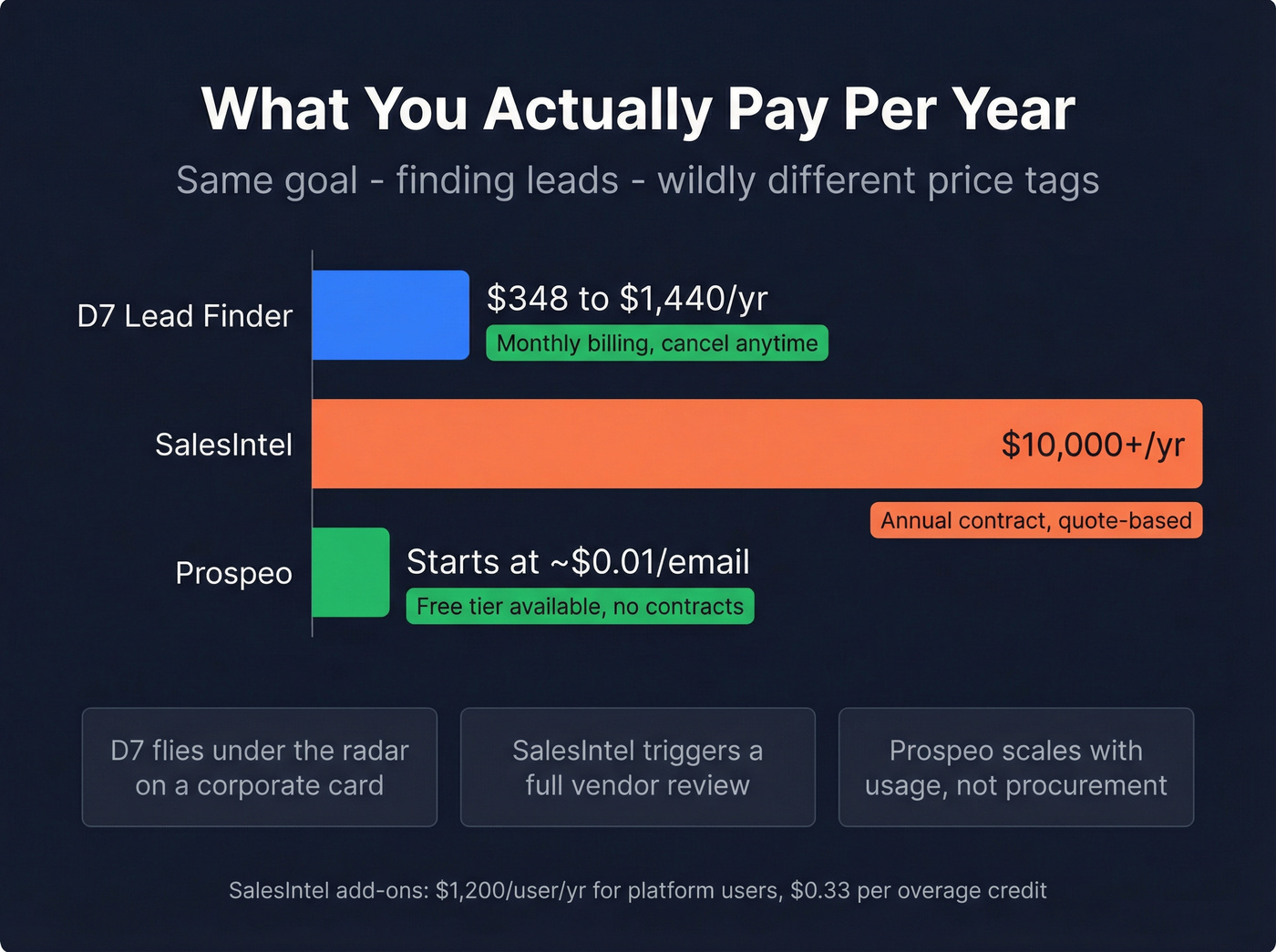
SalesIntel's pricing is quote-based, but the numbers commonly shake out to roughly $10k/yr starting for a package that includes one platform user, 30,000 download credits/year, 120 Research on Demand credits, and 60,000 enrichment integration credits. Additional platform users run around $1,200/user/year, data-only users around $300/user/year. Multi-year deals often drop to ~$8k/yr on a two-year term or ~$7.5k/yr on three years. Overage credits typically land around $0.33 each.
$50/mo vs $10k/yr isn't just a data decision. It's a procurement decision. D7 flies under the radar on a corporate card while SalesIntel triggers a full vendor review. (If you're comparing vendors across categories, our guide to data enrichment services can help frame the tradeoffs.)
What Users Actually Say
SalesIntel holds a 4.3/5 on both G2 (538 reviews) and Capterra (34 reviews). Users praise the ease of use, CRM integrations, and Research on Demand - Capterra reviewers single it out as a standout feature. The recurring complaints? Outdated or inaccurate data shows up repeatedly in G2 cons tags, and Capterra reviewers flag phone number gaps and a frustrating 500-contact export limit.
D7 sits at 3.7/5 on G2. Implementation is self-serve - sign up, search, export - versus SalesIntel's roughly one-month onboarding timeline.
We've found that most comparison articles don't publish bounce rates or refresh cadence, which makes it nearly impossible to compare actual deliverability outcomes from marketing pages alone. Test a small batch before committing to either. (If you're cleaning lists before sending, see our picks for Bouncer alternatives and the broader email reputation tools stack.)
When Neither Fits
When weighing D7 Lead Finder vs SalesIntel, some teams realize neither tool matches what they actually need: verified contacts at self-serve pricing with no annual lock-in. Prospeo fills that gap. It covers 300M+ profiles with 98% email accuracy, 125M+ verified mobiles (30% pickup rate), and a 7-day data refresh cycle - compared to SalesIntel's 90-day reverification and D7's unpublished cadence. Credits start at ~$0.01/email with a free tier of 75 emails per month. No contracts, cancel anytime. Native integrations with Salesforce, HubSpot, Smartlead, Instantly, and Lemlist mean you can plug it into an existing outbound stack without a month-long implementation. (If you're evaluating broader options, start with our best sales prospecting databases roundup.)
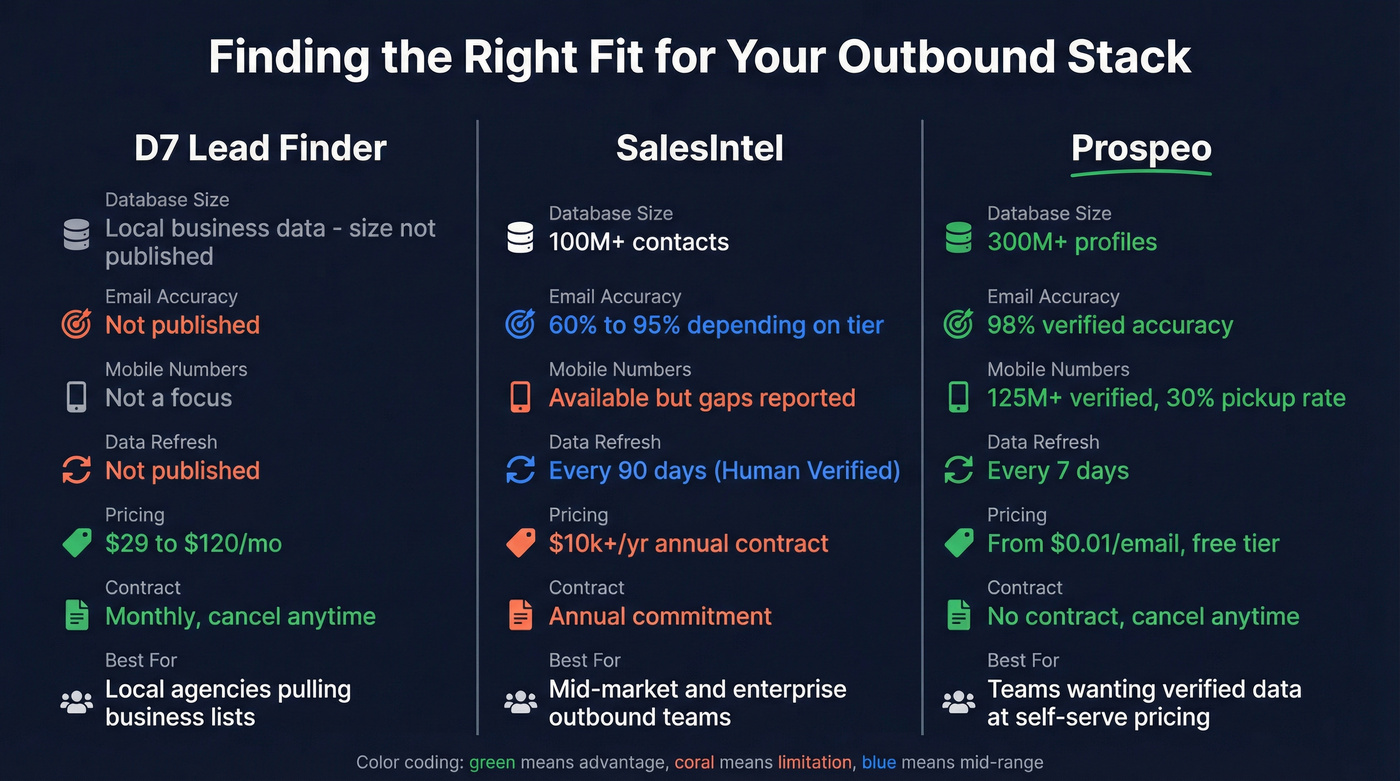
Why pay $10k/yr for SalesIntel or settle for D7's scraped local lists? Prospeo gives you 300M+ profiles, 125M+ verified mobiles with 30% pickup rates, and native integrations with HubSpot, Salesforce, and Instantly - all at ~$0.01/email with no annual contract.
Enterprise-grade data at self-serve pricing. Free tier included, cancel anytime.
FAQ
How long does SalesIntel take to implement?
Expect roughly one month for full implementation including CRM integrations and team onboarding. D7 Lead Finder is self-serve - sign up, search, export in minutes. If you're on a tight timeline, factor SalesIntel's setup period into your decision before committing to an annual contract.
What bounce rate should I target for cold outreach?
Keep total bounces under 2% and hard bounces under 1%. If your list consistently exceeds these thresholds, your data source or verification step is the problem - not your sending infrastructure. Test a small batch of 100-200 contacts before scaling any new list source.
Can I verify D7 Lead Finder exports before sending?
Yes - and you should. Run exported lists through a dedicated verification tool before loading them into your sequencer. That extra step is the difference between a clean sender reputation and a blacklisted domain.