

Data-Driven Email Marketing: Benchmarks, Metrics, and Strategies That Move Revenue
Data-driven email marketing returns $36 for every $1 spent - higher than any other digital channel. Yet 21% of marketers don't even measure email ROI, and plenty of teams still batch-and-blast unsegmented lists to unverified addresses. McKinsey's research puts it bluntly: email is 40x more effective than Facebook or X for customer acquisition. The gap between teams using data and teams ignoring it has never been wider.
The short version:
- Open rates are broken. Apple MPP inflated them. Track clicks, conversions, and revenue per recipient instead.
- Automated flows generate 41% of email revenue from just 5.3% of sends.
- Bad data kills everything else. A 35% bounce rate is enough to wreck deliverability and sender reputation fast (see check bounce).
What Data-Driven Email Marketing Actually Means
Using behavioral and transactional signals to decide what you send, who receives it, and when it arrives - that's the core. With 4.73 billion email users worldwide by 2026, email is the largest opt-in first-party data channel most companies have. It's also one of the cleanest left standing as Safari and Firefox block third-party cookies and Chrome shifts toward user-level controls.
Metrics That Actually Matter
Benchmarks at a Glance
Mailchimp (billions of emails, updated December 2023):
| Industry | Open Rate | Click Rate | Unsub Rate |
|---|---|---|---|
| Business/Finance | 31.35% | 2.78% | 0.15% |
| Non-Profit | 40.04% | 3.27% | 0.18% |
| Ecommerce/Retail | 29.81% | 1.74% | 0.19% |
| All Users | 35.63% | 2.62% | 0.22% |
ActiveCampaign (campaigns sent throughout 2025):
| Industry | Open Rate | Click Rate |
|---|---|---|
| Non-Profit | 42.68% | - |
| Ecommerce/Retail | 35.66% | 5.07% |
| Software/SaaS | 36.20% | 6.67% |
| All Users | 39.26% | 6.21% |
ActiveCampaign's higher click rates reflect a customer base that skews toward segmented, engaged lists. Don't compare your numbers to a single benchmark and spiral.
Why Open Rates Lie
Apple Mail Privacy Protection preloads tracking pixels via proxy servers, firing an "open" even when nobody reads your email. This affects anyone using the Apple Mail app - regardless of whether the underlying address is Gmail, Outlook, or anything else.
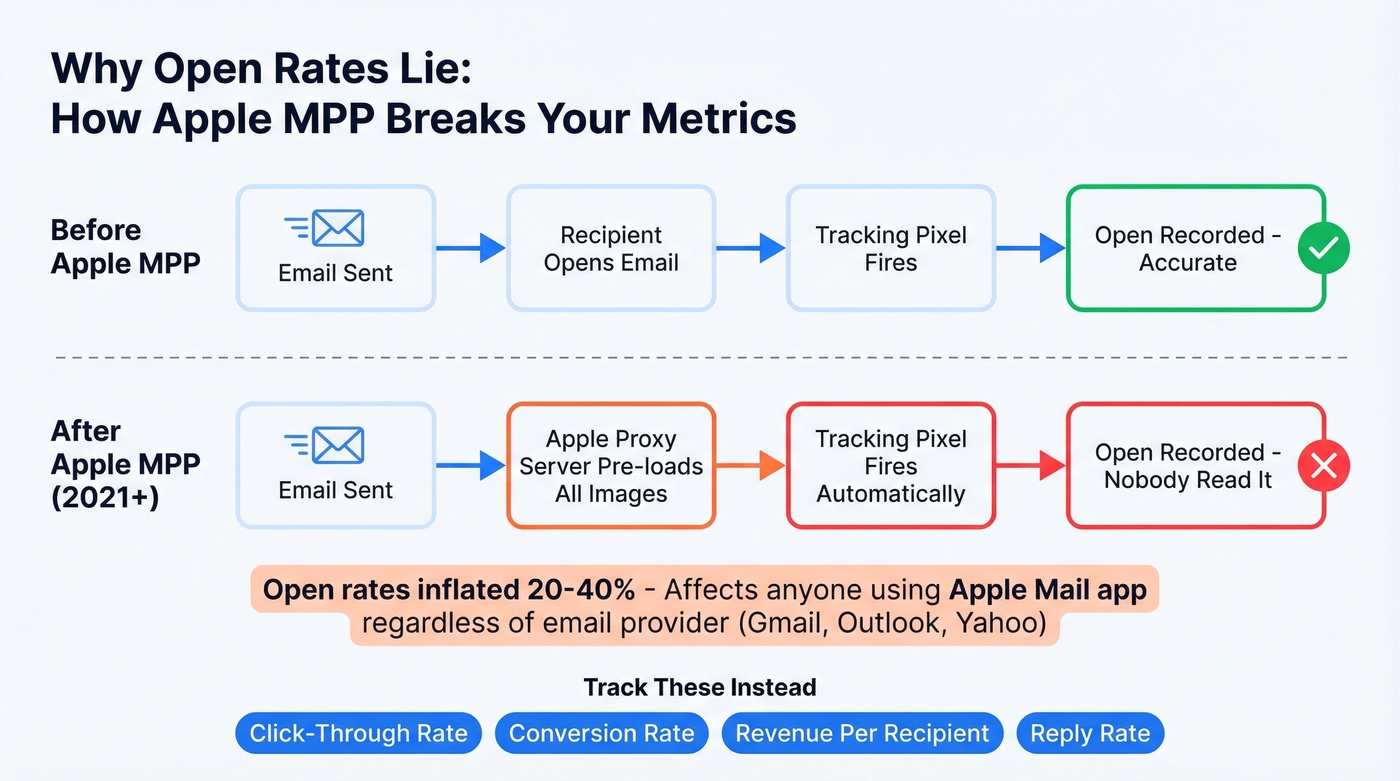
The post-MPP metrics worth tracking: click-through rate, conversion rate (ecommerce conversions often land around 0.5-2% depending on offer and list quality), revenue per recipient, reply rate, and retention. For B2B and SaaS, Litmus recommends focusing on activation, feature adoption, and pipeline influence rather than vanity opens.
The Automation Revenue Gap
Klaviyo's analysis of 183,000+ ecommerce customers makes the case definitively. Automated flows - welcome sequences, cart abandonment, re-engagement, post-purchase - generate 41% of total email revenue from 5.3% of sends. Revenue per recipient runs 18x higher for flows than campaigns. Click rates hit 5.58% versus 1.69%. And flows capture roughly 48% of new buyer revenue versus 16% for manual campaigns.
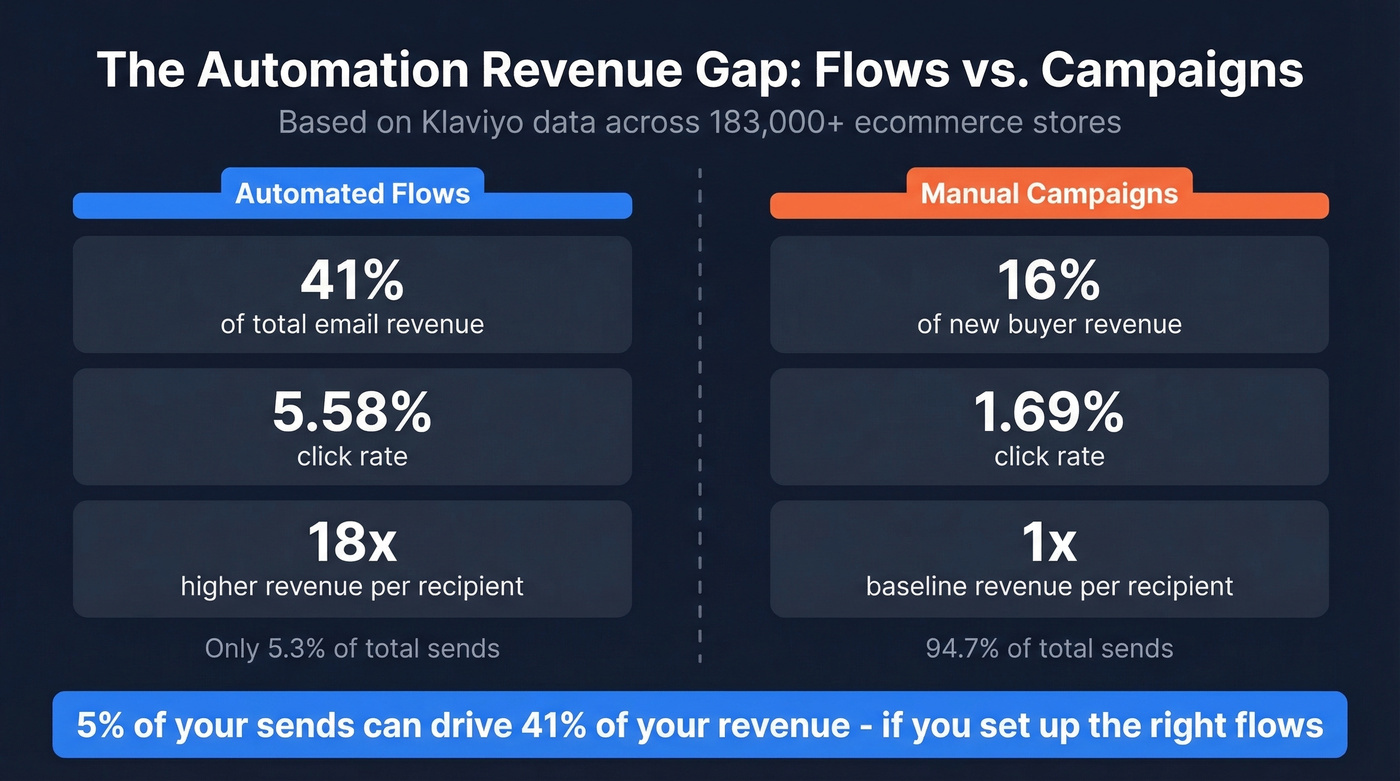
Here's the thing: if you're sending every email manually, you haven't turned on the highest-ROI feature your ESP already includes. The four flows every team needs are welcome, cart abandonment, re-engagement, and post-purchase. Two of those take an afternoon to build. The other two take a morning.

Automated flows drive 41% of email revenue - but only if your emails actually land. Prospeo's 5-step verification removes invalid addresses, spam traps, and honeypots before they torch your sender reputation. At $0.01 per email, verification costs less than a single bounce damages.
Stop feeding bad data into your best-performing channel.
Five Strategies That Move Revenue
1. Segment Beyond Demographics
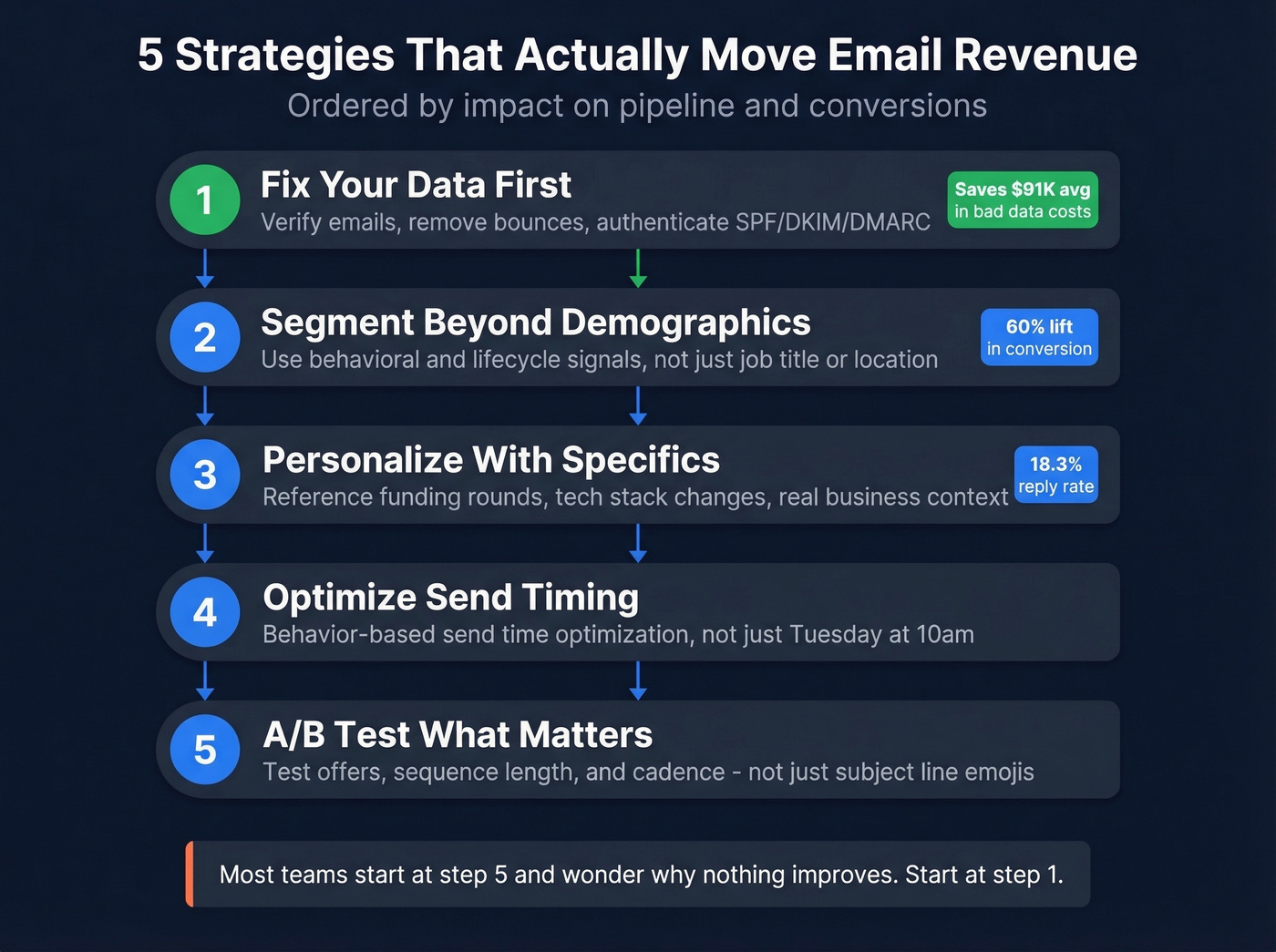
The real lift comes from behavioral and lifecycle-stage segmentation. Love Child Organics grew their list from 2,000 to 16,000 subscribers and saw a 60% lift in coupon landing page conversion rates by segmenting on customer behavior rather than demographics alone. Demographics tell you who someone is. Behavior tells you what they're about to do.
2. Personalize With Specifics
A Warmer AI study of 2,847 cold emails found hyper-personalized messages referencing specific business challenges hit an 18.3% reply rate versus 2.1% for generic templates - 8.7x higher. The consensus on r/Emailmarketing is that true behavior-based prediction remains rare. Don't confuse AI-generated subject lines with real personalization. Mentioning someone's recent funding round or tech stack change is personalization. Swapping in their first name isn't. (If you're doing this at scale, see AI Email Personalization.)
3. Optimize Send Timing
Behavior-based send-time optimization delivers emails when each recipient is most likely to engage. Klaviyo users on Reddit report slightly higher open rates and fewer bounces after enabling it. Two minutes to toggle on, permanent improvement.
4. A/B Test What Matters
Everyone tests subject lines. Almost nobody tests the offer, the sequence structure, or the send cadence. We've watched teams obsess over emoji placement while sending the same underperforming offer to the same unsegmented list for months. Test the things that move revenue - the offer itself, the number of emails in a sequence, the gap between sends. (Need copy to start from? Use these email blast templates.)
5. Fix Your Data First
None of the above matters if your emails don't arrive. Adobe's survey of 400+ marketers found poor data quality costs companies $91,000 on average. Bad addresses cause bounces, bounces damage sender reputation, and a damaged reputation means Gmail and Outlook throttle delivery to everyone - including your best subscribers. This is where data enrichment becomes essential: appending missing fields, correcting outdated records, and validating contact information so every send reaches a real inbox (see benefits of data enrichment). Keep hard bounces under 1-2%, and make sure SPF, DKIM, and DMARC authentication records are configured correctly (use this sender authentication guide).
Prospeo's email verification catches this before it becomes a problem. One customer, Meritt, cut their bounce rate from 35% to under 4%, and deliverability climbed above 94%. The 5-step verification process removes invalid addresses, spam traps, and honeypots before they hit your ESP. At roughly $0.01 per email, it costs less than a single bounced contact damages. (If you're comparing options, start with the best email verifier tools.)
Tools for Email Analytics and Verification
In our experience, teams that verify before every campaign see far fewer deliverability fires. No ESP matters if your list data is rotten underneath. (If you're building lists from scratch, read our guide on how to build an email list for marketing.)
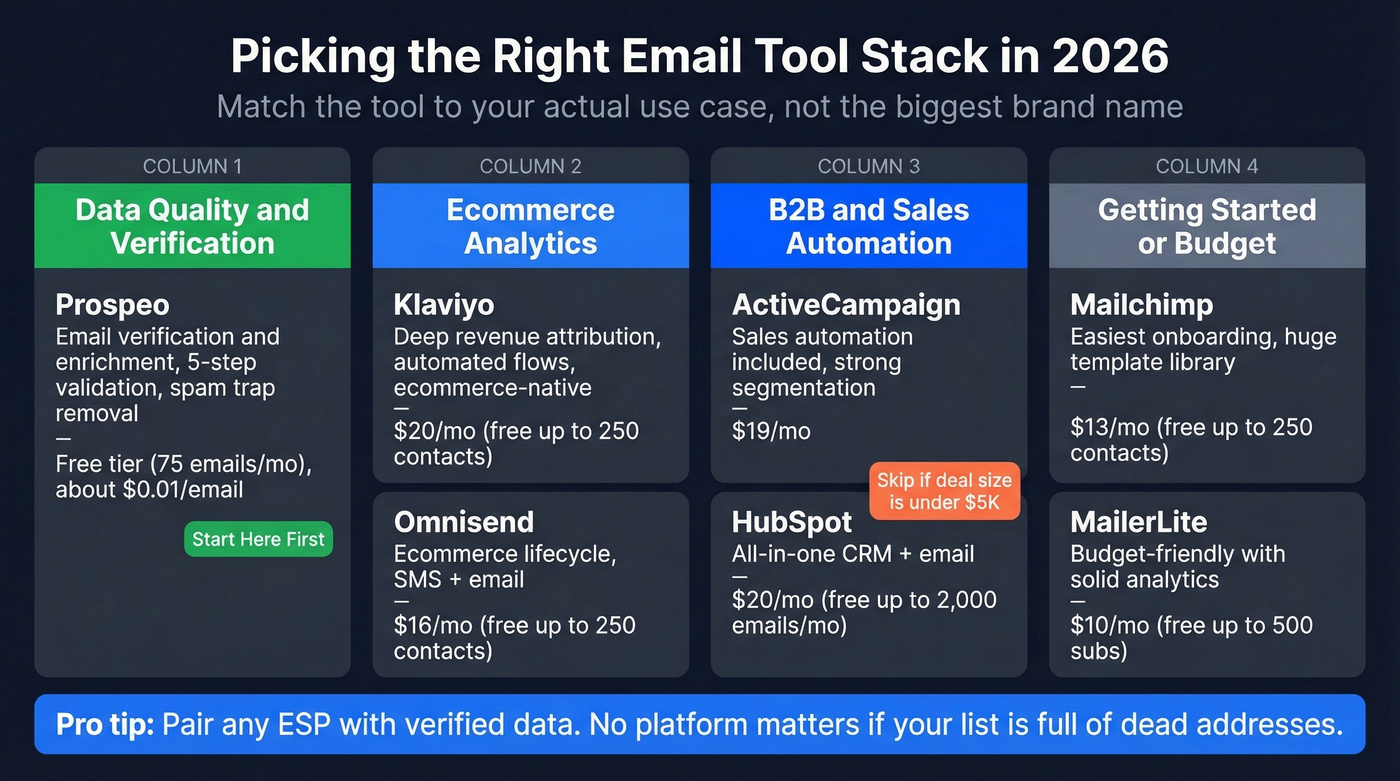
| Tool | Best For | Starting Price |
|---|---|---|
| Prospeo | Email verification & enrichment | Free tier (75 emails/mo), ~$0.01/email |
| Klaviyo | Ecommerce analytics | $20/mo (free up to 250 contacts) |
| ActiveCampaign | B2B sales automation | $19/mo |
| HubSpot | All-in-one CRM + email | $20/mo (free up to 2,000 emails/mo) |
| Mailchimp | Getting started | $13/mo (free up to 250 contacts) |
| MailerLite | Budget-friendly analytics | $10/mo (free up to 500 subs) |
| Omnisend | Ecommerce lifecycle | $16/mo (free up to 250 contacts) |
Klaviyo is the clear winner for ecommerce teams that want deep revenue attribution. ActiveCampaign includes sales automation features most competitors charge extra for. HubSpot makes sense if you're already in their CRM ecosystem - skip it if you're not, because you'll end up paying for features you won't touch. (If you're deciding between the two, see ActiveCampaign vs HubSpot.)
Let's be honest: if your average deal closes under $5K, you probably don't need HubSpot's paid tiers. Klaviyo or ActiveCampaign paired with verified data will outperform an expensive all-in-one you only half-use.
Compliance in 30 Seconds
- CAN-SPAM: $53,088 penalty per non-compliant email. Include a physical address and clear unsubscribe link.
- GDPR: Fines up to EUR 20M or 4% of global revenue. Requires explicit consent for EU recipients.
- CCPA: California residents can opt out of data sale. Honor requests within 30 days.
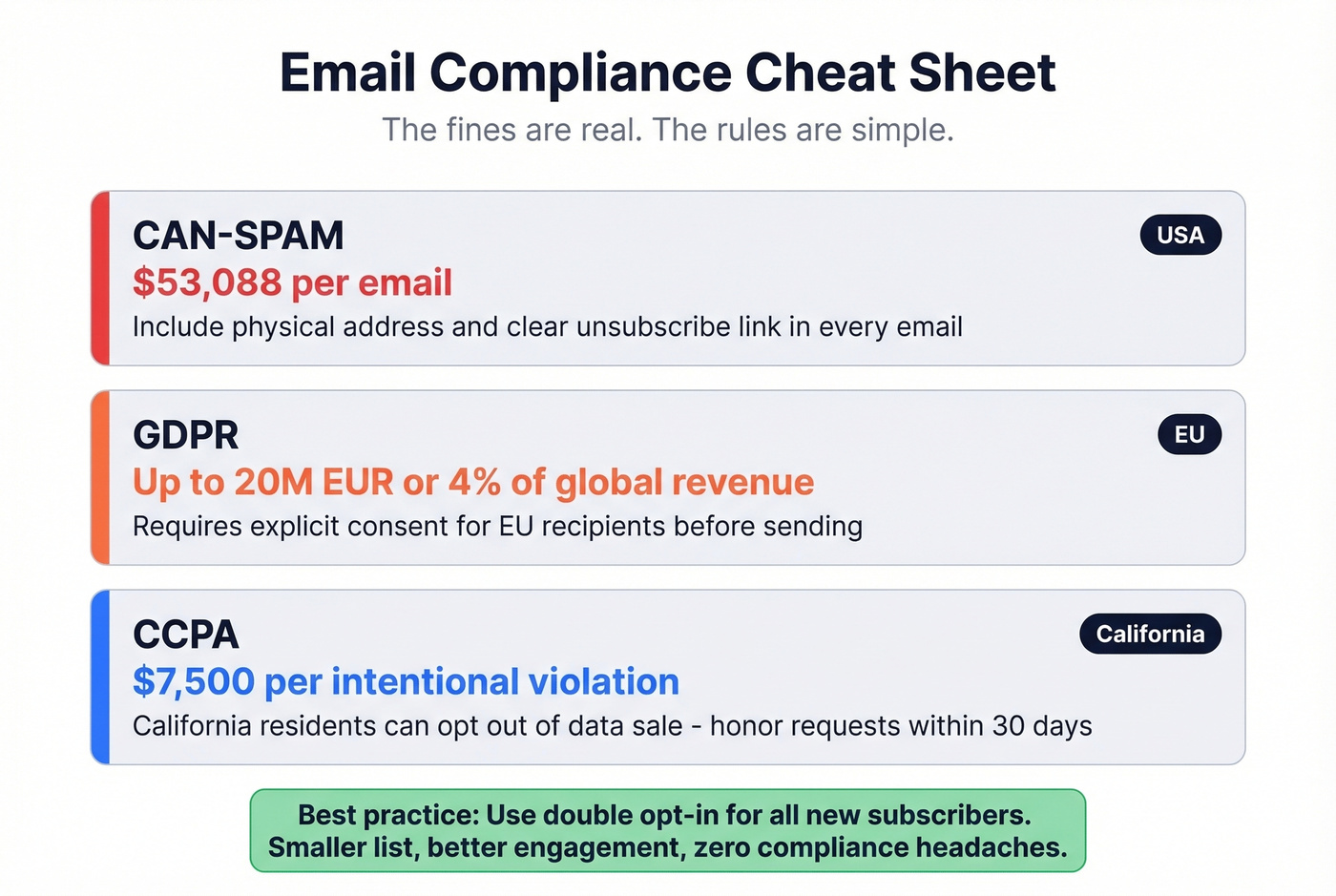
Use double opt-in for new subscribers. It reduces list size slightly but improves list quality and engagement - a tradeoff every data-driven email marketing program should make. (For a deeper compliance checklist, see B2B compliance.)
Personalization at 18.3% reply rates requires real data - funding rounds, tech stacks, job changes. Prospeo enriches contacts with 50+ data points refreshed every 7 days, so your segmentation runs on signals that are actually current. Meritt cut bounce rates from 35% to under 4% and tripled pipeline.
Enrich your list with data that makes every send count.
FAQ
What's the most important email metric in 2026?
Revenue per recipient and click-through rate. Open rates are unreliable since Apple MPP preloads tracking pixels, inflating numbers by 20-40%. Focus on metrics tied directly to revenue and real interaction - conversions, RPR, and reply rate for B2B.
How often should I clean my email list?
Before every major campaign, and at minimum quarterly. Hard bounce rates above 1-2% damage sender reputation across your entire list. Verification at roughly $0.01 per email is far cheaper than the deliverability damage a dirty list causes.
Do automated flows really outperform manual campaigns?
Dramatically. Klaviyo's data across 183,000+ stores shows flows generate 41% of email revenue from 5.3% of sends, with revenue per recipient 18x higher than campaigns. Welcome, cart abandonment, re-engagement, and post-purchase are the four essential flows.
What's the biggest mistake in data-driven email programs?
Optimizing content and timing while ignoring list hygiene. Adobe found poor data quality costs companies $91,000 on average. No amount of segmentation or personalization matters if 10%+ of your list bounces - it throttles delivery to everyone, including engaged subscribers.