

How to Build an Email List for Marketing - Even Starting from Zero
You've got a landing page, a Mailchimp account, and 14 subscribers - four of whom are your mom using different email addresses. The vendor blogs make it sound effortless: "just add a popup!" Meanwhile, your dashboard hasn't moved in two weeks.
This is the honest guide those blogs won't write. The one that starts at zero and doesn't pretend it's easy.
What You Need Before Anything Else
Before you touch a single tactic, nail these four things:
- A landing page with a specific incentive. Not "subscribe to our newsletter." Something concrete: a template, a discount, early access. One clear reason to hand over an email.
- One distribution channel you'll work daily. A subreddit, a Slack community, a social platform. Pick one. Master it before adding a second.
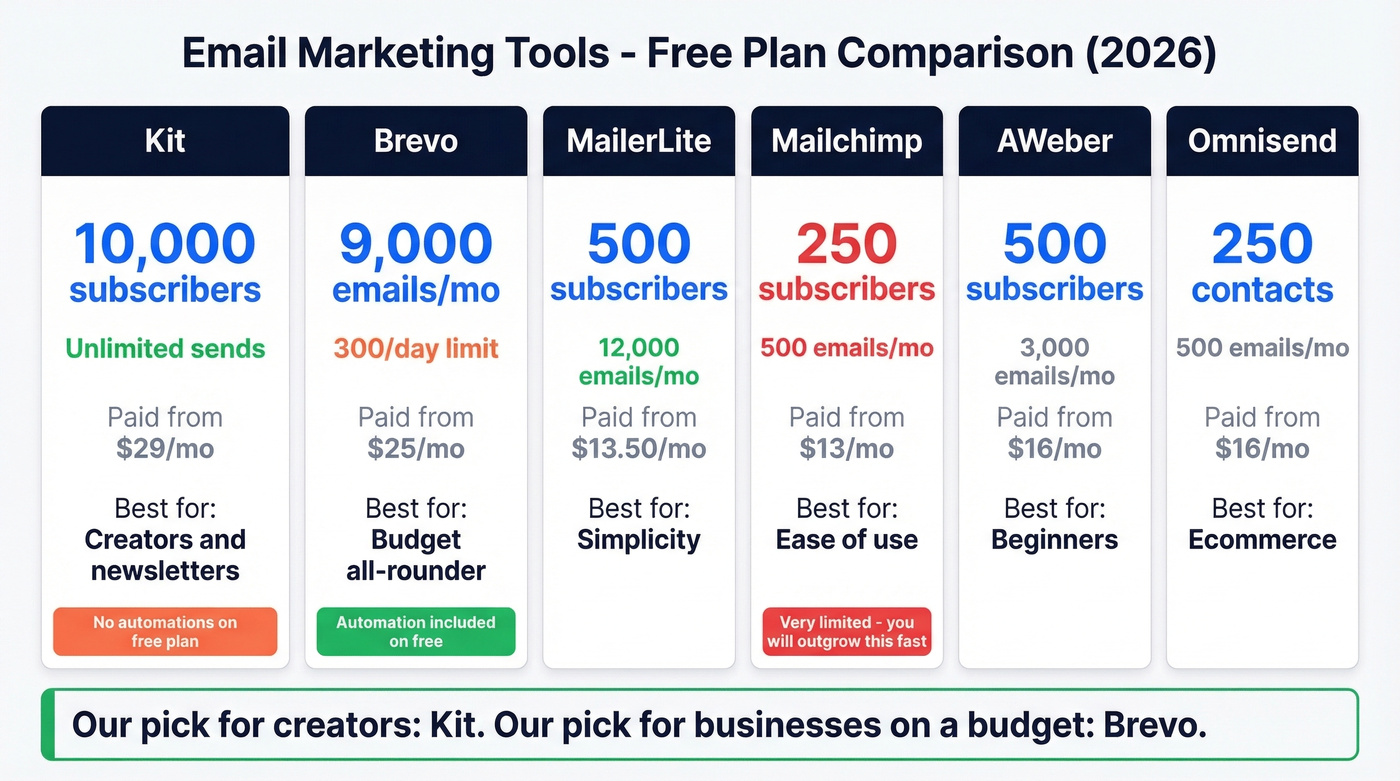
- A free ESP to collect and email subscribers. Our two favorite starting points: Kit (free up to 10K subscribers, though automations are limited on the free plan) or Brevo (9K emails/month free with automation).
- A 5-email welcome sequence, written before you launch. Don't collect emails you aren't ready to email. That's how lists go cold.
The motivation to get this right? Email marketing returns $36-$40 for every $1 spent. No other channel comes close. But that ROI only works if your list is clean - run it through an email verification tool before your first send so you aren't burning deliverability on day one.
Why Email Still Wins in 2026
Social algorithms change quarterly. Email doesn't. There are over 4 billion daily email users worldwide, and unlike your Instagram followers, your email list is a first-party asset you actually own. If Meta throttles your reach tomorrow, your email list still works.
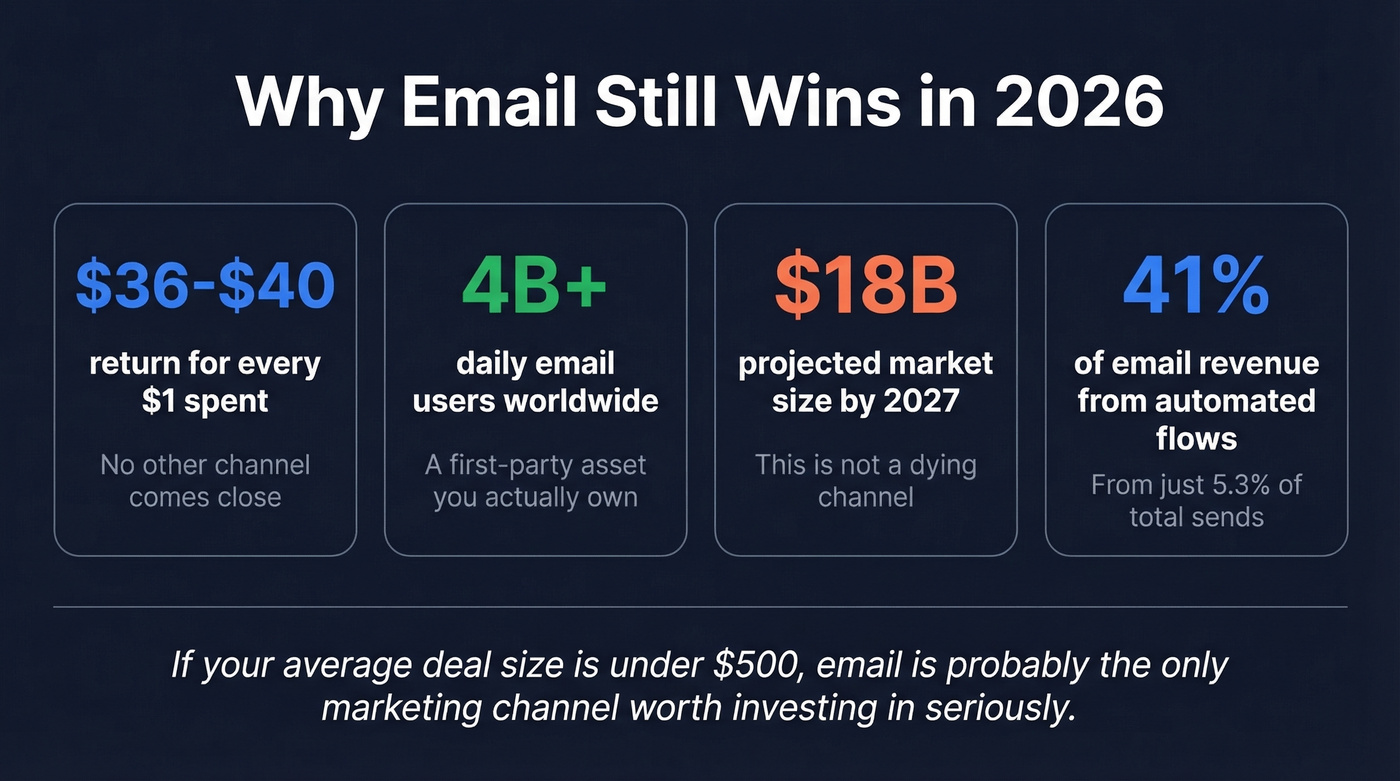
The global email marketing market is projected to hit $18 billion by 2027. That's not a dying channel.
Here's the thing: if your average deal size is under $500, email is probably the only marketing channel worth investing in seriously. Paid ads eat your margin, SEO takes months, and social is a slot machine. Email is the one channel where the math works at every price point, which is exactly why learning to grow a subscriber list is the highest-leverage skill you can develop this year.
The Zero-to-500 Playbook
Most list-building advice assumes you already have traffic. You don't. So let's talk about what actually works when you're starting from nothing.
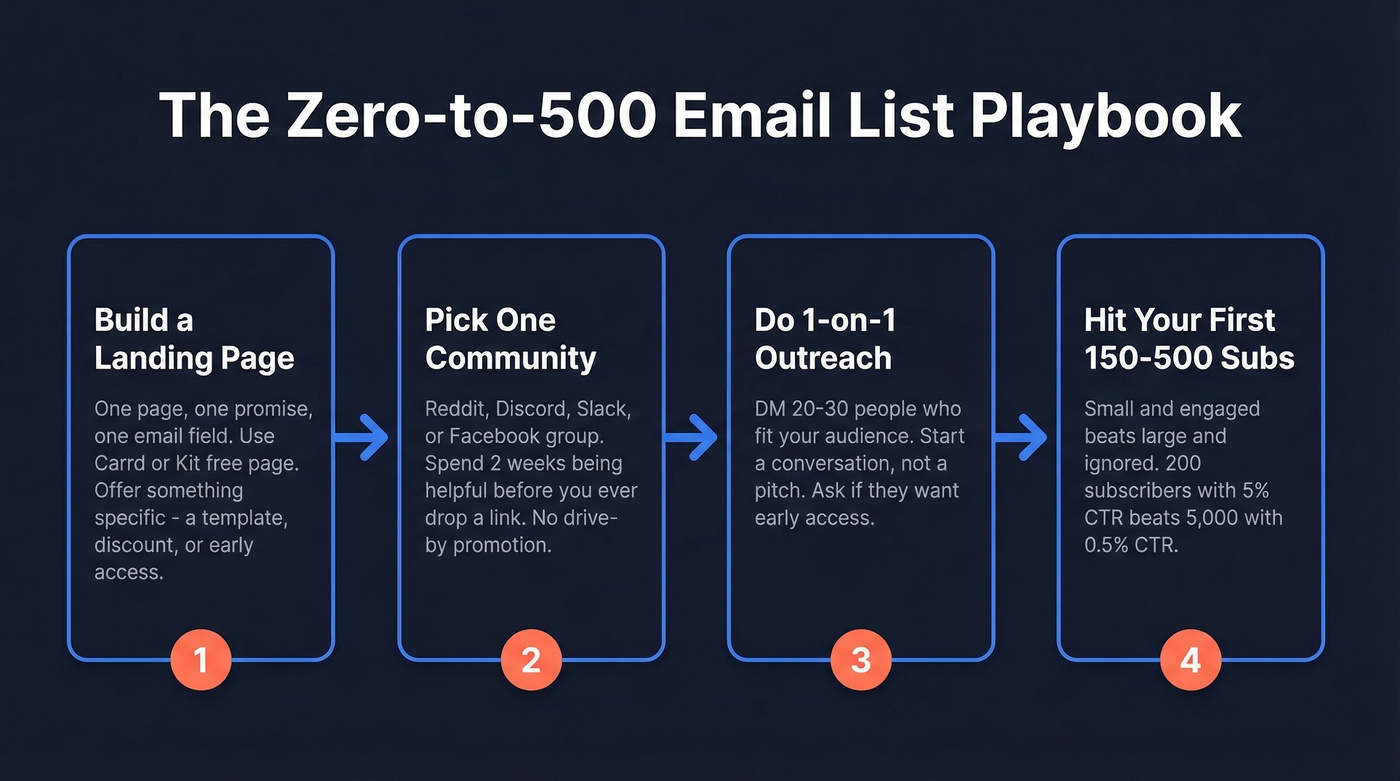
A user in r/DigitalMarketing documented their prelaunch strategy - no audience, no ads, no product yet. Their approach was dead simple: a landing page with "Get early access and 15% off when we launch," posted carefully in niche forums and relevant subreddits, plus direct outreach to 20-30 people through genuine conversations. No spam. The result was roughly 150 emails collected in a few weeks, which later converted into their first sales. That's the playbook at its core.
Create a landing page with one specific incentive. Not a homepage with seven CTAs. A single page, a single promise, a single email field. Tools like Carrd (paid plans start around $19/year) or even a free Kit landing page work fine.
Pick one community and contribute before you promote. Whether it's a subreddit, a Discord server, or a niche Facebook group, spend two weeks being genuinely helpful before you ever drop a link. People can smell drive-by promotion instantly.
Do direct 1-on-1 outreach to 20-30 people. DM people who fit your audience. Not a pitch - a conversation. "Hey, I'm building X for people like you. Would you want early access?" This doesn't scale, but it doesn't need to. You need 20 subscribers, not 20,000. (If you're doing this for B2B, borrow a few sales prospecting techniques so your outreach doesn't sound like a template.)
Now, the contrarian take most guides won't give you: stop obsessing over list size. A 200-person list with a 5% click-through rate generates 10 engaged clicks per send. A 5,000-person list with a 0.5% CTR generates 25 - but you're paying for 5,000 contacts and your deliverability is suffering from all the dead weight. We've watched teams chase subscriber counts for months while ignoring the 200-person list that was actually driving revenue. Small and engaged beats large and ignored every single time.
10 Tactics That Actually Grow Your List
1. Signup forms - popup, embedded, and exit-intent. Popups convert around 2-4% of visitors when timed well (after 5-10 seconds or on scroll). Exit-intent popups typically hit 1-3%. Embedded forms in blog posts convert lower at 0.5-1.5% but feel less intrusive.
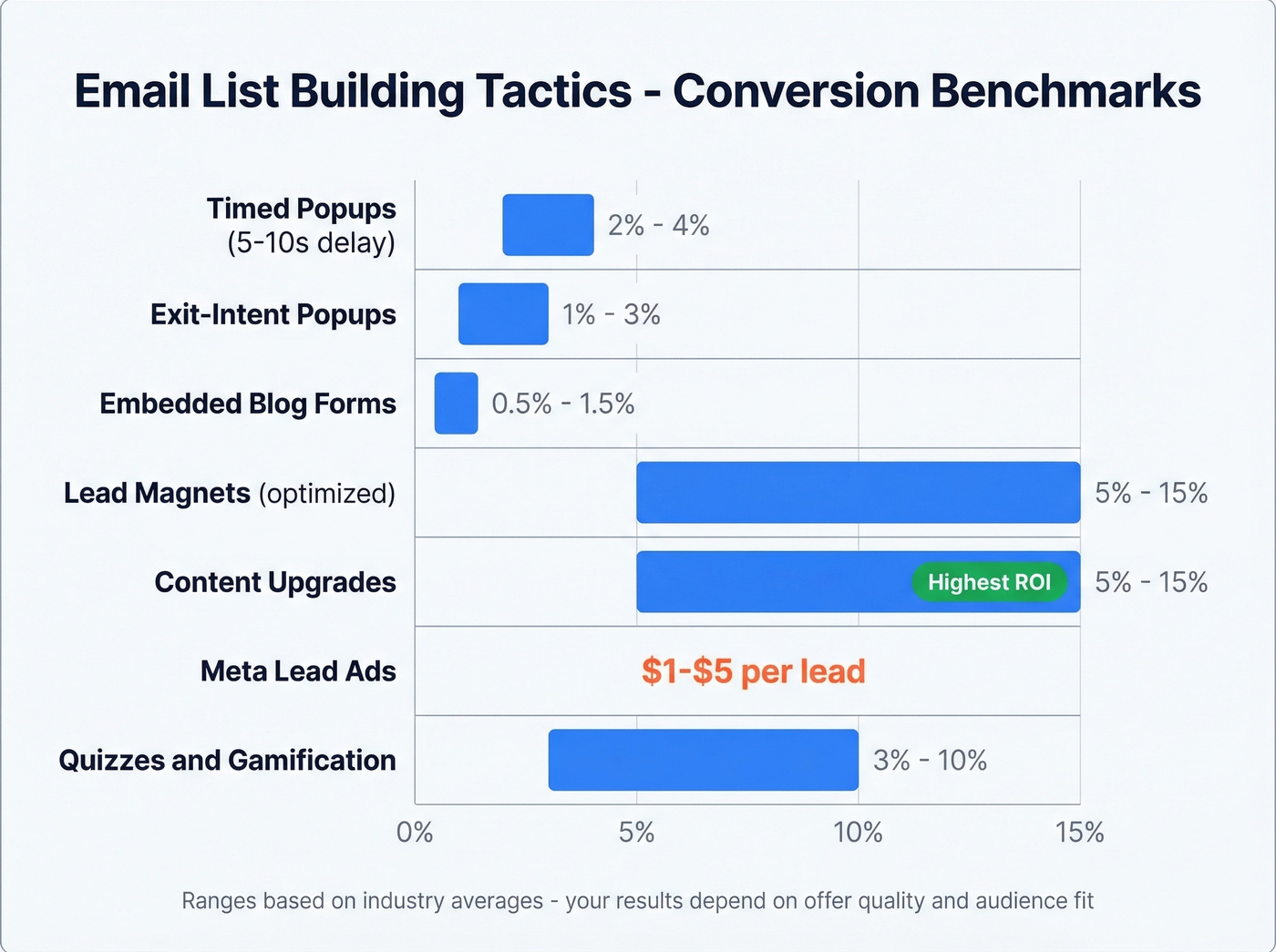
2. Lead magnets that solve a specific problem. A generic PDF nobody reads isn't a lead magnet - it's a waste of everyone's time. Effective formats include checklists, templates, data-driven reports, mini-courses, quizzes, resource libraries, and case studies. A real estate agent offering a "Due Diligence Checklist for First-Time Buyers" will outperform "Subscribe for Updates" every time. Target 5%-15% conversion rates on a well-optimized lead magnet.
3. Content upgrades. A lead magnet embedded inside a specific blog post, directly related to what the reader is already consuming. "Download the spreadsheet template from this tutorial" converts far better than a sidebar opt-in because the context is perfect.
4. Social media promotion. Pin your lead magnet link to your profile. Tease the content in posts. Use stories with swipe-up links. One post won't move the needle, but weekly promotion compounds over months.
5. Meta Lead Ads. If you've got even $5-10/day in budget, Meta Lead Ads let people subscribe without leaving the platform. Lower friction means lower cost per lead - often around $1-$5 for B2C lists, depending on targeting and creative. (If you're tracking cost per subscriber, use a simple subscriber acquisition cost formula so you don't fool yourself.)
6. Webinars and live events. Registration requires an email. The content builds trust. The follow-up sequence nurtures. It's a three-step funnel disguised as education.
7. Referral programs. "Share with a friend, get bonus content" works because it turns your existing subscribers into a distribution channel.
8. Offline collection. QR codes on business cards, event signups on a tablet, in-store forms. If you interact with humans in person, you should be collecting emails in person.
9. Partnerships and cross-promotions. Find a non-competing brand with a similar audience and swap newsletter mentions. Both lists grow. Nobody pays anything.
10. Gamification - quizzes, contests, and interactive signups. A quiz like "What's your marketing personality?" captures emails at the results gate. Contests with a relevant prize (not a random iPad - something your actual audience wants) generate bursts of signups. The key is making the prize specific enough that only your target audience cares, otherwise you'll fill your list with freebie-seekers who never open another email.
Your First Welcome Sequence
74% of new subscribers expect a welcome email, and 79% of marketing leads never convert without proper follow-up. Welcome emails get 4x higher open rates and 5x higher click-through rates than regular campaigns. Skip this step and you're wasting the moment of highest engagement.
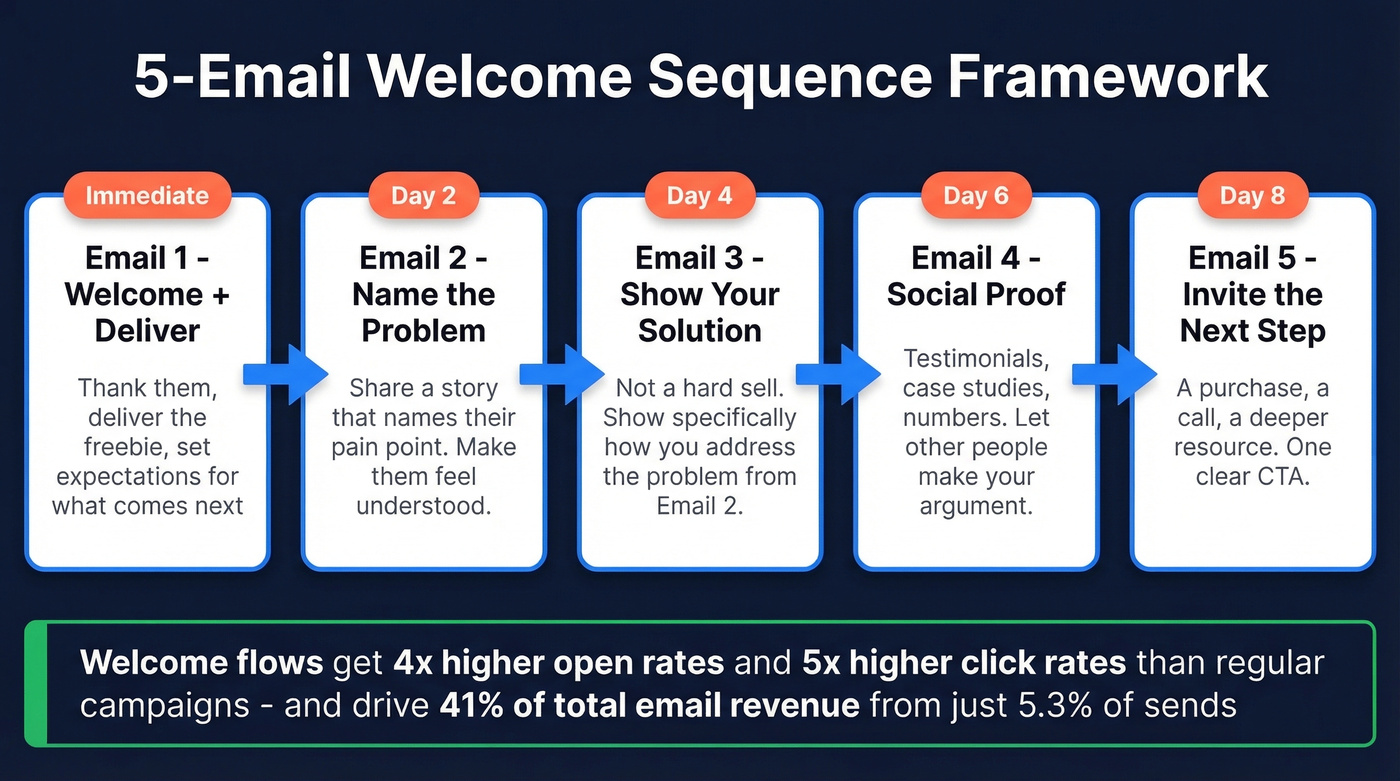
This 5-email framework works across industries:
- Welcome + deliver the freebie. Send immediately. Thank them, deliver what you promised, set expectations for what's coming next. Clarity beats cleverness.
- Identify their problem. Share a story or insight that names the pain point your audience has. Make them feel understood.
- Show your solution. Not a hard sell - show how you or your product addresses the problem from email #2. Be specific.
- Social proof. Testimonials, case studies, numbers. Let other people make your argument for you.
- Invite the next step. A purchase, a call, a deeper resource. One clear CTA.
The data backs this approach hard. Across 183,000+ Klaviyo customers, automated flows generate roughly 41% of total email revenue from just 5.3% of sends. Flow click rates hit 5.58% versus 1.69% for regular campaigns, and flows drive 13x higher placed order rates than standard campaigns. Nearly 48% of flow-driven revenue comes from new buyers. Your welcome sequence isn't a nice-to-have - it's where the money is. (If you want to tighten the copy, keep a swipe file of email subject lines and test aggressively.)

You just read that bad data kills deliverability on day one. Prospeo's 5-step email verification and 7-day data refresh cycle mean every contact you add to your marketing list is current and real - 98% accuracy, not the 79-87% you'd get elsewhere.
Stop burning sender reputation on dead emails. Verify before you send.
Choosing Your Email Tool in 2026
Free Plans Compared
| Tool | Free Limits | Paid From | Best For |
|---|---|---|---|
| Kit | 10K subs, unlimited sends | ~$29/mo | Creators, newsletters |
| Brevo | 9K emails/mo (300/day) | ~$25/mo | Budget all-rounder |
| MailerLite | 500 subs, 12K emails/mo | $13.50/mo | Simplicity |
| Mailchimp | 250 subs, 500 emails/mo | ~$13/mo | Ease of use |
| AWeber | 500 subs, 3K emails/mo | ~$16/mo | Beginners |
| Omnisend | 250 contacts, 500 emails/mo | $16/mo | Ecommerce |
What Users Actually Say
The consensus across r/MarketingAutomation is pretty clear on each tool's strengths and weaknesses.
ActiveCampaign (starting at $19/mo for the Lite plan) is one of the strongest mid-market ESPs for automation and behavioral targeting. The learning curve is steep and pricing ramps quickly as your contact count grows. It's the right tool if you'll actually use advanced workflows - overkill for a weekly newsletter.
Mailchimp's free plan is a trap. 250 contacts, 500 emails/month, no automations. You'll outgrow it fast. The paid plans are fine but unremarkable - you're paying for brand recognition more than capability. (If you're seeing inboxing issues, start with a deliverability guide before you blame the ESP.)
Brevo has one of the best free tiers for anyone who wants automation without paying. 9,000 emails/month with basic automation included. The templates feel basic compared to Mailchimp, but the functionality-to-price ratio is hard to beat.
Klaviyo is the obvious choice if you're on Shopify - the native integration works exceptionally well and cart abandonment flows are a major strength. Outside ecommerce, it's overpriced. Skip it if you aren't selling products online.
Our recommendation for most people starting from zero: Kit if you're a creator building a newsletter, Brevo if you're a business that needs automation on a budget.
Verify Before You Send
Here's what happens when you skip verification: a bounce rate around 10% is a fast way to damage your sender reputation with Gmail and Outlook. They start routing your emails to spam - punishing the valid addresses on your list because of the dead ones. Most ESPs charge you for contacts on your list, including bad addresses, so you're literally paying to damage your own deliverability. (If you want the full breakdown, start with email bounce rate benchmarks and fixes.)
We've seen lists go from strong engagement to the spam folder in weeks because someone skipped this step. It's genuinely frustrating to watch.
There are two approaches: proactive verification at the point of collection (validating emails as they come in) and reactive cleanup after the fact (bulk-verifying your existing list). You should do both. Tools like Prospeo run a 5-step verification process including catch-all handling, spam-trap removal, and honeypot filtering - 98% accuracy at roughly $0.01 per email. The free tier gives you 75 email verifications per month, enough to validate your first list before your first campaign goes out.
The article says direct outreach to 20-30 people is how you break zero. Prospeo gives you 143M+ verified emails with 30+ filters - job title, industry, company size, intent signals - so those first 30 conversations happen with exactly the right people.
Find your first 500 subscribers with data that actually connects.
Email Benchmarks - What "Good" Looks Like
Industry Benchmarks
| Industry | Open Rate | CTR | Unsub | Bounce |
|---|---|---|---|---|
| All industries | 19.21% | 2.44% | 0.89% | 2.48% |
| Ecommerce | 15.68% | 2.01% | 0.27% | 0.19% |
| IT / Tech | 17.60% | 2.50% | 0.20% | 0.90% |
| Government | 30.50% | 4.10% | - | - |
Data via WebFX's 2026 benchmark report. Use these as directional guides, not gospel - your list, your content, and your audience will produce different numbers.
Why Open Rates Are Fiction
If you're still reporting open rates to your boss, you're reporting fiction. Apple Mail Privacy Protection pre-loads tracking pixels for all Apple Mail users, inflating open rates across the board. Since Apple Mail accounts for a massive share of email opens, your "42% open rate" might really be 25% with a bunch of phantom opens mixed in.
Focus on CTR and click-to-open rate instead. Good CTR ranges run 2%-5% for general marketing emails, 1%-3% for promotional sends, and 5%+ for transactional messages. Over 60% of emails are opened on mobile, so if your CTAs aren't tap-friendly, you're losing clicks before the content even matters. (If you need a clean definition, use a standard click rate formula and stick to it.)
Mistakes That Kill Your List
The biggest list-killer is sending too often. 69% of people unsubscribe because they get too many emails. B2B lists do well at 2-4 emails per month. B2C retail can push 4-8 per month. Ecommerce can go up to 4-5 per week if you're segmenting properly. Start low and increase based on engagement data, not your content calendar's ambition.
The second most common mistake is cramming multiple CTAs into a single email. Emails with a single CTA can increase click-through rates by up to 371%. Every additional button dilutes attention. Pick one action per email and make it obvious.
A few more worth calling out:
- Subject lines over 50 characters. Mobile screens cut them off. Keep them tight.
- Never cleaning your list. Remove hard bounces immediately. Re-engage non-openers after 6-12 months, then remove the ones who still don't respond. Clean every 3-6 months at minimum. (If you're dealing with deliverability landmines, learn spam trap removal basics before you do a big send.)
- Automation without personalization. The r/EmailWhisperers crowd calls this out constantly - brands setting up automation and assuming the tech will do the thinking. Scheduled emails without segmentation aren't automation. They're scheduled spam.
- Ignoring mobile. Tiny text, broken layouts, impossible-to-tap CTAs - still rampant in 2026. Test every email on a phone before you send it.
Compliance - What You Legally Need
| Rule | GDPR (EU/UK) | CAN-SPAM (US) | CASL (Canada) | Spam Act (Australia) |
|---|---|---|---|---|
| Prior consent? | Yes, explicit | No (honor opt-outs) | Yes, documented | Yes, express or inferred |
| Unsub timeline | Immediately | 10 business days | 10 business days | 5 working days |
| Penalties | EUR 20M or 4% revenue | $51,744/violation | $10M CAD/violation | $2.22M AUD/day |
| Can individuals sue? | Yes | No | Yes | No |
GDPR applies based on where your recipients are, not where your business is based. If you're emailing anyone in the EU, GDPR applies to you. Pre-checked consent boxes don't meet GDPR standards - consent must be clear and affirmative.
Double opt-in is legally required in Germany through court interpretation and recommended across the entire EU for the strongest proof of consent. For US-only audiences, single opt-in with a confirmation email is standard practice.
Real talk: don't buy email lists. Purchased lists violate GDPR and CASL, destroy your sender reputation, and the data is almost always garbage. Build your list the right way - it takes longer, but every subscriber is actually worth something. (If you need the legal breakdown, read is it illegal to buy email lists.)
FAQ
How many emails do I need before I start sending?
You can start with as few as 10 subscribers. A small engaged list beats a large dead one. Send your welcome sequence the moment someone subscribes - don't wait for an arbitrary list size milestone.
Should I use single or double opt-in?
Double opt-in is legally required in Germany and recommended across the EU for the strongest proof of consent. For US-only audiences, single opt-in with a confirmation email reduces friction while still confirming intent.
How often should I email my list?
B2B lists perform best at 2-4 sends per month. B2C retail can push 4-8 monthly. Ecommerce can go up to 4-5 per week with proper segmentation. Start at the low end and increase based on engagement metrics, not guesswork.
What's the best free email tool in 2026?
Kit gives you 10,000 free subscribers with unlimited sends - best for creators and newsletter operators. Brevo offers 9,000 emails/month free with automation included - the stronger choice for businesses. Mailchimp's free plan (250 contacts, no automations) is too limited to recommend.
How do I verify collected emails before sending?
Start with one landing page, one incentive, and one community. The list builds itself from there.