

How to Use Data for Lead Generation (Without Wasting Budget on Bad Contacts)
A RevOps lead we know ran a bake-off last quarter - three data providers, 500 accounts each, six weeks of tracking. The "premium" database delivered 75% usable contacts. The budget option hit 65%. The team running a waterfall enrichment stack? 88%, in half the time. That gap isn't a rounding error. It's the difference between pipeline and wasted spend.
75% of senior marketing ops professionals estimate that at least 10% of their lead data is inaccurate, outdated, or non-compliant. Nearly half spend 10+ hours a month on data hygiene alone. That's a structural problem, and it compounds every quarter your CRM goes uncleaned.
What You Need (Quick Version)
Three things determine whether your lead data generates pipeline or burns budget:
- Accuracy verification: Aim for 98%+ email accuracy. Below that, deliverability and sender reputation deteriorate fast.
- Data freshness: B2B contact data decays ~25-30% per year. If your provider refreshes quarterly, you're working with stale records within weeks.
- Multi-source enrichment: No single database covers every contact. The waterfall approach - running leads through multiple sources and keeping the best match - consistently outperforms single-provider strategies.
What Is Lead Generation Data?
Lead generation data is the contact, company, and behavioral information you use to identify, reach, and qualify potential buyers. Databox benchmarks show the median B2B company generates just 27 new leads per month, compared to 196 for B2C. When every lead carries that much weight, accuracy isn't optional.
First-party data - form fills, product usage, email engagement - converts at higher rates but is limited in scale. Third-party data from external providers gives you reach into accounts you'd never find organically, but accuracy varies wildly by vendor. Most teams need both, layered intelligently.
Six Types That Drive Results
Not all lead data is equal. Here's what actually moves the needle.
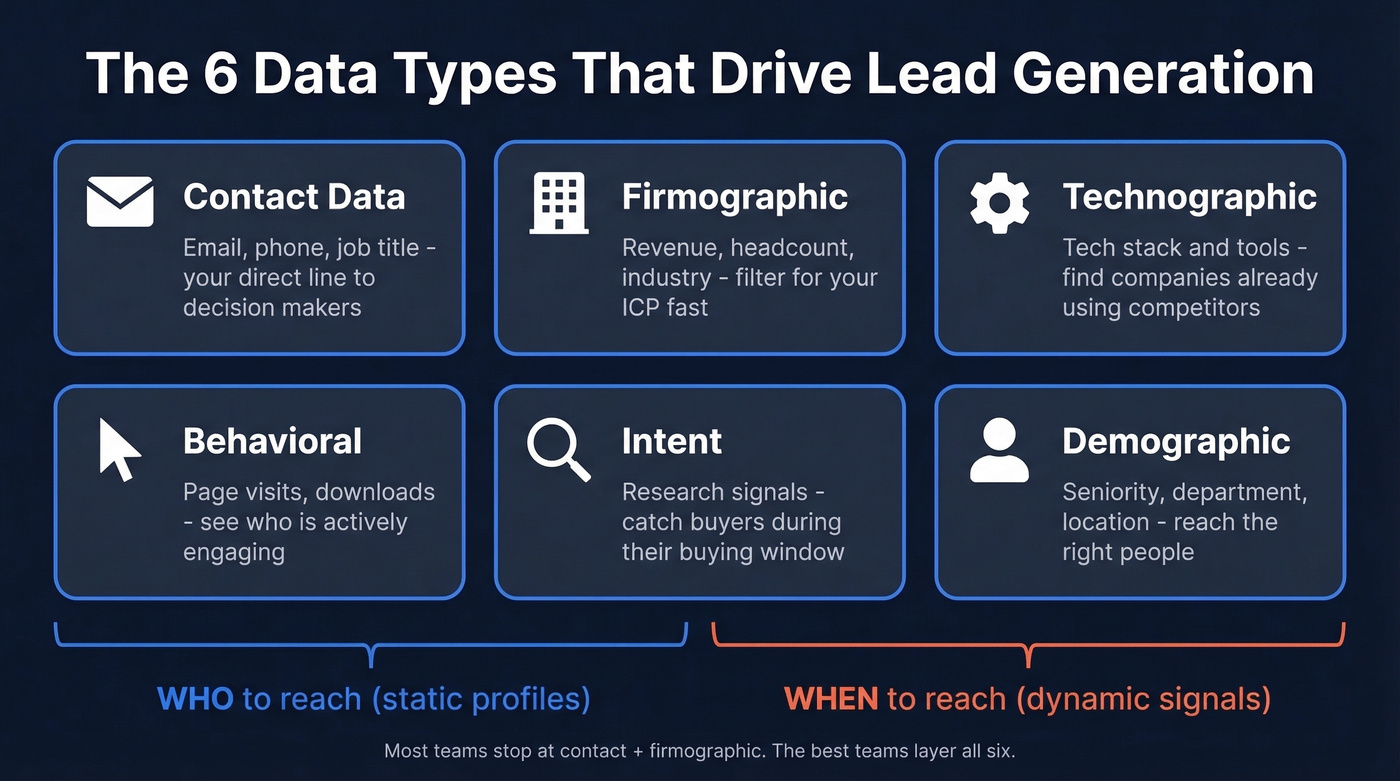
| Data Type | What It Covers | Example Use |
|---|---|---|
| Contact | Email, phone, title | Direct outreach to VP of Sales |
| Firmographic | Revenue, headcount, industry | Filter for 50-200 employee SaaS companies |
| Technographic | Tech stack, tools used | Target companies running Salesforce + Outreach |
| Behavioral | Page visits, content downloads | Prioritize leads who viewed pricing page |
| Intent | Active research signals | Catch accounts researching "CRM migration" |
| Demographic | Seniority, department, location | Focus on director+ in North America |
Intent data is the most underused type on this list. Most teams buy contact and firmographic records, maybe add technographics, and stop there. But intent signals - knowing which accounts are actively researching topics relevant to your product - transform cold outreach into warm outreach. That timing difference alone can multiply reply rates, because you're reaching someone during their buying window instead of interrupting their Tuesday.
Behavioral and intent data together tell you when to reach out, not just who to reach.
Why Most Lead Data Fails
Here's the thing: the data quality problem isn't about picking the wrong provider. It's structural. B2B contact data decays at roughly 25-30% per year. People change jobs, companies get acquired, phone numbers rotate. Without continuous refresh, accuracy drops materially within months.
Mobile data is even worse. One startup reported their database returned accurate mobile numbers for just 15% of leads. If your outbound motion depends on cold calls, that number should terrify you. (If you're building a call-heavy motion, tighten your phone sales skills alongside your data stack.)
In a field test comparing Apollo, ZoomInfo, and waterfall enrichment, Apollo delivered ~65% accurate contacts and ZoomInfo hit ~75%. Those numbers mean 1 in 4 - or 1 in 3 - contacts you're reaching out to is a dead end. Bad data costs the average organization $12.9M per year when you factor in wasted rep time, damaged sender reputation, and missed opportunities.
The Salesforce State of Sales Report shows reps spend 9% of their week researching prospects, 8% prospecting, and 8% prioritizing leads - a full quarter of their time on activities that bad data makes exponentially harder. On Reddit, practitioners regularly express frustration with Apollo and Crunchbase data freshness, with one user summarizing months of use as "haven't been too impressed." Meanwhile, 92% of marketing ops teams are now considering or have already invested in automated lead data governance platforms. Manual cleanup is a losing strategy.

Bad data costs $12.9M per year. Prospeo's 5-step verification - with catch-all handling, spam-trap removal, and honeypot filtering - delivers 98% email accuracy on a 7-day refresh cycle. Stop burning rep time on dead contacts.
Verify every lead at $0.01/email before it touches your sequencer.
Single-Source vs. Waterfall Enrichment
This is the section that'll save you the most money.
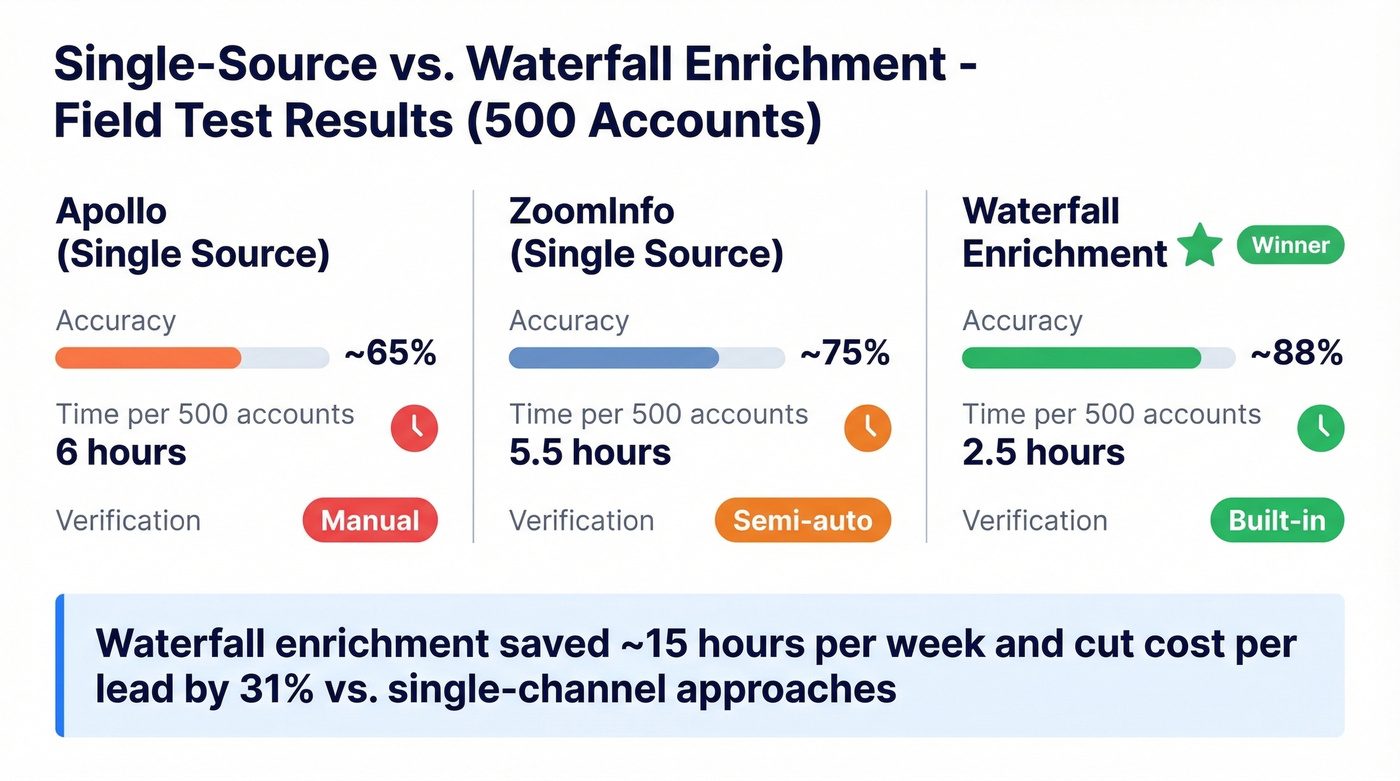
Single-source means you buy from one database - Apollo, ZoomInfo, Lusha - and use it for everything. Simple, but you're leaving accuracy on the table. Waterfall enrichment runs your target accounts through multiple sources sequentially, keeps the best match from each, and verifies the output. We've seen teams cut their bounce rates in half just by adding a verification step at the end of this chain. (If you're comparing vendors, start with our breakdown of the best B2B databases.)
The field test numbers tell the story clearly:
| Approach | Accuracy | Time (500 accounts) | Verification |
|---|---|---|---|
| Apollo (single) | ~65% | 6h | Manual |
| ZoomInfo (single) | ~75% | 5.5h | Semi-auto |
| Waterfall | ~88% | 2.5h | Built-in |
The waterfall approach didn't just win on accuracy - it saved ~15 hours per week across the team. Multi-channel campaigns built on waterfall-enriched contacts also show 31% lower CPL than single-channel approaches, because you're not burning budget on dead contacts.
Prospeo fits into this stack as the accuracy and verification layer. With 98% email accuracy, a proprietary 5-step verification process that includes catch-all handling, spam-trap removal, and honeypot filtering, and a 7-day refresh cycle, it's built to be the final quality gate in a waterfall workflow. At ~$0.01 per email, the unit economics make it viable to verify every contact before it hits your sequencer. (For a deeper vendor shortlist, see the best email verifier tools and our tested roundup of best data enrichment tools.)
Waterfall enrichment only works if the final verification layer is airtight. Prospeo gives you 98% email accuracy, 125M+ verified mobiles with a 30% pickup rate, and 30+ filters to build targeted lists - all refreshed weekly, not quarterly.
Be the accuracy layer that turns 65% hit rates into 88%.
Lead Data Tools and Pricing
Here's what pricing typically looks like when you're evaluating a purchase for your sales team.
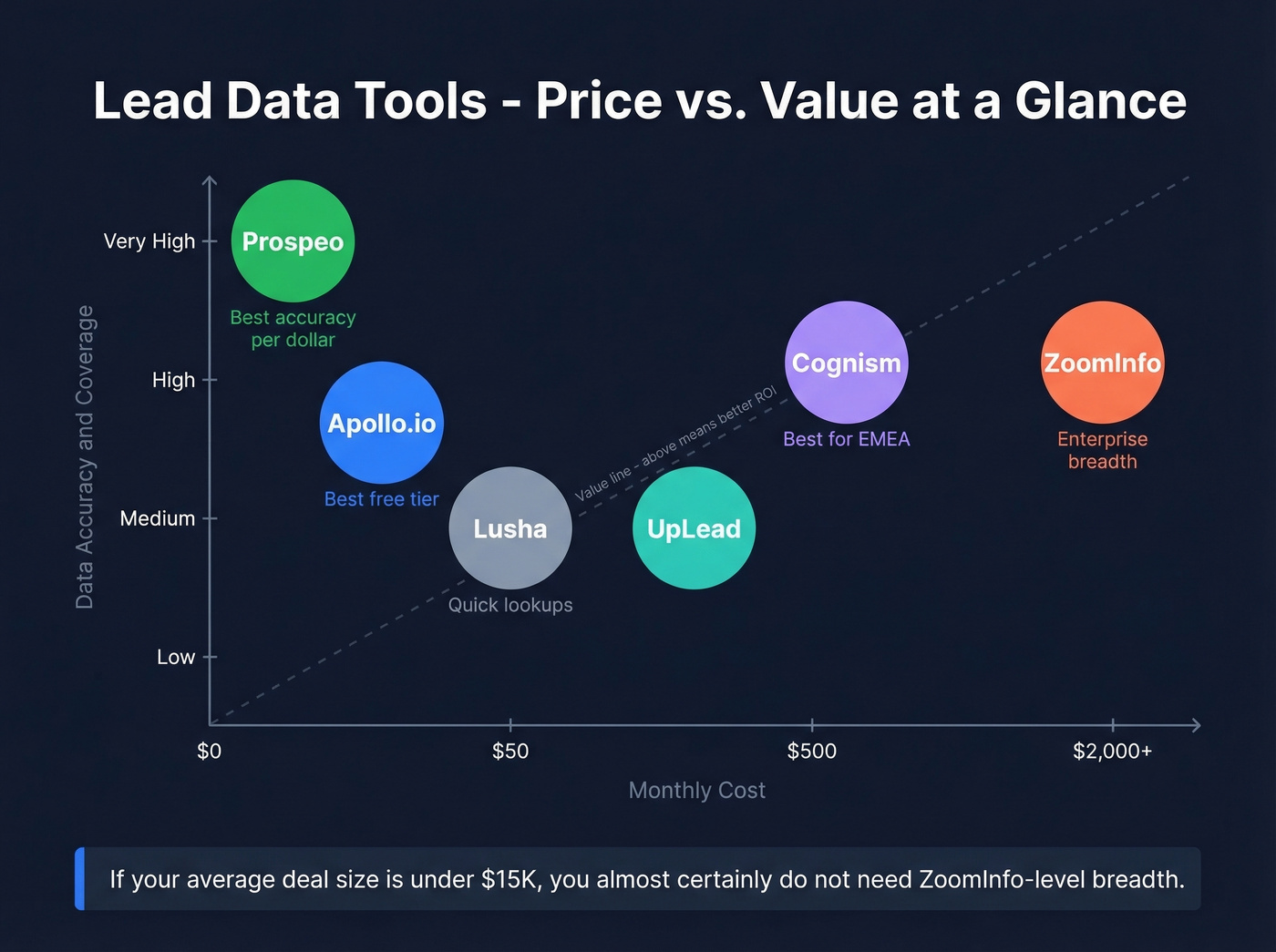
| Tool | Free Tier | Starting Price | Pricing Model | Best For | Verdict |
|---|---|---|---|---|---|
| Prospeo | 75 emails + 100 ext. credits/mo | ~$0.01/email | Credits, self-serve | Verified accuracy at scale | Best accuracy per dollar |
| Apollo.io | 1,200 credits/mo | $59/mo | Credits + seats | All-in-one prospecting | Best free tier |
| ZoomInfo | None | ~$15-40K/yr | Custom, annual | Enterprise breadth | Best for enterprise (if you'll use it all) |
| Cognism | None | ~$1-3K/mo | Custom, tiered | EMEA coverage | Best for European markets |
| Lusha | 40 credits/mo | $49/mo | Credits + seats | Quick lookups | Good for ad-hoc research |
| UpLead | None | $99/mo (170 credits) | Credits | Budget mid-market | Solid mid-range option |
| Kaspr | Yes | $49/user/mo | Credits + seats | European contacts | Skip if selling outside EMEA |
| HubSpot Breeze | None | $30/mo (100 credits) | Credit packs | HubSpot-native enrichment | Only if you're already on HubSpot |
| Crunchbase | None | $49/mo (annual) | Subscription | Company/funding research | Research only - not an outbound tool |
Apollo's free tier is genuinely generous - 1,200 credits a month is enough for a solo founder to run real outbound. But the accuracy gap means you'll spend time cleaning what you pull. ZoomInfo pricing is a common complaint on r/sales, and for good reason: a user-reported quote came in at ~$2K per user per month, putting a 10-seat contract well into six figures annually.
Cognism is the play if you're selling into EMEA. In one case study, they reported a 98% match rate versus 72% for ZoomInfo on European contacts, with call connect rates jumping from 14% to 22%. Lusha and Kaspr work for quick lookups but don't scale for high-volume outbound.
Let's be honest: if your average deal size is under $15K, you almost certainly don't need ZoomInfo-level breadth. A waterfall stack built on a credit-based tool plus a verification layer will outperform a $40K/year contract that your team only uses for email lookups. Save the enterprise budget for when you actually need enterprise coverage. Teams looking for unlimited prospect data should be especially skeptical of per-seat pricing models that cap exports - credit-based tools often deliver more usable contacts per dollar. (If you're shopping by procurement model, compare options in our guide to pay-as-you-go B2B data.)
Scoring and Prioritizing Leads
Pulling accurate data is only half the job. 80% of new leads never translate into sales, and 63% won't convert for at least three months. Without a scoring framework, your reps are guessing.
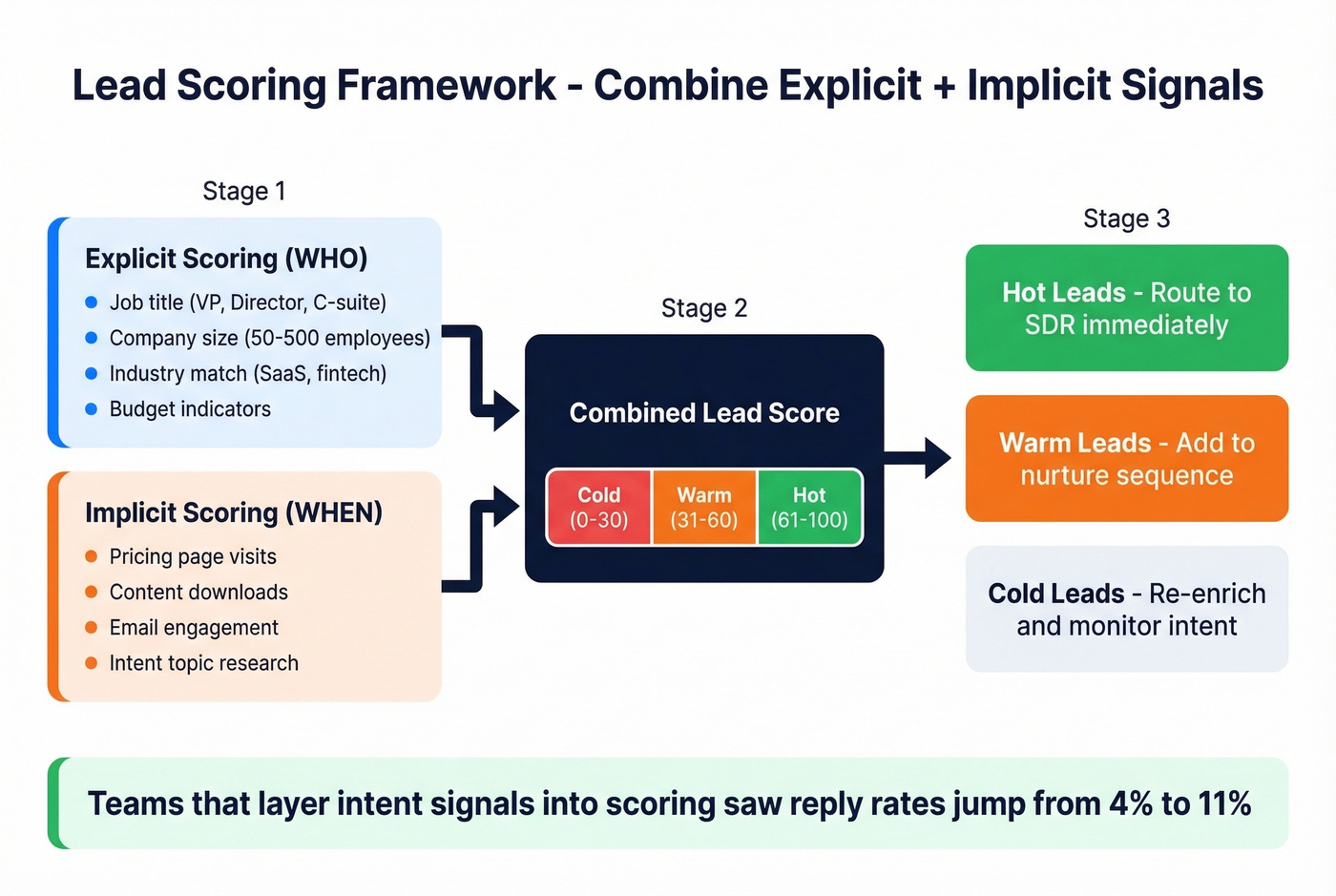
Explicit scoring uses observable data - job title, company size, industry, budget. Implicit scoring tracks behavior - page visits, email opens, content downloads. The best models combine both, weighted by what actually predicts closed revenue in your specific sales cycle. Firmographic data feeds explicit scores. Behavioral and intent signals feed implicit scores. Technographic data does both - a company running your competitor's product signals budget and in-market intent. (If you need a clean starting point, build around an Ideal Customer Profile.)
In our experience, teams that layer intent signals into their scoring models see the biggest jump in conversion rates, because reps stop wasting time on accounts that aren't actively buying. One team we worked with went from a 4% reply rate to 11% just by filtering for Bombora intent topics before building their outbound lists. (For a practical framework, see how to identify buyer intent signals.)
Compliance Essentials
Compliance isn't optional, and the penalties are severe. GDPR fines can reach EUR 20M or 4% of global revenue. A January 2025 FCC rule change tightened consent requirements for lead generation and telemarketing. Only 31% of marketing ops professionals say they're completely confident in their compliance efforts. (If you're formalizing policy, use a dedicated B2B compliance framework.)
- Verify your data provider's compliance posture. Ask for DPAs, understand their data sourcing, confirm opt-out enforcement. If they can't answer clearly, walk away. (For EU-specific sourcing requirements, start with a GDPR compliant database checklist.)
- Honor opt-outs globally, not just in jurisdictions that require it. It's cheaper than litigation.
- Document consent chains. If you can't trace how a contact entered your database, you're exposed.
- Audit quarterly. 34% of organizations have experienced reputational or financial harm from privacy lapses.
FAQ
What types of data matter most for lead generation?
Six types drive results: contact, firmographic, technographic, behavioral, intent, and demographic. Contact and firmographic records tell you who to reach. Intent and behavioral signals tell you when. Layer all six for the highest conversion rates - teams using intent data alongside contact info consistently see higher reply rates.
How often should I refresh my lead database?
At minimum, quarterly. B2B data decays 25-30% per year - roughly 7% of records go stale every 90 days. Platforms with weekly refresh cycles keep accuracy high without manual intervention, which is why we recommend building refresh cadence into your vendor evaluation criteria from the start.
What tools verify email accuracy before outreach?
Dedicated verification tools like NeverBounce, ZeroBounce, and Bouncer handle standalone checks. Prospeo includes built-in 5-step verification with catch-all handling and spam-trap removal. The key is verifying after enrichment and before sequencing - never skip this step, regardless of which database you're pulling from.
Should I buy lead data or build lists manually?
For most outbound teams, buying from a verified provider and layering in manual research only for top-tier accounts is the smarter move. Manual list building from company websites gives you high-quality contacts but doesn't scale past a handful of accounts per day. The hybrid approach gives you both coverage and precision without burning rep hours on data entry.