


7 Best DataBees Alternatives for Self-Serve Prospecting in 2026
You're paying $975+/mo for a human researcher to build contact lists, and delivery takes 24-48 hours. Sometimes longer. Meanwhile, your SDRs need leads now - not tomorrow, not after a requirements call with a project manager. DataBees earns its 4.8/5 on G2 for a reason, but the managed-service model doesn't fit every team's speed or budget.
If that friction sounds familiar, here are seven self-serve tools that put prospecting back in your hands.
Our Picks (TL;DR)
- Prospeo - Best for verified emails and direct dials at ~$0.01/lead. Self-serve, free tier, no contract.
- Clay - Best for enrichment workflows across multiple data sources. Starts at $185/mo.
- Apollo - Best all-in-one prospecting suite on a budget. Free tier available.
Why Teams Switch From DataBees
DataBees does excellent work for complex, niche research - TAM mapping, event-speaker identification, industry-specific signals that automated tools can't replicate. But three things push teams toward self-serve.
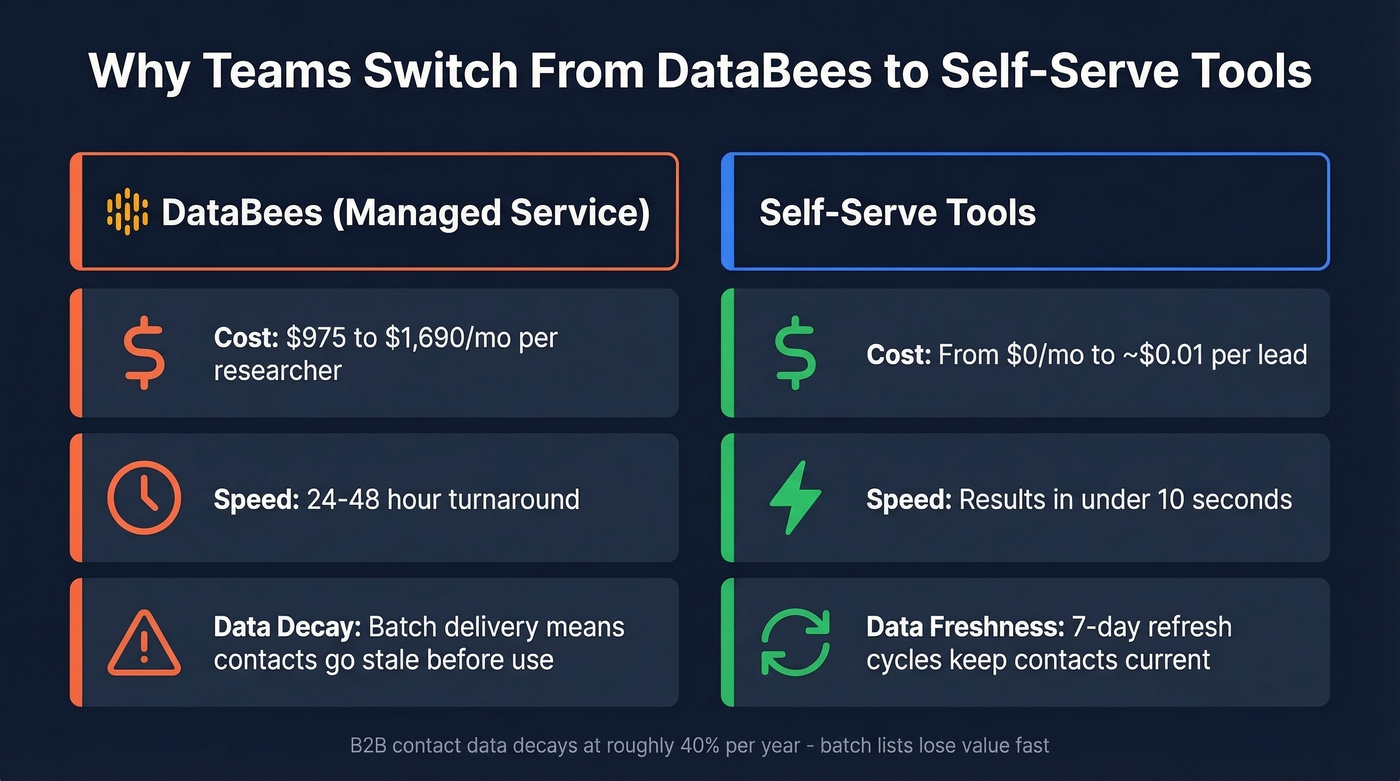
Cost. Plans start at $975/mo per researcher and scale to $1,690/mo for specialist work. That's real money when you just need verified emails and phone numbers.
Speed. A 24-48 hour turnaround doesn't work when reps are building lists between calls. Self-serve tools deliver results in seconds.
Data decay. B2B contact data goes stale at roughly 40% per year. If you're working in batches, some contacts are already degrading by the time they hit your CRM. The consensus on r/sales is that batch-delivered lists lose value fast - and we've seen the same thing firsthand.

DataBees charges $975+/mo for one researcher with 24-48 hour turnaround. Prospeo gives you 300M+ profiles with 98% verified emails and 125M+ direct dials - instantly, at ~$0.01/lead. Data refreshes every 7 days, not whenever a human gets to it. Start with 75 free emails, no contract required.
Replace the managed-service bottleneck with self-serve data that's actually fresh.
The 7 Best DataBees Alternatives
1. Prospeo - Verified Emails Without the Overhead

Use this if you want DataBees-level data quality without the managed-service model.
Prospeo's database covers 300M+ professional profiles with 143M+ verified emails at 98% accuracy and 125M+ verified mobile numbers hitting a 30% pickup rate. The 7-day data refresh cycle is the stat that matters most here - the industry average is six weeks, which means most tools are serving you contacts that have already started to rot.
Let's put the cost difference in perspective. DataBees runs $975-$1,690/mo for one researcher. Prospeo costs roughly $0.01 per lead, with a free tier giving you 75 verified emails per month to test before spending anything. When Snyk rolled out Prospeo across 50 AEs, their bounce rate dropped from 35-40% to under 5%, and AE-sourced pipeline jumped 180%.
You get 30+ search filters - buyer intent, technographics, job changes, headcount growth, funding signals - plus intent data across 15,000 topics powered by Bombora, a Chrome extension used by 40,000+ prospectors, and native integrations with Salesforce, HubSpot, Smartlead, Instantly, and Clay.
Skip this if you need deeply custom research like TAM mapping for niche verticals where human researchers add real value.
2. Clay - Enrichment Workflows Across Multiple Sources
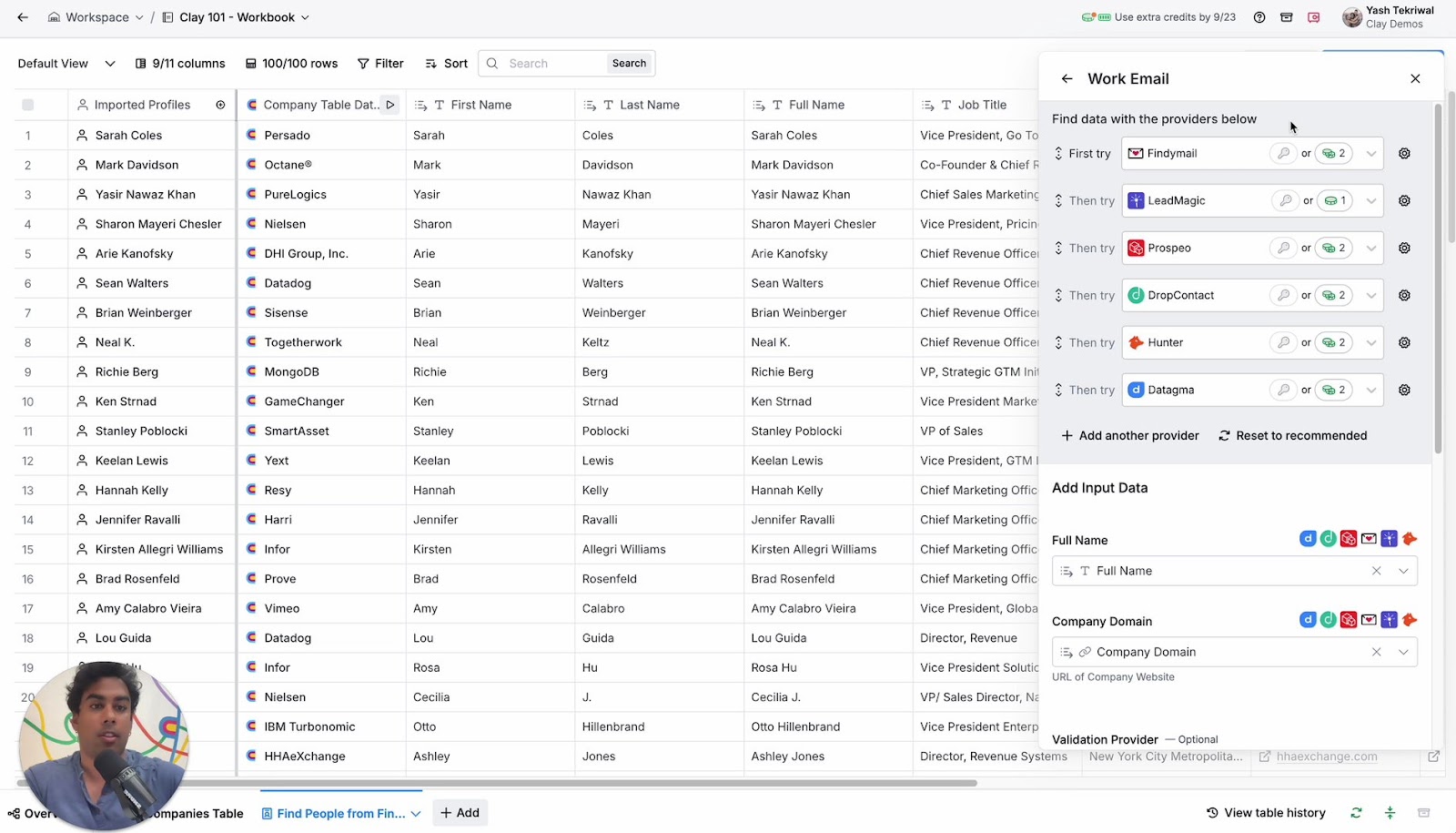
Clay isn't a database. It's a workflow engine that pulls from 75+ data providers and lets you build enrichment waterfalls, scoring logic, and automated list-building sequences. If you're not building multi-step enrichment workflows, you're overpaying for capability you won't use.
Clay overhauled its pricing on March 11, 2026. New tiers: Launch at $185/mo ($167/mo annually) and Growth at $495/mo ($446/mo annually). The model runs on dual currency - data credits for enrichment lookups and actions for orchestration steps. One welcome change: you don't get charged for failed lookups anymore.
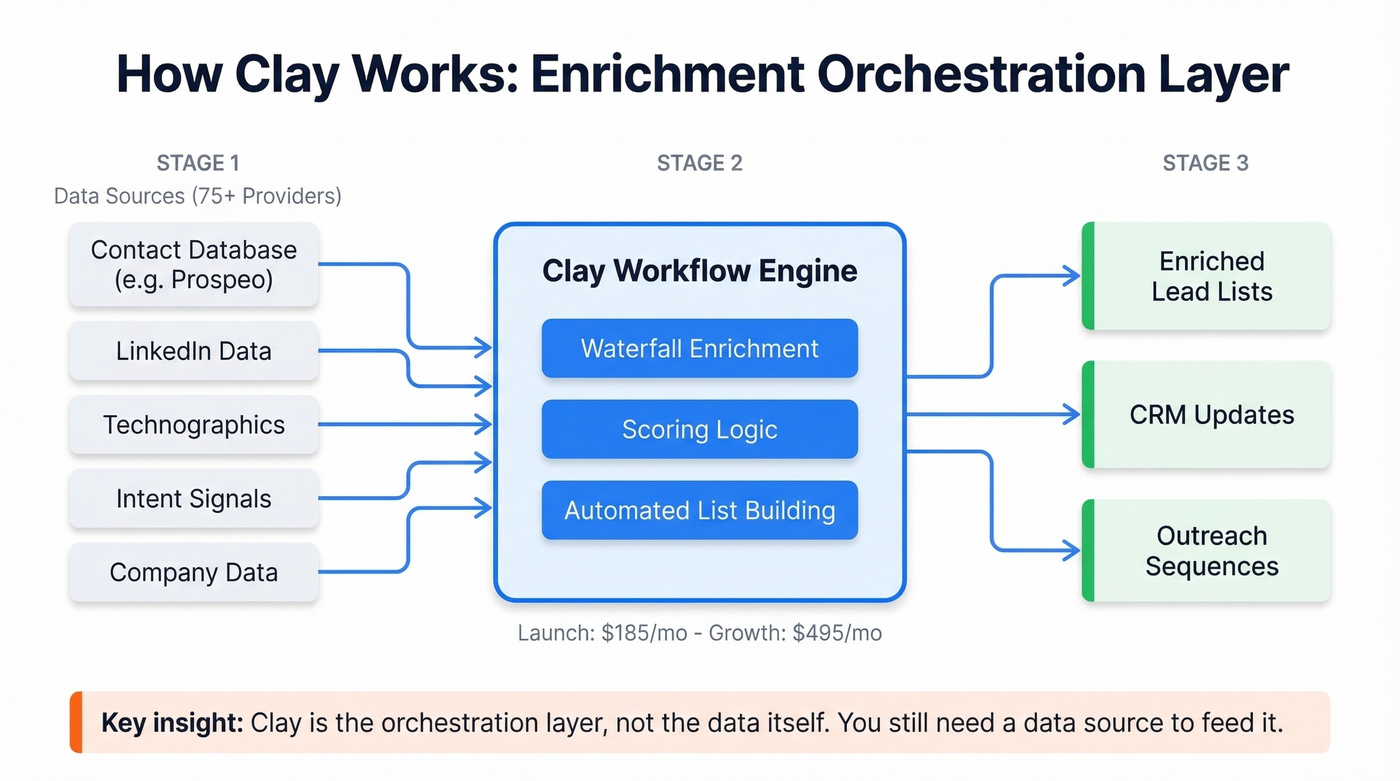
Here's the thing about Clay, though: it still needs a data source to feed it. It's the orchestration layer, not the data itself. Many teams pair Clay with a dedicated contact data provider as the underlying source - we've seen this work well in practice, and it's how you get the best of both worlds. (If you want a deeper breakdown, see our guide to Clay list building.)
3. Apollo - Volume Prospecting With Built-In Outreach
Apollo is the Swiss Army knife of budget prospecting. Free tier, paid plans at ~$49-$99/mo per user, a built-in sequencer, and a dialer - all in one platform. The learning curve is gentle, and you're live in minutes.
Where Apollo wins over DataBees: instant access, self-serve list building, and integrated outreach. Where it falls short: email accuracy. In our testing, we've seen bounce rates around 10-15% on Apollo-sourced lists without additional verification, which lines up with what GTMnow and other outbound communities report. Serious outbound teams often layer a dedicated verification tool on top (see: email bounce rate benchmarks and fixes). Apollo is a great starting point, but don't treat it as your single source of truth for deliverability-critical campaigns.
4. Cognism - European Direct Dials
Cognism's strength is EMEA mobile data and a compliance-first approach that matters if you're selling into the UK or EU. Third-party benchmarks cite 400M business profiles and 200M verified business emails.
The tradeoff is price. A typical mid-market deployment runs $25,000+/year, with per-user fees on top. That's far from self-serve pricing. ZoomInfo is typically stronger for US depth, while Cognism is the go-to for European mobile coverage and GDPR compliance posture.
5. ZoomInfo - Enterprise-Scale Database
ZoomInfo dominates the enterprise segment, and for large sales orgs running outbound, ABM, and intent from one platform, it earns its price tag. For teams exploring DataBees alternatives, though, it's almost certainly overkill.
Annual contracts start at ~$15,000+/year for Professional and climb to $40,000+ for Elite. Add-ons stack up: extra credits at ~$3,000 per 5,000, Global Data at ~$9,995, NeverBounce verification at ~$3,000. If you're coming from DataBees' $975/mo starting point, ZoomInfo's pricing will feel like a different universe entirely.
6. Ocean.io - Account-Based Lookalike Discovery
Ocean.io takes a different angle: feed it your best customers, and it finds lookalike companies. Starter plans run $79/mo and Professional at $299/mo, with annual commitment required for all paid tiers.
The credit model gets granular - showing a verified email costs 3 credits, a mobile number costs 10. At scale, credits burn faster than you'd expect. It's a solid complement to a broader data tool, not a full replacement for DataBees' contact-level research. (If you're building an ABM motion, this pairs well with account-based selling best practices.)
7. B2B Rocket - AI-Powered Outreach Agent
B2B Rocket automates prospecting with AI agents that handle outreach end-to-end. Starter plans begin at $59/mo (annual), Growth at $99/mo, and Scale at $149/mo. It's a niche fit for teams that want fully hands-off prospecting - but the AI agent approach means less control over messaging and targeting. If you care about brand voice, tread carefully here. For more options in this category, compare AI cold email outreach tools and workflows.
Pricing Comparison
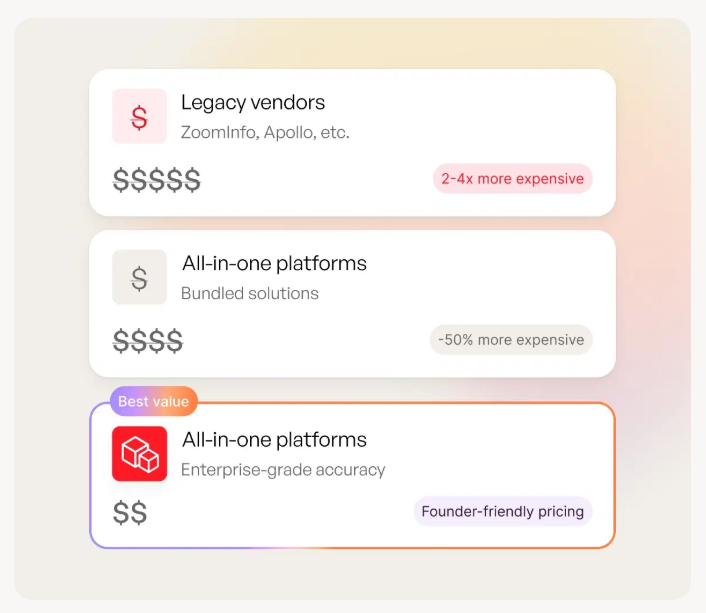
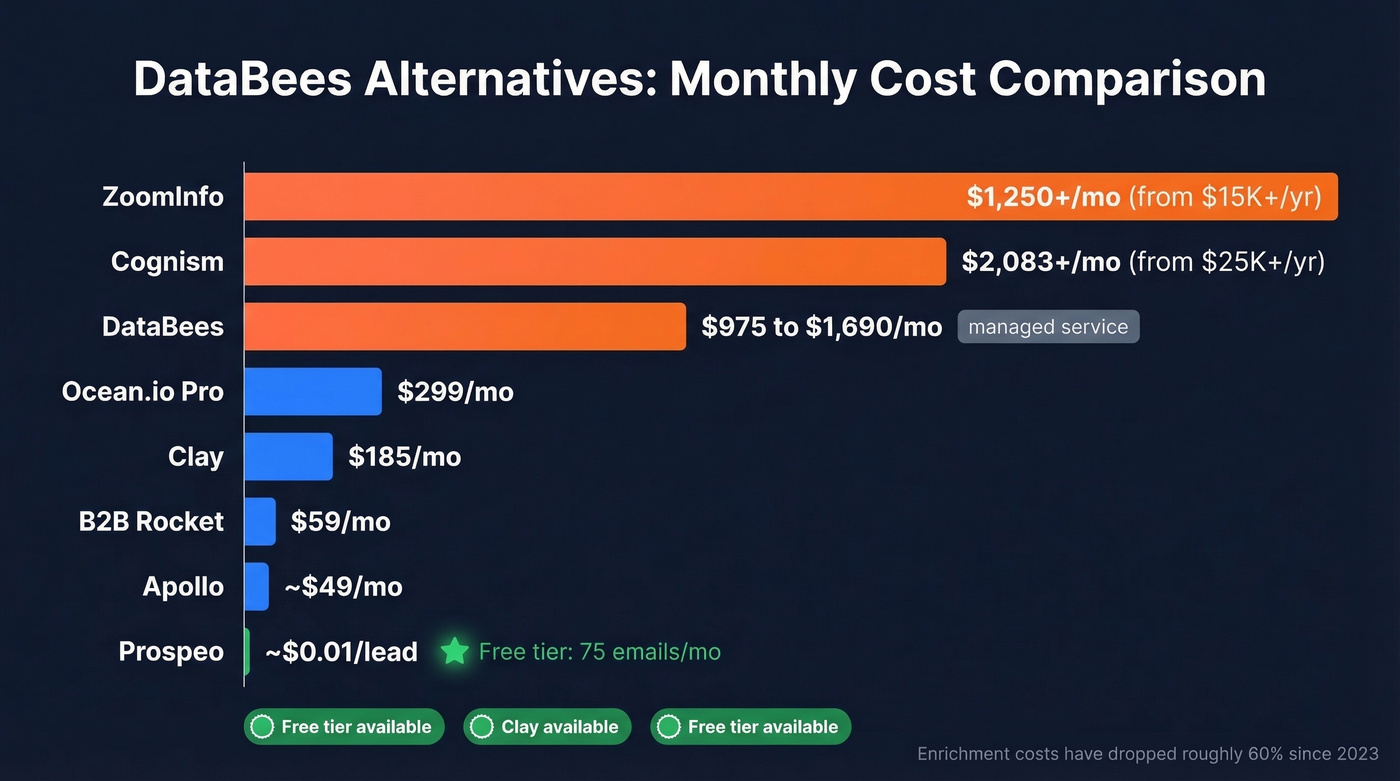
Enrichment workflow costs have dropped roughly 60% since 2023, making self-serve tools viable for teams that would have needed managed services two years ago. Here's where the numbers land:
| Tool | Starting Price | Model | Free Tier |
|---|---|---|---|
| DataBees | $975/mo per researcher | Subscription (managed service) | No |
| Clay | $185/mo | Credits + actions | Yes (100 credits/mo) |
| Apollo | ~$49/mo per user | Per-seat | Yes |
| Ocean.io | $79/mo | Credit-based (annual) | No |
| B2B Rocket | $59/mo | Tiered subscription | No |
| Cognism | ~$25,000+/yr | Quote-based (annual) | No |
| ZoomInfo | ~$15,000+/yr | Quote-based (annual) | No |
How to Choose the Right Tool
Look, most teams paying for managed data research don't actually need it. If your use case is "get me verified emails and direct dials for these personas at these companies," you're paying a human to do what a database does in seconds. Save the managed service for Tier 1 accounts that need deep, custom research - and run self-serve for everything else. (If you're rebuilding your outbound motion, start with these sales prospecting techniques.)
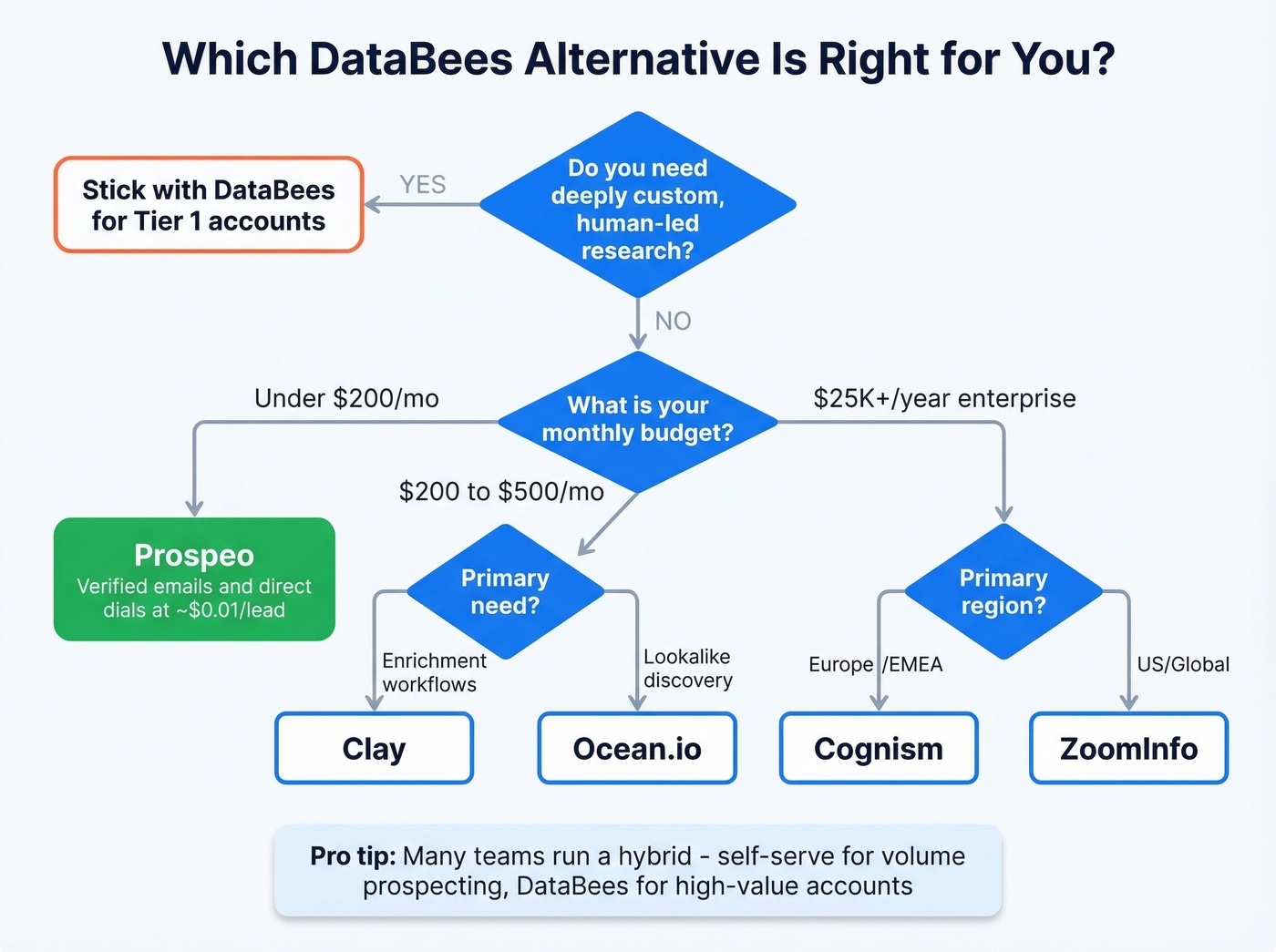
The decision comes down to four things:
Managed vs. self-serve. If you need human researchers for deeply custom data, stick with DataBees. Some teams run a hybrid - self-serve tools for volume prospecting and DataBees for high-value accounts that need manual verification. That's a smart play.
Budget. Spending under $200/mo and you just need emails and phones? Prospeo. $200-$500/mo and you want workflow automation? Clay for enrichment orchestration, Ocean.io for lookalikes. Enterprise budget with enterprise needs? Cognism or ZoomInfo.
Data region. Selling into Europe? Cognism's mobile coverage is hard to beat. Global or US-focused? Most self-serve tools cover all regions well.
Use case. Verified contact data at high accuracy - Prospeo. Enrichment orchestration across dozens of sources - Clay. Full prospecting suite with built-in outreach - Apollo. AI-driven outreach with minimal manual work - B2B Rocket. If you're comparing broader vendors, see our roundup of data enrichment services and sales prospecting databases.
Batch-delivered lists decay before they hit your CRM. Prospeo's 7-day refresh cycle means your reps always work with current data - not contacts that changed jobs last month. Snyk saw bounce rates drop from 35-40% to under 5% across 50 AEs and pipeline jump 180%.
Stop prospecting with stale data. Build verified lists in seconds.
FAQ
What does DataBees actually do?
DataBees is a data-as-a-service provider that pairs human researchers with waterfall enrichment technology to build custom contact and account lists. It excels at complex, niche research - TAM mapping, event-speaker identification, industry-specific signals - where automated tools fall short. Plans start at $975/mo per researcher.
Can self-serve tools match DataBees' data quality?
For standard contact lists - verified emails, direct dials, firmographics - yes. Self-serve tools now match managed-service quality for standard contact data and deliver it in seconds instead of 24-48 hours. For highly custom research like niche industry signals or deep account mapping, DataBees' human researchers still hold an edge.
Is there a free alternative to DataBees?
Prospeo gives 75 verified emails per month free with no credit card required. Clay offers 100 data credits per month on its free plan. Apollo has a free tier with limited credits. All three let you test data quality and deliverability before committing.
How fast do self-serve B2B data tools return results?
Most self-serve platforms return verified contact data in under 10 seconds per search. That's compared to DataBees' 24-48 hour turnaround. For teams running high-velocity outbound, that speed difference compounds across hundreds of daily searches - and it's the single biggest reason we see teams make the switch.