

What a Day in the Life of an SDR Actually Looks Like
It's 9:47 AM. You're 22 dials into your first call block, and you've heard three voicemails, one "wrong number," and seventeen rings to nowhere. Then your AE pings you on Slack: "That lead you booked yesterday - wrong person. The record hasn't been updated in four months."
That's the job. The average sales development rep lasts 14 months before moving on, and 54% say burnout is a top reason they'd leave. More than 40% say prospecting itself is the hardest part of the entire sales process. Most SDR advice tells you to "just make more calls." That's lazy management advice. The reps who hit quota consistently aren't dialing more - they're dialing better numbers, with better data behind every touch.
The Quick Version
Here's what the data says about a typical SDR daily routine in 2026:
- 100+ activities/day producing roughly 3.6 quality conversations (see sales activities benchmarks)
- Outbound and inbound are fundamentally different jobs with different stress profiles
- Average tenure is 14 months; the promotion window to AE is 12-18 months
- OTE ranges from $70k-$95k, with top markets reaching $100k (how OTE in sales is calculated)
- The single biggest lever for making the day less painful: data quality (why data enrichment matters)
Bad numbers and stale emails silently destroy your productivity. We've seen teams lose 30%+ of their call blocks to disconnected lines, and that compounds fast across hundreds of daily touches.
Inbound vs. Outbound - Two Different Jobs
Most "day in the life" articles treat SDRs as one role. They're not.
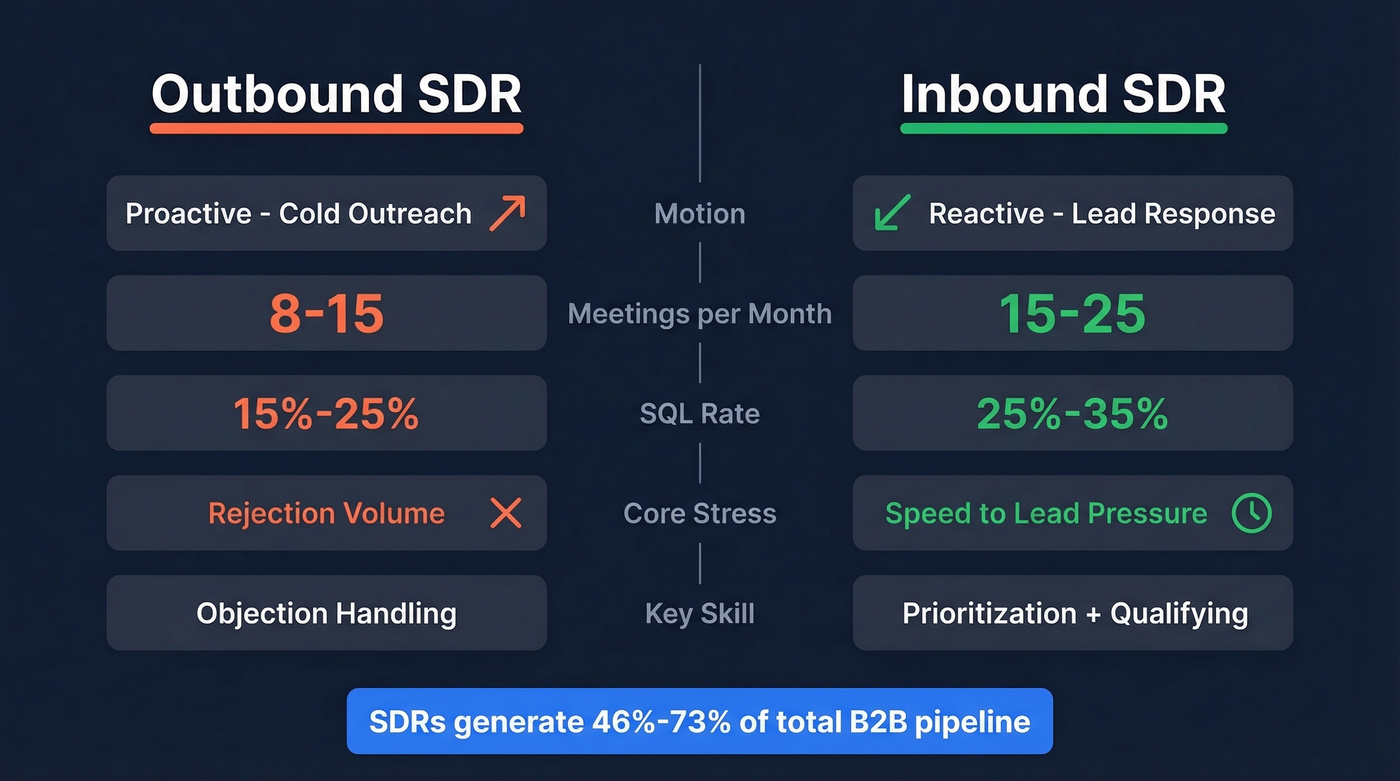
| Outbound SDR | Inbound SDR | |
|---|---|---|
| Motion | Proactive - cold outreach | Reactive - lead response |
| Meetings/mo | 8-15 | 15-25 |
| SQL rate | 15%-25% | 25%-35% |
| Core stress | Rejection volume | Speed-to-lead pressure |
| Key skill | Objection handling | Prioritization + qualifying |
Both feed pipeline. At most B2B companies, SDRs generate 46%-73% of total pipeline. That's not a supporting role - it's the engine.
Hour-by-Hour: The Outbound SDR Schedule
| Time | Block | Expected Output |
|---|---|---|
| 8:00-8:30 | Prep - review accounts, check intent signals | 10-15 accounts prioritized |
| 8:30-10:30 | Call block #1 | ~18-20 dials, 1-2 connects |
| 10:30-11:30 | Email + social touches | ~15 personalized emails, 7 social touches |
| 11:30-12:00 | CRM updates + admin | Pipeline notes, activity logging |
| 12:00-1:00 | Lunch | - |
| 1:00-3:00 | Call block #2 | ~18-20 dials, 1-2 connects |
| 3:00-3:30 | Follow-ups + voicemail drops | ~15 emails, 15 voicemails |
| 3:30-4:00 | Team standup or 1:1 coaching | - |
| 4:00-5:00 | Research + next-day prep | Account mapping, list building |
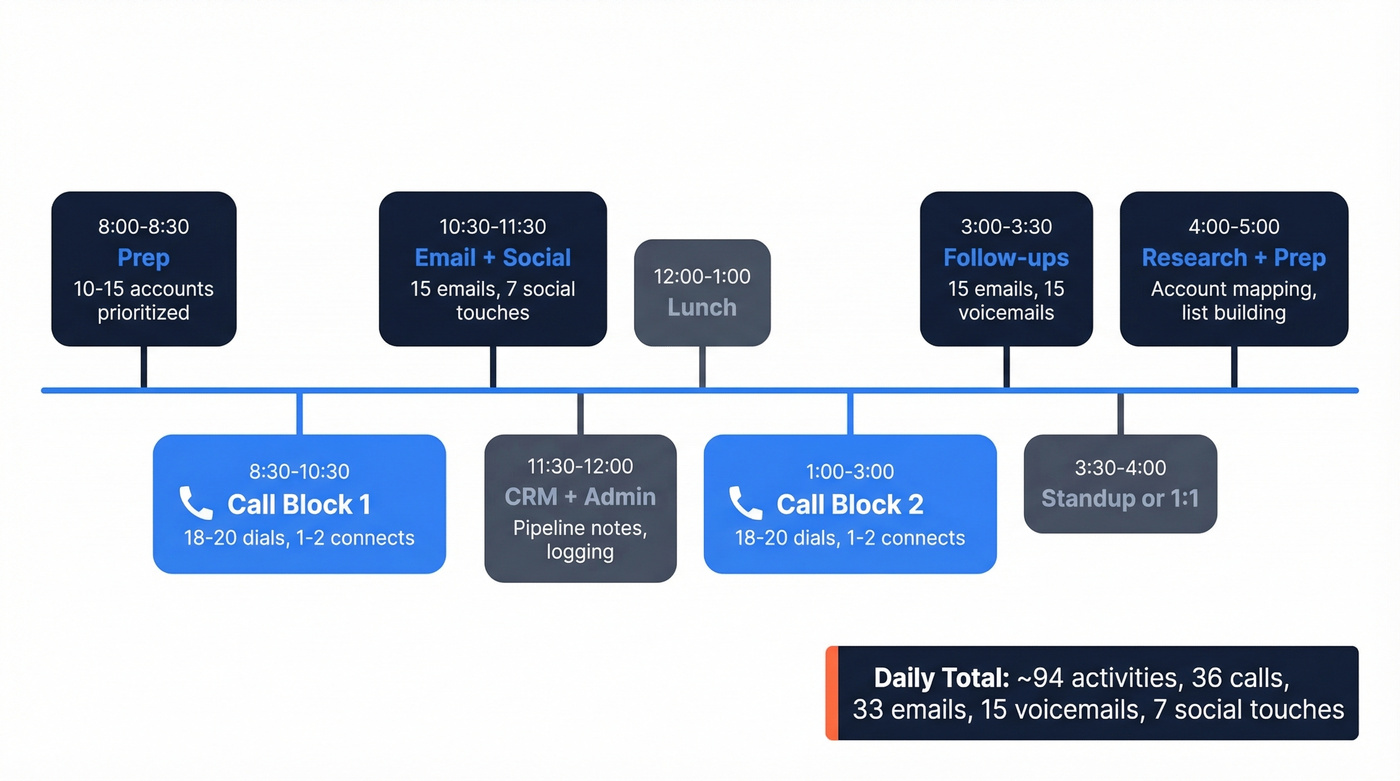
That adds up to roughly 94.4 activities per day: 35.9 calls, 32.6 emails, 15.3 voicemails, and 7 social touches. The two call blocks are the engine. Everything else supports them.
If you're wondering what the work actually feels like, it's structured blocks of focused activity separated by admin and prep. The rhythm matters more than the raw numbers - reps who protect their call blocks from meeting creep consistently outperform those who let their calendars fragment (a practical cold calling system helps).
The Inbound SDR Schedule
| Time | Block | Expected Output |
|---|---|---|
| 8:00-9:00 | Triage overnight leads, prioritize by score | 5-8 leads qualified |
| 9:00-11:00 | Discovery calls + hot lead routing to AEs | 4-6 calls, 2-3 meetings booked |
| 11:00-12:00 | CRM updates, lead scoring adjustments | - |
| 12:00-1:00 | Lunch | - |
| 1:00-3:00 | Nurture sequences + follow-up calls | 3-5 calls, 8-10 follow-up emails |
| 3:00-4:00 | Re-engage stalled leads, book next-week calls | 5-8 emails |
| 4:00-5:00 | Reporting + next-day prep | - |
The inbound day revolves around speed. Response within 5 minutes is the standard - miss that window and conversion rates crater. Less cold calling, more qualification judgment, and the constant pressure of knowing every minute of delay costs pipeline.

Your 50-dial call block shrinks to 35 when 30% of numbers are disconnected. Prospeo's 125M+ verified mobiles refresh every 7 days - not every 6 weeks - so your dials actually connect. Teams using Prospeo book 26% more meetings than ZoomInfo users.
Stop burning call blocks on dead numbers. Start dialing prospects who pick up.
The Rejection Math
Here's the thing nobody puts in the job description. It takes 18+ dials to reach a single prospect. The cold-call-to-meeting conversion rate sits at 2.3%. Cold email reply rates run 1%-5%.
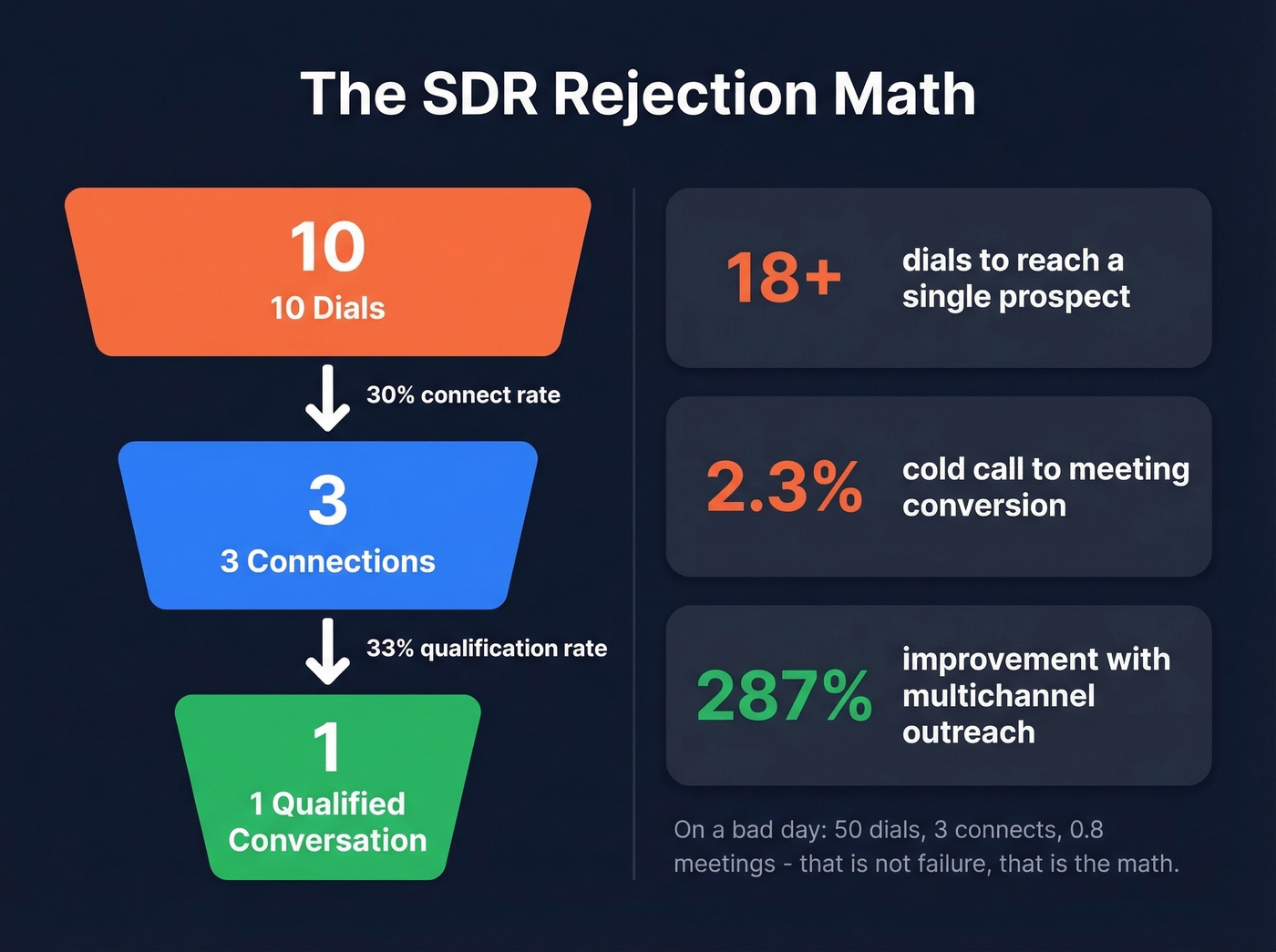
The simplest mental model is the 10-3-1 rule: 10 calls produce 3 connections produce 1 qualified conversation. On a bad day, 50 dials get you roughly 3 connects and 0.8 meetings. That's not failure. That's the math.
Multichannel outreach - email, phone, and social combined - improves results by 287% over single-channel. That's the biggest unlock in the data, and it's why the best SDR orgs don't let reps live in one channel all day. Ask any sales development rep what kills their day and the answer is almost always the same: bad data and pointless admin. We've watched reps lose an hour per day to disconnected numbers alone - time they'll never get back (see common cold call rejection fixes).
The 2026 SDR Tech Stack
As Ernest Owusu at 6sense put it: prior prospecting techniques "would absolutely not work nowadays." The modern stack has five layers, and the data layer is where most teams quietly break (a full list of SDR tools helps).
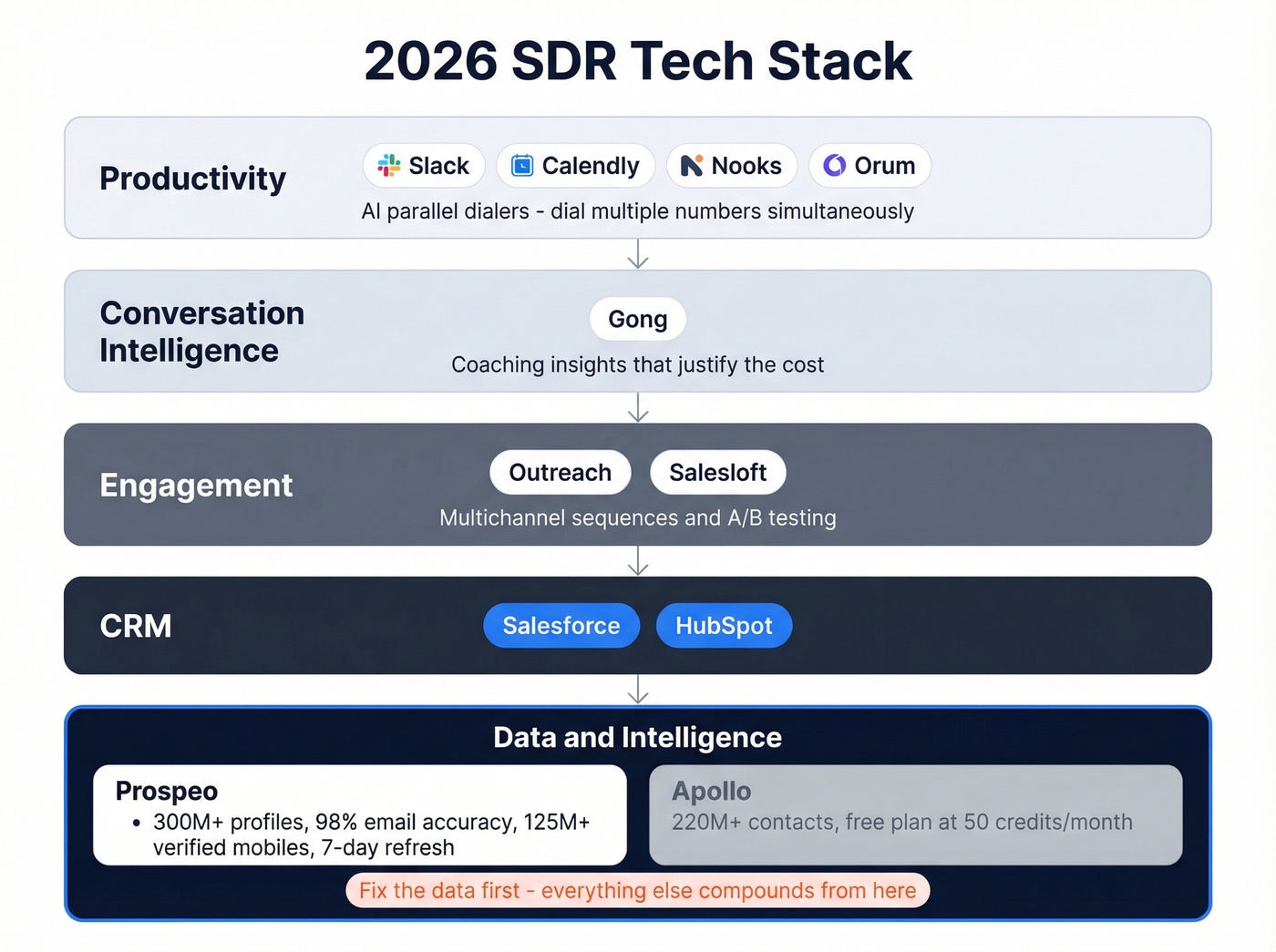
CRM: Salesforce or HubSpot. This is where your activity lives. Non-negotiable.
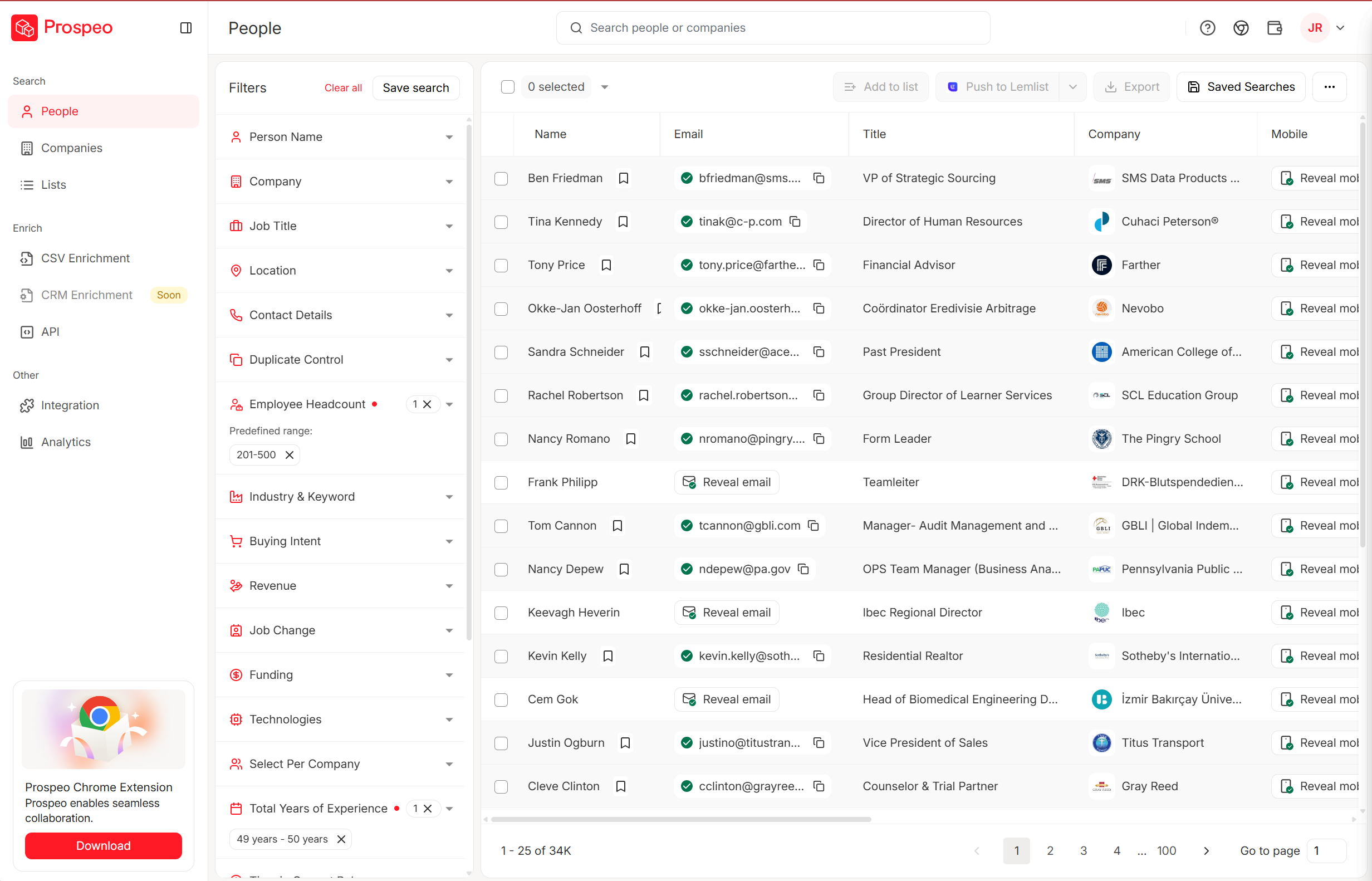
Data & Intelligence: If 30%+ of your dials hit disconnected numbers, your 50-call block just became a 35-call block. Prospeo covers 300M+ profiles with 98% email accuracy and 125M+ verified mobile numbers, refreshed every 7 days - the industry average is 6 weeks. It integrates directly with Salesforce, HubSpot, Outreach, and Salesloft, so your call block starts with numbers that actually ring. Apollo is another solid option with 220M+ contacts and a free plan at 50 credits/month, though in our experience the email accuracy gap shows up fast at scale (how to choose a sales prospecting database).
Engagement: Outreach or Salesloft for multichannel sequences and A/B testing. These are the workhorses that turn your data into actual touchpoints (see sequence management best practices).
Conversation Intelligence: Gong. Period. The coaching insights alone justify the cost.
Productivity: Slack, Calendly, and AI parallel dialers like Nooks or Orum that let reps dial multiple numbers simultaneously. If your team isn't using a parallel dialer in 2026, you're leaving meetings on the table.
Let's be honest - the stack doesn't matter if the foundation is rotten. I've seen teams running $50k/year in tooling on top of a contact database that hasn't been refreshed in two months. Fix the data first. Everything else compounds from there.
What SDRs Earn in 2026
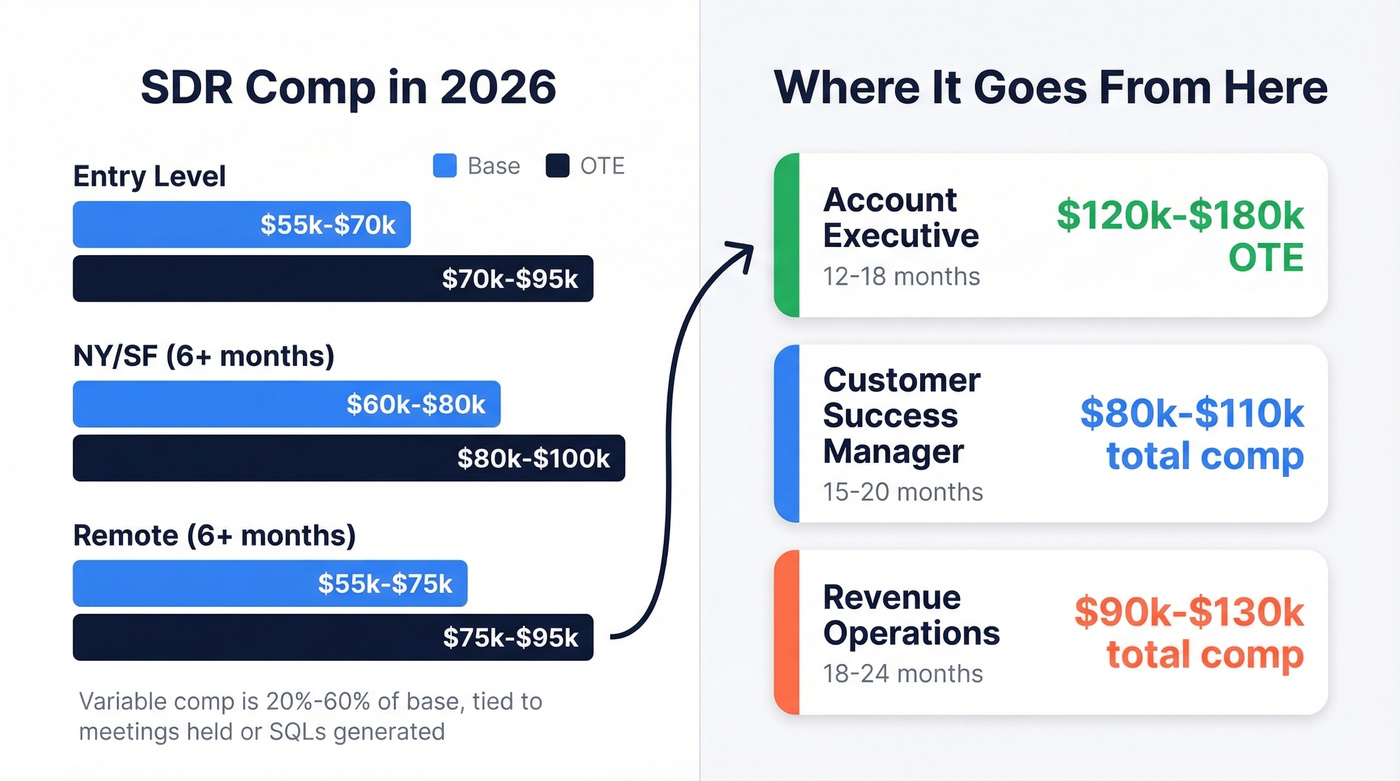
Betts Recruiting's comp data showed 5%-10% salary increases year-over-year. If that pace holds, 2026 ranges look like this:
| Level | Base | OTE |
|---|---|---|
| Entry-level | $55k-$70k | $70k-$95k |
| 6+ months (NY/SF) | $60k-$80k | $80k-$100k |
| 6+ months (remote) | $55k-$75k | $75k-$95k |
Variable comp is tied to meetings held or SQLs generated, typically running 20%-60% of base. Most plans include accelerators after 100% quota - hit 120% and your per-meeting payout jumps. The consensus on r/sales is that you should negotiate for a higher base-to-variable ratio early in your career, since quota attainment in your first quarter is unpredictable and you don't want rent depending on a ramp period.
If your deal sizes sit below five figures, your company probably doesn't need to pay ZoomInfo-level prices for data. The SDRs who burn out fastest aren't the ones facing rejection - they're the ones whose tools waste their time before they even pick up the phone.
Where the SDR Role Takes You
The standard promotion window is 12-18 months, with high performers making AE in 10-12 months. The unlock is usually 90%+ quota attainment for two straight quarters. Top-performing SDRs generate 22% higher meeting-to-opportunity conversion and 34% shorter sales cycles when they track full-funnel metrics - and that's exactly the kind of data that gets you promoted (what to track in funnel metrics).
Document your wins with pipeline and revenue impact, not just activity counts. "I made 4,000 calls last quarter" means nothing. "I sourced $1.2M in pipeline that closed at 28%" gets you promoted.
AE OTE ranges from $120k-$180k at mid-market companies - roughly double what you're making as a sales development rep. Not everyone wants to carry a quota forever. CSM roles run $80k-$110k total comp after 15-20 months, and RevOps sits at $90k-$130k after 18-24 months.
If your company doesn't give you a clear promotion path with documented criteria, that's a red flag. Get it in writing during the interview process, not after you've been grinding for a year. Skip any company that can't answer "what does the path from SDR to AE look like here?" with specifics.
The 10-3-1 rule assumes your data is clean. With stale emails bouncing at 35%+ and disconnected mobiles eating your dial blocks, the real math is worse. Prospeo delivers 98% email accuracy and a 30% mobile pickup rate - turning that 0.8 meetings/day into actual pipeline.
Fix the data layer and every activity in your SDR day compounds.
FAQ
Do you need a degree to become an SDR?
No. Most tech companies prioritize coachability and communication skills over formal education. Top performers regularly come from hospitality, teaching, and military backgrounds - hiring managers care about grit and curiosity, not diplomas.
How has AI changed the SDR workflow in 2026?
AI now handles email drafting, call transcription, and parallel dialing, but human judgment still drives qualification. Roughly 30% of outbound messages are AI-assisted. The role is shifting toward higher-value conversations, not disappearing.
What's the fastest way to boost SDR productivity?
Fix your data first. Every disconnected number or bounced email is a wasted activity that compounds across hundreds of daily touches. A 7-day data refresh cycle and 98%+ email accuracy eliminate most of that waste - that's the bar to hold any provider to.
How does an SDR's day differ at a startup vs. enterprise?
At a startup, you're often building your own lists, writing sequences, and doing light AE work. Enterprise companies offer more rigid schedules, dedicated tooling, and stricter handoff processes. Both paths teach fundamentals, but startups tend to accelerate your learning curve faster. If you want structure and coaching, go enterprise. If you want breadth and speed, go startup.