


Deal Intelligence Alternatives: 5 Better CI Tools (2026)
68% of B2B sales deals now involve at least one direct competitor, yet sales teams rate their competitive preparedness 3.8 out of 10. That's a brutal gap. If you've been searching for deal intelligence alternatives, you've probably noticed most lists confuse the brand with generic buyer intent and sales intelligence tools. SoftwareWorld's alternatives page recommends ZoomInfo and 6sense - strong platforms for intent and sales data, but not CI battlecard tools.
Here are the actual CI alternatives worth evaluating, plus the contact data layer most teams forget until it's too late.
Our Picks (TL;DR)
- Klue - Best for teams that need high adoption and battlecard distribution across the org.
- Crayon - Best for mid-market teams monitoring a large competitive set. Vendr median buyer pays ~$28,750/year.
- Kompyte - Best for fast deployment. First insights in 24-48 hours, full implementation in 1-2 weeks.
- Contify - Best for teams that need market intelligence beyond direct competitor tracking.
What Is Deal Intelligence?
Deal Intelligence is an AI-powered competitive intelligence platform built for B2B revenue teams. Its core differentiator is relationship-based intelligence - instead of tracking websites or monitoring keywords, it monitors professional communities and social networks to identify verified interactions between your accounts and competitors.
The value proposition: proactive early-warning alerts about active evaluations, delivered into Salesforce and Slack. When a prospect starts engaging with a competitor, you know before the deal review.
On G2, Deal Intelligence holds a 5.0/5 rating - but from just 5 reviews, split across SMB (2) and mid-market (3). That small sample size is part of the story. The CI tools market is projected to hit $1.46B by 2030, and Deal Intelligence occupies a narrow slice of it.
Why Teams Look for Alternatives
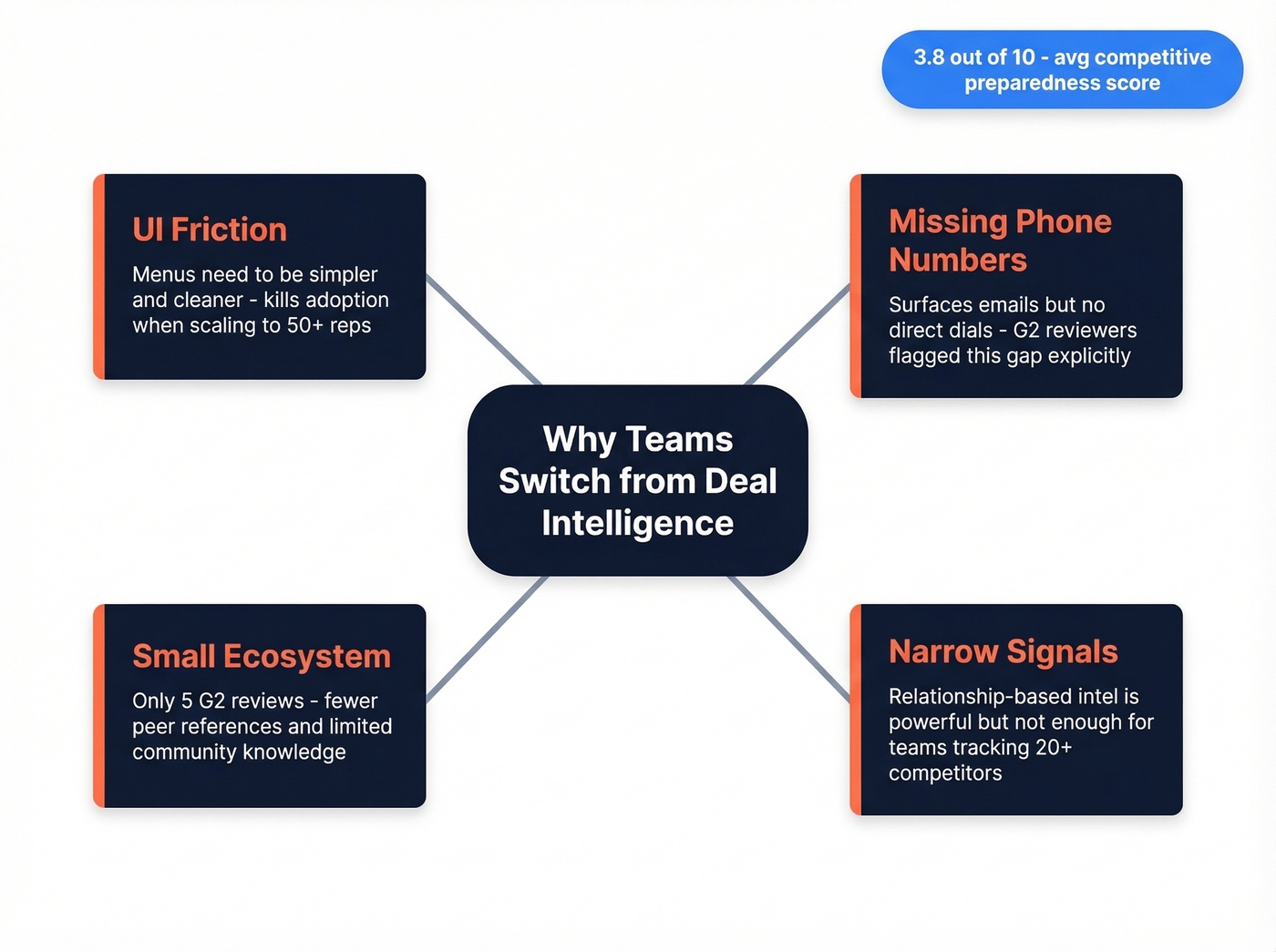
The complaints are specific and recurring. A December 2024 G2 review flagged the UI as needing simpler, cleaner menus - the kind of friction that kills adoption when you're trying to get 50 reps to actually use the tool. A February 2023 review praised the email contact data but explicitly asked for phone numbers, noting the platform surfaces emails but not direct dials.
Beyond the product itself, there are structural concerns:
- Small ecosystem. Five G2 reviews signals limited market traction. That's not necessarily a dealbreaker, but it means fewer peer references and less community knowledge to draw from when you're troubleshooting.
- Pricing opacity. Deal Intelligence doesn't publish pricing. Expect $10K-$40K/year based on typical niche CI platform ranges, but you'll need a sales conversation to confirm.
- Niche positioning. Relationship-based signals are powerful but narrow. Teams tracking 20+ competitors across websites, job postings, review sites, and social media need broader coverage.
CI Alternatives Pricing
CI pricing is notoriously opaque. Here's what teams actually pay, based on Vendr benchmarks and common market ranges.
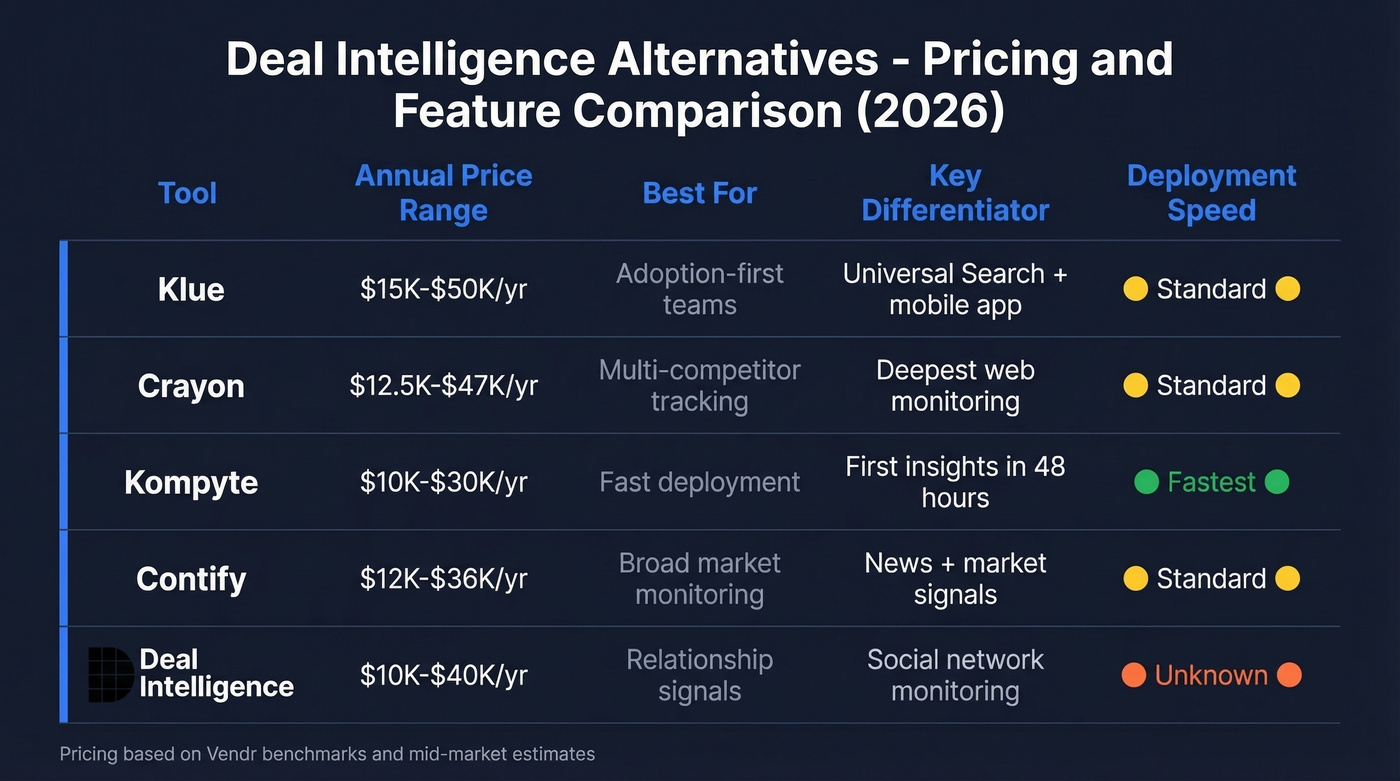
| Tool | Type | Starting Price | Best For | Differentiator |
|---|---|---|---|---|
| Klue | CI Platform | ~$15K-$50K/yr | Adoption-first teams | Universal Search + mobile |
| Crayon | CI Platform | ~$12.5K-$47K/yr | Multi-competitor tracking | Deepest web monitoring |
| Kompyte | CI Platform | ~$10K-$30K/yr | Fast deployment | 48-hr first insights |
| Contify | Market Intel | ~$12K-$36K/yr | Broad market monitoring | News + market signals |
| Deal Intelligence | CI Platform | ~$10K-$40K/yr | Relationship signals | Social network monitoring |

That G2 reviewer wasn't wrong - Deal Intelligence surfaces emails but not phone numbers. Prospeo fills that gap with 125M+ verified mobile numbers (30% pickup rate) and 143M+ emails at 98% accuracy. Layer contact data into your CI workflow so when battlecards flag a competitive threat, your reps can actually reach the buyer.
Competitive intel without direct dials is just expensive news. Fix that.
The Best CI Tools to Replace Deal Intelligence
Klue
Use this if you've struggled with CI tool adoption. Klue's entire pitch centers on getting reps to actually consume competitive intel - not just collecting it. The Universal Search feature, mobile app, and browser extension mean reps access battlecards where they already work, not in a separate tab they'll forget about. Adoption analytics tie usage directly to revenue impact, which makes renewal conversations with your CFO much easier.
Klue runs four tiers - Starter, Essentials, Pro, and Plus - and pricing scales by users, not competitors tracked. That's a meaningful distinction: if your competitive set is expanding but your team size is stable, costs stay predictable. Over 80 former Crayon clients have switched to Klue, largely on the strength of this adoption story. Expect $15K-$50K/year depending on tier and team size.
We've found that the biggest predictor of CI tool ROI isn't data quality - it's whether reps open the tool at all. Klue is built around that insight, and it shows. But if you're a small team tracking five or fewer competitors, you're paying for distribution infrastructure you won't fully use.

Crayon
Crayon is the brute-force option. It monitors more data sources across more competitors than any other CI tool on this list, and the Vendr benchmark from ~90 purchases puts the median contract at $28,750/year with a range of $12,450-$47,100.
The platform runs three tiers - Essentials, Professional, and Enterprise - and here's the catch: pricing scales by the number of competitors you track, which makes costs less predictable as your market evolves. Add-ons for custom integrations or services can tack on 15-30% to the base price. We've seen teams get surprised by this at renewal, so nail down your competitor count before signing.
The trade-off is distribution. Klue emphasizes Universal Search plus a mobile app and browser extension for easier access, while Crayon is more in-platform. For teams with a dedicated CI analyst who synthesizes and distributes insights, that's fine. For teams expecting reps to self-serve, it's a problem. The consensus on r/sales threads about CI tools tends to echo this: great data, mediocre last-mile delivery.

Kompyte
First insights in 24-48 hours. Full deployment in 1-2 weeks. That's Kompyte's headline claim, and it's one of the fastest time-to-value timelines in the CI space.
Every plan includes a dedicated CSM, personalized onboarding, and automations plus integrations out of the box. The three tiers break down cleanly: Essentials covers 10 companies and 25 users, Professional bumps to 20 companies and 100 users with an unlimited companies database for research, and Unlimited removes all caps with SSO plus advanced permissions. Kompyte monitors websites, job postings, review sites (G2, Capterra, TrustRadius, Gartner Peer Insights), social media, and app stores. Expect $10K-$30K/year for mid-market deployments.
The weakness is analytics. Kompyte focuses on speed and coverage, not on proving ROI to your board. If you need adoption dashboards and revenue-impact reporting, Klue is the better fit.
Contify
Contify takes a different angle. It's a news and market intelligence platform - better suited for teams that need to monitor industry trends, regulatory shifts, and broader market movements alongside direct competitor activity. If your CI needs extend beyond "what is Competitor X doing?" into "what's happening in our market?", Contify fills that gap well.
Pricing runs ~$12K-$36K/year for mid-market deployments. It's not a replacement for Klue or Crayon when battlecard distribution is your priority, but it's a strong complement for strategy teams that feed insights to product, marketing, and the C-suite - not just sales reps.
Acting on Competitive Signals
Here's the thing most CI vendors won't tell you: the intelligence itself is the easy part. Every platform on this list will tell you when a competitor is in the deal. None of them help you actually reach the decision-maker.
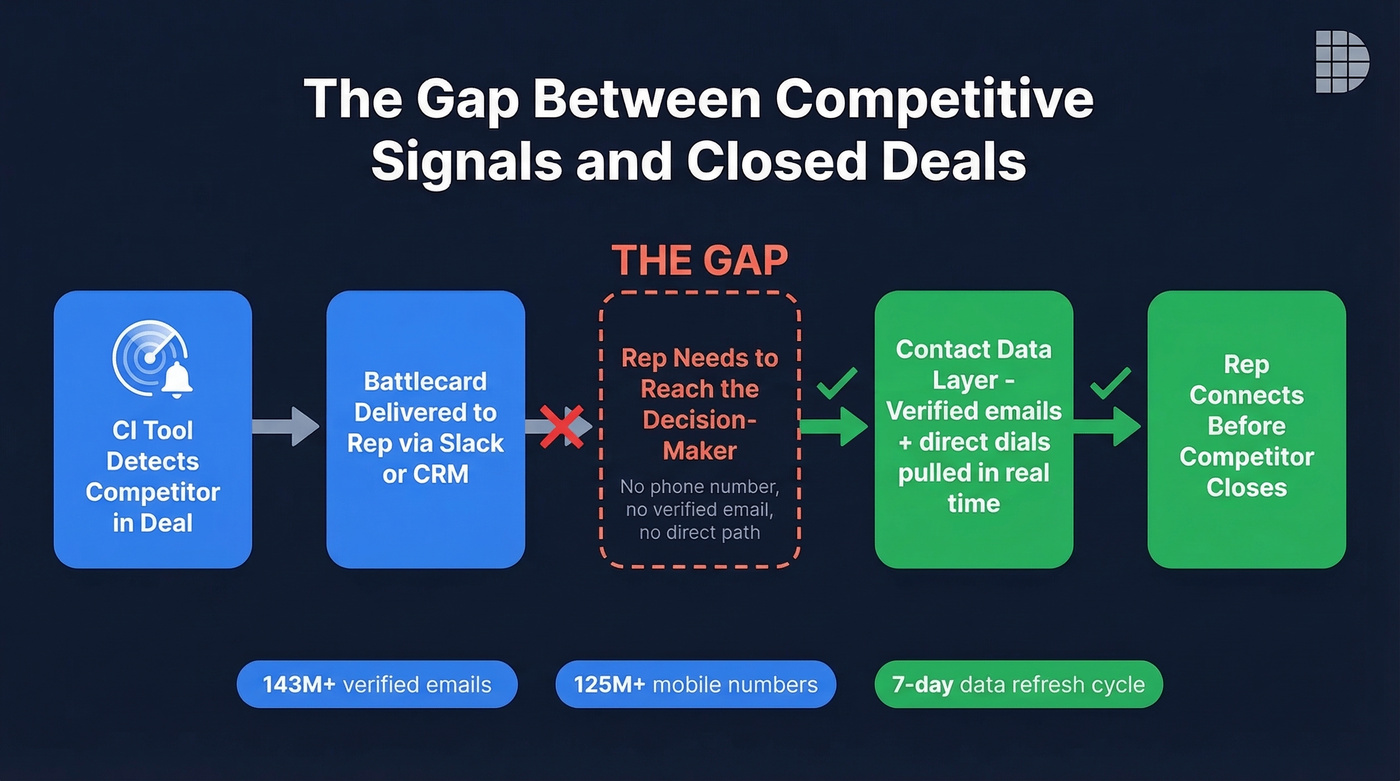
Deal Intelligence's own users flagged this - the platform surfaces email contacts but no phone numbers. Crayon and Klue don't provide contact data at all. You get the alert, and then you're on your own.
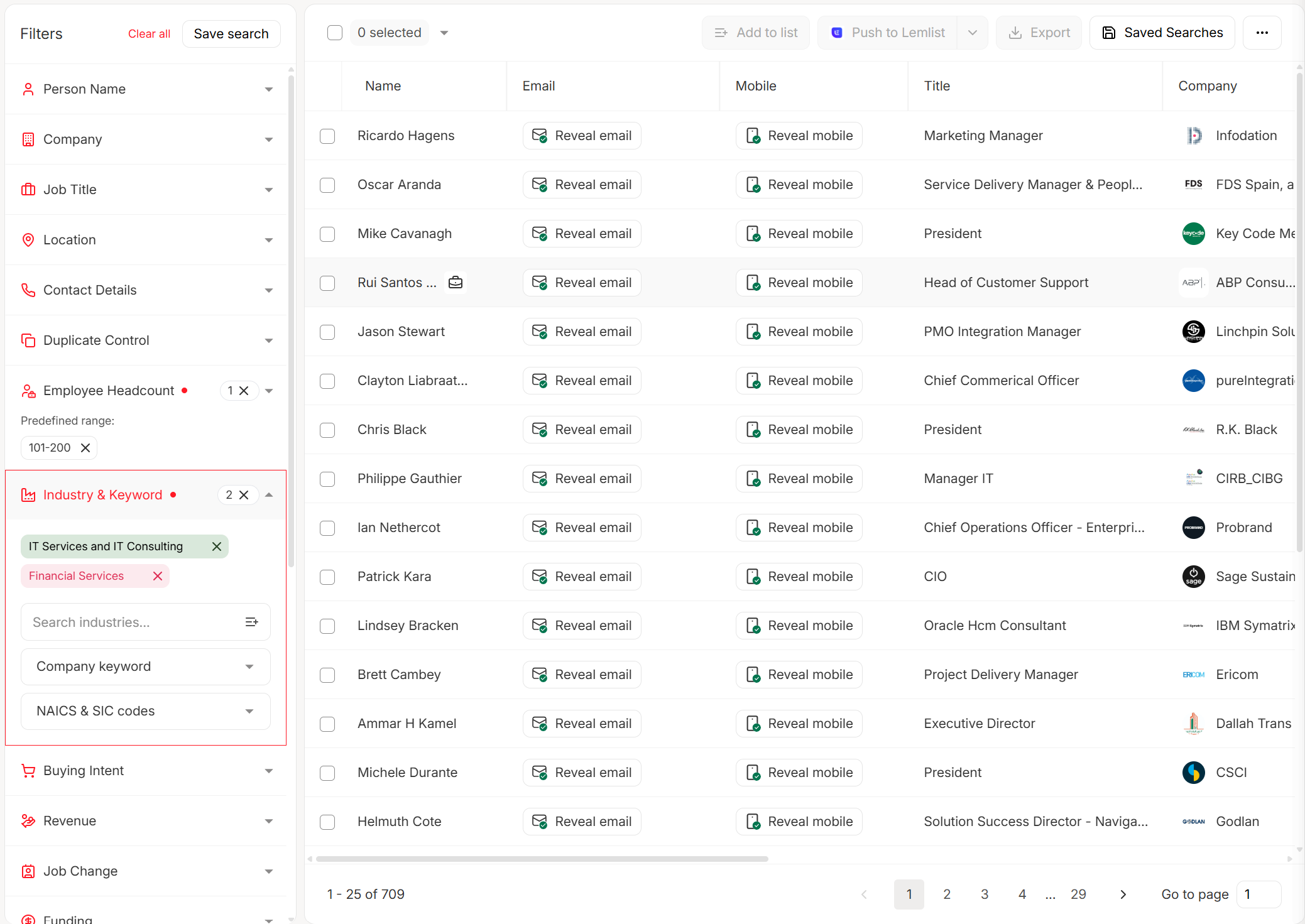
Prospeo closes that gap. With 143M+ verified emails at 98% accuracy and 125M+ verified mobile numbers with a 30% pickup rate, it's the contact data layer that makes CI signals actionable. Data refreshes every 7 days - not the 6-week industry average - so when your CI tool flags a competitive threat on Monday, the contact data you pull on Tuesday is current. The free tier gives you 75 verified emails per month plus 100 Chrome extension credits, paid plans run ~$0.01 per email, and there's no contract or sales call required.
If you want to go deeper on the data layer, start with data enrichment and how it fits into lead enrichment workflows.
Every CI tool on this list tells you who's evaluating competitors. None of them give you the verified email and direct dial to call that buyer before the deal slips. Prospeo's data refreshes every 7 days - not 6 weeks - so you're reaching the right person at the right number, not a recycled contact from last quarter.
Win competitive deals by being the first team to actually connect. Start at $0.01/email.
If You Meant "Deal Intelligence" (the Category)
Some people searching "deal intelligence" want revenue intelligence or pipeline analytics - a different stack entirely. Gartner published its first Magic Quadrant for Revenue Action Orchestration in December 2025, signaling that conversation intelligence, sales engagement, and revenue intelligence are converging. 75% of top-performing companies now integrate revenue intelligence into core processes, but that's a separate investment from competitive intelligence.
The two heavyweights are Gong (~$250/user/month) and Clari ($75-400/user/month depending on modules). Stacking both for a 100-person sales org runs $480K-$600K annually. These tools analyze pipeline metrics, CRM records, and conversation transcripts to explain why deals win or lose - a fundamentally different problem than detecting competitive threats early.
If you're evaluating that stack, it helps to understand pipeline health and how teams operationalize sales forecasting solutions.
How to Choose the Right Alternative
Let's be honest: I've watched teams spend six months evaluating CI platforms, only to pick the one with the best demo and worst adoption. Four criteria matter more than everything else:
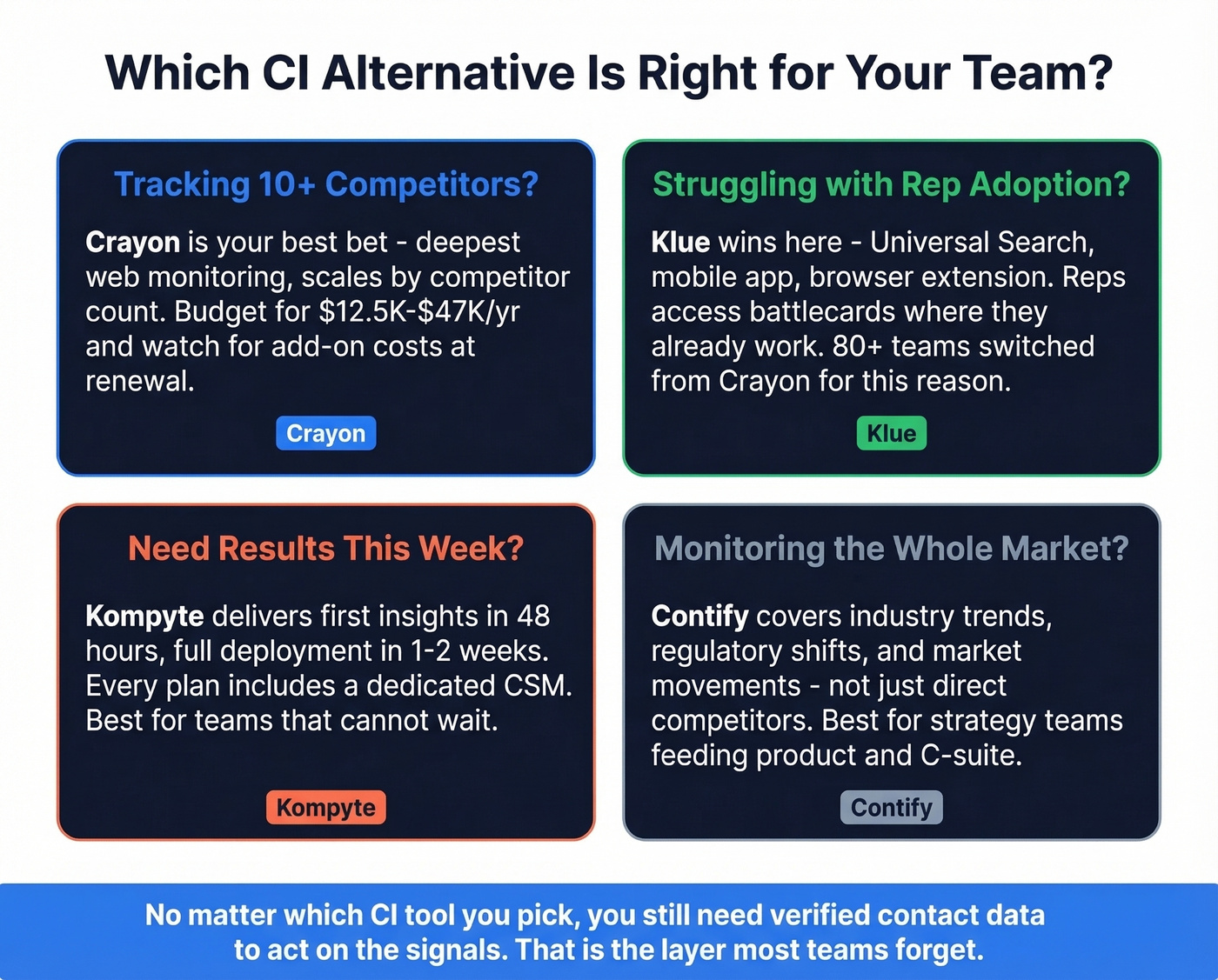
How many competitors you track. This determines whether Crayon's per-competitor pricing or Klue's per-user model is cheaper for you. Kompyte's tiered packaging gives you a clear ceiling at 10, 20, or unlimited companies.
Team adoption. If reps won't use the tool, the intelligence is worthless. Run a 30-day pilot and measure logins, not just data quality. (If you need a broader enablement plan, map it to a 30-60-90 day plan for sales reps.)
Speed to value. Kompyte's 48-hour first insights vs. multi-week rollouts is a real difference, especially mid-quarter when you need competitive intel now.
Verified contact data. CI signals without verified contact info create a dead end. Make sure your stack includes a data layer with accurate emails and direct dials - the last mile between detecting a competitive threat and doing something about it. For execution, pair it with sales prospecting techniques and tight sales follow-up templates.
FAQ
What are the best deal intelligence alternatives in 2026?
Klue (best adoption), Crayon (broadest competitor tracking at ~$28,750/yr median), Kompyte (fastest deployment at 48 hours to first insights), and Contify (best for market-level intelligence) are the top four. Choose based on whether your priority is rep adoption, monitoring breadth, speed, or strategic market context.
Is Crayon or Klue better for competitive intelligence?
Klue wins on adoption and distribution with its mobile app, browser extension, and Universal Search. Crayon is stronger for teams tracking many competitors across a broad data surface. Klue scales pricing by users; Crayon scales by competitors tracked. If your headcount is growing faster than your competitive set, Crayon is cheaper - and vice versa.
How do you get contact data from competitive intelligence alerts?
Most CI platforms surface competitive signals but don't provide verified contact info for the people involved. Pair your CI tool with a B2B data platform like Prospeo - 143M+ verified emails at 98% accuracy plus 125M+ direct dials - to act on alerts immediately. The free tier covers 75 emails per month, enough to test the workflow before committing.