

DealSignal vs Apollo.io: Which B2B Data Tool Is Worth Your Budget?
DealSignal and Apollo.io get lumped together in every sales intelligence roundup, but comparing them 1:1 is like comparing a scalpel to a Swiss Army knife. DealSignal is a data platform - its entire job is delivering verified contacts. Apollo is an engagement platform with a database bolted on. That distinction matters because B2B contact records decay at roughly 30% per year, and the tool you pick determines whether you're fighting that decay or feeding it straight into your sequences.
30-Second Verdict
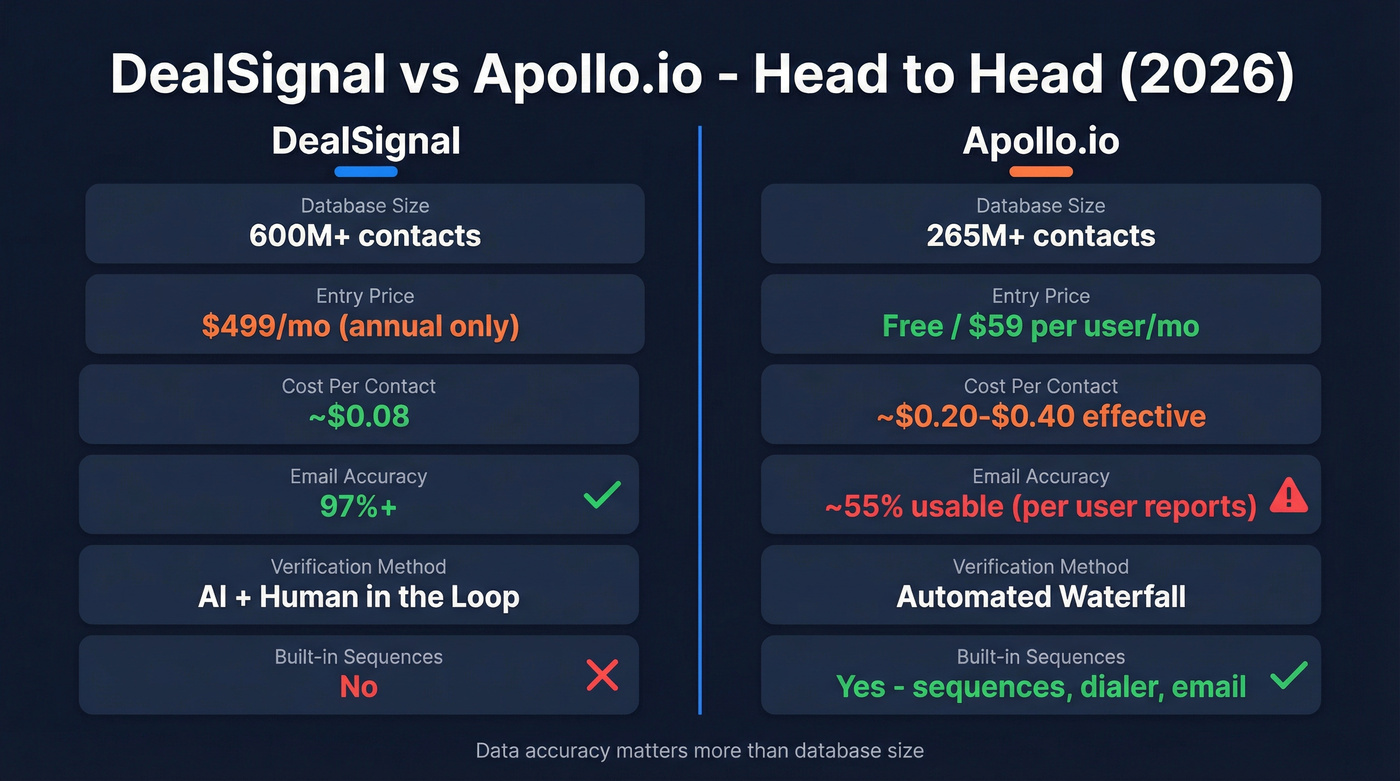
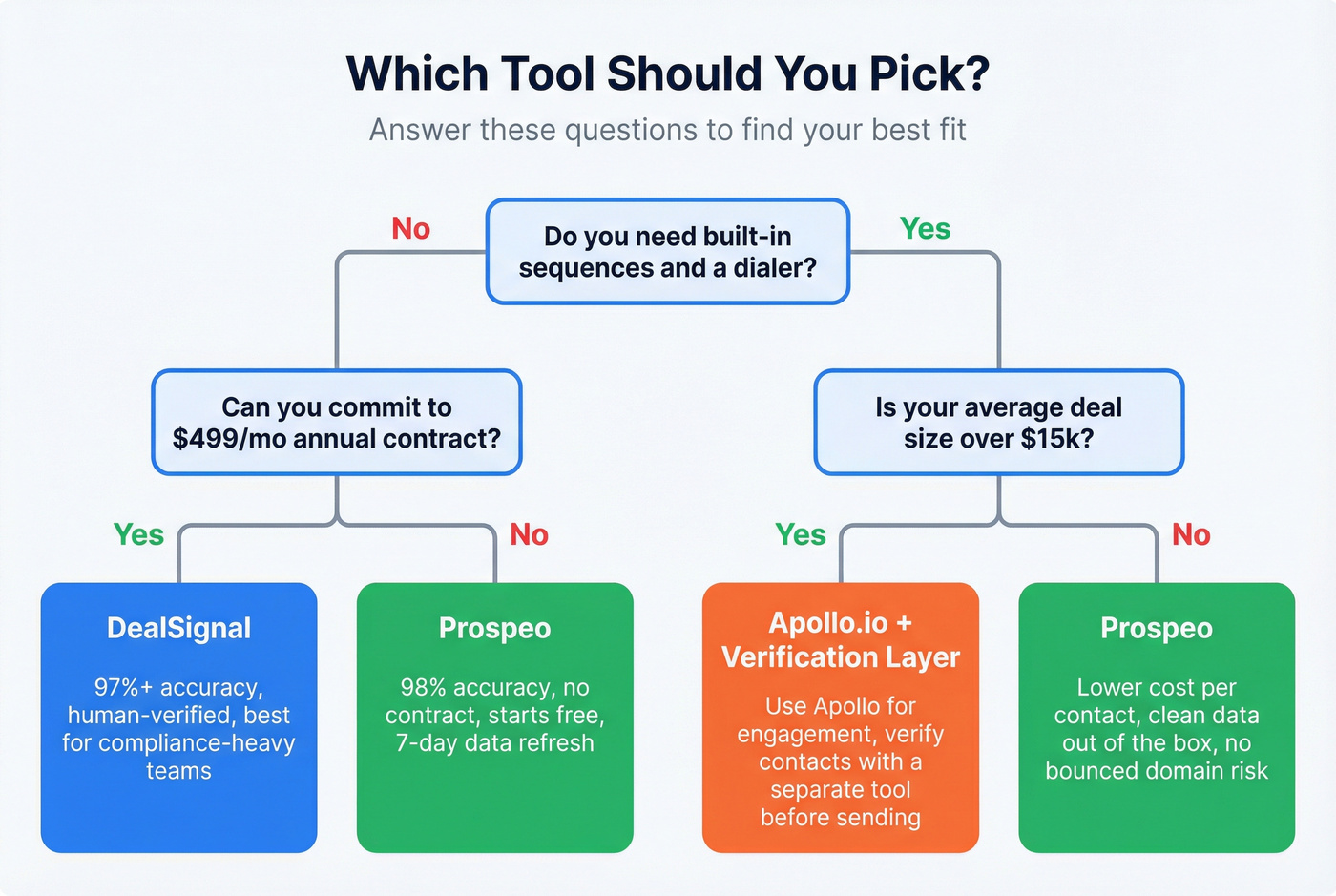
Pick DealSignal if you need human-verified data and will pay a premium for accuracy - roughly $0.08/contact, with a $499/mo minimum on an annual contract.
Pick Apollo if you want sequences, a dialer, and a database in one platform and can tolerate data quality tradeoffs. Budget roughly $0.20-$0.40 per usable contact after credits and bounces.
Skip both if you want 98% verified emails without an annual contract or a $499/mo floor.
Side-by-Side Comparison
| DealSignal | Apollo.io | |
|---|---|---|
| Database size | 600M+ companies and contacts | 265M+ contacts |
| Entry price | $499/mo (annual) | Free / $59 per user/month (Basic) |
| Credits included | 6,000 | Varies by tier |
| Cost per contact | ~$0.08 | ~$0.20-$0.40 effective |
| Email accuracy | 97%+ | Varies; bounce complaints common on exports |
| Verification | AI + human-in-the-loop | Automated + third-party waterfall |
| Data refresh | Rechecked before delivery | Freshness varies by record |
| Intent data | Bombora (via intent module) | Available via integrations (tier-dependent) |
| Engagement tools | No | Yes (sequences, dialer, email tracking) |
| CRM integrations | Salesforce, HubSpot | Salesforce, HubSpot |
| GDPR filtering | Yes | Compliance features (workflow-dependent) |
| Free tier | No | Yes |
| Contract | Annual required | Monthly available; annual discounts common |
Both tools can be paired with intent data, but Bombora is company-level intent only. You still need accurate contact data to activate those signals - and that's where the real difference shows up.
Data Quality - What "Verified" Actually Means
DealSignal's verification combines AI/ML and human analysis, then rechecks your data before delivery. The result: a 4.8/5 G2 rating with 95% five-star reviews across 47 reviewers. One reviewer noted "updates are not instantaneous... cannot expect immediate turnaround times." You're trading speed for precision. DealSignal also lets you filter out contacts in GDPR-governed regions, which matters for compliance-sensitive campaigns.
If you're building a broader outbound stack, it helps to understand how data enrichment and verification fit together.
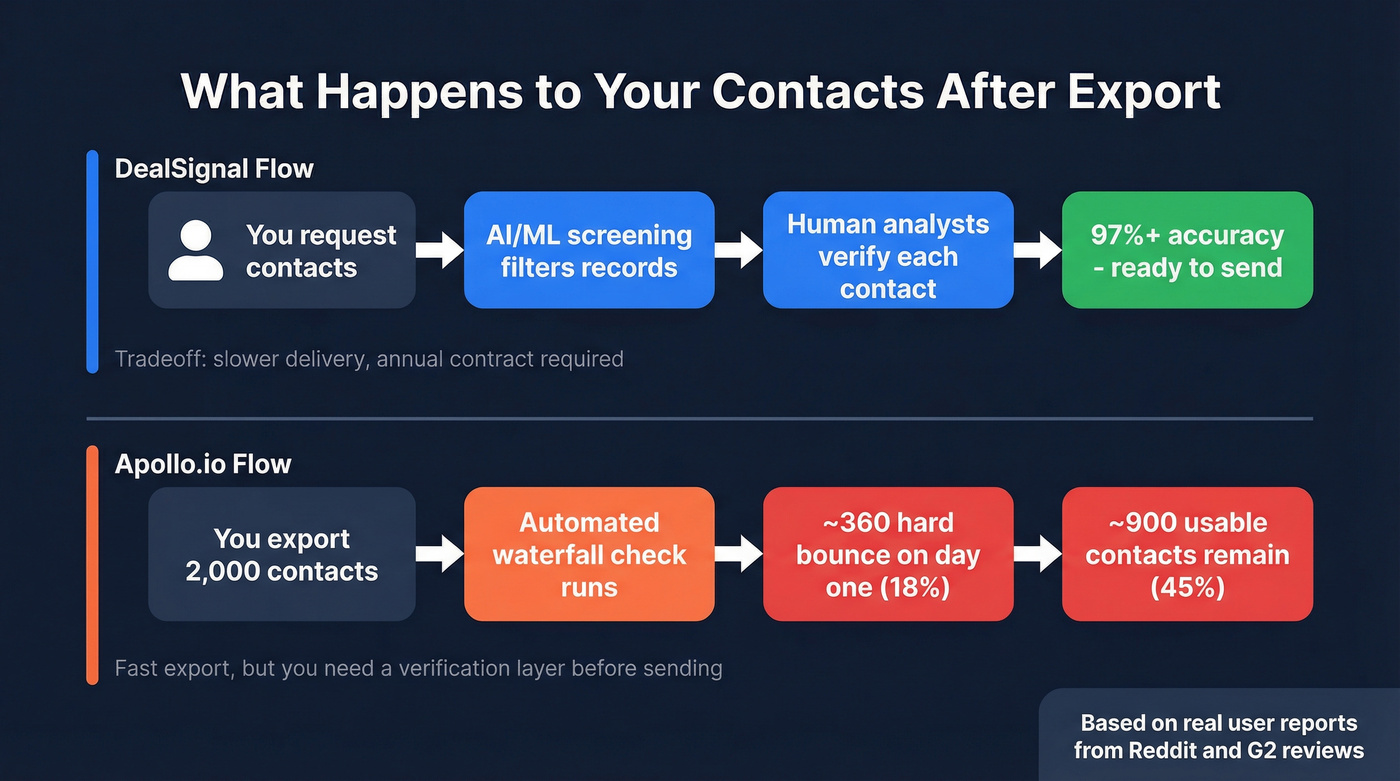
Apollo's "verified" label tells a different story in the wild. A practitioner breakdown on r/coldemail described ~18% hard bounces on day one of a fresh export, plus a wave of "left the company months ago" replies. Out of 2,000 contacts, roughly 900 were usable. That's a 55% waste rate.
If you're doing cold email marketing at any volume, bounce rates like that become a deliverability problem, not just a data problem.
Another Reddit thread flagged that Apollo's "verified" contacts frequently include stale emails and role-based addresses like info@ - which technically don't bounce but never reach a human. Here's the thing: Apollo's database is massive and genuinely useful for discovery. But if you're running cold email at scale, you need a verification layer on top of it. Treating Apollo exports as send-ready is how domains get burned.
For a deeper breakdown of what to monitor, see email bounce rate and email deliverability.

Apollo users report 18% hard bounces. DealSignal charges $499/mo minimum. Prospeo delivers 98% verified email accuracy from 300M+ profiles at ~$0.01/email - with a 7-day data refresh cycle that keeps contacts current.
Stop choosing between accuracy and affordability - get both.
Pricing - The Real Cost Per Contact
DealSignal's Starter plan runs $499/mo billed annually with 6,000 credits. At one credit per contact, that's ~$0.08/contact. Professional and Enterprise tiers are custom-priced with 12K-500K+ credits. No free tier and no monthly billing - frustrating if you want to test before committing a full year.
If you're comparing vendors across the category, this sales prospecting database roundup can help frame pricing vs accuracy.
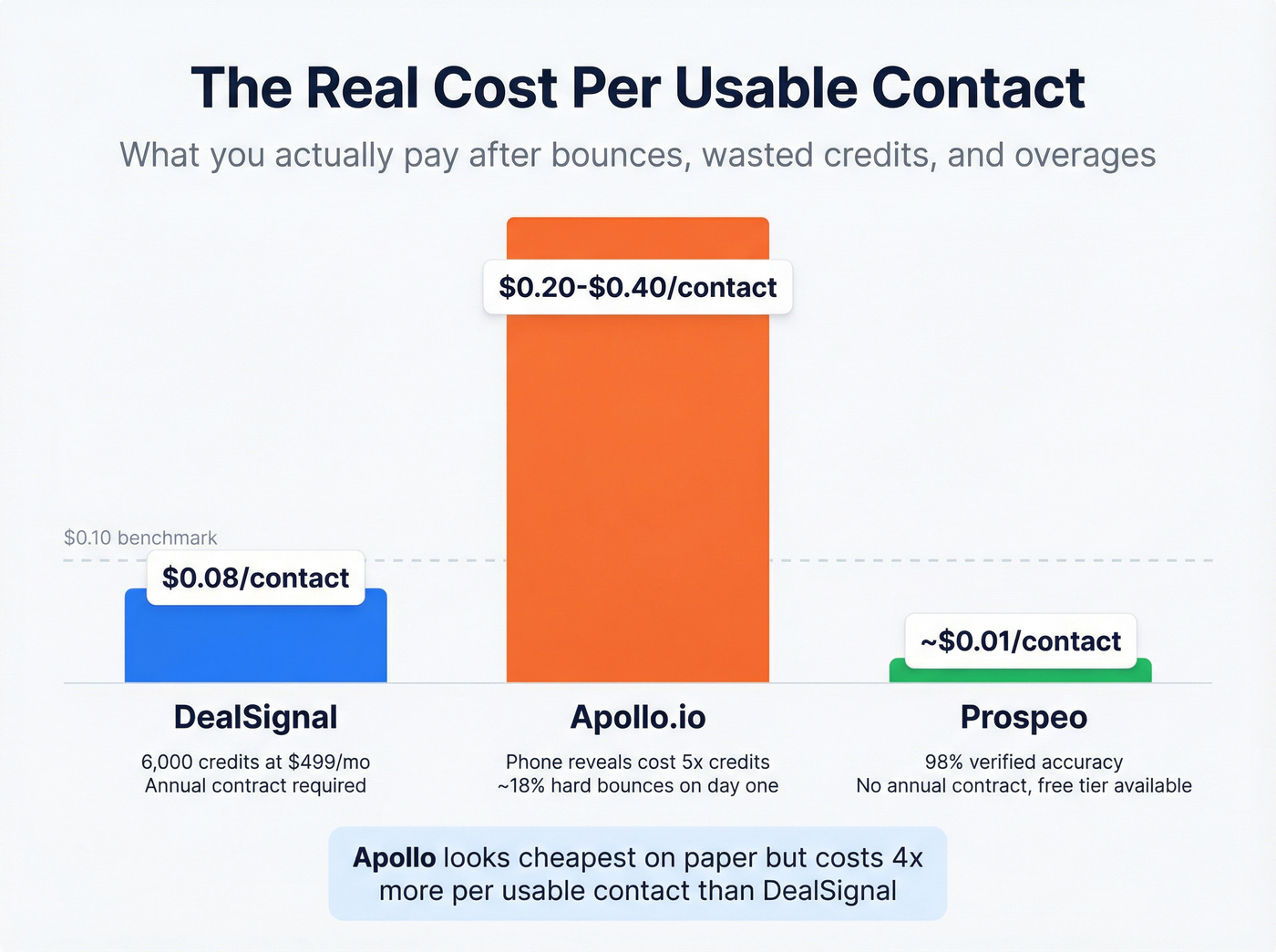
Apollo looks cheaper on paper. Basic is $59 per user/month and Professional is $99 per user/month, with Enterprise custom-priced. But the real budget story is credits: phone reveals can cost 5x a standard credit, and enrichment can consume up to 6 credits per contact. We've seen teams burn through their monthly allotment in two weeks, then sit idle or pay overages. In practice, the effective cost per usable contact - factoring in bounces and credit consumption - often lands at $0.20-$0.40.
If your average deal size is under $15k, Apollo's "free" tier is probably costing you more in bounced domains and wasted rep time than a paid tool with clean data.
Who Should Pick Which
DealSignal Is Best For...
Small teams that need premium accuracy and can commit to $499/mo. DealSignal's G2 reviewer base skews European (32 of 47 reviewers) and small business (37 of 47) - that's where it finds its best fit. If you need CRM hygiene workflows with reverified contacts, the "verified before delivery" model is genuinely differentiated. The annual contract is the main friction point, and for teams doing fewer than 2,000 lookups a month, you're paying for credits you won't use.
If you're operationalizing this, a simple lead generation workflow keeps enrichment, verification, and routing from breaking.
Apollo Is Best For...
Teams that want engagement and data in one platform without stitching together three tools. Apollo's built-in sequences, dialer, and email tracking make it the obvious starting point for teams that need to move fast on a budget. Just layer in verification before you hit send.
If you're evaluating the broader category, this guide on implementing a sales engagement platform is a useful checklist.
Skip Apollo for local SMB prospecting. The consensus on Reddit is clear: users consistently report getting generic inboxes and front desk numbers instead of owner contacts for contractors and trades.
When Neither Fits
Let's be honest - neither side of the DealSignal vs Apollo.io debate addresses teams that want clean data, no annual lock-in, and a low entry price. Prospeo fills that gap with 98% verified email accuracy from 300M+ professional profiles and a 7-day data refresh cycle. Plans start at ~$0.01/email with a free tier of 75 verified emails per month - no contracts, no minimum seats, GDPR compliant out of the box. In our testing, teams using Prospeo book 35% more meetings compared to Apollo, backed by a 5-step verification process that includes catch-all handling, spam-trap removal, and honeypot filtering.
If you're still shopping, these free lead generation tools can help you test without committing budget.

DealSignal's annual lock-in and Apollo's bounce rate roulette both cost you pipeline. Prospeo's 5-step verification - including catch-all handling, spam-trap removal, and honeypot filtering - is why teams book 35% more meetings vs Apollo.
Clean data, no contracts, free tier included. The debate is over.
FAQ
Is Apollo's data really that inaccurate?
Users consistently report 15-20% hard bounce rates on fresh Apollo exports, with additional stale records that technically deliver but never reach a decision-maker. The sequences and dialer are strong - just don't treat exports as send-ready without running them through a dedicated verification tool first.
Can I use DealSignal and Apollo together?
Yes, and some teams do exactly this - running Apollo for sequences and dialing, then feeding in contacts verified elsewhere. This "best of both" approach works but doubles your tool spend. Budget accordingly and make sure the accuracy gains justify the extra line item.
What's the best free alternative to both tools?
Prospeo offers 75 free verified emails and 100 Chrome extension credits per month - no credit card, no contract. At 98% email accuracy with a 7-day refresh cycle, it outperforms Apollo's free tier on data quality while costing nothing to start.