

What Is a Demand Generation Specialist? The Complete Guide for 2026
Every demand gen job description reads like it was written by someone who's never done demand gen. "Drive pipeline through multi-channel campaigns" tells you nothing about whether you'll spend Tuesday morning troubleshooting UTM parameters or project-managing a direct mailer. Let's fix that.
The Quick Version
A demand generation specialist plans and executes marketing programs that fill the top and middle of the sales funnel with qualified prospects. Average salary: $70,615 base (PayScale) to $91K total comp (Glassdoor). The three skills that get you hired: marketing automation (HubSpot or Marketo), paid media (Google Ads + Meta), and analytics (GA4 + dashboard building).
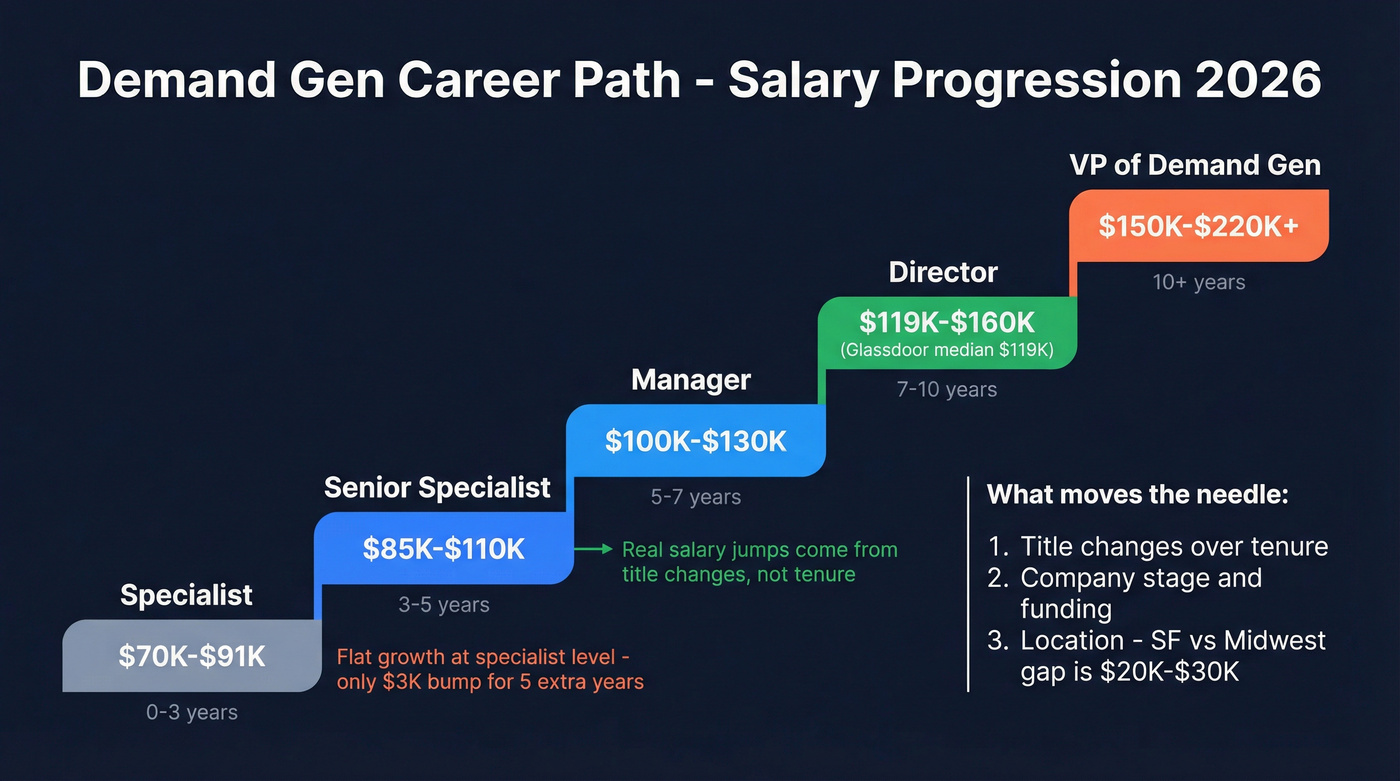
The career path typically runs from specialist ($70-91K) through manager and director roles, where the broader "Demand Generation" title hits a $119K median on Glassdoor. You'll usually report to a Director or VP of Marketing and own everything from campaign execution to MQL reporting.
What Does This Role Actually Involve?
A demand generation specialist is the person who makes sure the right prospects know your product exists, engage with your content, and eventually raise their hand for sales. It's not brand marketing - that's awareness without a conversion goal. And it's not sales - that's closing deals someone else sourced. Demand gen sits in the gap, building the engine that turns strangers into pipeline.
In most orgs, the specialist reports to a Director or VP of Marketing and owns the execution layer. You're not setting the quarterly strategy (that's your boss), but you're the one building the campaigns, QA-ing the tracking, pulling the reports, and flagging when something's broken.
MarketOne frames the hiring decision around your company's primary bottleneck - lead quantity, lead quality, conversion, or reporting/analytics. This matters because it shapes your entire day-to-day. Hired to fix lead quantity? Your week is heavy on paid media and content distribution. Hired to fix conversion? You're deep in nurture sequences and lead scoring. Ask in the interview which bottleneck you're solving. The answer tells you more about the job than the description ever will.
The role is inherently cross-functional. You'll work with content teams on assets, sales on lead handoff, and marketing ops on CRM workflows. If you don't like context-switching, this isn't your job.
Demand Gen vs. Growth vs. Performance Marketing
These titles get used interchangeably on job boards, which creates real confusion. Here's how they actually differ:
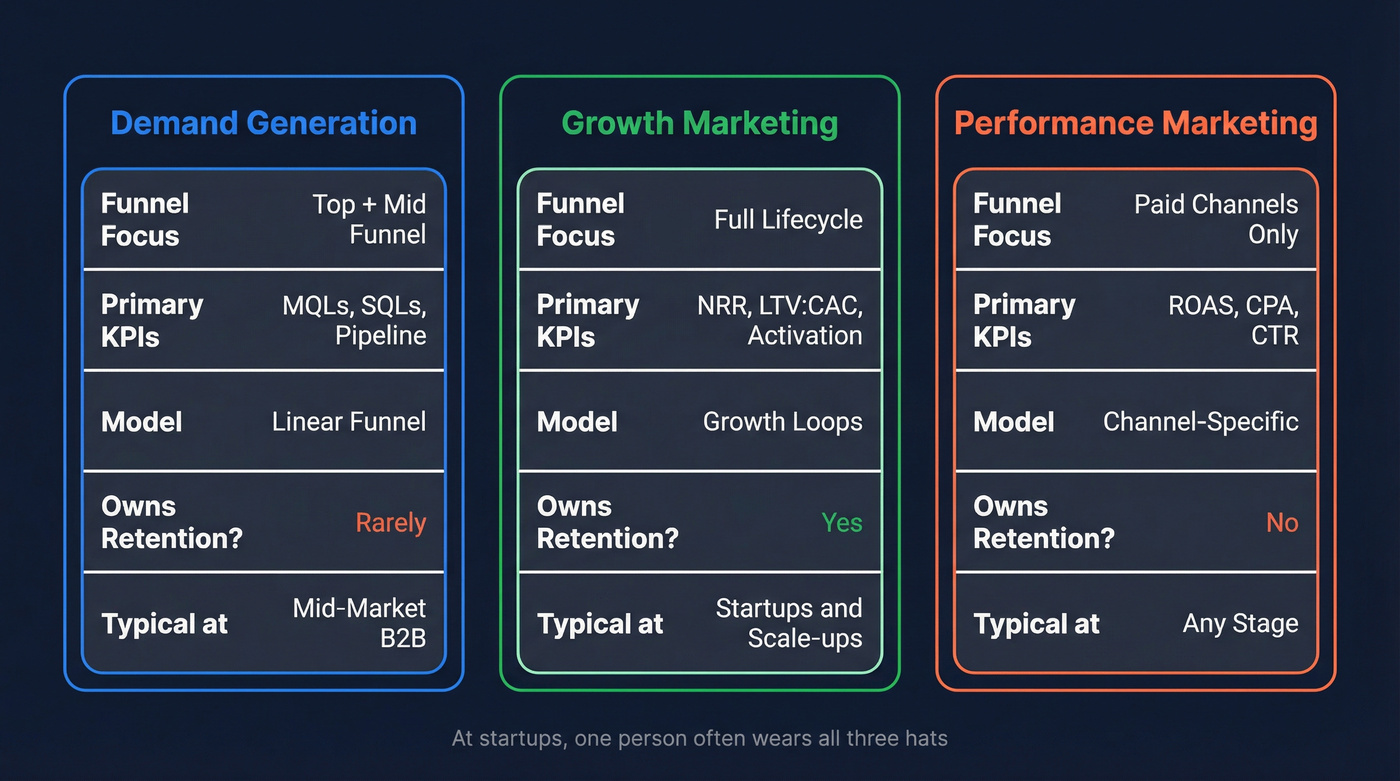
| Demand Gen | Growth Marketing | Performance Marketing | |
|---|---|---|---|
| Funnel focus | Top + mid | Full lifecycle | Paid channels |
| Primary KPIs | MQLs, SQLs, pipeline | NRR, LTV:CAC, activation | ROAS, CPA, CTR |
| Model | Linear funnel | Growth loop | Channel-specific |
| Owns retention? | Rarely | Yes | No |
The practical distinction: a demand gen specialist builds pipeline. A growth marketer optimizes the entire customer lifecycle including retention and expansion. A performance marketer runs paid channels and optimizes spend efficiency. Overlap is huge at startups where one person wears all three hats.
Watch for title drift. We've seen "Demand Generation Specialist" postings that were actually Growth Operations roles - supporting go-to-market systems, CRM data integrity, and pipeline forecasting. If the job description mentions "sequencing inbound leads" and "CRM data hygiene" more than "campaign execution," you're looking at a RevOps Manager role with a demand gen label.
A Real Week in the Life
Here's what your week actually looks like at a mid-market B2B SaaS company.
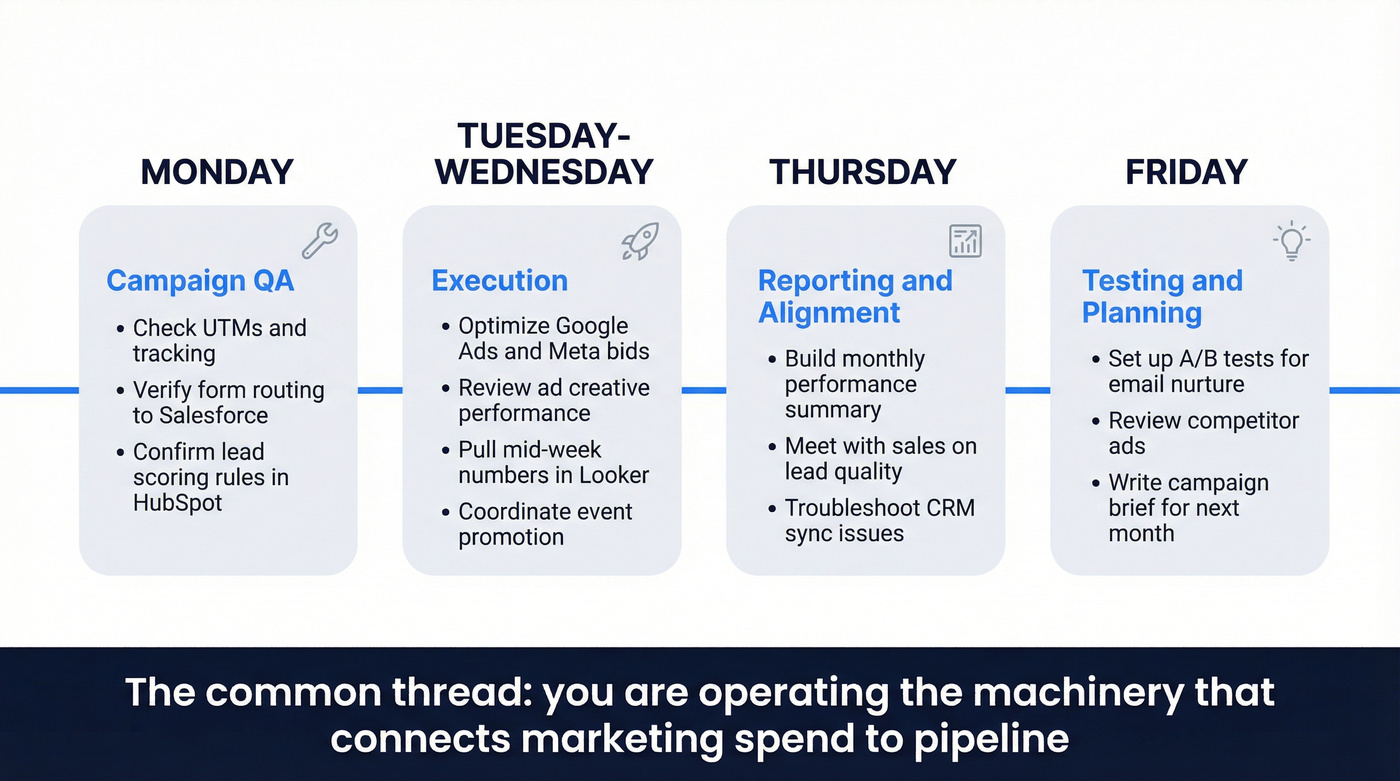
Monday starts with campaign QA. You're launching a new Google Ads campaign targeting IT directors, so you're checking UTMs, verifying that landing page forms route correctly to Salesforce, and confirming lead scoring rules fire in HubSpot. This is the unglamorous work that real job posts emphasize - Branch's demand gen listing specifically calls out "routing, UTMs, and landing experiences firing cleanly" as core responsibilities.
Tuesday and Wednesday are execution days. You're optimizing bids across Google Ads and Meta, reviewing ad creative performance, and pulling mid-week numbers in Looker. At some companies you'll also be project-managing a direct mailer or coordinating event promotion for an upcoming trade show - demand gen isn't purely digital.
Thursday is reporting and cross-functional alignment. You're building a monthly performance summary, meeting with sales to review lead quality feedback, and troubleshooting a CRM anomaly where webinar leads aren't syncing properly. These are the hours that separate a good specialist from a great one, because catching sync issues before they snowball saves weeks of cleanup later.
Friday is testing and planning - A/B tests for next week's email nurture, competitor ad reviews, and the campaign brief for next month's product launch. You maintain a running log of launches, changes, and learnings that keeps campaigns from repeating mistakes.
The common thread: you're not just "running campaigns." You're operating the machinery that connects marketing spend to pipeline. When something breaks - a form doesn't fire, a UTM is wrong, leads aren't routing - you're the one who notices and fixes it.
Core Skills for 2026
Hard Skills (Non-Negotiable)
Marketing automation platform proficiency. HubSpot for mid-market, Marketo for enterprise. We've seen hiring managers reject otherwise strong candidates because they couldn't demonstrate hands-on MAP experience. If you're applying to mid-market roles, HubSpot fluency is table stakes.
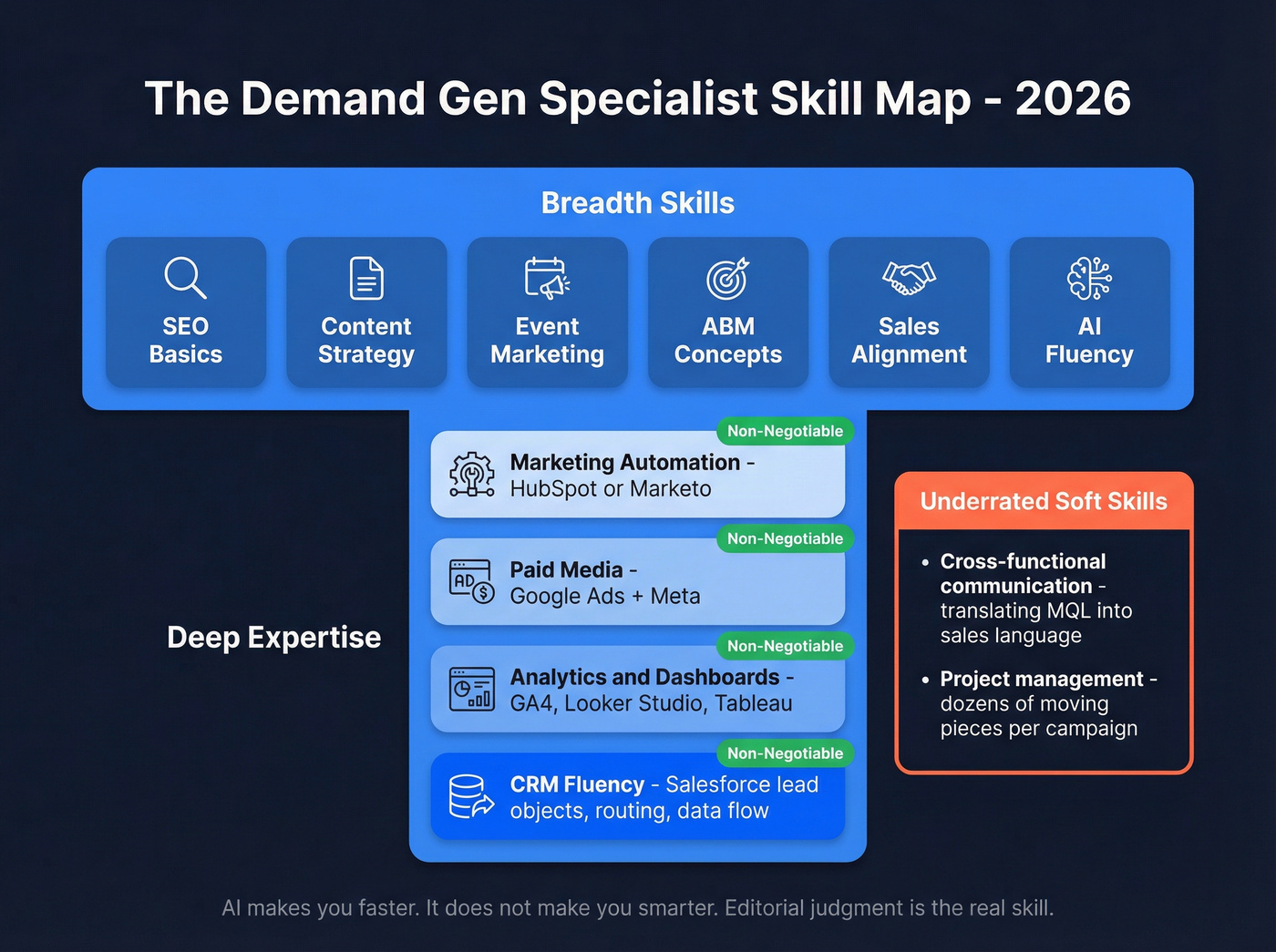
Paid media management. Google Ads and Meta at minimum. You need to build campaigns, manage budgets, and optimize toward pipeline metrics - not just clicks.
Analytics and dashboard building. GA4 for web analytics, Looker Studio or Tableau for reporting. The specialist who builds self-serve dashboards that the VP can check without asking for a report is worth significantly more than one who manually pulls numbers every Friday.
CRM fluency. Salesforce is the standard. You don't need to be an admin, but you need to understand lead objects, routing rules, and how marketing data flows into sales workflows.
Soft Skills (Underrated)
Cross-functional communication will consume more of your time than you expect. The ability to translate "marketing qualified lead" into language a sales rep cares about is a career accelerator. Pair that with strong project management - demand gen campaigns have dozens of moving pieces, and if you can't manage a timeline, campaigns slip.
The AI Fluency Question
The "new T-shaped marketer" concept explains what's happening - AI has expanded the breadth axis of what one person can execute. You iterate faster, test more ideas, and build more assets without waiting on other teams. But the skill that matters isn't prompt engineering. It's editorial judgment - knowing which AI output is good enough to ship and which is slop that'll damage your brand. AI makes you faster. It doesn't make you smarter.

You're building campaigns, QA-ing UTMs, and routing leads to sales - the last thing you need is bad data killing your pipeline. Prospeo gives demand gen specialists 300M+ profiles with 98% email accuracy and 30+ filters (intent, technographics, job change) so every campaign hits real buyers.
Stop feeding your funnel with garbage data. Start at $0.01 per email.
Tools and Tech Stack
Your stack depends on company stage and budget:
| Category | Tools | Typical Cost |
|---|---|---|
| Marketing Automation | HubSpot, Marketo | $20/mo starter - $3K+/mo |
| CRM | Salesforce, HubSpot CRM | Free - $25+/user/mo |
| Analytics/BI | GA4, Looker Studio, Tableau | Free - $70/user/mo |
| Prospecting/Data | Prospeo, ZoomInfo | Free tier - $40K+/yr |
| Ad Platforms | Google Ads, Meta Ads | B2B CPCs $2-$15 |
| ABM/Intent | 6sense, Demandbase | $30K-$100K+/yr |
| SEO/Content | Semrush, Ahrefs | $100-$450/mo |
| Sales Engagement | Outreach, Lemlist, Instantly | $30-$100/user/mo |
| Event/Webinar | Cvent, Sequel.io | $5K-$50K+/yr |
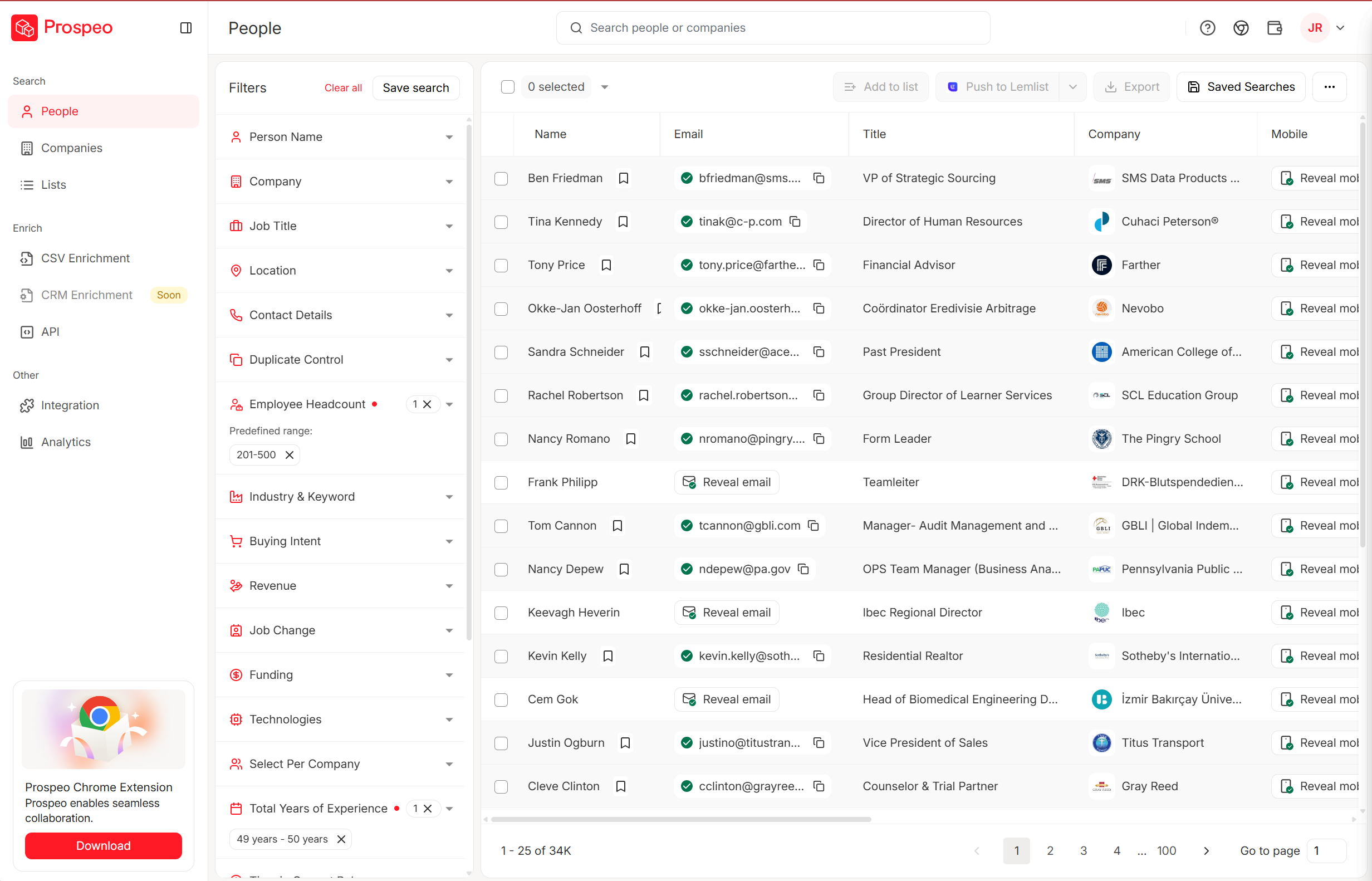
If you're at a startup with limited budget, here's the stack that gets you moving: HubSpot free CRM + Marketing Starter, Google Ads for paid acquisition, Prospeo for building verified prospect lists, and Looker Studio for reporting. That's a functional demand gen engine for under $200/month before ad spend, with self-serve tools and no annual contracts.
Here's the thing: if your average deal size is under $10K, you almost certainly don't need a $40K/year data platform. Start with self-serve tools, prove the channel economics, then upgrade when the ROI justifies it.
Salary - What You'll Actually Earn
Three data sources paint a consistent picture for 2026:
| Source | Metric | Amount | Sample |
|---|---|---|---|
| PayScale | Avg base | $70,615 | 93 profiles |
| Glassdoor | Median total | $91,000 | 221 salaries |
| SureCost (job post) | Posted range | $75K-$90K | Single listing |
The gap between PayScale and Glassdoor comes down to what's measured. PayScale reports base salary. Glassdoor includes additional pay, which adds $14K-$26K on top of a $56K-$94K base range.
Experience progression is surprisingly flat at the specialist level. PayScale shows early-career (1-4 years) total comp at $67,781 and mid-career (5-9 years) at $70,517. That's a $3K bump for five extra years. The real salary jump comes from title changes, not tenure - which is why the career path section below matters more than grinding years in the same seat.
Location and company stage matter more than experience bands. A demand gen specialist at a well-funded Series B in San Francisco will out-earn a mid-career specialist at a bootstrapped company in the Midwest by $20K-$30K.
KPIs You'll Own
A demand generation specialist lives and dies by these metrics:
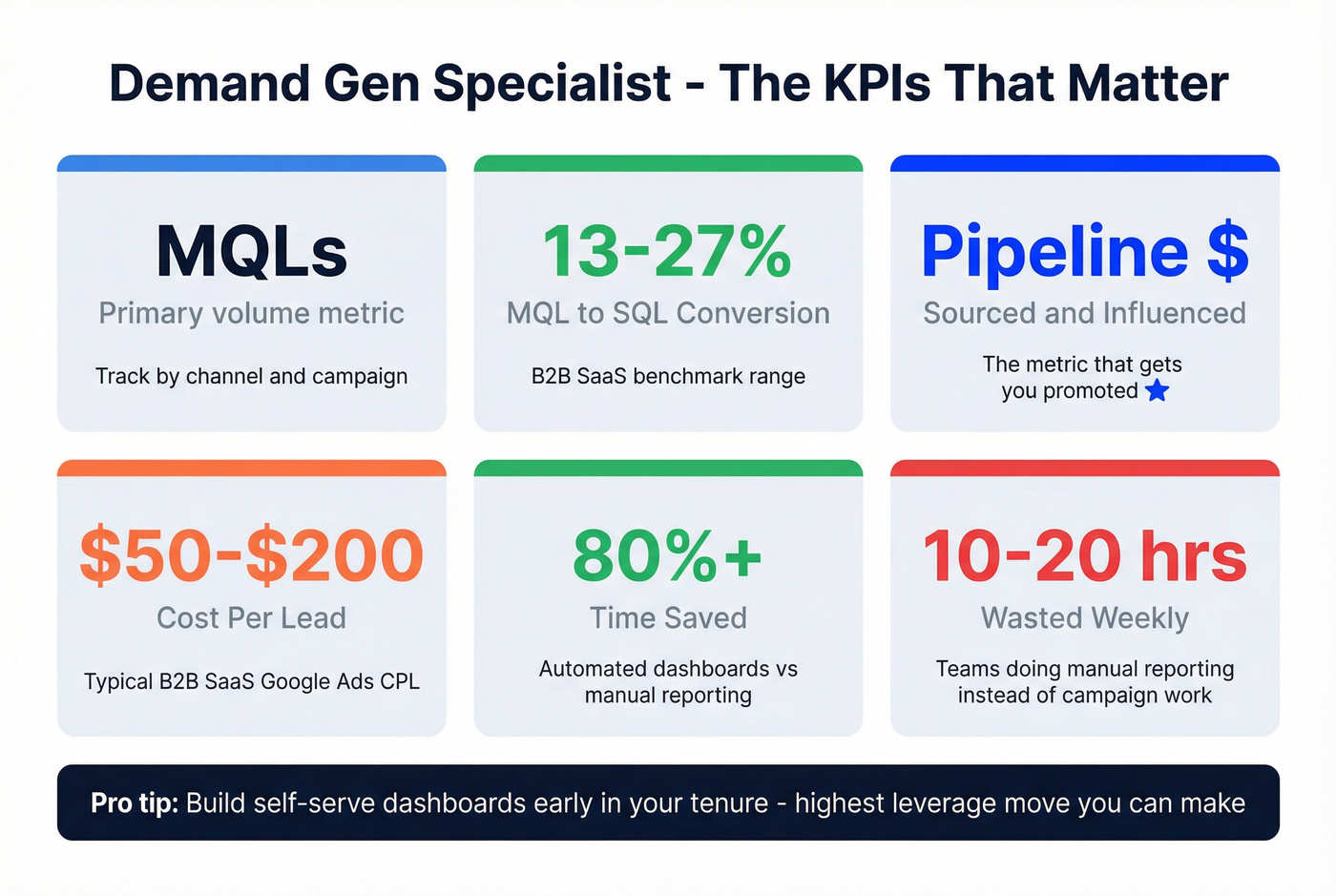
MQLs generated - your primary volume metric. Track by channel and campaign.
MQL-to-SQL conversion rate - B2B SaaS benchmarks typically fall in the 13-27% range. Below that, your lead quality needs work. Above that, you might be under-investing in top-of-funnel.
Pipeline sourced and influenced - the dollar value of opportunities your campaigns created or touched. This is the metric that gets you promoted.
Beyond those three, you'll track cost per lead by channel (Google Ads CPL for B2B SaaS typically runs $50-$200), customer acquisition cost inputs, and email deliverability rate. If deliverability is slipping, your list hygiene and sending practices need attention.
On reporting: teams often spend 10-20 hours per week on manual reporting. Automated dashboards cut that by 80%+. In our experience, building self-serve dashboards early in your tenure is one of the highest-leverage moves you can make - it frees your time for actual campaign work and makes you indispensable to leadership.
Mistakes That Get You Fired
Sending to unverified lists. This is the #1 operational risk. One campaign to a dirty list - full of invalid addresses, spam traps, and honeypots - can tank your sender domain reputation for months. Recovering from a domain blacklist isn't a weekend project; it's a quarter-long remediation that kills every email campaign in the pipeline. The fix is simple: verify every email before it enters your automation platform. At $0.01 per verified email with tools like Prospeo, there's no excuse for skipping this step. (If you want a deeper playbook, start with an email deliverability guide.)

Ignoring mid-funnel nurture. Generating MQLs is the easy part. Converting them to SQLs requires nurture sequences that deliver relevant content based on intent signals, not just a drip of generic newsletters.
Treating all leads equally. A whitepaper download and a demo request are not the same signal. Without proper lead scoring, you'll flood sales with low-intent leads and erode trust in marketing-sourced pipeline. This is the fastest path to sales/marketing misalignment - and once that trust breaks, it takes quarters to rebuild.
No UTM discipline. If you can't attribute pipeline to specific campaigns and channels, you can't optimize spend. Sloppy UTMs mean budget conversations based on gut feel instead of data. I've watched teams lose six-figure budgets because they couldn't prove which channels were actually driving pipeline.
Focusing on volume over pipeline quality. Generating 5,000 MQLs that convert at 3% is worse than generating 1,000 that convert at 20%. The specialist who understands this gets promoted. The one who doesn't gets managed out.
How to Get Hired
Glassdoor's bank of 789 interview questions for demand gen roles reveals a dominant pattern: "Walk me through your most successful demand gen campaign - what was the goal, what did you do, and what were the results?" If you can't answer that with specific numbers, you won't get past the second round.
The Sloane Staffing seniority framework breaks down what hiring managers screen for at each level. For specialists, it's tool proficiency (HubSpot/Marketo), A/B testing methodology, and KPI prioritization. For managers, it shifts to scaling programs and cross-functional alignment with sales. Know which level you're interviewing for.
If you don't have a formal demand gen title yet, build a portfolio that proves you can do the work:
Start with a sample campaign brief. Pick a hypothetical product, define the ICP, choose channels, set a budget, and outline the measurement plan. This shows you think in systems, not just tactics. (Use an Ideal Customer Profile template if you need one.)
Build a Looker Studio dashboard with sample data showing MQLs, conversion rates, CPL by channel, and pipeline influenced. Walk through it in the interview like you built it for a real stakeholder.
Run a real A/B test - even on a personal project - and document the hypothesis, methodology, sample size, and outcome. Hiring managers care about the process, not the scale.
Let's be honest: most demand gen job descriptions are wishlists, not requirements. If you match 60-70% of the listed skills and can demonstrate structured thinking about campaign execution, you're a viable candidate. Skip the roles that require 5+ years for a specialist title - that's a company that doesn't know what level they're hiring for.
Career Path - Specialist to VP
The title ladder runs: Specialist -> Senior Specialist -> Manager -> Senior Manager -> Director -> VP of Demand Generation. The money follows the titles, not the years.
A demand generation specialist earns a $91K median total comp. The broader "Demand Generation" title - which often maps to manager or director level - hits $119K median with a range of $90K-$163K. That's a $28K jump for moving from execution to strategy ownership.
The specialist-to-manager transition is where the real money is. It's also where most people stall. The key shift: you stop being the person who builds campaigns and start being the person who decides which campaigns get built. That requires budget allocation, team management, forecasting, and the ability to defend your pipeline numbers to a CFO. Start building those muscles while you're still a specialist - volunteer to present campaign results to leadership, take ownership of a budget line item, mentor a junior hire - and the promotion conversation happens naturally. (If you want to level up the measurement side, study funnel metrics and pipeline health.)
Great demand gen means MQLs that sales actually wants to call. Prospeo's intent data tracks 15,000 topics so you target prospects already researching your category - not cold strangers. Layer buyer intent with job role, headcount growth, and funding signals in one search.
Turn your campaign targeting from spray-and-pray into pipeline-on-demand.
FAQ
Is demand generation the same as lead generation?
No - lead gen is a subset of demand gen. Demand generation builds awareness and interest across the full top and mid funnel through content marketing, paid media, events, and webinars. Lead generation specifically captures contact information. A demand gen specialist runs the broader strategy; lead capture is one tactic within it.
What tools should I learn first?
HubSpot (or Marketo for enterprise), Google Ads, and GA4. These three cover marketing automation, paid acquisition, and analytics - the core skills hiring managers screen for. Add a prospecting tool for building verified target lists, and you've got the foundation covered.
Can I break into demand gen without experience?
Yes. Start with HubSpot Academy certifications (free), run a small Google Ads campaign with a $500 budget, and build a sample reporting dashboard in Looker Studio. Walk into interviews with a portfolio showing real metrics, not just theory. Structured proof of competence beats years of vaguely related experience.
What's the salary jump from specialist to manager?
Specialists earn roughly $91K median total comp; managers and directors reach $119K median with a ceiling around $163K. That's a $20K-$30K increase that comes from owning strategy, budget allocation, and team management - not just accumulating years in the same execution role.
How long does it take to land this role?
Most specialists have 1-3 years of marketing experience before earning the title. If you're transitioning from content marketing, a coordinator role, or paid media, the move can happen in under a year with the right portfolio. Career changers from outside marketing typically need 6-12 months of focused learning and certification work. The r/demandgeneration subreddit has solid threads from people who've made the switch - worth browsing for real-world timelines.