

Direct Mail vs Email: Cost, ROI & When to Use Each in 2026
The direct mail vs email debate usually devolves into dueling response rates. That's the wrong frame. Email opens are inflated by Apple Mail Privacy Protection, and mail response rates aren't useful without cost context. The only metric worth arguing about is cost per outcome.
Quick Verdict
Need speed? Email. Launch in hours, A/B test by lunch.
Need attention from a high-value list? Direct mail. Physical pieces cut through inbox noise in ways pixels never will.
Need the highest conversion? Mail first, email follow-up. We've tested this sequence repeatedly, and the data below explains why it wins.
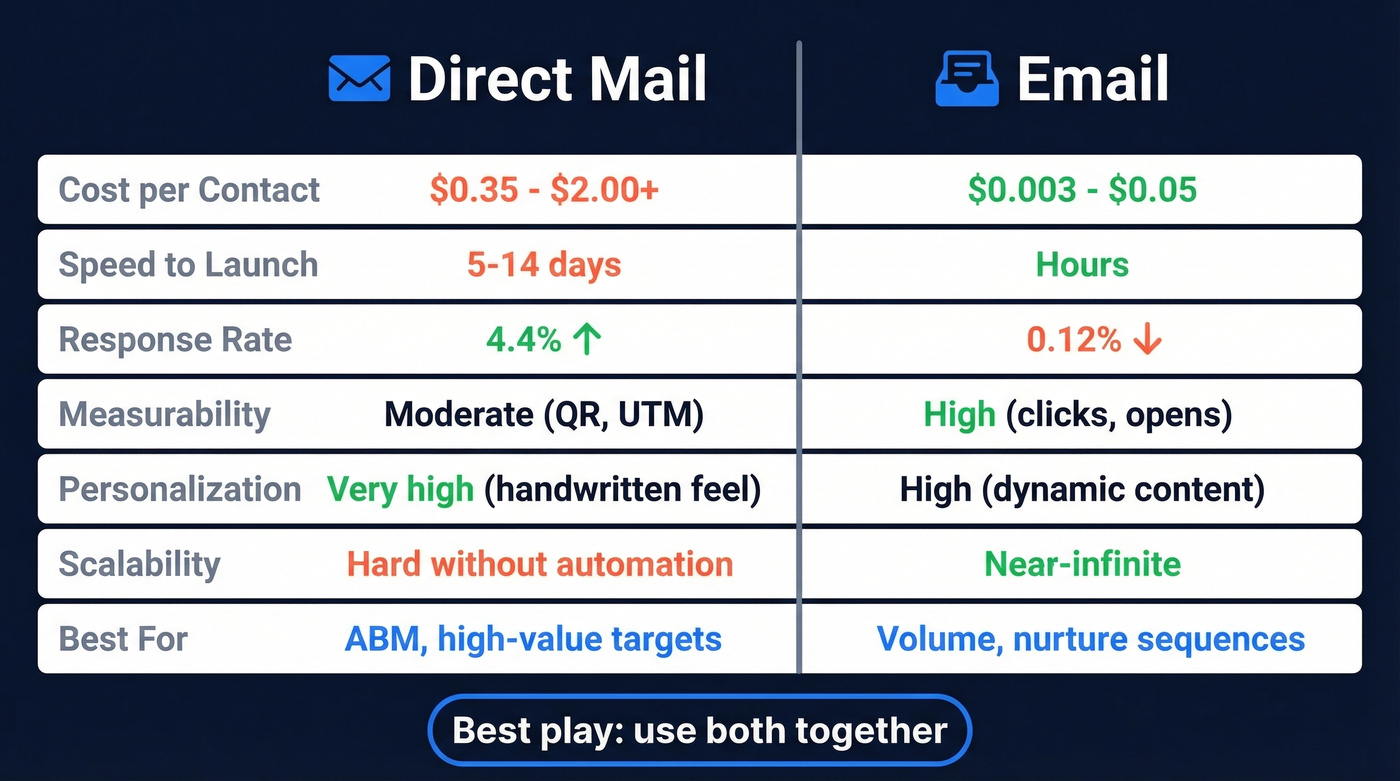
Side-by-Side Comparison
| Metric | Direct Mail | |
|---|---|---|
| Cost per contact | $0.35-$2.00+ | $0.003-$0.05 |
| Speed to launch | 5-14 days | Hours |
| Response rate | ~4.4% (DMA) | ~0.12% (DMA) |
| Measurability | Moderate (QR, UTM) | High (clicks, opens) |
| Personalization | Very high (handwritten) | High (dynamic content) |
| Scalability | Hard without automation | Near-infinite |
| Best for | ABM, high-value targets | Volume, nurture sequences |
What Each Channel Actually Costs
Direct Mail Pricing
| Component | Cost Range |
|---|---|
| Printing | $0.10-$0.80/piece |
| Postage | $0.247 (EDDM) - $0.55 (First-Class) |
| Mailing list | $0.03-$0.15/name |
| Design/creative | $200-$1,000 flat |
EDDM postcards run $0.35-$0.55 all-in. Targeted, personalized letters land between $0.75 and $2.00 per piece. At scale, Click2Mail's data shows $1.71/piece at 500 units dropping to $1.26 at 100K+, which is a meaningful difference if you're running quarterly campaigns to large segments.
If you're using direct mail for pipeline, treat it like direct mail for lead generation, not a brand-only channel.
Email Marketing Pricing
| List Size | Monthly ESP Cost | Per-Send (weekly) |
|---|---|---|
| 5,000 | ~$62 | ~$0.003 |
| 10,000 | ~$100 | ~$0.0025 |
| 50,000 | ~$270 | ~$0.0014 |
At 10,000 contacts sending weekly, you're looking at 40,000 sends/month - roughly $0.0025 each. Most small businesses spend $50-$1,400/month total. Agency-managed programs run $2,500-$10,000+, but that includes strategy and copywriting on top of the sends.
If you're scaling outbound, your bottleneck is usually email deliverability, not ESP pricing.
Break-Even Math
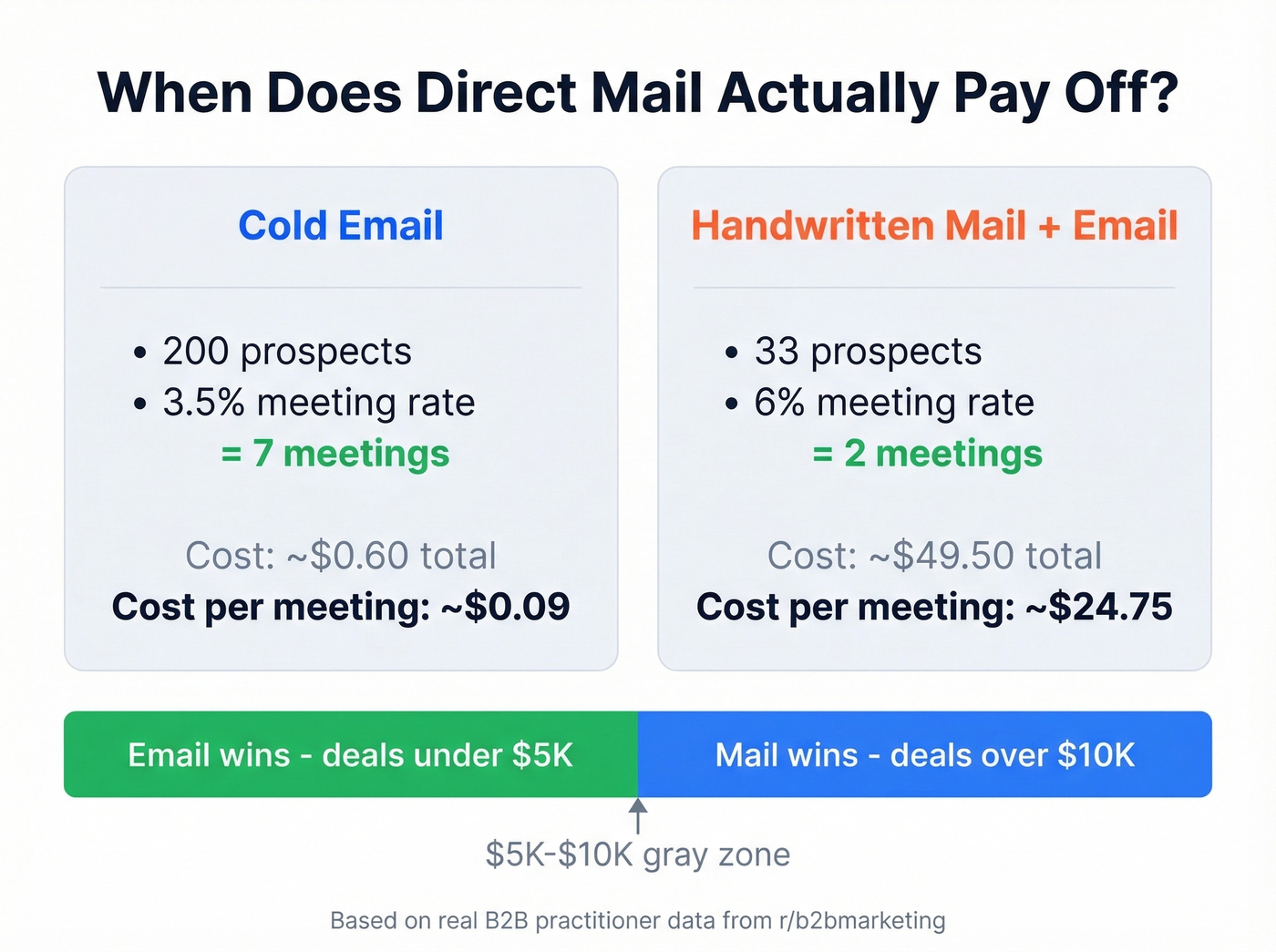
A $1.50 mail piece costs 600x more than a single email send. That gap closes fast when deal size enters the picture. A practitioner on r/b2bmarketing ran a head-to-head: cold email to 200 prospects produced a 3.5% meeting rate, while handwritten mail plus two follow-up emails to 33 prospects hit 6%. For deals worth $10K+, that meeting-rate delta more than covers the cost difference.
Here's the thing: if your average deal is under $5K, direct mail usually doesn't pencil out. Stick with email and invest the savings in better targeting data.
Here's the thing: if your average deal is under $5K, direct mail usually doesn't pencil out. Stick with email and invest the savings in better targeting data.
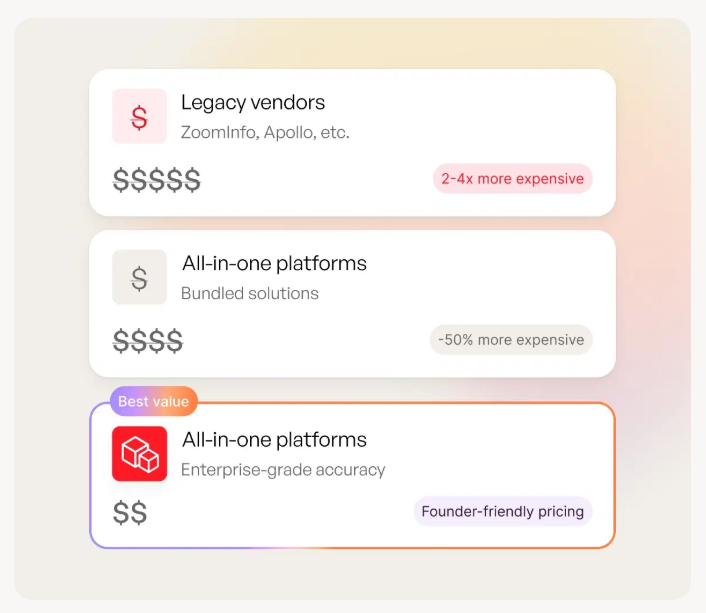

Better targeting data is the difference between mail that converts and mail that wastes $1.50/piece. Prospeo gives you 300M+ profiles with 30+ filters - buyer intent, technographics, funding, headcount growth - so every dollar you spend on postage hits the right desk.
Stop mailing blind. Build a list worth the stamp.
2026 Performance Benchmarks
MailerLite's dataset - 3.6M campaigns across 181K accounts - puts email open rates at 43.46%, click rates at 2.09%, unsubscribe rates at 0.22%, and click-to-open at 6.81%. Apple Mail Privacy Protection inflates those open numbers, so clicks are the real metric now. Don't let a 43% open rate fool you into thinking nearly half your list is engaged.
If you want a reality check, compare against a standard email open rate and track your email bounce rate alongside clicks.
On the mail side, Lob's enterprise survey of 405 professionals found 79% of executives rank direct mail as their top-performing channel. Enterprise mail volume nearly doubled from 34.9M pieces in 2024 to a planned 67.3M in 2025. The catch: 93% of operational mail leaders say manual workflows block them from scaling further.
Track Direct Mail Like Digital
Physical mail isn't "untrackable." People just skip the setup.
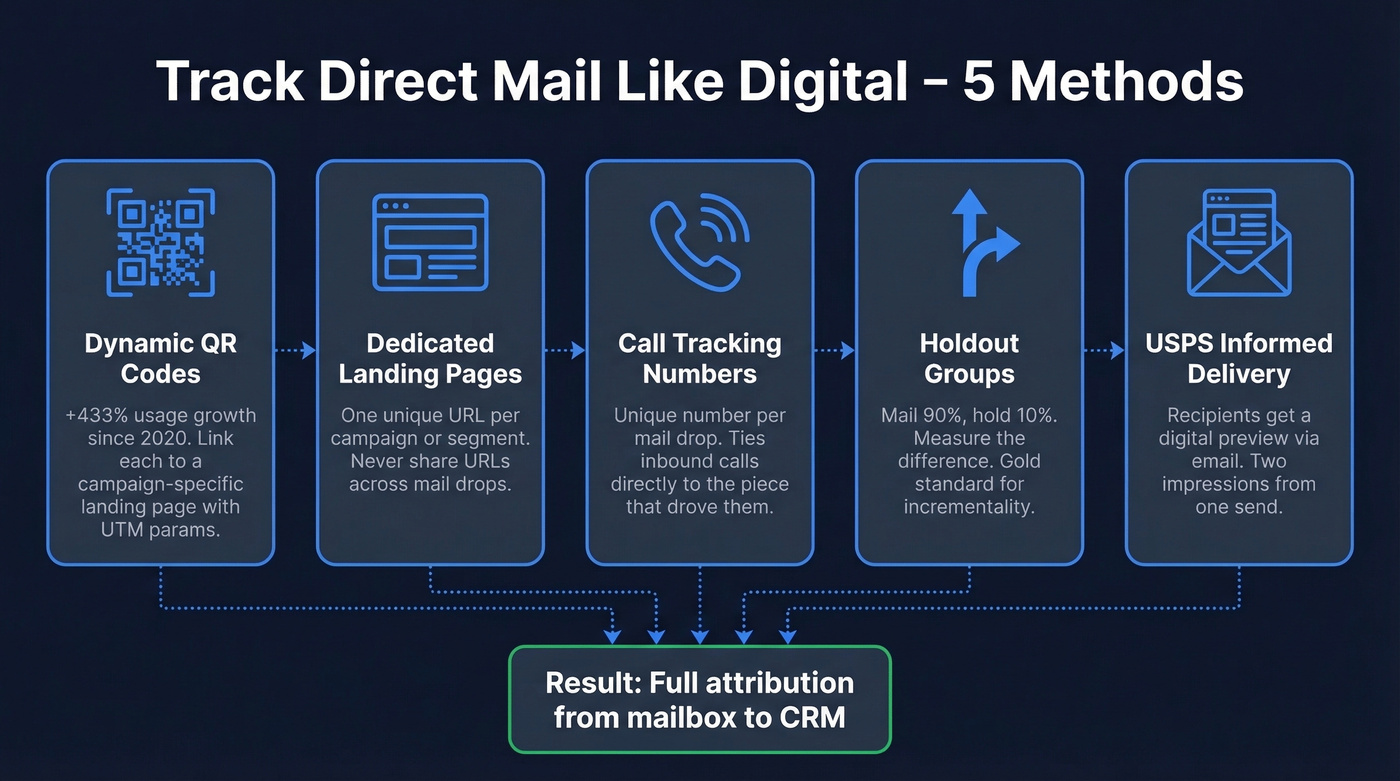
- Dynamic QR codes - usage grew +433% from 2020-2023. Link each to a campaign-specific landing page with UTM parameters.
- Dedicated landing pages per campaign or segment. No shared URLs.
- Call tracking numbers unique to each mail drop.
- Holdout groups - mail to 90% of a segment, hold 10% back, measure the difference. This is the gold standard for incrementality.
- USPS Informed Delivery - recipients get a digital preview of incoming mail via email, giving you two impressions from a single send.
Skip the holdout group if your list is under 500. The sample's too small to draw meaningful conclusions, and you're better off just sending to everyone and tracking QR scans.
If you're running multi-touch outreach, tighten your sequence management so mail and email timing stays consistent.
Best Play: Mail First, Email Follow-Up
The strongest results come from sequencing both channels rather than choosing one. BKM's case studies show ads plus mail producing +21% to +44% sales lift, and mailing prospects twice generating +53% lift over a single send.
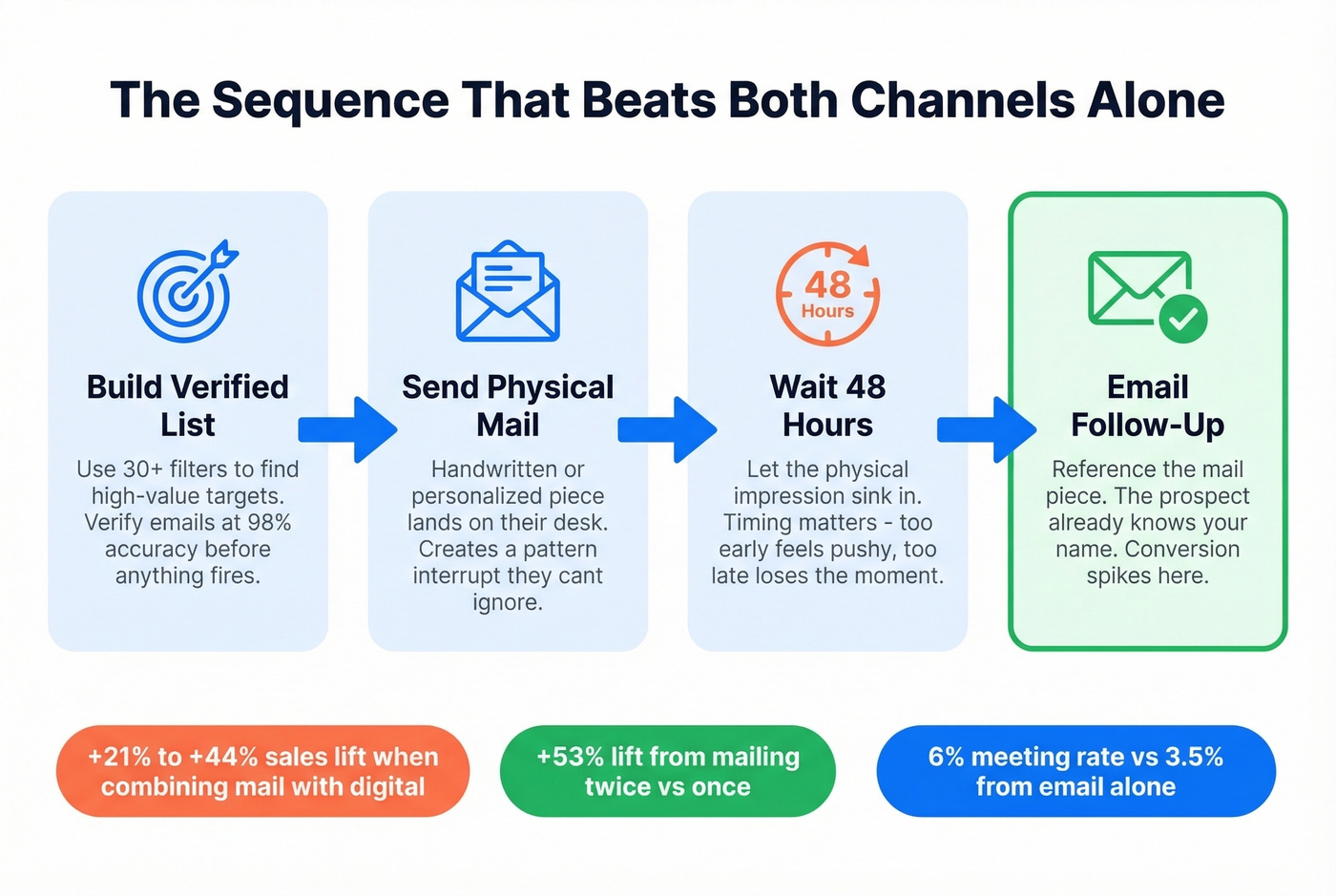
The logic is simple. A physical piece lands on someone's desk and creates a pattern interrupt. Follow up with email within 48 hours while the impression is fresh. The Reddit consensus on r/b2bmarketing backs this up - the handwritten-mail-plus-email sequence consistently outperforms either channel alone, especially for enterprise deals where getting a single meeting can justify the entire campaign cost.
Even when you automate the mail side, the follow-up email only works if the address is valid. We run our lists through Prospeo's email finder before sending - 98% accuracy with real-time verification means you don't burn deliverability on the most important touchpoint in the sequence.
To increase replies, pair the follow-up with proven sales follow-up templates and stronger email subject lines.
Sustainability Check
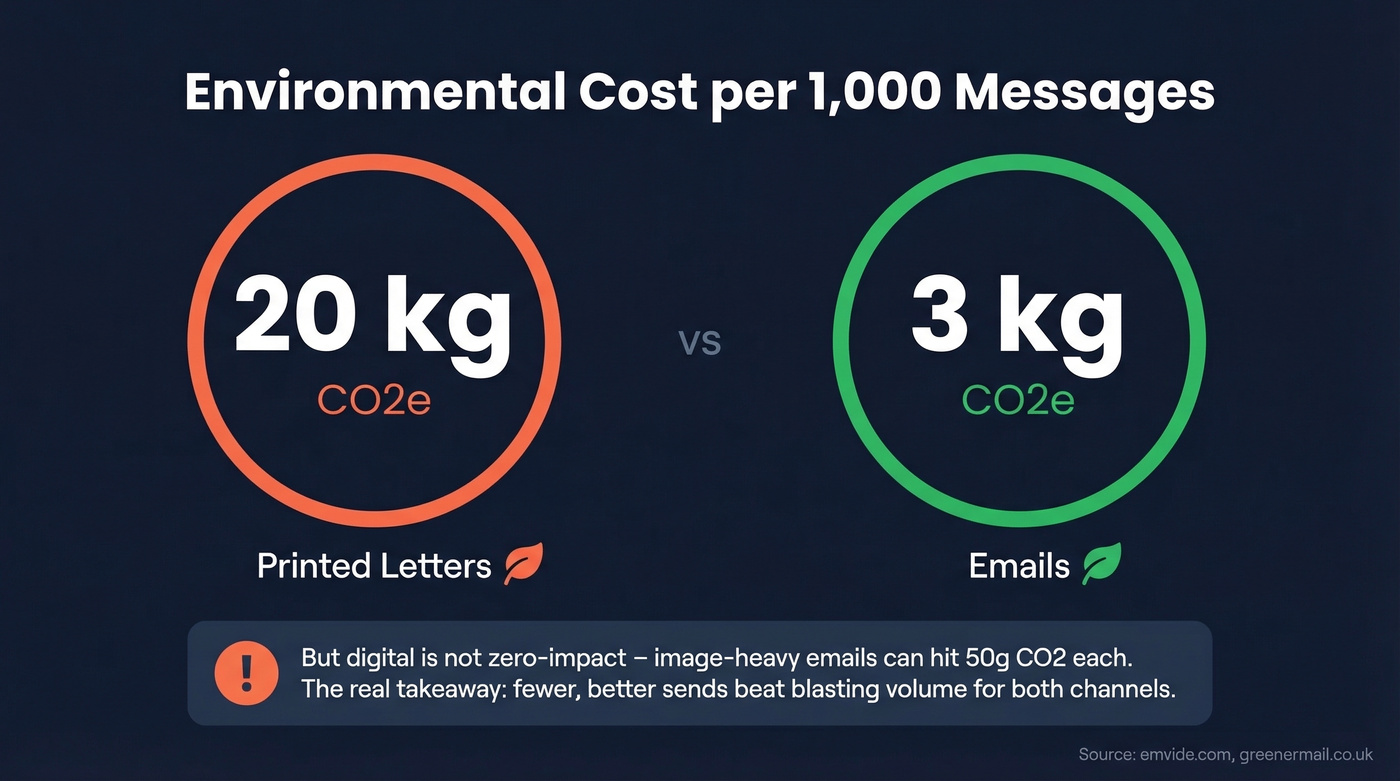
Per 1,000 messages, printed letters produce ~20 kg CO2e versus ~3 kg CO2e for emails. Digital isn't zero-footprint though - heavier emails with images can hit 50g CO2 each. The takeaway for both channels: fewer, better sends beat blasting volume.
FAQ
What's the average response rate for mail versus email?
DMA figures put direct mail at ~4.4% and email at ~0.12%. But compare cost-per-response: 4.4% at $1.50/piece = $34/response, while 0.12% at $0.003/send = $2.50/response. Always compare cost per outcome, not raw percentages.
Is direct mail worth it for B2B?
For high-value targets with deal sizes above $10K, yes. Handwritten mail plus email follow-ups produced a 6% meeting rate versus 3.5% from cold email alone in one B2B experiment. The key is targeting a small, valuable list - not blasting thousands of pieces.
How do I build a clean list for follow-up campaigns?
Use a verified B2B data platform like Prospeo - 300M+ profiles with 98% email accuracy and a 7-day data refresh cycle. Bad data kills deliverability and wastes every dollar you spent on the mail piece that preceded it.
Can I automate a mail-then-email sequence?
Yes. Platforms like Lob or Postalytics handle triggered mail sends, and tools like Smartlead or Instantly manage the email follow-up. Connect them through Zapier or Make, and use a data enrichment API to verify contact data before either touchpoint fires.
The mail-then-email sequence beats both channels alone - but only if your follow-up email actually lands. Prospeo's 98% email accuracy and real-time verification at $0.01/email means your most critical touchpoint doesn't bounce.
Don't waste a $1.50 mail piece on a dead email address.