

Direct Sales Channels: What They Cost, When They Work, and How to Choose
A RevOps lead we know launched a 10,000-contact outbound campaign last quarter. Thousands of emails bounced, the sending domain's reputation cratered, and the SDR team spent two weeks rebuilding instead of selling. The channel wasn't the problem - the data was.
Most guides on direct sales channels hand you textbook definitions and call it a day. We're going to give you actual CAC benchmarks, real numbers, and a framework that'll save you from expensive mistakes.
What Are Direct Sales Channels?
A direct sales channel is any path where you sell to customers without intermediaries - no distributors, no resellers, no retail partners taking a cut. You control the relationship, the data, and the margin.
Indirect channels like wholesalers, VARs, and marketplace partners extend your reach but typically cost you 15-50% in margin and control. Direct distribution means customers buy and receive goods straight from the source.
Types of Direct Channels in 2026
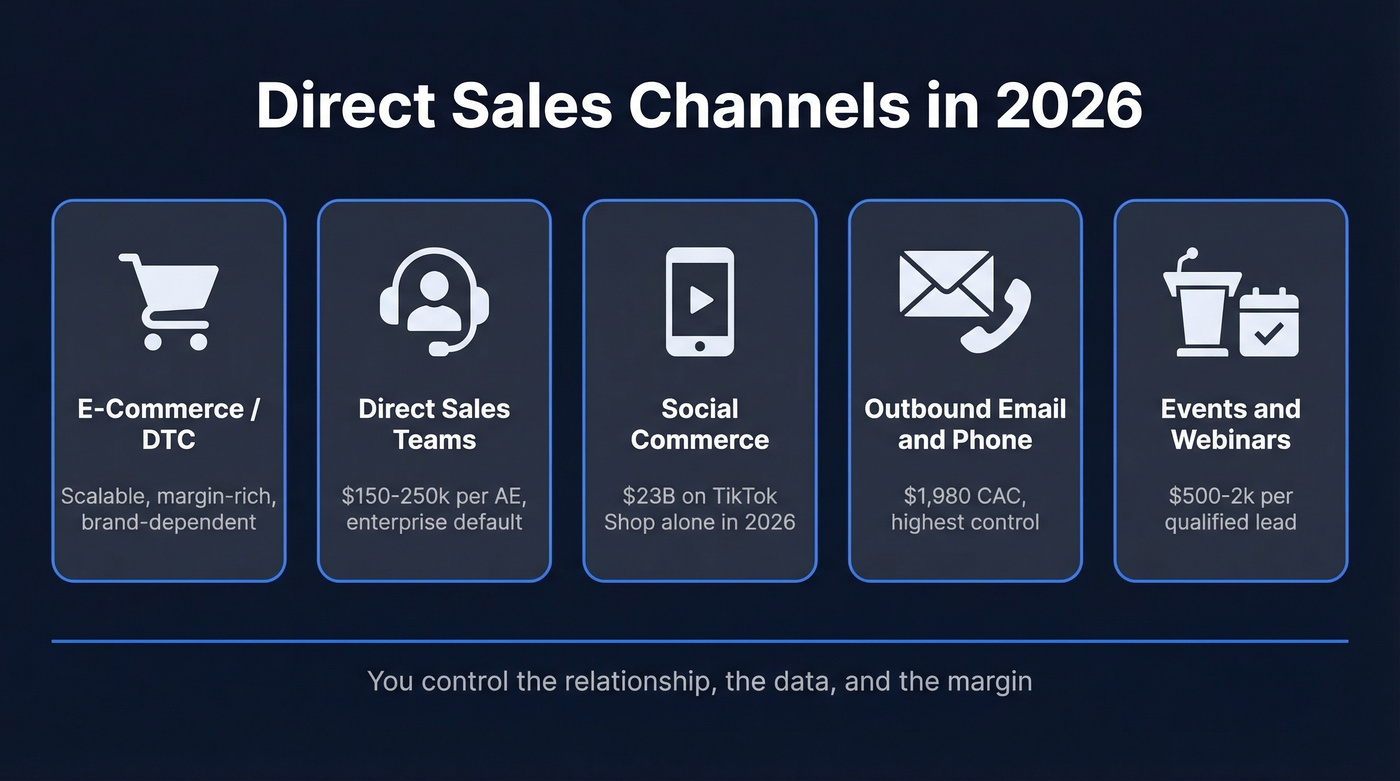
E-Commerce and DTC Websites
The most scalable direct channel for consumer brands. 60% of consumers expect lower prices when buying from a brand's own site - fail to deliver on that expectation and shoppers default to marketplaces. The margin math is simple: you keep more instead of giving 30-50% to a retailer. But you're also on the hook for fulfillment, support, and customer acquisition, which means DTC only works if your brand is strong enough to drive its own traffic.
Direct Sales Teams
The B2B default. Inside reps running demos over Zoom, field reps closing six-figure deals in person. By 2026, 80% of B2B sales interactions happen through digital channels, and 73% of B2B buyers prefer online channels over traditional methods. Your "field" team is increasingly a screen-share team.
The upside is total control over messaging and deal velocity. The downside is headcount - a fully loaded AE often runs $150-250k/year before closing a single deal. For enterprise deals above $50k ACV, though, there's really no substitute. Self-serve and inbound alone rarely close contracts at that size, which is why every major B2B company still invests heavily here despite the cost.
Social Commerce
Social commerce isn't emerging anymore. It's arrived. [TikTok Shop alone is forecast to hit $23.41B](https://www.emarketer.com/content/faq-on-social-commerce - how-creators - platforms-power-shopping-2026) in US e-commerce sales in 2026, up 48% year over year. The broader market is on track to grow from $683B to over $1T by 2029 (https://www.bigcommerce.com/articles/omnichannel-retail/social-commerce/). And [73% of US Gen Zers](https://www.emarketer.com/content/faq-on-social-commerce - how-creators - platforms-power-shopping-2026) say social media is their main source for learning about new products.
In-app checkout removes the friction that kills mobile conversions, and that's why this channel is eating traditional e-commerce share. If you're selling anything under $200 to consumers under 35, you should be testing this yesterday.
Outbound Email and Phone
The most expensive direct channel at $1,980 CAC for B2B. But it's the only channel where you choose exactly who you sell to. You're not waiting for inbound leads or hoping the algorithm serves your ad to the right VP.
The catch: data quality is the single biggest variable in whether outbound works or burns money. We'll dig into this below because it's where we've seen teams waste the most budget.
Events and Webinars
Expect around $500-2,000 per qualified lead at trade shows, less for webinars. They're a complement to other selling channels, not a standalone strategy for most teams. Skip this as your primary channel unless you're in an industry where handshakes still close deals - think manufacturing, medical devices, or high-end professional services.
Direct vs. Indirect - The Real Numbers
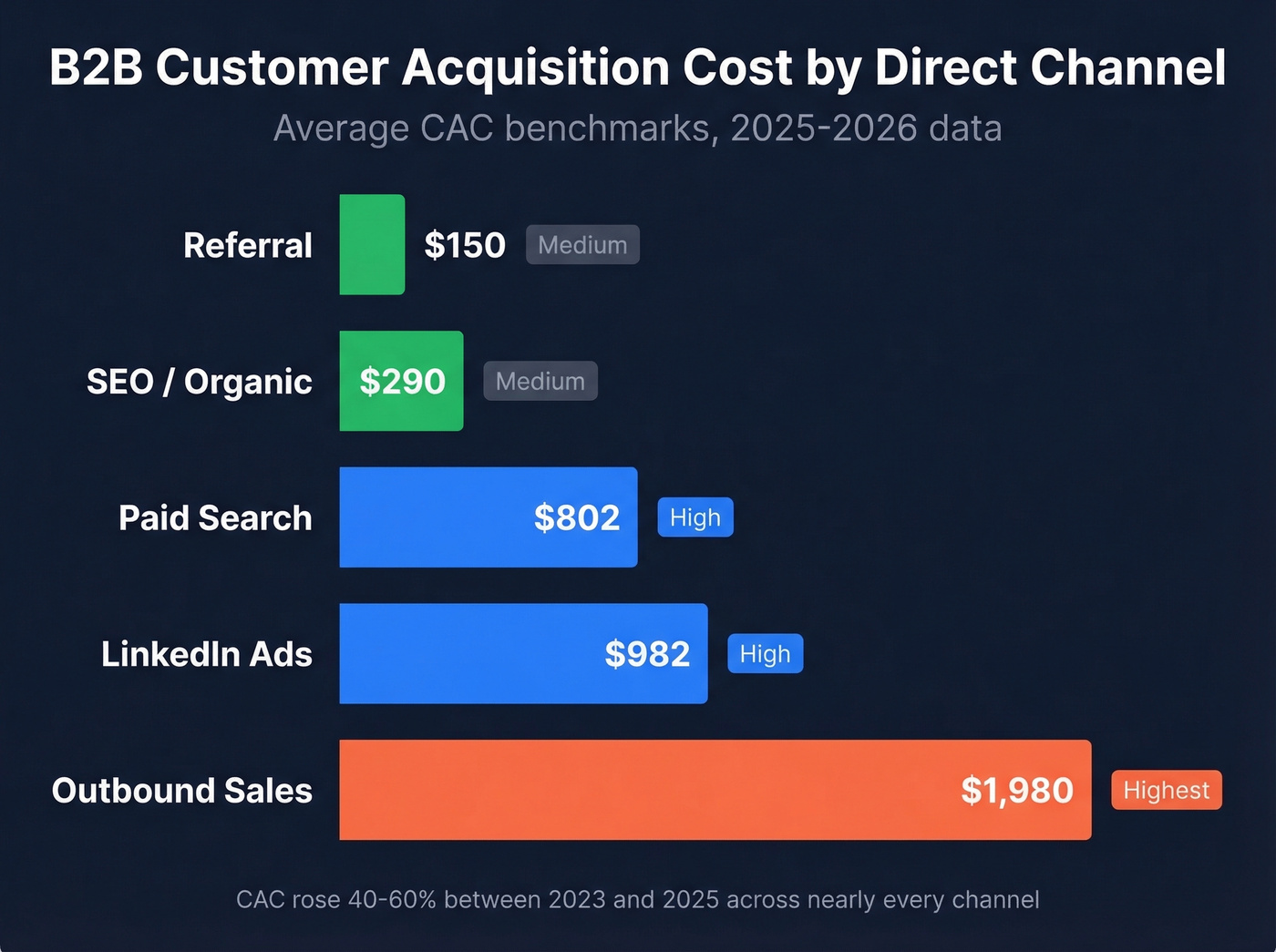
Here's what each direct channel actually costs to acquire a customer:
| Channel | Avg. B2B CAC | Control | Best For |
|---|---|---|---|
| Referral | ~$150 | Medium | Early traction, high-NPS products |
| SEO / Organic | ~$290 | Medium | Long-term compounding growth |
| Paid Search | ~$802 | High | Demand capture, known categories |
| LinkedIn Ads | ~$982 | High | Targeted ABM, niche audiences |
| Outbound Sales | ~$1,980 | Highest | Enterprise deals, named accounts |
Direct channels retain more margin - the tradeoff is CAC. Indirect channels flip that equation: wholesale partners typically take 15-25%, retail partners 30-50%, but they bring warm introductions and existing relationships you'd spend years building on your own.
CAC rose 40-60% between 2023 and 2025 across nearly every channel. ICONIQ Capital's State of GTM research found B2B SaaS companies derive 20%+ of revenue from channel sales - indirect isn't going away, even as direct gets more sophisticated.

At $1,980 CAC, outbound is the priciest direct sales channel on this list. Bad data makes it worse - every bounce erodes your domain reputation and inflates costs further. Prospeo delivers 98% email accuracy on a 7-day refresh cycle, so your SDRs spend time selling, not rebuilding burned domains.
Stop paying enterprise CAC on data that bounces a third of the time.
When Direct Wins (and When It Doesn't)
Go direct when:
- You're pre-$1M ARR and need to own the feedback loop
- Your product requires consultative selling
- Margin matters more than speed-to-market
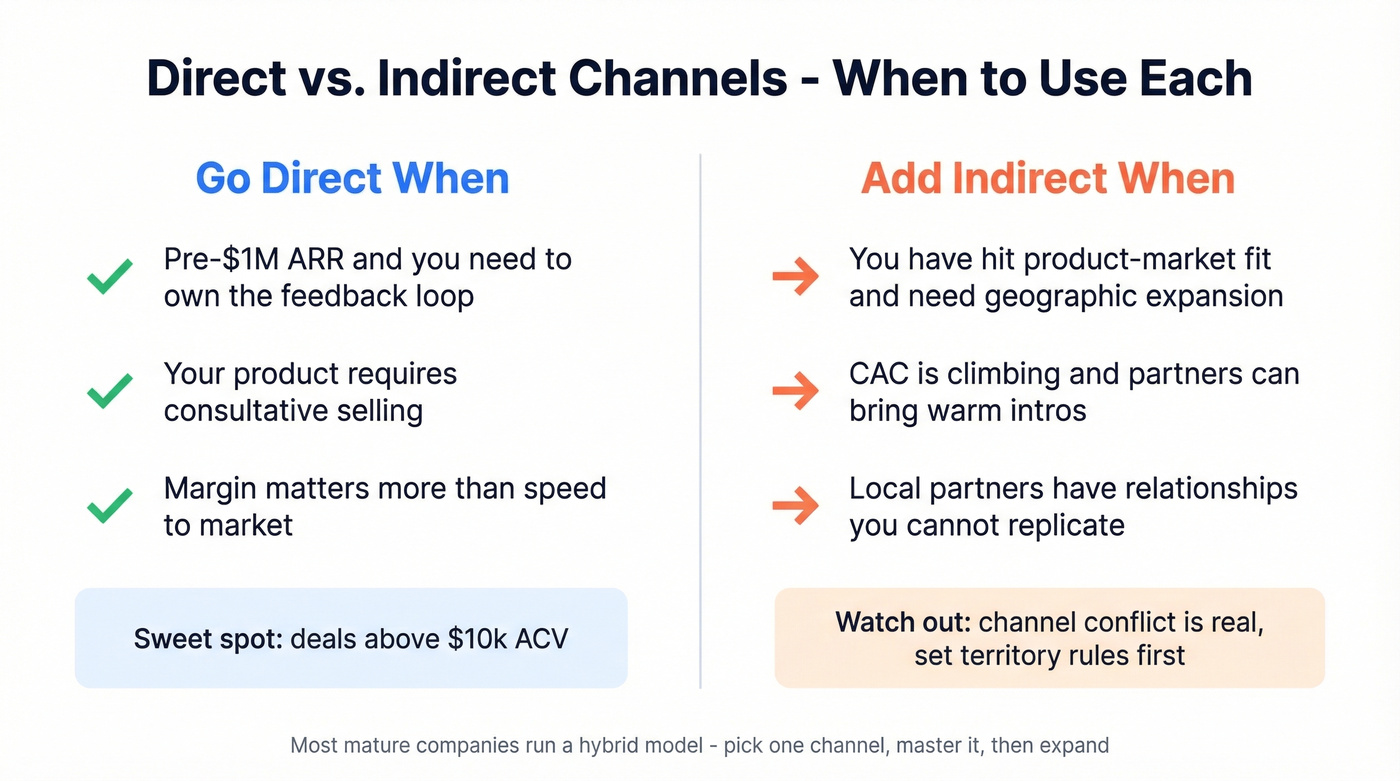
Add indirect when:
- You've hit product-market fit and need geographic expansion
- Your CAC is climbing and partners can bring warm intros
- Local partners have existing relationships you can't replicate
Here's the thing: if your average deal size sits below $10k, you probably don't need a direct outbound motion at all. Referral and organic will get you further, faster, and cheaper. We've seen teams spread across five channels and dominate none of them. Pick one, master it, then expand.
One warning on hybrid models - channel conflict is real. When Huntress, a cybersecurity vendor that was channel-only, opened direct sales, MSP partners raised concerns about mixed messaging. Client-facing materials showed Huntress branding and Huntress support contact details, which eroded trust fast. If you're going hybrid, set clear rules on territory and deal registration before you flip the switch.
The Data Problem That Kills Outbound
At $1,980 CAC, outbound lives or dies on one variable: data quality. Bad emails bounce, which tanks your domain reputation, which means even your good emails stop landing in inboxes. Your SDRs waste hours dialing disconnected numbers. The whole channel becomes a money pit.
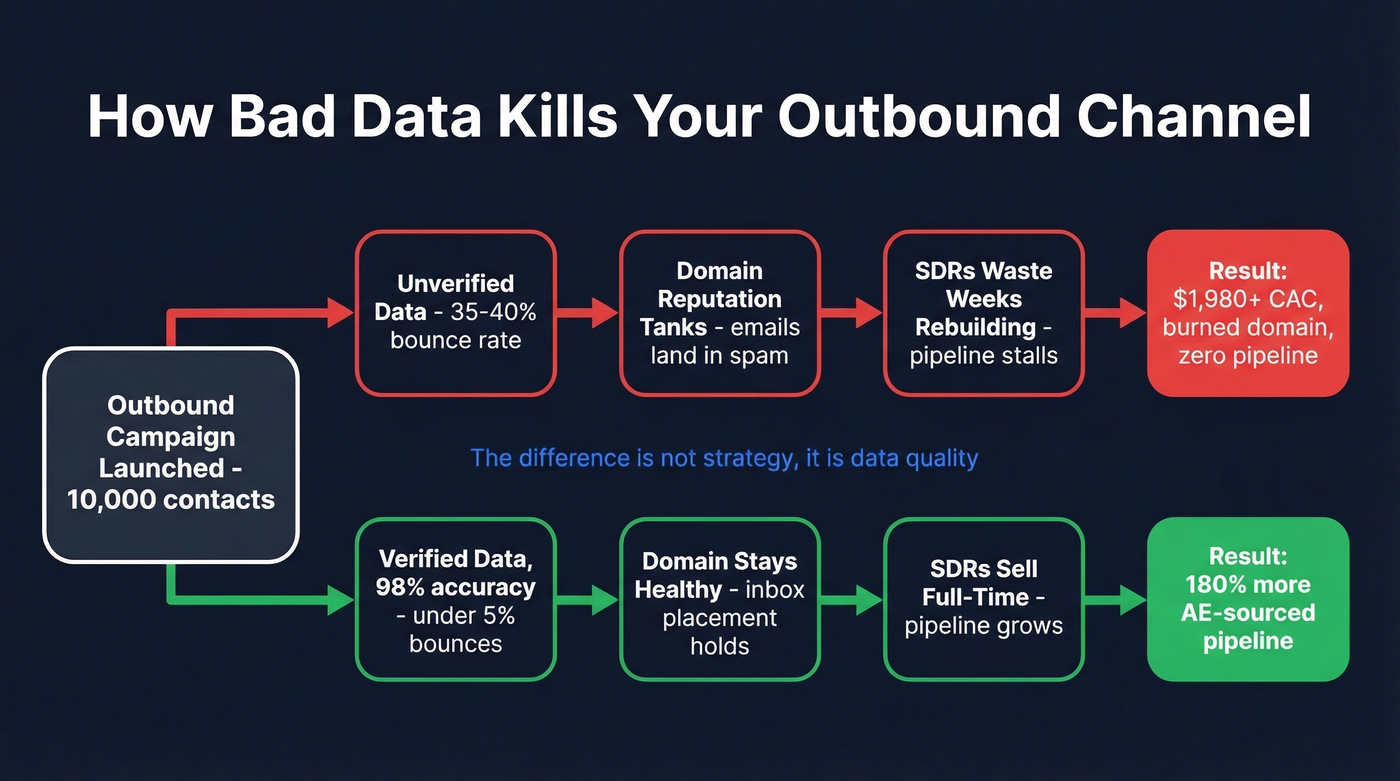
Snyk's sales team saw this firsthand - bounce rates running 35-40% before they fixed their data source. After switching to Prospeo, bounces dropped under 5% and AE-sourced pipeline jumped 180%. That's not a marginal improvement; it's the difference between outbound working and outbound failing.

Let's be honest: most outbound failures aren't strategy failures. They're data failures dressed up as strategy problems. If your bounce rate is above 5%, fix the data before you touch anything else. If you need a benchmark and remediation checklist, start with bounce rate and then work through a full deliverability audit.
Snyk cut bounce rates from 35-40% to under 5% and grew AE-sourced pipeline 180%. The difference wasn't strategy - it was switching to verified data. Prospeo gives you 300M+ profiles, 125M+ verified mobiles, and 30+ filters to target the exact accounts your direct sales team needs.
Your direct channel is only as good as the data powering it.
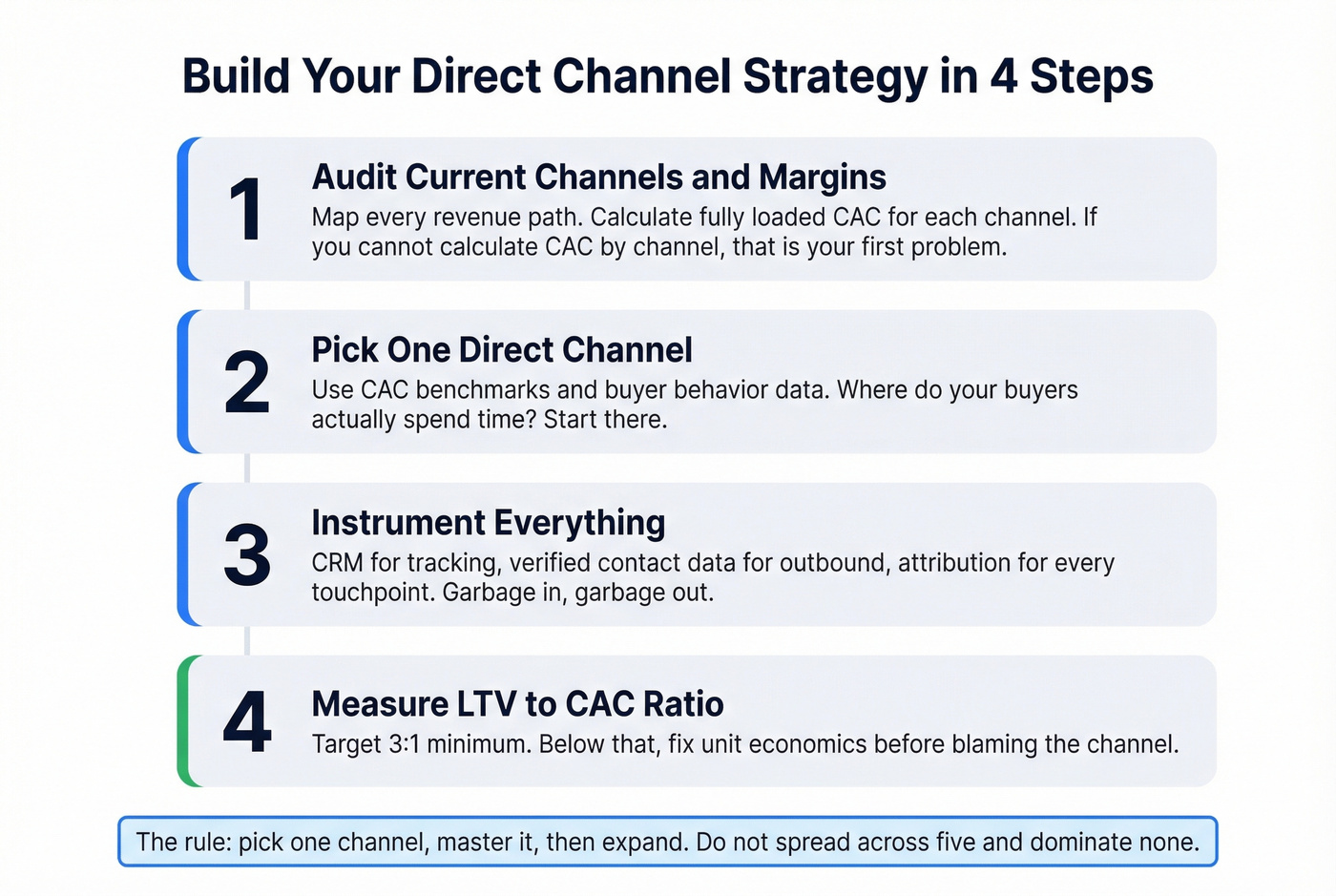
Build Your Direct Channel Strategy
- Audit current channels and margins. Map every path revenue comes through today and calculate the fully loaded CAC for each. If you can't calculate CAC by channel, that's your first problem (use this CAC guide to standardize the math).
- Pick one direct channel based on the benchmarks above and where your buyers actually spend time.
- Instrument it. CRM for tracking, verified contact data for outbound, attribution for everything. Garbage-in, garbage-out applies to your pipeline data just as much as your prospect data. If you're building lists at scale, use a clear ICP and a repeatable lead generation workflow.
- Measure LTV:CAC ratio. Target 3:1 minimum. If you're below that, fix your unit economics before blaming the channel.
FAQ
What's the cheapest direct sales channel?
Referral programs, at roughly $150 CAC for B2B SaaS. Organic search comes second at around $290. Both require upfront investment in content or customer experience but compound over time, making them the best long-term bets for teams watching unit economics closely.
Can you use direct and indirect channels simultaneously?
Yes - most mature companies run a hybrid model. The risk is channel conflict: partners undercut on pricing or reps compete for the same accounts. Set clear rules on territory, pricing, and deal registration before launching both.
How do you keep outbound data from tanking deliverability?
Use a provider that verifies emails in real time and refreshes records frequently. A 7-day refresh cycle with 98% email accuracy is the standard you should hold any vendor to - the industry average sits at six weeks, which means a lot of stale data hitting inboxes. Test with a free tier before committing budget.
Which direct channel works best for enterprise B2B?
Outbound sales teams targeting named accounts, supported by field events for relationship-building. Enterprise deals above $50k ACV almost always require a consultative, rep-led process. Self-serve or inbound alone rarely closes contracts at that size, which is why outbound remains the default despite its higher CAC.