

DiscoverOrg vs QuickEnrich: Which B2B Data Tool Wins?
44% of B2B teams still rely on a single data provider - and most of them are overpaying for accuracy that doesn't hold up. If you're weighing DiscoverOrg against QuickEnrich, you're comparing a legacy enterprise platform that merged into ZoomInfo against a newer enrichment tool with virtually no third-party review presence. Neither publishes pricing transparently.
Here's what you're actually getting with each, and whether a third option makes more sense.
30-Second Verdict
Pick DiscoverOrg (ZoomInfo) if you need intent data, org charts, and your budget clears $30K/year.
Pick QuickEnrich if you want enrichment-first workflows through Clay or n8n and you're comfortable adopting a tool without independent validation.
What Is DiscoverOrg (ZoomInfo)?
DiscoverOrg merged with ZoomInfo in 2019. ZoomInfo is the platform you're buying today.
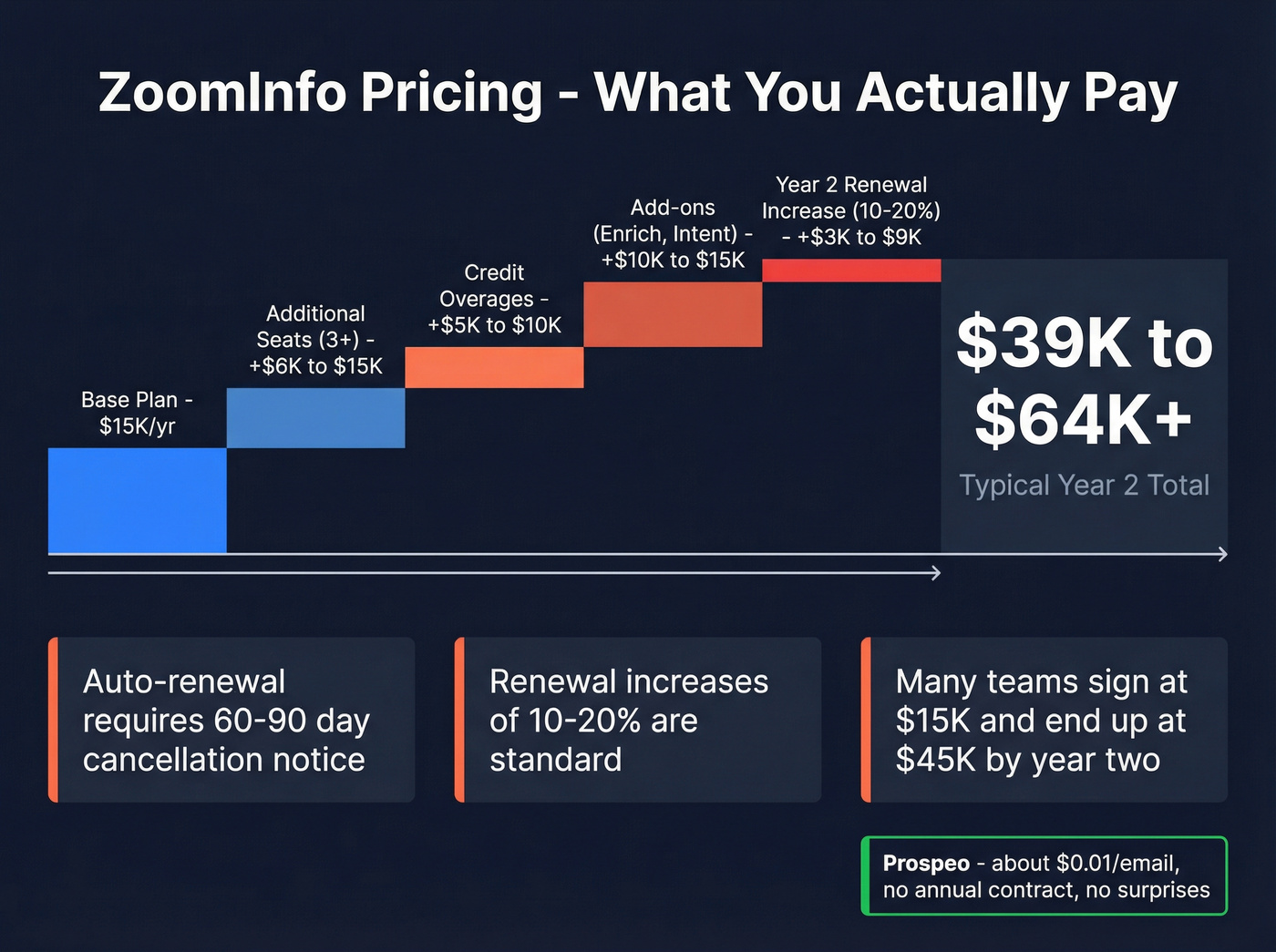
It's positioned for enterprise teams that want a broad go-to-market dataset - contacts, companies, department-level org charts, and intent data - all under one roof. The database covers 320M+ contacts, and integrations span Salesforce, HubSpot, Outreach, and Salesloft. That breadth is real. But it comes with annual contracts, auto-renewal windows, and a price tag that starts around $15K/year and often climbs into the $30K-$60K+ range once you add seats, credits, and modules. We've talked to teams who signed thinking they'd pay $15K and ended up at $45K by year two.
What Is QuickEnrich?
QuickEnrich is an enrichment-focused tool with 130M+ contacts. Its core pitch is "Double Verified Emails" - emails run through multiple verification tools including SMTP checks and catch-all verification, with the goal of filtering out risky addresses. They also display an email verification date on records, which is a genuinely useful transparency touch.
The tool supports two lookup methods: LinkedIn URL exact match and company URL + first name + last name exact match. QuickEnrich also claims "250% more email domains" by identifying true email domains beyond a company's website domain, which matters for waterfall enrichment workflows. Mobile coverage sits around 25% of enriched contacts, and integrations lean toward Clay, n8n, and API access with a 1,000 requests/minute default rate limit.
Here's the tradeoff: QuickEnrich doesn't have a major third-party review footprint. The G2 page that sometimes surfaces is for Quicken, the personal finance app - not QuickEnrich. So you're evaluating vendor methodology and fit, not a stack of independent benchmarks.
Feature Comparison
| Feature | DiscoverOrg (ZoomInfo) | QuickEnrich | Winner |
|---|---|---|---|
| Database Size | 320M+ contacts | 130M+ contacts | ZoomInfo |
| Email Verification | Pattern + SMTP-style validation | Double-verified + verification date shown | QuickEnrich (on paper) |
| Real-World Accuracy | ~75-85% per third-party writeups | No independent benchmarks available | ZoomInfo (more documented) |
| Pricing | ~$15K-$60K+/yr | Free tier; paid tiers not public | QuickEnrich (lower entry) |
| Free Tier | No self-serve free plan | Yes | QuickEnrich |
| Mobile Numbers | Strong North America direct-dial coverage | ~25% of contacts | ZoomInfo |
| Key Integrations | Salesforce, HubSpot, Outreach, Salesloft | Clay, n8n, API | ZoomInfo (breadth) |
| Intent Data | Yes | No | ZoomInfo |
| Compliance | Documented | Not specified | ZoomInfo |
| Contract Terms | Annual | Not public | ZoomInfo |
| Third-Party Reviews | Extensive | None available | ZoomInfo |
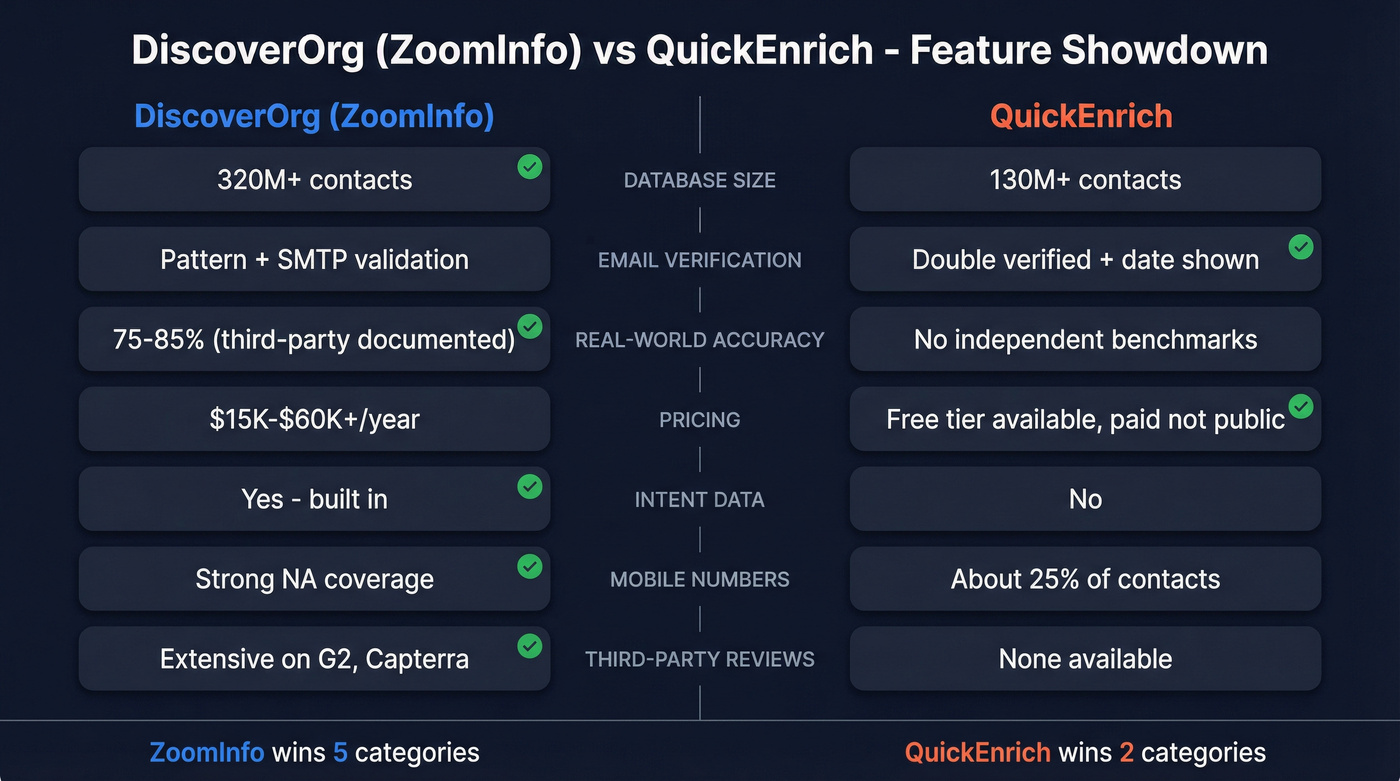
The social proof gap is the real story. ZoomInfo has years of market presence and mountains of public feedback. QuickEnrich's multi-tool verification sounds more rigorous on paper, but without independent benchmarks, it's harder to validate at scale.

ZoomInfo's accuracy drops to 75-85% in the real world. QuickEnrich has zero independent benchmarks. Prospeo delivers 98% verified email accuracy through a proprietary 5-step process - with data refreshed every 7 days, not every 6 weeks.
Stop choosing between expensive and unproven. Start with data that actually works.
Pricing Reality
ZoomInfo's base plans start around $15,000/year, but most teams end up paying $30,000-$60,000+ after seats, add-ons, and credits. A common real-world reference point is ~$15K-$18K/year for three seats on an entry tier, with additional seats running $2,000-$5,000 per seat/year. Credit overages commonly land in the $0.25-$1.50 per credit range, and add-ons like Enrich often tack on $10K-$15K/year. Renewal increases of 10-20% are standard, and many contracts require cancellation 60-90 days before your term ends to dodge auto-renewal.
QuickEnrich offers a free tier, but paid pricing isn't public. Based on market positioning, expect $49-$299/month depending on volume - typical for self-serve data enrichment tools.
Let's be honest: if your average deal size is under five figures, ZoomInfo-level spend doesn't pencil out. You'll burn $30K/year on data to close deals that barely cover the subscription.
Data Quality: What You Actually Get
ZoomInfo markets ~95% email accuracy, but third-party writeups commonly place real-world accuracy around 75-85%. Bounce rates around 15% are a frequent risk point, and the consensus on r/sales threads often puts it higher - 20%+ isn't unusual.
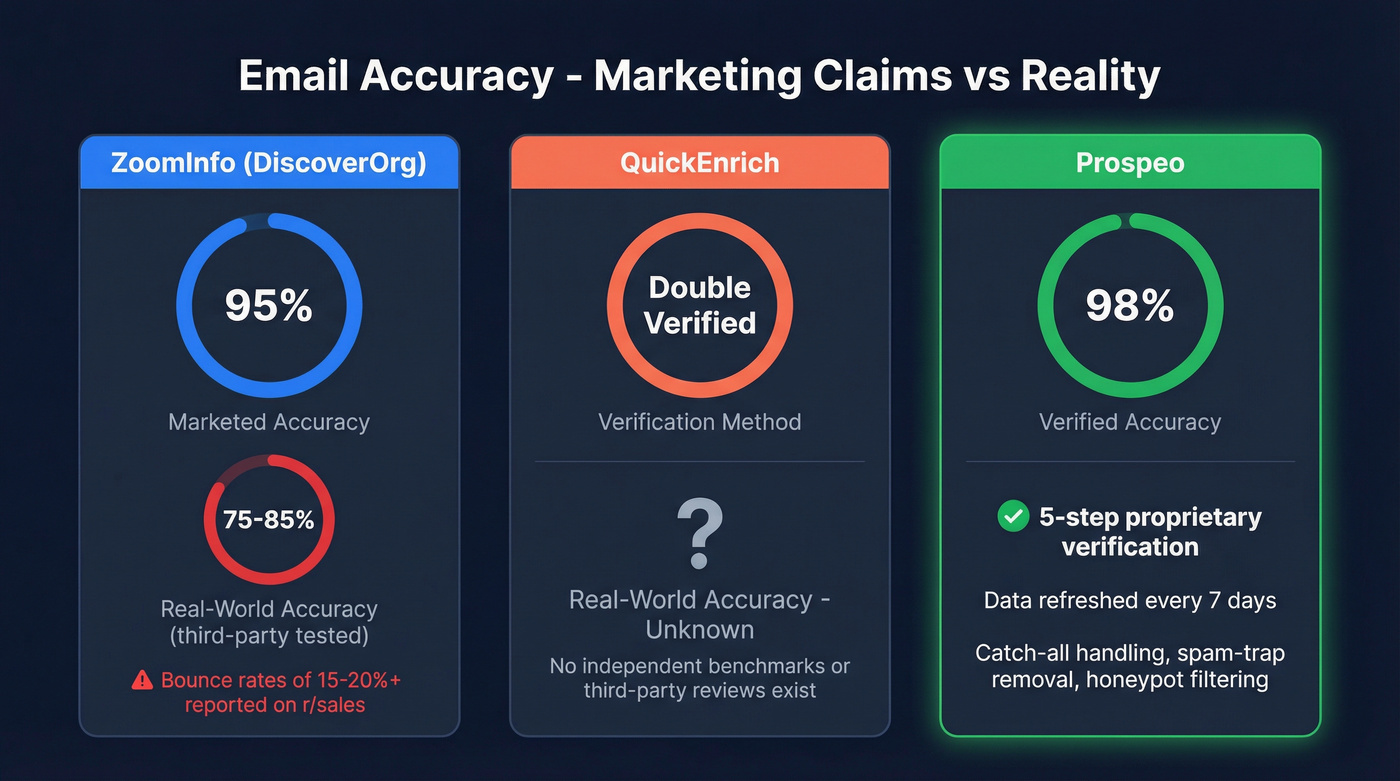
Those bounces don't just waste sends. They damage your sender reputation and reduce deliverability across your entire domain, which means even your good emails start landing in spam. Data decay compounds the problem: it's common to export lists where 10-20% of contacts have already changed jobs by the time you hit send.

QuickEnrich's double-verification approach should produce better results in theory - running emails through multiple tools plus SMTP and catch-all checks is sound methodology. But without independent benchmarks or user reviews, the real-world output quality is still an open question.
If you're trying to reduce bounces fast, start with your email bounce rate benchmarks and fix deliverability at the source with an email deliverability guide.
The Third Option Worth Considering
If ZoomInfo's too expensive and QuickEnrich is too unproven, there's a middle path. Prospeo covers 300M+ professional profiles with 143M+ verified emails and 125M+ verified mobile numbers hitting a 30% pickup rate. Data refreshes every 7 days - compared to the 6-week industry average - so you're not reaching out to people who changed jobs last quarter.
We've tested the verification pipeline extensively, and the 98% email accuracy holds up in production, not just on a marketing page. That accuracy comes from a proprietary 5-step process with catch-all handling, spam-trap removal, and honeypot filtering. On the integration side, it connects natively with Salesforce, HubSpot, Smartlead, Instantly, Lemlist, Clay, and Zapier - covering both the enterprise CRM crowd and the enrichment-workflow users that QuickEnrich targets.
Pricing is self-serve and transparent at roughly $0.01 per email. No annual contracts, no "talk to sales" gates, no surprise renewal bumps. For context, one customer - Snyk - dropped their bounce rate from 35-40% to under 5% and saw AE-sourced pipeline jump 180% after switching.

Snyk's 50 AEs cut bounce rates from 35-40% to under 5% and grew AE-sourced pipeline 180% with Prospeo. 300M+ profiles, 125M+ verified mobiles, native Clay and CRM integrations - at $0.01/email with no annual contract.
Enterprise-grade data without the enterprise price tag or the blind faith.
Which One Should You Pick?
Pick DiscoverOrg (ZoomInfo) if you're an enterprise team already on the platform, need intent data and org charts, and your budget comfortably exceeds $30K/year. It's the safe choice for large orgs with existing workflows built around it.
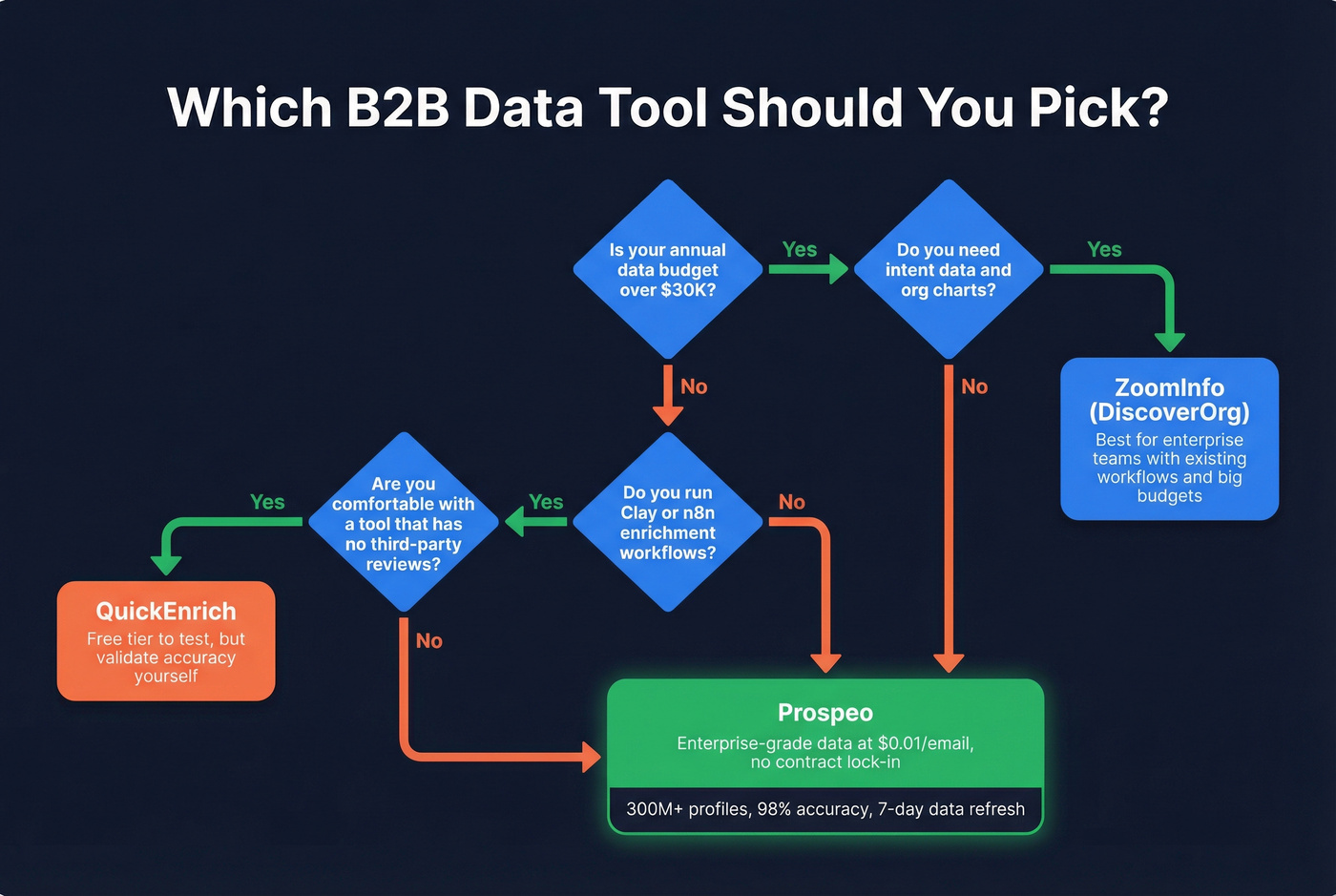
Pick QuickEnrich if you run enrichment-first workflows through Clay or n8n and you're comfortable with a tool that has limited third-party validation. For teams that already trust their own testing process and want to experiment, the free tier makes it low-risk to try.
If you're still comparing vendors, it helps to zoom out and review the broader landscape of sales prospecting databases and B2B company data providers.
FAQ
Is DiscoverOrg the same as ZoomInfo?
Yes. ZoomInfo acquired and merged with DiscoverOrg in 2019. ZoomInfo is the active platform and brand today - you can't purchase DiscoverOrg as a standalone product anymore.
Does QuickEnrich have a free plan?
QuickEnrich offers a "Start for Free" option, though paid tier pricing isn't publicly listed. Based on comparable enrichment tools, expect $49-$299/month depending on credit volume.
How accurate is ZoomInfo's email data in 2026?
ZoomInfo markets ~95% accuracy, but third-party writeups commonly place real-world accuracy around 75-85%. Bounce rates around 15% are a common risk point, and job title decay of 10-20% means a meaningful chunk of contacts are already outdated by the time you export.