

Does Email Warmup Actually Work?
You warmed up 10 inboxes for three weeks. The dashboard glowed green - 100% reputation, healthy engagement, everything looks perfect. Then you launched your first campaign and half the Gmail sends landed in spam.
So does email warmup work, or is it just expensive theater?
Here's the thing: in 2026, automated warmup tools are mostly theater. The fundamentals win. They always have.
The Short Answer
Automated warmup is largely ineffective. Google detects and discounts fake engagement from warmup pools. The GMass shutdown in 2023 was the canary; Gmail's November 2025 enforcement phase was the hammer.
What actually moves the needle: authentication (SPF/DKIM/DMARC), clean data, manual volume ramp, and sending relevant emails to real people. And the fastest way to tank your reputation isn't skipping warmup - it's sending to unverified emails that bounce. High bounce rates do real, fast damage.
What People Mean by "Warmup"
Two things get called "warmup," and the distinction matters.
Manual warmup is the old-school approach. You get a new inbox, send a handful of real emails per day, gradually increase volume, and let organic engagement build your sender reputation over weeks. This still works. It's just slow, and it requires discipline.
Automated warmup tools do something different entirely. They connect your inbox to a pool of other accounts and simulate engagement - opens, replies with canned messages, moving emails out of spam, marking them as important. The idea is to flood ISPs with positive signals so your domain looks trustworthy. Clever in theory. In practice, Google figured it out years ago.
Why Warmup Tools Stopped Working
The GMass Shutdown
In January 2023, Google gave GMass an ultimatum: shut down your warmup system or lose Gmail API access. GMass complied on January 31, killing a system that had processed 1.29 billion warmup emails across 236,000 accounts. GMass's founder was blunt - Google "made it clear they don't want warmup taking place at all" and considers it a Terms of Service violation.
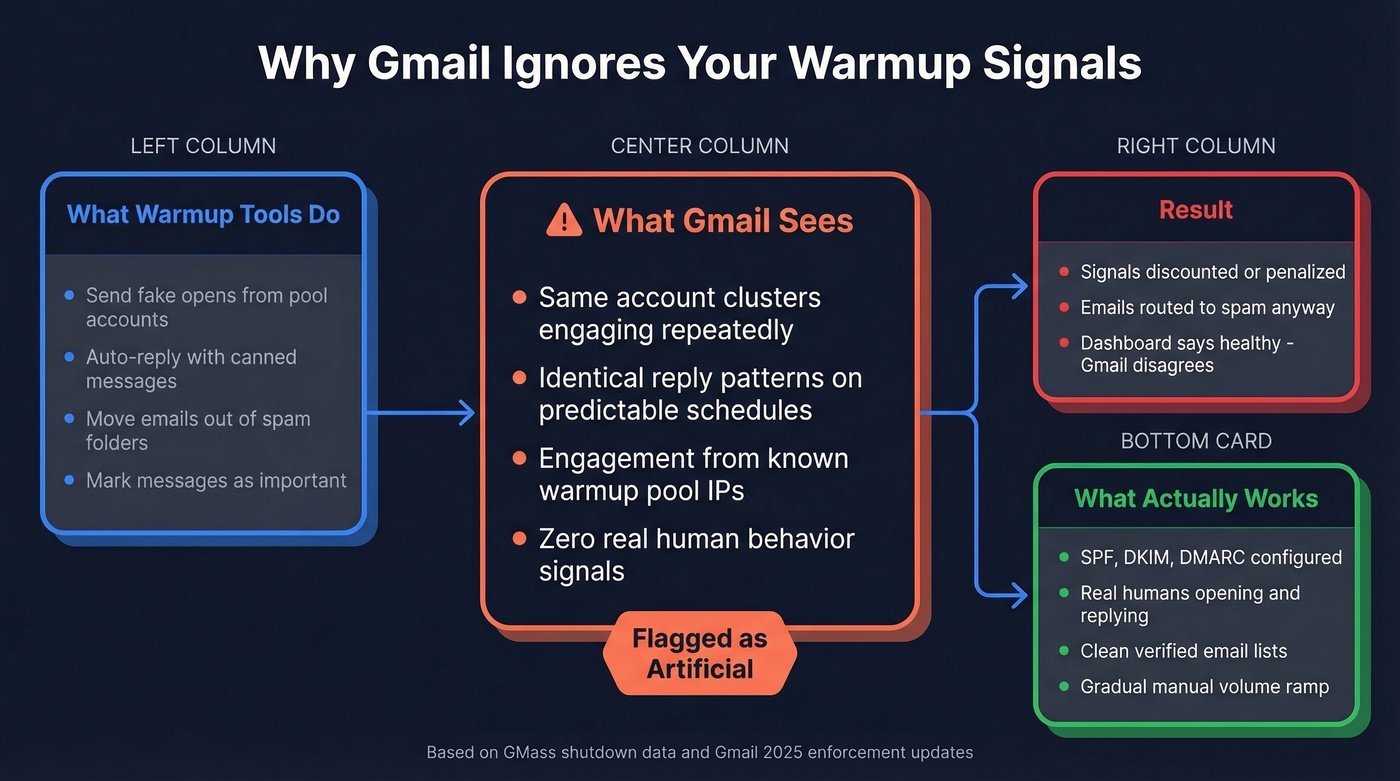
This wasn't a quiet policy tweak. It was Google telling the entire industry that artificial engagement manipulation is off-limits. The founder even noted that Google would likely detect IMAP-based warmup too, not just API-based tools. That statement aged well.
The Dashboard Lie
A user on r/coldemail warmed Google Workspace mailboxes with Smartlead for three-plus weeks. Dashboard showed 100% warmup reputation. They ran independent placement tests with EmailGuard. Most Gmail sends landed in spam. Outlook was fine. SPF, DKIM, DMARC - all correctly configured.
The warmup tool said everything was perfect. Gmail disagreed.
This pattern shows up constantly. A deliverability consultant at Postbox Services tested nearly all major warmup tools and reported "none demonstrated any meaningful improvements in deliverability or reputation." The dashboards looked great. Inbox placement didn't budge. There's a technical reason warmup networks are easy to flag: they create predictable, unnatural engagement patterns at scale. When the same kinds of accounts generate the same kinds of opens and replies on the same kinds of schedules, it doesn't look like organic email behavior - and ISPs simply ignore or penalize those signals.
One telling data point: Sean (@seanb2b) reported that his reply rates actually improved after turning warmup off entirely. The fake engagement was actively hurting, not helping.
Over on r/Emailmarketing, users call out warmup vendors for astroturfing Reddit threads with success stories. When the community itself questions whether the entire category is a "bullshit echo chamber," that tells you where sentiment has landed.
The Strongest Case FOR Warmup
Let's be fair. Pro-warmup vendors like Mailivery make a reasonable argument: large SMTP/IMAP networks with diverse, real-looking accounts can still generate positive engagement signals. The GMass crackdown targeted API access specifically - SMTP/IMAP tools kept operating.
That argument had legs in 2024. Gmail's November 2025 enforcement phase shifted the game toward hard compliance. Non-compliant mail can get rejected at the SMTP level - not just spam-foldered. Warmup can generate all the fake opens it wants, but it can't fix SPF alignment, DMARC enforcement, or a spam complaint rate above 0.10%.

Warmup tools mask the real problem: bad data. Bounces destroy sender reputation faster than any fake engagement can build it. Prospeo's 5-step verification delivers 98% email accuracy with 7-day data refresh - so every address you send to is real, current, and safe for your domain.
Stop warming up dead emails. Start with verified ones.
Gmail's 2026 Rules Changed Everything
Gmail's November 2025 enforcement phase was the biggest shift in email deliverability in years. Google added stricter compliance checks and more SMTP-level blocking for non-compliant traffic. Postmaster Tools v2 now surfaces Pass/Fail-style compliance signals alongside deliverability and reputation views. If you fail the basics, no warmup tool on earth matters.
Google's bulk sender guidelines make one thing painfully clear: keep your spam complaint rate under 0.10%, never exceed 0.30%. That bar applies even if you're not sending at enterprise volume.
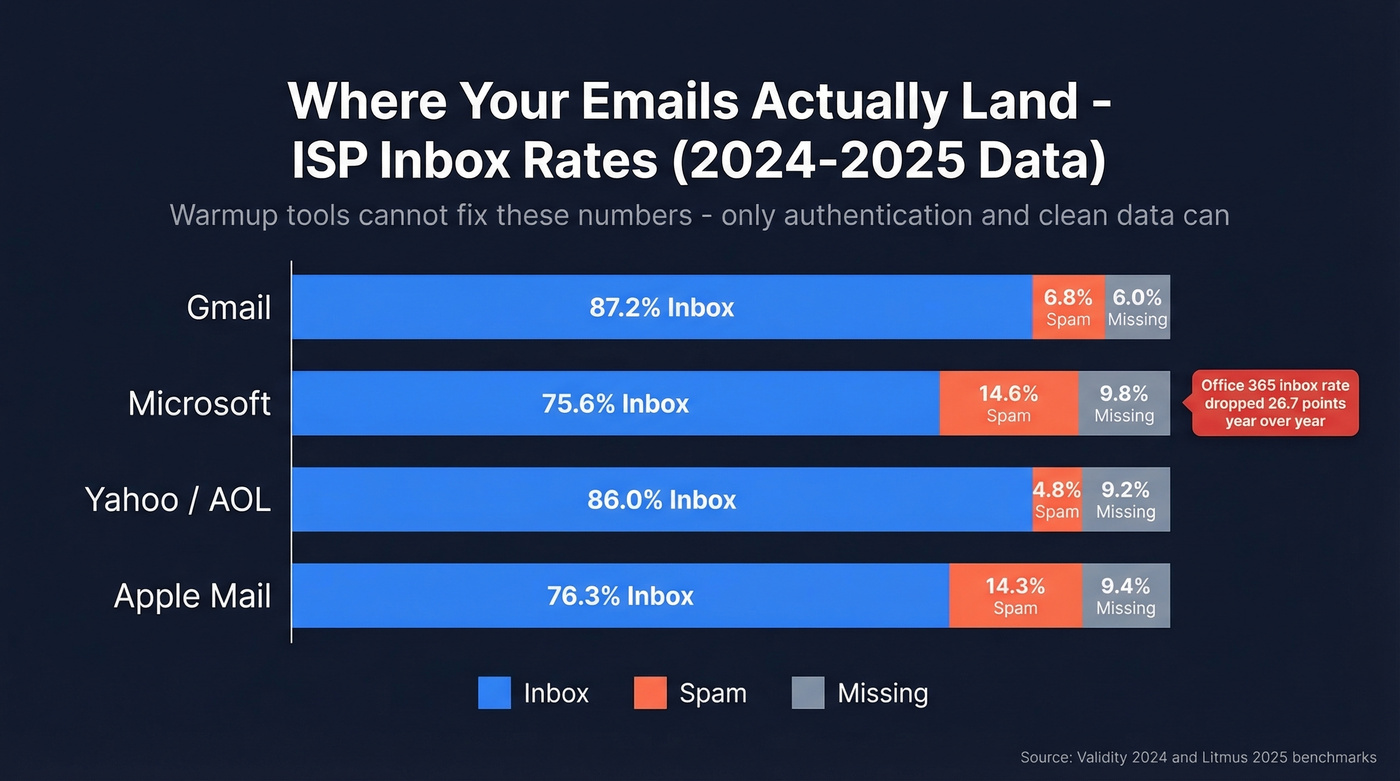
Here's where the major ISPs stand on inbox placement:
| ISP | Inbox Rate | Spam Rate | Missing |
|---|---|---|---|
| Gmail | 87.2% | 6.8% | 6.0% |
| Microsoft | 75.6% | 14.6% | 9.8% |
| Yahoo/AOL | 86.0% | 4.8% | 9.2% |
| Apple Mail | 76.3% | 14.3% | 9.4% |
Validity 2024 / Litmus 2025 benchmark data.
Microsoft is the hardest inbox to crack - and it's getting worse. Office 365 inbox placement dropped 26.7 points year-over-year, new domains face roughly a 30-point penalty compared to mature domains, and only 7.6% of domains enforce DMARC with quarantine or reject policies. The bar for getting into the inbox keeps rising. Warmup tools aren't clearing it.
What Actually Fixes Deliverability
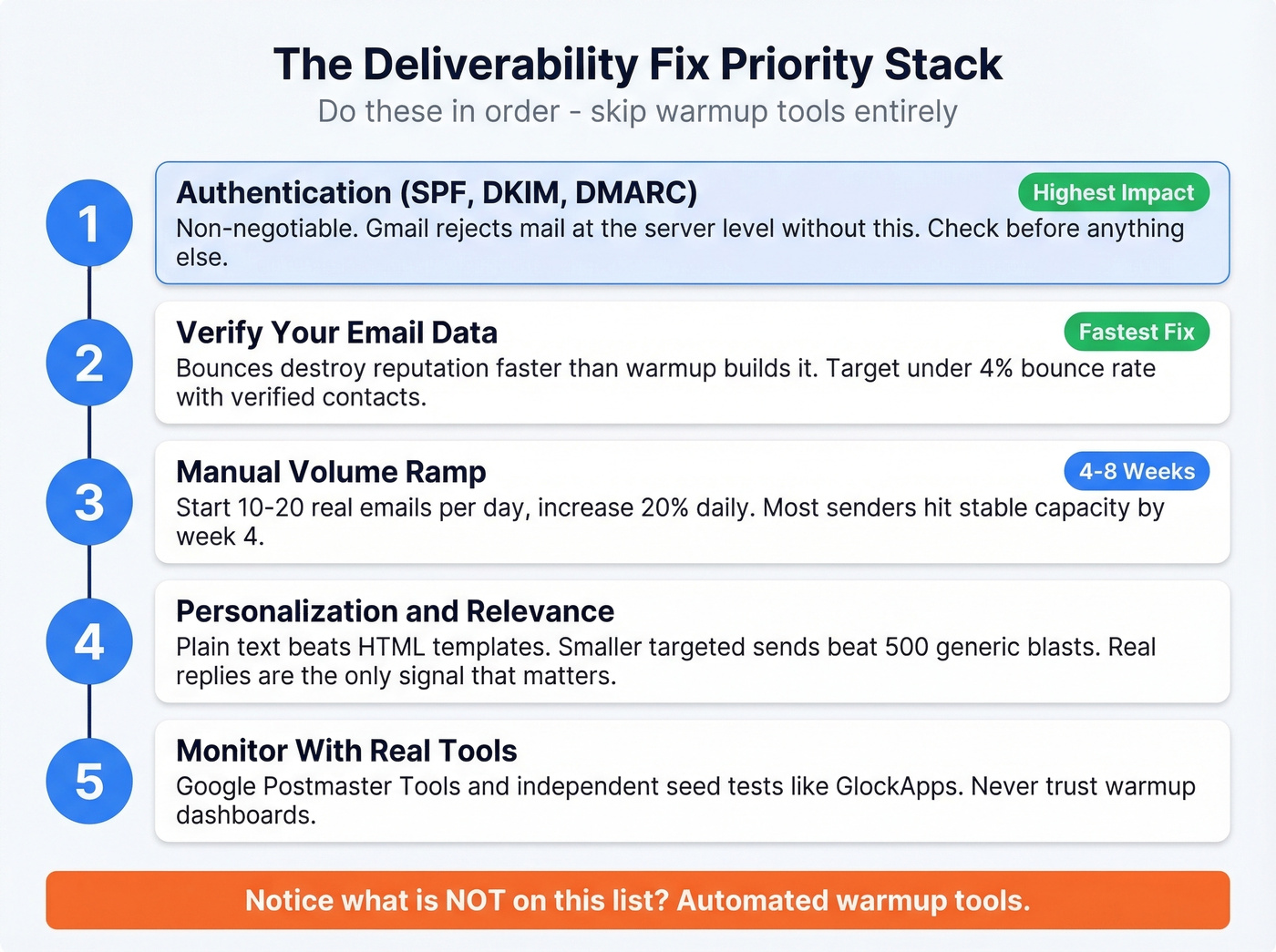
1. Authentication Is Non-Negotiable
If you're failing compliance checks, Gmail can reject your mail at the server level. Before you think about volume, content, or tools, lock down the basics: SPF, DKIM, and DMARC configured correctly. Valid forward and reverse DNS. TLS on sends. RFC 5322 formatting compliance.
We've seen teams spend months troubleshooting deliverability when the root cause was a misconfigured DMARC record. Check authentication first. Always.
2. Verify Your Data
Bounces destroy sender reputation faster than any warmup tool can build it. A 5% bounce rate signals to ISPs that you don't know who you're emailing - and they respond by throttling or spam-foldering everything else you send.

This is where data quality tools pay for themselves. Prospeo's 5-step verification process handles catch-all domains, removes spam traps and honeypots, and delivers 98% email accuracy across 143M+ verified emails. The data refreshes every 7 days - not the 6-week industry average - so you're not sending to addresses that went stale last month. One customer, Meritt, went from 35% bounce rates to under 4%. You can test with 75 free emails per month before committing.
If you're seeing bounce spikes, start by checking your email bounce rate and then run a proper email deliverability audit.
3. Manual Volume Ramp
Skip this if you're already sending from a mature domain with established reputation - you don't need to start at 10 emails a day. But for new domains or fresh inboxes, here's the ramp schedule that works:
| Week | Daily Volume | Notes |
|---|---|---|
| Week 1 | 10-20/day | Real emails to real people |
| Week 2 | 20-40/day | Monitor bounces and complaints |
| Week 3 | 40-80/day | Check Postmaster Tools |
| Week 4 | 80-150/day | Stable sending volume |
| Weeks 5-8 | +50-100/week | Scale based on metrics |
Cap cold emails at roughly 50 per day per account. Brand-new accounts should start at 2-3 per day and increase about 20% daily. With SPF/DKIM/DMARC already configured and clean data, most senders hit stable capacity by week 4.
If you want to go deeper on safe scaling, use an email velocity framework instead of guessing.
4. Personalization and Relevance
The only "engagement signal" that actually matters is a real human opening, reading, and replying to your email. Plain text outperforms HTML templates. Smaller, targeted sends to relevant recipients beat blasting 500 generic messages.
If your email is genuinely useful to the person receiving it, deliverability takes care of itself over time. That's not a platitude - it's how ISP algorithms are designed to work.
For practical copy patterns, borrow from these cold email sequences and cold email follow-up templates.
5. Monitor With Real Tools
Stop trusting warmup dashboards. Use Google Postmaster Tools to see what Google actually thinks of your domain. Run independent seed tests with GlockApps or EmailGuard. In our experience, teams that skip Postmaster Tools and rely on warmup dashboards waste 2-3 months before realizing the problem is fundamentals, not warmup.
If you're troubleshooting content-related filtering, an email spam checker can help you isolate issues faster.
The Cost Math Nobody Does
Warmup Inbox charges $19 per inbox per month. Ten inboxes - a modest setup - runs $190/month. Instantly's warmup typically lands around $20-$40 per account monthly. Smartlead sits around $25-$50.
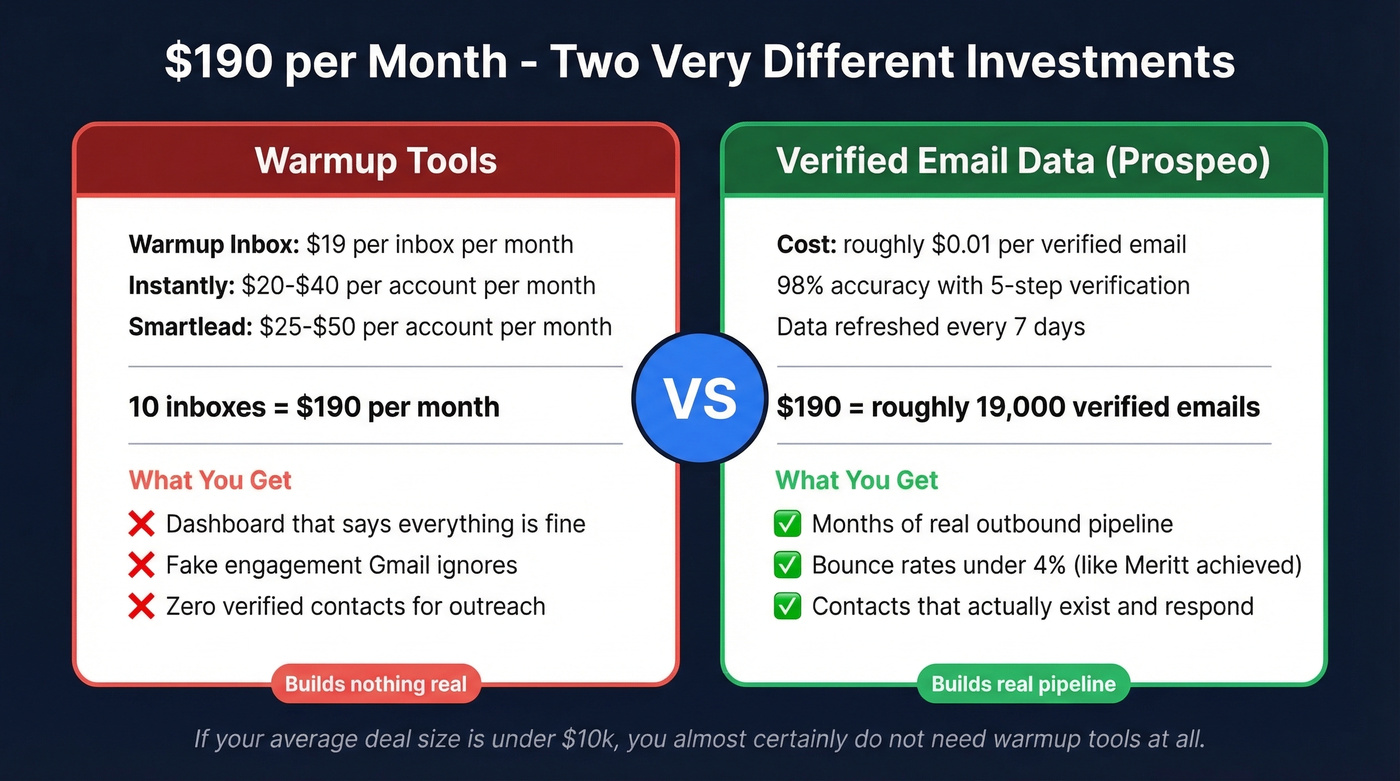
That same $190/month buys about 19,000 verified emails from Prospeo at roughly $0.01 per email - enough contacts for months of outbound campaigns. One investment builds pipeline with real, verified contacts. The other builds a dashboard you can't trust.
Hot take: If your average deal size is under $10k, you almost certainly don't need warmup tools at all. You need 50 well-targeted emails a day to verified addresses with proper authentication. That's it. The warmup industry exists because it's profitable, not because it works.
Spending $190/month on warmup dashboards instead of verified data is the cold email equivalent of buying a gym membership and never going.
Meritt went from 35% bounce rates to under 4% and tripled their pipeline - not with warmup tools, but with clean data. Prospeo verifies 143M+ emails, catches spam traps and honeypots, and refreshes every 7 days so you never send to a stale address.
The fastest deliverability fix is data that doesn't bounce.
Email Warmup FAQ
Is email warmup against Gmail's terms of service?
Yes. Google forced GMass to shut down its warmup system in 2023 and explicitly considers automated warmup a ToS violation. SMTP/IMAP-based tools operate in a gray area, but account restriction risk is real - especially after Gmail's November 2025 enforcement update.
How long does manual warmup take?
Four to eight weeks with proper authentication already configured. Start at 10-20 real emails per day, increase volume roughly 20% daily, and most senders hit stable capacity by week 4.
Can warmup fix a damaged domain reputation?
No. Automated warmup can't repair a burned domain. Stop sending, fix authentication errors, clean your list with a verification tool, and rebuild slowly with real engagement over several weeks.
Should you skip automated warmup entirely?
For most teams in 2026, yes. Manual volume ramping with verified data and proper authentication outperforms any automated warmup tool on the market. The money and time saved is better spent on list quality and personalization.
What's the safest daily sending limit for cold email?
Cap at roughly 50 cold emails per account per day. Start brand-new accounts at 2-3 sends daily and ramp gradually - about 20% increase per day - while monitoring bounce rates and spam complaints in Postmaster Tools.