

Ecommerce Demand Generation: Channels, Benchmarks, and What Actually Works
Your Meta ROAS has been declining for three quarters straight. The CFO's asking questions, and your "full-funnel strategy" slide from last year looks increasingly fictional. Ecommerce demand generation - the work of making people want your product before they're ready to buy - is the discipline that fixes this. Here's the framework: channels, numbers, and the measurement approach that keeps you from killing campaigns too early.
Why Demand Gen Is the Bottleneck
U.S. DTC sales hit $213B in 2024, and the market's still growing. But the playbook that got brands there - pump Meta, scale lookalikes, watch the ROAS - stopped working reliably around 2023. iOS privacy changes, rising CPMs, and audience saturation mean cold Meta traffic alone isn't profitable for most brands anymore.
More than 60% of buyers choose the brand they had in mind before they even start searching. If you aren't that brand, you're competing on price in someone else's funnel. Demand gen fixes that upstream problem. Lead gen is the email popup that captures visitors when they arrive - it's a different job entirely. Conflating the two leads to bad decisions (see Demand Generation vs Lead Generation).
The Channel Stack That Scales
Most ecommerce brands that scale profitably run three channels in sequence, not ten in parallel. Meta drives cold discovery at the top. Google Ads retargeting captures store visitors through Display-style retargeting and branded search, picking up people who discovered you on social and then Googled your name. Email and SMS close the loop with cart abandonment, browse abandonment, and post-purchase flows.
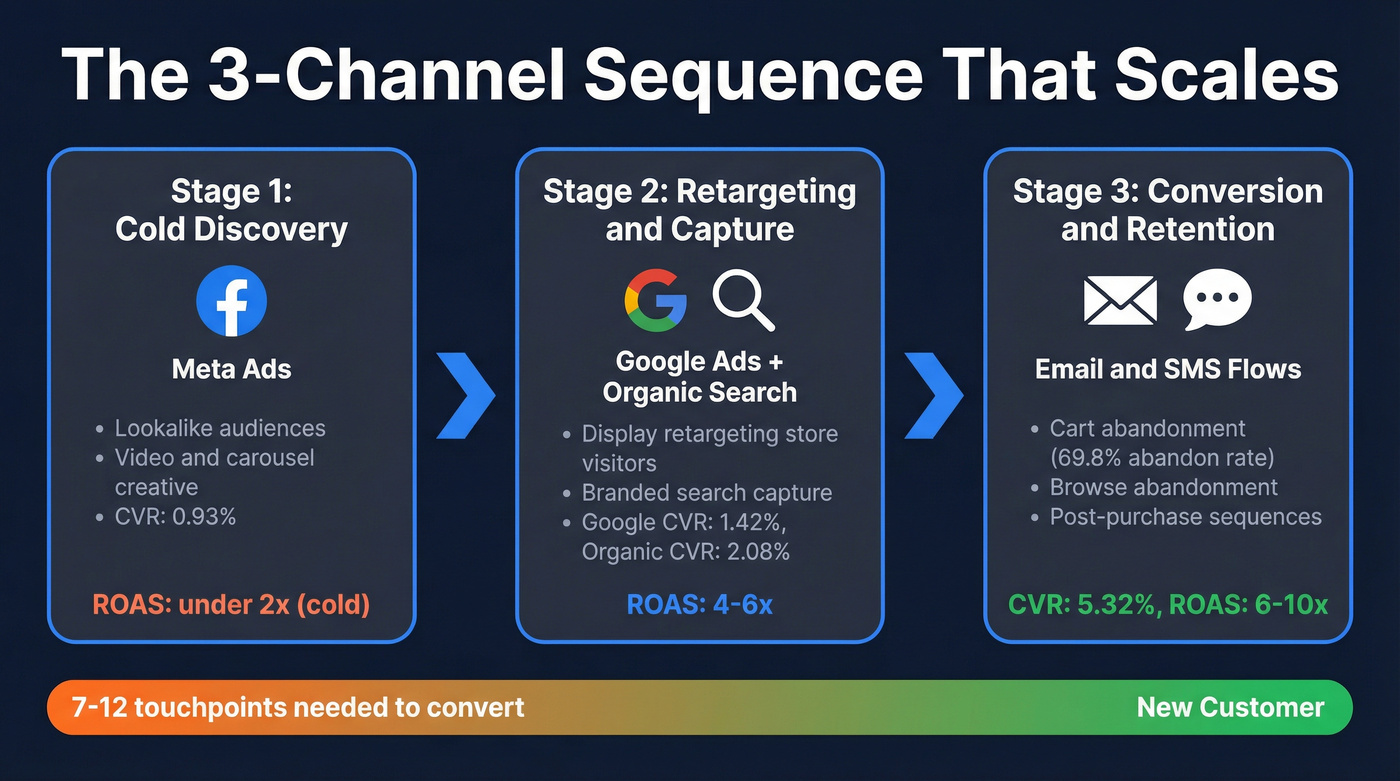
It takes 7-12 touchpoints on average to convert a new customer, which is why single-channel attribution always tells a misleading story. Organic and paid search together account for roughly 65% of ecommerce traffic, but email converts at 5.32% - about 3.7x the rate of Google Ads and roughly 5.7x Facebook.
| Channel | Avg CVR | ROAS Range | Funnel Role |
|---|---|---|---|
| Email/SMS | 5.32% | 6-10x | Conversion & retention |
| Organic search | 2.08% | - | Mid-funnel capture |
| Google Ads | 1.42% | 4-6x | Retargeting & branded |
| Facebook/Meta | 0.93% | <2x (cold) | Top-of-funnel discovery |
Email represents 10-15% of ad-attributed revenue for well-run stores, yet most brands underinvest in it. With a 69.8% cart abandonment rate across the industry, abandonment recovery alone can shift your blended economics meaningfully.
Then there's the mobile gap: 71% of traffic is mobile, but only 57% of revenue comes from mobile. That delta is where SMS shines. The brands still growing fast didn't rely on a single channel. Frank Body went from $5K to $20M in two years; Gymshark grew from $108K to $11.8M in four. Both built demand generation systems across multiple channels simultaneously.
Here's the thing: demand gen success is 80% distribution, 20% content creation. Most brands obsess over the creative and neglect the sequencing. Get the channel stack right first, then optimize the assets running through it.
Google Ads Demand Gen for Ecommerce
Google's Demand Gen campaign type places ads across YouTube, Discover, and Gmail - interruption-based inventory for top- and mid-funnel awareness. Think of it as your TOF/MOF accelerant, while PMax handles BOF conversion. They're complementary, not interchangeable. Google sunset Video Action Campaigns in 2024, pushing advertisers into Demand Gen, and a 2026 update added channel controls so you can choose where you show up.
Don't expect Search-level ROAS. Demand Gen's job is to feed warmer audiences into your Search, Shopping, and PMax campaigns downstream. Judge it on last-click and you'll kill it prematurely.
Setup that works: Start with one consolidated campaign to speed the learning phase. Use separate ad groups by channel - Shorts, In-Stream, Discover/Gmail - so you can read performance clearly. Layer customer lists, custom segments built from search terms, and lookalike audiences. Turn off Optimised Targeting for remarketing segments to keep audiences clean. Google's data shows advertisers adopting at least 3 of 4 best practices saw 40%+ more conversions on average. Cropp hit a 50% ROAS uplift by following the recommended audience and creative playbook.
Budget: Google recommends $100/day or 20x your target CPA - whichever is higher. Don't launch Demand Gen before your Search, Shopping, and PMax campaigns are solid. And don't launch it until you've got a retargeting funnel ready to catch the traffic it generates.

Your ecommerce demand gen funnel is only as strong as the contact data feeding it. Prospeo gives you 300M+ verified profiles with 98% email accuracy and 125M+ mobile numbers - so every touchpoint in your 7-12 touch sequence actually reaches a real buyer.
Stop generating demand you can't convert because of bad data.
Benchmarks Worth Knowing
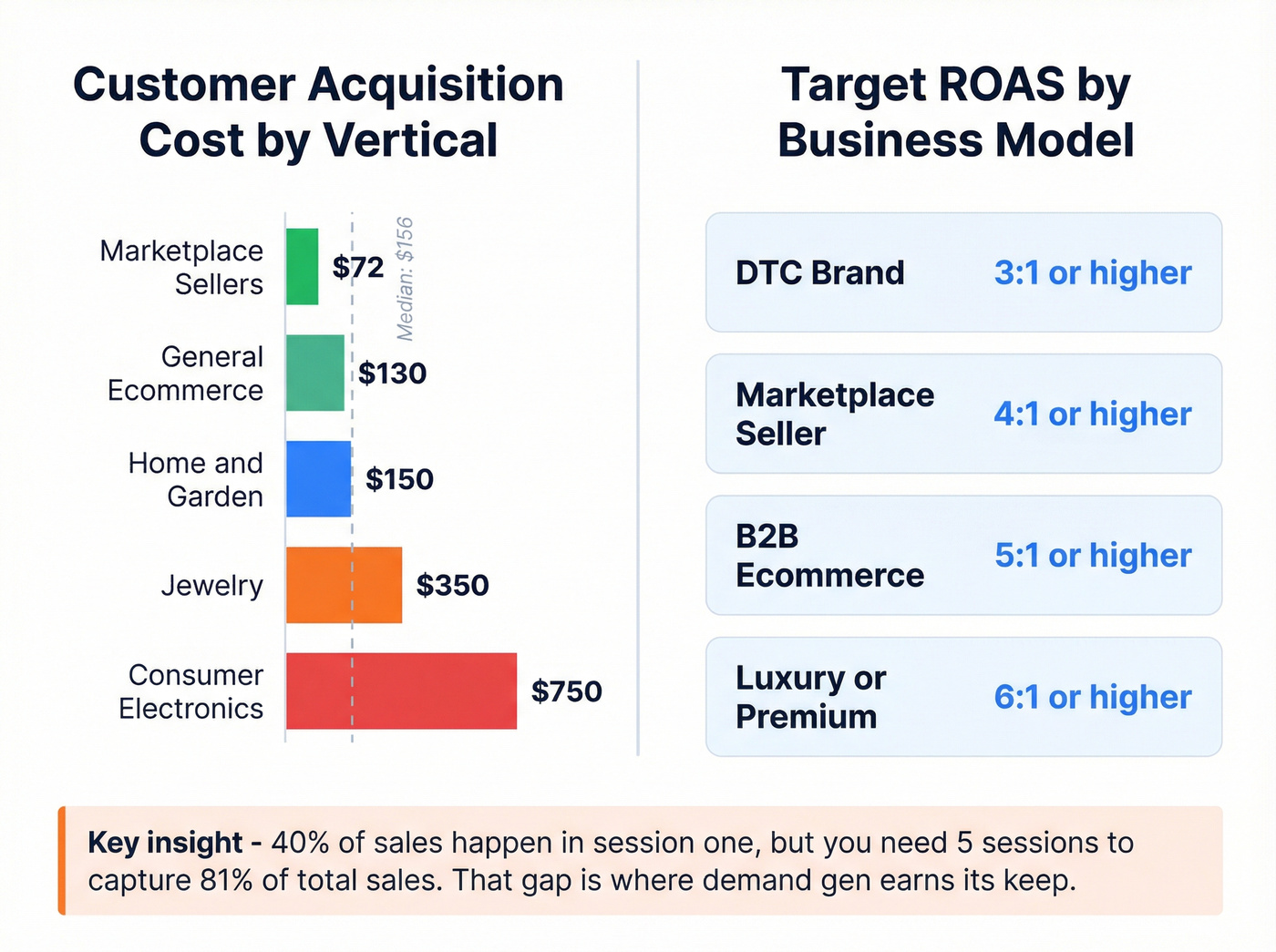
The median ecommerce CAC is $156, but vertical variation is massive (compare against broader Average CAC by Industry benchmarks):
| Vertical | Avg CAC |
|---|---|
| Marketplace sellers | $72 |
| General ecommerce | $130 |
| Home & garden | $150 |
| Jewelry | $350 |
| Consumer electronics | $750 |
ROAS targets vary by business model. A DTC brand running its own fulfillment needs different economics than a marketplace seller with lower margins.
| Business Model | Target ROAS |
|---|---|
| DTC brand | 3:1+ |
| Marketplace seller | 4:1+ |
| B2B ecommerce | 5:1+ |
| Luxury/premium | 6:1+ |
One stat that reframes everything: 40% of sales happen in a single session, but it takes up to 5 sessions to capture 81%. That remaining 41% between session one and session five is where demand gen earns its keep.
Measuring What Matters
Last-click attribution is the single biggest reason ecommerce brands kill demand gen too early. 73% of shoppers use multiple channels before buying, and roughly 30% of marketing budgets get misallocated when you rely on incomplete tracking.
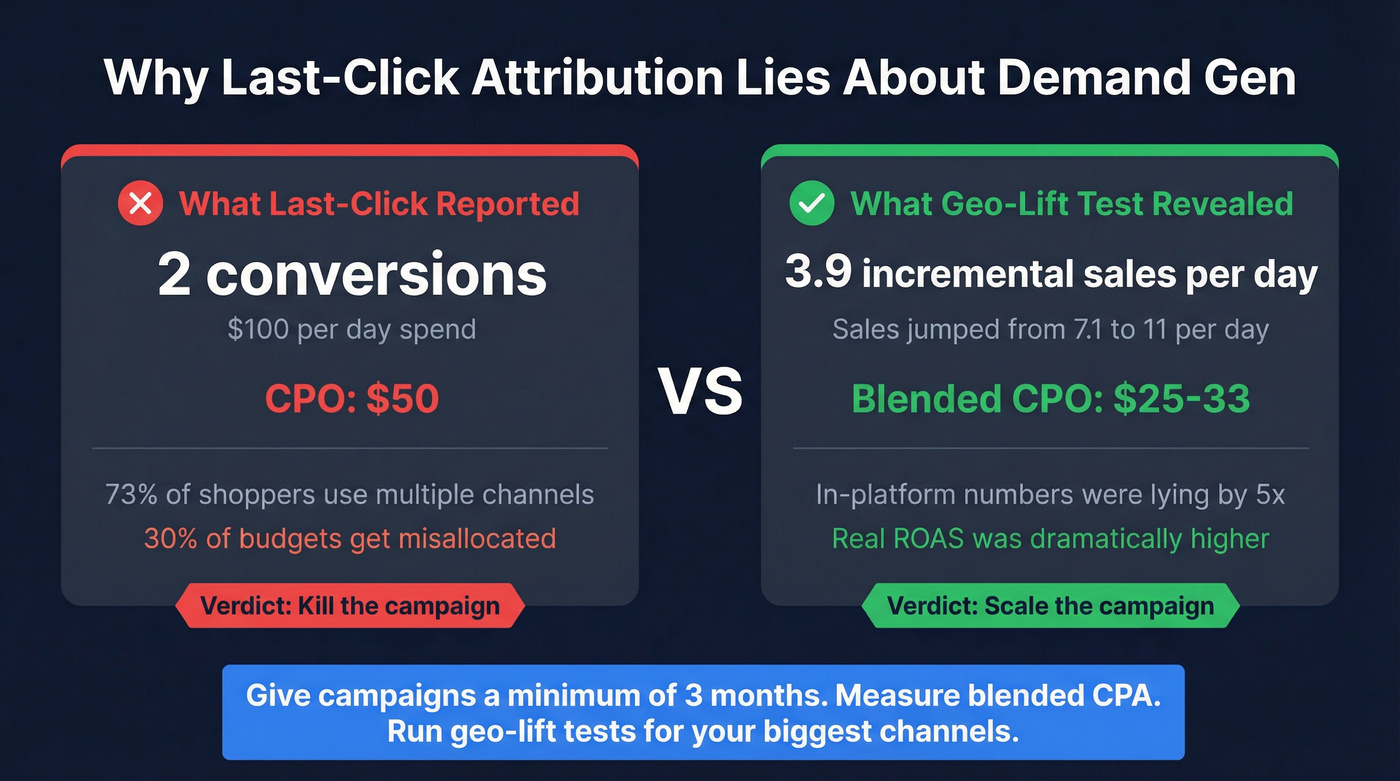
We've seen this play out firsthand. One geo-lift test told the real story: Google Ads reported just 2 conversions on a $100/day Demand Gen campaign, but real-world sales in the test region jumped from 7.1 to 11 per day - an uplift of nearly 4 sales daily, putting the blended CPO at $25-33. The in-platform numbers were lying by a factor of 5x. Reddit's r/PPC community is full of similar stories, with advertisers ready to kill Demand Gen campaigns that were actually driving significant incremental revenue invisible to last-click reporting.
In our experience, brands that run blended CPA as their primary metric and supplement with geo-lift tests for their biggest channels make dramatically better scaling decisions (more on demand generation metrics and B2B marketing measurement frameworks). Give campaigns a minimum of 3 months. Anything less and you're optimizing on noise.
5 Mistakes That Kill Campaigns
Budget too small. $10/day targeting all of the USA is burning money. You need $100/day minimum for Google Demand Gen, and Meta cold campaigns need similar scale to exit the learning phase.
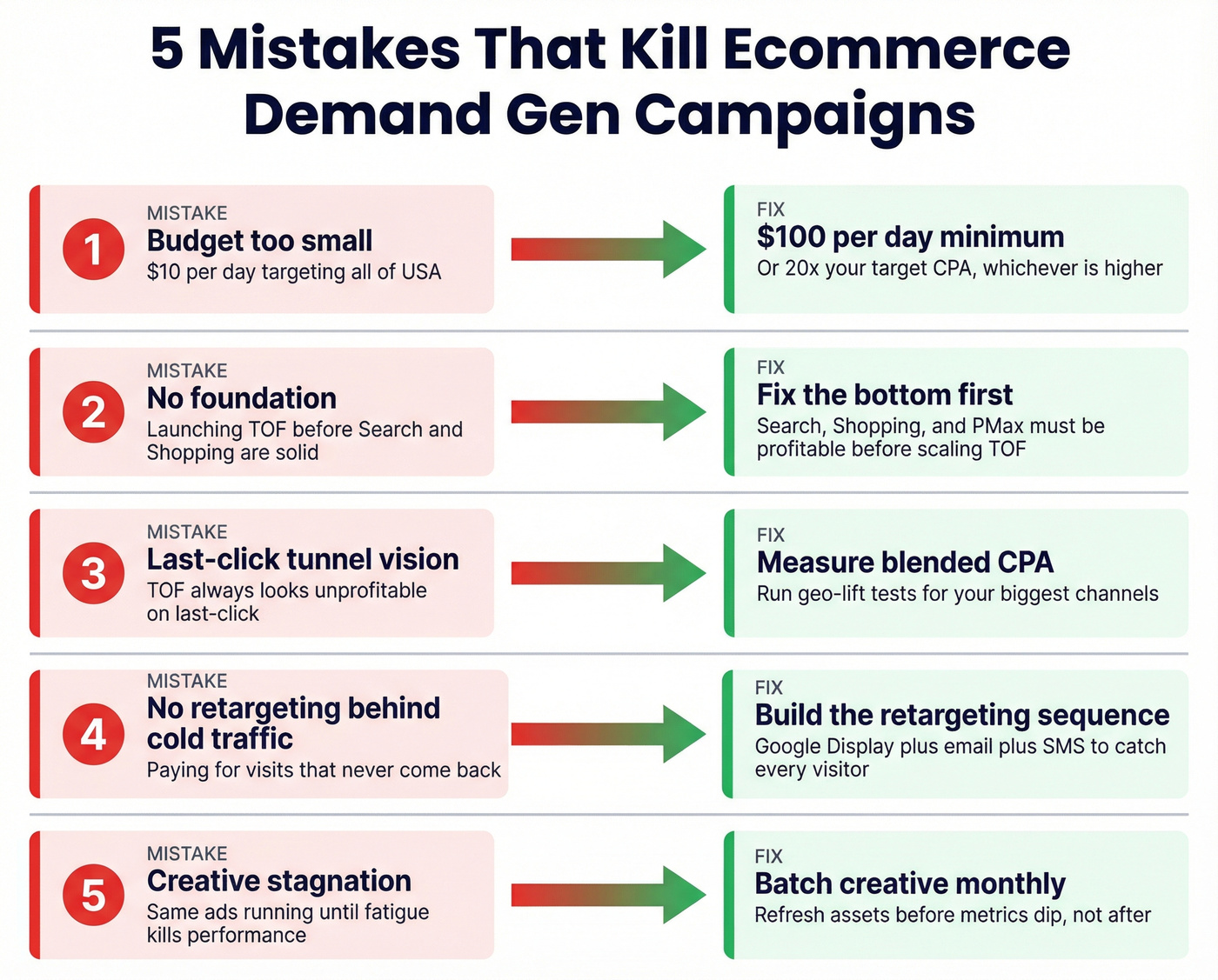
No foundation. Launching Demand Gen before Search and Shopping are solid means paying for awareness that leaks out the bottom. Fix the bottom of the funnel first (use a clear demand generation framework so sequencing doesn't break).
Last-click tunnel vision. TOF will always look unprofitable on last-click. Measure blended CPA or run lift tests - otherwise you'll cut the campaigns feeding your entire pipeline.
No retargeting behind cold traffic. Cold traffic needs a retargeting sequence - Google Display, email, SMS - to convert. Without it, you're paying for visits that never return. This is the most common mistake we see, and it's the most expensive one because the wasted spend compounds every day the gap stays open (see demand generation retargeting).
Creative stagnation. Demand Gen runs on visual inventory. If you aren't refreshing assets regularly, fatigue kills performance within weeks. Skip this problem by batching creative production monthly rather than scrambling when metrics dip.
Running multi-channel demand gen at scale means enriching thousands of leads across Meta, Google, and email without tanking deliverability. Prospeo's 7-day data refresh and 5-step verification keep bounce rates under control - the same way Stack Optimize hit 94%+ deliverability across all clients.
Protect your sender reputation with emails verified every 7 days.
FAQ
What's the difference between demand gen and performance marketing?
Demand gen creates awareness before purchase intent exists - top-of-funnel work that makes people want your product. Performance marketing captures existing intent at the bottom of the funnel. You need both. Demand gen fills the top; performance marketing converts what flows down. Most brands over-index on performance and starve the top, then wonder why CAC keeps climbing.
How long do campaigns take to show results?
Expect 60-90 days minimum. Top-of-funnel campaigns need time to build audience pools and influence downstream metrics like branded search volume and blended CPA. Cutting a campaign at 30 days almost guarantees you'll miss the payoff.
Can demand gen work for B2B ecommerce?
Absolutely. B2B ecommerce demand generation combines paid channels with outbound prospecting. Tools like Prospeo help identify decision-makers at target accounts with verified emails and intent data - a tactic that doesn't exist in DTC but drives measurable pipeline for wholesale and B2B storefronts.
What's a realistic budget to start?
Allocate at least $100/day per channel - $3,000/month minimum for Google Demand Gen alone. Below that threshold, the algorithm can't exit the learning phase fast enough to deliver meaningful data. Pair it with an existing Search/Shopping foundation and a retargeting funnel to capture the traffic it generates.