

How to Build a Demand Generation Framework That Actually Has Numbers in It
CAC is up 40-60% since 2023. The average B2B deal now takes 62.4 touches across 3.6 channels, involves 6.3 contacts, and drags on for 192 days. And most demand generation framework guides floating around are just funnel diagrams with no dollar amounts attached. That's not a framework - it's a poster.
The Short Version
- Prepare, Create, Capture, Measure. Four stages. That's the framework.
- Only 3-5% of your market is buying right now. Demand creation matters more than capture.
- Budget 10% of revenue to marketing, with 34-38% going to demand gen once you're past $5M ARR.
- Your framework is dead on arrival if your contact data bounces. Bad emails mean wasted touches, torched sender reputation, and inflated CPL.
The benchmarks table below has the actual numbers.
Why Most Frameworks Fall Flat
Most frameworks you'll find are conceptual. They show you a funnel, label the stages, maybe throw in "awareness, consideration, decision" like that's actionable. None of them tell you what it costs, how long it takes, or where the money goes.
B2B SaaS CAC now averages $536 per customer for startups, and enterprise deals can stretch 6-18 months. The Dreamdata benchmark of 62.4 touches over 192 days means your demand generation model needs to orchestrate half a year of multi-channel engagement per deal. A funnel diagram doesn't do that. A budget spreadsheet does.
Here's the thing: most teams don't need a more sophisticated strategy. They need a plan with actual numbers and the discipline to fund demand creation instead of dumping everything into capture. The companies in practitioner communities reporting 27-268% pipeline growth from demand gen aren't running exotic plays - they're running the basics with real budgets behind them.
Demand Gen vs. Lead Gen vs. Demand Capture
These three terms get used interchangeably, and it causes real confusion.
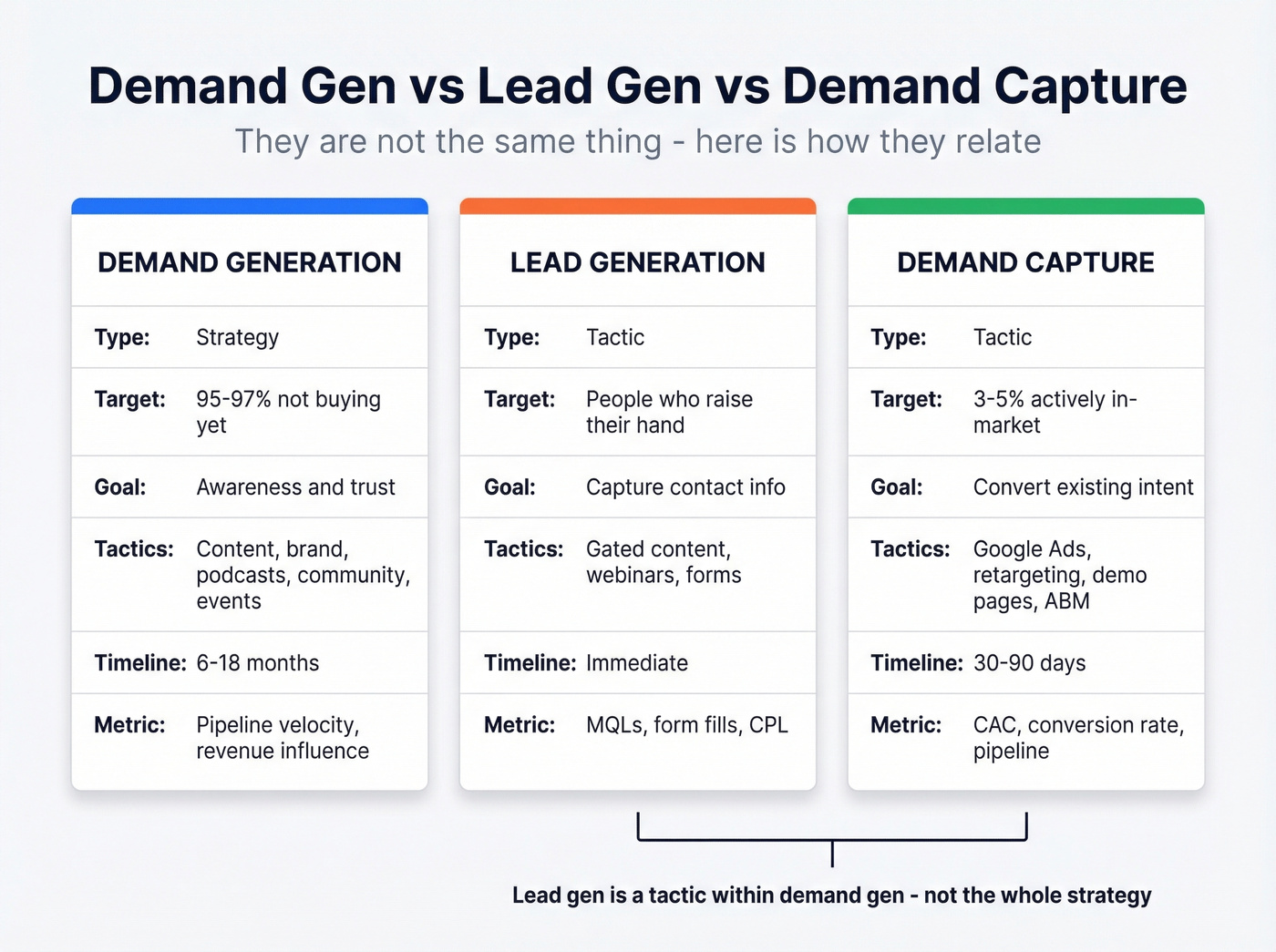
Demand gen is a strategy. It builds awareness and trust across the 95-97% of your market that isn't buying yet - content, brand, education, community. The long game. Lead gen is a tactic within that strategy: it captures contact information from people who've raised their hand, optimized for volume, often at the expense of quality. Demand capture targets the 3-5% who are actively in-market right now - Google Ads, retargeting, bottom-funnel content, demo pages.
Use a demand creation model when you're building a category or entering a new market. Use demand capture when you've got brand recognition and need to convert existing intent. Use lead gen as the mechanism to bridge the two - but never mistake it for the whole strategy.

Your framework maps 62 touches across 192 days - but none of that matters if emails bounce. Prospeo's 98% accuracy and 7-day data refresh keep every nurture sequence and ABM tier alive. At $0.01 per verified email, your CPL drops instead of your sender reputation.
Stop funding a demand gen framework built on dead email addresses.
The 4-Stage Framework
Stage 1 - Prepare (ICP + Buyer Journey)
Everything starts with knowing who you're targeting and how they buy. Run an 80/20 analysis: which 20% of your customers drive 80% of your revenue? That's your ICP focus.
If you need a tighter definition, start with an Ideal Customer Profile scoring rubric before you map channels and budgets.
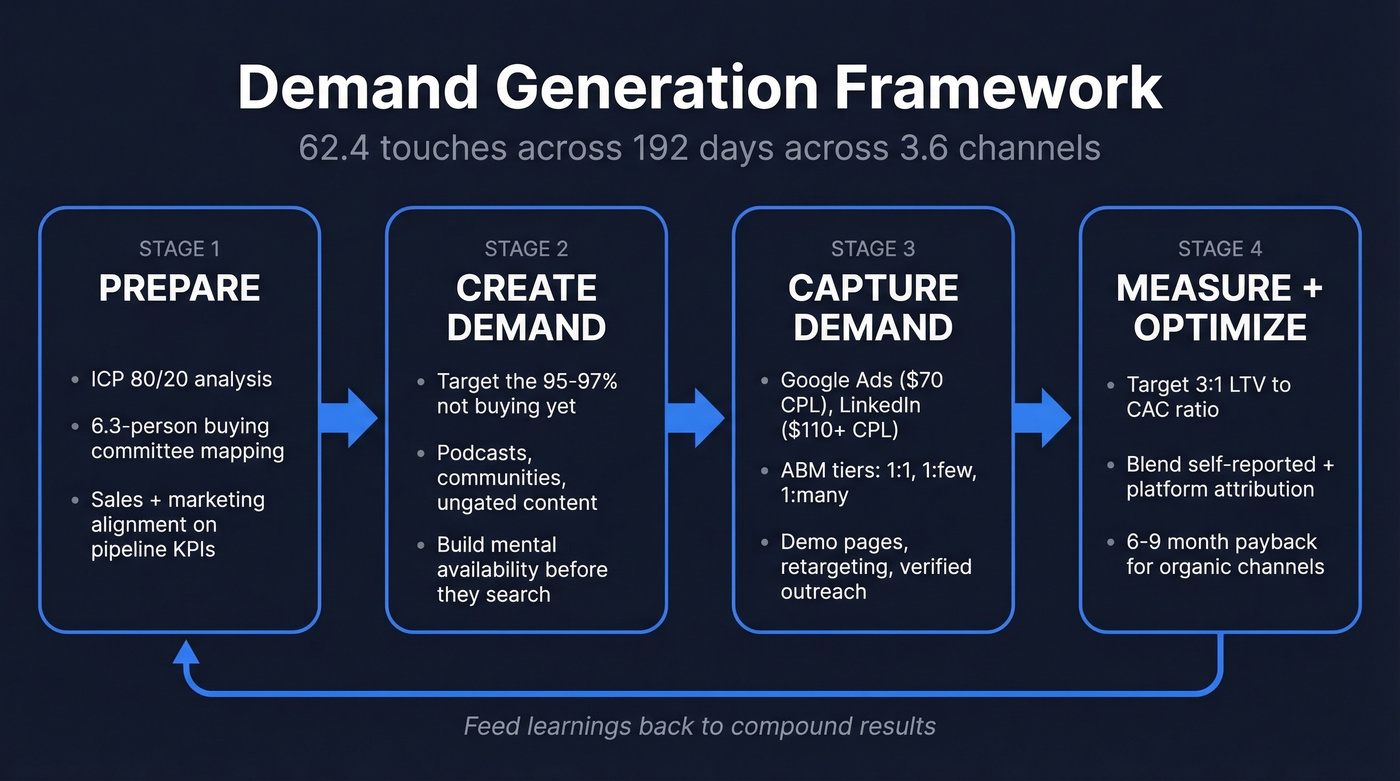
Map the buyer journey for that ICP. The average B2B deal involves 6.3 contacts - you're not marketing to one person, you're multi-threading into a buying committee. Define the roles: champion, economic buyer, technical evaluator. Map the channels each one trusts. And align sales and marketing on shared pipeline KPIs from day one, because a framework with two teams pulling in different directions is just an expensive argument. This preparation phase also forces you to sharpen your value proposition - the specific problem you solve, for whom, and why your approach is different - before a single dollar gets spent on distribution.
Stage 2 - Create Demand
This is where most teams underinvest. Only 3-5% of your market is actively looking to buy. Worse, one widely-circulated benchmark says 41% of B2B buyers have a single vendor in mind when they start the buying process, and 92% have a shortlist locked before formal evaluation begins.
If you're not in the conversation early, you're not in the conversation at all.
Demand creation means showing up where your ICP learns - podcasts, communities, ungated content, thought leadership, events. The goal isn't a form fill. It's mental availability: being the name that surfaces when the buyer finally enters the market.
Gartner projected a 25% drop in traditional search volume by 2026, and early data from companies optimizing for AI-powered discovery backs that up - one SaaS company went from 500 to 3,500 AI-referred trials per month in seven weeks after restructuring content for AI citation. Your content needs to be built for both traditional SEO and AI discoverability. If you're rebuilding the engine, treat it like B2B content marketing with distribution baked in, not a blog calendar. One more stat worth paying attention to: fewer than 10% of sources cited in AI answers rank in the top 10 Google organic results for the same query. That changes what "visibility" means.
Stage 3 - Capture Demand
Once you've created awareness, capture converts it. Paid search runs around $70 CPL on Google Ads; LinkedIn campaigns start at $110+ CPL. Demo request pages and ABM motions round out the capture layer.
ABM layers in with tiered targeting: 1:1 for your top 10-50 accounts, 1:few for 50-200, and 1:many for 200-1,000+. 76% of top B2B companies run both demand gen and ABM under unified revenue goals - they're not competing motions. If you're operationalizing this, borrow from account-based selling best practices so targeting and messaging stay consistent.
Both ABM and paid capture depend on reaching the right person at a valid address. That's where most programs quietly die. If your emails bounce, your nurture sequences collapse and your sender reputation craters. We've seen teams fix this overnight by switching to verified data with a short refresh cycle - Prospeo's 98% email accuracy and 7-day refresh keeps capture motions alive at roughly $0.01 per verified email. (If you want the mechanics, start with email bounce rate benchmarks and fixes.)
Stage 4 - Measure and Optimize
The benchmark for sustainable growth is an LTV:CAC ratio of 3:1. Below that, you're buying growth at a loss. Above 5:1, you're probably underinvesting.
Attribution over 192-day cycles is genuinely hard. No model is perfect when a deal touches 62 interactions across 3.6 channels. We've found the most practical approach is blending self-reported attribution with platform data, then reconciling quarterly rather than obsessing over per-touch credit. The teams that measure demand gen well are the ones that accept imperfect attribution and focus on directional trends - pipeline velocity, CAC by channel cohort, and revenue influence - instead of chasing per-touch precision. To keep reporting honest, align on a small set of funnel metrics that map to revenue.
Expect 6-9 months for organic channels to show payback. Paid channels produce faster signals but at higher cost. Build your measurement cadence around those timelines, not monthly MQL dashboards that tell you nothing about revenue. This final stage is what separates a repeatable process from a one-off campaign: you feed learnings back into Stages 1-3 and compound results over time.
What Demand Gen Actually Costs
Median B2B companies spend 10% of revenue on marketing, with the top quartile pushing 16-20%. Companies under $5M revenue typically allocate 14%.
If you're pressure-testing spend, it helps to sanity-check against cost to acquire customer definitions and inputs (not just blended CAC).
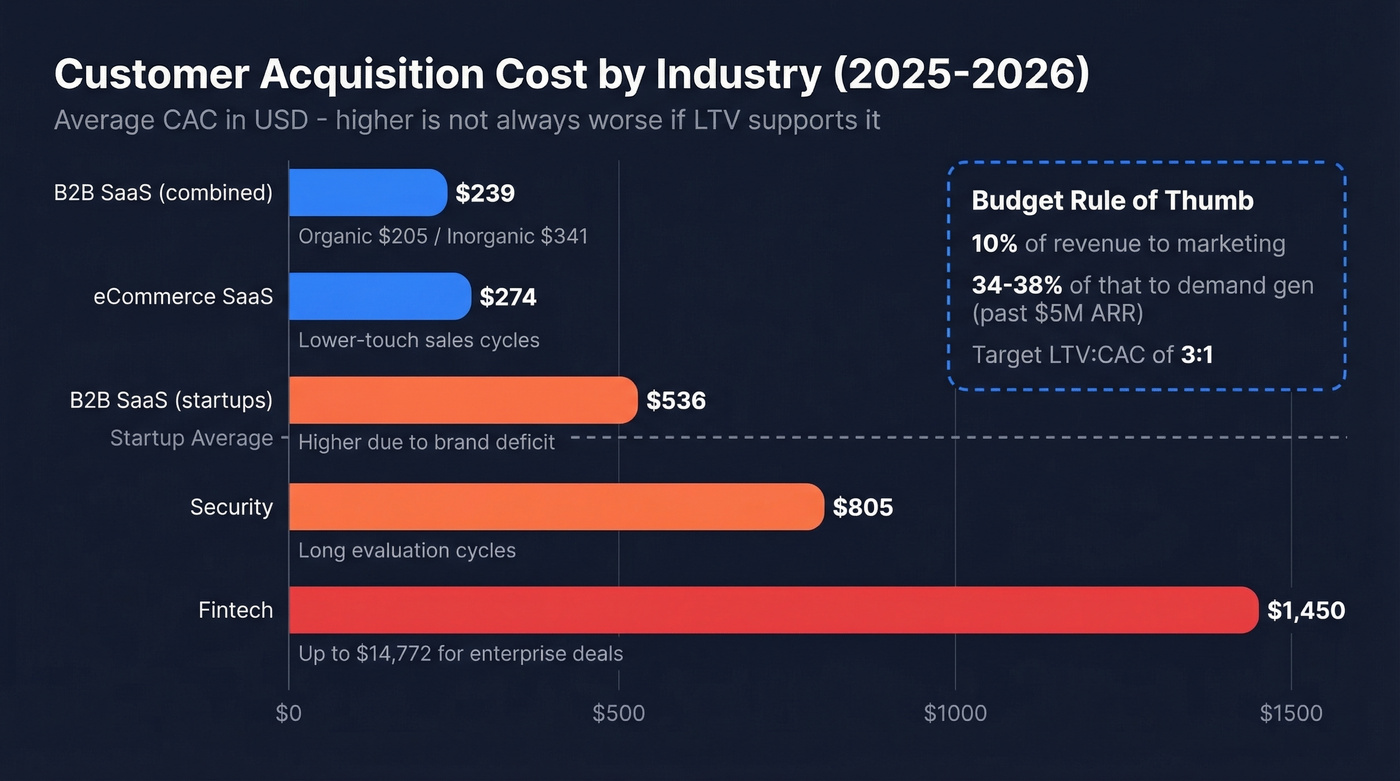
CAC by Industry
| Industry | Avg CAC | Notes |
|---|---|---|
| B2B SaaS (combined) | $239 | Organic $205 / Inorganic $341 |
| B2B SaaS (startups) | $536 | Higher due to brand deficit and smaller organic channels |
| Fintech | $1,450 | Up to $14,772 enterprise |
| eCommerce SaaS | $274 | Lower-touch sales cycles |
| Security | $805 | Long eval cycles |
CPL by Channel
| Channel | Avg CPL |
|---|---|
| Google Ads | ~$70 |
| LinkedIn Ads | $110+ |
| All-channel avg | $84 |
For budget allocation, a solid starting model: 40-50% to ads, 20-30% to content and SEO, 15-20% to events and enablement, 10-15% to martech. Demand gen's share of the total marketing budget typically lands at 34-38% for companies past $5M revenue, then drops to 29-30% above $100M as events and channel marketing take a bigger slice.
Five Mistakes That Kill the Program
1. Broken handoffs destroy speed-to-lead. Marketing generates the lead, but sales doesn't follow up fast enough. Fix: set a clear SLA, enforce it, and measure it weekly. If you need a baseline process, use a handoff email template to standardize what sales receives.
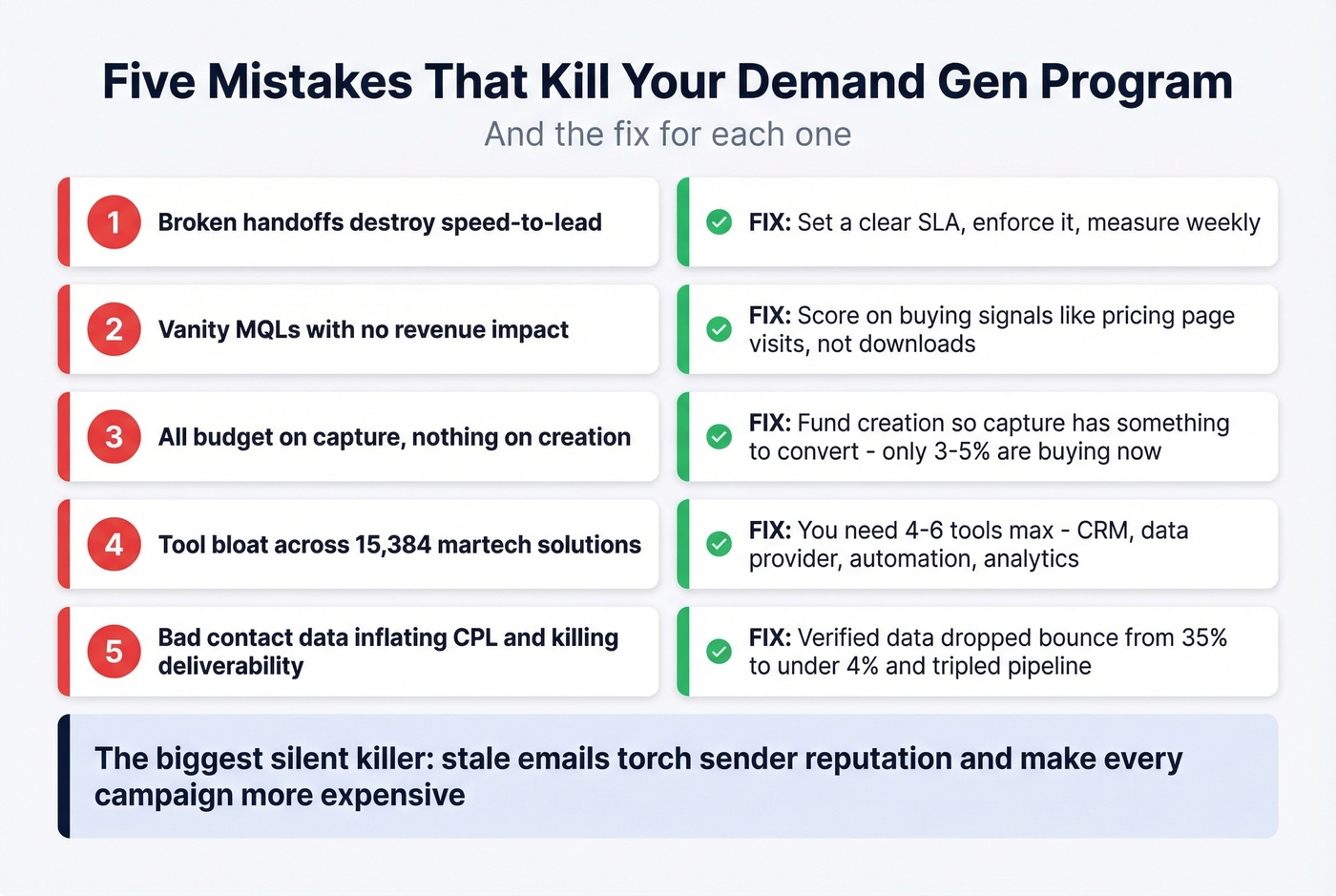
2. Vanity MQLs with no revenue impact. If your MQLs don't turn into pipeline, your scoring model is broken. Score on buying signals like pricing page visits and multi-stakeholder engagement, not content downloads. A simple lead scoring model usually fixes this faster than adding more tools.
3. All budget on capture, nothing on creation. You're fighting over 3-5% of the market and wondering why CPL keeps climbing. Fund demand creation so capture has something to convert.
4. Tool bloat. There are 15,384 martech solutions on the market. You need 4-6: a CRM, a data provider, marketing automation, analytics, and maybe an ABM platform. That's it. If you're auditing your stack, start with data enrichment services and work outward.
5. Bad contact data inflating CPL and killing deliverability. Meritt went from a 35% bounce rate to under 4% and tripled pipeline to $300K/week after switching to verified data. Snyk saw similar results: AE-sourced pipeline jumped 180% and bounce rates dropped from 35-40% to under 5% after fixing their data foundation. Stale emails don't just bounce - they torch your sender reputation and make every subsequent campaign more expensive. If you're cleaning this up, prioritize email deliverability and improve sender reputation before you scale volume.
Start Building
A demand generation framework isn't a funnel diagram. It's a budget, a timeline, and a measurement plan with real numbers behind it. You now have the CAC benchmarks, the CPL ranges, the budget splits, and the mistakes to avoid.
Let's be honest about what ties it all together: every touch in that 62-touch, 192-day process depends on reaching the right person at a valid address. Get the data right and the framework works. Get it wrong and you're just burning budget with extra steps.
Multi-threading into 6.3-person buying committees requires real contact data for every stakeholder. Prospeo gives you 300M+ profiles with 30+ filters - buyer intent, job changes, department headcount - so your ICP targeting in Stage 1 actually connects to reachable people in Stage 3.
Reach the full buying committee, not just the one contact who bounces.
FAQ
What's the difference between demand generation and lead generation?
Demand gen builds awareness across the 95-97% not buying yet; lead gen captures contact info from the 3-5% who are ready. Demand gen is the strategy, lead gen is one tactic within it. Most teams over-index on lead gen and starve creation, which inflates CAC over time.
How much should I budget for demand gen?
Median B2B companies spend 10% of revenue on marketing, with 34-38% allocated to demand gen after $5M ARR. Startups often push 30-50% of total revenue into marketing. Those benchmarks give you a defensible starting point for board-level conversations.
How long does a demand generation framework take to show results?
Expect 6-9 months for organic channels and 192 days for the average B2B deal cycle. Paid channels produce faster signals - $110+ CPL on LinkedIn versus ~$70 on Google Ads - but cost more per lead. Measure progress in quarters, not weeks.
What tools do I need for demand generation?
A CRM like HubSpot or Salesforce, a verified data provider like Prospeo for accurate contact enrichment, marketing automation, and an analytics platform. Four core tools. You don't need 15,000 martech solutions - you need the right four working together.