

Elevator Pitch Templates That Actually Work (Fill-In Scripts)
You're at a conference. Someone important - exactly the kind of person you wanted to meet - turns to you and asks, "So, what do you do?" Your brain locks up. You start rambling about your "journey," toss in some buzzwords, and by the time you find your actual point, they're scanning the room for someone else to talk to.
You need an elevator pitch template that fits your actual situation, not a generic fill-in-the-blank from a college career center. We've put together seven of them. (If you want more variations, here are sample elevator pitches you can steal and customize.)
One person on r/interviews described their "tell me about yourself" answer stretching to five full minutes - two minutes on their "brand," another three connecting experience to the role. That's not a pitch. That's a TED talk nobody asked for.
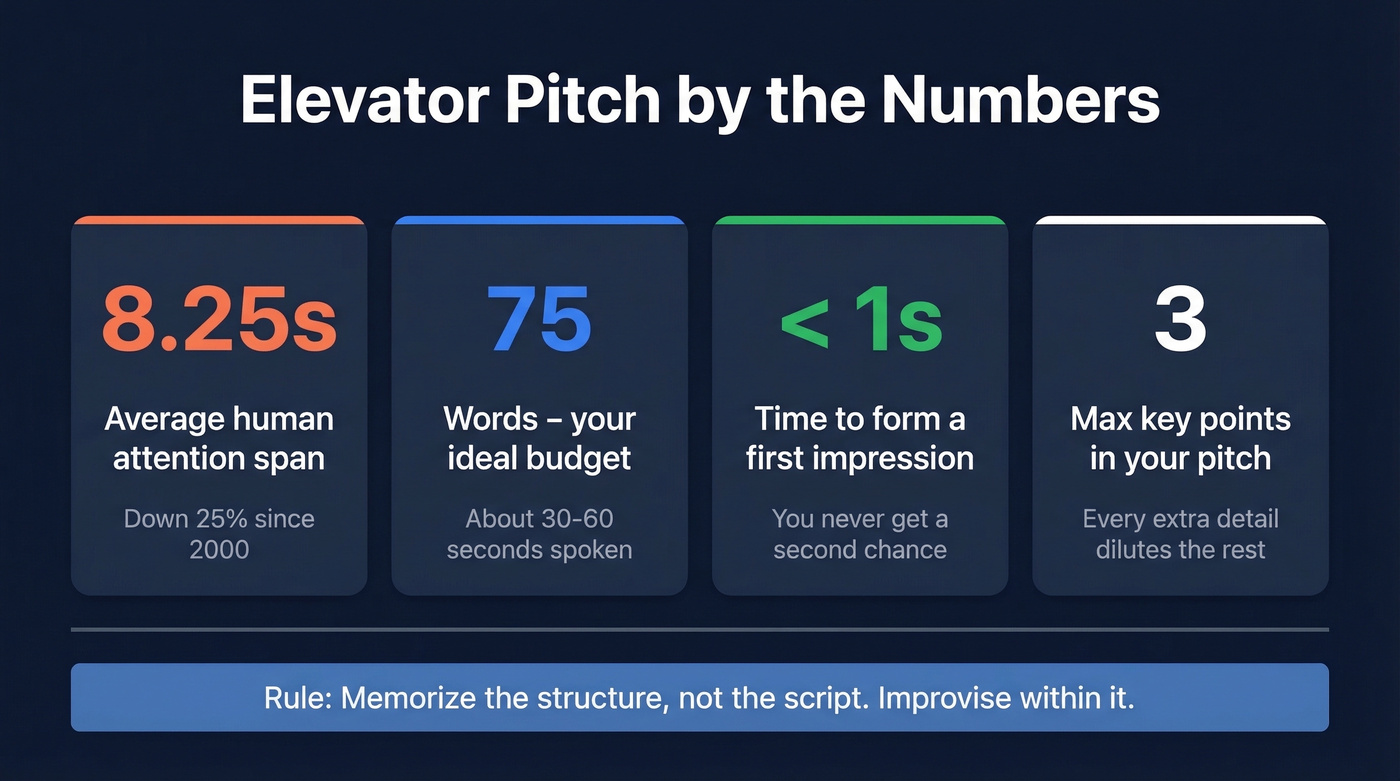
Human attention spans have dropped roughly 25% since 2000, from about 12 seconds down to 8.25 seconds by 2015. Research shows first impressions form in under a second. You don't get to "build up" to your point. Seventy-five words is a great budget - much longer and it stops being an elevator pitch and turns into a monologue.
What You Need (Quick Version)
- Your pitch should be around 75 words - typically 30-60 seconds at a natural speaking pace.
- Pick a framework: Problem-Solution works great for job seekers, PAS for sales, AIDA for founders.
- Memorize the structure, not the script. Improvise within it.
- Jump to your template: Job Seeker | Career Changer | Networking | [Sales / B2B](#sales - b2b-cold-outreach) | [Startup Founder](#startup-founder - investor-pitch) | One-Sentence | [Written / Email](#written-pitch-email - professional-profile)
What Makes a Great Pitch
The best pitches share three qualities - what Boston University's career team calls the 3 C's: clarity, conciseness, and confidence. Clarity means a stranger understands what you do without Googling jargon. Conciseness means keeping it to around 75 words. Confidence means you sound like you believe what you're saying, not like you're reading off a cue card.
What does confidence actually look like? It's pausing instead of filling silence with "um." It's making eye contact instead of staring at the floor. It's stating "I built a content engine that drove 40% of pipeline" instead of "I was kind of involved in some content stuff." Confidence isn't volume - it's specificity.
A 2026 systematic review in Springer analyzed a decade of pitch research and found the evidence is still conflicting on whether logic or emotion wins. The practical takeaway: use both. Lead with a rational structure, deliver it with energy. That combination outperforms either approach alone.
Once you nail the structure, experiment with your delivery style. Some pitches land better when they're stat-heavy and precise. Others work best as a quick story or even a light joke. We've heard hundreds of pitches at events, and the ones that stick always match the speaker's natural energy - not some template voice they borrowed from a YouTube video.
Choose Your Pitch Formula
Not every pitch needs the same skeleton. The right framework depends on what you're trying to accomplish.
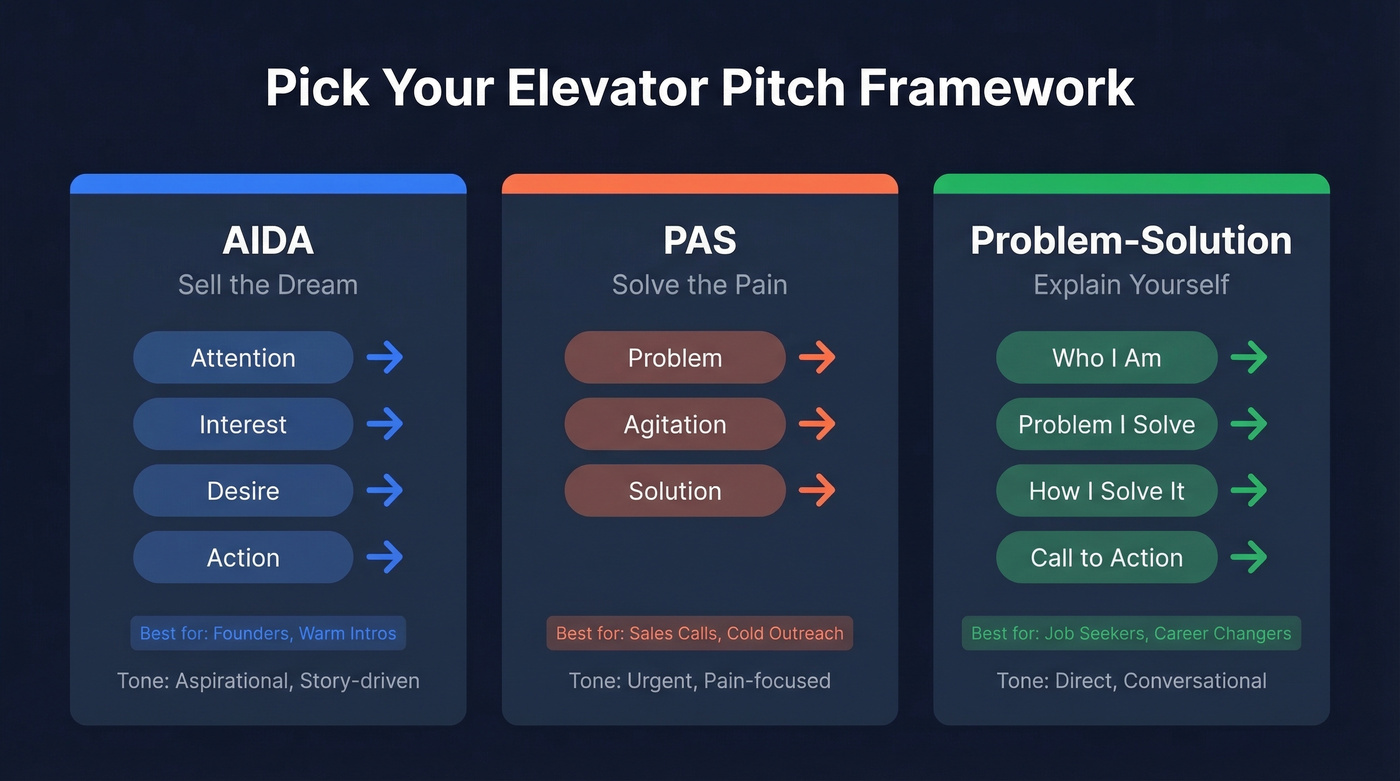
| Framework | Structure | Best For | Tone |
|---|---|---|---|
| AIDA) | Attention → Interest → Desire → Action | Founder networking, warm intros | Aspirational, story-driven |
| PAS | Problem → Agitation → Solution | Sales calls, cold outreach | Urgent, pain-focused |
| Problem-Solution | Who I am → Problem I solve → How → CTA | Job seekers, career changers | Direct, conversational |
Selling a dream? AIDA. It builds desire before asking for anything. Solving a pain? PAS. It makes the problem feel urgent, then positions you as the fix. Explaining yourself? Problem-Solution. It's the simplest structure and the hardest to screw up.
CrazyEgg's breakdown puts it well: AIDA works for aspirational, story-driven content while PAS works for direct-response situations where the prospect already feels the pain. For job seekers or career changers, Problem-Solution keeps things conversational without the sales pressure that PAS can create.
How to Craft Your Pitch Step by Step
Pick Your Hook
Your first sentence does one job: stop someone from mentally checking out. Four hook types that work:
- Surprising stat: "Did you know 68% of B2B emails never get a reply?"
- Pain question: "Ever spend an hour prepping for a call, only to hit voicemail?"
- Mutual referral: "Sarah mentioned you're scaling your outbound team - I help with exactly that."
- Mini case study: "We helped a 10-person sales team triple their pipeline in 90 days."
Pick one. Don't stack them.
Fill the Middle
After the hook, you've got about 15-20 seconds to cover three things: the problem, your solution, and one piece of proof. Monday.com's sales team breaks it down by seconds:
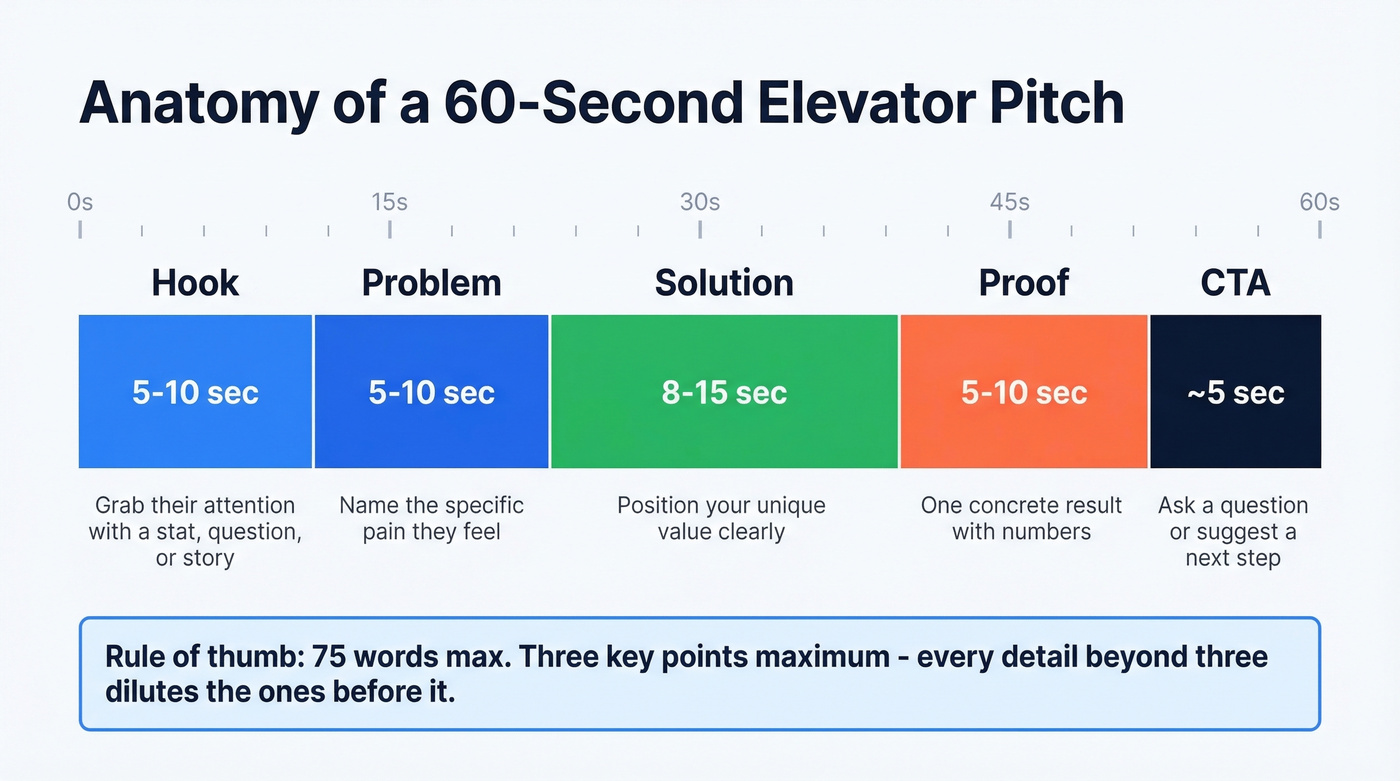
| Component | Time | Purpose |
|---|---|---|
| Hook | 5-10s | Grab attention |
| Problem | 5-10s | Name the pain |
| Solution | 8-15s | Position your value |
| Social proof | 5-10s | Build credibility |
| CTA | ~5s | Start a conversation |
Stick to three key points maximum. Every detail beyond three dilutes the ones before it. If you're struggling to identify your proof points, use the STAR method to mine your experience for concrete results - Situation, Task, Action, Result.
Land the Close
Your pitch isn't a speech - it's a conversation starter. End with a question or a specific next step:
- "Can I send you a one-pager?"
- "Are you free for 15 minutes Thursday?"
- "What's your biggest challenge with [topic] right now?"
A pitch without a CTA is just a monologue that ends awkwardly. And pay attention to how the other person reacts while you're talking. If their eyes light up at your proof point, lean into that. If they look confused, simplify. The best pitchers adjust in real time - they don't just recite.

A great elevator pitch gets you 30 seconds of attention. But after the handshake, you need verified contact data to follow up. Prospeo gives you 98% accurate emails and 125M+ direct dials so your pitch actually turns into a pipeline.
Don't let a perfect pitch die in a LinkedIn request.
7 Elevator Pitch Templates
Job Seeker ("Tell Me About Yourself")
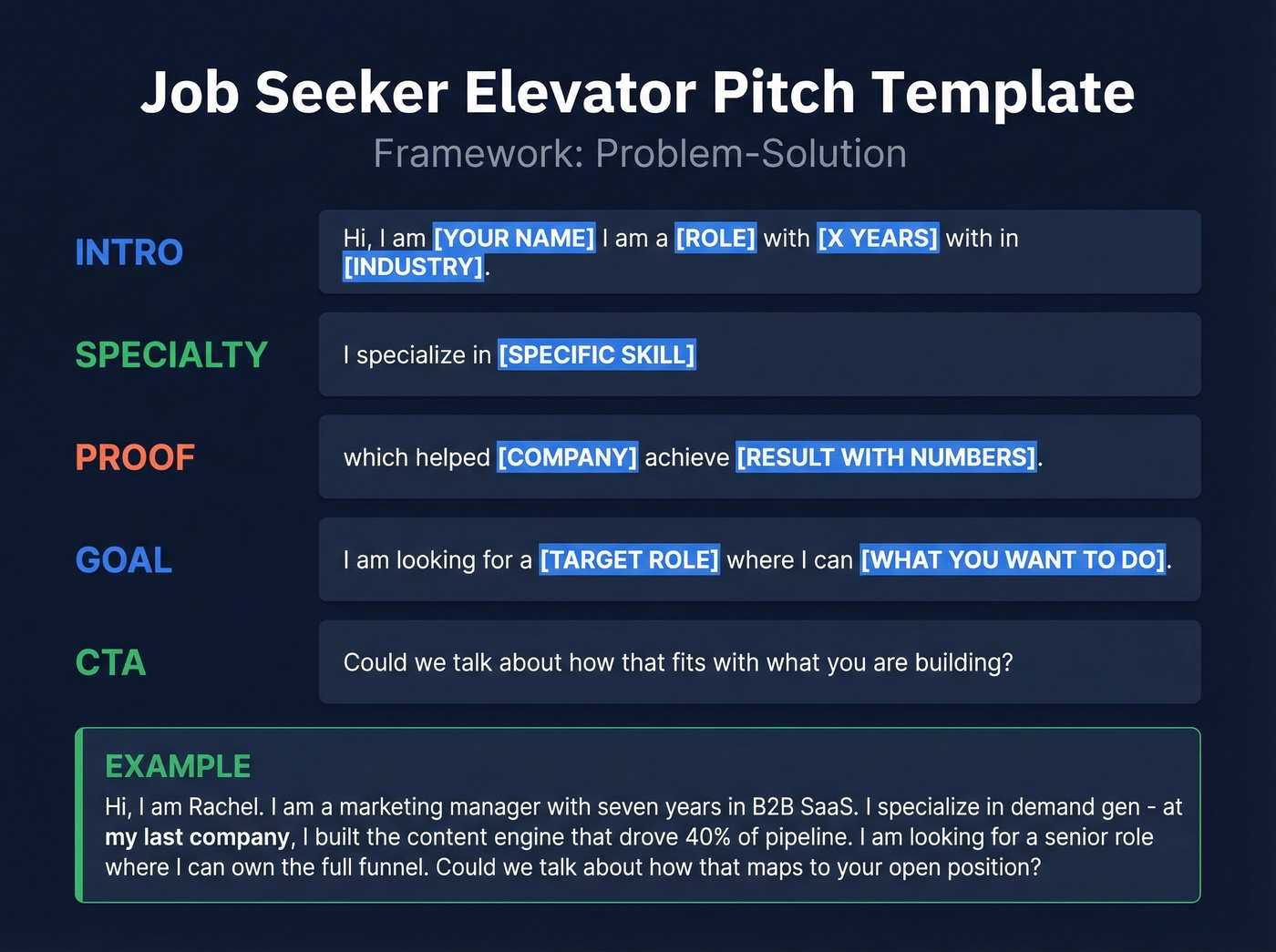
Framework: Problem-Solution
Template:
Hi, I'm [name]. I'm a [role] with [X years] of experience in [industry/skill]. I specialize in [specific thing you do well], which helped [previous company] achieve [specific result with numbers]. I'm looking for a [target role] where I can [what you want to do next]. Could we talk about how that fits with what you're building?
Filled example:
Hi, I'm Rachel. I'm a marketing manager with seven years in B2B SaaS. I specialize in demand gen - at my last company, I built the content engine that drove 40% of pipeline. I'm looking for a senior role where I can own the full funnel, not just top-of-funnel content. Could we talk about how that maps to your open position?
Use this for interviews, career fairs, and any "tell me about yourself" moment.
Career Changer
This one trips people up because they feel like they need to justify the pivot. You don't. You need to connect the dots. General Assembly's 4-step structure nails it: Introduce, previous experience, connect the dots, introduce the change.
Template:
I'm [name], and I've spent the last [X years] in [previous field] doing [what you did]. What I loved most was [transferable skill/interest]. That skill translates directly to [new field], so I've been [what you've done to prepare]. I'm now looking for [specific role] where I can bring that [skill] to [new industry].
Filled example:
I'm Jordan, and I've spent five years managing social media for a lifestyle brand - growing our audience from 12K to 200K. What I loved most was understanding what makes people choose one product over another. That's brand management, not just social. I completed a brand strategy certification and I'm now looking for a brand manager role in health food.
Never apologize for the pivot. Your job is to connect the dots so the listener sees the logic before you spell it out.
Networking Event
Framework: AIDA
Template:
[Attention - surprising fact or question]. I'm [name], a [role] who [what you do in one line]. [Interest - one specific result or project]. [Desire - what you're working on next]. I'd love to hear what you're focused on - can we grab coffee this week?
Filled example:
Most product teams ship features nobody asked for - I help them stop. I'm Alex, a product designer at a mid-stage fintech. Last quarter, I redesigned our onboarding flow and cut drop-off by 35%. Right now I'm exploring how AI can speed up user research. I'd love to hear what you're working on - can we grab coffee this week?
Networking pitches should feel like the start of a conversation, not a sales call. Talk for 30 seconds, then ask a genuine question. You'll outperform 90% of the room.
Sales / B2B Cold Outreach
Framework: PAS + Monday.com timing
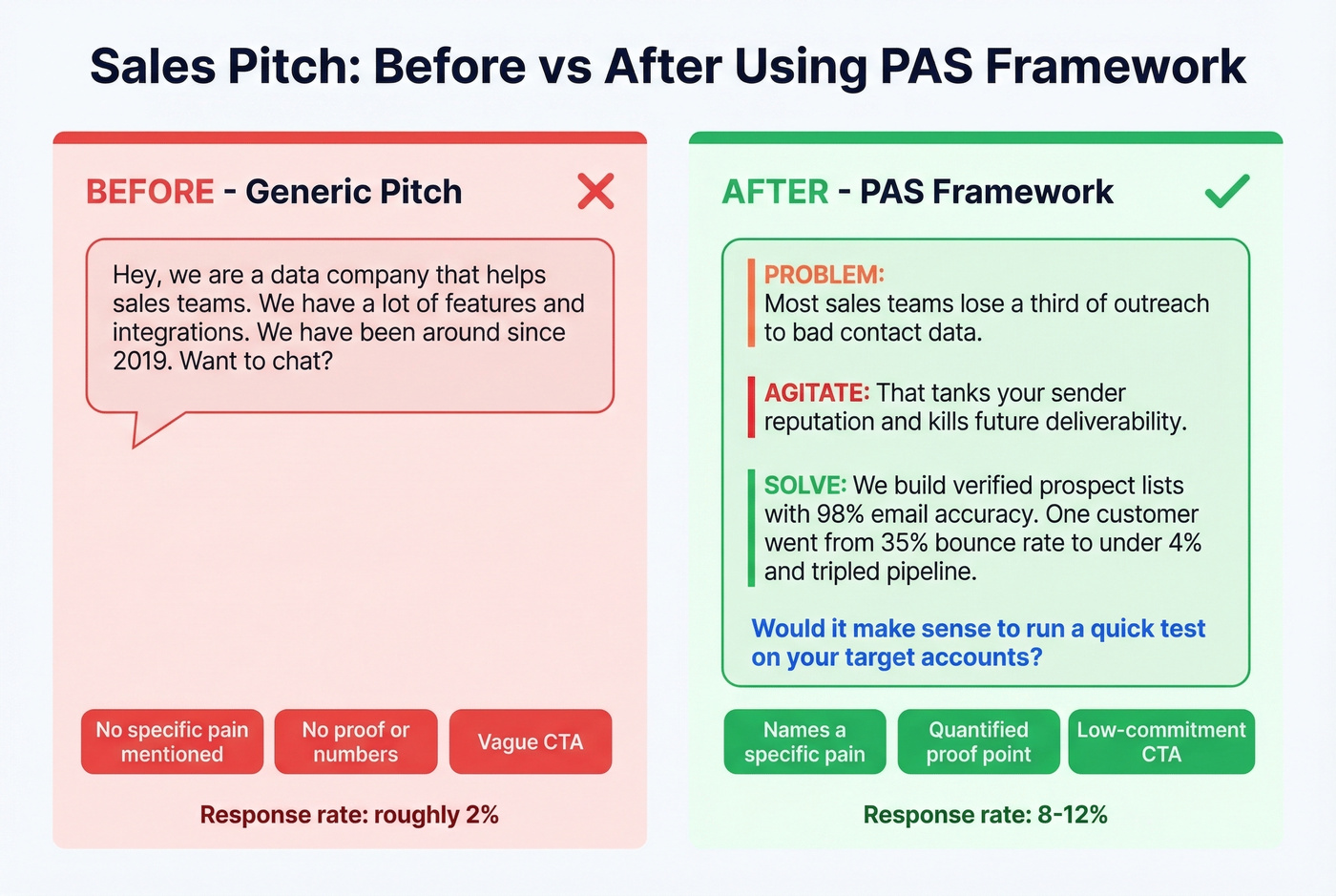
This is the elevator pitch template where structure matters most, because you're interrupting someone's day. Every word needs to earn its place.
Template:
[Problem - name the pain in one sentence]. [Agitation - what it costs them]. [Solution - what you do, specifically]. We helped [similar company] achieve [result with numbers]. Would it make sense to [specific CTA]?
Filled example:
Most sales teams lose a third of their outreach to bad contact data - bounced emails, wrong numbers, wasted rep time. That's not just annoying, it tanks your sender reputation and kills future deliverability. We build verified prospect lists with 98% email accuracy and direct dials that actually connect. One of our customers went from a 35% bounce rate to under 4% and tripled their pipeline. Would it make sense to run a quick test on your target accounts?
Here's the thing about B2B pitches: your script is only as good as the person hearing it. Before you pick up the phone, make sure you're reaching the right decision-maker with a verified email or direct dial. Prospeo searches across 300M+ professional profiles with 98% email accuracy, and you can start with 75 free verified emails a month. (If you're building a repeatable outbound motion, use these sales prospecting techniques to keep your pipeline full.)
Startup Founder / Investor Pitch
Framework: Antler's 5 elements - Who, What, How, For whom, Why now
Template:
We're [company name]. We [what you do] for [who you do it for]. [How it works in one sentence]. [Why now - market shift, regulation, technology change]. We're [traction metric] and raising [round] to [what the money does].
Filled example:
We're Relay. We automate compliance reporting for mid-market fintechs - what used to take a 3-person team two weeks now takes 20 minutes. New SEC reporting requirements mean every fintech under $500M AUM needs this by Q3. We've got 40 paying customers and $800K ARR, and we're raising a $3M seed to expand into banking.
The goal isn't a term sheet on the spot. It's the next meeting. Give them just enough to lean forward and ask a follow-up question.
One-Sentence Pitch
Framework: Founder Institute template - "My company ___ is developing ___ to help ___ solve ___ with ___."
Template:
My company [name] is developing [product/service] to help [target customer] solve [problem] with [secret sauce / unique approach].
Filled example:
My company Relay is developing automated compliance software to help mid-market fintechs solve SEC reporting bottlenecks with AI that reads regulatory filings in real time.
Founder Institute alumni have raised over $1.85B in funding using variations of this format. It's not elegant, but it forces you to answer the five questions every investor asks in a single sentence. Use it for intros, email subject lines, and the first line of your pitch deck.
Written Pitch (Email / Professional Profile)
For written pitches, you lose tone of voice and body language. Every word carries more weight, and the reader decides in seconds whether to keep going. This is where personalization matters most - a generic script sent to 500 inboxes performs worse than a tailored version sent to 50.
Template:
[One-line hook about their problem]. At [your company], we [what you do] - [one specific result]. [Social proof in one line]. Would [specific CTA] make sense?
Filled example:
Most VP Sales teams I talk to are losing 2-3 hours per rep per day to manual prospecting. At Relay, we automate list building and verification - our average customer cuts prospecting time by 60%. We work with teams like [recognizable company]. Would a 15-minute walkthrough make sense this week?
When your pitch lives in an email, deliverability matters as much as the words themselves. Verify every address before you send - a single batch of bad emails can tank your sender reputation for months. If you need a tighter process, follow an email deliverability guide and monitor your email bounce rate.
You just nailed your B2B sales pitch - now you need to scale it. Prospeo's 300M+ profiles with 30+ filters let you find exactly the right prospects to pitch, at $0.01 per verified email. No contracts, no guessing.
Turn every pitch into a conversation with the right person.
Before & After - Fixing Bad Pitches
Transformation 1: The Jargon Trap
❌ Before: "I work on nanotechnology to deliver medical therapies to targeted cells."
✅ After: "We're using the manufacturing techniques of the computer industry to make better vaccines."
The first version assumes the listener has a PhD. The second uses an analogy anyone can follow. Antler calls this the accessibility principle - if an 8th grader can't get it, simplify.
Transformation 2: The Generic Job Seeker
❌ Before: "I'm a results-driven professional passionate about innovation with a proven track record of exceeding expectations in fast-paced environments."
✅ After: "I'm a marketing manager who built a content program that generated $2.4M in pipeline last year. I'm looking for a senior role where I own demand gen end-to-end."
Every word in the "before" version describes literally anyone. "Results-driven" and "passionate about innovation" are filler that signal you haven't thought about what makes you specific. Replace adjectives with numbers. Replace vague claims with concrete outcomes.
5 Mistakes That Kill Your Pitch
1. It's too long. Remember the Reddit user whose "tell me about yourself" answer stretched to five minutes? That's what happens when you skip the structure. Keep it around 75 words, 30-60 seconds. That's the ceiling.
2. It's too generic. "I'm passionate about helping companies grow" describes every business professional on the planet. Replace passion with specifics. What do you actually do, for whom, and what happened when you did it?
3. There's no CTA. You delivered a great 25 seconds and then... stopped. Without a clear next step - a meeting, an email, a coffee - the conversation dies. Always end with a question. (If you want ready-to-send follow-ups, use these sales follow-up templates.)
4. Too much jargon. If your pitch requires a glossary, you've lost. Use the Antler test: could someone outside your industry understand this in one pass?
5. Robotic delivery. Stop memorizing your pitch word for word. Memorize the structure - hook, problem, solution, proof, CTA - and let the words change every time. In our experience, the pitches that bomb hardest are the ones delivered perfectly. A slightly different version each time sounds natural. A perfectly recited script sounds like a hostage reading a statement.
Pitch Audit Checklist
Before you use your pitch, run it through this:
- ✅ Under ~75 words?
- ✅ Ends with a clear CTA or question?
- ✅ Uses specific numbers or outcomes, not buzzwords?
- ✅ Tailored to this specific audience?
- ✅ Can you say it in 30-60 seconds at a natural pace?
- ✅ Would an 8th grader understand it?
- ✅ Does it invite a response?
If you can't check every box, cut words until you can. The checklist is ruthless on purpose - your audience will be too.
Let's be honest: you don't need to read one more article about pitching. You need to pick the template that fits your situation, swap in your numbers, and practice it out loud three times before your next meeting. Go.
FAQ
How long should an elevator pitch be?
Thirty to sixty seconds, or around 75 words at a natural speaking pace. If you're going over 60 seconds, it's a presentation. Time yourself out loud - most people speak faster in their head than in reality.
Should I memorize a template word for word?
No. Memorize the structure - hook, problem, solution, proof, CTA - and let the exact phrasing change each time. Pitches that sound rehearsed lose trust. A slightly different version each delivery sounds natural and conversational.
How do I pitch when changing careers?
Use the Problem-Solution framework. Name your transferable skill, connect it to the new industry's biggest pain point, and close with a specific ask. The career changer template above walks you through each step - swap in industry-specific proof points rather than rewriting from scratch.
Can I use the same pitch everywhere?
Tailor the hook and CTA to your audience. A networking pitch ends with "let's grab coffee." A sales pitch ends with "can I send you a case study?" Same skeleton, different words.
What if my pitch reaches the wrong person?
The best pitch in the world fails if it hits the wrong inbox. For B2B outreach, tools like Prospeo let you find verified emails and direct dials for decision-makers before you ever open your mouth. Pair that with a CRM like HubSpot or Salesforce to track who you've pitched and follow up on time.