

Elevator Pitch Training: The 7-Day Plan to Sound Natural, Not Rehearsed
You're about to walk into an assessment interview and the recruiter says: "Give me your 30-second pitch." You freeze - because nobody taught you elevator pitch training as a performance skill. Most advice stops at writing. That's like handing someone sheet music and calling it piano training.
Here's the real plan, and it starts with a counterintuitive rule: train for 8 seconds first. If you can't hook someone in 8, the remaining 22 don't matter.
Why Delivery Beats Writing
People form trustworthiness judgments in 100 milliseconds. That's before you've finished your first word. Those snap impressions aren't fleeting - Gunaydin et al. (2017) found that first impressions persist for months, and Barrick et al. (2010) showed they predict hiring decisions with surprising accuracy, even when interviewers later receive contradictory evidence.
Voice, pacing, body language, and the ability to stop talking - that's the skill stack. A perfectly written pitch delivered robotically loses to a decent pitch delivered with confidence and eye contact. Every time.
Build Your Pitch in 10 Minutes
Use one framework. Don't overthink it.
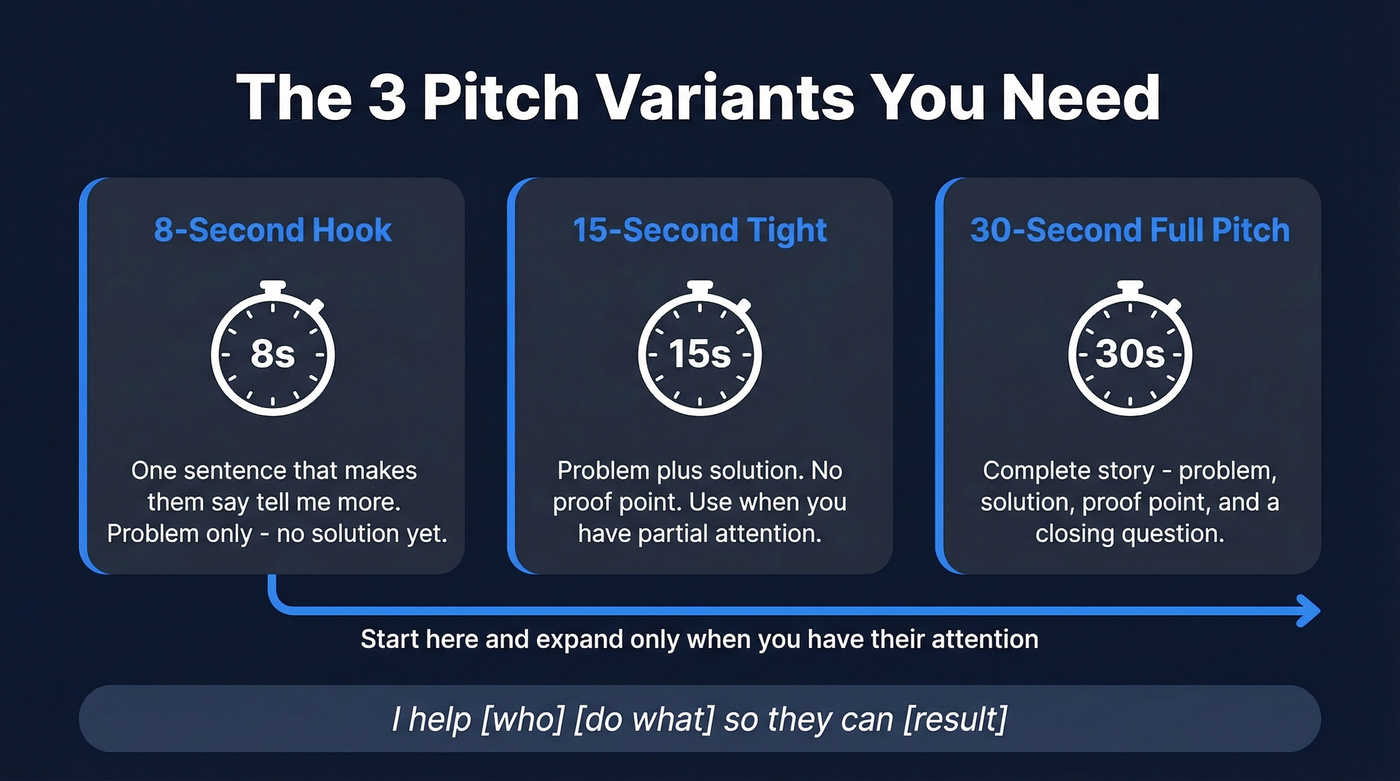
The structure: "You know [problem]... well, what we do is [solution]... in fact, [proof]." Then stop talking. Or use the fill-in version: "I help [who] [do what] so they can [result]."
Now create three variants:
- 30-second full pitch - your complete story with a proof point and a closing question.
- 15-second tight version - problem and solution only, no proof point.
- 8-second hook - one sentence that makes someone say "tell me more."
Princeton's career center recommends writing experiences in STAR format, shortening them to 1-2 sentences, then analyzing themes and tailoring to your audience. That's solid for the writing phase. Training starts now.
If you want examples you can adapt fast, start with these sample elevator pitches.
The 7-Day Practice Plan
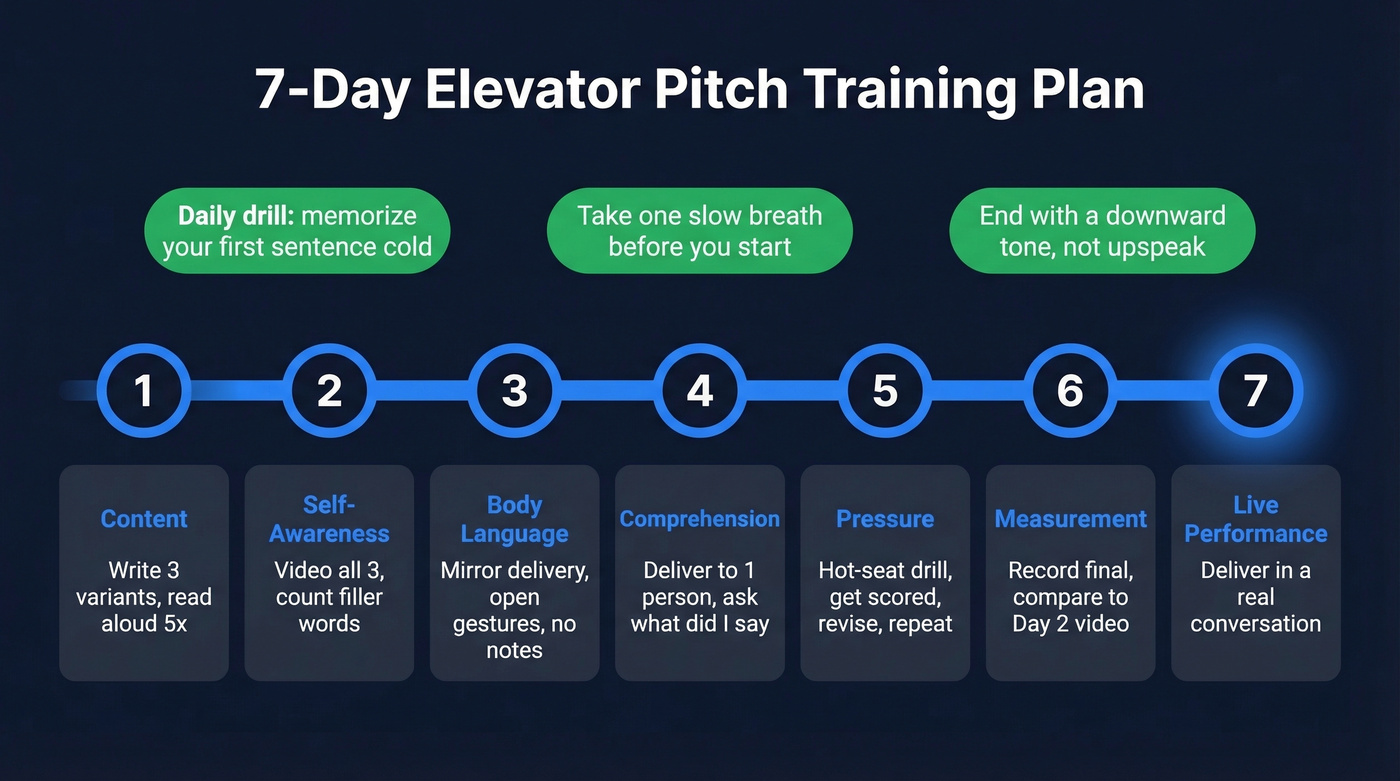
"Overlearning" - practicing beyond memorization until delivery becomes instinctive - separates people who sound natural from people who sound like they're reading a teleprompter. This plan builds that muscle in one week.
| Day | Drill | Focus |
|---|---|---|
| 1 | Write 3 variants. Read aloud 5x. | Content |
| 2 | Video all 3. Count filler words. | Self-awareness |
| 3 | Mirror delivery. Open gestures. No notes. | Body language |
| 4 | Deliver to one person. Ask: "What did I say?" | Comprehension |
| 5 | Hot-seat: deliver, get scored, revise, repeat. | Pressure |
| 6 | Record final. Compare to Day 2 video. | Measurement |
| 7 | Deliver in a real conversation. | Live performance |
Three delivery mechanics to drill daily: memorize your first sentence cold (it's your recovery anchor when your mind blanks), take one slow breath before you start, and end with a downward tone - not upspeak.
Here's the thing most guides skip: handling interruptions. When someone cuts in mid-pitch, welcome it. Confirm you understood their question, answer briefly, then bridge back to your core point. Interruptions mean they're engaged - that's a win, not a disruption.
After your pitch, pause. Let them respond. We've watched people nail a pitch and then keep talking right through the moment where the other person was about to say "that's interesting, tell me more." Your goal is dialogue, not a monologue.
If you want your pitch to land in real selling situations, tighten your sales communication the same way you train delivery.
Score Your Delivery
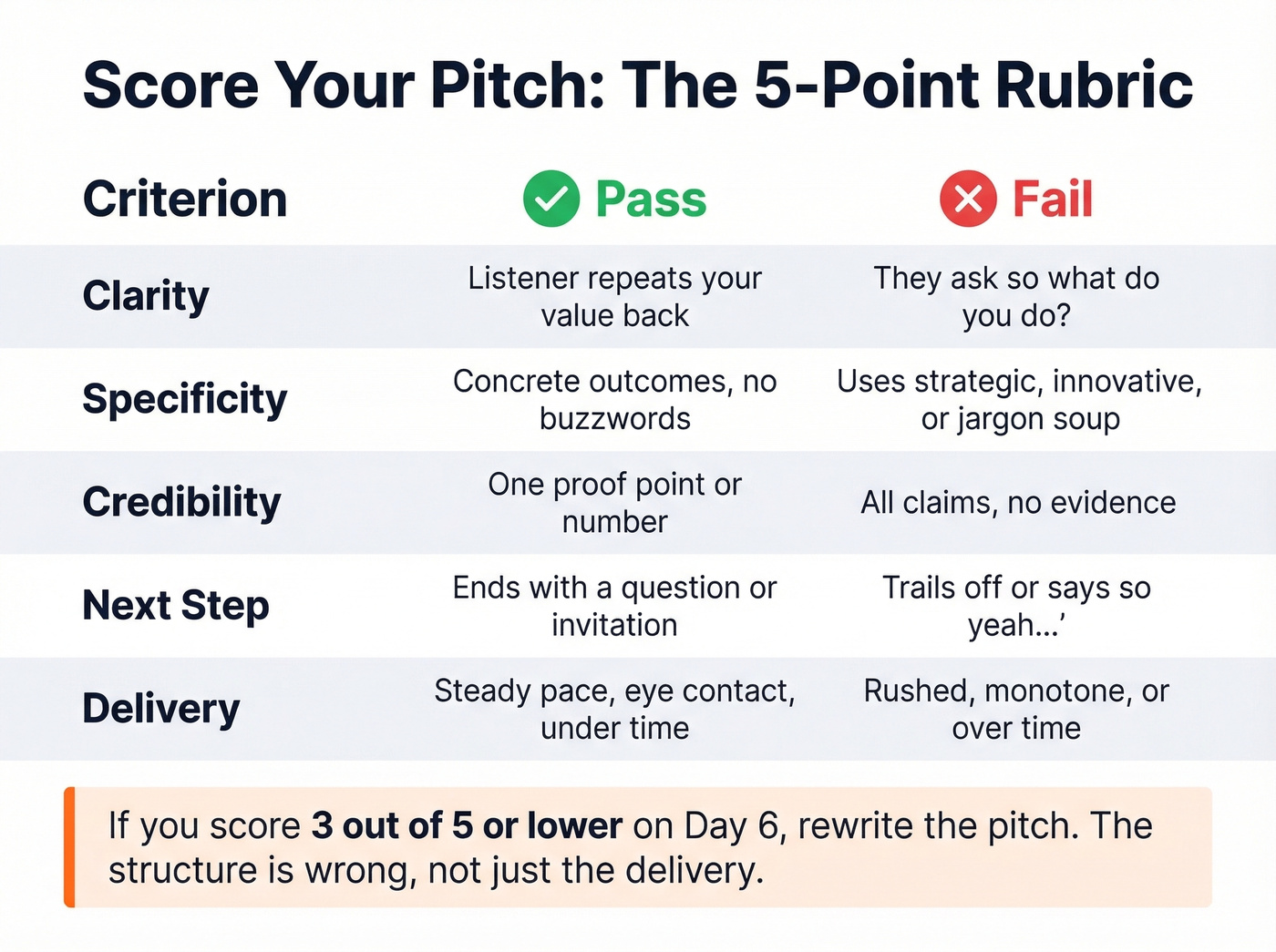
A pitch without a scoring system is just talking. Use this rubric after every rep from Day 2 onward.
| Criterion | Pass | Fail |
|---|---|---|
| Clarity | Listener repeats your value back | They ask "so what do you do?" |
| Specificity | Concrete outcomes, no buzzwords | Uses "strategic," "innovative," or jargon soup |
| Credibility | One proof point or number | All claims, no evidence |
| Next-step | Ends with a question or invitation | Trails off or says "so, yeah..." |
| Delivery | Steady pace, eye contact, under time | Rushed, monotone, or over time |
If you score 3/5 or lower on Day 6, rewrite the pitch. The structure is wrong, not just the delivery.
If you're building this for outbound, pair the rubric with a simple lead scoring model so you practice on the right targets.

You just built a pitch that cuts new-hire ramp time or triples pipeline. Now who hears it? Prospeo gives you verified emails and direct dials for the exact decision-makers you're targeting - 300M+ profiles, 98% email accuracy, 30+ filters to find hiring managers, VPs, or founders by role, company size, and intent signals.
Stop pitching into the void. Start reaching the people who matter.
Mistakes That Kill Your Pitch
Let's be honest: the most common failure mode is cramming corporate filler into 30 seconds. "Strategic," "partner with SMEs," "learning science," and a bunch of abstract nouns that don't land. That's a word cloud, not a pitch.
The fix is simple. Say what you do, who it's for, and one concrete result. Example: "I redesign onboarding programs - my last one cut new-hire ramp time by 40%." Specific beats impressive-sounding every time.
The other killers: talking past the close (you delivered the pitch - now stop), using the same pitch for every audience, and ending without a question. If your pitch doesn't invite a response, you've delivered a monologue to a stranger. The consensus on r/sales is that the best pitches feel like the start of a conversation, not a performance - and that tracks with everything we've seen in our own outreach.
To keep the conversation moving after the pitch, use proven sales follow-up templates instead of improvising.
How to End an Elevator Pitch
The worst endings trail off into "so, yeah..." or awkward silence. The best endings do one of three things:
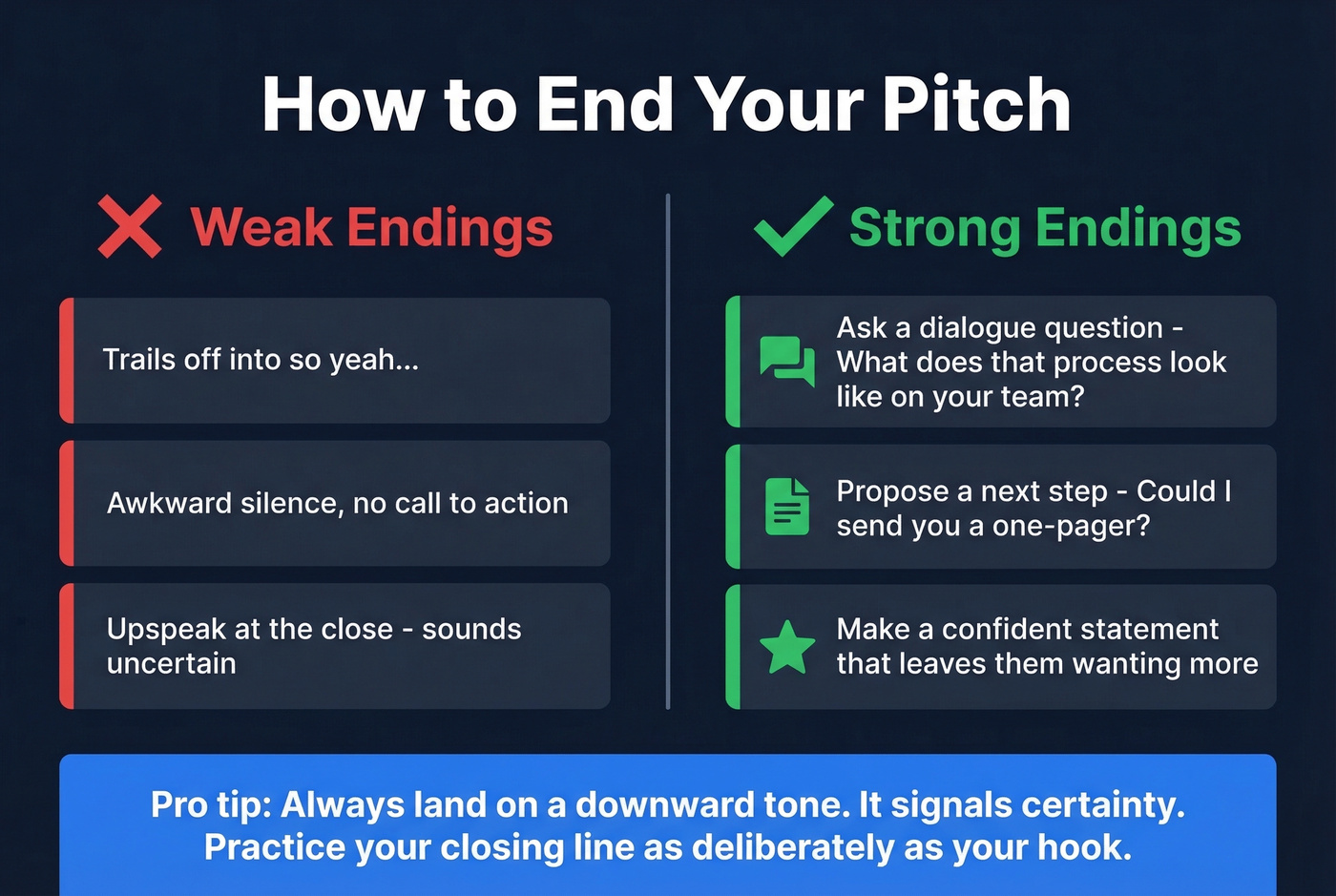
- Ask a question that invites dialogue. "What does that process look like on your team?"
- Propose a concrete next step. "Could I send you a one-pager?"
- Make a brief, confident statement that leaves them wanting more.
Always land on a downward tone - it signals certainty. Upspeak at the close undercuts everything you just said. Practice your closing line as deliberately as you practice your hook; it's the last thing they remember.
If you need more ways to close cleanly, borrow from these talk track examples.
Tools and Training Options
Most people need nothing more than a phone camera, a timer, and the rubric above. Free. Three reps a day for a week will transform your delivery more than any course. In our experience, the phone camera + rubric combo outperforms paid tools for the majority of people.
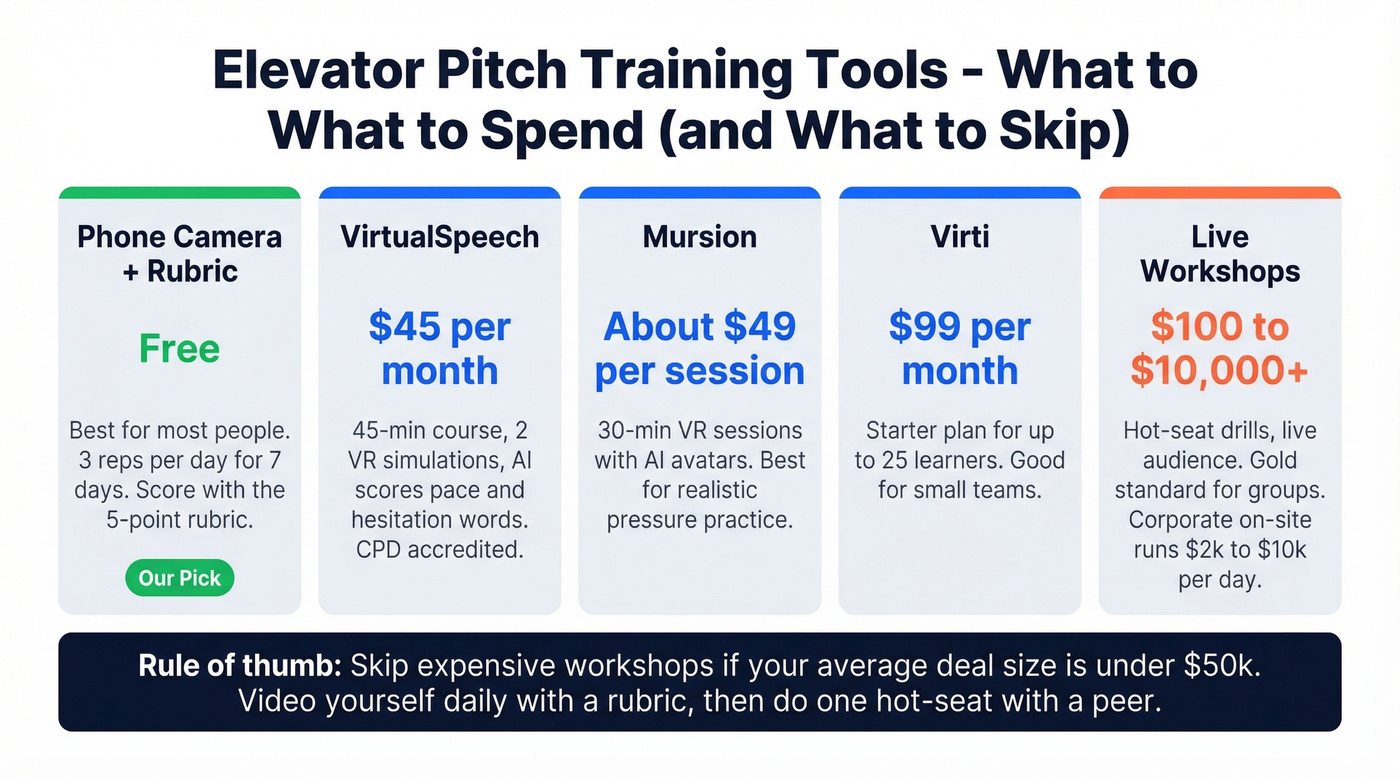
For data-driven types, VirtualSpeech runs $45/mo for an all-access subscription that includes a 45-minute elevator pitch course with two timed VR simulations. The AI scores pace, hesitation words, and confidence. CPD-accredited at 0.75 credits. If you need numbers to improve, it's worth a month.
Teams wanting higher-end VR simulation can look at Mursion (~$49 per 30-minute session per person) or Virti ($99/mo starter plan for up to 25 learners). Live workshops - like the WBENC pitch academy format with hot-seat drills in front of a live audience - remain the gold standard for group training. Public sessions often run $100-$500 per seat, and corporate on-site training typically runs $2,000-$10,000 per day.
Skip the expensive workshops if your average deal size is under $50k. Video yourself daily with a rubric, then do one hot-seat session with a peer. That combination beats any course we've seen.
If you're doing this for sales, combine practice with modern sales prospecting techniques so you get more real reps.
Turn Your Pitch Into Real Conversations
A trained pitch is useless if you never deliver it to the right people. You need verified contact data for the people you're pitching - hiring managers, potential clients, decision-makers. Tools like Prospeo give you verified emails at 98% accuracy so you spend time in conversations instead of chasing bounced emails.
If you're building lists from scratch, start with a repeatable lead generation workflow before you scale outreach.
A trained pitch without a target list is a monologue to nobody. Prospeo's Chrome extension lets you pull verified contact data for any prospect you find - on LinkedIn, company sites, or your CRM. 40,000+ users already prospect this way, at roughly $0.01 per verified email.
Deliver your 8-second hook to real buyers, not your bathroom mirror.
FAQ
How long should an elevator pitch be?
Thirty seconds is the standard, but train 15-second and 8-second versions too. Most real conversations don't give you a full 30. If your hook doesn't land in 8 seconds, the rest won't matter - start short and expand only when you have the listener's attention.
How do I stop sounding scripted?
Memorize key points, not full sentences. The only line you should know word-for-word is your opener - improvise everything else around your structure. Record daily and listen for robotic phrasing; natural variation between takes is a sign you're doing it right.
What's the best method for solo practice?
Record a 30-second video, score it against the five-point rubric (clarity, specificity, credibility, next-step, delivery), then re-record. Three reps a day for a week beats any single workshop.
How do I end a pitch without it feeling awkward?
Close with a specific question or a clear next step - never let your pitch fade into silence. A strong ending like "Would it make sense to grab 15 minutes this week?" gives the listener a reason to respond and keeps the conversation moving forward.