

The 8 Best Email Bounce Back Checkers in 2026
Your last campaign bounced at 12%, and now your ESP is giving you the side-eye. That's not a list hygiene issue - that's a deliverability problem an email bounce back checker should have caught before you hit send. Left unchecked, it snowballs into throttling, spam placement, or account review. The practical target: keep bounces under 2% and you stay out of trouble.
Here's the thing most teams miss: not all verification tools do the same job. Some only validate addresses you already have, acting as a dedicated bounce email checker for existing lists. Others help you start with verified data so you never need to clean garbage after the fact.
Our Picks
- Prospeo - Best for starting with pre-verified data (98% accuracy, 5-step verification, 7-day refresh)
- ZeroBounce - Best all-around standalone verifier (100 free monthly checks, credits never expire)
- NeverBounce - Best for high-volume list cleaning (refund if bounces exceed 3%)
- BounceBan - Best for catch-all email verification (85-95% catch-all resolution)
- Hunter - Best bundled value (email finding + verification in one credit pool)
What Email Bounces Actually Are
A bounce is the mail server telling you "nope" when you try to deliver. That "nope" comes with SMTP status codes, and the family matters.
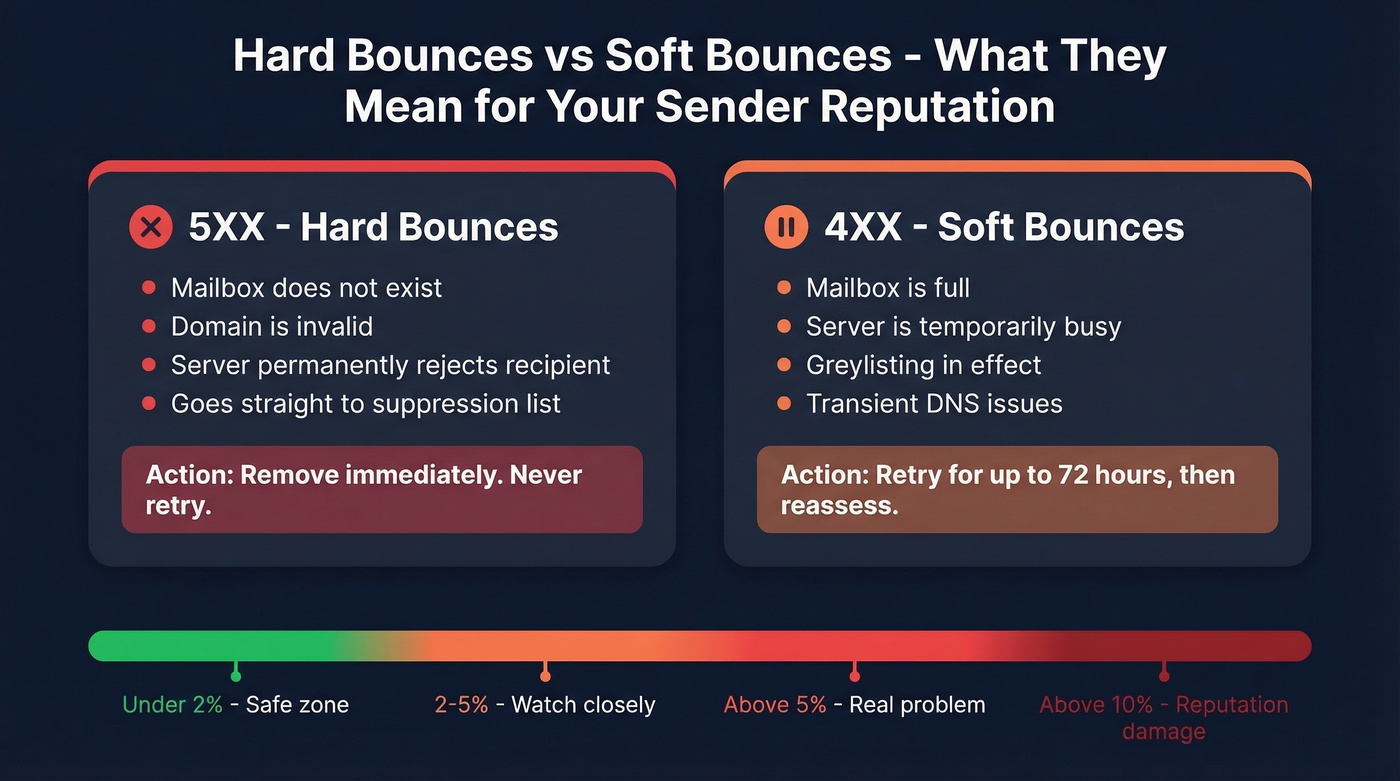
Hard bounces carry 5XX codes - permanent failures where the mailbox doesn't exist, the domain is invalid, or the server flat-out rejects the recipient. Hard bounces should go straight onto your suppression list. Keeping them around is how you rack up repeat failures and torch sender reputation.
Soft bounces are usually 4XX codes - temporary failures like a full mailbox, a busy server, greylisting, or transient DNS issues. They're not always your fault, but they're not harmless either. SendGrid retries soft bounces for up to 72 hours before treating them as a longer-term deferral, per Twilio's bounce management guide. That's why one campaign can look fine on day one and uglier on day three.
The benchmark most teams aim for: less than 2% bounce rate. Above 5% means you have a real problem. Above 10% risks throttling and long-term sender reputation damage that's hard to fix once it compounds. If you want the deeper benchmarks and remediation steps, see our guide on bounce rate.
How Bounce Verification Works
Most verification tools run layered tests that approximate deliverability without sending a real email. They're doing polite probing of the recipient's mail infrastructure. If you want the bigger picture, this sits inside your overall email deliverability stack.
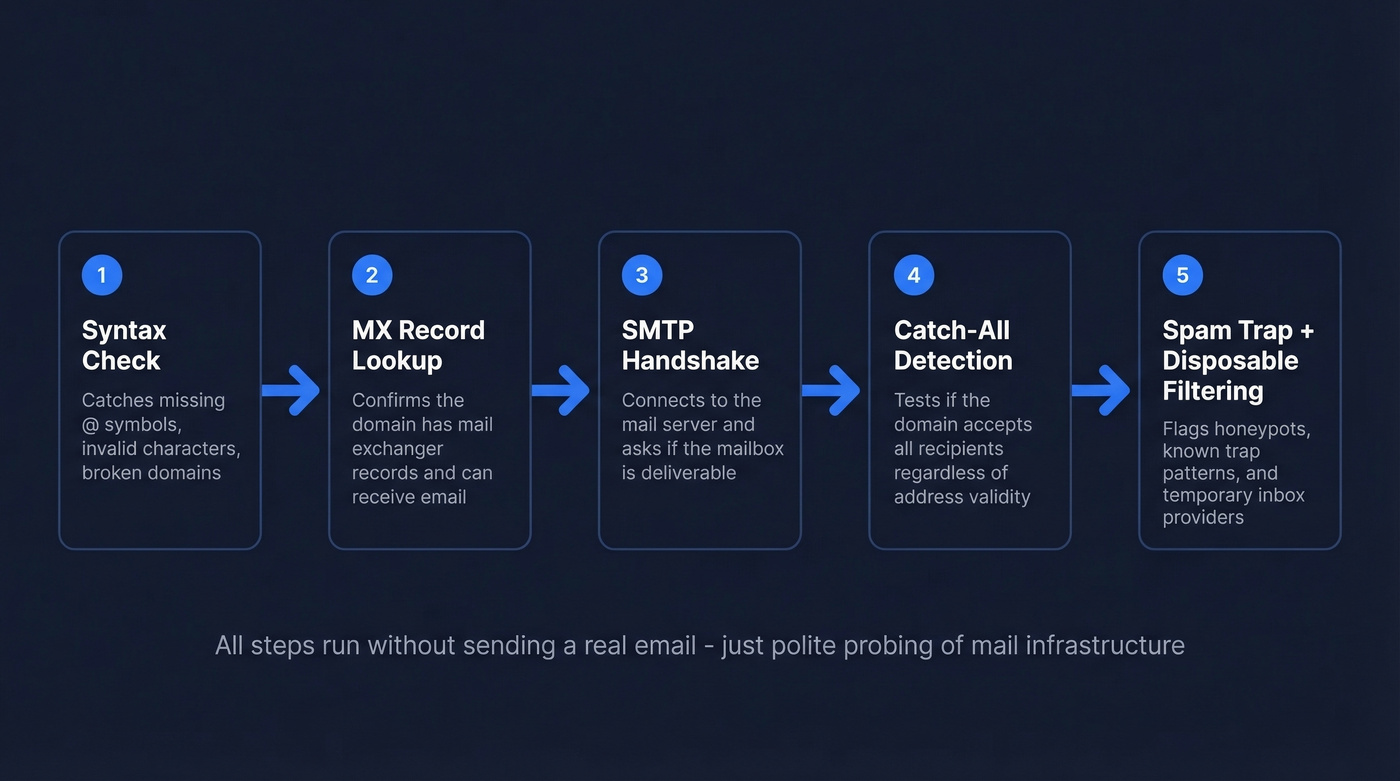
The typical flow:
- Syntax check - catches obvious junk like missing
@symbols, invalid characters, and broken domains. - MX record lookup - confirms the domain can receive email by checking for mail exchanger records.
- SMTP handshake - connects to the mail server and asks if the mailbox is deliverable, without actually delivering a message.
- Catch-all detection - tests whether the domain accepts all recipients regardless of whether the address exists.
- Spam-trap + disposable filtering - flags risky addresses including honeypots, known trap patterns, and temporary inbox providers.
Different tools disagree on the same address because they use different handshake strategies, timeouts, retry logic, and risk heuristics. There's no universal standard, and mailbox providers don't make it easy on purpose.
The Catch-All Problem
Catch-all domains are where verification tools go to die.
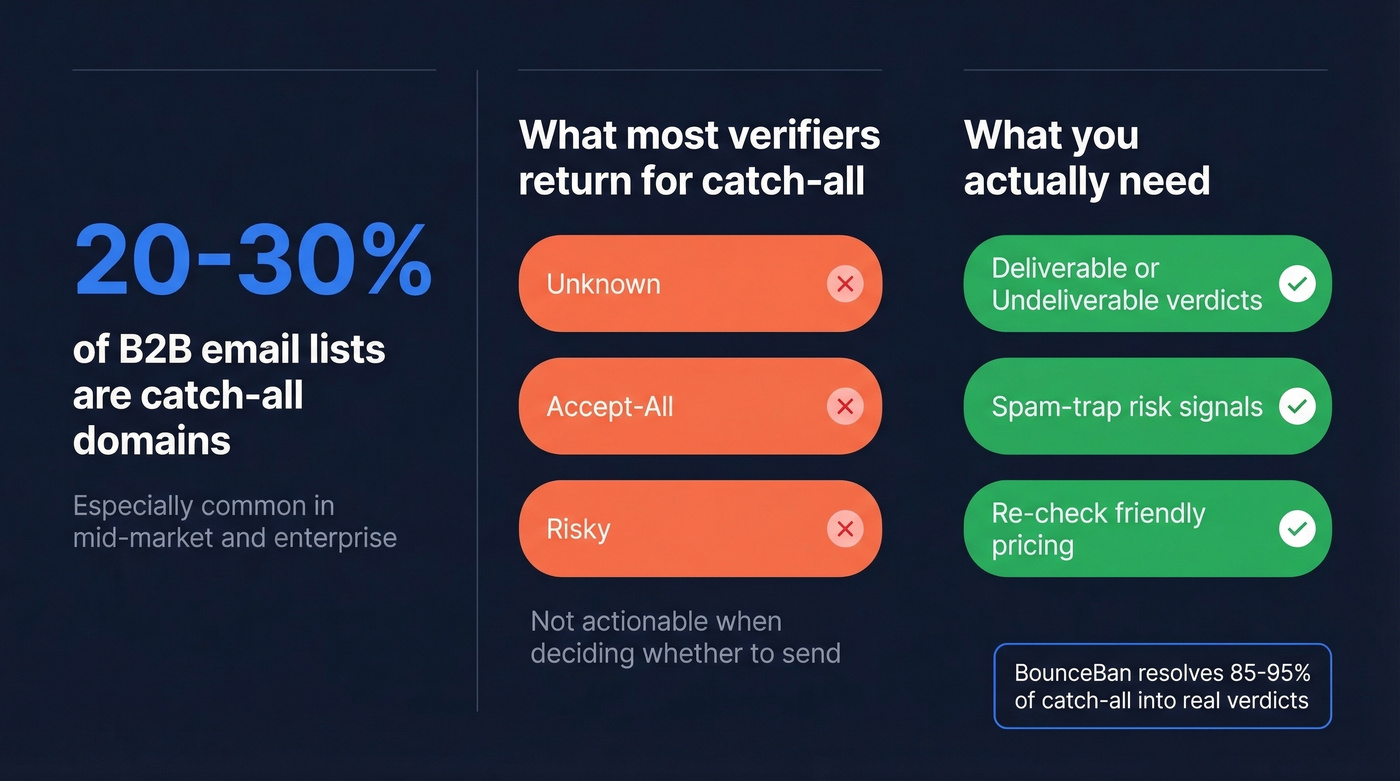
Roughly 20-30% of B2B lists run through catch-all setups, especially in mid-market and enterprise where IT wants fewer false rejects. Most verifiers respond by punting: "Unknown," "Accept-all," "Risky." That's not actionable when you're deciding whether to send. What actually matters for catch-all handling is actionable verdicts rather than just "unknown," spam-trap risk signals, and re-check-friendly pricing that doesn't punish you for verifying the same list twice. If you need a dedicated remediation workflow, see our spam trap removal playbook.
BounceBan is the exception worth calling out. It goes after the hard cases and resolves 85-95% of catch-all, greylisted, or SEG-protected emails into a real deliverable/undeliverable verdict. That's a big deal if your ICP skews enterprise B2B sales.

Catch-all headaches disappear when your data is verified before you build the list. Prospeo's 5-step verification - with catch-all handling, spam-trap removal, and honeypot filtering - runs on every record in a 143M+ email database refreshed every 7 days. That's why teams like Snyk dropped bounce rates from 35-40% to under 5%.
Stop cleaning bad lists. Start with data that doesn't bounce.
The 8 Best Tools Compared
Prospeo - Best for Pre-Verified Data
Use it if... you want to solve bounces at the source instead of paying to clean bad inputs. Prospeo gives you access to 143M+ verified emails inside a 300M+ profile database, with 98% email accuracy measured at collection. The data refreshes every 7 days - the industry average is about 6 weeks - which matters more than most teams realize once titles and inboxes start changing. This approach is especially useful if you're building lists at scale (see: how to generate an email list).
The 5-step verification process is built for outbound reality: catch-all handling, spam-trap removal, and honeypot filtering are all part of the pipeline. Economics are simple - about ~$0.01/email, with a free tier of 75 emails/month.
The proof points tell the story: Meritt took bounce rate from 35% to under 4%, Snyk went from 35-40% to under 5%, and Stack Optimize runs under 3% bounces across all clients with zero domain flags. When the upstream data is clean, deliverability becomes boring - in the best way.
Skip it if... you only need a one-time scrub of a legacy CSV and don't care where future leads come from.
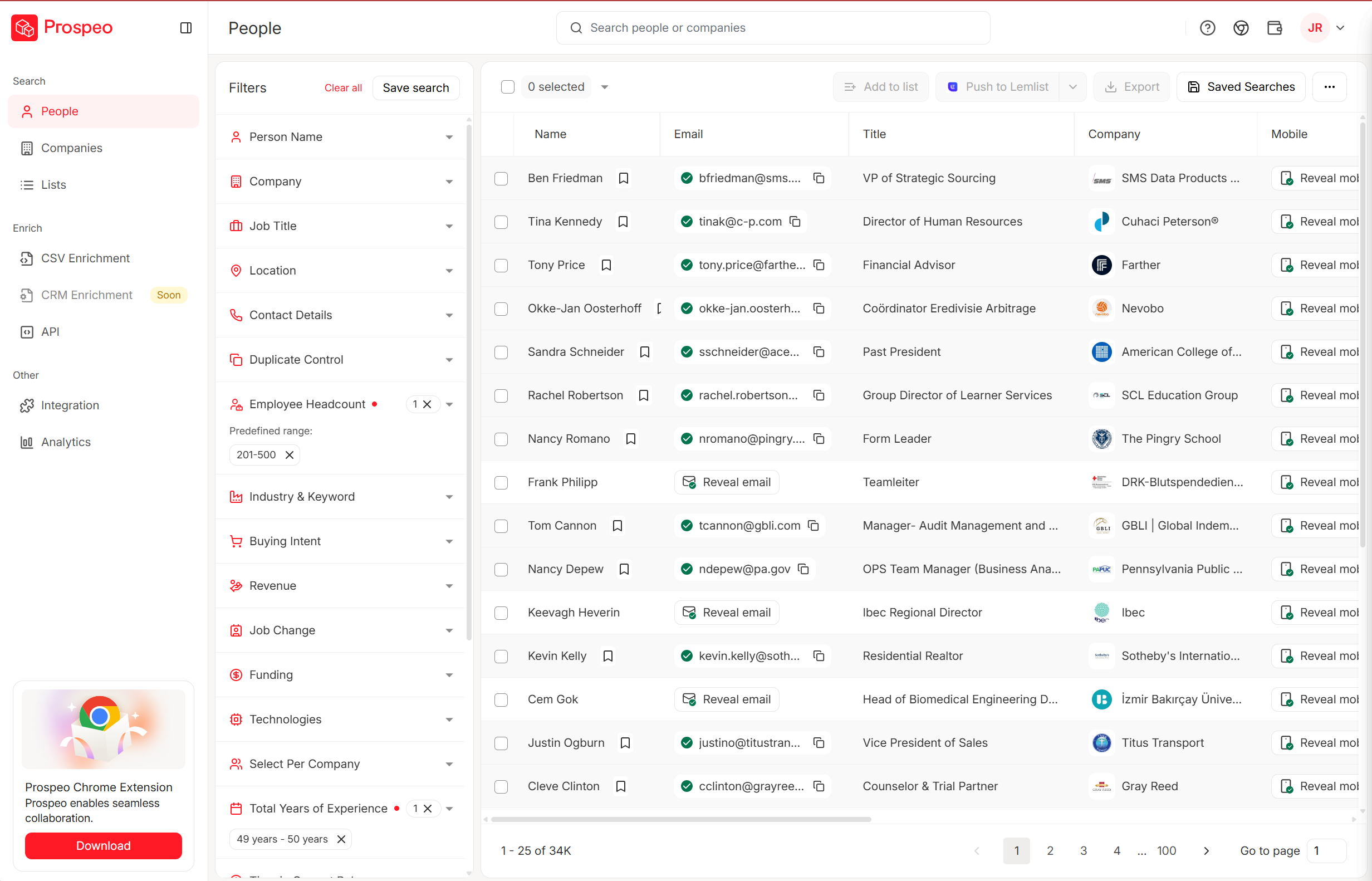
Every bounce checker on this list costs money per verification. At ~$0.01/email, Prospeo gives you the verified contact and the verification in one step - no separate cleaning tool needed. 75 free emails/month, no credit card, no contracts.
One tool. Pre-verified emails. Zero bounce cleanup workflows.
ZeroBounce - Best All-Around Verifier
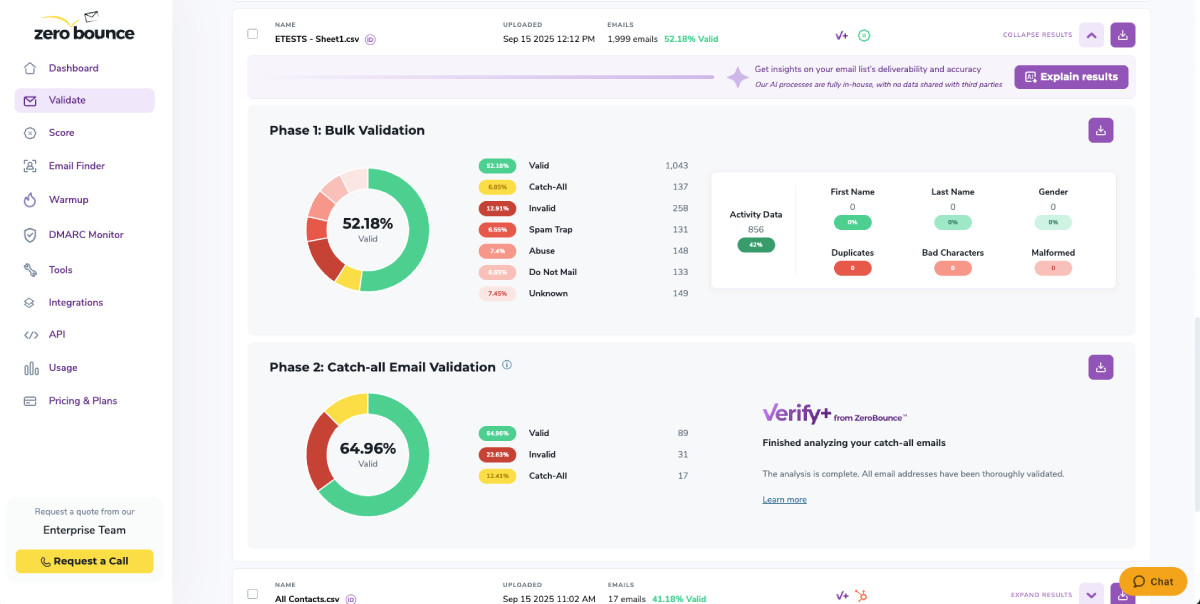
Use it if... you want a standalone verifier that's easy to operationalize across teams. ZeroBounce gives you 100 free monthly verifications (requires a business/premium domain) and - crucially - credits never expire per their pricing page. Unknown results are also free, which stops you from paying for "shrug" outcomes.
Pay-as-you-go runs about $0.01 to $0.00275/email depending on volume, and subscriptions land at $49-$249/month or $39-$199/month billed annually. Reviews are strong: 4.7/5 on Capterra across 549 reviews. If you're looking for a free option to test the waters, ZeroBounce's 100-credit monthly allowance is one of the better no-commitment starting points.
Skip it if... catch-all scoring is your whole problem. ZeroBounce's catch-all AI scoring burns extra credits, and one recurring complaint is that validation results get deleted after 30 days - annoying when you're trying to audit list sources later.
NeverBounce - Best for High-Volume Cleaning
NeverBounce is the workhorse you want when you're cleaning big lists constantly and need predictable economics. Pay-as-you-go is straightforward: $8 per 1,000 credits, so $80 per 10k, per their pricing page. The Growth plan at $49/month includes automation like auto-sync plus unlimited parallel list cleaning, which matters when you're validating multiple segments at once.
Two mechanics stand out. First, duplicates are free - you only pay for new, unique emails. Second, the guarantee: NeverBounce will refund if your bounce rate exceeds 3% after using their verified list. That's confidence you can hold them to.
Accuracy-wise, a 90-day test across 47,000 emails put NeverBounce at 99.1%, with catch-all detection accuracy at 94%. We've run bake-offs where NeverBounce wasn't the sexiest option, but it was the one that stayed stable at scale. Credits expire after 12 months, so this isn't the tool for teams that validate once a quarter.
BounceBan - Best for Catch-All Emails
BounceBan is the specialist you bring in when "unknown" is killing your throughput. It focuses on catch-all, greylisted, and SEG-protected environments and resolves 85-95% of those cases into a real verdict, delivering roughly 40% more actionable outcomes than standard verifiers.
It's built for modern enterprise stacks: Office 365, Google Workspace, and SEGs like Mimecast and Proofpoint. Expect $120-$200+ per 10k for bulk verification based on the specialist positioning and feature set. Unlimited single verifications are free forever, which is a nice way to test it on your worst domains before committing.
Hunter - Best Bundled Value
Hunter is the verifier you already have if you use Hunter for finding emails - and that's exactly why it works. Verification costs 0.5 credits, so the free plan's 50 credits/month equals up to 100 verifications/month if you spend those credits on verification. Starter is $49/month for 2,000 credits (4,000 verifications), and Growth is $149/month for 10,000 credits (20,000 verifications), per Hunter's pricing page.
Let's be honest about the numbers: Hunter's own benchmark puts their accuracy at 70% overall, and they explicitly note their ground-truth labeling may bias results in their favor. That's not a dunk - it's a reminder that bundled tools optimize for workflow, not perfect verification. If verification accuracy is your primary concern, pair Hunter's finding with a dedicated bounce tool like ZeroBounce or NeverBounce. If you're evaluating alternatives, start with our Hunter alternatives breakdown.
Clearout - Best Budget Option
Clearout is the value play that keeps showing up in comparisons for good reason. A 90-day test pegs it at ~$40 per 10k with 98.4% accuracy across 47,000 emails. That's half the cost of NeverBounce or ZeroBounce at the same 10k volume.
A separate 15-tool benchmark scored Clearout at 68.37% overall accuracy, which tells you what you already know: benchmarks vary wildly based on dataset and how "unknown" results affect scoring. For budget-sensitive teams that need bulk cleaning, Clearout is hard to ignore.
Bouncer
Bouncer is a solid mid-range option when you want decent accuracy without enterprise pricing. The same 90-day benchmark scored it at 97.8% with pricing around $49 per 10k. It's rarely the best at one thing, but it's rarely a mistake either. If you're comparing similar tools, see our roundup of Bouncer alternatives.
QuickEmailVerification
QuickEmailVerification wins on free-tier generosity: 3,000 free credits/month, plus a Starter plan at $4 for 500 verifications, and credits never expire. For low-volume founders or agencies doing sporadic list checks, it's the easiest way to stay under that 2% bounce target without committing to a bigger platform.
Honorable mentions: Verifalia (developer-focused API with strong documentation), Email Hippo (fraud risk scoring layer), Kickbox (consistent mid-pack performer in benchmarks), and MailTester.Ninja (privacy-first single checks).
Pricing Comparison
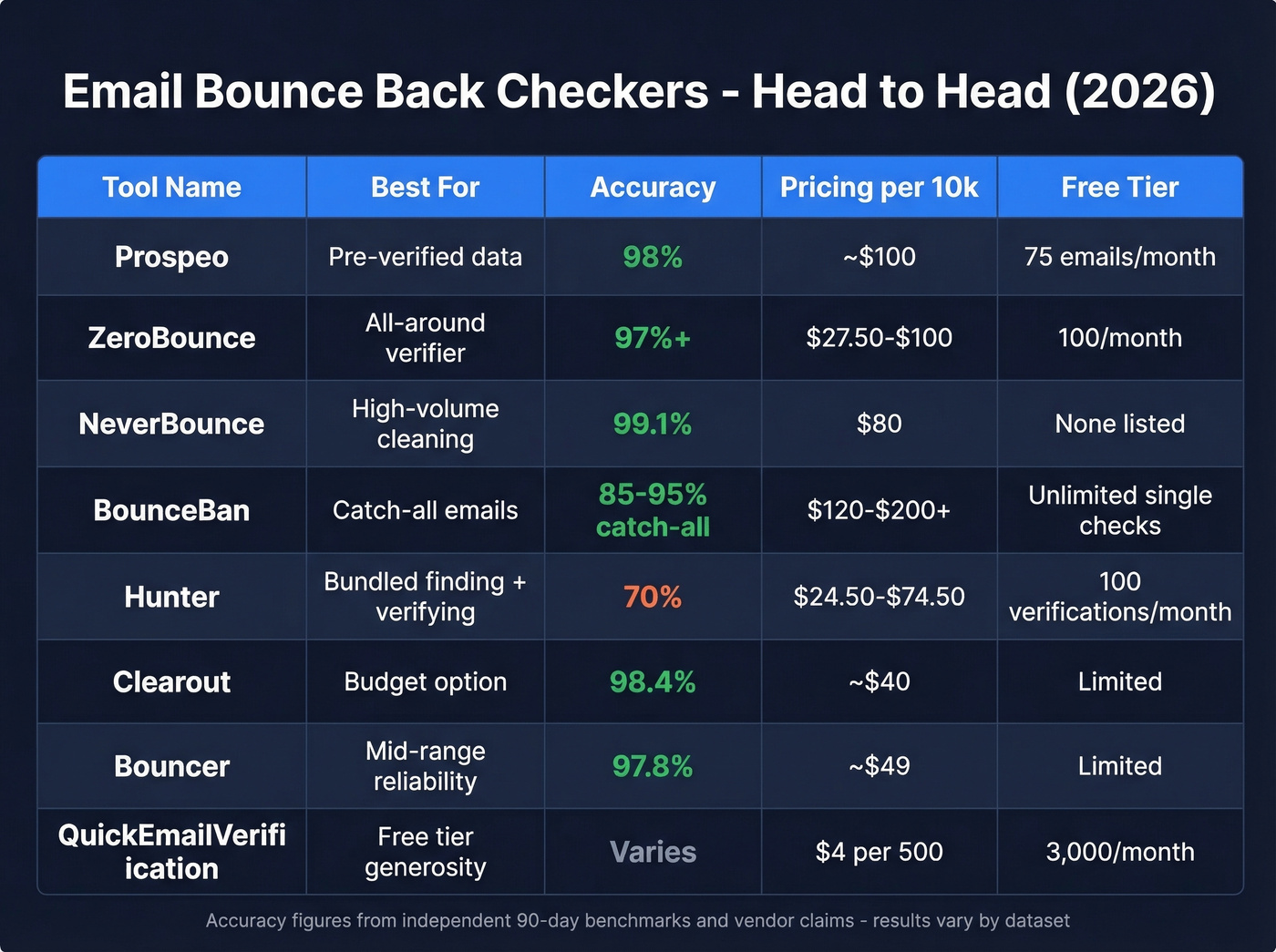
Pricing is where teams get tricked, because "$49/month" can mean wildly different things depending on credit rules, expiration, and whether you're paying for unknowns. Here's the cleanest comparison: normalize to 10,000 verifications and call out free tiers and expiration behavior.
One note: Prospeo's cost covers finding AND verifying emails - every other tool on this list only verifies addresses you already have. If you're buying data elsewhere, it’s worth understanding the tradeoffs in email list providers.
| Tool | Price / 10k Emails | Free Tier | Credits Expire? | Best For |
|---|---|---|---|---|
| Clearout | $40 | Limited | Not public | Budget bulk cleaning |
| QuickEmailVerification | ~$40 | 3,000/mo | No | Low-volume / free tier |
| Bouncer | $49 | Limited | Not public | Mid-range reliability |
| NeverBounce | $80 | Limited | Yes (12 months) | High-volume ops |
| ZeroBounce | $80 | 100/mo (business email) | No | All-around verifier |
| Prospeo | ~$100 (find + verify) | 75 emails/mo | No contracts | Pre-verified outbound |
| Hunter | ~$122* | Up to 100 verifications/mo | Monthly reset | Bundled finding + verifying |
| BounceBan | ~$120-$200+ | Unlimited single checks | N/A | Catch-all specialist |
*Hunter: $49/month for 4,000 verifications = ~$122/10k equivalent
Look, if your deal sizes sit below five figures, you probably don't need a $200/10k catch-all specialist. Run Clearout or NeverBounce, accept the unknowns, and spend the savings on more pipeline. Catch-all resolution matters when you're targeting enterprise accounts where every contact is worth hundreds of dollars in pipeline.
Accuracy: Claims vs. Reality
Every vendor says "99% accurate." The gap between marketing and reality in this space is absurd.
Hunter published a 15-tool benchmark using 3,000 real business emails plus 300 invalids, scoring tools on correct predictions where "unknown" hurts your score. The leaders were Hunter at 70%, Clearout at 68.37%, and Kickbox at 67.53%. They also admit a key caveat: their ground truth may bias toward Hunter because it uses activity recorded in their own platform.
Then there's the 90-day test across 47,000 emails scored against actual bounce outcomes, where the top numbers are much higher: NeverBounce at 99.1%, Clearout at 98.4%, ZeroBounce at 96.5%. Different dataset, different scoring, different definition of "truth."
This is why Reddit threads keep circling the same complaint: tools conflict, and it's hard to know which verdict to trust. One community test of 10 tools found the same address getting three different verdicts depending on the provider. In production, the only thing that matters is your measured bounce rate after send.
How to Choose the Right Tool
Most teams treat verification like a one-time chore. That's how you end up bouncing again 60 days later. A workflow makes it boring and repeatable.
Start with a verified data source. If your emails are already verified at the point of collection - through a process like 5-step verification with catch-all handling and spam-trap removal - you're not "fixing" data. You're starting with good inputs. This is also where data enrichment can help keep records current.
Run a dedicated verifier as a safety net. Even with great upstream data, run ZeroBounce or NeverBounce on the final send list before campaigns, especially if you've merged sources.
Suppress hard bounces immediately. Don't wait for the next cleanup. Hard bounces should be auto-suppressed in your ESP and CRM the moment they happen.
Re-verify every 30-90 days. Data decays about 2-3% per month as people change roles, companies, or providers. The longer your sales cycle, the more this matters. Running an email list bounce checker on a regular cadence catches decay before it hits your sender reputation. If you're also scaling volume, pair this with an email velocity plan.
Watch bounce rate like a canary. If you're above 2%, investigate the source. Above 5% means stop and fix it before you burn domains. If you're already seeing issues, use this guide on how to improve sender reputation.
We've seen teams waste weeks debating which verifier is "most accurate," then ignore the actual control metric: bounce rate by list source and segment. Track that number, and the right tool reveals itself.
FAQ
What's a good email bounce rate?
Under 2% is healthy for most outbound and marketing sends. Above 5% and ESPs start flagging deliverability risk. Above 10% risks throttling, suspension, and long-term sender reputation damage that compounds over time.
Hard bounce vs. soft bounce - what's the difference?
Hard bounces (5XX SMTP codes) are permanent failures where the address doesn't exist - suppress them immediately. Soft bounces (4XX codes) are temporary issues like greylisting or a full mailbox, and most ESPs retry them for up to 72 hours before giving up.
Can I check if an email will bounce without sending it?
Yes. An email bounce back checker validates via an SMTP handshake, connecting to the recipient mail server and testing mailbox deliverability without delivering a real message. Tools also layer in syntax checks, MX lookups, and disposable/spam-trap filtering to reduce false positives.
Why do different verification tools give different results?
Each tool uses different SMTP connection methods, timeout thresholds, retry logic, and catch-all handling strategies. There's no universal standard, which is why benchmarks show accuracy ranging from about 67% to 99% depending on dataset and scoring methodology.
What's the most accurate way to avoid bounces?
Start with a verified data source where emails are collected at 98% accuracy and refreshed weekly, instead of scraping addresses and cleaning them later. Then layer a dedicated verifier as a final safety net before sending to keep bounces under 2%.