

Email Deliverability News Today: Everything That Changed in 2026
An estimated 392.5 billion emails cross the internet every day in 2026. That's 4.73 billion users, more volume than ever, and mailbox providers who've stopped warning and started rejecting. Most "deliverability news" posts are evergreen guides with a fresh year slapped on the title. This one has dates, error codes, and dollar amounts.
The 30-Second Version
- Gmail now rejects non-compliant emails at the SMTP level - not just spam-foldering them.
- Microsoft followed on May 5, 2025. The rejection code is
550 5.7.515. - Three major provider outages hit in January 2026 alone.
- Lululemon got fined A$702,900 for sending 370,000 emails without unsubscribe links.
- 70.9% of domains still have no effective DMARC protection.
- If you do one thing today: check your complaint rate in Google Postmaster Tools v2 and verify your list before the next send.
Recent Outages That Spiked Bounces
January 2026 was rough. Three outages across three providers in four days.
Yahoo went down on January 21 for under an hour - minor, but enough to spike bounce rates for senders mid-campaign. Microsoft Outlook followed on January 22 with a nearly 11-hour outage that started during U.S. business hours. Users saw 451 4.3.2 temporary server issue errors, and the impact bled into Teams, OneDrive, and SharePoint. Then on January 24, Gmail's spam-check and inbox-labeling systems degraded for 4 hours and 53 minutes between 05:02 and 09:55 PT. Google published a public incident report on February 6, stating no emails were lost - just delayed up to ~10 minutes.
Here's the thing: don't panic-change your DNS settings during an outage. Temporary 4xx errors resolve themselves. Permanent 5xx errors mean you have a real problem.
Provider-by-Provider Enforcement Updates
Each major mailbox provider has its own enforcement posture right now. Let's break down what actually matters for each.
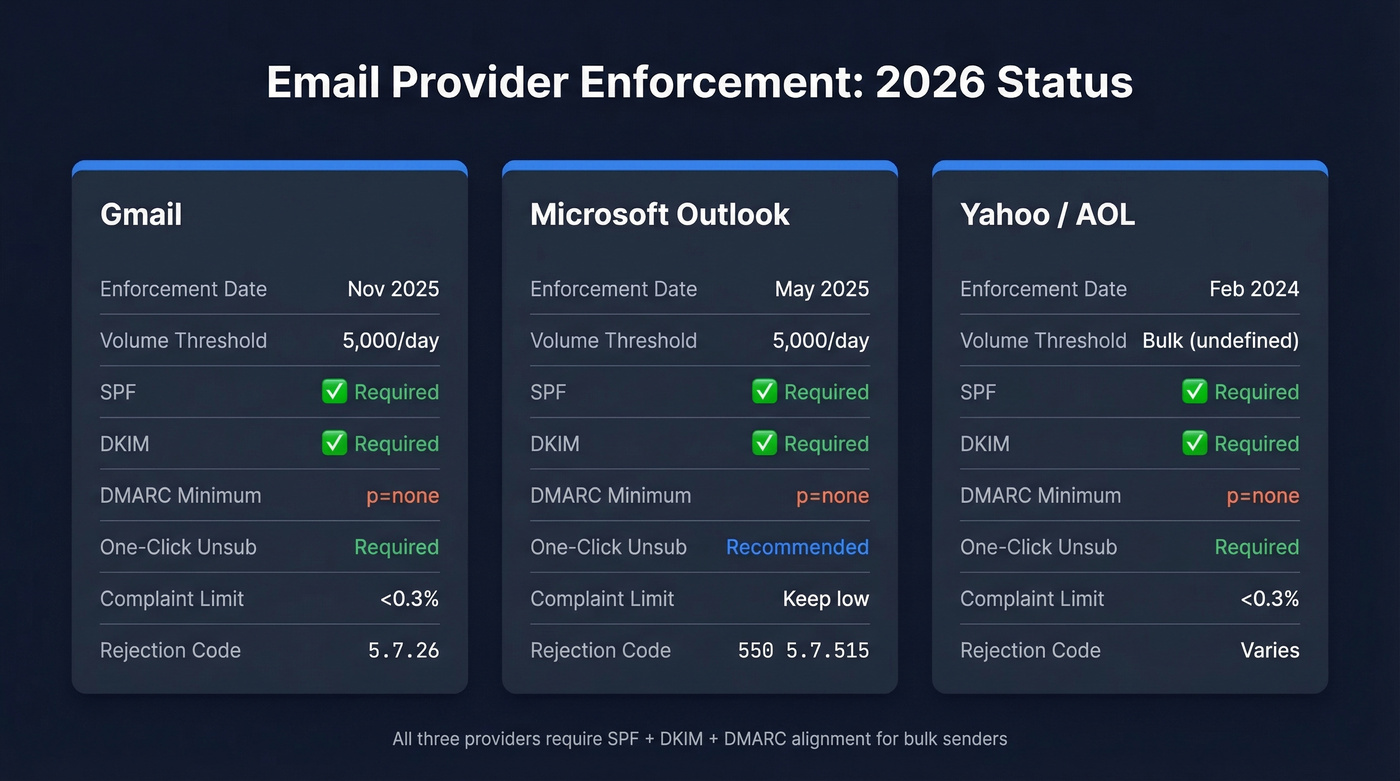
Gmail
Gmail's educational phase is over. Since November 2025, messages that fail the bulk sender requirements announced in February 2024 are actively rejected at the SMTP level - not quietly routed to spam. This applies to personal Gmail accounts like @gmail.com and @googlemail.com, not inbound mail within Google Workspace.
Error codes you'll see if you're non-compliant:
- 4.7.32 - alignment warning
- 5.7.26 - alignment rejection
- 4.7.27 - SPF fail
- 4.7.30 - DKIM fail
- 4.7.29 / 5.7.29 - TLS issues
- 5.6.0 - RFC 5322 compliance rejection
Postmaster Tools v2 replaced v1, which shut down October 31, 2025. The new dashboard emphasizes binary Pass/Fail compliance status rather than the old reputation charts. Gmail's complaint rate threshold: stay below 0.3%, target below 0.1%.
Two other Gmail changes worth noting. The "Manage Subscriptions" view rolled out July 8, 2025, letting users see all subscription senders sorted by frequency and unsubscribe in one click. And Gmailify/POP fetching support for new users stops by Q1 2026.
Microsoft Outlook
Microsoft's bulk sender requirements went live May 5, 2025. Senders pushing more than 5,000 emails per day to Outlook.com consumer domains - outlook.com, hotmail.com, live.com - need SPF pass, DKIM pass, and DMARC with at least p=none aligned with SPF or DKIM. Non-compliant mail gets the 550 5.7.515 rejection code.
Microsoft also calls out ARC as a best practice for forwarding and mailing list scenarios. This update caught many senders off guard despite months of advance notice.
Yahoo/AOL
Yahoo and AOL were early enforcers alongside Google in February 2024. Bulk senders need both SPF and DKIM, DMARC with at least p=none, and one-click unsubscribe via the List-Unsubscribe header. Unsubscribes must be honored within 2 days. Yahoo recommends ARC headers for forwarding scenarios that break DMARC alignment.
Apple Mail (iOS 18)
Apple isn't a mailbox provider, but its client-side changes reshape how deliverability looks in your dashboards. iOS 18.2 introduced inbox tabs that reduce Primary exposure. AI-generated previews can replace your carefully crafted preheaders. And Mail Privacy Protection - now covering around 48-54% of email opens - continues generating fake opens that make open-rate tracking unreliable.
Prioritize live text over image-heavy emails so Apple's AI summaries actually render your content correctly.
| Requirement | Gmail | Microsoft | Yahoo/AOL |
|---|---|---|---|
| Enforcement date | Nov 2025 | May 2025 | Feb 2024 |
| Volume threshold | 5,000/day | 5,000/day | Bulk (undefined) |
| SPF | Required | Required | Required |
| DKIM | Required | Required | Required |
| DMARC minimum | p=none | p=none | p=none |
| One-click unsub | Required | Recommended | Required |
| Complaint limit | <0.3% | Keep complaints low | <0.3% |
| Rejection code | 5.7.26 / 4.7.32 | 550 5.7.515 | Varies |
The Authentication Reality Check
70.9% of nearly one million monitored domains still have no effective DMARC protection as of March 2026. Only 10.7% have full protection at p=reject with pct=100. Another 18.4% have partial coverage.
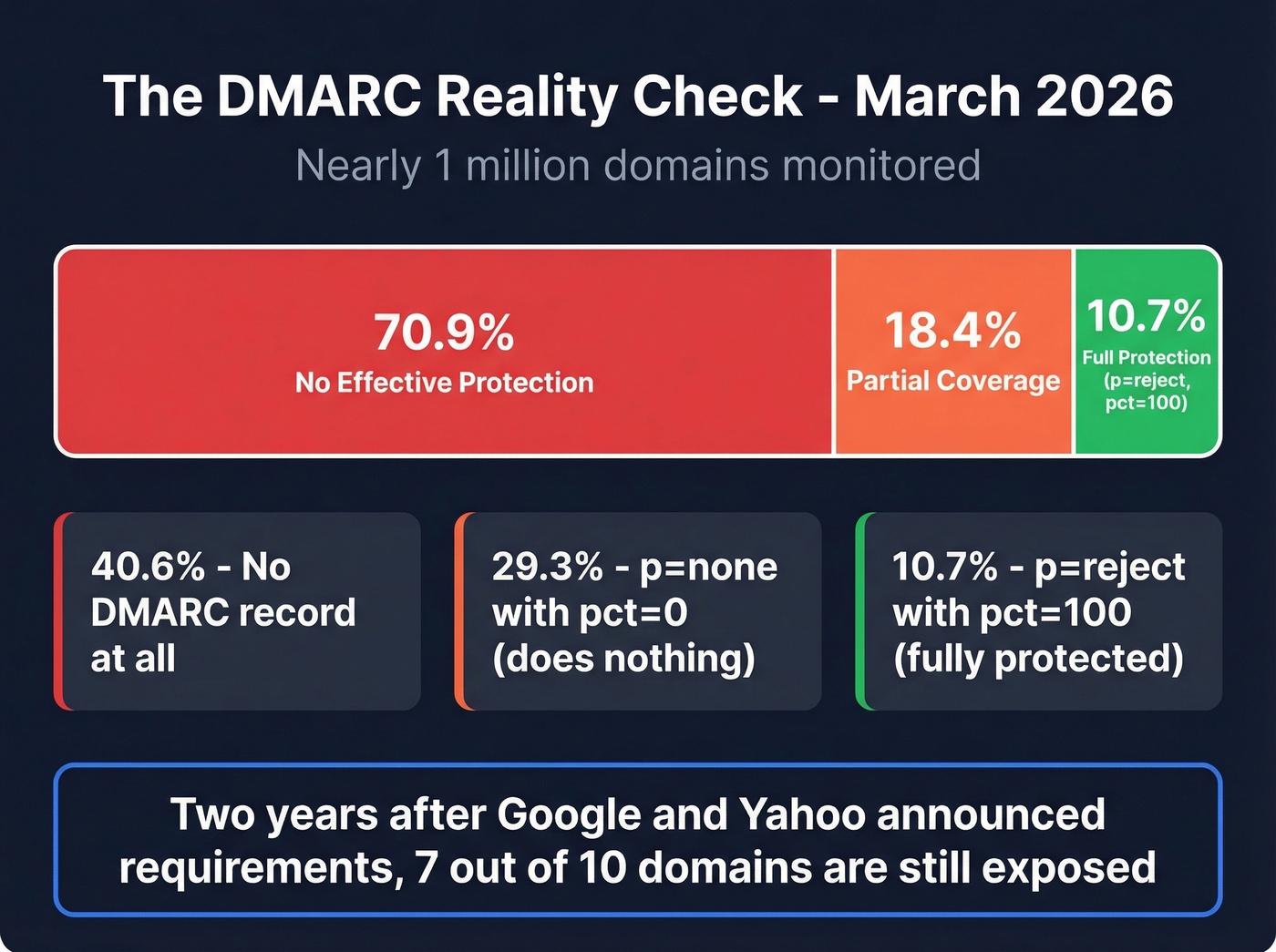
That's embarrassing - two years after Google and Yahoo announced these requirements. The industry had ample warning. Yet 40.6% of domains have no DMARC record at all, while 29.3% have it set to p=none with pct=0, which does nothing. If your domain falls in that 70.9%, fix it today. SPF, DKIM, and DMARC at p=quarantine or p=reject aren't optional anymore.
Quick reference for SMTP codes you'll encounter:
| Code | Provider | Meaning |
|---|---|---|
| 4.7.32 | Gmail | Alignment warning |
| 5.7.26 | Gmail | Alignment rejection |
| 4.7.27 | Gmail | SPF failure |
| 4.7.30 | Gmail | DKIM failure |
| 4.7.29 / 5.7.29 | Gmail | TLS issue |
| 4.7.23 / 5.7.25 | Gmail | rDNS/DNS issue |
| 5.6.0 | Gmail | RFC 5322 rejection |
| 550 5.7.515 | Microsoft | Auth level not met |

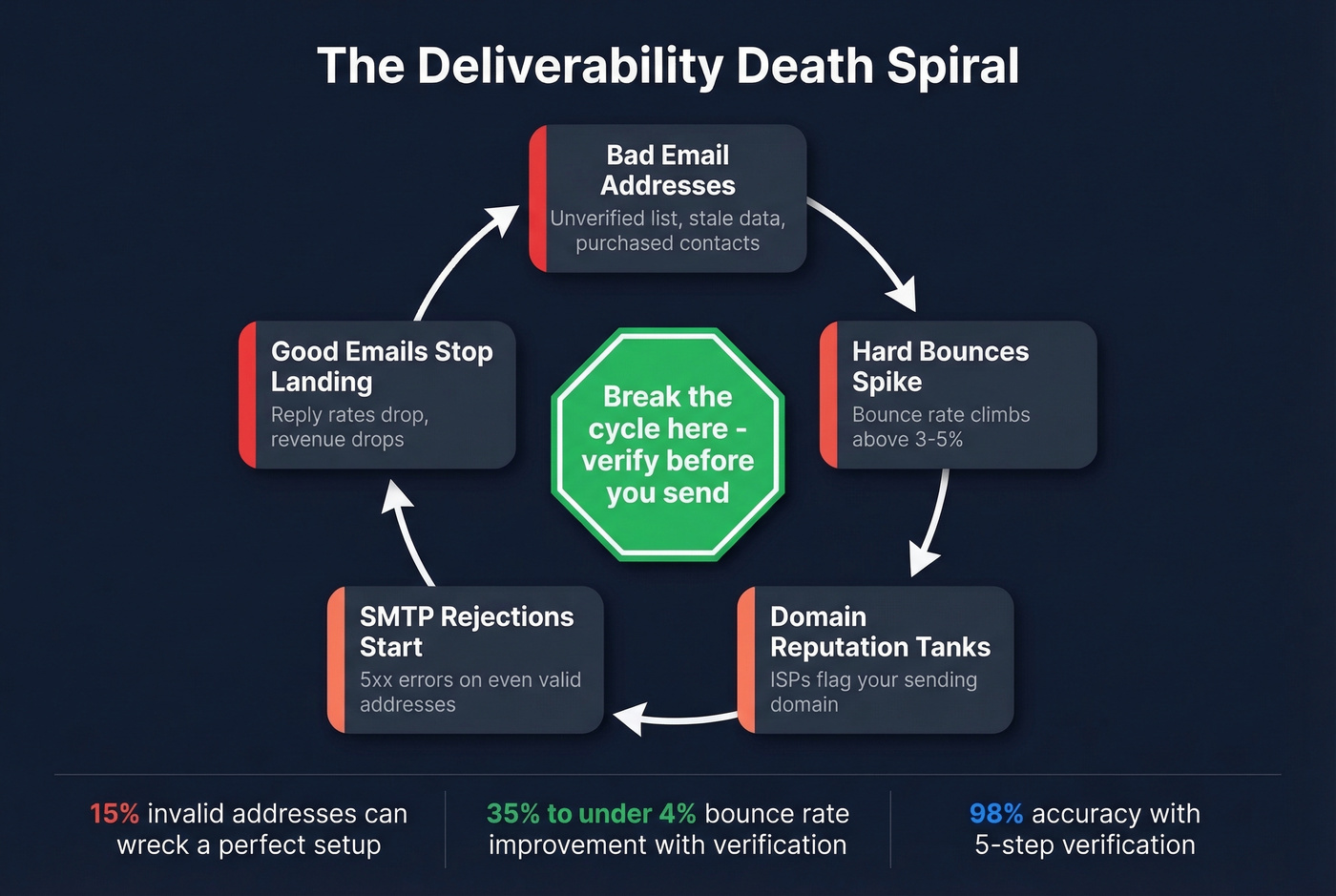
Every bounced email pushes your complaint rate closer to that 0.3% threshold. Prospeo's 5-step verification - including catch-all handling, spam-trap removal, and honeypot filtering - delivers 98% email accuracy. Teams using Prospeo cut bounce rates from 35%+ to under 4%.
Stop feeding bad addresses to Gmail's rejection engine.
How Inbox Filtering Works in 2026
The filtering model has shifted. IP reputation used to be the primary signal. Now it's engagement and complaint-driven.
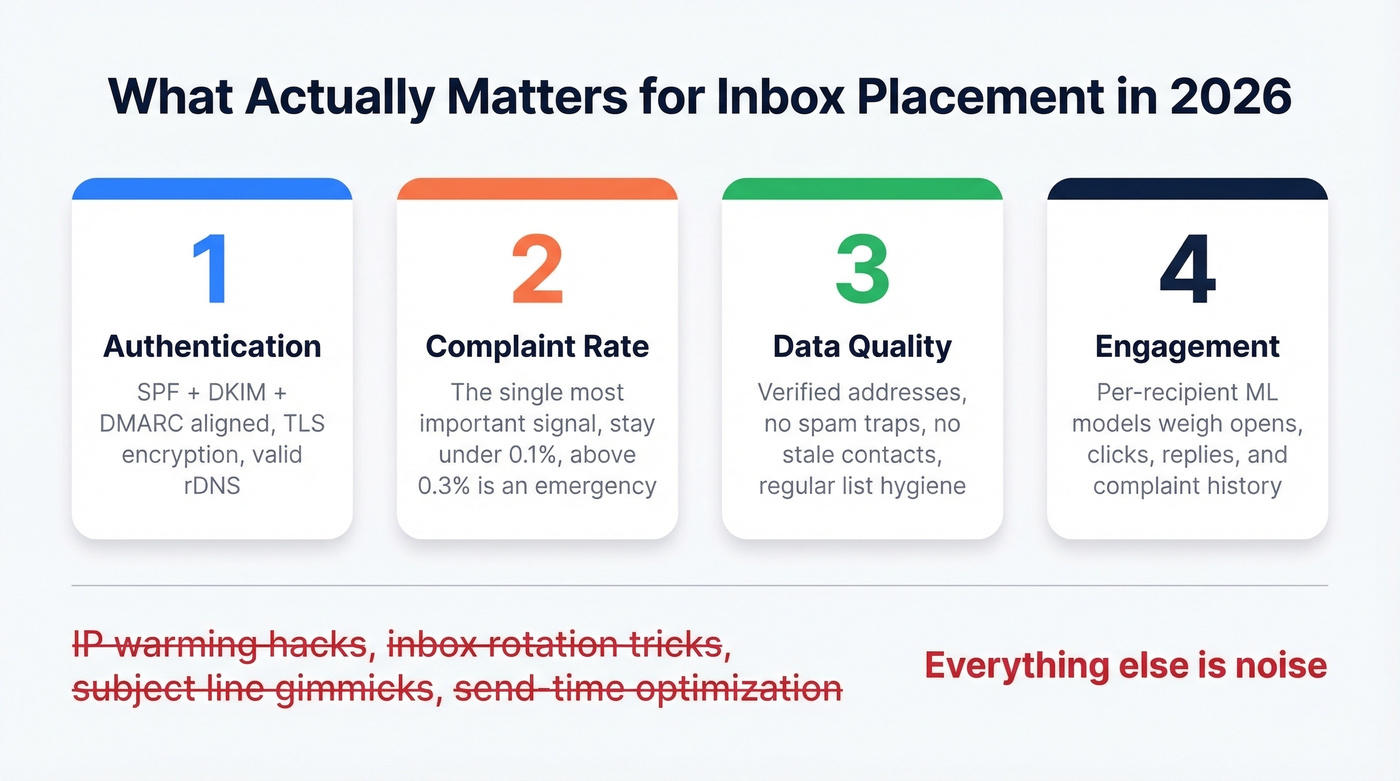
Complaint rates are the new PageRank of email - the single most important indicator in ISP escalations. Filtering is increasingly per-recipient, too. Gmail and Outlook use ML models that weigh each individual's engagement history, not just aggregate sender reputation. This means "quiet filtering" - where inbox placement silently degrades without any bounce or error code - is now the most dangerous failure mode. You won't see a 5xx rejection. You'll just watch reply rates drop and wonder what happened.
Orange, for instance, applies throttling automatically when complaint thresholds are exceeded, with 7-30 day observation windows before restrictions lift. You don't negotiate with a human. You fix the problem and wait.
We've seen teams obsess over warming schedules and IP rotation while ignoring their 0.4% complaint rate. That's backwards. Only four things matter in 2026: authentication, complaint rate, data quality, and engagement. Everything else is noise.
Regulatory and Enforcement Actions
Deliverability isn't just about inbox placement anymore - it's about legal exposure.
Lululemon was fined A$702,900 by the ACMA on March 11, 2026, for sending 370,000 marketing emails without functional unsubscribe links. That's not a sophisticated compliance failure - that's basic hygiene. The UK's ICO issued PS225,000 in fines for mass nuisance marketing, reinforcing that vague consent won't cut it as a defense.
In the U.S., L'Oreal faces a class action in Washington State over "Free Gift" subject lines - the argument being that misleading subject lines violate state consumer protection laws. Worth watching.
One more thing that'll quietly spike your bounce rates: Google now purges accounts inactive for 24 months, and Yahoo purges after 12 months. Yahoo also started cutting free mail storage for some users on February 4, 2026. Full inboxes and deleted accounts both mean hard bounces, which means reputation damage for senders who aren't monitoring bounce categories closely.
Cold Email Deliverability in 2026
Cold email infrastructure has its own norms now. The consensus on r/coldemail is clear: 3-5 mailboxes per domain, 15-25 sends per mailbox per day once warmed, and a 14-21 day warmup period. Diversify across 2-3 domain registrars and 2+ ESPs. Azure-hosted inboxes are riskier - cap at 5-10 sends/day vs 15-25 on standard Workspace. Reseller inboxes run $2.50-$3.50/mailbox; shared SMTP providers charge $3-$15/inbox. A solid reply rate at scale is 2-4%.
But infrastructure is only half the equation.
The fastest way to destroy your sender reputation isn't bad content - it's bad data. The deliverability death spiral works like this: bad email addresses lead to hard bounces, which tank domain reputation, which trigger SMTP rejections, which means even your good emails stop landing. We've watched teams with perfect infrastructure and strong copy get wrecked because their contact list was 15% invalid.
This is where data quality becomes a deliverability issue, not just a sales ops issue. Prospeo's 5-step email verification catches invalid addresses, spam traps, and catch-all domains before they enter your sequences - and the 7-day data refresh cycle means you're not sending to addresses that went stale three weeks ago.
Your Compliance Checklist
Do these this week:
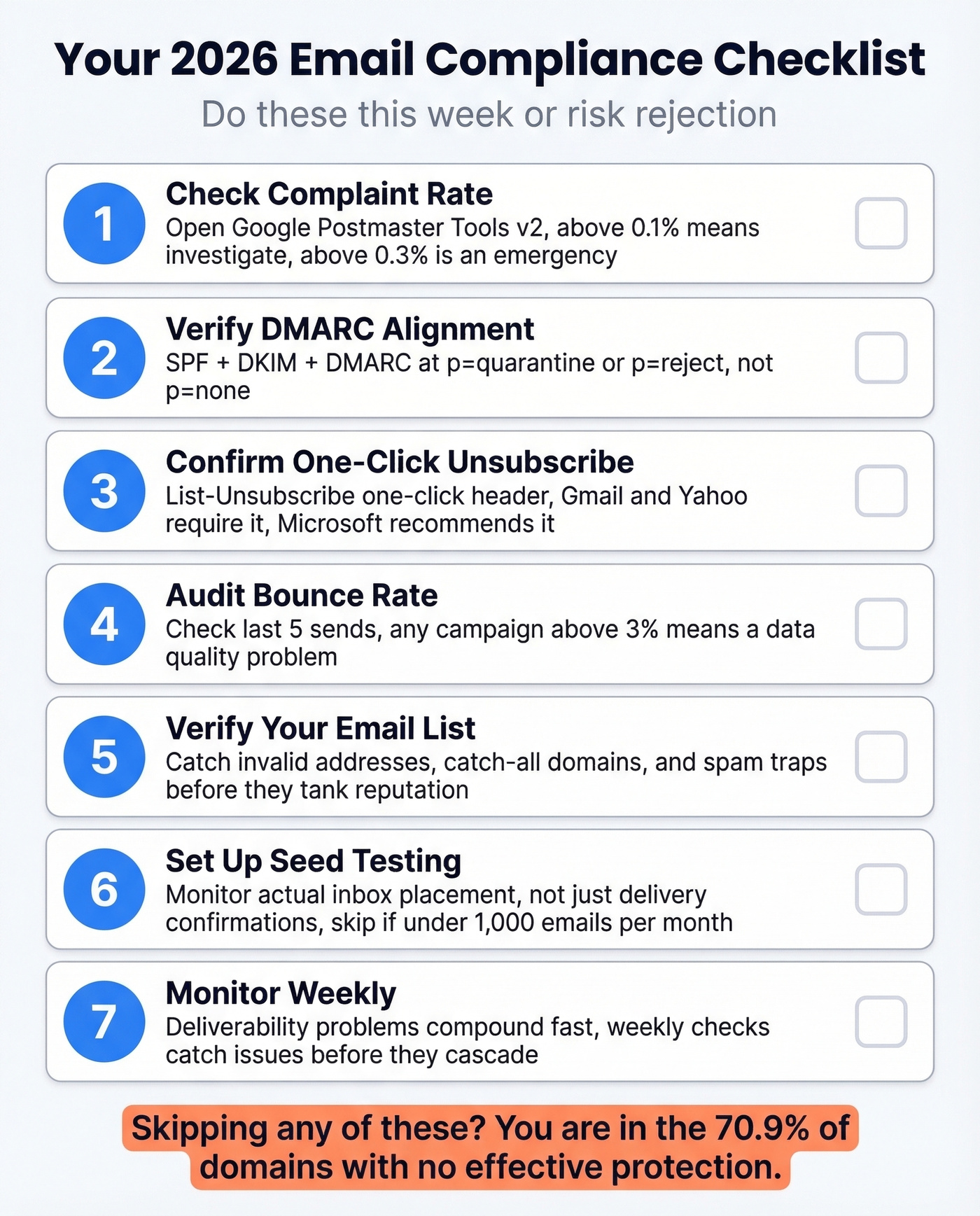
- Check complaint rate in Google Postmaster Tools v2. Above 0.1%, investigate. Above 0.3% is an emergency.
- Verify DMARC alignment. SPF + DKIM + DMARC at p=quarantine or p=reject. Not p=none. (If you need a walkthrough, start with a DMARC checker.)
- Confirm one-click unsubscribe via List-Unsubscribe one-click. Gmail and Yahoo require it. Microsoft recommends it. Just do it everywhere. (See the full email unsubscribe requirements.)
- Audit bounce rate on the last 5 sends. Any campaign above 3% means a data quality problem. (Compare against email bounce rate benchmarks.)
- Verify your email list before the next campaign - catch invalid addresses, catch-all domains, and spam traps before they tank your reputation.
- Set up seed testing to monitor actual inbox placement, not just delivery confirmations. (Use dedicated inbox placement tools if you're scaling.)
- Monitor weekly. Deliverability problems compound fast. Weekly checks catch issues before they cascade. For critical transactional messages, consider SMS as a fallback channel.
Skip seed testing if you're sending under 1,000 emails per month - at that volume, Postmaster Tools and bounce logs give you enough signal. But for teams running outbound at scale, seed tests are the only way to catch quiet filtering before it eats your pipeline.
70.9% of domains lack effective DMARC protection, and providers are rejecting non-compliant senders with 5xx codes. Authentication matters - but so does list quality. Prospeo refreshes all 300M+ records every 7 days, not the 6-week industry average, so you're never sending to stale addresses that spike bounces and trigger filters.
Clean data every 7 days. Your sender reputation depends on it.
FAQ
What's a good inbox placement rate in 2026?
Above 95% inbox placement is strong; below 90% signals authentication gaps or data quality problems needing immediate attention. Track inbox placement specifically - delivery rate (accepted by the server) and inbox rate (landed in Primary) are different metrics, and confusing the two is one of the most common mistakes we see.
What complaint rate triggers rejections?
Gmail and Yahoo penalize senders above 0.3% and recommend staying below 0.1%. Microsoft enforces similar thresholds without publishing exact numbers. One bad campaign can trigger weeks of throttling across all three providers.
Do I need DMARC under 5,000 emails per day?
Yes. The 5,000/day threshold applies to the strictest enforcement tier, but Gmail, Microsoft, and Yahoo all expect DMARC from every sender regardless of volume. Every major provider update in 2025 and 2026 has reinforced this expectation. There's no safe volume where you can skip authentication.
How do bounces from bad data affect sender reputation?
High bounce rates signal to providers that you're mailing unverified lists, which tanks domain reputation and triggers SMTP rejections on future sends. Cleaning your list before every campaign - removing invalid addresses, spam traps, and honeypots - is the single most effective way to keep bounce rates under the 3% danger threshold.
Are open rates still reliable for tracking deliverability?
No. Apple Mail Privacy Protection generates fake opens for roughly 48-54% of email recipients. Use complaint rates, bounce rates, and Postmaster Tools v2 compliance status instead - open rates are the metric most likely to mislead you in 2026.