

What Is a Spam Trap (and What to Do When You Hit One)
A sender on r/coldemail described it perfectly: deliverability "plummeted overnight" after a list import. Their basic verifier caught hard bounces just fine but "missed the advanced stuff." By the time they figured out what happened, their domain reputation was wrecked and recovery took weeks. No warning, no bounce notification - just silence and a slow realization that emails weren't landing anymore.
That invisible damage? Almost certainly a spam trap.
Spam Traps, Explained
A spam trap is an email address used by mailbox providers, blocklist operators, and anti-spam organizations to identify senders with bad list practices. It's not a content filter scanning your subject lines for "FREE" in all caps. It's an address that shouldn't be on any legitimate sender's list - and if it is, that tells the receiving system something went wrong with how you built or maintained your data.
These trap addresses don't bounce. They don't reply. They silently accept your email and contribute to reputation and blocklist signals behind the scenes. That's what makes them so dangerous: by the time you notice the damage, it's already compounding.
Three Types of Email Spam Traps
Not all traps are equal. Knowing the difference helps you prioritize what to fix first.
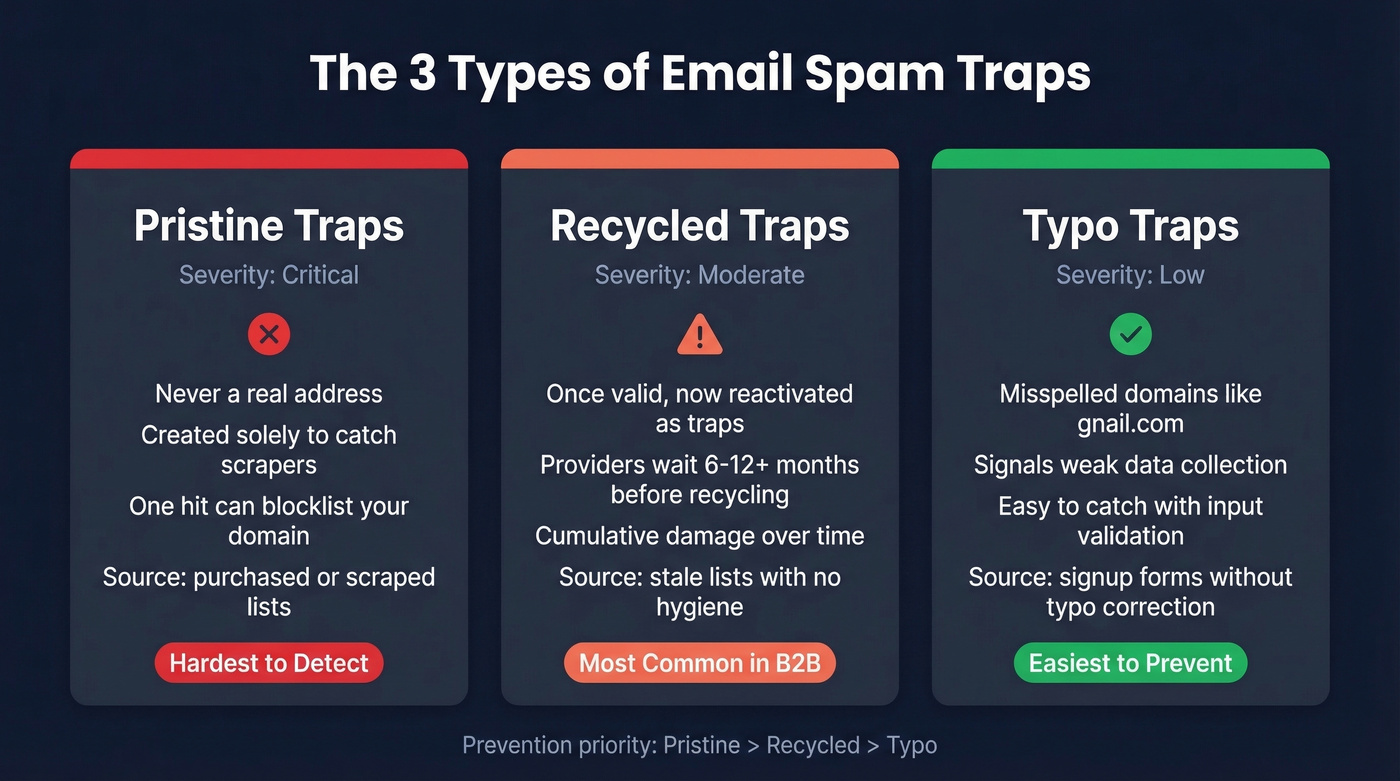
| Type | How It Enters Your List | Severity | Detection Difficulty | Remediation |
|---|---|---|---|---|
| Pristine | Scraped or purchased lists | Severe - can trigger blocklisting | Very hard - never bounces | Remove source; consider a fresh subdomain |
| Recycled | Stale lists, no hygiene | Moderate - cumulative | Hard - accepted silently | Suppress 6-month inactives; re-verify |
| Typo | Weak signup forms | Low - hygiene signal | Easy - pattern matching | Add typo correction at capture |
Pristine traps are the worst. These addresses were never valid for real communication - they exist solely to catch senders who scrape or buy contacts. A single hit can trigger blocklisting and spam placement across your entire sending infrastructure. If you're hitting pristine traps, your acquisition source is compromised. Full stop.
Recycled traps cause the most cumulative damage in B2B outbound, in our experience, because teams hold onto "good" contacts for too long. Inbox providers typically leave deleted accounts inactive for 6-12+ months before recycling them into traps. Those windows matter - they define how fast a valid address can become a weapon against you. We've seen teams with perfectly clean sending practices get burned simply because they didn't prune contacts who stopped engaging eight months ago.
Typo traps are the most preventable. Domains like gnail.com, yaho.com, and hotnail.com catch senders with weak collection forms and no input validation. Low severity individually, but they tell mailbox providers you're not paying attention to data quality.
What Happens When You Hit One
Here's the thing: one pristine trap email can be enough to trigger blocklisting that cascades across your entire sending operation. That's not hyperbole.
A sender on r/Emailmarketing described a similar failure mode - SPF, DKIM, and DMARC all passing, yet Gmail was routing everything to spam across multiple sending paths. They tested a dedicated subdomain through Amazon SES and still hit spam placement. Authentication passing doesn't guarantee inboxing. When your sender reputation is damaged, no amount of technical configuration saves you.
The damage works at two levels. IP-level reputation affects your sending infrastructure and can be mitigated by switching IPs, though that's a band-aid. Domain-level reputation follows your brand everywhere - every IP, every ESP, every subdomain. That second kind is the one that keeps deliverability teams up at night.
The Numbers That Matter
Deliverability has gotten measurably worse. In the most recent annual benchmark, Office 365 inbox placement dropped from 77.43% to 50.70% year-over-year - a 26.73 percentage point decline. Outlook and Hotmail fell even harder, from 49.33% to 26.77%. Only 23.6% of B2B marketers verify their lists before campaigns.
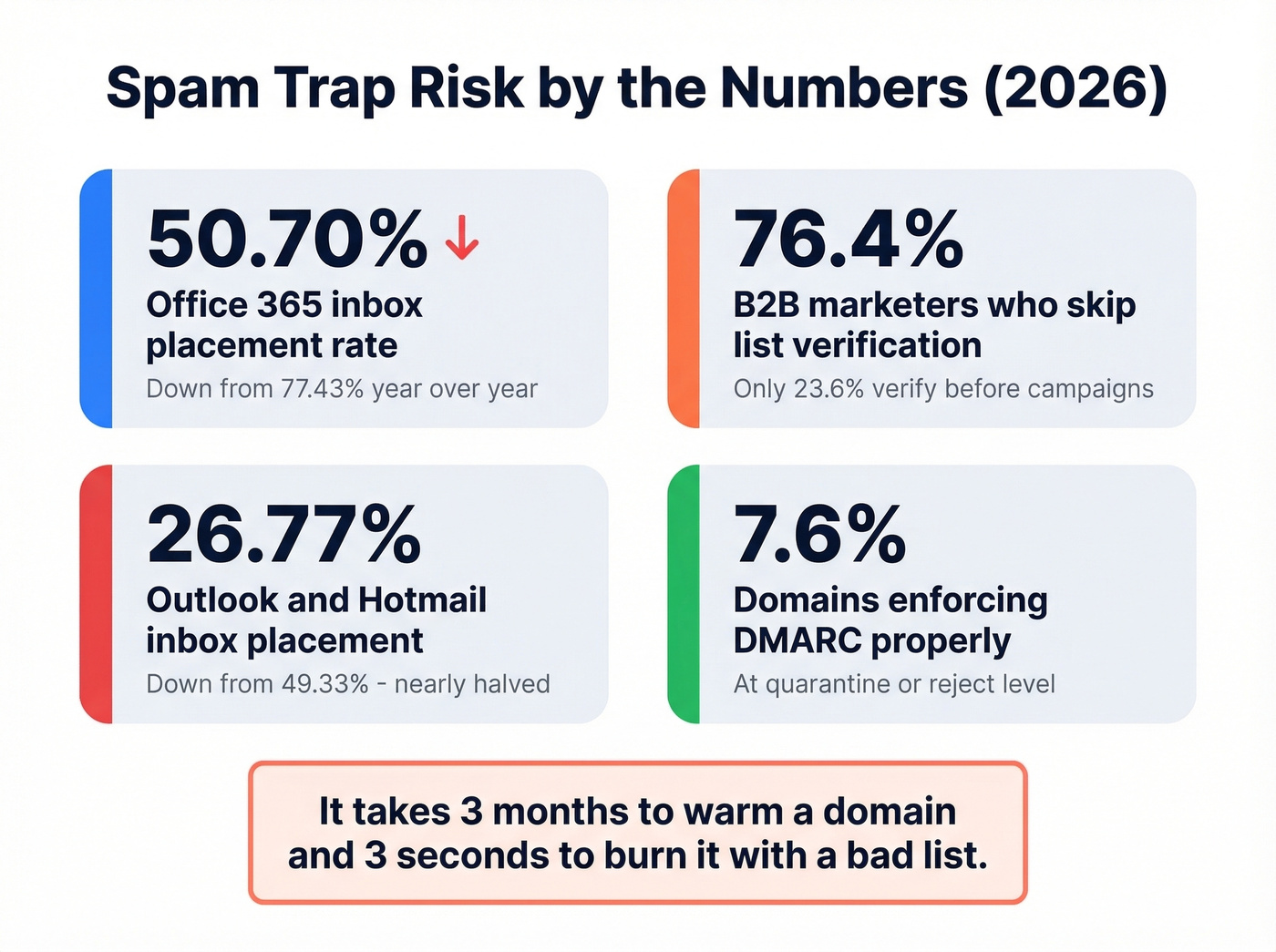
That gap between "emails delivered" and "emails in the inbox" is exactly where trap addresses do their damage.
Thresholds You Can't Exceed
- Complaint rate: Target below 0.10%. Anything above 0.30% consistently risks blocking or permanent spam placement.
- Bounce rate: Keep total bounces below 2%, hard bounces under 1%. (More benchmarks: bounce rate.)
- DMARC enforcement: Only 7.6% of domains enforce DMARC at quarantine or reject level. If you're not in that group, you're flying blind on authentication failures. (Related: DMARC alignment.)
It takes three months to warm up a domain and three seconds to burn it with a bad list.

Spam traps thrive on stale, unverified data - exactly the kind most providers sell you. Prospeo's 5-step verification catches catch-all domains, honeypots, and spam traps before they ever touch your list. With a 7-day data refresh cycle (vs. the 6-week industry average), contacts don't have time to go stale and become recycled traps.
Stop sending to addresses that silently destroy your reputation.
How to Monitor for Trap Hits
Gmail Postmaster Tools (2026)
If a guide tells you to check your High/Medium/Low reputation score in Gmail Postmaster Tools, that dashboard no longer exists. Google retired the old Postmaster Tools on September 30, 2025, and the updated v2 focuses on compliance rather than reputation scoring. IP and domain reputation dashboards are gone.
One quirk worth knowing: GPT v2 can show a 100% spam rate on days with zero sends. That's a calculation artifact from delayed complaints dividing by zero volume. Focus on 30-day trends, not daily spikes.
Microsoft SNDS (2026)
Microsoft overhauled SNDS as of January 22, 2026. The portal now requires authentication for network access approvals, JMRP feeds have been standardized to ARF format, complaint sample downloads are discontinued, and automated report links expire after 30 days. If you're running Outlook-heavy campaigns, SNDS is still a primary feedback loop - just know the interface has changed significantly.
Blocklist Lookups
Spamhaus remains the most consequential blocklist operator. Their taxonomy includes SBL (known spam sources), XBL (compromised hosts), PBL (IPs that shouldn't send unauthenticated SMTP), DBL (spammy domains), CSS, and ZEN (the aggregate list). Major providers that reject mail based on Spamhaus listings include Apple iCloud, Microsoft, Yahoo, Proofpoint, and Rackspace.
Check Spamcop and Barracuda too. Delisting usually comes down to the same essentials: identify the root cause, document remediation, show prevention steps, and submit a formal request. Expect days to weeks. There's no fast lane. (If you’re already listed, follow a dedicated Spamhaus blacklist removal workflow.)
Can Verifiers Actually Detect Spam Traps?
A thread on r/sysadmin put it bluntly: if trap lists are secret, how can any vendor claim to clean them?
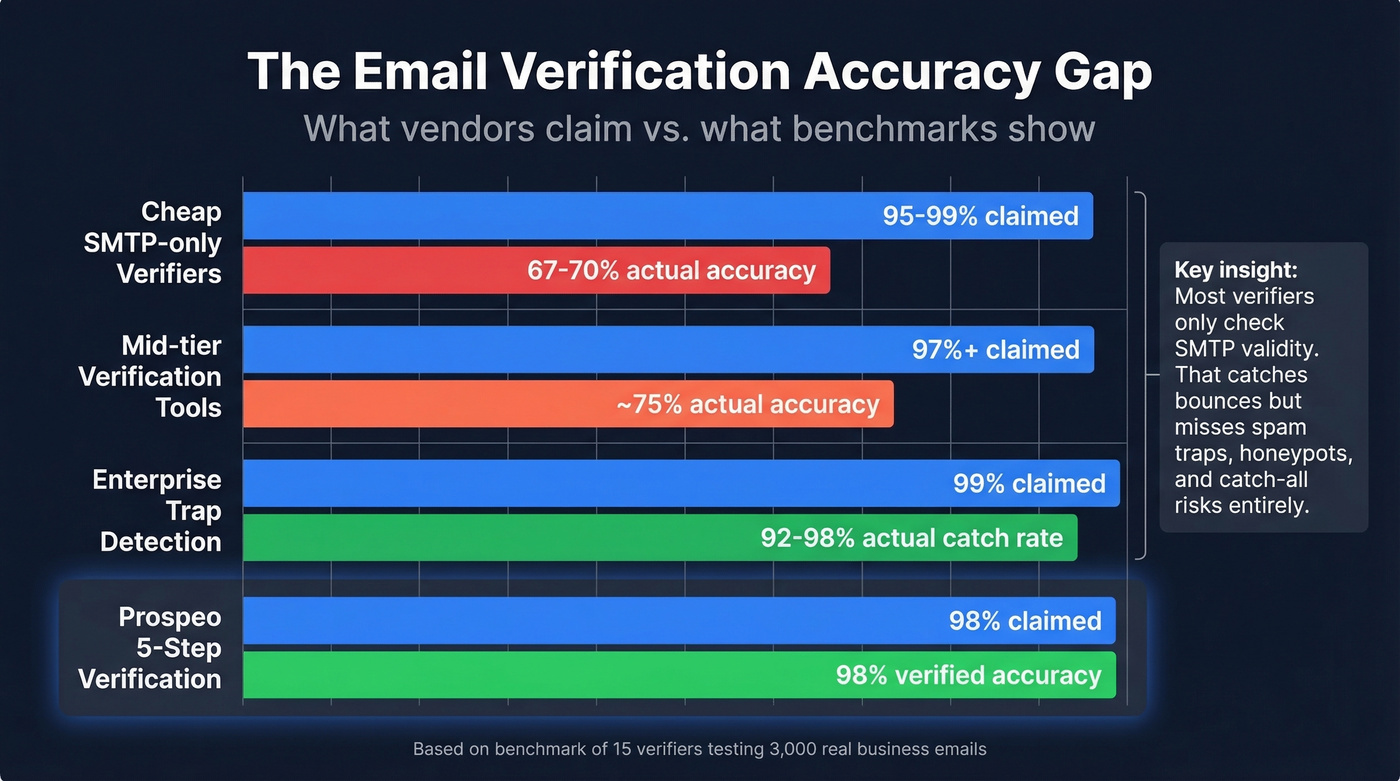
Fair objection. No vendor has a master list of every trap address. Anyone who says otherwise is lying. What good verification does is flag high-risk patterns - role-based addresses, domains with no MX records, trap-associated domain signatures, addresses with zero engagement history. It's pattern detection, not omniscience.
Let's be honest about the accuracy gap. A benchmark of 15 verifiers using 3,000 real business emails found general verification accuracy topping out at 67-70% - not the 99% vendors plaster on their landing pages. For trap detection specifically, enterprise solutions typically estimate 92-98% catch rates, but at enterprise prices. Verification costs range from $1.50 to $25 per 1,000 addresses depending on the tool. (If you’re comparing tools, start with Bouncer alternatives.)
Cheap verifiers create false confidence. They catch hard bounces and miss everything else. We've tested dozens, and the accuracy gap between marketing claims and reality is enormous. Prospeo's 5-step verification layers spam-trap and honeypot filtering using pattern-based detection across catch-all domains, role-based addresses, and known trap signatures - 98% email accuracy without the enterprise price tag.
Skip any verifier that only checks SMTP validity. That's table stakes, not protection. (More on the bigger picture: email deliverability.)
How to Prevent Traps in Your List
The most effective prevention happens before you send.
Clean data sourcing. Never buy or scrape lists. Purchased lists are the top source of pristine traps. If your lead source can't explain how addresses were collected, walk away. Stack Optimize, an outbound agency using Prospeo, maintains 94%+ deliverability across all their clients with bounce rates under 3% and zero domain flags - and the foundation of that is clean sourcing paired with real-time verification, not post-send cleanup. (If you’re evaluating vendors, see email list providers.)
Verification at point of capture. Every address should be verified before it enters your system. For marketing, double opt-in is the single most effective prevention mechanism - and most B2B teams skip it because it adds friction to signups.
For cold outbound, double opt-in isn't an option. That means your verification and sourcing need to be bulletproof. This is the single biggest reason B2B outbound teams need verification that goes beyond bounce checking. (Related: cold email marketing.)
Engagement-based suppression. Remove anyone who hasn't engaged in 6+ months. Recycled traps live in the stale segment of your list, and they're invisible until they've already done damage.
Role-based address filtering. Suppress abuse@, postmaster@, security@, hostmaster@, webmaster@, and noc@ addresses. These aren't prospects - they're infrastructure addresses that frequently overlap with trap networks.
Bulk sender compliance. If you're sending 5,000+ emails per day to Gmail or Yahoo, SPF, DKIM, DMARC, and RFC 8058 one-click unsubscribe aren't optional. They're requirements enforced since early 2024. (Also watch your email velocity.)

Recovery After a Trap Hit
If your deliverability has already cratered, here's the diagnostic workflow.
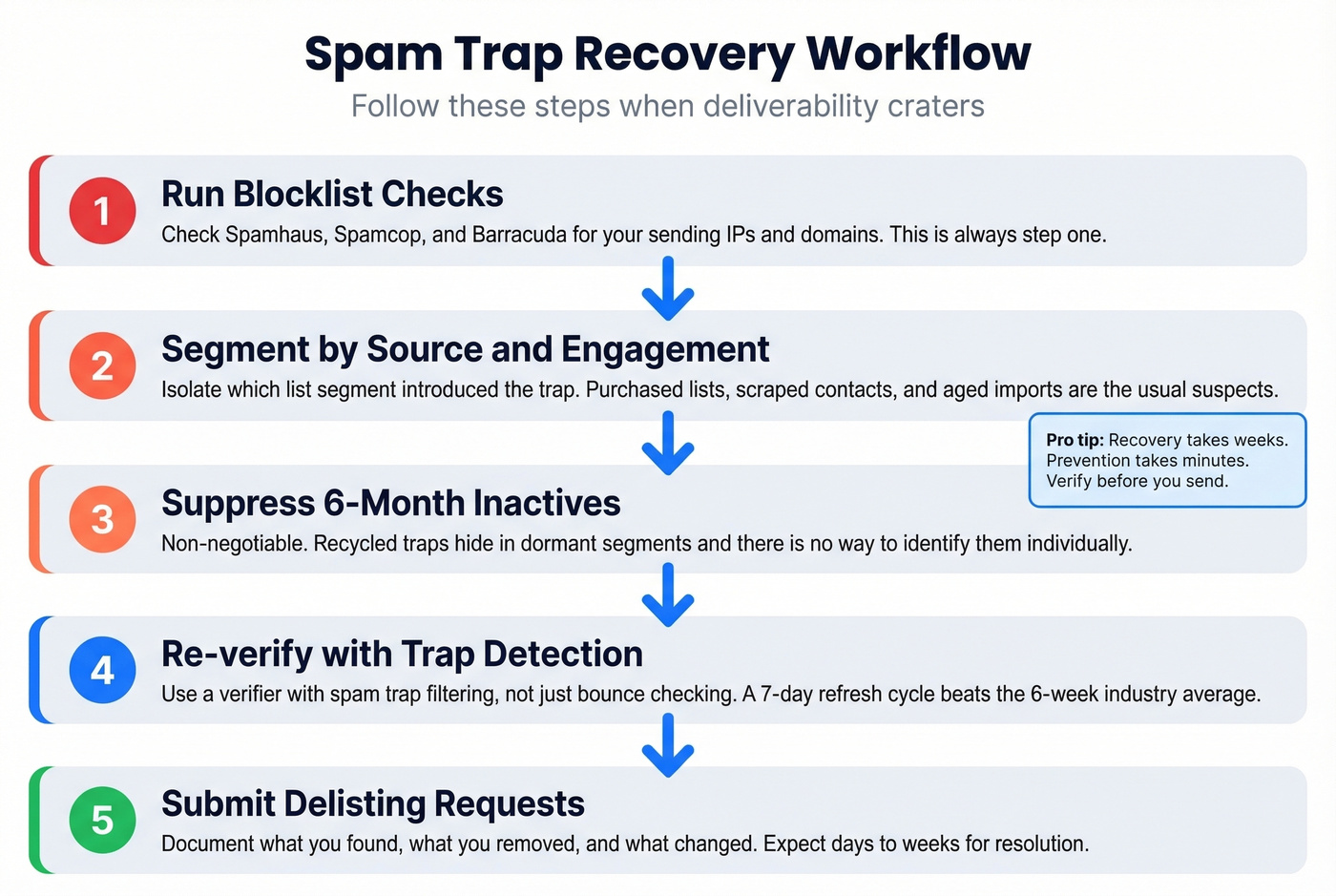
Run blocklist checks. Check Spamhaus, Spamcop, and Barracuda for your sending IPs and domains. This is step one, always.
Segment by acquisition source and engagement. Isolate which list segment introduced the trap. Purchased lists, scraped contacts, and aged imports are the usual suspects.
Suppress all contacts inactive for 6+ months. Non-negotiable. Recycled traps hide in dormant segments, and there's no way to identify them individually.
Re-verify your remaining list with a tool that includes trap detection - not just bounce checking. A 7-day data refresh cycle reduces the window where a once-valid address can go stale and turn into a recycled trap, compared to the roughly 6-week refresh cycle that's common across the industry. That difference matters when a valid address can become a trap within months. (If you need a deeper remediation plan, use this spam trap removal playbook.)
Submit delisting requests with remediation evidence. Document what you found, what you removed, and what you've changed going forward.
Monitor for 30 days. Watch complaint rates and inbox placement daily. Recovery is gradual, not instant. If you hit a pristine trap, the damage may warrant starting fresh on a new subdomain - painful, but sometimes faster than waiting months for reputation recovery.
That 67-70% verification accuracy benchmark? It's the industry ceiling for generic verifiers. Prospeo's proprietary email infrastructure doesn't rely on third-party providers - it runs triple verification with spam-trap removal and honeypot filtering built in. The result: 98% email accuracy, bounce rates under 4%, and zero domain flags for agencies sending at scale.
Start with data that was built to protect your deliverability.
FAQ
How do I know if I've hit a spam trap?
You won't get a bounce notification. Watch for sudden drops in inbox placement, appearances on blocklists like Spamhaus, and rising complaint rates. Monitor via Microsoft SNDS and Gmail Postmaster Tools v2, and run regular blocklist lookups on your sending IPs and domains.
Can I remove spam traps from my list?
Not directly - trap addresses look like normal emails. Suppress all contacts inactive for 6+ months, re-verify your entire list with a tool that includes pattern-based trap detection, and segment by acquisition source to isolate the contaminated segment.
Is buying email lists safe?
No. Purchased lists are the top source of pristine traps. One hit can trigger blocklisting and domain-level reputation damage that takes months to recover from.
What's the difference between a spam trap and a honeypot?
Honeypots are a subset of spam traps - specifically, pristine addresses planted on websites to catch scrapers. All honeypots are spam traps, but recycled traps and typo traps aren't "planted." They emerge from abandoned addresses and misspelled domains.
How often should I clean my list?
At minimum, re-verify every 3 months. Ideally, verify at the point of capture and again before every campaign. Suppress anyone who hasn't engaged in 6 months - that's where recycled traps live.