

Email Finder Comparison: 9 Best Tools Tested (2026)
Here's what most comparisons won't tell you: the tool that "finds" the most emails often costs you the most money. 37.3% of email addresses change annually. If your finder isn't refreshing its data, you're paying for contacts that bounced three months ago. The deliverability math is unforgiving - keep total bounces below 2% and hard bounces under 1%, or your sending domain takes damage that takes weeks to repair. The tool you pick isn't a prospecting decision. It's a deliverability decision.
Our Picks (TL;DR)
| Pick | Best For | Starting Price | Why This One |
|---|---|---|---|
| Prospeo | Accuracy + freshness | Free (75 emails/mo) | 98% email accuracy, 7-day refresh, ~$0.01/email |
| Hunter | Simplicity + free tier | Free (50 credits/mo) | Strong domain search, unlimited users, well-established |
| Apollo | All-in-one platform | Free tier available | Email finder + sequences + CRM in one tool |
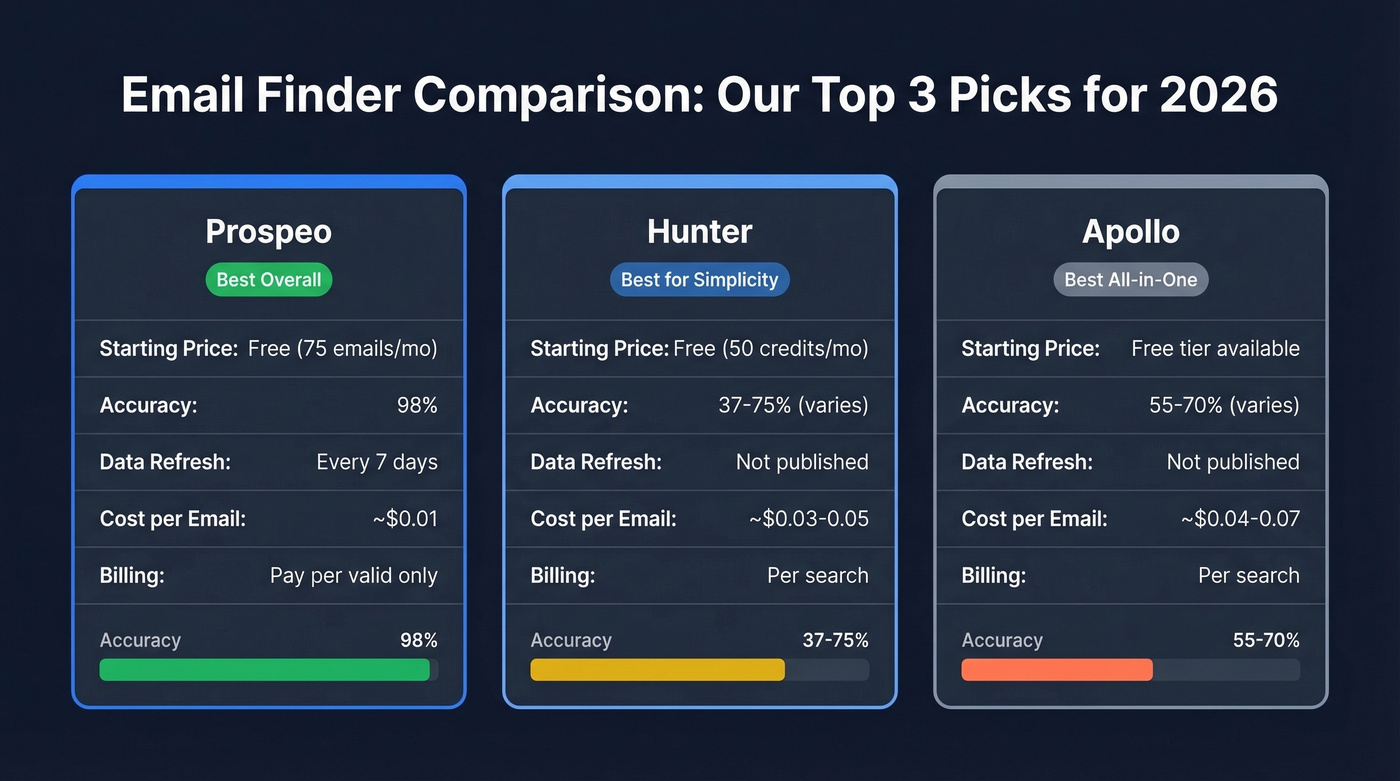
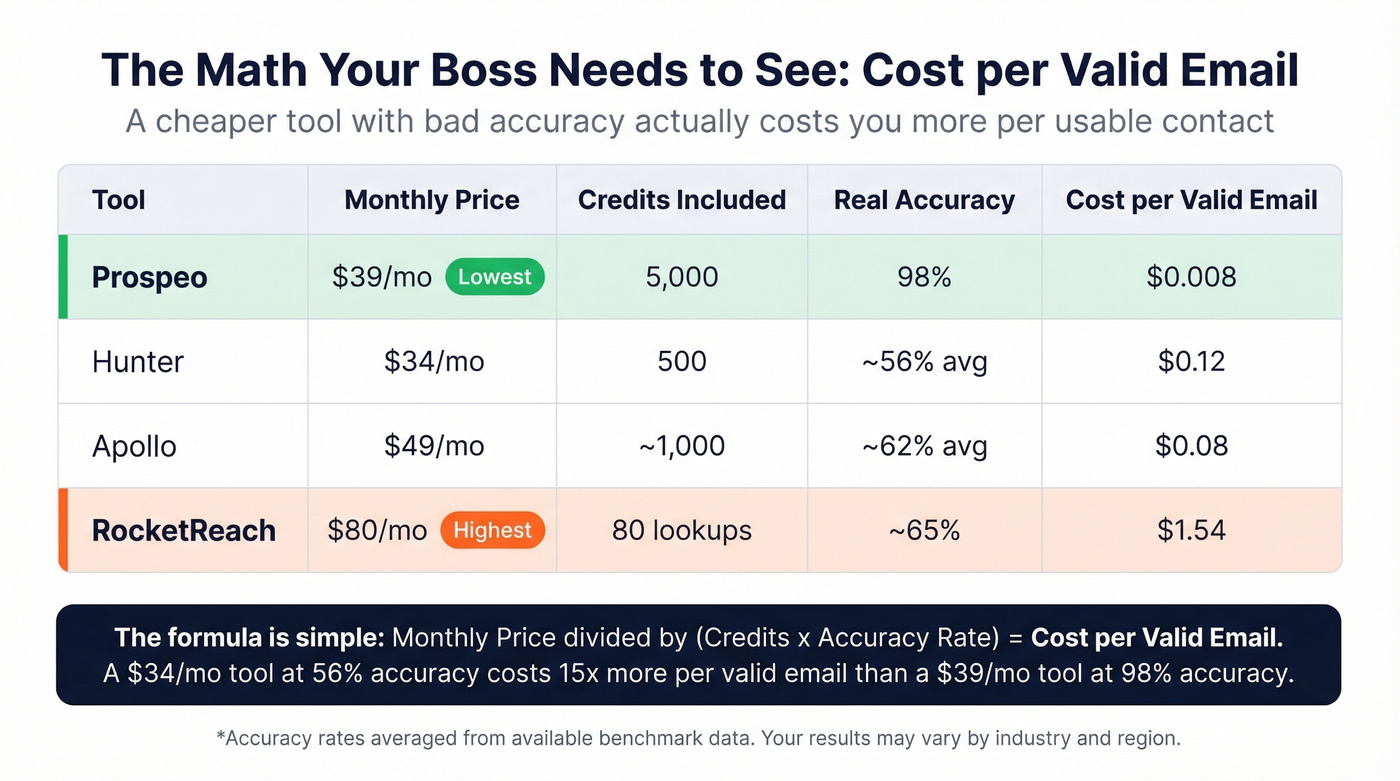
The cost-per-valid-email math - which we've never seen another comparison bother to calculate - is further down. That's the table you should send to your boss.
What Actually Matters When Comparing Email Finders
Stop comparing database size. Here are the five criteria that actually predict whether a tool will work for your outbound.
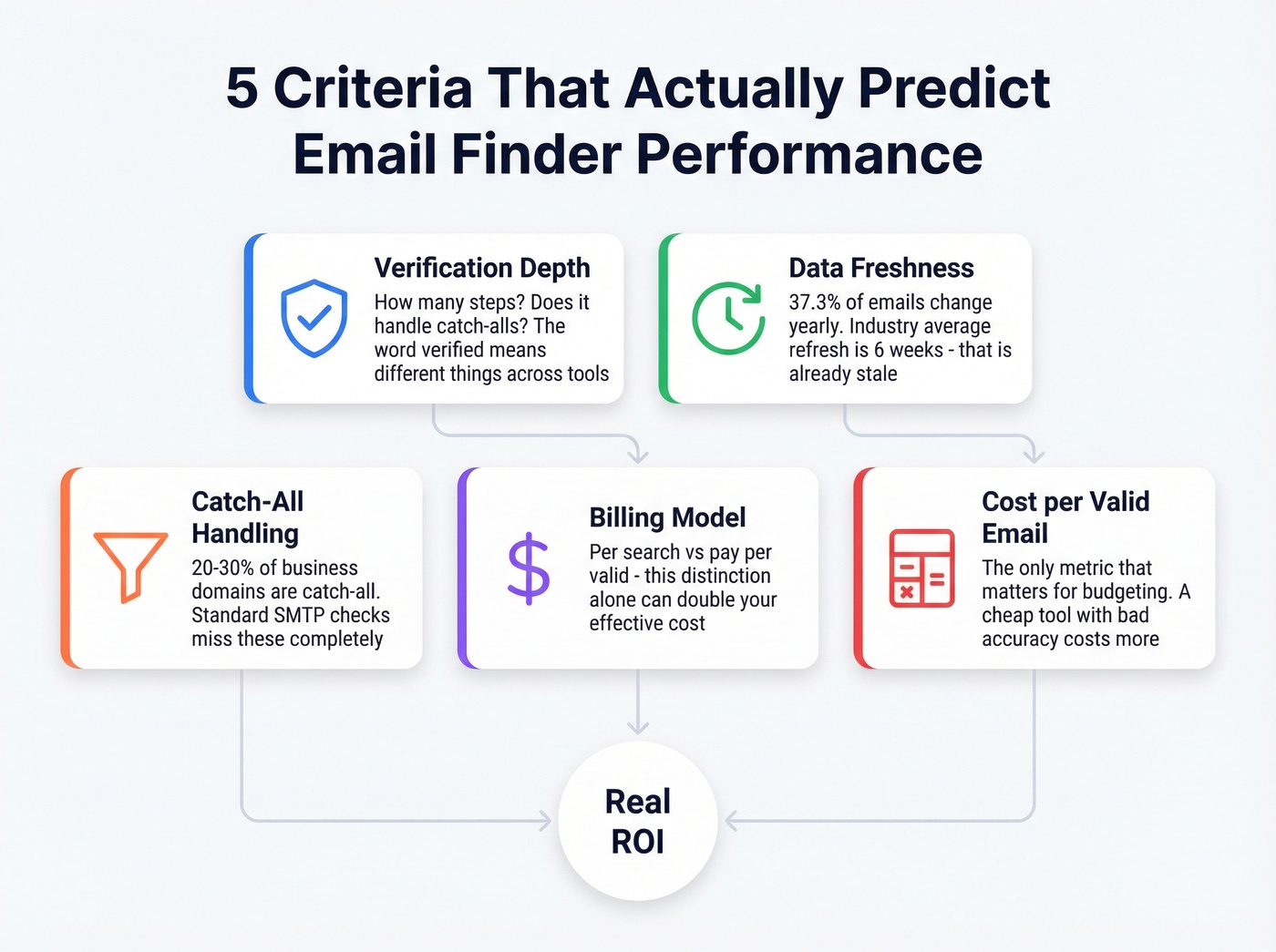
Verification depth. The word "verified" means wildly different things across tools. Hunter ran a benchmark of 15 email verifiers on 3,000 real business emails - the top performer hit just 70% accuracy. That means even the best verifier in that test got 3 out of 10 wrong. "Verified" on a tool's UI doesn't mean deliverable. Ask how many verification steps the tool runs, and whether it handles catch-all domains. If you want a deeper breakdown of what "verified" should mean, start with an email deliverability guide.

Data freshness. This is the metric nobody compares, and it matters more than database size. With 37.3% of addresses changing every year, a database refreshed quarterly is already stale by the time you use it. The industry average refresh cycle sits around 6 weeks. That gap compounds fast when you're sending thousands of emails per month.
Catch-all handling. Roughly 20-30% of business domains are configured as catch-all, meaning they accept mail for any address - even fake ones. Standard SMTP verification sends a "RCPT TO" command and gets an "OK" back, but that doesn't confirm the mailbox actually exists. Tools that don't handle catch-alls will charge you for emails that look valid but bounce.
Billing model. Some tools charge per search, whether or not they find an email. Others charge only for verified results. This distinction can double your effective cost per contact.
Cost per valid email. This is the only metric that matters for budgeting. A tool at $49/mo with 60% accuracy costs you more per usable contact than one at $99/mo with 98% accuracy. We do the math below. If you’re trying to reduce bounces fast, use these email bounce rate benchmarks and fixes as your baseline.

You just read why cost-per-valid-email matters more than sticker price. At ~$0.01/email with 98% accuracy and 5-step verification including catch-all handling, Prospeo delivers the lowest effective cost on this list.
Stop paying for emails that bounce. Start with 75 free verified emails.
9 Providers Tested Head-to-Head
Pricing at a Glance
| Tool | Starting Price | Free Tier | Verification | Billing Model |
|---|---|---|---|---|
| Prospeo | ~$0.01/email | 75 emails/mo | 5-step + catch-all | Pay per valid |
| Hunter | $34/mo (annual) | 50 credits/mo | SMTP + pattern | Per search |
| Apollo | ~$49/user/mo | Yes | Basic SMTP | Per search |
| Findymail | ~$49/mo | Limited | Multi-step | Pay per valid |
| Anymail Finder | £14/mo | Limited | Multi-step | Pay per valid |
| Snov.io | $39/mo | 50 credits | SMTP + pattern | Per search |
| RocketReach | $80/user/mo | No | Basic | Per search |
| Lusha | ~$22.45/mo | 40 credits/mo | Basic | Per credit |
| Skrapp | $39/mo | 100 credits/mo | SMTP | Per search |
Features & Capabilities
| Tool | Data Refresh | Chrome Extension | Mobile Numbers |
|---|---|---|---|
| Prospeo | 7 days | Yes (40K+ users) | 125M+ verified |
| Hunter | Not public | Yes | No |
| Apollo | Not public | Yes | Limited |
| Findymail | Not public | Yes | No |
| Anymail Finder | Not public | Yes | No |
| Snov.io | Not public | Yes | Limited |
| RocketReach | Not public | Yes | Yes |
| Lusha | Not public | Yes | Yes |
| Skrapp | Not public | Yes | No |
Notice how many tools don't publish their data refresh cycle. That's not an accident - most teams only discover data staleness after bounce rates start climbing.
Prospeo
Prospeo's database covers 300M+ professional profiles with 143M+ verified emails and 125M+ verified mobile numbers. The 5-step verification process includes catch-all handling, spam-trap removal, and honeypot filtering - all run on proprietary infrastructure rather than third-party email providers. That's how it hits 98% email accuracy and a 30% mobile pickup rate. If you’re building a broader stack around enrichment, compare options in our data enrichment services guide.
The 7-day data refresh cycle is the headline differentiator. Meritt saw their bounce rate drop from 35% to under 4% after switching. Snyk - running 50 AEs - went from 35-40% bounces to under 5%, with AE-sourced pipeline up 180%.
The Chrome extension has 40K+ users and works across company websites and professional profiles. Intent data covers 15,000 Bombora topics, which is unusual at this price point. Pricing starts free with 75 emails and 100 Chrome extension credits per month, with paid plans running about $0.01 per email. No contracts, no sales calls. If you’re evaluating adjacent tools, see our roundup of SDR tools for 2026.
Use this if: You care about deliverability above everything else, or you've been burned by stale data from another provider.

Most tools on this list won't even publish their data refresh cycle. Prospeo refreshes every 7 days - not 6 weeks. That's why Snyk cut bounces from 35-40% to under 5% across 50 AEs and grew pipeline 180%.
Run your own comparison. 75 free emails, no credit card required.
Hunter
Hunter is the tool most people think of first when they hear "email finder," and that brand recognition is earned. The domain search feature is genuinely best-in-class - plug in a company domain and get a structured list of email patterns and addresses Hunter has indexed. It's clean, fast, and the free tier at 50 credits/month is enough to test properly. If you want more options in the same category, check our Hunter alternatives list.
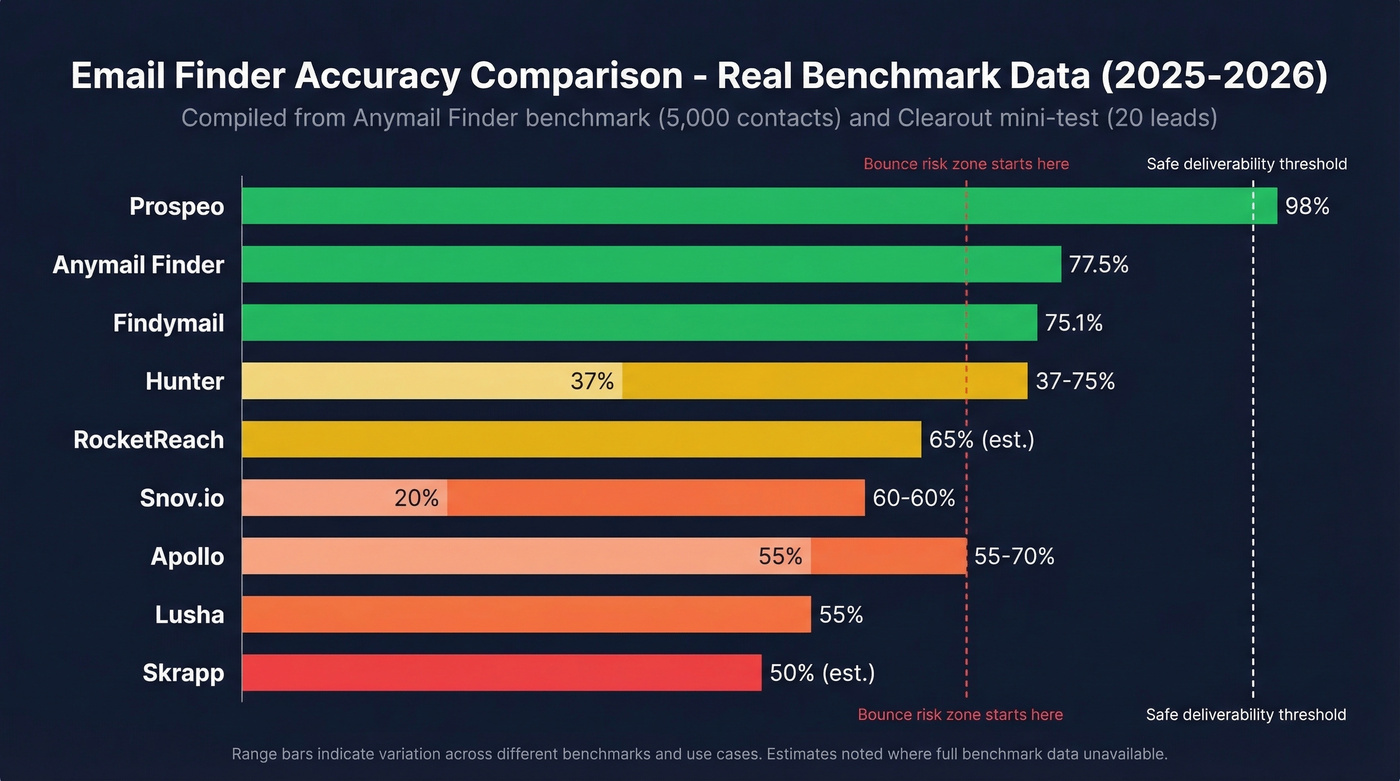
Pricing scales reasonably: Starter at $34/mo billed yearly, Growth at $104/mo, Scale at $209/mo. All plans include unlimited users, which is rare and genuinely useful for teams. The catch is accuracy. In a September 2025 benchmark by Anymail Finder testing 5,000 contacts uploaded via each tool's web interface, Hunter returned a 37.6% verified rate overall. Clearout's 20-lead mini-test put Hunter higher at 75%, which suggests performance varies significantly by use case and input quality.
Use this if: You need quick domain-level lookups and value simplicity over depth. Skip this if: You're running high-volume outbound where every bounce percentage point matters.

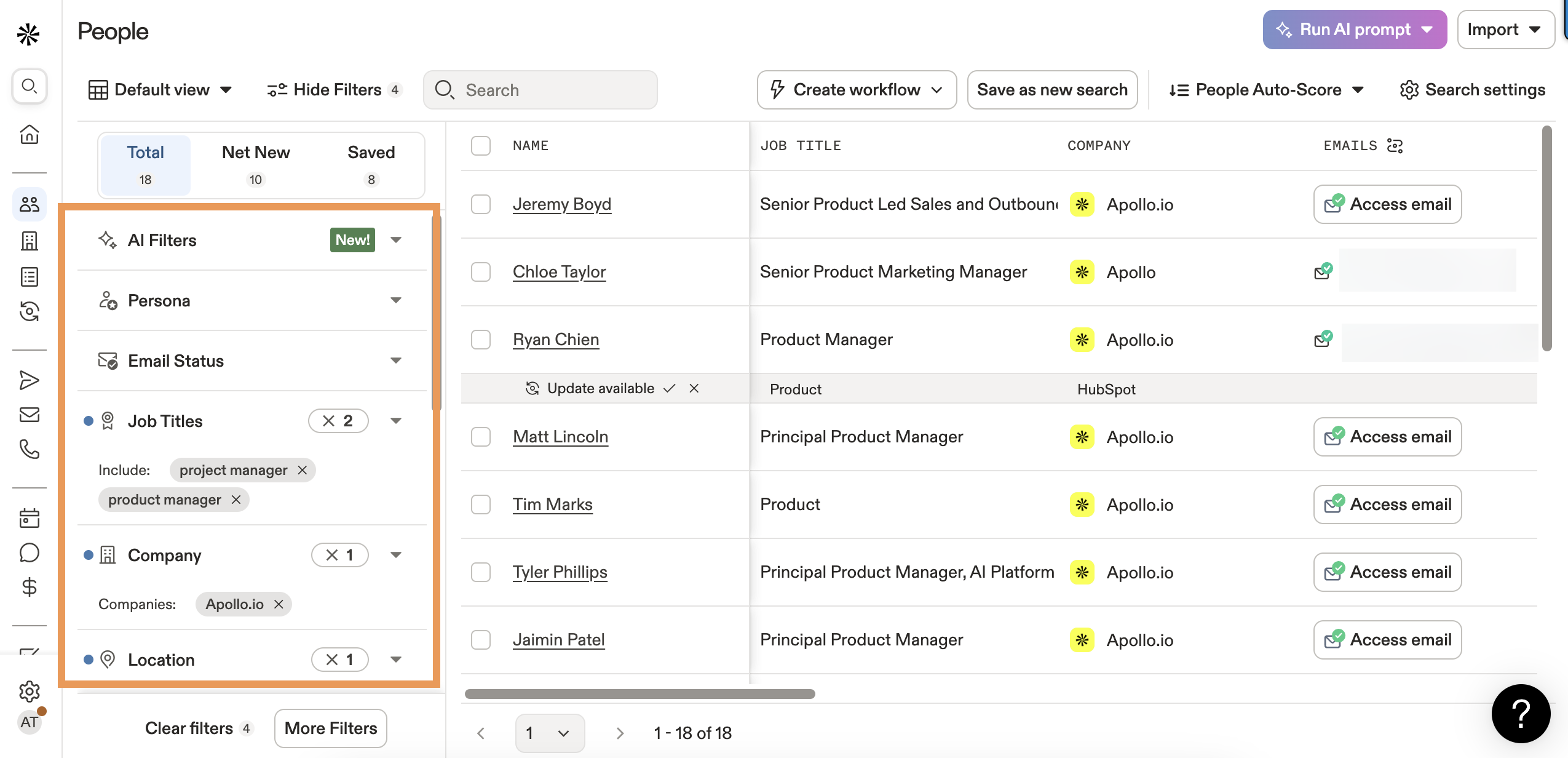
Apollo
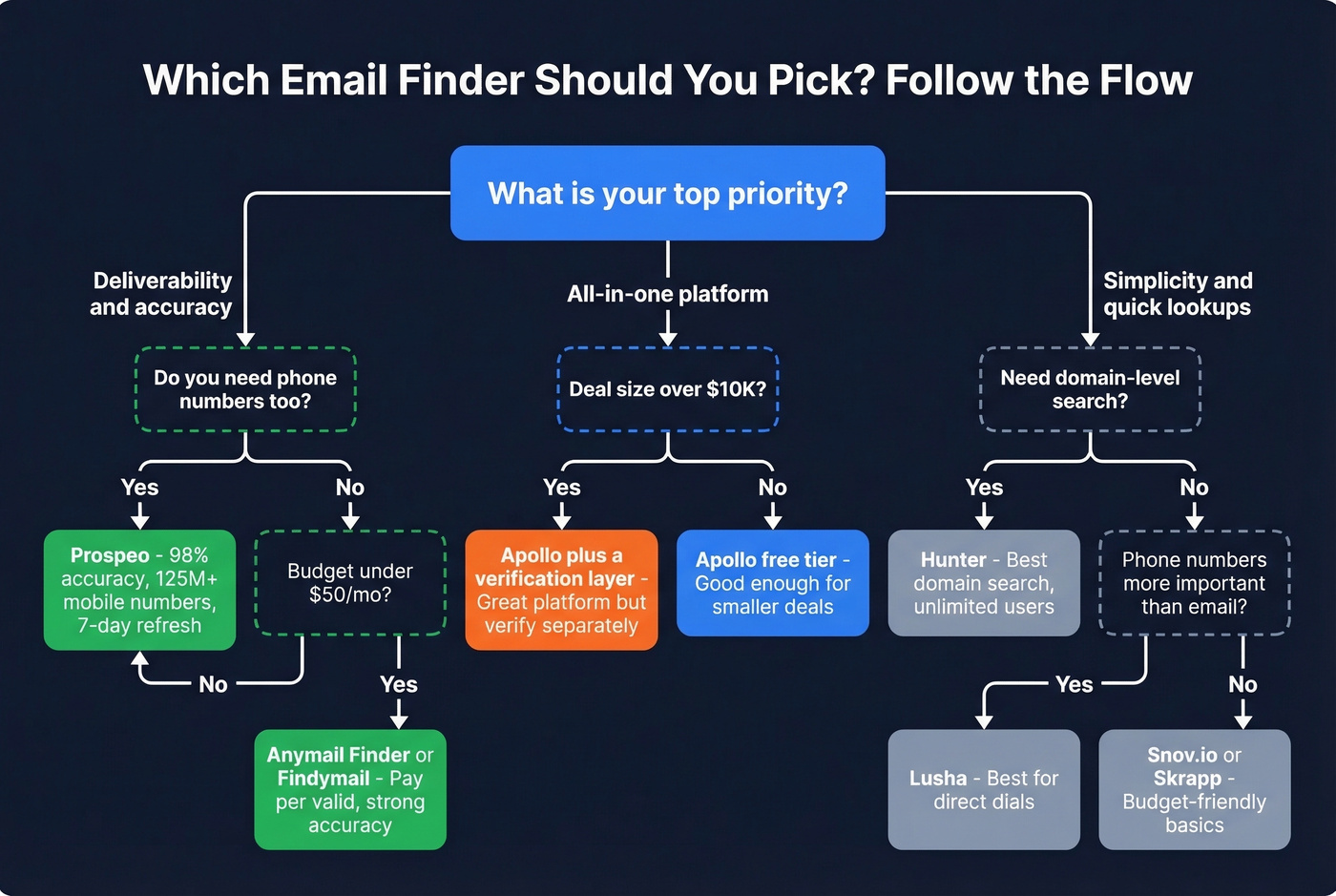
Here's the blunt verdict on Apollo: it's the best all-in-one platform on this list, and it's also the one most likely to get your domain flagged if you trust its data without verification.
The database is massive, the free tier is generous, and paid plans start around $49/user/month. For a Series A company trying to get outbound running without stitching together five tools, Apollo makes a lot of sense. But the consensus on r/sales is that you're looking at 60-70% valid emails in real-world testing, with phone numbers at "50/50 at best." Clearout's mini-test landed Apollo at 55% email accuracy. The platform doesn't publish a data refresh cycle, which usually means it isn't fast. We've seen teams run Apollo as their primary database and then layer a verification tool on top to catch the 30-40% that doesn't hold up. If you’re standardizing your process, pair this with a clear sales prospecting techniques playbook.
Hot take: If your average deal size is under $10K, Apollo's all-in-one convenience probably outweighs its data quality gap. Above that threshold, every bounced email to a VP costs you real pipeline - and you need cleaner data.
Findymail
Findymail quietly puts up strong numbers. In that September 2025 Anymail Finder benchmark, it hit a 75.1% verified rate. The pay-only-for-valid billing model means you aren't burning credits on dead ends. Pricing typically starts around $49/month and scales with volume.
This is a specialist tool that does one thing well: find emails that actually work. No CRM, no sequences, no bloat. If you're already running Instantly or Lemlist for outreach, Findymail slots in cleanly as the data layer. For more on list-building workflows, see how to generate an email list.
Anymail Finder
Anymail Finder topped their own benchmark at 77.5% - which, yes, deserves an asterisk. They designed the test, ran the test, and ranked themselves #1. That said, the methodology is unusually transparent: 5,000 fresh contacts, two input scenarios, clear sample sizes. The pay-only-for-verified model starts at £14/mo and scales to £239/mo. Worth testing if you're evaluating multiple tools head-to-head.
Snov.io
Snov.io bundles email finding, verification, and cold email sequences into one platform - similar to Apollo's approach but at a lower price point. The free trial gives you 50 credits, and paid plans run from $39/mo to $738/mo. If you’re also building sequences, use a proven B2B cold email sequence structure.
The accuracy problem is real: that same September 2025 benchmark returned 20.1% verified emails for Snov.io. Clearout's 20-lead mini-test was kinder at 60%, but neither number inspires confidence for high-volume outbound. Snov.io works better as a lightweight outreach platform for small teams than as a dedicated email finding engine.
RocketReach
RocketReach carries a 4.4/5 on G2 from 917 reviews, and the database is solid for US contacts. Individual plans run $80-$300/user/month, with team plans dropping to $83-$207/user/month on annual billing. Reddit threads consistently flag billing and cancellation headaches alongside otherwise decent data. Credit overages can hit $0.30-$0.45 per lookup if you blow past your plan limits.
Skip this if: You're price-sensitive or want transparent billing with no surprises.
Lusha
Lusha's real strength is phone numbers, not emails. The free tier gives you 40 credits per month, and entry pricing starts around ~$22.45/month on annual billing. In Clearout's mini-benchmark of 20 leads, Lusha hit 55% for email finding - middle of the pack. For phone-heavy outbound motions where you need direct dials more than emails, Lusha deserves a look. For email-first workflows, there are better options on this list.
Skrapp
Skrapp focuses on finding emails from professional profiles and company domains. Free tier: 100 credits/month. Paid plans from $39/mo to $699/mo. That September 2025 benchmark put Skrapp at 42.8% verified rate. It's a functional tool for light prospecting but doesn't stand out in a crowded field. If you’re comparing pricing and true cost, see Skrapp pricing.
Cost Per Valid Email
This is the math that actually matters - and the table we've never seen another comparison build. Here's what you're really paying per usable contact:
| Tool | Monthly Cost | Credits | Est. Valid Rate | Cost/Valid Email |
|---|---|---|---|---|
| Prospeo | ~$39/mo | ~3,900 | 98% | ~$0.01 |
| Hunter (Starter) | $34/mo | 2,000 | ~38% | ~$0.04 |
| Apollo | ~$49/mo | ~1,000 | ~65% | ~$0.08 |
| Snov.io | $39/mo | ~1,000 | ~50% | ~$0.08 |
| RocketReach | $80/mo | ~1,200 | ~60% | ~$0.11 |
| ZoomInfo | $15K-$45K+/yr | Varies | ~70-80% | $0.50-$1.00+ |
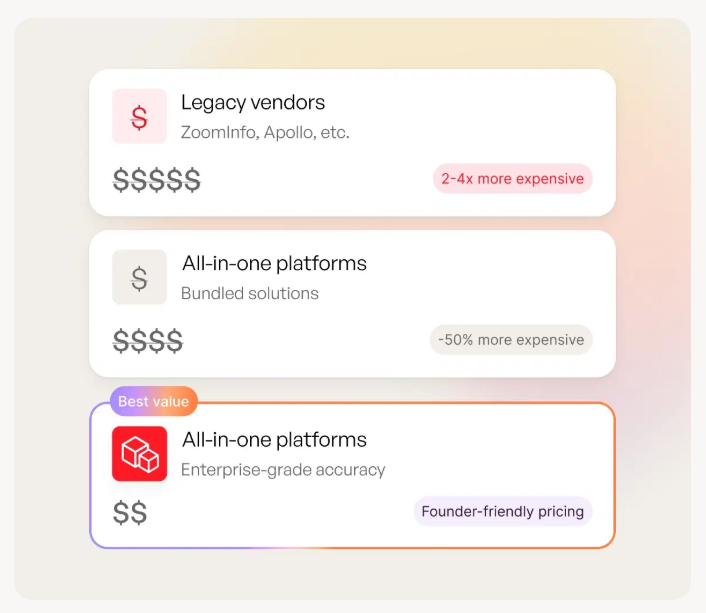
The pay-per-search model punishes you twice: once for the search, and again when the email bounces. Tools with pay-per-valid billing like Findymail and Anymail Finder shift that risk to the provider. ZoomInfo sits in a completely different budget tier - $15K-$45K+ per year with annual contracts and reported 10-20% renewal uplifts. It's a sales intelligence platform, not an email finder, and comparing it to tools on this list is like comparing a fleet lease to a gas card.
Do You Need More Than One Tool?
A single email finder typically returns 60-70% valid results. A waterfall approach - routing leads through multiple providers sequentially - can push that to roughly 90% based on real user testing shared across Reddit and Slack communities.
But here's the contrarian take: you need 1-2 good tools, not 10.
If your primary finder delivers 98% accuracy on the emails it returns, the gap you're filling with a second tool is coverage - contacts it couldn't find - not quality. That's a different problem than running three mediocre tools and hoping one gets it right.
For most teams under 10 reps, one strong tool with high accuracy beats a complex multi-provider stack every time. When you do want to build a cascade, tools like Clay, Zapier, and Make make it easy to automate without custom engineering. If you want the cost/workflow math, start with Clay list building.
FAQ
How accurate are email finders in independent tests?
The best email verifiers top out around 70% accuracy in independent testing - and that's for verification alone, not finding. Email finders with inline verification perform better on precision but return fewer total results. The gap between "verified" on a dashboard and "actually deliverable" is where most bounces hide.
What's a catch-all email and why does it matter?
A catch-all domain accepts mail for any address, so standard SMTP verification can't confirm whether a specific mailbox exists. Tools that don't handle catch-alls mark these emails as "valid" when they'll bounce. Look for providers that explicitly detect and flag catch-all domains rather than silently passing them through.
How many email finder credits do I need monthly?
A solo SDR sending 500 cold emails per month needs roughly 600-800 credits, accounting for unfound contacts and invalid results. A 5-person outbound team typically needs 3,000-5,000 credits. Start with a free tier to calibrate your actual find rate before committing to a paid plan.
Can I use multiple email finders together?
Yes - waterfall enrichment routes leads through multiple providers sequentially and can push valid email rates from 60-70% to roughly 90%. Tools like Clay and Zapier make this easy to automate. Start with one high-accuracy provider as your primary, then add a second for coverage gaps only.
The email finder you pick is a deliverability decision disguised as a prospecting decision. Pick for accuracy and freshness first, features second. Everything else follows from data quality.