

Best Email Lead Generation Services for 2026 (Tools + Agencies)
Organizations generate an average of 1,877 leads per month, and 80% of those leads never convert. That's not a pipeline - it's a landfill. The difference between email lead generation services that book meetings and ones that burn your domain comes down to two things: data quality and sending infrastructure. Most teams get one right and botch the other.
You don't need to spend $5,000+/month on an agency to run effective email outbound. But you might. It depends on whether you've got someone in-house who can dedicate five hours a week to prospecting. Let's break down both paths.
Our Picks (TL;DR)
Best DIY tools (for teams with at least one person running outbound):
- Prospeo - Best data accuracy. 98% verified emails, 300M+ profiles, free tier with 75 emails/month. ~$0.01/email on paid plans.
- Instantly - Best sending infrastructure. Unlimited email accounts and warmup from $30/mo on annual billing.
- Saleshandy - Budget all-in-one. Database + sending from $25/mo.
Best agencies (for teams with zero outbound capacity):
- Belkins - Most established, highest volume. $5,000-$14,800/mo retainers.
- SalesRoads - 5.0/5 rating. $5,500-$9,500 per 4-week cycle.
- Cleverly - Budget entry point at $397/mo.
Most teams don't need an agency. They need verified data and a sending tool. Read the cost breakdown below before you commit $5K+/month to something you could run yourself for $100.
Agency vs. DIY: Which Path?
This is the first decision, and it's worth getting right because the cost difference is enormous.
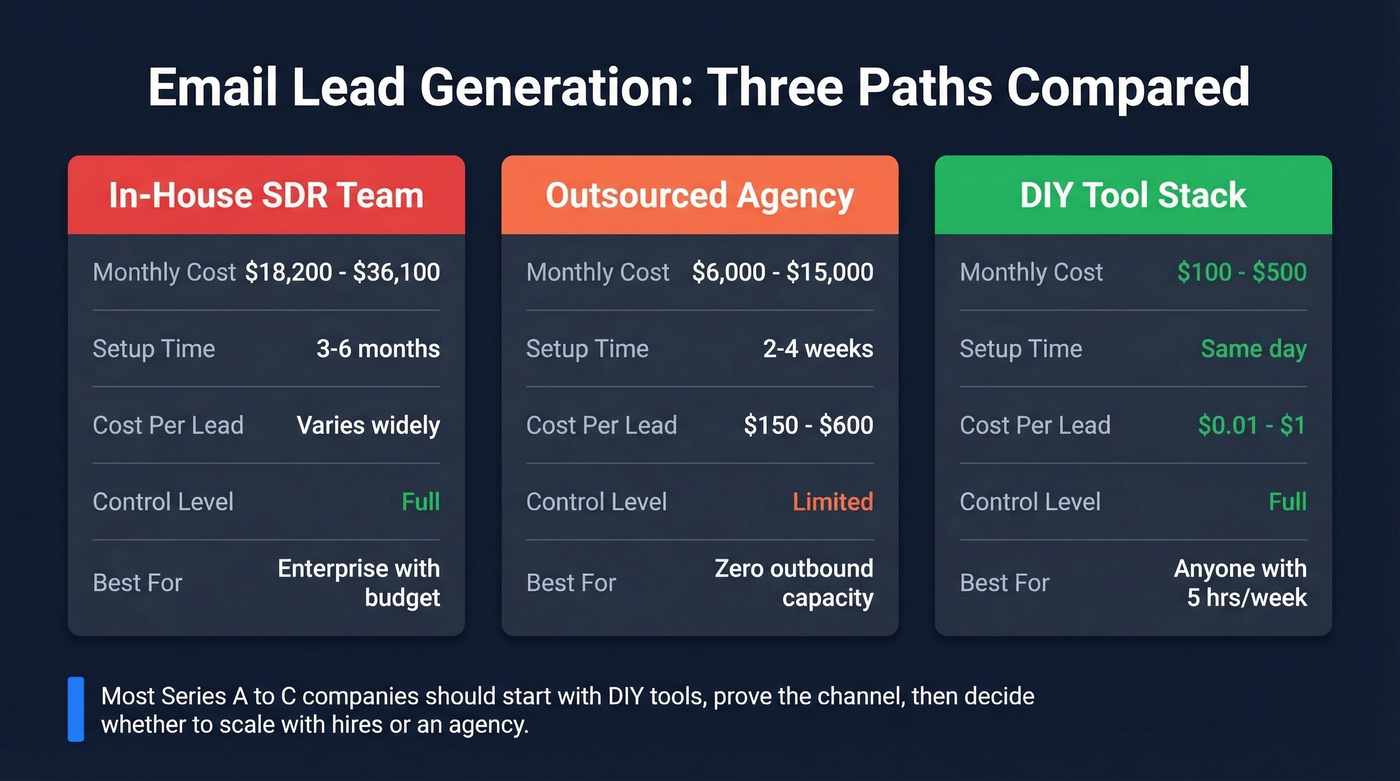
Running a 2-person SDR team in-house costs $18,200-$36,100/month when you factor in salaries, benefits, tools, data subscriptions, training, and management overhead. Outsourcing to an agency runs $6,000-$15,000/month. A self-serve tool stack? $100-$500/month.
New reps take up to 10 months to become fully productive. Outsourcing can be 43-65% more cost-effective when you account for ramp time, turnover, and the infrastructure you'd need to build internally. Top agencies use 8+ touches across email, phone, and social to warm leads before booking a meeting - that's a workflow most solo operators can't replicate without dedicated tools.
Here's a useful operational benchmark: to send roughly 300 emails per day at a safe rate of 30 per mailbox, you need about 10 email accounts. A 1,000-contact campaign costs approximately $2,200 in-house when you add up data, tooling, and time. That math changes fast if you're running multiple campaigns simultaneously.
| Factor | In-House SDR Team | Outsourced Agency | DIY Tool Stack |
|---|---|---|---|
| Monthly cost | $18,200-$36,100 | $6,000-$15,000 | $100-$500 |
| Setup time | 3-6 months | 2-4 weeks | Same day |
| Cost per lead | Varies widely | $150-$600 | $0.01-$1/contact |
| Control | Full | Limited | Full |
| Best for | Enterprise w/ budget | Zero outbound capacity | Anyone w/ 5 hrs/week |
The sweet spot for most Series A through Series C companies: start with DIY tools, prove the channel works, then decide whether to hire reps or outsource the scaling. Don't skip straight to a $10K/month agency retainer without knowing your ICP converts via cold email first.
Here's the thing - if your average deal size is under $10K, you almost certainly don't need an agency. The unit economics just don't work. A $5,000/month retainer producing leads for an $8K contract means you need to close more than half your pipeline just to break even on acquisition costs. Start with tools, learn what messaging converts, and only bring in an agency when you've hit the ceiling of what one person can manage.
Best Email Lead Generation Tools
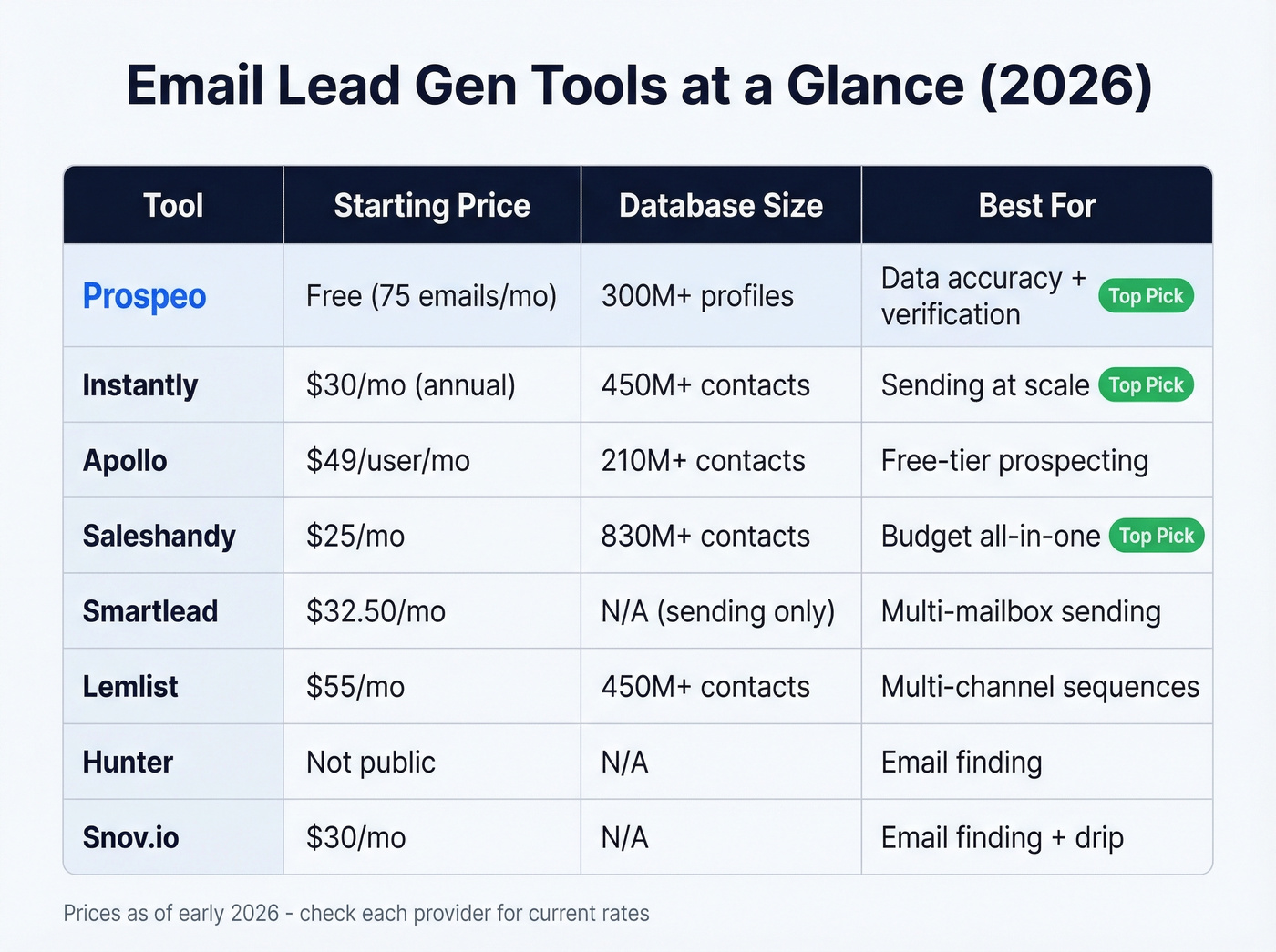
| Tool | Starting Price | Database Size | Best For |
|---|---|---|---|
| Prospeo | Free (75 emails/mo) | 300M+ profiles | Data accuracy + verification |
| Instantly | $30/mo (annual) | 450M+ contacts | Sending at scale |
| Apollo | $49/user/mo | 210M+ contacts | Free-tier prospecting |
| Saleshandy | $25/mo | 830M+ contacts | Budget all-in-one |
| Smartlead | $32.50/mo | N/A (sending only) | Multi-mailbox sending |
| Lemlist | $55/mo | 450M+ contacts | Multi-channel sequences |
| Hunter | Not public | N/A | Email finding |
| Snov.io | $30/mo | N/A | Email finding + drip |
Prospeo
Use this if: You care about data quality above everything else, you've been burned by bounced emails from other providers, or you're running outbound for clients and can't afford domain flags.
Skip this if: You want a single platform that also sends emails - Prospeo focuses on the data layer and pairs with dedicated sending tools like Instantly or Smartlead.
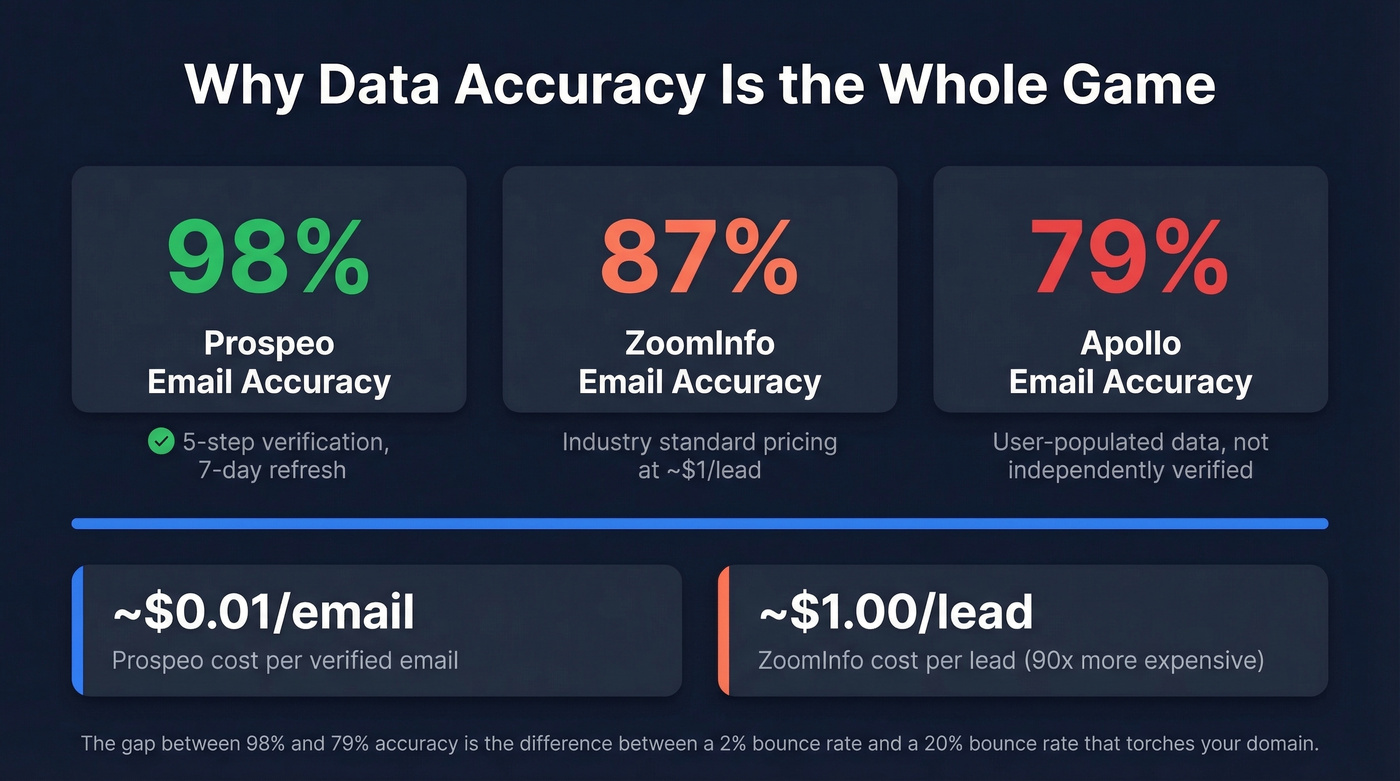
Prospeo's database covers 300M+ professional profiles with 143M+ verified emails and 125M+ verified mobile numbers. The 98% email accuracy rate comes from a proprietary 5-step verification process that includes catch-all handling, spam-trap removal, and honeypot filtering. For context, ZoomInfo's email accuracy sits around 87% and Apollo's around 79% - that gap is the difference between a 2% bounce rate and a 20% bounce rate that torches your domain. Data refreshes every 7 days, compared to the 4-6 week cycle at most competitors.
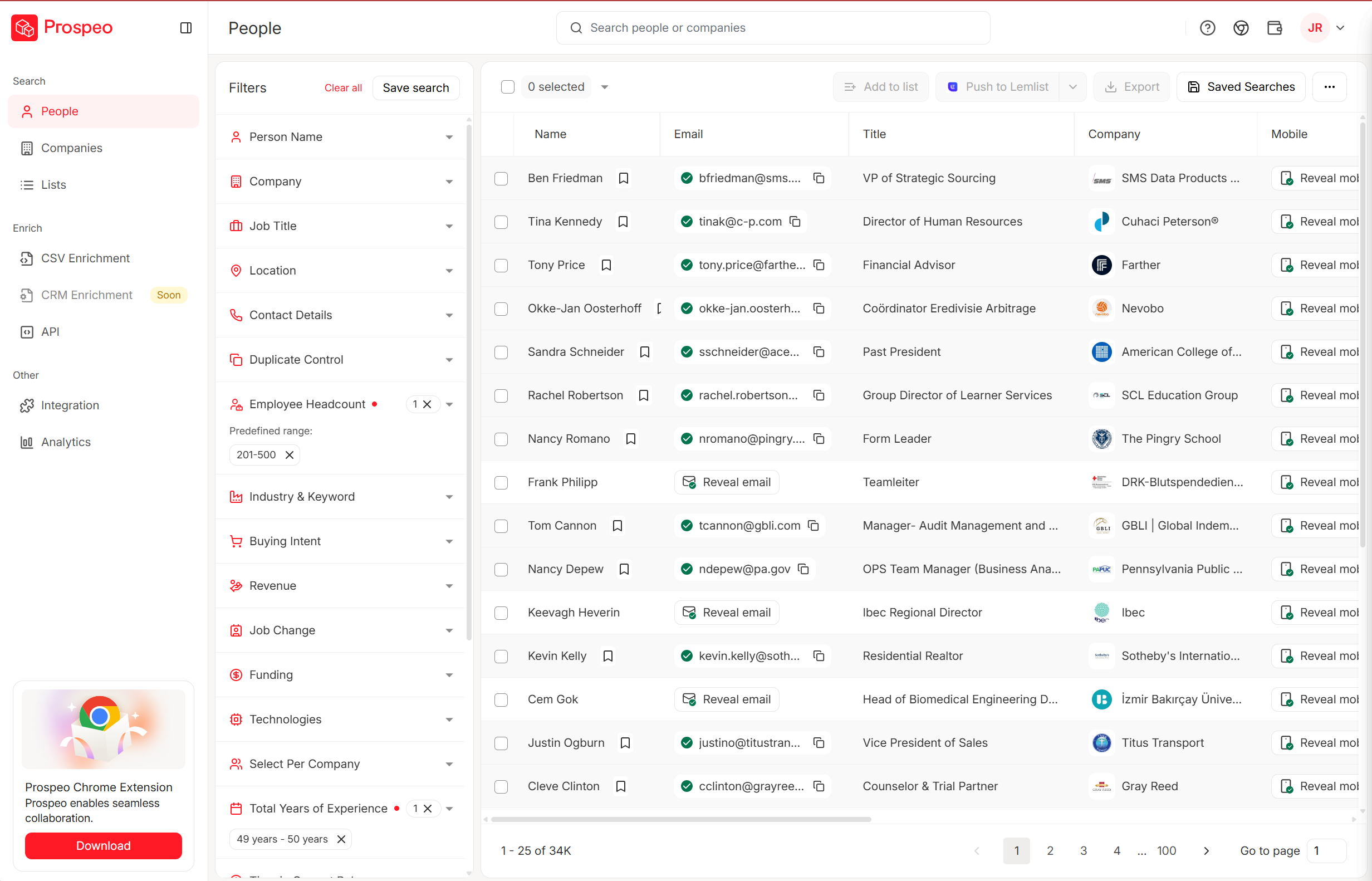
The database includes 30+ search filters - buyer intent, technographics, job changes, headcount growth, funding rounds, and revenue - so you can build hyper-targeted lists without manual research. Prospeo also layers buyer intent data tracking 15,000 topics via Bombora, letting you prioritize prospects who are actively researching solutions in your category rather than just matching a job title filter. The Chrome extension (40,000+ users) pulls verified emails and phone numbers from any website or CRM in one click.
We've seen the results firsthand: Stack Optimize built from $0 to $1M ARR using Prospeo as their data layer, maintaining 94%+ deliverability, bounce rates under 3%, and zero domain flags across all clients. Snyk's 50-person AE team cut bounce rates from 35-40% to under 5% and grew AE-sourced pipeline 180% after switching.
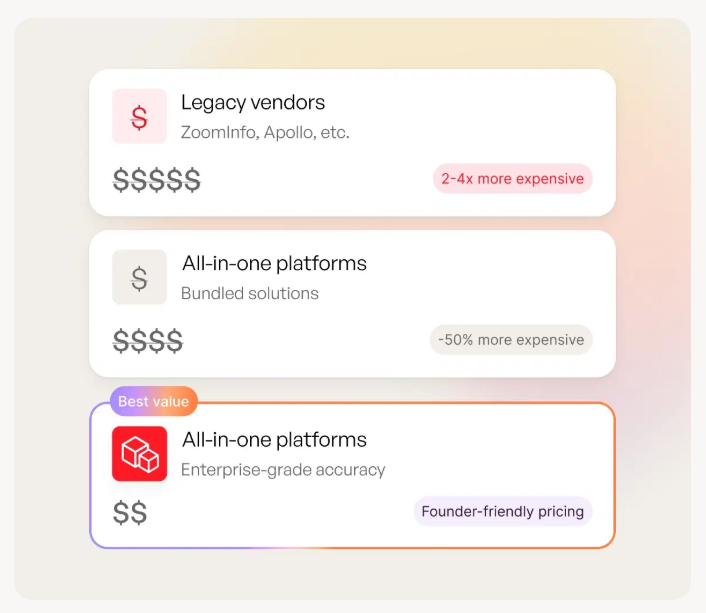
At roughly $0.01 per email (90% cheaper than ZoomInfo's ~$1/lead), the pricing removes the usual "do I really need this contact?" hesitation. Free tier gives you 75 emails/month to test, plus 100 Chrome extension credits/month. No contracts. The platform integrates natively with Instantly, Smartlead, Lemlist, Salesforce, HubSpot, Clay, and more.
Instantly
Use this if: You need to scale sending volume across dozens of mailboxes with built-in warmup and don't want to manage the infrastructure yourself.
Skip this if: You need high-accuracy contact data - Instantly's 450M+ database is a nice add-on, but data quality isn't its core strength.
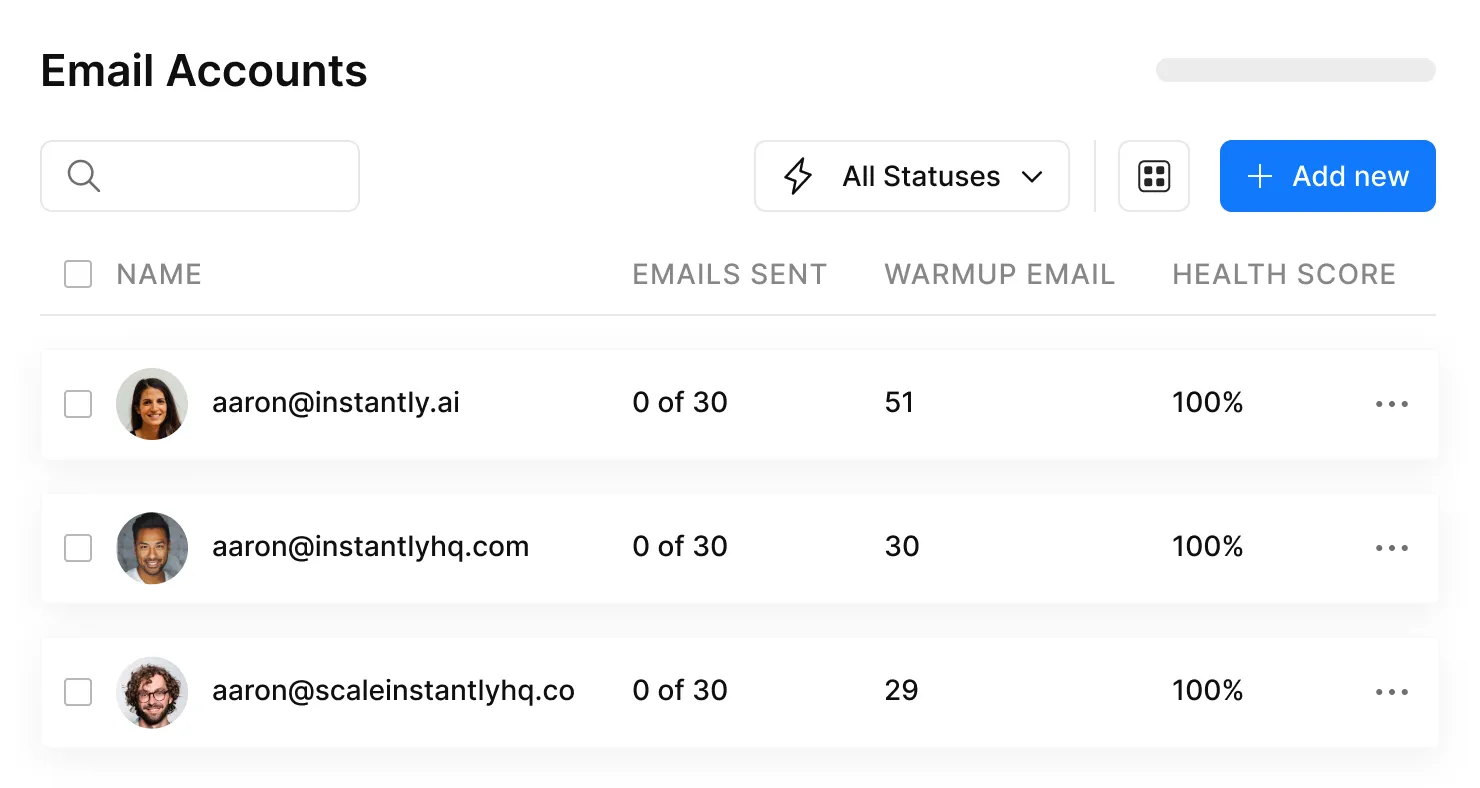
Instantly's outreach plans start at $30/mo (annual) for 5,000 email sends/month with unlimited email accounts and warmup. The Hypergrowth tier at $77.60/mo bumps you to 100,000 email sends/month. Their leads database is a separate module starting at $47/mo for 1,500-2,000 credits.
The sending infrastructure is genuinely excellent - multi-mailbox rotation, automatic warmup, and smart throttling. For the data side, we've gotten better results pairing Instantly with a dedicated data provider for verified contacts, then pushing them into Instantly for sequencing. That combination - accurate data in, optimized sending out - is what consistently produces sub-3% bounce rates at scale.
Apollo
Apollo's free tier is generous, and that's both its biggest strength and its biggest trap.
You get access to 210M+ contacts at no cost, which makes it the default starting point for bootstrapped teams. The problem is that Apollo's data is largely user-populated and not independently verified - a well-known issue that practitioners on r/sales flag regularly. Its built-in email infrastructure also has documented deliverability issues that show up once you're sending at any real volume.
The verdict: Treat Apollo data as unverified draft material. Paid plans start at $49/user/mo, but the real cost is the verification step you'll need to add on top. Always run Apollo exports through a separate verification tool before loading them into sequences. Skip that step and expect bounce rates north of 15%.
Saleshandy
For teams spending less than $50/month on outbound tooling, Saleshandy is the most complete package available. At $25/mo you get access to an 830M+ contact database and built-in sending. The database is large, though accuracy varies more than what you'd get from a dedicated data platform. Think of it as the Honda Civic of outbound: reliable, affordable, not exciting. It gets the job done for teams sending under 5,000 emails per month who don't want to assemble a multi-tool stack.
Smartlead
Smartlead is pure sending infrastructure - no database, no frills. Starting at $32.50/mo, it handles unlimited warmup and mailbox rotation with the kind of granular control that agencies need when managing multiple client campaigns. If you already have a reliable data source, Smartlead is one of the cleanest sending platforms available. Pair it with a dedicated data provider and you've got a stack that scales without the bloat of an all-in-one platform.
Lemlist, Hunter, Snov.io
Lemlist ($55/mo) combines a 450M+ contact database with multi-channel sequences beyond email. More expensive than Instantly but offers broader channel coverage out of the box. If your outbound strategy involves more than just email, Lemlist earns the premium.
Hunter is a focused email-finding tool - great for one-off lookups and domain searches, less useful as a full prospecting platform. No sending infrastructure included.
Snov.io ($30/mo) bundles email finding with campaigns. Solid budget option if you need both in one place, though neither capability is best-in-class.
Clay deserves a mention here too. It's not a traditional lead gen tool - it's an enrichment and workflow platform that pulls data from dozens of sources and lets you build custom prospecting automations. Pricing starts around $149/mo. If you're technical and want maximum flexibility in how you build lists, Clay is worth evaluating.
Top Email Lead Gen Agencies
Belkins
Belkins is the most established name in outsourced B2B email lead generation, and their pricing reflects it. Retainers run $5,000-$14,800/month with 3-6 month minimums and setup fees of $2,000-$5,000. Per-appointment costs for enterprise deals land between $150-$800+.
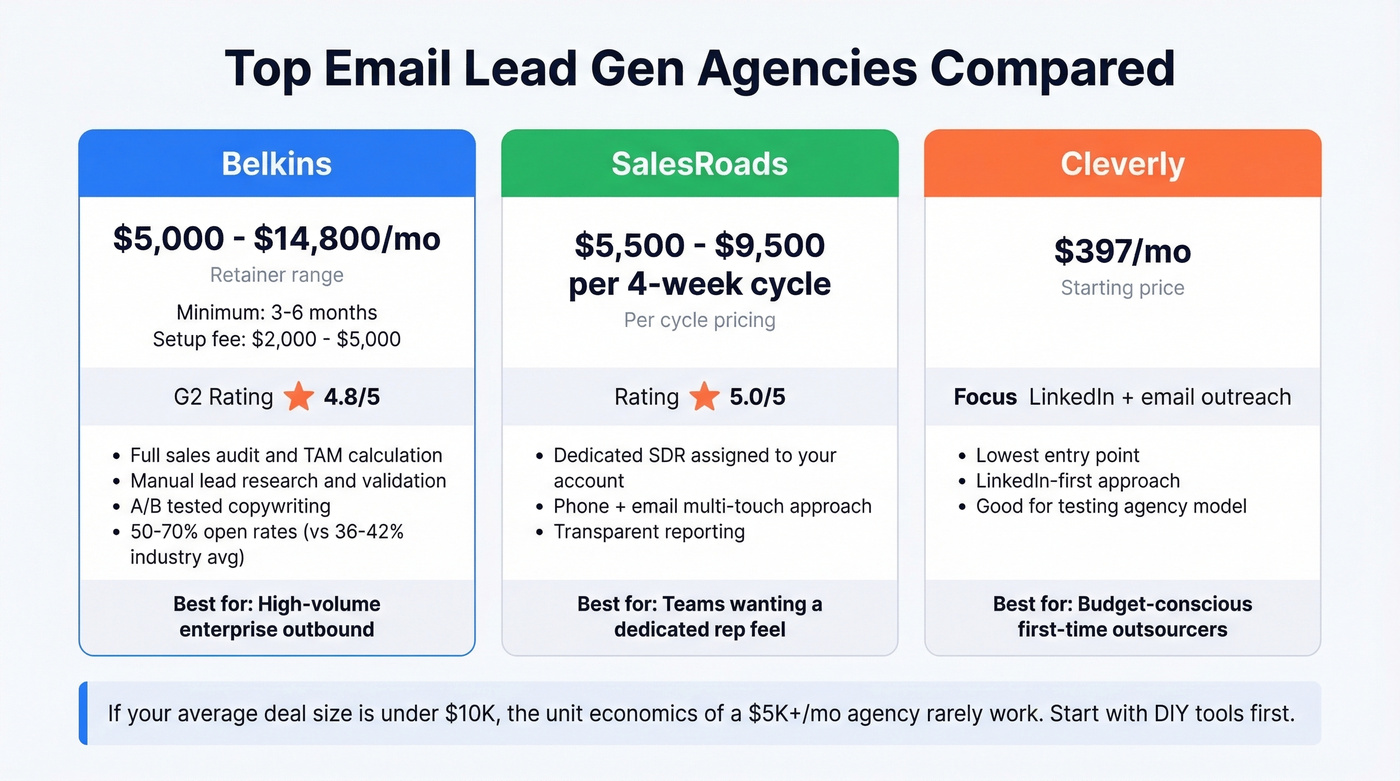
What you get: a full sales audit and TAM calculation, manual lead research and validation, copywriting with A/B testing, appointment scheduling with no-show recovery, and transparent reporting with weekly updates. Belkins benchmarks 50-70% open rates versus the industry's 36-42%, and 15-19% reply rates versus the 5.8% average. Those are strong numbers - ask for case studies in your specific vertical before signing. G2 rating: 4.8/5.
The tradeoff: you're paying premium rates and giving up control over messaging cadence and targeting adjustments. For companies with deal sizes above $50K, the math can work. Below that, the retainer eats too much margin.
SalesRoads
SalesRoads charges $5,500-$9,500 per 4-week cycle and has a 5.0/5 rating. They're strongest for mid-market B2B companies that need dedicated SDR capacity without the overhead of hiring. If Belkins feels too enterprise-heavy for your deal size, SalesRoads is the next conversation to have.
Cleverly
Cleverly starts at just $397/mo, making it the lowest-cost entry point for testing outsourced lead generation. Plans scale to $997/mo. Rating: 4.8/5. It's a good way to validate whether outsourced outbound works for your ICP before committing to a $5K+/month retainer elsewhere. Don't expect Belkins-level volume at this price point, but for early-stage testing, the economics make sense.
Martal Group, Callbox, CIENCE, RevBoss
Martal Group starts at $5,000/mo with a 4.6/5 G2 rating across 132 reviews. Users praise the team's professionalism, but common complaints include poor lead quality and limited campaign control.
Callbox runs $4,500-$5,300/mo. G2: 4.5/5 with 91 reviews. Strong multi-channel approach, though some users flag payment and support issues.
CIENCE charges $4,200-$9,000/mo. Rating: 3.8/5 - the lowest-rated agency on this list. Reviews are mixed; proceed with caution and ask for recent references.
RevBoss starts at $2,500/mo with a 4.6/5 rating. The most affordable mid-tier option if Cleverly feels too lightweight.
| Agency | Monthly Cost | G2 Rating | Min Commitment |
|---|---|---|---|
| Belkins | $5,000-$14,800 | 4.8/5 | 3-6 months |
| SalesRoads | $5,500-$9,500/4 wks | 5.0/5 | Varies |
| Cleverly | $397-$997 | 4.8/5 | Monthly |
| Martal Group | From $5,000 | 4.6/5 | Varies |
| Callbox | $4,500-$5,300 | 4.5/5 | Varies |
| CIENCE | $4,200-$9,000 | 3.8/5 | Varies |
| RevBoss | From $2,500 | 4.6/5 | Varies |

80% of leads never convert - usually because the emails bounce or land in spam. Prospeo's 5-step verification delivers 98% email accuracy, cutting bounce rates from 35%+ to under 4%. At $0.01/email with 300M+ profiles, you get enterprise-grade lead generation for less than the cost of one agency meeting.
Replace your $5K agency retainer with data that actually connects.
Cold Email Benchmarks
Before you evaluate any tool or agency, you need to know what "good" actually looks like.
Average B2B cold email reply rates run 3-5.1%. Top-quartile performers hit 15-25%. If an agency promises 20%+ reply rates as a baseline, they're claiming top-1% performance - ask for proof with specific campaign data, not cherry-picked screenshots.
A few operational benchmarks that actually move the needle: the 3-7-7 follow-up cadence (follow up on days 3, 7, and 14) captures 93% of replies by day 10. Segmenting into cohorts of 50 contacts or fewer increases reply rates by 2.76x. Timeline hooks like "We're launching X in Q2" pull roughly 10% reply rates versus problem hooks at ~4.4%.
Deliverability is the silent killer most teams ignore. Bounce rates above 5% start damaging your sender reputation, and once a domain is flagged, recovery takes weeks. This is why data accuracy matters more than database size - sending 10,000 emails from a 79%-accurate database means 2,100 bounces. Sending the same volume from a 98%-accurate database means 200 bounces. That's not a marginal difference; it's the difference between a healthy domain and a blacklisted one. (If you want the mechanics, start with an email deliverability guide and an email bounce rate breakdown.)
Look - if you're hitting 8-10% reply rates consistently, you're outperforming most outbound teams. Don't let an agency make you feel like 5% is a failure. It's literally average.
Red Flags When Evaluating Providers
Before signing with any provider, watch for these warning signs:
- Resold leads. The #1 complaint on r/LeadGeneration is providers selling the same contact lists to multiple clients. Your "exclusive" leads aren't exclusive.
- Vanishing guarantees. One Reddit user reported paying $650/mo for a service with a money-back guarantee that was quietly removed from the website after they disputed results.
- Shared email aliases instead of dedicated sending infrastructure. If they're running 100 "email accounts" off one domain with aliases, your deliverability is at their mercy.
- No compliance documentation. If they can't explain their CAN-SPAM and GDPR processes, you're the one who'll pay the fine.
- Undisclosed data sources. You need to know where your leads come from.
- No transparency into emails being sent. You should see every message going out under your brand.
- You don't own the sending domains or inboxes. If you leave, your warm domains should leave with you.
- Vague "qualified lead" definitions. Get the qualification criteria in the contract, not a handshake.
Compliance Essentials
CAN-SPAM applies to all commercial email - including B2B. There's no exemption for business-to-business messages. Penalties reach $53,088 per email in violation, and the FTC holds both the brand being promoted and the company sending the emails responsible. Outsourcing doesn't transfer liability. Read that again: if your agency sends a non-compliant email promoting your product, you pay the fine.
Core requirements: include a valid physical postal address, provide a clear opt-out mechanism, honor opt-outs within 10 business days, and don't use deceptive subject lines or misleading headers. These aren't suggestions - they're federal law.
The US operates on an opt-out model, meaning you can email someone cold as long as you follow the rules. Most other jurisdictions aren't that permissive. The EU (GDPR), Canada (CASL), UK (PECR), and Australia (Spam Act) all require explicit opt-in with proof of consent. If you're prospecting internationally, compliance gets complex fast. Make sure your data provider is GDPR compliant with opt-out enforcement and DPAs available - especially if you're building lists that cross borders.
How to Choose the Right Service
Group these questions into three categories and work through them before signing anything.
Targeting and qualification - these determine whether you'll get leads worth calling. How does the provider define and refine your ICP? Do they specialize in your vertical, or are they generalists producing generic results? Are goals tied to revenue outcomes or vanity metrics like "leads delivered"? And what's their lead qualification criteria - get it in writing. (If you need a system, use a lead scoring model.)
Operations and integration - these determine whether the work actually flows into your pipeline. Does their tech stack integrate with yours? CRM compatibility isn't optional. How do they handle data hygiene and compliance across CAN-SPAM, GDPR, and CASL? What's the reporting cadence? Weekly minimum, or you're flying blind. (This is where data enrichment services and a clean lead generation workflow matter.)
Commercial terms - these determine whether you're locked into a bad deal. Is pricing transparent, or will there be add-ons? What are the contract terms and SLAs? Month-to-month is ideal; 6-month minimums need strong justification. Can they provide 3 recent references in your market? If they hesitate, walk. (Also sanity-check your cost to acquire customer math.)
The best email lead generation services - whether tools or agencies - share one trait: they're transparent about data sources, deliverability metrics, and pricing. If a provider gets cagey about any of those three, keep looking.
Stack Optimize built a $1M agency on Prospeo data - 94%+ deliverability, zero domain flags. Snyk's 50 AEs grew pipeline 180% after switching. The difference isn't volume. It's 7-day data refresh, catch-all handling, and spam-trap removal that other email lead generation tools skip entirely.
Your domain reputation is worth more than cheap data. Start with accuracy.
FAQ
What's the difference between a lead gen tool and a lead gen agency?
Tools give you data and sending infrastructure; you run campaigns yourself for $25-100/mo. Agencies handle list building, copywriting, sending, and appointment setting for $2,500-$15,000/mo. Choose tools if you've got someone who can dedicate 5+ hours/week to outbound; choose an agency if you have zero in-house capacity.
How much does email lead generation cost per lead?
DIY tools run $0.01-$1 per contact for data. Agencies charge $150-$600 per qualified appointment. A full in-house SDR team costs $18,200-$36,100/mo including salary, tools, and overhead. Per-lead math almost always favors self-serve tools if you have the bandwidth to execute.
What reply rate should I expect from cold email?
Average B2B cold email reply rates are 3-5%. Top performers hit 15-25%. Anything consistently above 10% is strong. Be skeptical of agencies promising 20%+ as a baseline - that's top-1% territory, and they should have extensive campaign-level proof to back it up.
Is cold email legal for B2B?
Yes, in the US under CAN-SPAM's opt-out model - but penalties reach $53,088 per violation, so compliance isn't optional. The EU, Canada, and UK require explicit opt-in consent. Always include a physical address and a working unsubscribe link in every message.
How do I avoid burning my domain with cold email?
Start with verified data - target bounce rates under 3%. Warm up new mailboxes for 2-4 weeks before sending campaigns. Cap volume at 30-50 emails/day per mailbox. Disable open and click tracking, which insert pixels and redirect links that spam filters flag. Never send from your primary company domain - use dedicated sending domains instead.