

Email Leads: How to Find & Convert Them in 2026
Every team thinks they have a lead volume problem - until they look at the numbers and realize it's a lead quality problem. The average cross-industry conversion rate sits at 2.9% for qualified leads. That means 97 out of every 100 email leads you collect won't convert. Adding more names to your spreadsheet doesn't fix that math. Getting the right names, verifying them properly, and staying visible long enough for timing to work in your favor - that's what moves the needle.
Finding contacts isn't hard. Finding good ones is.
What Are Email Leads?
Most guides treat email leads as one thing. They're not. An email lead is any contact whose email address you've captured to start a commercial relationship, but that definition spans three distinct categories:
Opt-in subscribers filled out your popup or gated content form and explicitly said "yes, email me." Outbound-prospected contacts are people whose work email you found through a tool or manual research - they haven't heard from you yet. Existing customers are contacts you're trying to re-engage or upsell.
Each category has different rules, different expectations, and different deliverability risks. The mistake most teams make is treating all three identically - same cadence, same verification standards, same compliance posture. That's how you end up with a 23% bounce rate and a domain reputation that takes months to rebuild.
The Quick Version
- Inbound: Use optimized popups with clear incentives. The top 10% of popups convert at 8.5% - most teams sit at the 0.9% median because they never test trigger type or layout.
- Outbound: Find verified B2B emails with a tool like Prospeo at ~$0.01/lead and 98% accuracy instead of buying stale lists or trusting "AI" tools that bounce 19-31%.
- Protect your domain: Authenticate with SPF, DKIM, and DMARC. Keep spam complaints under 0.1%. Never cross 0.3%.
Why This Is a Long Game
Here's the thing most teams get wrong: they optimize for volume when they should optimize for timing. The 95/5 rule - popularized by the B2B Institute at LinkedIn - says only 3-5% of your total addressable market is actively in-market at any given moment. The other 95% are future buyers who aren't ready yet.
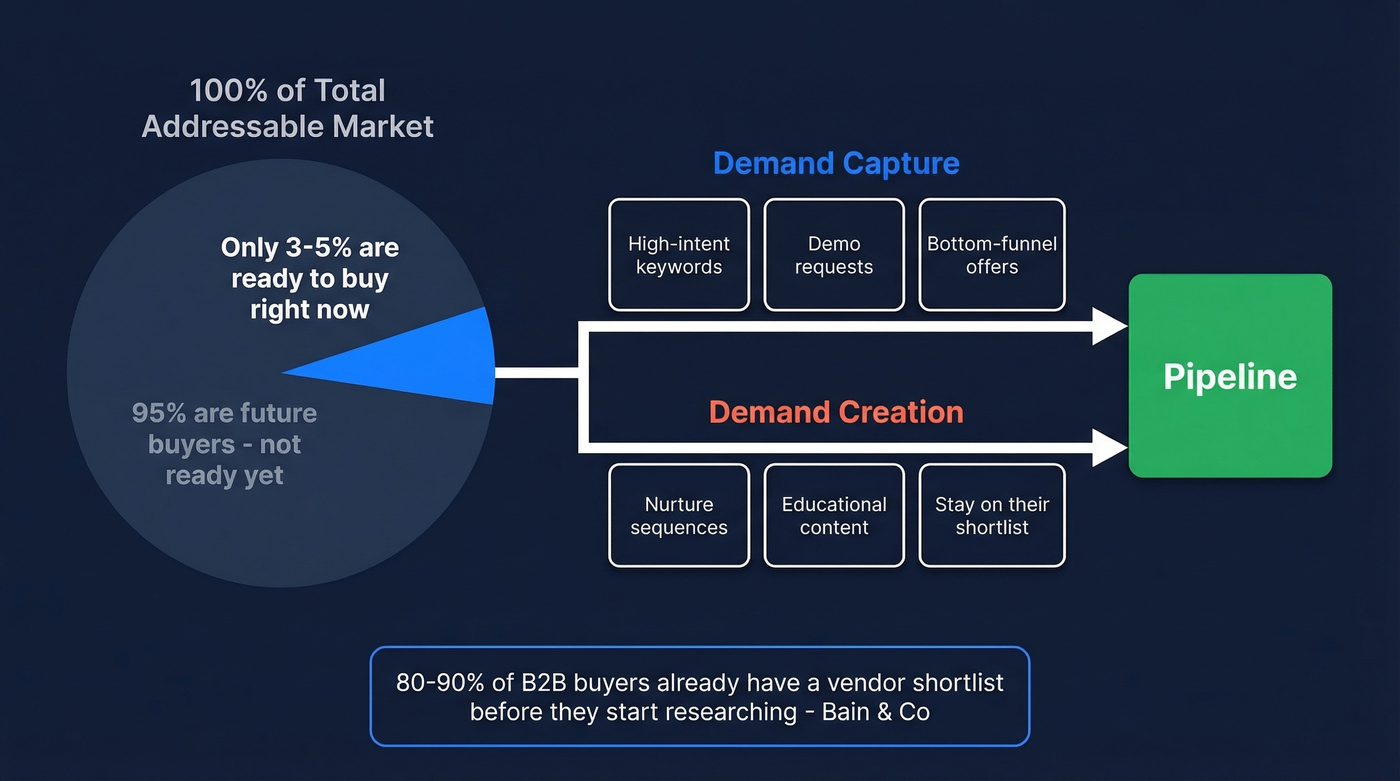
That stat should reshape how you think about your list. You're not building it to blast offers at. You're building it to stay on the "day one" shortlist when those buyers finally enter the market. Bain & Co research found that 80-90% of B2B buyers have a vendor list in mind before they start researching, and 90% ultimately choose from that initial list.
In our experience, the teams that win aren't generating the most contacts. They're the ones who stay visible to the 95% until those buyers become the 5%. Your strategy needs two engines: demand capture for the 3-5% who are ready now, and demand creation for everyone else through consistent, valuable touchpoints. A strong email marketing program bridges both engines by nurturing contacts until they're ready to buy.
If your average deal size is under $10k, you probably don't need a $15,000/year data platform. A $49/month tool with clean data and a well-written sequence will outperform an enterprise suite that your team barely uses.
Generating Inbound Email Leads
Your marketing team spent $2,000 on ads driving traffic to a landing page. You got 47 email signups. Your popup conversion rate is 0.9% - the median. You're not failing; you're average. Here's how to reach the top 10%.
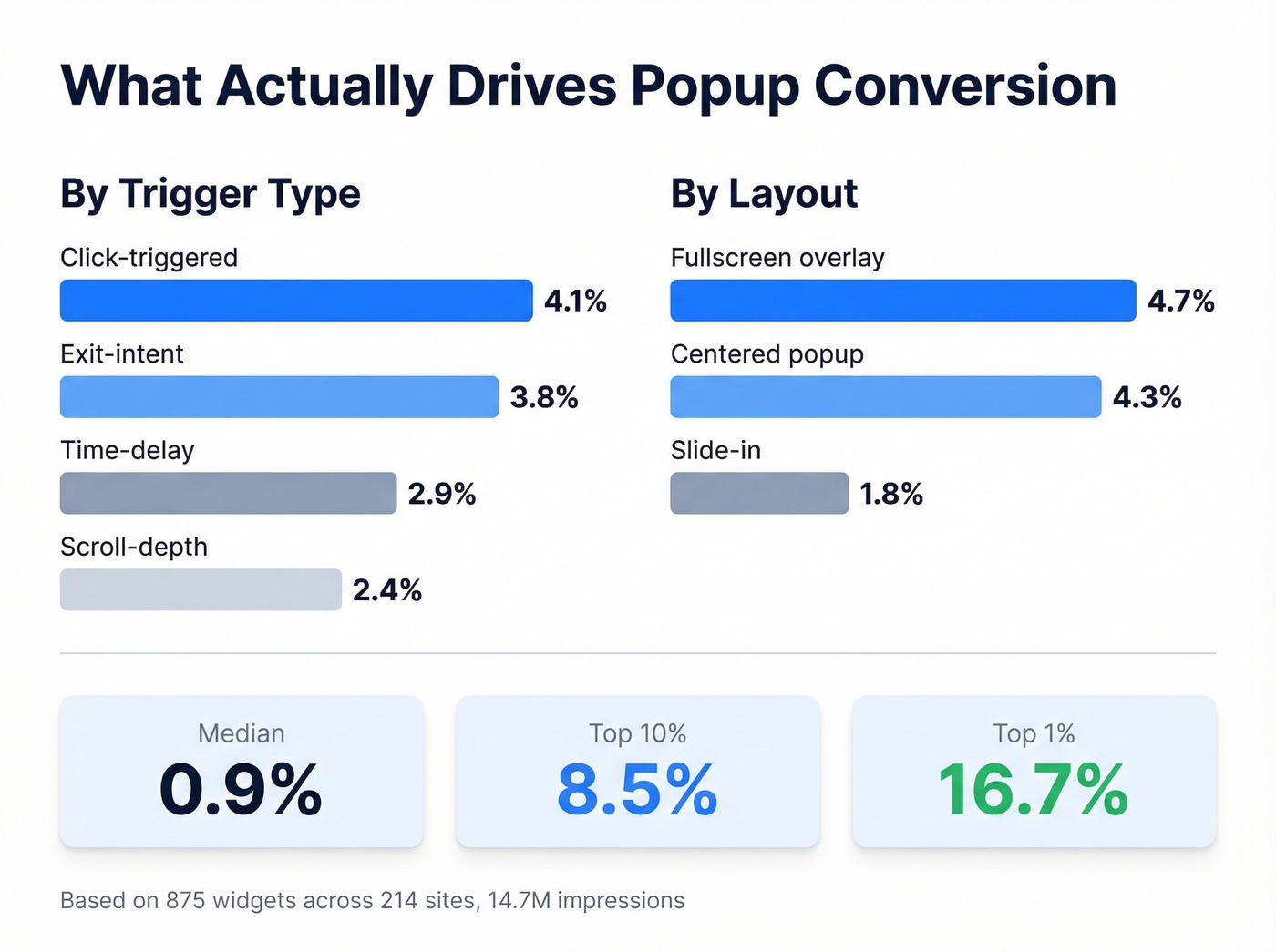
A dataset of 875 widgets across 214 sites spanning 14.7M impressions and 473k subscriptions gives us unusually specific benchmarks:
| Metric | Conversion Rate |
|---|---|
| Mean | 3.2% |
| Median | 0.9% |
| Top 10% (p90) | 8.5% |
| Top 1% (p99) | 16.7% |
The gap between median and top 10% is enormous - and it's driven by a few specific levers.
Trigger type matters more than copy. Click-triggered popups average 4.1% conversion, beating exit-intent at 3.8%, time-delay at 2.9%, and scroll-depth at 2.4%. If your popup fires on a timer, test switching to a click trigger tied to a specific CTA.
Layout drives conversion. Fullscreen overlays hit 4.7%, centered popups reach 4.3%, and slide-ins lag at 1.8%. The fullscreen overlay feels aggressive, but the data doesn't lie.
Targeting separates average from excellent. Showing the same popup to all visitors converts at 2.1%. Target returning visitors and you're at 3.9%. Target cart abandoners and you jump to 6.5%. The top 1% - those hitting 16.7% - typically stack spin-to-win mechanics with fullscreen layouts and tight audience targeting.
Timing matters too. BFCM popups see a 65% conversion uplift, Christmas 42%, and Valentine's Day 28%. If you're not adjusting your lead capture around seasonal peaks, you're leaving signups on the table.
Beyond popups, reduce form friction ruthlessly. Every additional field drops conversion. Remove CAPTCHA entirely and use background spam protection like Akismet instead. Mobile converts slightly better than desktop (3.6% vs 2.9%), so your forms need to be mobile-optimized by default, not as an afterthought.

The article above shows that median popup conversion is 0.9% - so every inbound lead is expensive. When you add outbound, you can't afford bounces destroying your domain. Prospeo delivers 98% email accuracy with a 7-day data refresh cycle, so your lists never go stale. At ~$0.01 per verified email, you get enterprise-grade lead quality without enterprise pricing.
Stop paying for leads that bounce. Start with 75 free verified emails.
Outbound Prospecting Done Right
Your SDR uploaded 2,000 "verified" leads from a shiny new tool. By Friday, 400 bounced, your spam complaint rate crossed 0.3%, and Gmail started throttling your entire outbound domain. That $200 list just cost you three months of deliverability recovery.
This isn't hypothetical. A practitioner on r/coldemail tested four "AI lead generation" platforms with 500 accounts each using the same ICP criteria. Bounce rates ranged from 19% to 31%. Reply rates sat between 2% and 4%. Their manual prospecting baseline? 8% bounce and 6% reply. The "AI" tools performed worse across the board.
The core issue is that many of these platforms repackage the same underlying databases with a generative AI wrapper. The AI part doesn't help if the foundational data is stale. You end up paying a premium for a prettier interface on top of the same bad emails.
When your data is clean, healthy cold email benchmarks become achievable: ~27.7% open rates, ~5.1% reply rates, ~7.5% bounce, and ~1.0% meetings booked. Those numbers assume proper authentication and a warmed domain.
Never send high-volume cold outreach from your primary corporate domain. Set up properly authenticated secondary domains and warm them for 2-3 weeks before scaling volume. We've seen teams skip this step and spend the next quarter rebuilding sender reputation instead of booking meetings.
Deliverability and Authentication
Gmail and Yahoo's bulk sender requirements aren't suggestions anymore. The major enforcement milestones landed in 2024 - authentication requirements for bulk senders starting in February, mandatory one-click unsubscribe by June, stricter spam-rate enforcement at 0.3% by October - and enforcement has only tightened since.
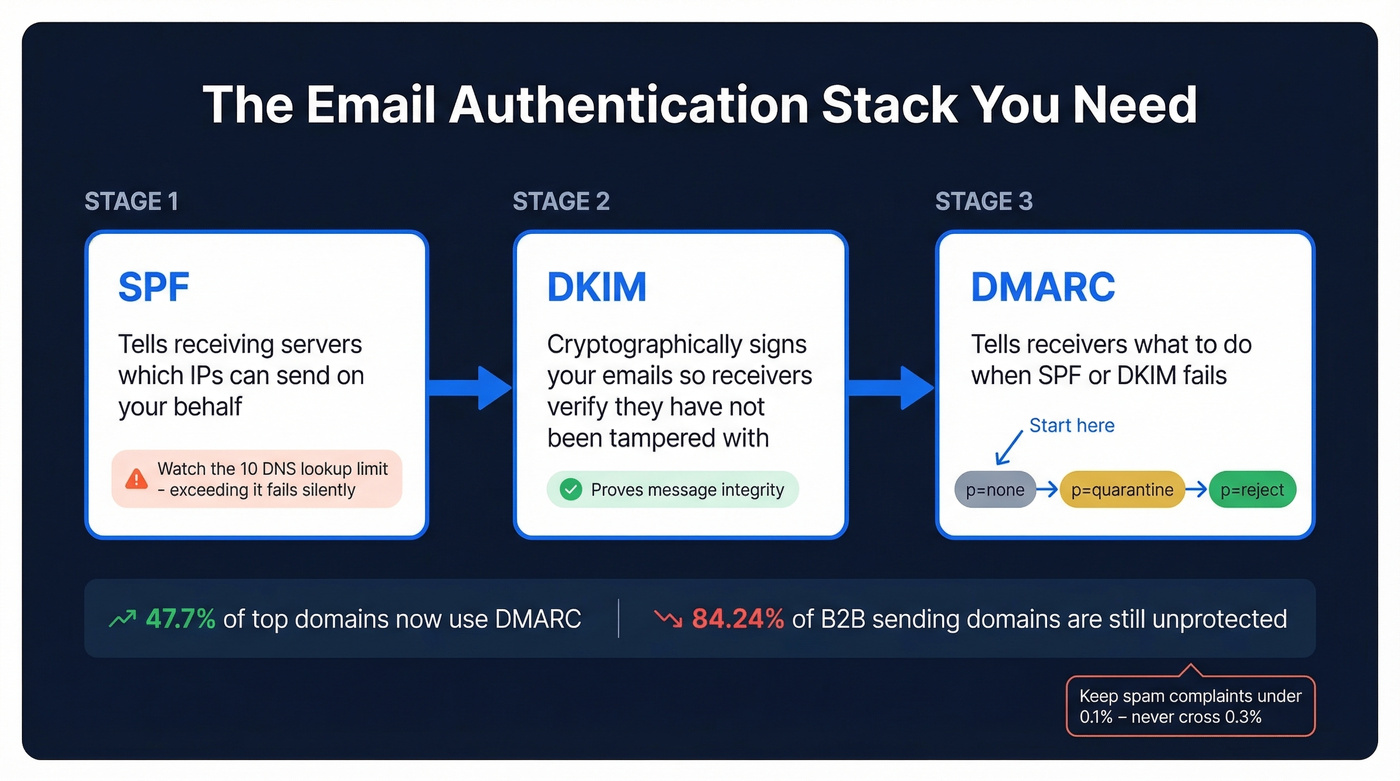
The authentication checklist is non-negotiable:
- SPF tells receiving servers which IPs can send on your behalf. Watch the 10 DNS lookup limit - exceeding it causes SPF to fail silently. (If you need examples, start with an SPF reference.)
- DKIM cryptographically signs your emails so receivers can verify they haven't been tampered with. If you're unsure it's set up correctly, use a quick DKIM check.
- DMARC tells receivers what to do when SPF or DKIM fails. Start with
p=nonefor monitoring, then move top=quarantineorp=reject. (More on DMARC alignment if you're troubleshooting.)
DMARC adoption jumped 75% between 2023 and 2025 - from 27.2% to 47.7% among the top 1.8M domains. That sounds like progress until you realize 84.24% of B2B sending domains are still completely unprotected. If your domain is in that 84%, you're at a disadvantage before you write a single subject line.
The complaint rate threshold kills most outbound programs. Keep spam complaints under 0.1%. Never cross 0.3%. We've seen teams lose entire quarters of pipeline because one bad list pushed them over the line, and recovery took months.
Compliance: CAN-SPAM, GDPR, and PECR
The US and EU take fundamentally different approaches. CAN-SPAM operates on an opt-out model - you can email someone as long as you provide a way to unsubscribe. GDPR and PECR require explicit opt-in before you send.
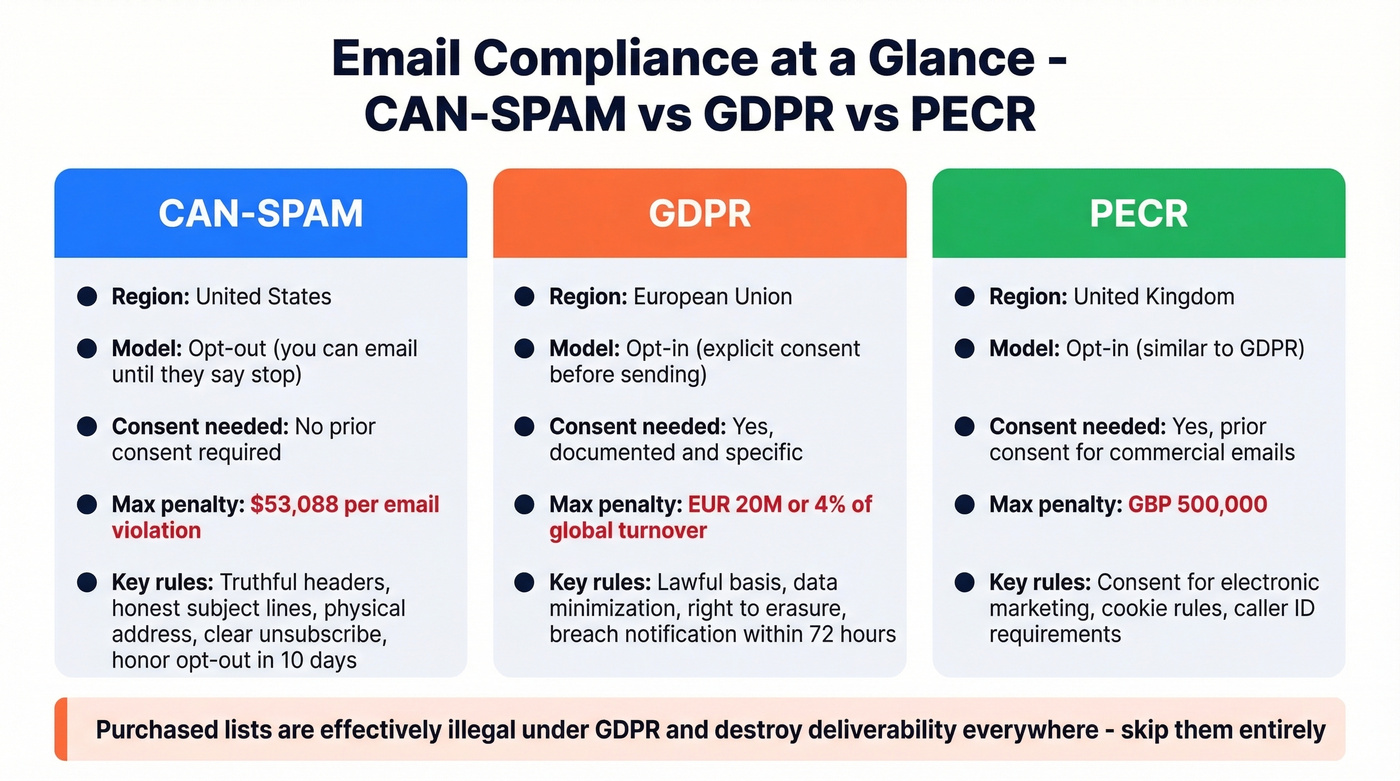
The penalties are real: up to $53,088 per email violation under CAN-SPAM, up to EUR 20M or 4% of global annual turnover under GDPR, and up to GBP 500,000 under PECR.
CAN-SPAM's seven core requirements: truthful headers, non-deceptive subject lines, ad identification, physical mailing address, clear opt-out mechanism, opt-out honored within 10 business days, and monitoring third-party compliance.
If you're selling into the EU or UK, the bar is higher. You need documented consent before sending commercial emails. Purchased lists are effectively illegal for most GDPR use cases - and even for US-only outbound, the deliverability damage from purchased lists usually outweighs any compliance risk. Skip them entirely.
Mistakes That Kill Your Pipeline
Over-automating without personalizing. A 12-step sequence with zero personalization trains recipients to ignore you - or mark you as spam. If you need a baseline, start with proven sales follow-up templates and then personalize.
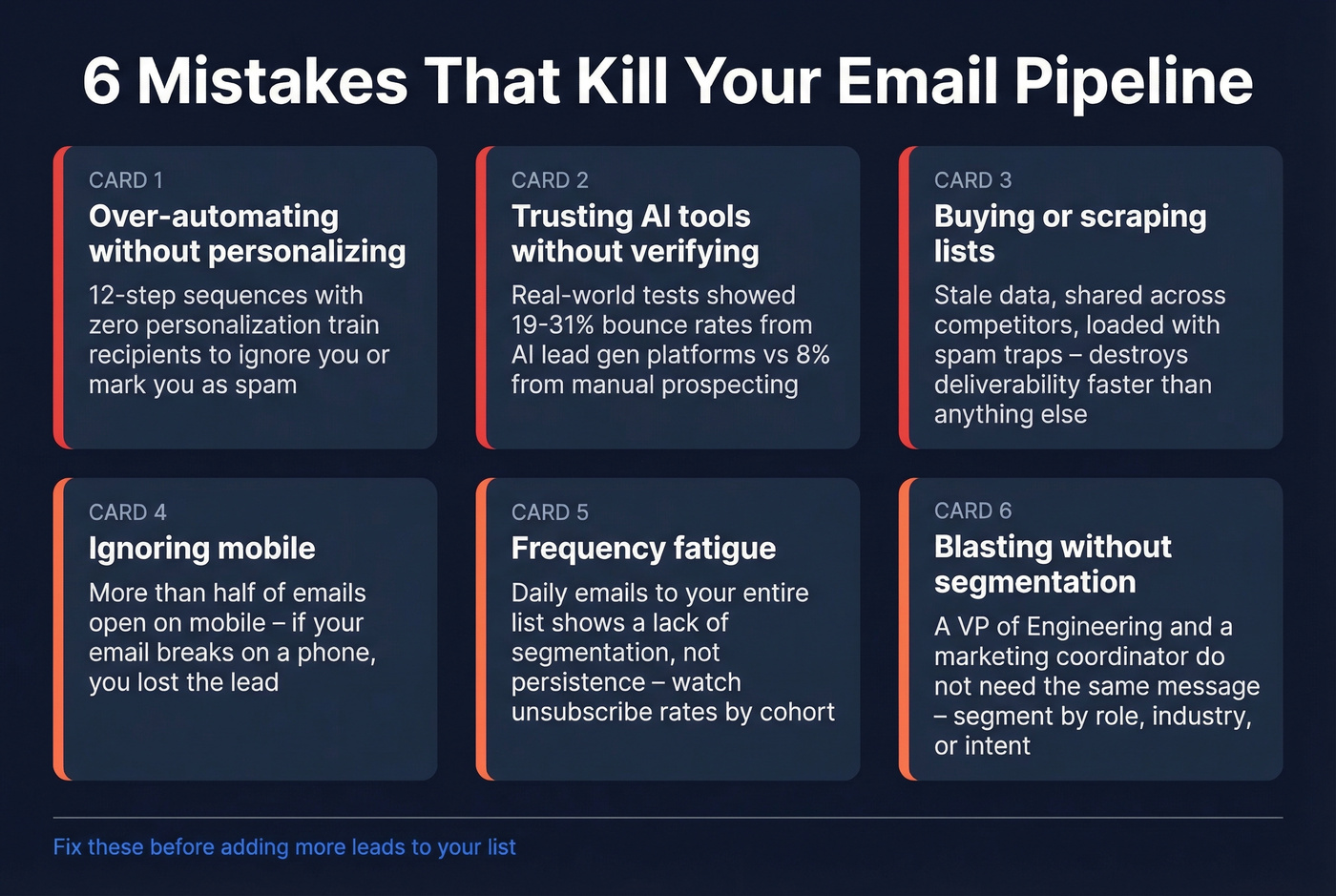
Ignoring mobile. More than half of emails open on mobile. If your email or landing page breaks on a phone screen, you've lost the lead before they read the second sentence.
Frequency fatigue. Sending daily emails to your entire list doesn't show persistence. It shows a lack of segmentation. Watch unsubscribe rates by cohort.
Blasting without segmentation. A VP of Engineering and a marketing coordinator don't need the same message. Segment by role, industry, intent signal, or funnel stage. (A simple intent signal model goes a long way.)
Trusting "AI" tools without verifying. Those AI lead gen platforms bounced 19-31% in real-world testing. Always verify emails before sending, regardless of what the tool promises. If you're comparing options, see email verification tools.
Buying or scraping lists. Purchased lists are stale, shared across competitors, and loaded with spam traps. They destroy deliverability faster than any other mistake on this list. If you're serious about building a quality contact list at scale, invest in first-party data and verified sources instead. (If you're tempted, read the breakdown on buying email lists first.)
Best Tools for Finding Email Leads
| Tool | Database | Starting Price | Email Accuracy | Best For |
|---|---|---|---|---|
| Prospeo | 300M+ profiles | ~$0.01/email | 98% | Accuracy + cost |
| Apollo.io | 275M+ contacts | $49/mo | ~80% | Free tier volume |
| Hunter.io | Domain search | $49/mo | Not public | Simple lookups |
| ZoomInfo | 260M+ profiles | ~$15,000+/yr | ~87% | Enterprise GTM |
| Lusha | 100M+ contacts | $49/mo | Not public | Quick Chrome lookups |
| Snov.io | Not public | $39/mo | Not public | Finding + sending |
| Skrapp | 150M+ profiles | $39/mo | ~92% | Budget email search |

Prospeo
At 98% email accuracy and roughly $0.01 per lead, Prospeo has the best unit economics in this category. The 5-step verification process handles catch-all domains, removes spam traps, and filters honeypots - all on a 7-day refresh cycle. Real results back this up: Meritt tripled their pipeline from $100K to $300K per week after switching, dropping their bounce rate from 35% to under 4%. Snyk saw AE-sourced pipeline jump 180% with bounce rates falling from 35-40% to under 5%. The free tier gives you 75 emails per month to test before committing.
Those "AI lead gen" tools bounced 19-31% in real-world tests. Prospeo's proprietary 5-step verification keeps bounce rates under 2% - no third-party email providers, no recycled databases. 300M+ profiles, 143M+ verified emails, 30+ filters to match your exact ICP. Teams using Prospeo book 35% more meetings than Apollo users.
Replace your bouncing list with 98% accurate email leads today.
Apollo.io
The obvious starting point for early-stage teams figuring out outbound without a big budget. The free tier is genuinely generous - 10,000 credits per month with access to 275M+ contacts and built-in email sequencing. You can go from zero to sending cold emails without spending a dollar. The tradeoff is data quality: email accuracy runs around 80%, and the consensus on r/sales is that credit throttling gets aggressive at volume. Paid plans start at $49/mo. If bounces climb past 10%, you'll need a verification layer on top.
Hunter.io
You need to find a handful of emails for a specific company. You don't want to learn a new platform. That's Hunter. Type in a domain, get associated email addresses with confidence scores. Starter plans begin at $49/mo and scale to $499/mo for Business. Skip this if you need to build large outbound lists - it's a domain-first lookup product, not a database. If you're evaluating similar tools, check Hunter alternatives.
ZoomInfo
The sticker shock comes first: ZoomInfo typically runs $15,000-$40,000 per year depending on seats and modules, and the renewal process is notoriously aggressive. Reddit's #1 complaint? Paying for modules you don't use. Email accuracy sits around 87% - decent but not exceptional given the cost. ZoomInfo makes sense if you need the full enterprise GTM suite with org charts, intent data, and workflow automation in one platform. For teams under 50 people, the math rarely works.
Lusha
You're on a prospect's profile and you need their email right now. That's Lusha's sweet spot. The Chrome extension delivers quick lookups with 50 free credits per month and a Pro plan starting at $49/mo. The database covers 100M+ B2B contacts but doesn't match larger platforms in depth. Best for individual reps doing ad-hoc research, not for teams prospecting at scale.
Snov.io
Email finder plus built-in cold email sequences from $39/mo. The best option for solo operators who want finding and sending in one tool without stitching together a multi-product stack. It's a practical choice when you're running outbound alone and don't want to manage multiple subscriptions.
Skrapp
Covers 150M+ business profiles with a daily refresh cycle and a claimed 92% email-finding success rate. Professional plans start at $39/mo for 1,000 searches - a solid budget option for teams that need basic email search without enterprise pricing.
FAQ
What's the difference between email leads and subscribers?
An email subscriber opted in to receive your content. Email leads are broader - the term includes opt-in subscribers and outbound-prospected contacts whose addresses you found through tools or research. Not all leads gave you permission, which is why verification and compliance matter differently for each type.
Is it legal to buy email leads?
Under US CAN-SPAM rules, you can email purchased lists if you follow opt-out requirements - but deliverability damage makes it a terrible strategy. Under GDPR, you generally need explicit consent, making purchased lists illegal for most use cases. Stick with first-party data and verified sources.
How do I verify contacts before sending?
Use a verification tool that checks MX records, catches spam traps, and handles catch-all domains. Never send to an unverified list - even one campaign with 20%+ bounces can damage your domain reputation for months.
How many signups should I expect from a popup?
The median popup conversion rate is 0.9% of impressions, while the top 10% convert at 8.5%. Results depend on trigger type, layout, and targeting. Click-triggered popups average 4.1%, fullscreen overlays hit 4.7%, and cart abandoner targeting reaches 6.5%. Test one variable at a time and benchmark against these percentiles.