

Best Email List Generators in 2026: B2B Prospecting, Lead Capture, and Email Marketing
Your sales manager just told you to generate a list of 500 decision-makers by Friday. Half the "email list generator" tools out there are popup builders for collecting opt-ins, and the other half are B2B databases for finding professional emails you don't already have. Pick the wrong category and you'll waste two days before you even start prospecting.
This space is growing fast - the lead gen software market is moving from $7.4B in 2025 to $16.2B by 2034 as teams scale outbound and inbound without torching deliverability.
Our Picks (TL;DR)
B2B email prospecting: Prospeo - 300M+ profiles, 98% email accuracy, 7-day refresh, starts free On-site lead capture: OptinMonster - from ~$7/mo, exit-intent popups that actually convert Email marketing: Brevo - 300 free emails/day, solid automation, paid from ~$25/mo
If you only remember one thing: "email list generator" can mean three totally different workflows. Match the tool to the workflow first, then worry about features.
Which Type Do You Need?
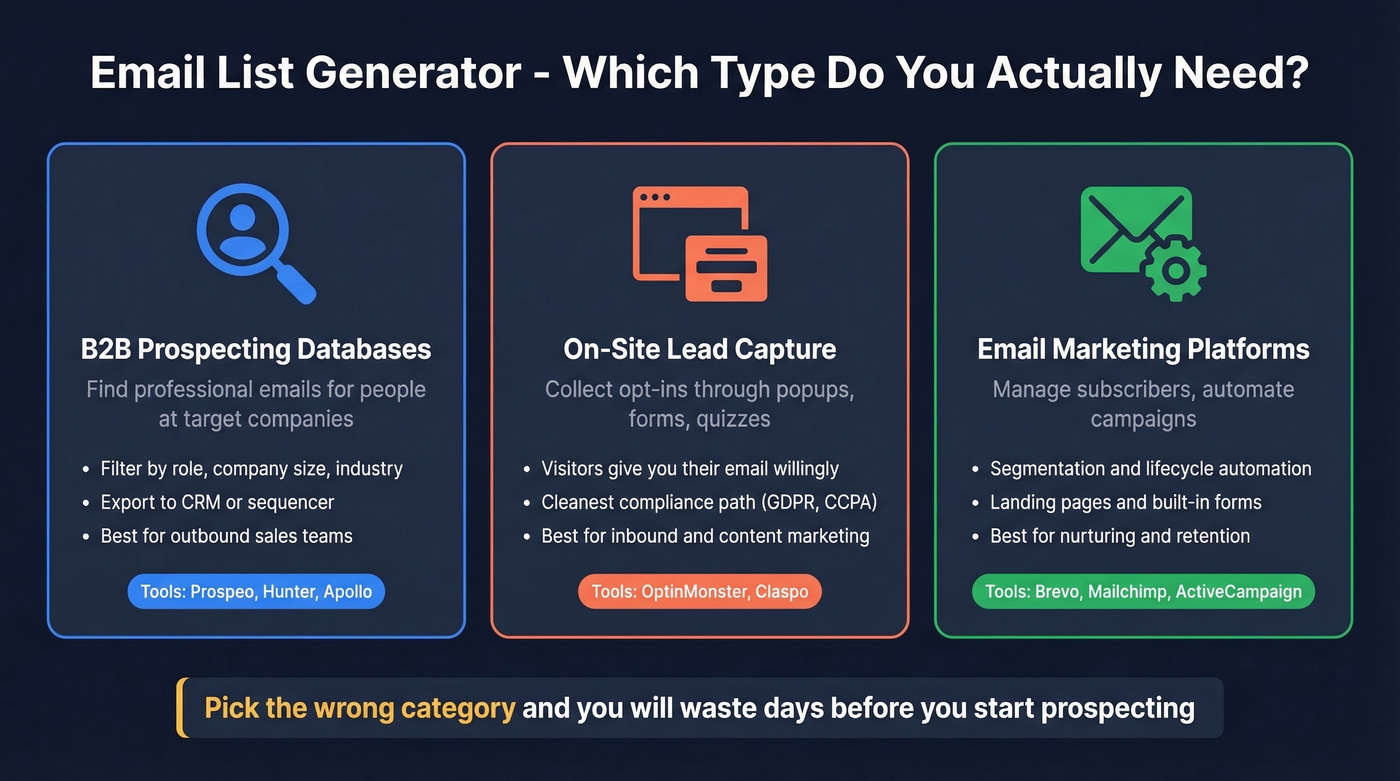
People use "email list generator" and "email list builder" interchangeably, but they usually mean one of three distinct workflows. An r/copywriting thread about list generation devolved into confusion over whether the poster needed to scrape emails or email existing customers. Let's clear that up before you touch a tool.
B2B Prospecting Databases
These tools generate lists by finding professional emails for people at companies you target. They're built for outbound: filtering by role, company size, industry, technographics, and intent, then exporting to your sequencer or CRM. If you need a bulk contact finder that can produce hundreds of verified addresses in a single search, this is the category.
On-Site Lead Capture Tools
These generate lists by collecting opt-ins through popups, embedded forms, exit intent, and quizzes. They don't "find" emails - they persuade visitors to hand them over. The compliance posture is totally different: opt-in capture is the cleanest path if you're in regulated markets.
Email Marketing Platforms
These tools manage subscribers and grow lists through landing pages, forms, and integrations. They're built for segmentation, automations, and deliverability controls at scale. The Reddit consensus is consistent: people love deep automation, then hate the learning curve and contact-based pricing creep once the list grows.
Best B2B Email Prospecting Tools
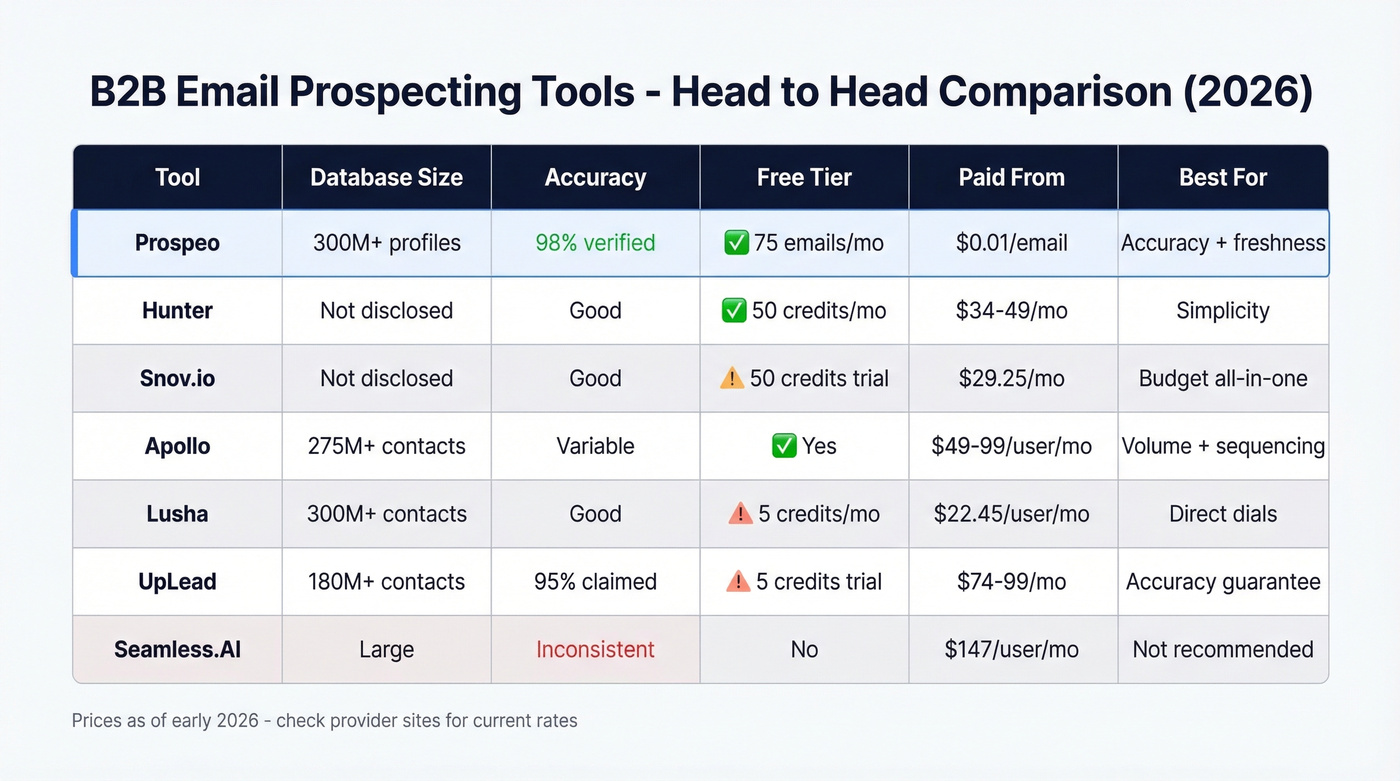
Prospeo - Verification Built In
Bad data doesn't just waste time - it damages your domain. We've seen teams "save money" on a cheaper database, then spend months recovering deliverability after a few high-bounce sequences. If you want the bigger picture on list quality, data enrichment is often the missing layer.
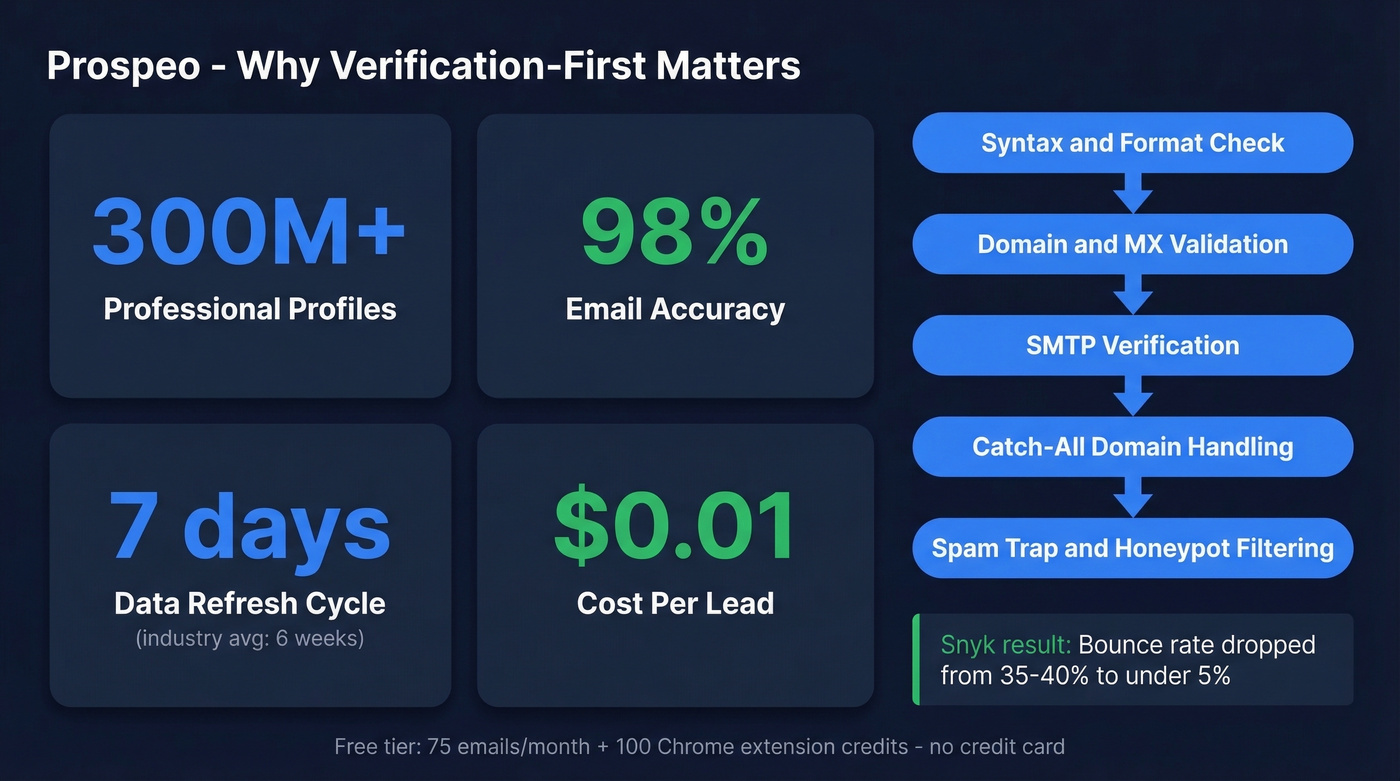
Prospeo fixes that by treating verification as the product, not a checkbox. You get 300M+ professional profiles, 143M+ verified emails, and 98% email accuracy, with a 7-day data refresh cycle (the industry average is six weeks). That freshness matters when you're targeting fast-changing org charts at growing companies.
The proof point we keep coming back to: Snyk took bounce rates from 35-40% to under 5% after switching, which is the difference between "we can run outbound" and "we're in spam jail." Prospeo's 5-step verification handles catch-all domains properly and filters spam traps and honeypots, so you're not paying for landmines.
Pricing is the other reason it's our default recommendation: ~$0.01/lead, plus a free tier with 75 emails/month and 100 Chrome extension credits/month. For teams evaluating a free email list generator, that no-credit-card tier is the most useful starting point in this category. If you're building a repeatable outbound motion, pair this with a clear sales prospecting process.
Hunter
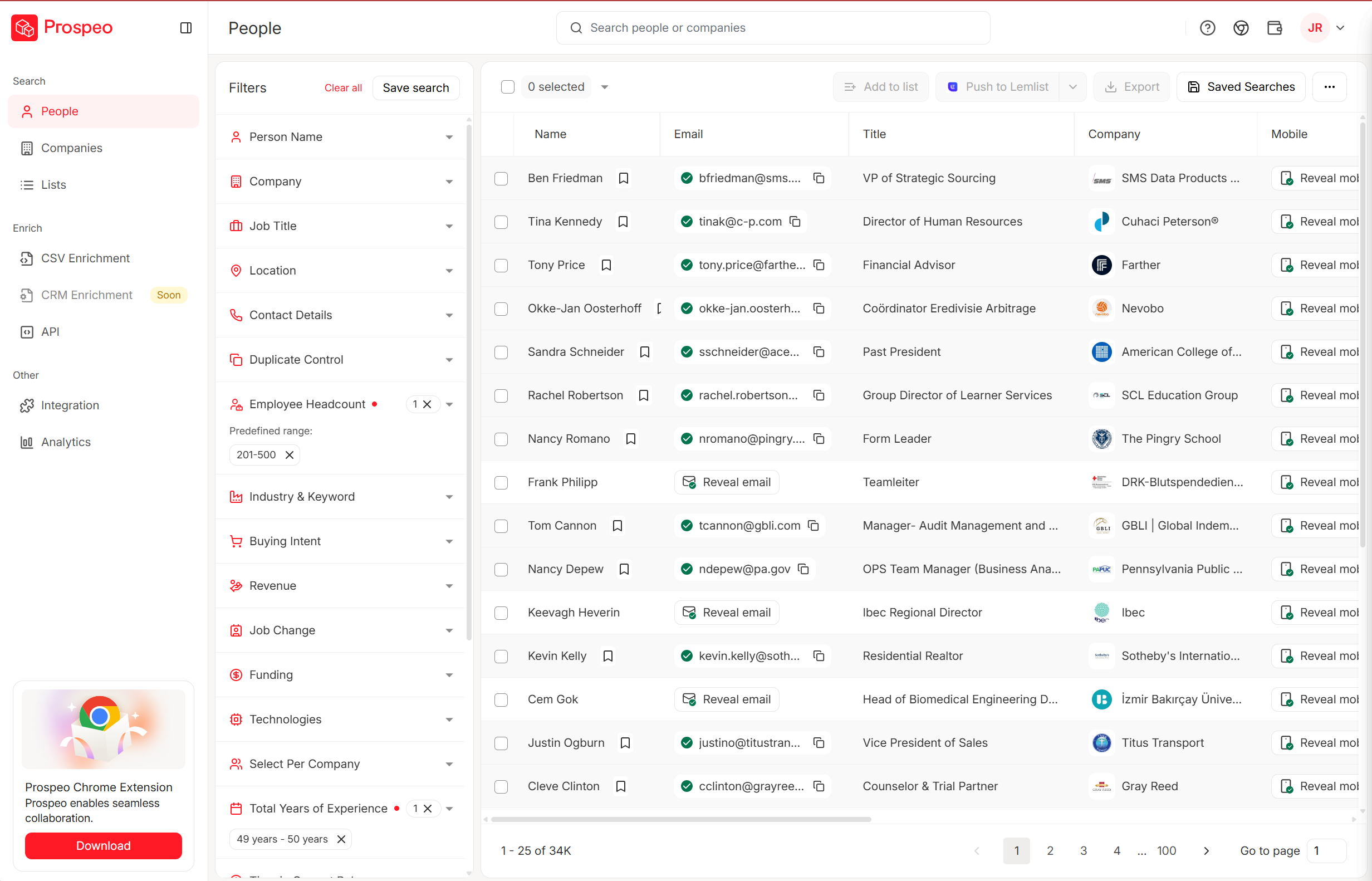
Hunter is the simplicity king. When a team wants "find emails, verify them, run light outreach" without a giant learning curve, Hunter has the cleanest UI in this category. It doubles as a finder and verifier, letting you search domains and validate results in the same workflow. If you're comparing options, see our breakdown of Hunter alternatives.
Pricing is refreshingly explicit: Free gets you 50 credits/month with 1 email account and 500 recipients per sequence. Starter runs $49/mo or $34/mo annually for 2,000 credits. Growth is $149/mo or $104/mo annually for 10,000 credits. Scale hits $299/mo or $209/mo annually for 25,000 credits.
Compared to ZoomInfo, Hunter wins on speed and transparency - you'll never sit through a sales demo just to see a price. ZoomInfo still wins on breadth of US coverage and org charts, but you'll pay for it and you'll sign a contract. Skip Hunter if you need lots of direct dials or deep firmographic filtering; it's an email-first tool by design.

Snov.io
Snov.io is the budget option that replaces 3-4 separate tools without forcing you into enterprise pricing: prospecting, verification, sequences, warm-up, and add-ons. If you're assembling a full stack, it helps to understand what belongs in SDR tools vs what belongs in your database.
Pricing starts at $29.25/mo for 1,000 credits (Starter) and $74.25/mo for 5,000 credits (Pro). Credits are the currency - searches and verifications both spend credits, so you need to model your workflow or you'll burn through them fast. The trial gives you 50 credits/month and 100 recipients, with most features gated. Warm-up is included: 3 warm-up slots on Starter and unlimited warm-ups on Pro.
Snov.io isn't competing on database depth. It's competing on "I can prospect and run sequences today for under $100/mo." Skip it if you want clean, predictable unit economics - credit systems are powerful, but they punish sloppy ops.
Apollo
Apollo is the obvious starting point for most SMB teams: a big database with a free tier and built-in sequencing. The database covers 275M+ contacts, and it's good enough to get reps moving fast. If you're building a broader outbound stack, compare it with other outbound lead generation tools.
Paid plans land around ~$49-$99/user/mo depending on features, with a free tier available. Apollo wins on price and rep adoption compared to ZoomInfo. Skip it if your top priority is verified accuracy and freshness - Prospeo's 98% verified email accuracy and weekly refresh cycles are built specifically for that problem.
Lusha
Lusha is strongest when phone numbers matter. The database covers 300M+ contacts and 150M+ verified emails, plus a big direct-dial footprint.
Free gives you 5 credits/month, then Pro starts from ~$22.45/user/mo billed annually or ~$29.90/user/mo monthly. Lusha leans hard into GDPR/CCPA compliance positioning, which helps when legal gets involved. Skip Lusha if you need heavy account-based filtering and enrichment depth - it's a contact tool, not a full GTM platform.
UpLead
UpLead is the "straightforward database with an accuracy guarantee" option, covering 180M+ contacts with a 95% accuracy message.
Pricing is clear: a 7-day trial is free but only 5 credits, so don't expect a real evaluation. Essentials is $99/mo for 170 credits, or $74/mo on annual billing. Plus is $199/mo for 400 credits. Skip UpLead if you want a generous free tier to test data quality - the trial is basically a teaser.
A Note on Seamless.AI
We excluded Seamless.AI from our picks. User complaints about accuracy and aggressive upselling are too consistent to ignore across Reddit and G2 reviews. Expect ~$147/user/mo annual, and expect to hear from their sales team frequently.

Most email list generators make you pay first and verify later. Prospeo's 5-step verification is built into every search - 300M+ profiles, 98% email accuracy, 7-day data refresh. Snyk cut bounce rates from 35% to under 5%.
Generate 75 verified emails free - no credit card, no contract.
Credit-based tools punish sloppy ops. Prospeo charges ~$0.01/email with a free tier that actually lets you evaluate data quality - 75 emails and 100 Chrome extension credits per month. Weekly refresh means your lists won't decay before Friday.
Build your 500-contact list before your manager asks again.
Best Lead Capture and Marketing Tools
Lead Capture: OptinMonster and Claspo
OptinMonster is the best value in lead capture because it focuses on conversion mechanics: exit-intent popups, targeting rules, and A/B testing. Entry pricing starts around ~$7/mo. This is a totally different game than B2B prospecting - you're monetizing your own traffic instead of buying access to someone else's database. If you're mapping the full funnel, start with a clean lead generation workflow.
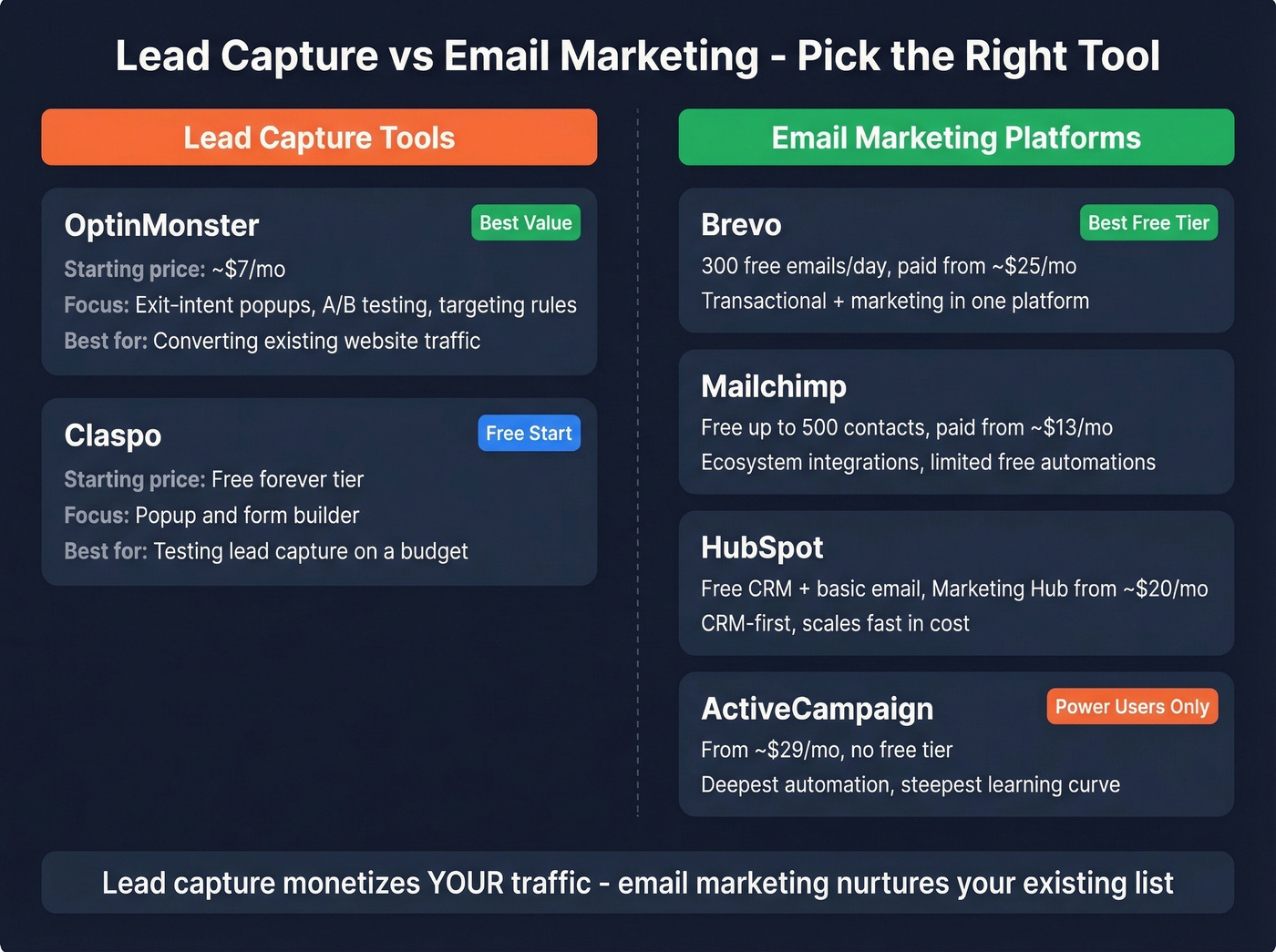
Claspo is a solid lifetime-free popup and form builder for testing. Expect $0 to start, then paid tiers typically start around ~$15-$30/mo once you need more templates, targeting, or volume. You'll outgrow it if you're already running serious CRO experiments, but for getting started it's hard to beat free.
Email Marketing: Brevo, Mailchimp, HubSpot, ActiveCampaign
Brevo is the best free tier for email marketing: 300 free emails/day, then paid from ~$25/mo. The consensus on r/emailmarketing is "great value, strong deliverability, but the good stuff is paid." For teams that need transactional email alongside marketing, Brevo handles both without forcing you onto separate platforms.
Mailchimp is the ecosystem play. Free goes up to ~500 contacts, but automations are limited; paid starts around ~$13/mo and scales with list size. It's fine, but you'll feel the ceiling quickly if lifecycle automation is core to your strategy.
HubSpot is the CRM-first choice. You can start free with CRM and basic email, then Marketing Hub starts around ~$20/mo and ramps fast as you scale contacts and features. Powerful, but it becomes a budget line item before most teams expect it.
ActiveCampaign has the deepest automation in this set, starting around ~$29/mo, with pricing climbing as contacts grow. Reddit praise is consistent on capability - and equally consistent on the learning curve being brutal. Here's the thing: if you don't have someone who genuinely enjoys building automations, this tool will collect dust. When it clicks, though, the segmentation and conditional logic outclass everything else at this price point.
Pricing at a Glance
Most teams overspend because they compare tools inside the wrong category. A popup builder won't replace a B2B database, and a database won't replace lifecycle automation. Use this table to sanity-check category, free tier, and the first paid step.
| Tool | Category | Free Tier | Paid From | Best For |
|---|---|---|---|---|
| Prospeo | B2B prospecting | 75 emails/mo | ~$0.01/email | Accuracy + freshness |
| Hunter | B2B prospecting | 50 credits/mo | $34-$49/mo | Simplicity |
| Snov.io | B2B prospecting | Trial: 50 credits | $29.25/mo | Budget all-in-one |
| Apollo | B2B prospecting | Yes | ~$49-$99/user/mo | Volume + sequencing |
| Lusha | B2B prospecting | 5 credits/mo | ~$22.45/user/mo | Direct dials |
| UpLead | B2B prospecting | 7 days / 5 credits | $74-$99/mo | Accuracy guarantee |
| OptinMonster | Lead capture | No | ~$7/mo | Conversion popups |
| Claspo | Lead capture | Yes | ~$15-$30/mo | Free testing |
| Brevo | Email marketing | 300 emails/day | ~$25/mo | Free tier value |
| Mailchimp | Email marketing | Up to 500 contacts | ~$13/mo | Ecosystem |
| HubSpot | Email marketing | Free CRM | ~$20/mo | CRM-first teams |
| ActiveCampaign | Email marketing | No | ~$29/mo | Deep automation |
Compliance You Can't Ignore
The penalties are ugly:
- CAN-SPAM: up to $53,088 per email
- GDPR: up to EUR 20M or 4% of revenue
- CCPA: $2,663-$7,988 per violation
- TCPA (calls/SMS): $500-$1,500 per incident
In the US, the model is mostly opt-out: you can email people as long as you follow CAN-SPAM rules - clear unsubscribe, physical address, honest headers and subject lines, honor opt-outs fast. In the EU/UK, GDPR pushes you toward explicit opt-in consent for marketing, which makes "buying random email lists" a high-risk move. If you need the deeper legal breakdown, see is it illegal to buy email lists.
Look, buying a list of "10,000 CEOs" from a sketchy broker isn't list generation - it's reputation roulette. Even if you don't get fined, you'll get blocklisted, and then every legitimate email you send suffers.
Why Verification Beats List Size
Here's a strong opinion: if your average deal is under five figures, you probably don't need a massive database. You need a small, accurate one. A smaller list of verified emails outperforms a giant list of "maybe" addresses every single time. If bounces are already creeping up, start with email bounce rate benchmarks and fixes.
Global inbox placement sits at only about 84%, which means roughly one in six emails never hits the inbox. Gmail lands around 87.2% inbox with 6.8% spam, while Microsoft is harsher at 75.6% inbox and 14.6% spam. Operationally, keep hard bounces under 2% and spam complaints under 0.3%. Once you cross those lines, mailbox providers start treating your whole domain like a problem - even when you email people who actually want your message. For the full playbook, use an email deliverability guide to diagnose root causes.
There's a workflow most tools don't talk about: when databases miss smaller companies, teams resort to guessing email patterns like firstname@company.com or f.lastname@company.com. It works surprisingly often, but without verification, you're sending blind into catch-all domains and potential spam traps. This is exactly where real-time verification earns its keep - catch-all handling, spam-trap removal, and honeypot filtering baked into the workflow, not bolted on after the fact.
FAQ
What is an email list generator?
A tool that builds email lists - either by finding professional addresses in B2B databases, capturing opt-ins on your website, or managing subscribers in an email marketing platform. The right type depends on whether you're doing outbound prospecting, inbound capture, or lifecycle marketing.
Is it legal to buy email lists?
In the US, CAN-SPAM allows cold emailing under an opt-out framework - include an unsubscribe link, physical address, and honest headers. In the EU/UK, GDPR requires explicit opt-in consent for marketing, making purchased lists a high-risk move that can trigger fines up to EUR 20M.
How do I build an email list for free?
Use B2B prospecting free tiers like Prospeo (75 verified emails/month) or Hunter (50 credits/month) for outbound. For opt-in lists, use Claspo's free popup builder for capture and Mailchimp's free plan (up to 500 contacts) for basic email marketing.
What's a good bounce rate for campaigns?
Keep hard bounces under 2% and spam complaints under 0.3%. The global average inbox placement rate is about 84%, so even "clean" senders lose deliverability when list hygiene slips. Verified-only workflows routinely stay under 3% bounce.
Email finder vs. email list builder - what's the difference?
An email finder locates professional addresses from databases for outbound sales. An email list builder collects opt-in subscribers through forms and popups for inbound marketing. Different workflows, different compliance requirements, different tools entirely.