

The Best Email Marketing Solutions for 2026 - With the Data to Prove It
A RevOps lead we know ran the same campaign through three different email marketing solutions last quarter. Same list, same copy, same send time. One platform landed 91% in the inbox. Another hit 74%. The third lost 22% of emails entirely - they just vanished into the void. The tool you pick matters more than most guides admit.
Why Email Marketing Still Wins in 2026
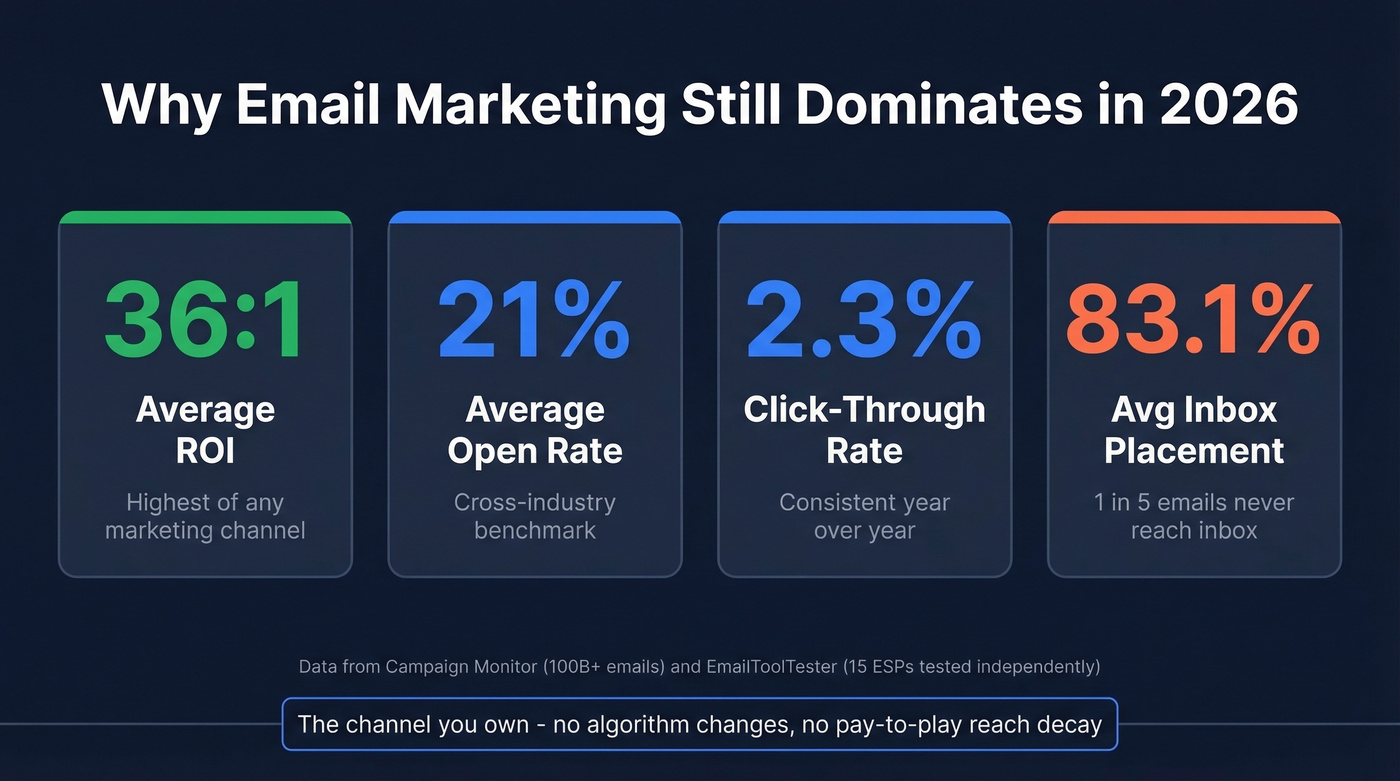
Email delivers a 36:1 ROI - the highest of any marketing channel. Cross-industry benchmarks from Campaign Monitor's dataset of 100B+ emails show a 21% average open rate and 2.3% click-through rate. Those numbers hold steady year after year because email is the one channel you actually own. No algorithm changes, no pay-to-play reach decay.
But most "best email marketing tools" roundups compare feature checklists and call it a day. We compared deliverability data, pricing at scale, integration ecosystems, and the hidden costs nobody shows you - like platforms that charge for unsubscribed contacts or gate basic automation behind $200/mo plans. We also factored in how well each tool connects to the rest of your stack through native integrations and Zapier, because a siloed ESP creates more problems than it solves.
Here's our hot take: most teams obsess over ESP features when their real problem is data quality. A 5-star deliverability platform sending to a dirty list will underperform a 3.5-star platform sending to a verified one. Fix the data first, then pick the tool.
Our Picks at a Glance
| Use Case | Pick | Why |
|---|---|---|
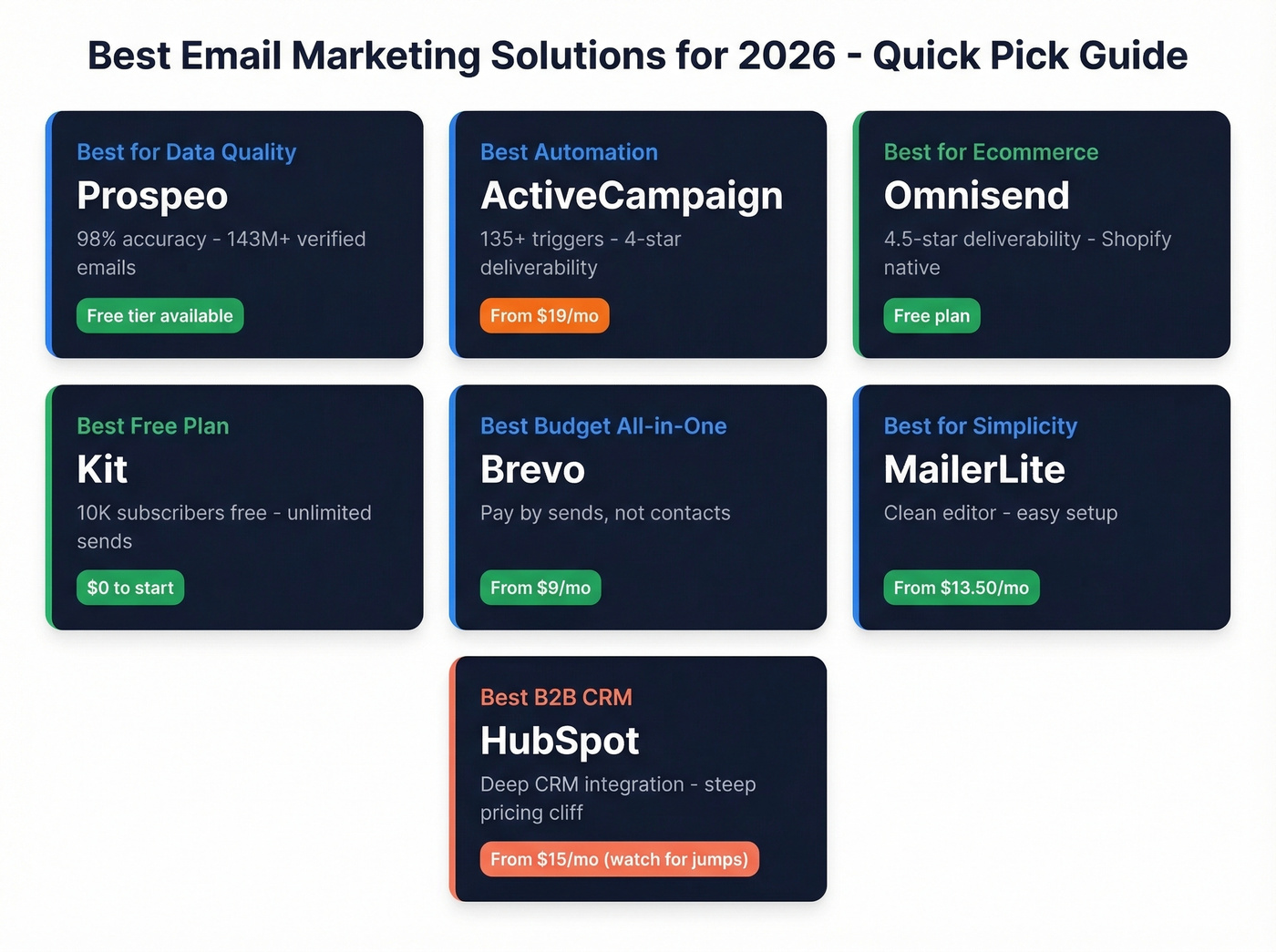
| Data quality & list verification | Prospeo | 98% accuracy, 143M+ verified emails, free tier |
| Best all-around automation | ActiveCampaign | 135+ triggers, 4-star deliverability |
| Best for ecommerce | Omnisend | 4.5-star deliverability, Shopify-native |
| Best free plan | Kit | 10K subscribers free, unlimited sends |
| Best budget all-in-one | Brevo | Priced by sends, not contacts |
| Best for simplicity | MailerLite | Clean editor, ~$13.50/mo at 1K contacts |
| Best B2B CRM integration | HubSpot | Deep CRM, steep pricing cliff |
Now let's talk about the metric that actually separates these tools.
Deliverability - The Metric Nobody Shows You
Your email platform's deliverability is the single biggest variable in your results, and almost no comparison guide publishes the data. EmailToolTester's independent testing across 15 ESPs found an average inbox placement rate of just 83.1%. Nearly 1 in 5 emails never reach the inbox - 10.5% land in spam, and 6.4% go missing entirely.
The gap between the best and worst platforms is massive:
| ISP | Inbox | Spam | Missing |
|---|---|---|---|
| Gmail | 89.8% | 6.4% | 3.8% |
| Yahoo | 87.3% | 6.4% | 6.3% |
| Apple Mail | 82.0% | 10.8% | 7.2% |
| Microsoft | 77.4% | 15.1% | 7.5% |
Microsoft is the hardest inbox to crack - nearly 1 in 4 emails don't make it. If your audience skews corporate and Outlook-heavy, your ESP choice matters even more. And before blaming your ESP, check your authentication: SPF, DKIM, and DMARC are table stakes in 2026. Without all three configured correctly, even the best platform can't save you.
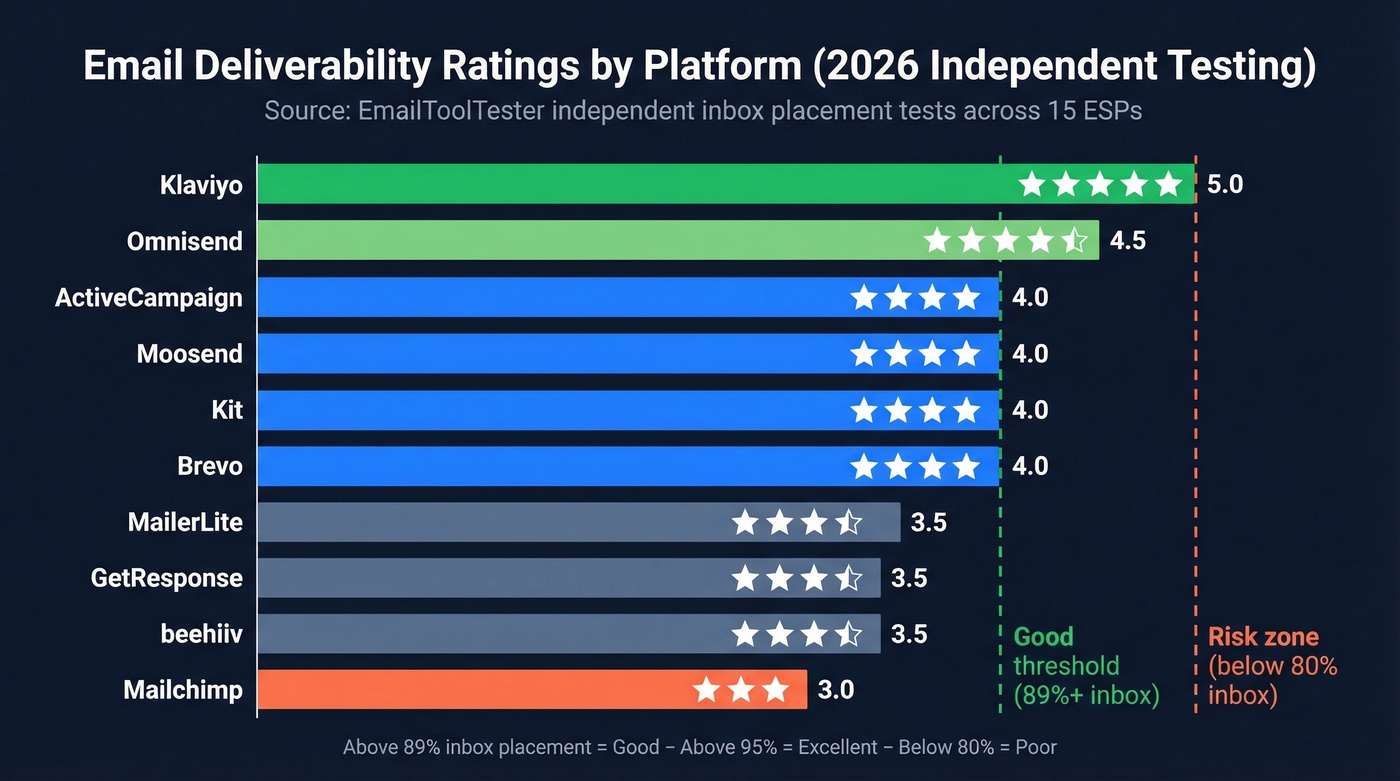
Independent testing rates each platform on a 5-star scale. The spread is dramatic.
Top tier: Klaviyo (5-star), Omnisend (4.5-star), ActiveCampaign (4-star), Moosend (4-star), Kit (4-star)
Bottom tier: Brevo (4-star), MailerLite (3.5-star), GetResponse (3.5-star), beehiiv (3.5-star), Mailchimp (3-star)
Above 89% inbox placement counts as "good," above 95% as "excellent," and below 80% as "poor." Most platforms cluster in the 80-89% range, which means your list hygiene and sending practices are doing a lot of the heavy lifting regardless of which tool you pick.
The takeaway: deliverability isn't just an ESP problem. It's a data quality problem. A platform with 5-star deliverability will still tank if you're sending to a list full of invalid addresses and spam traps. That's where list verification enters the picture - and why we've included it in this guide alongside the traditional ESPs.
Top Email Marketing Solutions Compared
We've organized these by strength, not alphabetical order, and assigned quick filters so you can skip to what matters.
ActiveCampaign - Best Automation
Use this if: You need serious automation depth - conditional branching, lead scoring, 135+ triggers - and you want deliverability that actually holds up (4-star rating).
Skip this if: You're on a tight budget at scale. ActiveCampaign gets expensive fast: Starter is $19/mo at 1K contacts, but Plus is $239/mo at 10K and $759/mo at 50K.
ActiveCampaign's automation builder is genuinely best-in-class for SMBs. The visual workflow editor handles if/then branching, split testing within automations, and CRM pipeline triggers that most competitors gate behind enterprise tiers. It also boasts 900+ native integrations, making it one of the most connected ESPs on the market. The AI content assistant can generate subject lines and email copy drafts, though you'll want to edit aggressively - we've found the output reads generic without heavy rewriting.

The catch: The Starter plan caps you at 5 automation actions with no branching logic - barely usable for real workflows. And as of late 2025, new accounts get charged for all contacts including unsubscribed, bounced, and unconfirmed. Existing accounts keep the old "active contacts only" billing, but new signups pay for dead weight.
Pricing: Starter $19/mo (1K) -> Plus $179/mo (5K) -> Plus $489/mo (25K). Enterprise starts at $159/mo for 1K contacts and scales from there.
Prospeo - Best for Data Quality & List Verification
Use this if: You want every other tool on this list to work better. Prospeo isn't an ESP - it's the data layer that ensures your emails actually reach real inboxes. With 143M+ verified emails and 98% accuracy, it runs a 5-step verification process with catch-all domain handling, spam-trap removal, and honeypot filtering. The 7-day data refresh cycle is genuinely unusual; the industry average is closer to 6 weeks.
The free tier gives you 75 email verifications and 100 Chrome extension credits per month - enough to test the accuracy before committing. No contracts, no annual lock-in. For teams running outbound or building cold lists, pair it with any ESP on this list and your bounce rates drop to near zero. One client went from 35% bounces to under 4% after switching their verification workflow.
Omnisend - Best for Ecommerce
Use this if: You're running a Shopify store and want pre-built automation flows that actually drive revenue. Omnisend is Shopify-native with 4.5-star deliverability - just behind Klaviyo's 5-star rating.
Skip this if: You're B2B or SaaS. Omnisend's entire feature set is built around ecommerce workflows: abandoned cart, browse abandonment, post-purchase, win-back. If you don't have a product catalog, most of the platform is irrelevant.
Klaviyo's benchmarks across 167,000+ customers show automated flows generating up to 30x more revenue per recipient than one-off campaigns. To put that in concrete terms, their data shows campaign revenue per recipient averaging around EUR 0.85, while abandoned cart flows hit EUR 2.62. Omnisend's pre-built flows tap directly into that same pattern across ecommerce platforms.
Pricing: Free plan covers 250 contacts. Standard runs ~$16/mo for 500 contacts, scaling to ~$132/mo at 10K. Competitive for what you get, especially with SMS built in.
Watch out for: The free plan's contact limit is tight. You'll outgrow it fast if your store has any traction.
Quick Deliverability Comparison
Before we continue with the remaining tools, here's how the top picks stack up on the metric that matters most:
| Tool | Deliverability | Best For | A/B Testing |
|---|---|---|---|
| ActiveCampaign | 4-star | Automation depth | In-automation split tests |
| Omnisend | 4.5-star | Ecommerce flows | Subject line + content |
| Brevo | 4-star | Budget multi-channel | Subject line + content |
| MailerLite | 3.5-star | Simplicity | Subject line + content |
| Kit | 4-star | Creator audiences | Subject lines only (free) |
Brevo - Pay by Volume, Not Contacts
Most ESPs charge by list size. Brevo flips the model: you pay by email volume. That's a massive advantage if you have a large list but send infrequently. A 50,000-contact list that sends twice monthly costs the same as a 5K list sending daily - as long as total volume matches. You also get email, SMS, and WhatsApp in one platform.
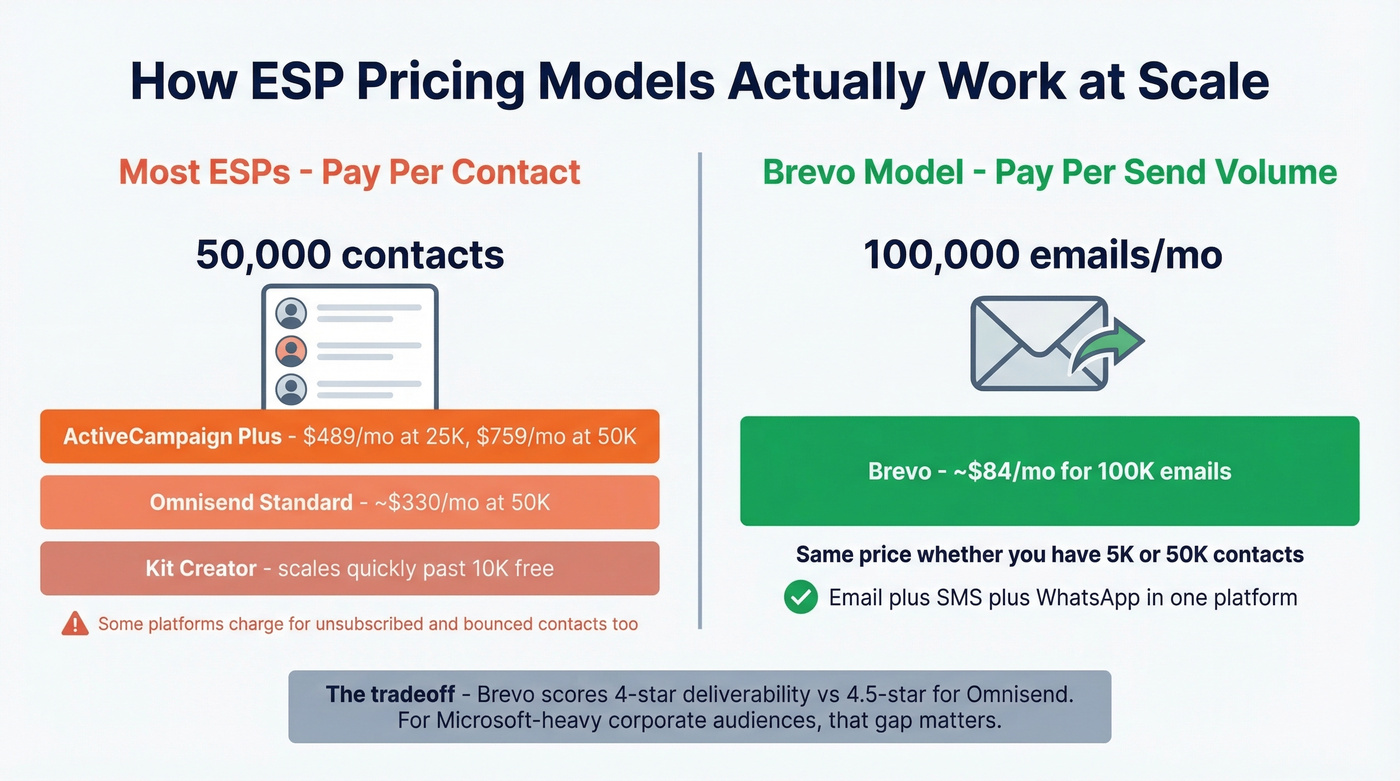
Pricing: Free (300 emails/day), $9/mo (5K emails/mo), $25/mo (20K), $39/mo (40K), scaling to ~$84/mo (100K).
The tradeoff is deliverability. Brevo scores 4-star - solid but not top-tier. For high-volume senders where every percentage point of inbox placement matters, ActiveCampaign or Omnisend edge it out. If you're sending to Microsoft-heavy audiences in corporate B2B, that gap means more emails hitting spam.
MailerLite - Best for Simplicity
MailerLite's drag-and-drop builder is genuinely pleasant to use. No learning curve, no feature overload, no confusing plan matrix. For solo operators and small teams who want to send good-looking emails without a certification course, this is the pick.
Pricing: Free (500 subscribers), ~$13.50/mo (1K), ~$73/mo (10K). Straightforward, no hidden fees.
The fine print: That 3.5-star deliverability rating isn't a rounding error. We've seen MailerLite users hit inbox rates in the low 80s on Gmail and struggle with Microsoft. If your open rates feel low, the platform might be the bottleneck - not your copy.
Kit - Best Free Plan for Creators
Kit (formerly ConvertKit) offers the most generous free plan on this list: 10,000 subscribers with unlimited sends. That's not a typo. Most competitors cap free plans at 250-500 contacts.
The platform is built for creators, newsletter operators, and solo founders building an audience without upfront costs. Kit's tagging and segmentation work well even on the free tier, and 4-star deliverability means your emails actually land. The free plan limits A/B testing to subject lines only and caps you at a single basic visual automation. Paid plans (Creator at $33/mo, Pro at $66/mo for 1K subs) unlock unlimited automations, but the pricing scales quickly.
If you need A/B testing on email content, advanced reporting, or ecommerce integrations beyond basic digital product sales, you'll hit walls fast. Kit is a creator tool, not a marketer's tool.
HubSpot - Best B2B CRM Integration
Use this if: Your sales and marketing teams live in HubSpot CRM and you need email tightly integrated with deal stages, lifecycle properties, and lead scoring.
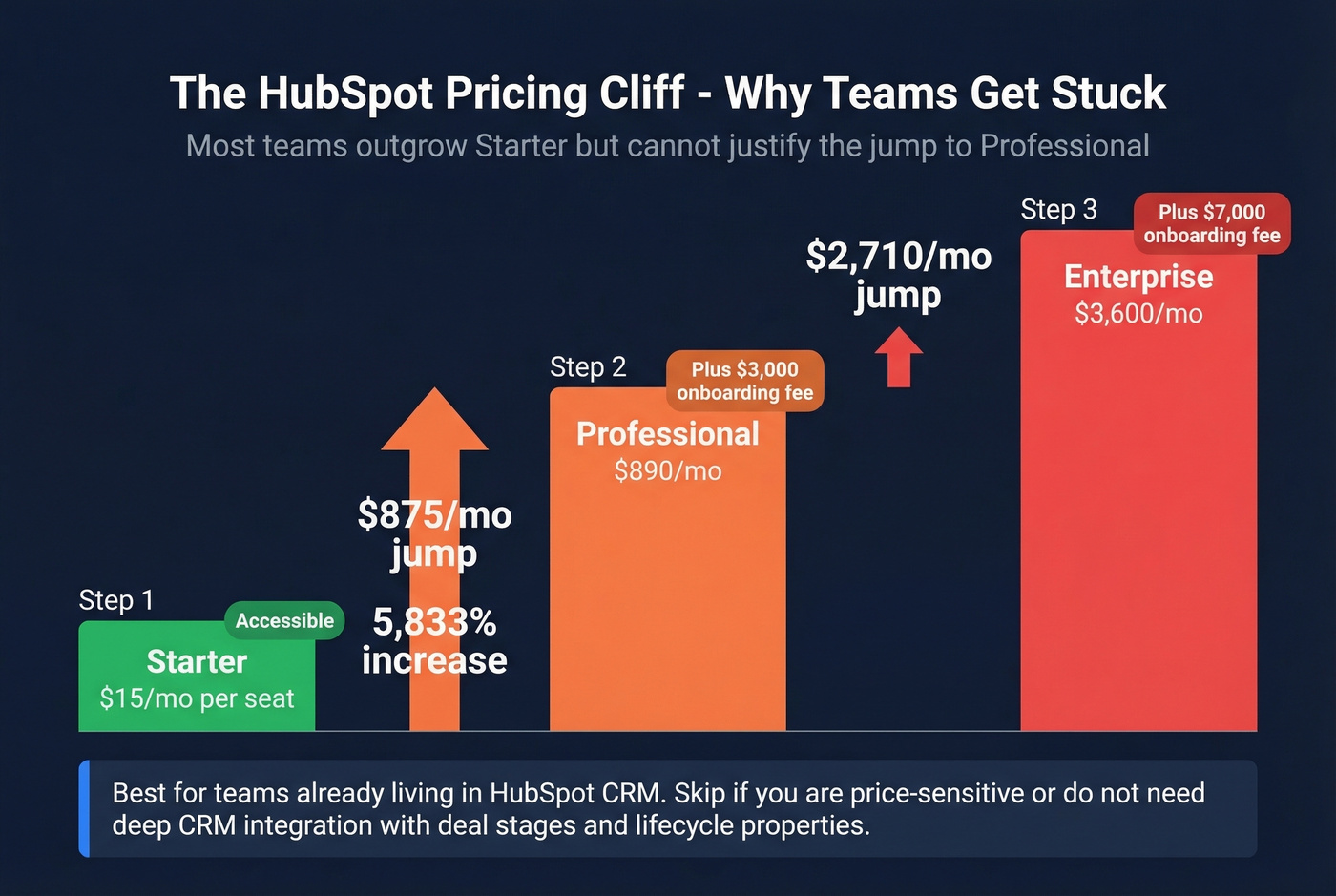
Skip this if: You're price-sensitive. HubSpot's email marketing pricing has one of the steepest cliffs in the industry: Starter at $15/mo/seat, then Professional jumps to $890/mo with a $3,000 onboarding fee. Enterprise hits $3,600/mo with a $7,000 onboarding fee.
That $15 -> $890 gap is the real story. Most teams outgrow Starter quickly, and the jump to Professional is brutal for mid-market companies. We've talked to teams who stayed on Starter for a year longer than they should have, just to avoid the sticker shock.
Mailchimp - Still Popular, No Longer Best Value
Mailchimp's brand recognition still carries weight, but the product has fallen behind. The free plan now caps at 250 subscribers and 500 sends - a fraction of what Kit offers. Worse, Mailchimp charges for inactive and unsubscribed contacts on paid plans, inflating your bill with dead weight.
The deliverability score is the real problem: 3-star, the lowest among major ESPs in independent testing. Pricing starts around ~$13/mo for small lists and climbs quickly into the $100+/mo range as you scale. For what you get, better options exist at every price point. (If you're stuck on it, start with these deliverability issues.)
GetResponse
Use this if: You run webinars as part of your marketing funnel. GetResponse is the only major ESP with built-in webinar hosting, which makes it a genuine differentiator for education-based businesses.
Skip this if: Deliverability is a priority. At 3.5-star, GetResponse sits in the bottom tier. The free plan covers 500 contacts but locks out automation entirely. Paid plans start at $19/mo (1K contacts), scaling to ~$79/mo at 10K.
Quick Pick: Moosend
Moosend is the quiet budget winner. At $7/mo for 500 contacts with 4-star deliverability, it punches above its weight. One pricing tier, no confusing plan matrix. For small lists under 5K contacts where you want solid deliverability without complexity, Moosend is the tool to beat. Scales to ~$32/mo at 5K and ~$64/mo at 10K.
beehiiv
Use this if: You're building a newsletter as a business, not just a marketing channel. beehiiv's referral programs, ad network, and monetization tools are purpose-built for newsletter operators.
Skip this if: You need marketing automation or ecommerce flows. beehiiv is a newsletter platform, not a full ESP. Free plan supports 2,500 subscribers, Scale runs $49/mo, Max $169/mo. Deliverability sits at 3.5-star, and the monetization features that make beehiiv special are gated behind paid plans.
Klaviyo
Klaviyo earns the only 5-star deliverability rating in independent testing - the best of any platform. It's the gold standard for Shopify Plus and high-revenue DTC brands willing to pay premium pricing (often ~$45/mo for 1K contacts, scaling steeply). If you're doing $1M+ in ecommerce revenue, Klaviyo's segmentation and predictive analytics justify the cost. Everyone else should look at Omnisend first.
Constant Contact
A legacy platform that still leans on event marketing features as its differentiator. Pricing runs higher than competitors for comparable functionality (~$12/mo for 500 contacts, ~$80/mo for 5K). Better options exist for nearly every use case in 2026 - Constant Contact's main advantage is familiarity for teams that have used it for years.
Other Tools Worth Knowing
Sender offers one of the strongest free plans in the budget tier - 15,000 emails/mo to 2,500 subscribers with automation included. EmailOctopus runs on Amazon SES infrastructure, giving you raw sending power at rock-bottom prices (~$24/mo for 10K contacts). Mailjet is the developer-friendly pick for transactional email, with a solid API and real-time collaboration features for template building. None of these replace the Tier 1 picks above, but they're worth evaluating if your needs are specific.

The article says it plainly: a 5-star ESP sending to a dirty list will underperform a 3.5-star one sending to verified contacts. Prospeo's 5-step verification with spam-trap removal and catch-all handling cuts bounce rates from 35% to under 4%. At $0.01 per email, fixing your data costs less than one wasted campaign.
Fix the data first. Every ESP on this list will thank you.
Pricing at Scale - The Hidden Costs
Most comparison guides show you the $9/mo starting price and call it a day. Here's what these tools actually cost as your list grows:
| Tool | 1K | 5K | 10K |
|---|---|---|---|
| ActiveCampaign (Starter) | $19 | $99 | $189 |
| Brevo* | $9 | $25 | $39 |
| MailerLite | ~$13.50 | ~$39 | ~$73 |
| Kit | Free | ~$66 | ~$100 |
| Omnisend | ~$16 | ~$65 | ~$132 |
| Mailchimp | ~$13 | ~$100 | ~$190 |
| HubSpot | $15/seat | $15/seat | $890 |
| GetResponse | $19 | ~$54 | ~$79 |
| Moosend | $7 | ~$32 | ~$64 |
| beehiiv | Free | $49 | $49 |
At 25K-50K contacts: ActiveCampaign Plus jumps to $489-$759/mo. MailerLite stays competitive at ~$139-$223/mo. Kit scales to ~$166-$249/mo. Mailchimp typically climbs into the $300-$500+/mo range. Omnisend runs ~$270-$430/mo. beehiiv's Max plan at $169/mo covers up to 100K subscribers - the best deal at scale for newsletter operators.
Brevo prices by email volume, not contacts. Prices assume standard send ratios. HubSpot Starter is per-seat; Professional ($890/mo) is required for most marketing features. Prices reflect published rates as of early 2026 - check vendor sites for current numbers.
Three hidden costs to watch:
ActiveCampaign's billing change. New accounts created after late 2025 pay for all contacts - including unsubscribed and bounced. A 10K "active" list with 3K dead contacts means you're billed for 13K.
Mailchimp's inactive contact charges. Same problem, different platform. Mailchimp bills for every contact in your account, active or not. Cleaning your list isn't just a deliverability best practice - it's a cost-saving measure.
HubSpot's onboarding fees. Professional requires a $3,000 onboarding fee. Enterprise requires $7,000. These are one-time costs, but they're rarely mentioned in pricing comparisons.
For enterprise-scale operations at 100K+ contacts with complex multi-brand sends, platforms like Salesforce Marketing Cloud and Adobe Campaign start around $1,000-$10,000+/mo. At that level, you're evaluating dedicated IPs, multi-department governance, and implementation timelines measured in months - a fundamentally different buying conversation.
Why Data Quality Decides Your Results
Every ESP on this list can send emails. The question is whether those emails reach real people.
Here's the scenario we see constantly: a team imports a purchased or scraped list, sends their first campaign, bounces 8%, and watches their sender reputation crater. Gmail starts throttling them. Microsoft routes everything to spam. The ESP's deliverability rating becomes irrelevant because the damage is done at the list level. (If you're seeing this pattern, start with email bounce rate basics and fixes.)
Gmail's complaint-rate threshold is brutal - exceed 0.3% and you trigger throttling. That's 3 complaints per 1,000 emails. A dirty list with spam traps and honeypots can blow past that threshold on a single send.

This is where list verification fits into the stack. Run your contacts through a verification tool before importing them into any ESP. A 5-step verification process catches invalid addresses, spam traps, and honeypots before they ever touch your sending domain. Teams running verified lists consistently report bounce rates under 4% - compared to the 8-15% we see from unverified imports. (If you need a deeper playbook, see our email deliverability guide.)
The math is simple: a 50,000-contact list verified at ~$0.01 per email costs ~$500. One deliverability crisis from a dirty list can take weeks to recover from and cost thousands in lost revenue. Verify first, send second.
Most ESPs refresh their data every 6 weeks. Prospeo refreshes every 7 days across 143M+ verified emails. That means fewer bounces, fewer spam traps, and inbox placement rates that actually match what your ESP promises. The free tier gives you 75 verifications to prove it.
Stop blaming your ESP when the real problem is stale data.
Five Mistakes That Kill Results
1. Sending to purchased or scraped lists. This is the fastest path to blacklisting. Purchased lists are full of spam traps, recycled addresses, and people who never opted in. One campaign to a bad list can land your domain on a blocklist that takes months to escape.
2. Over-sending without segmentation. Blasting your entire list with every campaign causes fatigue, unsubscribes, and spam complaints. The consensus on r/EmailWhisperers is that frequency without relevance is the number-one self-inflicted wound in email marketing. Segment by engagement, purchase behavior, or lifecycle stage - even basic segmentation cuts complaint rates dramatically.
3. Ignoring mobile design. 42% of emails are opened on mobile. Tiny text, broken layouts, and hard-to-tap CTAs aren't just annoying - they're revenue killers. Every template should be tested on a phone before it goes out.
4. Automation without real personalization. Setting up a 12-email drip sequence doesn't make it personalized. One practitioner managing 40+ ecommerce brands found that adding the recipient's city to subject lines consistently doubled open rates versus generic copy. That's the kind of contextual detail that matters - not just inserting a first name merge tag.
5. Publishing unedited AI-generated content. AI is great for drafts and brainstorming. It's terrible at sounding like a human who cares about your product. The same practitioner put it well: "AI made things faster but not better." Edit aggressively, or your emails will read like everyone else's. One tactic worth stealing from that thread: resending your best-performing campaigns with fresh subject lines added 25-50% more revenue for multiple brands.
What's Changing in 2026
Open rates are becoming unreliable. Apple Mail Privacy Protection pre-fetches tracking pixels, inflating open rates for Apple Mail users. Bot pre-fetching from security tools does the same. The smartest teams are already shifting to click-based engagement metrics as their primary signal. If you're still segmenting by "opened in last 30 days," you're working with dirty data. (If you want to get more precise, use a real click rate formula in email marketing.)
BIMI is gaining traction. Brand Indicators for Message Identification lets you display your logo next to your emails in supported inboxes. It requires DMARC authentication and a Verified Mark Certificate, but the payoff is real - visual brand verification builds trust before the recipient even opens the email.
Zero-party data collection is replacing inference. With third-party cookies dying and privacy regulations tightening, the brands winning at email are the ones asking subscribers directly: what do you want to hear about? Preference centers, interactive surveys, and progressive profiling are replacing the "track everything and guess" approach.
AI governance is a compliance issue. Litmus flags the EU AI Act as something email marketers need to watch. If you're using AI for content generation or personalization, transparency about AI use is now a regulatory requirement in the EU and increasingly expected elsewhere. (For practical workflows, see AI for sales emails.)
The through-line across all these trends: data quality matters more than ever. When open rates are unreliable, deliverability is your only real metric. When compliance requirements tighten, clean lists aren't just best practice - they're legal protection. (If you're actively repairing a damaged domain, start with how to improve sender reputation.)
The Bottom Line
For most teams evaluating email marketing solutions, ActiveCampaign handles the automation and Prospeo ensures the data is clean before it ever touches your ESP. That combination covers 90% of use cases. Ecommerce teams should swap ActiveCampaign for Omnisend. Budget-conscious operators should start with Brevo or Kit. But regardless of which platform you choose, verify your list first - it's the single highest-impact action in your entire email stack. (If you're also building lists, use this how to generate an email list playbook.)
FAQ
What's the best email marketing solution for small business?
ActiveCampaign for automation depth, MailerLite for simplicity, Kit for creators building an audience. All three offer entry points under $20/mo. ActiveCampaign's Starter plan at $19/mo for 1K contacts is the sweet spot for small teams needing real workflow automation without enterprise pricing.
How much does email marketing software cost?
Free plans exist - Kit supports 10K subscribers at no cost. Most businesses pay $20-$200/mo depending on list size and features. Watch for hidden costs: some platforms charge for inactive contacts, and HubSpot's onboarding fees add $3,000-$7,000 upfront. Budget guides estimate $0-$99/mo for lists under 5K.
What's a good email deliverability rate?
Above 89% inbox placement is good, above 95% is excellent, and below 80% is poor - per independent benchmarks. The average across 15 tested ESPs is 83.1%, meaning nearly 1 in 5 emails miss the inbox. Platform choice matters, but list hygiene matters more.
Do I need to verify my email list before sending?
Yes. A bounce rate above 5% damages sender reputation fast, and Gmail throttles senders who exceed a 0.3% complaint rate. Verification catches spam traps and invalid addresses before they tank deliverability. At ~$0.01 per email, it's the cheapest way to protect your sending domain.
Is Mailchimp still the best option?
No. Mailchimp's free plan caps at 250 subscribers and 500 sends - a fraction of what Kit or Brevo offer. It charges for inactive contacts on paid plans and scored 3-star in deliverability testing, the lowest among major ESPs. ActiveCampaign, Omnisend, and MailerLite all outperform it on value and inbox placement.