

How to Email a Prospective Client (And Actually Get a Reply)
The average cold email reply rate is 3.43%. For every 100 emails you send to a prospective client, 97 people ignore you. And yet, cold email still returns roughly $36 for every $1 spent. That gap between "most emails" and "emails that work" isn't luck - it's process.
Here's the short version:
- Verify your contact data before you send anything - bounce rates above 5% damage your domain.
- Write under 80 words. Personalized opener, one value prop, one soft CTA.
- Follow up 4-5 times on a 3-7 day cadence. 42% of replies come from follow-ups.
Before You Write a Word
Your copy doesn't matter if the email bounces. Deliverability is the prerequisite every outreach guide skips, so let's start there.
Authentication is non-negotiable. Set up SPF, DKIM, and DMARC on every sending domain. Gmail has required SPF and DKIM plus a DMARC policy since February 2024 and Outlook Outlook enforced the same for high-volume senders in mid-2025. If you haven't done this, stop reading and go do it now.
Clean your list. We've seen teams drop their bounce rate from 11% to under 2% just by verifying contacts before hitting send - and their reply rate doubled from 3% to 6% over 62 days. Manual verification doesn't scale past a few dozen contacts, though. Prospeo's 5-step verification flags catch-all domains, spam traps, and honeypots, delivering 98% email accuracy. The free tier gives you 75 email verifications per month plus 100 Chrome extension credits - enough to test whether your list is clean or radioactive.

Use a dedicated sending domain. Never send cold outreach from your primary domain. A subdomain or separate domain protects your main reputation if something goes wrong. We've seen teams wreck months of sender reputation from a single campaign sent off the wrong domain.
Before building any list, get clear on your ICP: industry, company size, job title, and the specific pain point you solve. A tight ICP means fewer emails sent and more replies received.
Subject Lines That Get Opened
Your subject line has one job: earn the open. A Belkins study of 5.5 million emails found that personalized subject lines hit a 46% open rate versus 35% without personalization - a 31% lift. Reply rates jumped from 3% to 7%.
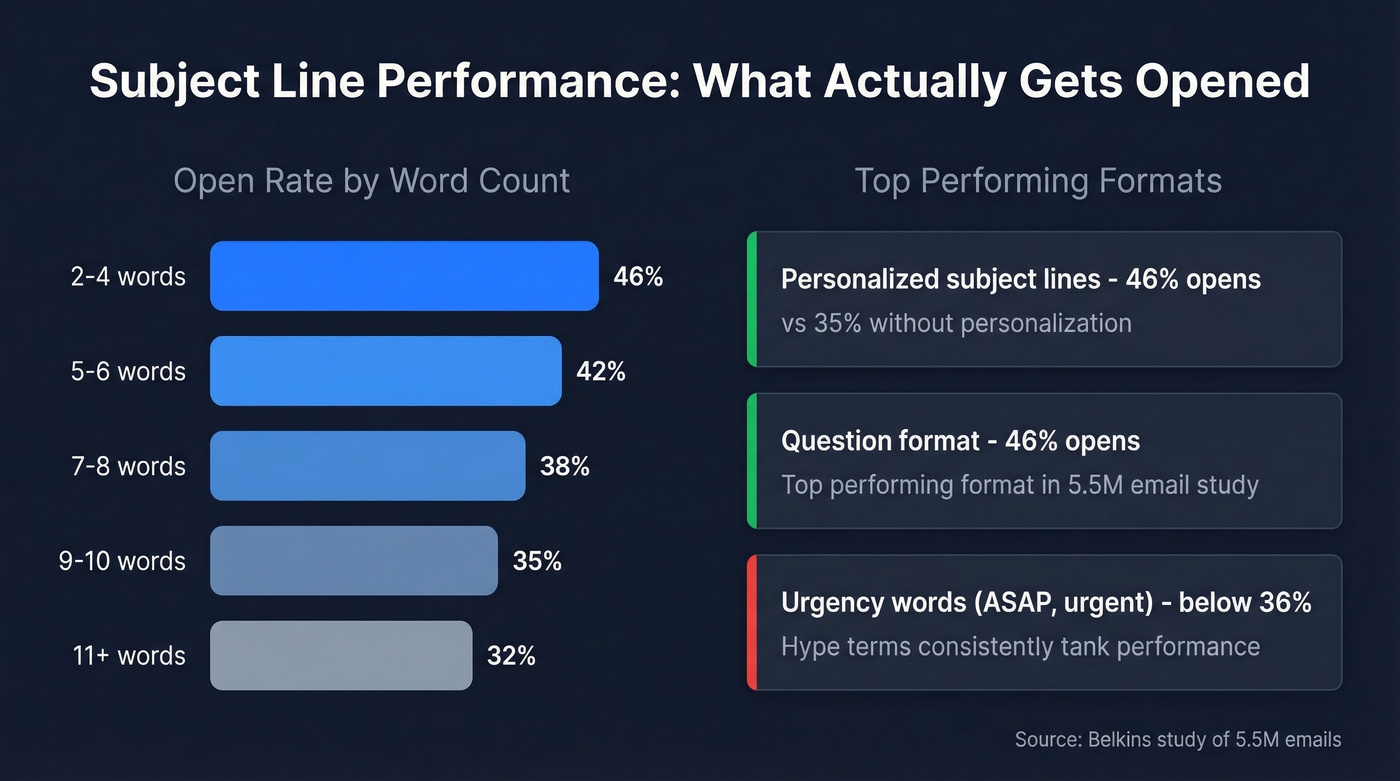
Two to four words perform best at 46% opens. Once you pass seven words, performance drops, with 9-10 word subject lines landing around 34-35%. Question-form subject lines also hit 46% opens, making them the top-performing format in the dataset.
Examples that work:
- "Quick question" - 39% opens in one practitioner's testing
- "{{Company}} + {{your company}}" - 33% opens
- "Saw your {{trigger event}}" - strong performer for relevance
- "Idea for {{company}}" - short, curiosity-driven
What tanks performance: hype terms like "ASAP," "urgent," or generic greetings push opens below 36%. Skip the urgency tricks.
If you want more options, pull from a swipe file of subject lines and test variations.
Writing Your Email: A 5-Part Framework
1. Personalized opener (one sentence). Don't just use their name - that's table stakes. Reference their role, a KPI they own, or a trigger event like a funding round, new hire, or product launch. Vague compliments and outdated info actually erode trust.
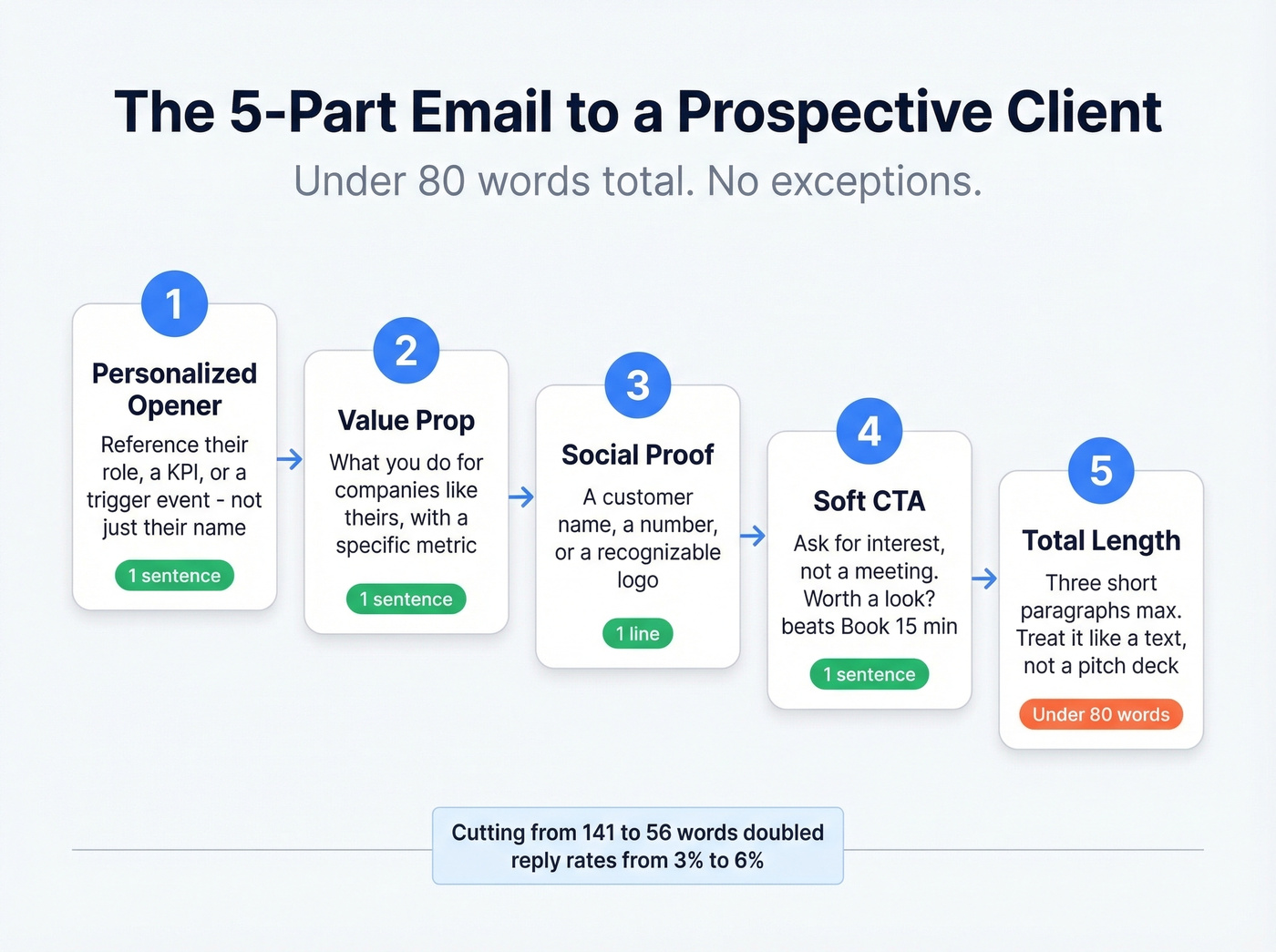
2. One-sentence value prop. What do you do for companies like theirs? "We help Series B SaaS teams cut CAC by 30%" beats "We help companies grow."
3. Social proof in one line. A customer name, a metric, a recognizable logo.
4. Soft CTA. Ask for interest, not a calendar slot. "Worth a look?" outperforms "Book 15 minutes on my calendar" because it's lower commitment.
5. Keep it under 80 words total. One practitioner cut their emails from 141 words to 56 and watched reply rates double. Three short paragraphs, maximum. That's it.
Here's the thing: if your average deal size is under five figures, you probably don't need a 200-word email with three paragraphs of social proof. The shorter and more direct you go, the better your economics. Treat cold outreach like a text message, not a pitch deck.
If you're building sequences, use a proven B2B cold email sequence structure instead of improvising.

You just read that bounce rates above 5% wreck your domain. Prospeo's 5-step verification delivers 98% email accuracy - catching spam traps, honeypots, and catch-all domains before they tank your sender reputation. Start with 75 free verifications.
Clean your list before your next email to a prospective client.
Templates That Actually Convert
Cold First Touch
Use this when you have a clear trigger event and a relevant value prop.
Hi {{first_name}},
Noticed {{company}} just {{trigger_event}}. When teams hit that stage, {{specific pain point}} usually becomes the bottleneck.
We helped {{similar company}} {{specific result}}.
Worth a quick look?
Why this works: the trigger event is publicly verifiable, so the personalization feels earned - not scraped.
Follow-Up After No Reply
Hi {{first_name}},
Circling back - {{new value: a case study link, a stat, or a short insight tied to their industry}}.
Thought of your team when I saw it. Still open to a quick chat?
Why this works: it adds new value instead of just nudging. Every follow-up should justify its own existence.
Trigger-Based (Funding / Hire / Launch)
Hi {{first_name}},
Congrats on {{specific event}}. Teams scaling from {{current stage}} to {{next stage}} usually run into {{pain point}}.
We work with {{similar companies}} on exactly that - {{one-line result}}.
Interested in hearing how?
Why this works: congratulations create goodwill, and the pain point is tied to a real transition they're navigating right now.
Warm Introduction Email
Hi {{first_name}},
{{Mutual connection}} suggested I reach out - they mentioned {{company}} is working on {{initiative}}.
We've helped teams like {{reference company}} with {{specific outcome}}. Happy to share what worked.
Why this works: the mutual connection does the trust-building for you. A warm intro typically outperforms cold touches by a wide margin.
For more variations, keep a set of sales follow-up templates handy.
The Follow-Up Schedule
58% of replies come from the first email, but 42% come from follow-ups. And 80% of deals require five or more touches. Don't send one message and give up after silence.
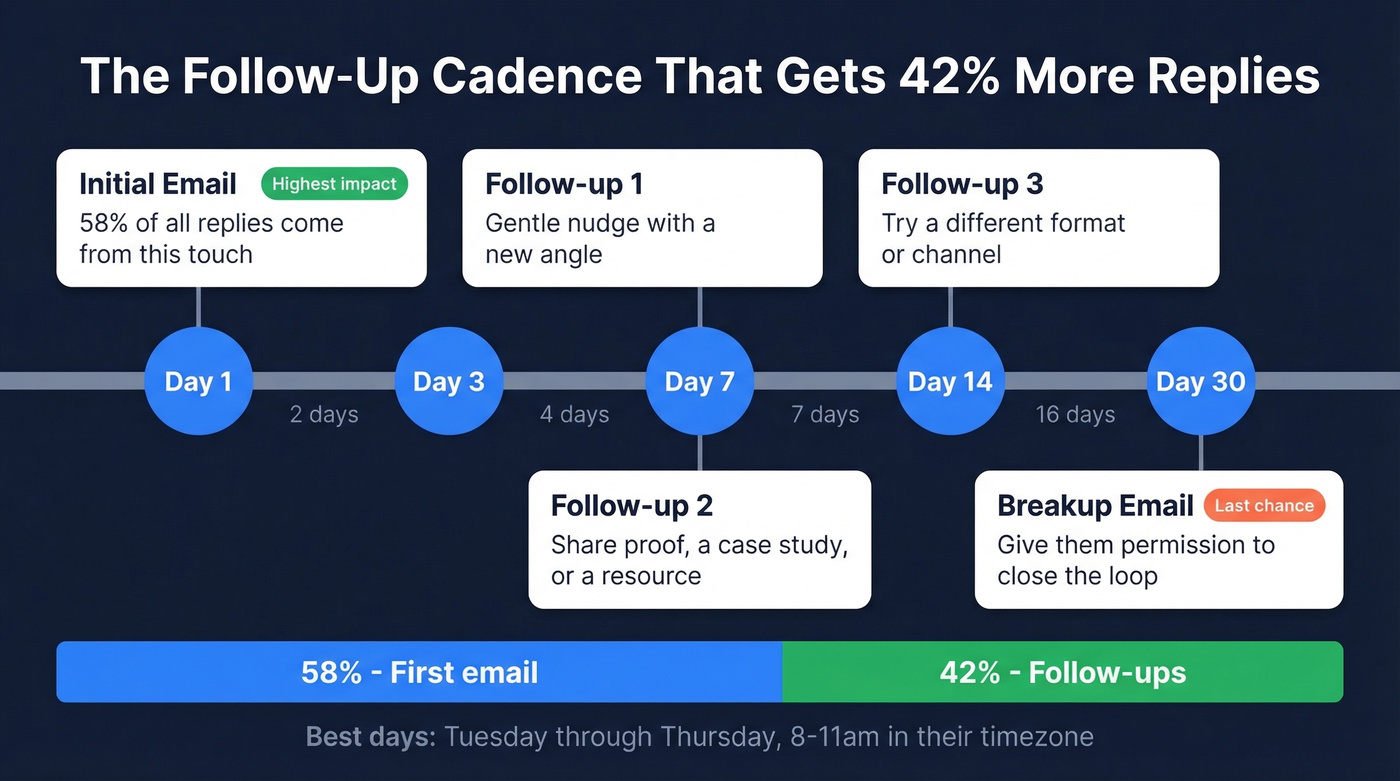
| Touchpoint | Timing | Purpose |
|---|---|---|
| Initial email | Day 1 | First touch - 58% of replies |
| Follow-up 1 | Day 3 | Gentle nudge, new angle |
| Follow-up 2 | Day 7 | Share proof or resource |
| Follow-up 3 | Day 14 | Try a different format |
| Breakup email | Day 30 | Permission to close the loop |
Best days to send: Tuesday through Thursday, with Tuesday and Wednesday strongest. Best window: 8-11am in the recipient's timezone. In our experience, shifting to this schedule alone can lift opens by around 16%.
If you want a deeper breakdown, use a data-backed guide on when to follow up.
If follow-up 3 gets no response, try a different channel entirely. A phone call or a comment on their recent post can break through inbox blindness in ways another email can't.
Legal Compliance Cheat Sheet
Cold email is legal in most jurisdictions - but the rules have teeth.
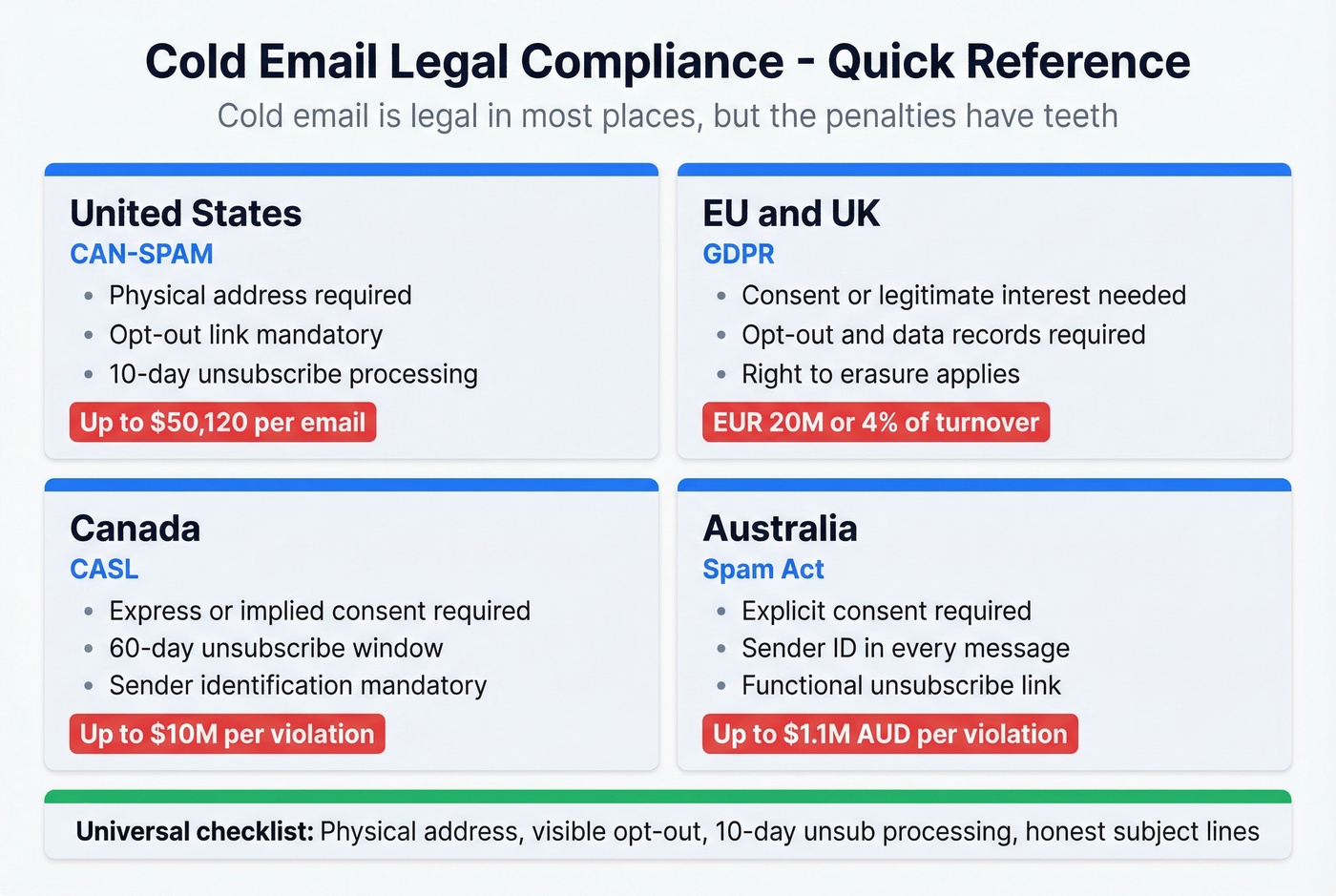
| Jurisdiction | Law | Key Requirements | Max Penalty |
|---|---|---|---|
| US | CAN-SPAM | Physical address, opt-out, 10-day processing | $50,120/email |
| EU/UK | GDPR | Consent/legit interest; opt-out; records | EUR 20M or 4% turnover |
| Canada | CASL | Express/implied consent; 60-day unsub | $10M/violation |
| Australia | Spam Act | Explicit consent, sender ID | $1.1M AUD/violation |
The practical checklist: include a physical mailing address, add a visible opt-out link, process unsubscribes within 10 business days, and never use misleading subject lines. These aren't optional - they're the baseline.
If you're unsure about list sourcing, read up on whether it's illegal to buy email lists.
Mistakes That Kill Reply Rates
Look, we've audited hundreds of outbound campaigns. The same mistakes show up over and over:
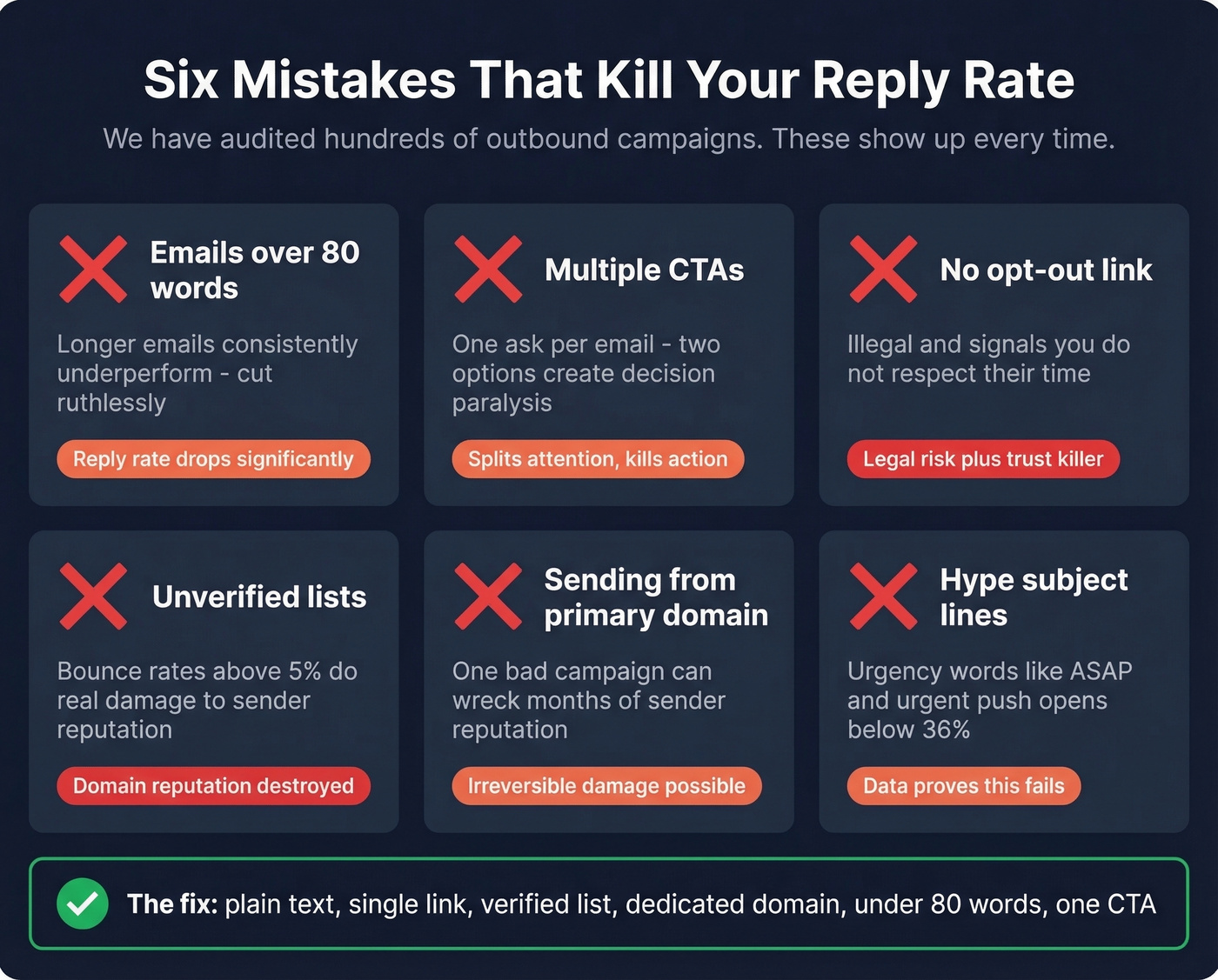
- Emails over 80 words. Longer emails consistently underperform. Cut ruthlessly.
- Multiple CTAs. One ask per email. Two options create decision paralysis.
- No opt-out link. Beyond being illegal, it signals you don't respect the recipient's time.
- Unverified lists. Run your list through a verification tool before every campaign - under 2% bounce rate is the target, and anything above 5% does real damage to your sender reputation.
- Sending from your primary domain. Use a dedicated sending domain. Always.
- Hype subject lines. The data is clear: urgency words push opens below 36%.
If you're consistently missing inbox placement, start with an email deliverability guide and then tighten your sender reputation.
Skip the fancy formatting too. HTML-heavy emails with images, colored fonts, and multiple links trigger spam filters. Plain text with a single link outperforms designed emails in cold outreach almost every time.
Templates are useless without the right contact data behind them. Prospeo gives you 300M+ verified profiles with 30+ filters - job title, funding stage, headcount growth - so every email to a prospective client hits a real decision-maker. Data refreshes every 7 days, not 6 weeks.
Stop emailing the wrong people. Find verified prospects at $0.01 each.
FAQ
How long should an email to a prospective client be?
Under 80 words. A practitioner who cut emails from 141 to 56 words doubled their reply rate from 3% to 6% over 62 days. Three short paragraphs maximum - opener, value prop, and CTA. Brevity wins whether you're sending a cold first touch or a warm referral.
What's a good reply rate for prospecting emails?
The 2026 average is 3.43%. Top performers hit 5.5%+, and elite campaigns exceed 10%. If you're below 3%, focus on list quality and deliverability before rewriting copy - bad data is almost always the bottleneck, not bad writing.
Do I need a different template for each situation?
Yes. A trigger-based email to a prospective client should reference the specific event, while a referral intro can lean on the mutual connection for credibility. Adapt the framework - personalized opener, value prop, soft CTA - to the context, but keep every version under 80 words.
How do I keep prospecting emails out of spam?
Set up SPF, DKIM, and DMARC on your sending domain. Verify every email address before sending. Use a dedicated sending domain, not your primary one, and keep spam complaints below 0.3%. If you're doing all of that and still landing in spam, check whether your email copy contains too many links or HTML formatting - plain text is your friend in cold outreach.