

Enterprise Client Meaning: Definition, Thresholds, and What Changes Upmarket
Your sales leader just told you to "move upmarket to enterprise." Everyone nodded. Nobody asked the obvious question: what does enterprise actually mean here?
The term shifts depending on who's talking - your CRO, your prospect's procurement team, and Gartner all use different numbers. Let's pin it down.
Quick version: A common working definition is 1,000+ employees OR $1B+ revenue OR a formal procurement/security/legal gate before you can close. If there's a purchasing department, it's enterprise.
The Core Definition
An enterprise client is a large organization with complex internal buying processes, formal procurement infrastructure, substantial budgets, and high expectations for vendor security, customization, and support. Think P&G running enterprise software across global divisions, Netflix buying from Microsoft, or NASA deploying Slack across departments.
The simplest shorthand comes from Karl Sakas: "If there's a purchasing department, it's an enterprise client." That single test cuts through most of the confusion. A 2,000-person company where the VP of Marketing can swipe a credit card for your tool? That's mid-market behavior. A 900-person company where legal, procurement, and IT security all need to sign off? That's enterprise buying.
In contract language, "enterprise client" often triggers different fee structures, licensing tiers, and SLA commitments - it's not just a marketing label. The working definition we'd recommend: 1,000+ employees OR $1B+ revenue OR formal procurement/security/legal gates. Hit any one of those three, and you're in enterprise territory.
SMB vs Mid-Market vs Enterprise
The boundaries aren't clean lines - they're fuzzy bands. Here are the most common frameworks side by side.
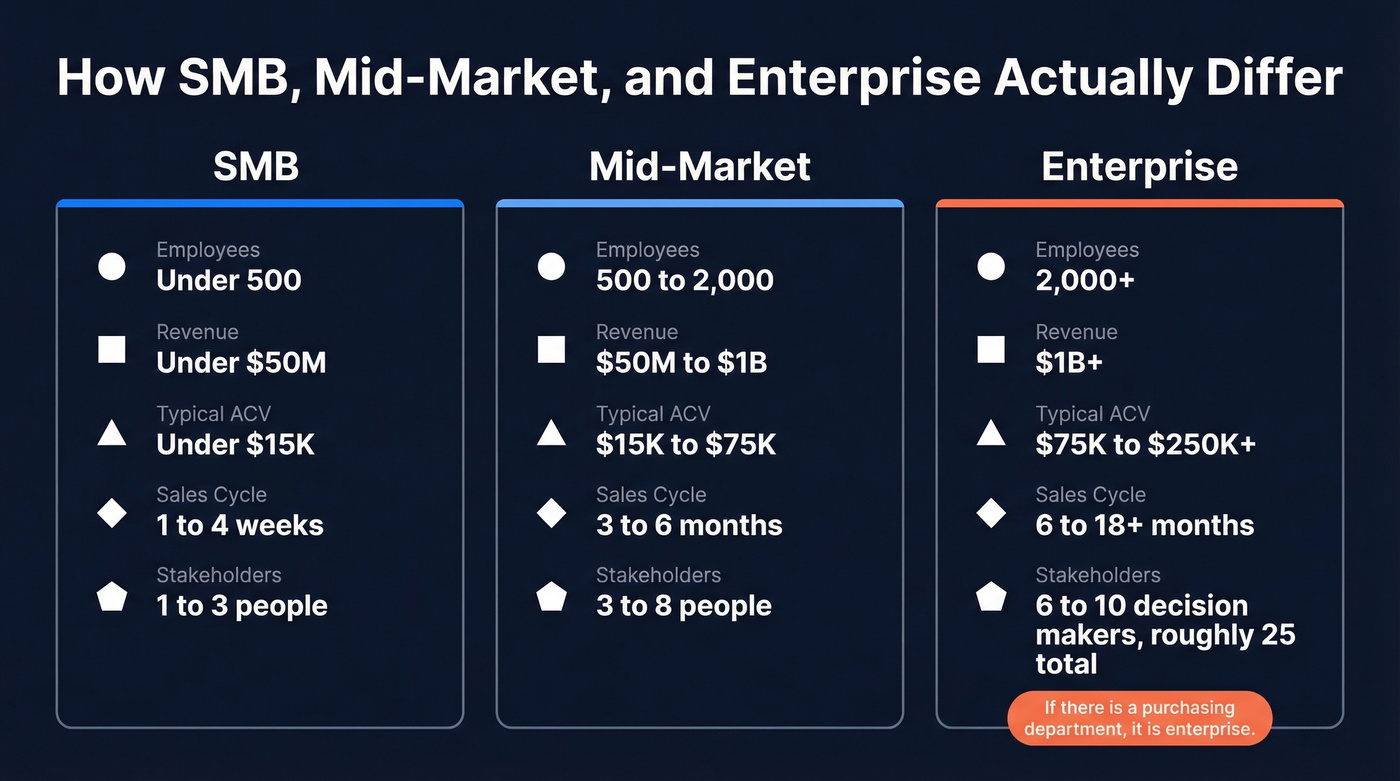
| SMB | Mid-Market | Enterprise | |
|---|---|---|---|
| Employees | <500 (often <100) | 500-2,000 | 2,000+ |
| Revenue | <$50M | $50M-$1B | $1B+ |
| Typical ACV | <$15K | $15-75K | $75-250K+ |
| Sales cycle | 1-4 weeks | 3-6 months | 6-18+ months |
| Stakeholders | 1-3 | 3-8 | 6-10 decision makers (~25 total) |
Ranges shown are composites - individual vendors draw lines differently.
Real companies define it based on their own sales motion. NetSuite treats anything over $200M in annual revenue as enterprise. Gong draws the line at $500M revenue or 1,500 employees. A Reddit poll on r/techsales showed options ranging from $200M to $1B+ in revenue, which tells you everything about how inconsistent this is. Gartner's midsize band is often cited as $50M-$1B revenue and 100-1,000 employees - enterprise starts above that ceiling.
Government definitions add another layer. In the U.S., the SBA's "small business" cutoff varies by industry and can be higher or lower depending on the NAICS code. In the EU, "medium" enterprises are 50-249 employees with turnover caps commonly cited at EUR50M. Everything above those ceilings starts entering enterprise territory, though the exact threshold depends on industry and region.

Enterprise buying committees average 25 stakeholders. One bounced email to the wrong VP can stall a six-month deal. Prospeo's 98% email accuracy and 7-day data refresh cycle mean you reach every decision-maker on the first attempt - across legal, procurement, IT security, and the C-suite.
Stop losing enterprise deals to bad contact data.
What Actually Changes When You Sell Enterprise
Forget the headcount for a moment. What changes when you sell to an enterprise customer is the buying process itself.
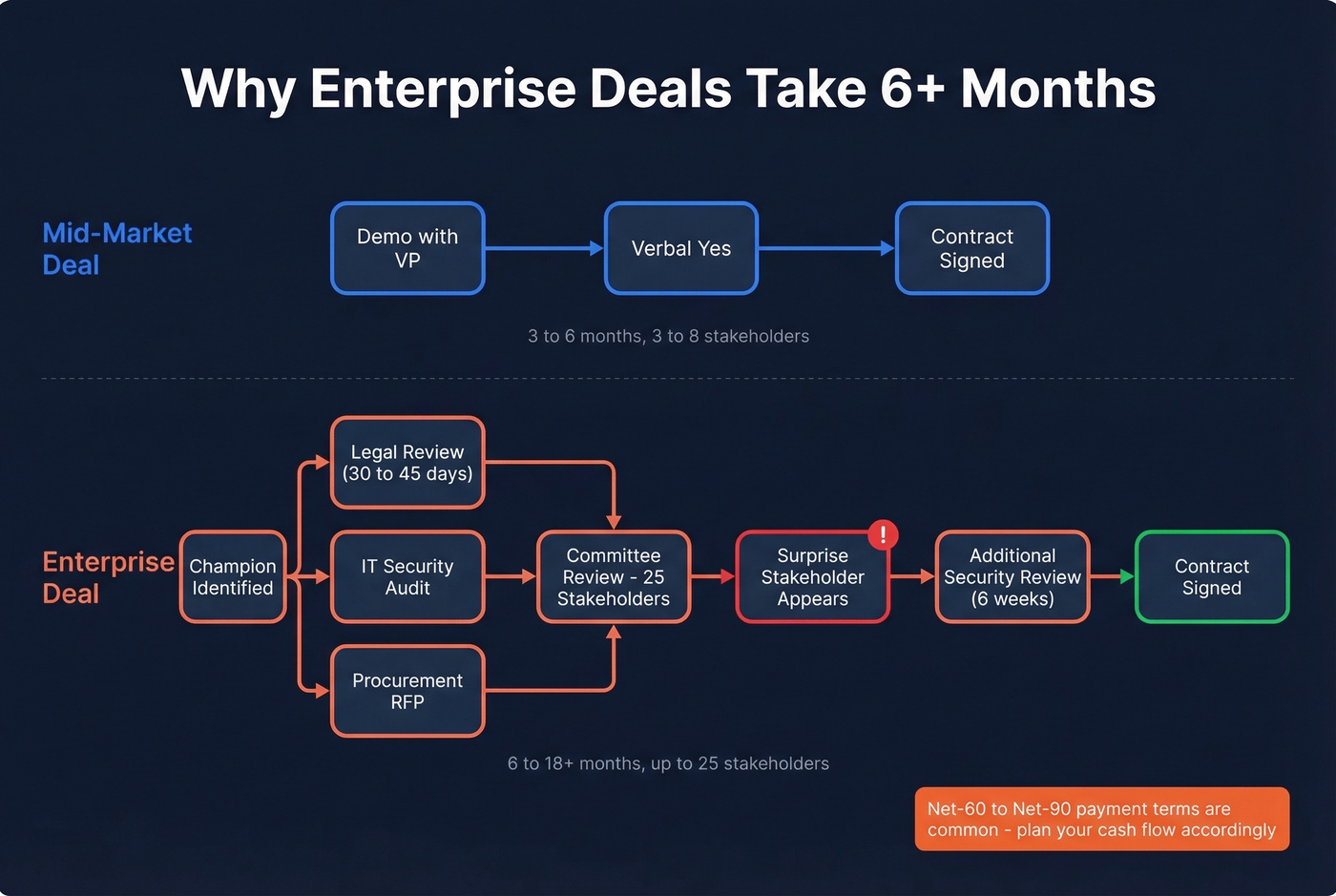
Buying committees have ballooned to roughly 25 stakeholders on average, up from 16 in 2017. That's not 25 people who all say yes - it's 25 people who can each say no. As one practitioner on Quora put it, the real difference isn't headcount; it's bigger contracts, longer cycles, deeper integration needs, and security requirements that multiply with every new geography.
Sales cycles stretch well past six months for large deals. Procurement, legal, and security reviews can add 30-45 days on top of whatever timeline you thought you had.
Payment terms get aggressive. Enterprise procurement teams negotiate hard on payment windows. Net-60 is common. Net-90 isn't unusual. Keurig Dr Pepper once issued an RFP with 360-day payment terms - that's a year of float your finance team needs to plan for.
Here's the thing: enterprise clients are lucrative and dangerous at the same time. If one account represents 30%+ of your revenue and their procurement team pushes Net-90 terms, a single delayed payment can crater your cash flow. Scope creep is the other killer - enterprise buyers expect custom integrations, dedicated support, and contract terms that slowly eat your margins. We've watched vendors celebrate a $500K deal and then spend the next 18 months underwater servicing it.
The "surprise stakeholder" is real, too. You've got verbal buy-in from your champion, the VP signed off, and then someone from IT security you've never met puts the deal on hold for a six-week review. We've seen this pattern derail timelines more than any other single factor in enterprise deals.
What Enterprise Clients Expect from Vendors
Enterprise buyers don't just evaluate your product. They evaluate your entire operation.
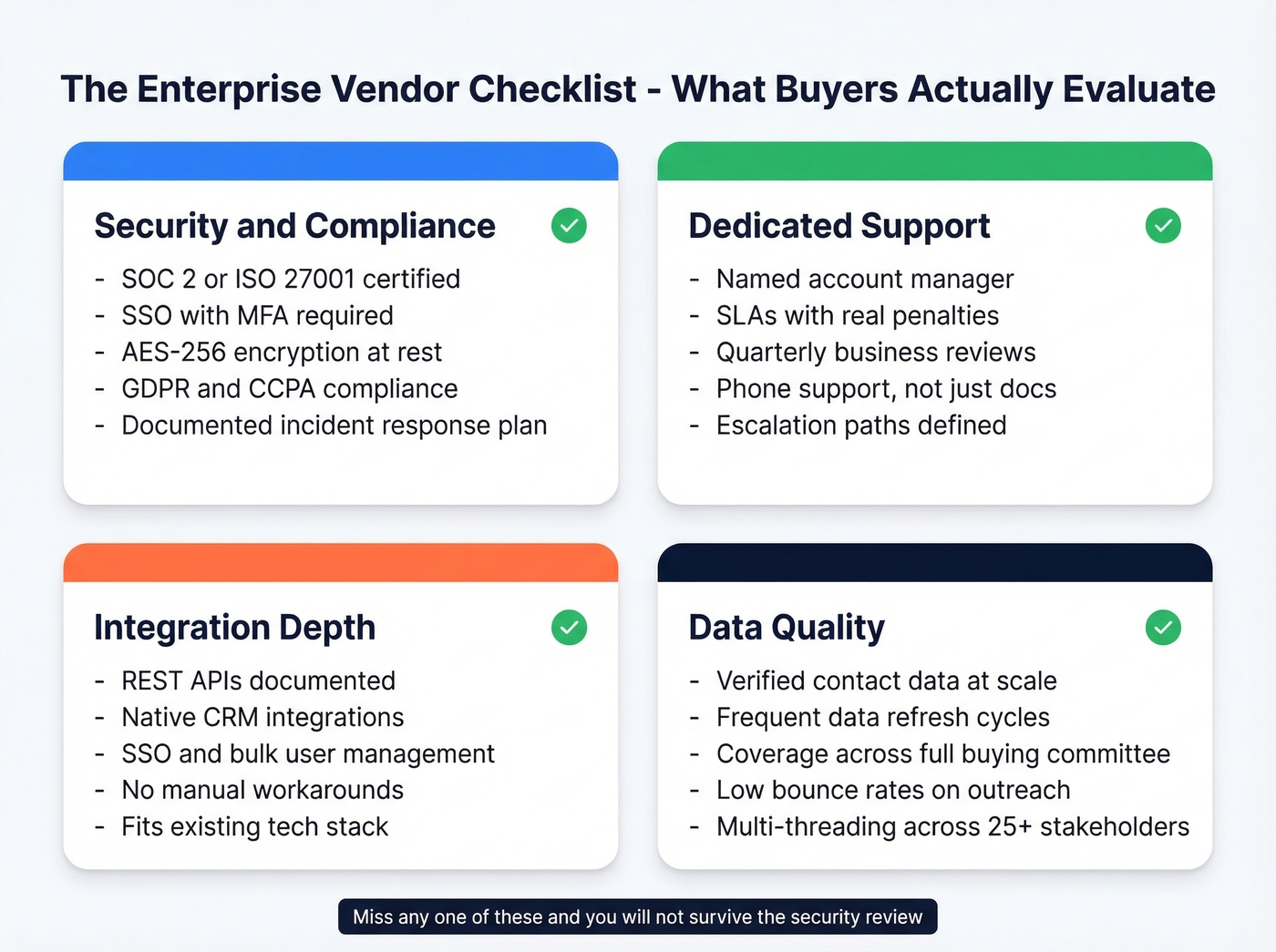
Security and compliance top the list. SOC 2 or ISO 27001 certification, SSO with MFA, AES-256 encryption at rest, TLS in transit, role-based access control, GDPR/CCPA compliance, and a documented incident response plan. Without these basics, you won't make it past the security review.
Dedicated support infrastructure matters just as much. Large organizations expect named account managers, SLAs with teeth, and quarterly business reviews. Self-serve documentation isn't enough - they want a human who picks up the phone. If you're building a repeatable cadence, keep a set of quarterly business reviews standards so enterprise accounts don't drift.
Integration depth is table stakes. APIs, SSO, bulk user management, and native CRM integrations aren't nice-to-haves. Enterprise tech stacks are complex, and your tool needs to fit without creating manual workarounds. (If you're tightening your process, a quick sales process optimization pass usually pays off fast.)
Data quality is where enterprise deals get unforgiving. When you're navigating a months-long cycle with 10+ stakeholders, a bounced email to the wrong VP isn't a minor inconvenience - it's a quarter lost. Large buying committees demand verified, fresh contact data. Tools like Prospeo address this with 98% email accuracy and a 7-day data refresh cycle, which matters when you're multi-threading across a massive buying committee and reaching the right person on the first attempt isn't optional. If you're evaluating vendors, compare data enrichment services and best B2B company data providers side by side.

Enterprise Sales Benchmarks in 2026
Here's where the numbers tell the real story.
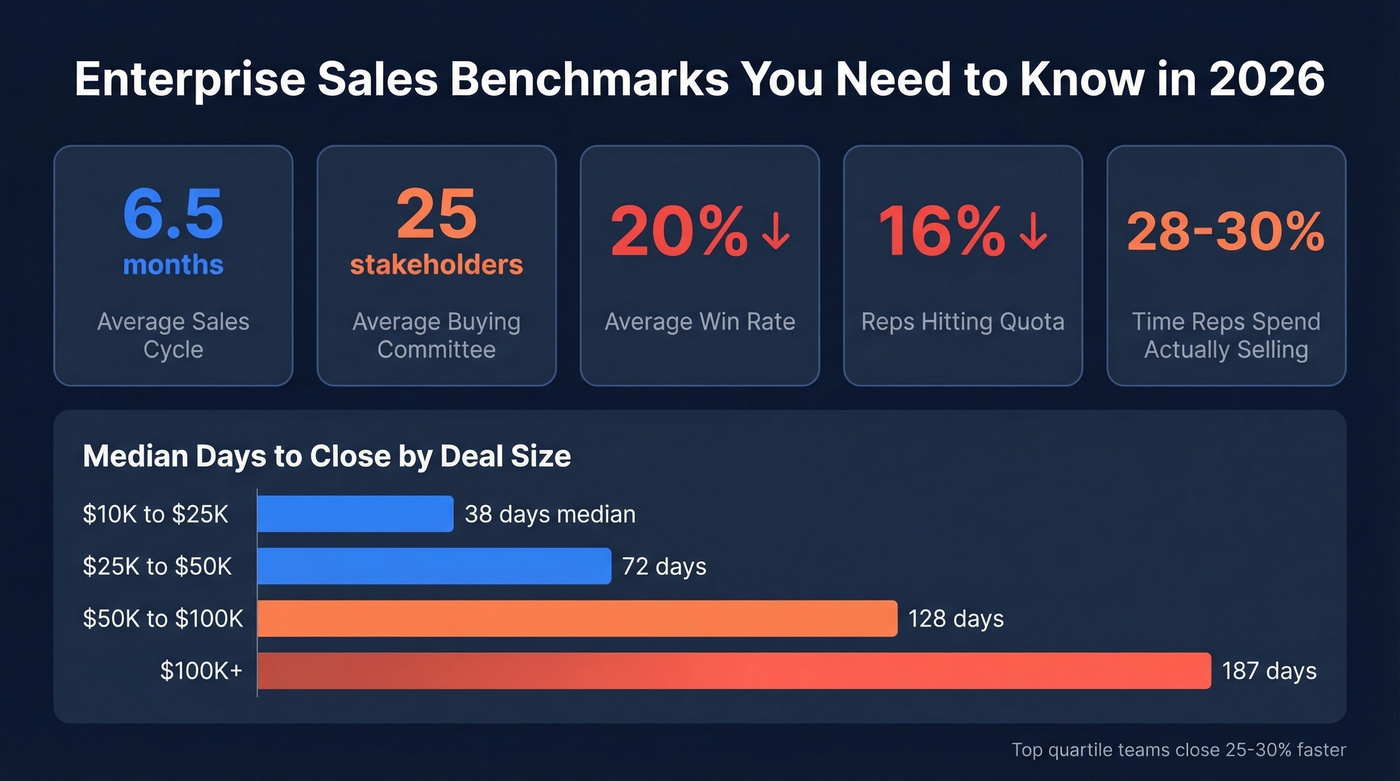
| Metric | Current Benchmark |
|---|---|
| Avg. sales cycle | 6.5 months |
| Buying committee | ~25 stakeholders |
| Win rate | 20-21% |
| Quota attainment | 16% of reps |
| Time spent selling | 28-30% |
And the deal-size breakdown that matters most for planning:
| ACV Band | Median Days | Top Quartile |
|---|---|---|
| $10-25K | 38 days | 26 days |
| $25-50K | 72 days | 51 days |
| $50-100K | 128 days | 94 days |
| $100K+ | 187 days | 142 days |
The numbers are sobering. Win rates hover around 20%. Reps spend less than a third of their time actually selling. The teams that win enterprise deals aren't necessarily the ones with the best pitch - they're the ones who identify and reach every stakeholder before a competitor does. Skip the "spray and pray" approach entirely; in our experience, enterprise wins come from surgical multi-threading with verified data, not volume. If you're building that motion, borrow from account-based selling best practices and tighten your sales prospecting techniques.
Moving upmarket means longer cycles, bigger committees, and zero tolerance for stale data. Prospeo gives you 300M+ profiles with 30+ filters - including headcount, revenue, funding, and buyer intent - so you can identify and reach enterprise accounts that actually match your ICP.
Find enterprise buyers with the filters that matter, starting at $0.01 per email.
FAQ
What's the difference between enterprise and mid-market?
Gartner's midsize band is roughly $50M-$1B revenue and 100-1,000 employees - enterprise starts above those thresholds. The real distinction is buying complexity: enterprise deals involve formal procurement, legal review, security audits, and committees reaching ~25 stakeholders. Mid-market deals close in 3-6 months with 3-8 decision makers.
How many employees make a company enterprise?
Common thresholds range from 1,000 to 5,000+ employees depending on who's defining it. Revenue and procurement complexity matter more than headcount alone - an 800-person company with formal procurement gates behaves more like enterprise than a 3,000-person firm where department heads buy independently.
Why does the enterprise client meaning vary between companies?
Every vendor draws the line based on their own sales motion and product pricing. NetSuite uses $200M+ revenue, Gong uses $500M+ or 1,500 employees, and some SaaS companies set the bar at 5,000+ seats. The safest universal test: if the buyer has a formal procurement department, treat it as enterprise.
What tools help you reach enterprise decision-makers?
Enterprise buying committees average ~25 stakeholders, so you need verified contact data at scale. Look for platforms offering high email accuracy, frequent data refreshes, and enough coverage to multi-thread across large accounts without bouncing off stale records.