

Your Enterprise Sales Pipeline Is Probably Fiction. Here's How to Fix It.
It's Thursday afternoon. The board deck is due Monday. Your CRO pulls up the enterprise pipeline report and sees $13.3M in open opportunities against a $3.5M quarterly target - a comfortable 3.8x coverage. Everyone exhales. Then someone asks how many of those deals have a confirmed economic buyer, and the room goes quiet.
Only 16% of reps hit quota, and reps spend barely 28-30% of their time actually selling. That's not a rounding error. It's a structural failure in how enterprise teams build, measure, and govern pipeline. The gap between what's in your CRM and what's actually going to close is where forecasts go to die.
The Three Things That Actually Matter
Enterprise pipeline management in 2026 comes down to three things:
- Weighted coverage math - not vanity totals. A raw 3.8x pipeline means nothing if 60% of it is stuck in early discovery.
- MEDDICC-enforced stage exit criteria - reps can't advance deals without documenting the economic buyer, decision process, and identified pain.
- Multi-threading across the full buying committee - because single-threaded deals die the moment your champion goes on PTO.
If your CRM lets reps drag deals forward without filling in these fields, your forecast is a guess dressed up in a Salesforce dashboard.
Enterprise Deals vs. Everything Else
Enterprise pipeline isn't just "bigger deals with longer cycles." It's a fundamentally different operating model. The buying committee is larger, the procurement gauntlet is real, and the coverage math changes completely.
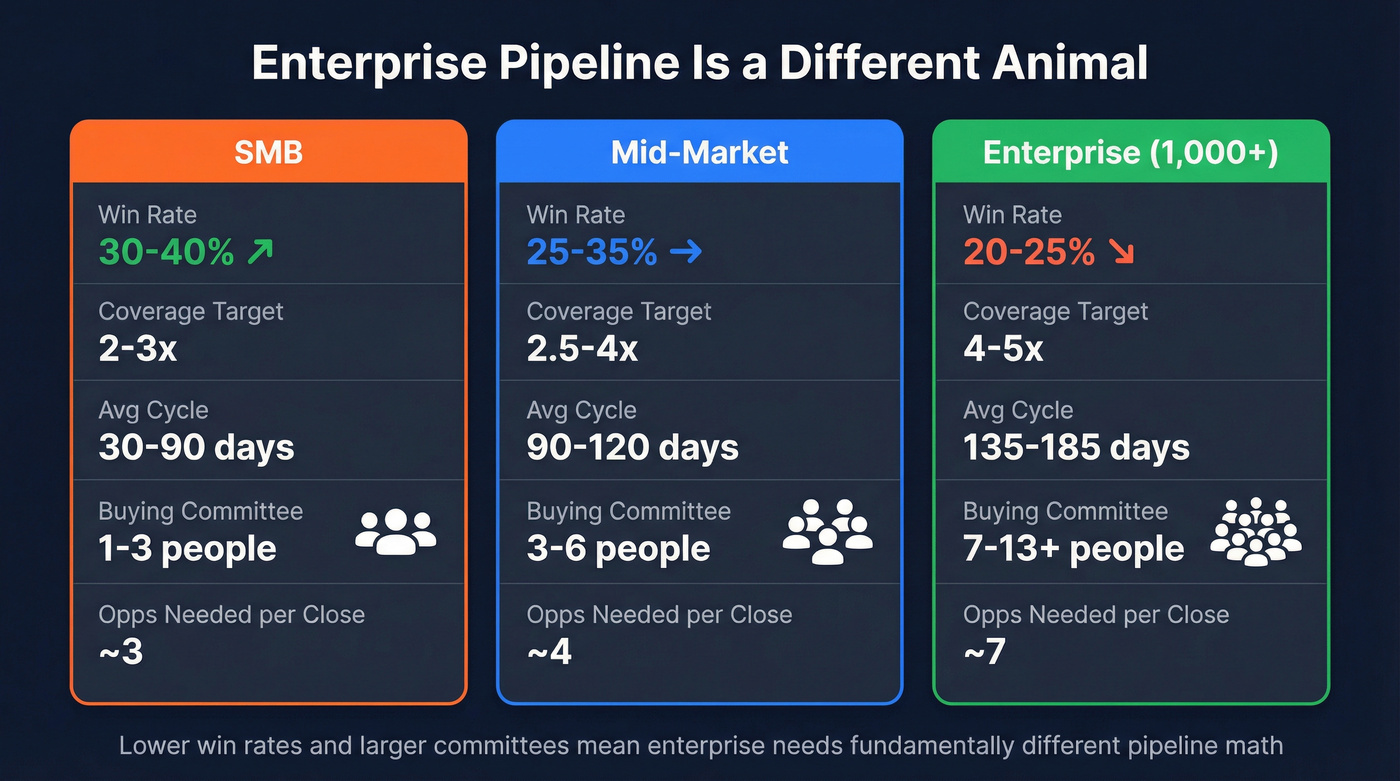
| Segment | Win Rate | Coverage Target | Avg Cycle | Buying Committee |
|---|---|---|---|---|
| Enterprise (1,000+) | 20-25% | 4-5x | 135-185 days | 7-13+ people |
| Mid-Market | 25-35% | 2.5-4x | 90-120 days | 3-6 people |
| SMB | 30-40% | 2-3x | 30-90 days | 1-3 people |
A 15% win rate means you need around seven qualified opportunities for every closed deal. That math cascades into everything - how many accounts you can realistically cover, how many reps you need, and how much pipe you have to generate every month just to stay flat.
Weighted Coverage Math That Works
Let's kill the vanity pipeline number. Total open opportunities multiplied by some gut-feel close rate isn't a forecast - it's a wish.
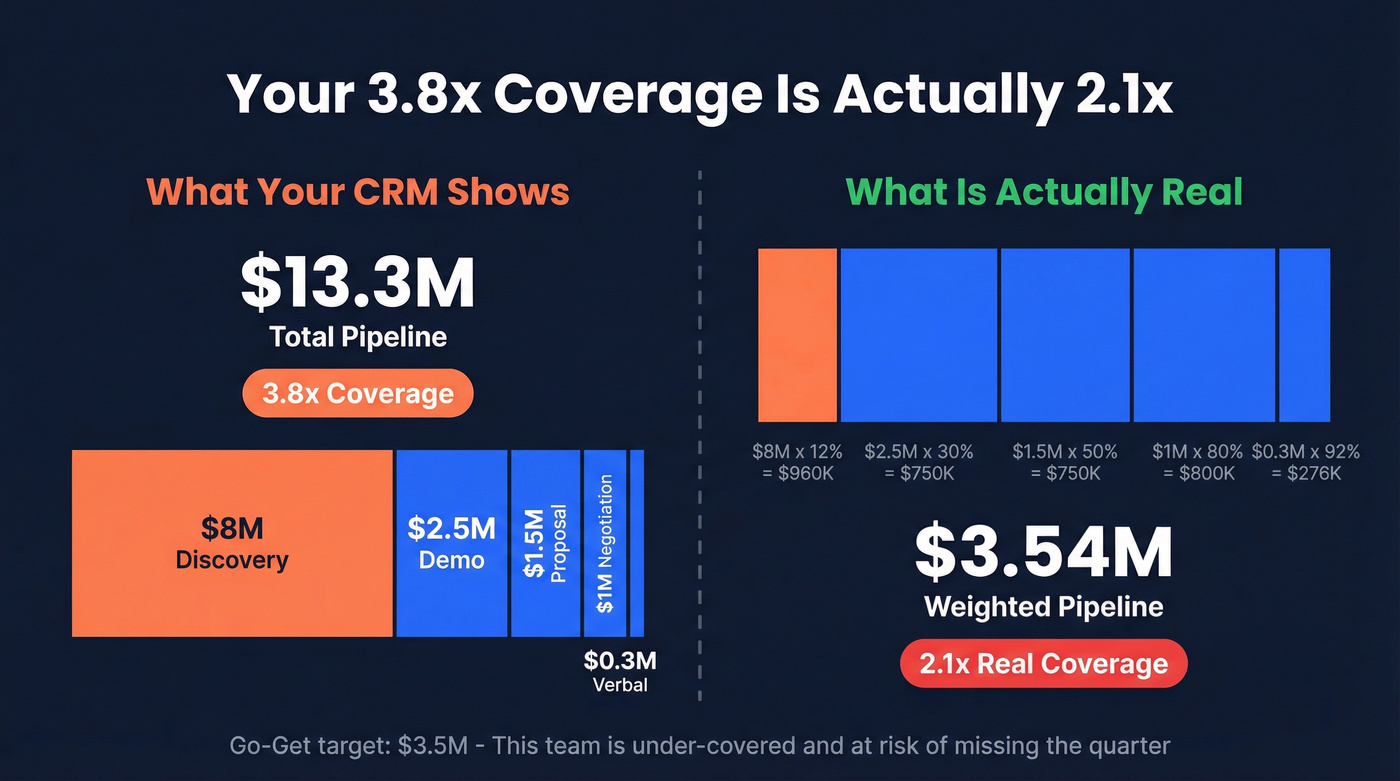
The formula that actually works: Coverage = Weighted Pipeline / Go-Get. "Go-Get" is your remaining revenue target for the period. Weighted pipeline applies a probability to each stage rather than treating a discovery call the same as a deal in contract review.
Common stage probability ranges:
| Stage | Probability |
|---|---|
| Discovery | 10-15% |
| Demo / Presentation | ~30% |
| Proposal / Quote | ~50% |
| Negotiation / Review | ~80% |
| Verbal Commit | 90-95% |
Now watch what happens. A team shows $13.3M in total pipeline against a $3.5M go-get - that's 3.8x. Looks comfortable. But when you weight it, $8M of that pipe is in Discovery at 10-15% probability. The weighted pipeline drops to around $7M, and your real coverage is closer to 2.1x. That's not comfortable. That's a problem.
We've seen this exact scenario play out at companies that looked healthy on paper and missed the quarter by 30%+. The weighted number doesn't lie.
Pipeline Stages That Actually Matter
Generic stages - Prospecting, Qualified, Proposal, Closed - are fine for SMB. Enterprise needs stages that map to how large organizations actually buy, which means procurement gates, security reviews, and legal redlines all get their own real estate.
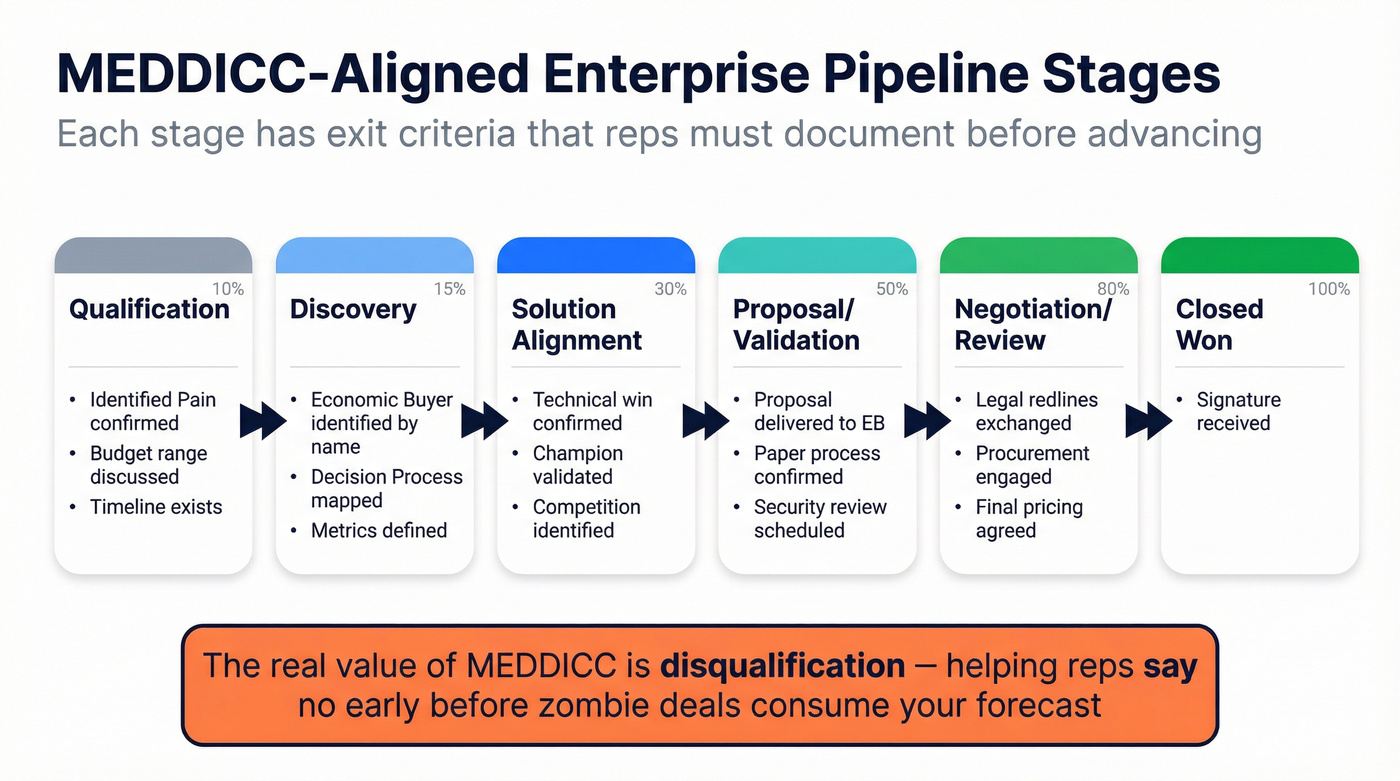
A MEDDICC-aligned stage model looks like this: Qualification, Discovery, Solution Alignment, Proposal/Validation, Negotiation/Review, Closed. Each stage needs explicit exit criteria enforced in your CRM. Validation rules in Salesforce can prevent reps from advancing an opportunity without documenting the economic buyer or confirming the decision process.
Here's the thing about MEDDICC: its real value isn't qualification - it's disqualification. The framework exists to help reps say "no" early, before a deal becomes a zombie consuming forecast credibility for three quarters. The common failure mode? Reps fill MEDDICC fields after calls based on guesses rather than confirmed buyer statements. That's how you end up with a CRM full of fiction.
For a $250K+ deal, expect 220 days or more from first contact to signature once you factor in security review, legal redline, and procurement. Build those gates into your stage model or watch deals "slip" every quarter. For comparison, Gong data shows the average $97K deal closes in about 69 days - proof that cycle length scales non-linearly with deal size.

MEDDICC stages mean nothing if your reps can't reach the full buying committee. Prospeo maps 300M+ verified profiles across 11-13 stakeholder roles per enterprise deal - with 98% email accuracy and 125M+ verified mobiles. One team dropped bounce rates from 35% to under 5% and grew AE-sourced pipeline 180%.
Stop filling your CRM with fiction. Fill it with verified buyers.
Building Enterprise Pipeline in 2026
The market has shifted. Reps on r/sales report increased radio silence and late-stage ghosting - prospects who were engaged through three demos suddenly go dark when procurement gets involved. Activity-based pipeline generation (blast 500 emails, book 20 meetings, hope for 3 opps) doesn't work when buying committees reach 11-13+ people and cycles stretch past six months.
Most enterprise teams don't have a pipeline problem - they have a timing problem. They reach the right accounts too early or too late. Signal-based generation fixes this by starting with account tiering and intent signals rather than spray-and-pray volume.

Your top 10-15 accounts get weekly internal reviews. The next 20-30 get bi-weekly reviews. Everything else is triggered by intent signals or job changes. For each Tier 1 account, you need verified contact data across the entire buying committee - not just the VP who took the first call. When you're mapping 11-13 stakeholders per deal, bad data compounds fast. One team we worked with ran this play using Prospeo across 50 AEs: bounce rates dropped from 35-40% to under 5%, and AE-sourced pipeline jumped 180%. That's what happens when reps stop wasting cycles on dead emails and disconnected numbers.
It takes roughly 5 touches to get a first response and 8-9 to generate an opportunity. If you average 8-9 touches per stakeholder across a 13-person committee, that's 100+ touchpoints per deal. You can't afford even 10% of those bouncing.
At 8-9 touches across a 13-person buying committee, a single enterprise deal requires 100+ touchpoints. Even 10% bouncing kills your pipeline math. Prospeo's 7-day data refresh and proprietary email verification keep every contact current - at $0.01 per email, not $1.
Your weighted coverage ratio starts with contacts that actually connect.
Multi-Threading Without Carpet-Bombing
The average B2B buying decision involves 11+ people. Top-performing reps - the ones at 150%+ quota - are 13% more likely to multi-thread than their peers. For enterprise, this isn't optional. One director goes on parental leave, one champion gets reorged, and your single-threaded deal is dead.
Build your champion first, then earn warm introductions to the economic buyer and technical evaluators. Tailor messaging by persona: the CISO cares about compliance, the CFO cares about ROI, the end users care about workflow disruption. Use three types of multi-threading - relationship across different stakeholders, channel across email, phone, and events, and content with case studies for execs and technical docs for evaluators.
If you’re still building your account plan, start with account tiering and a clear ideal customer profile.
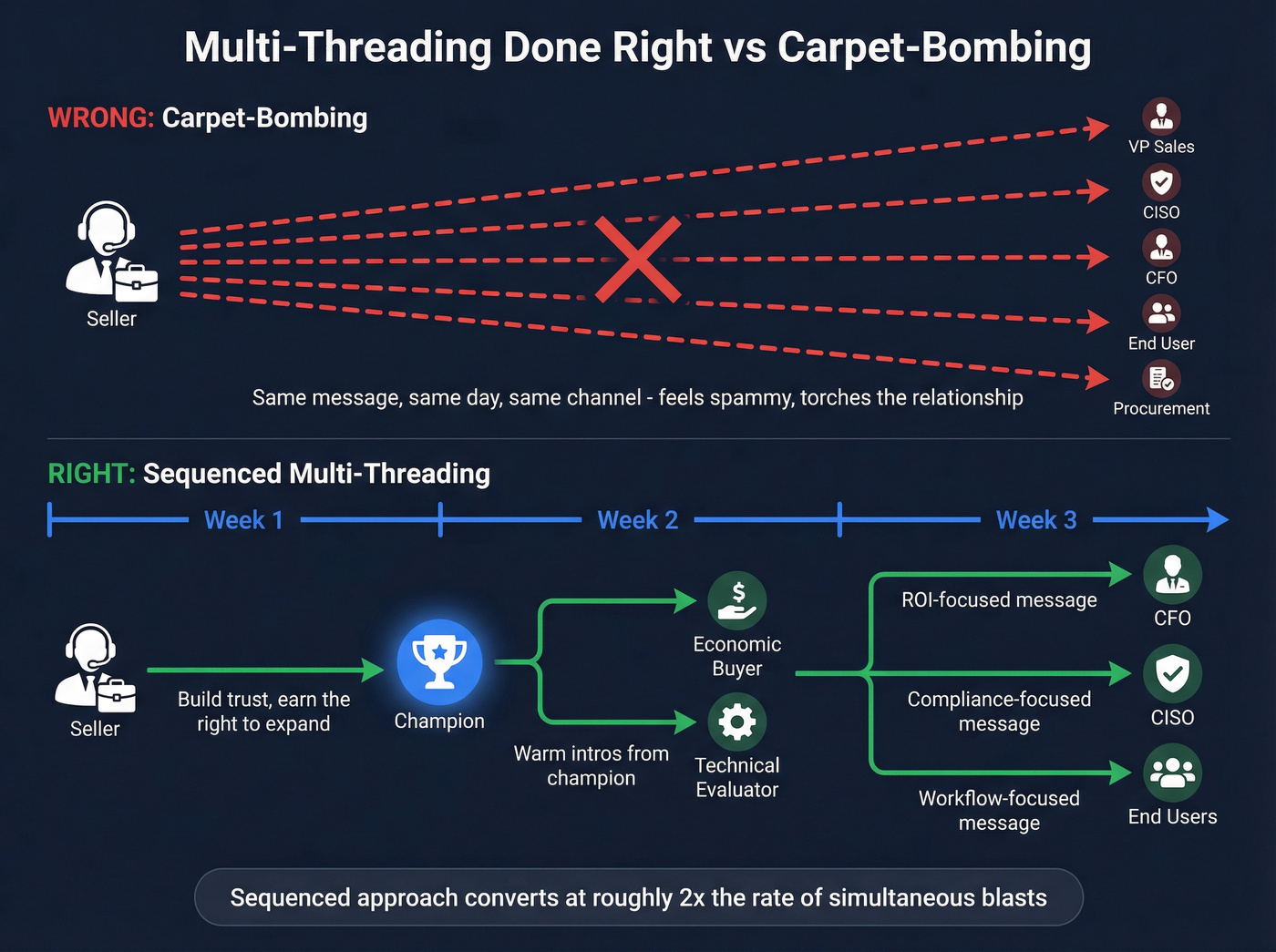
What doesn't work: blasting five people at the same account on the same day with the same message. That's not multi-threading - that's carpet-bombing. Reps on Reddit worry that reaching out to multiple stakeholders feels spammy, and they're right to worry. The fix is sequencing. Start with your champion, earn the right to expand, then stagger outreach to adjacent stakeholders over 2-3 weeks. In our experience, this sequenced approach converts at roughly double the rate of simultaneous blasts - and it doesn't torch the relationship.
Mutual Action Plans Close More
Deals with mutual action plans close at a 26% higher win rate than those without. Yet only 45% of sellers use them consistently. For enterprise deals where 77% of buyers say purchasing is "too complex", a MAP is the single best artifact you can create to keep momentum.
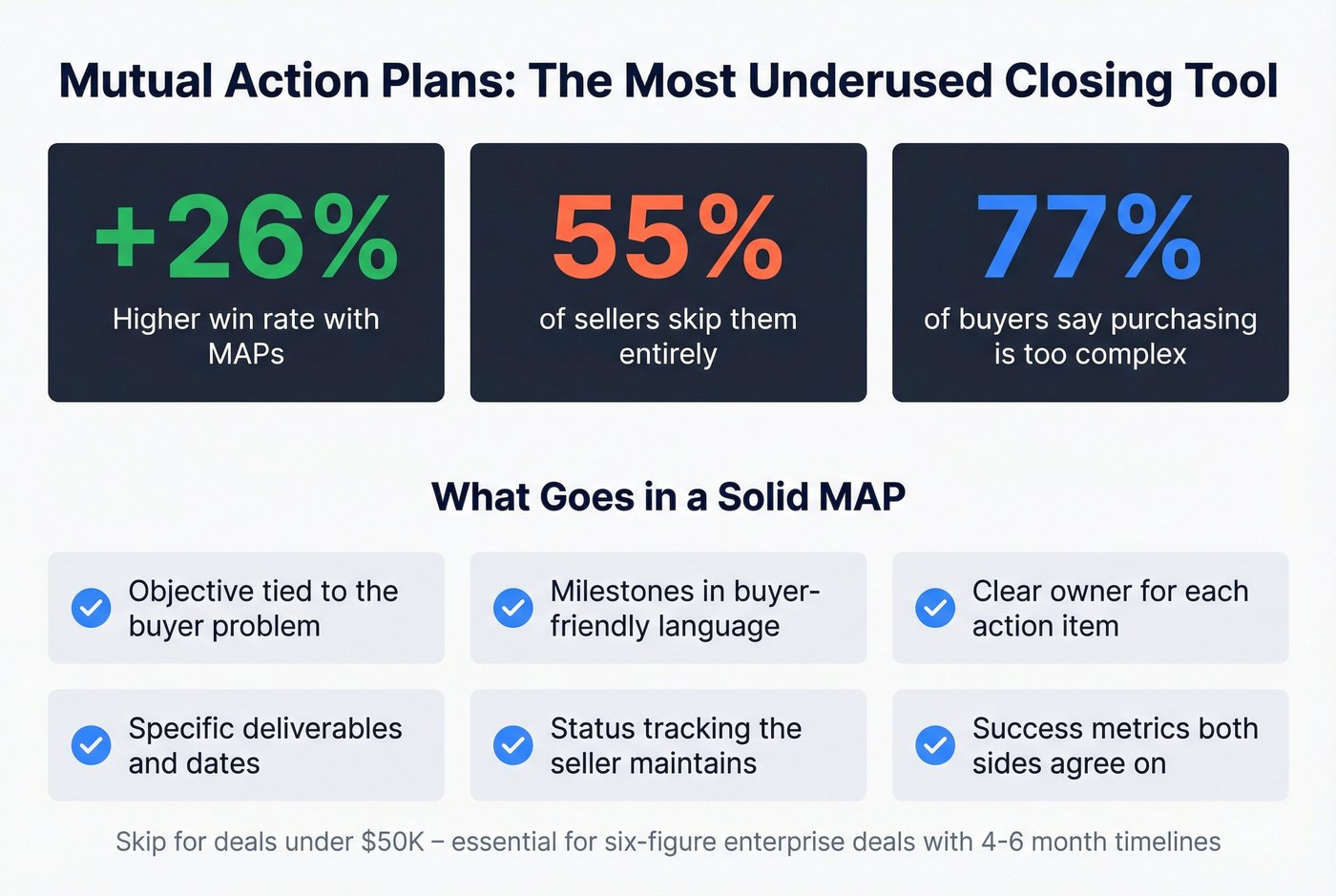
A solid MAP needs six sections: an objective tied to the buyer's problem, milestones in buyer-friendly language, an owner for each action, deliverables, status tracking, and success metrics. The seller should do most of the upkeep - reducing buyer workload is the whole point. Skip this if your deals are under $50K with short cycles; the overhead isn't worth it. But for six-figure enterprise deals with 4-6 month timelines, not having a MAP is malpractice.
Running Pipeline Reviews
Cancel your teamwide pipeline review. Seriously. It's a status meeting disguised as coaching, and everyone knows it.
Run 1:1s instead, 30 minutes max, focused on five things: qualification gaps in the top 5 deals, weighted coverage against go-get, buyer-committed next steps with actual dates, forecast accuracy for any deal that's slipped more than once, and what the rep is doing this week to advance their biggest opportunity.
If a deal hasn't advanced in 30 days and has no dated next step, it's not a deal. Move it out or kill it. We've found the 30-day anti-stall rule is the single most effective hygiene practice - it forces honest conversations before zombie deals metastasize across the forecast. Diagnose your pipeline shape too: top-heavy means you need to accelerate mid-funnel; bottom-heavy means your generation engine is stalling. For investor-facing reviews, add lead source, buying unit, and closed-lost reasons to your standard fields.
If you want a tighter operating cadence, align reviews to pipeline health and standardize your sales operations metrics.
Pipeline Hygiene
A frustrating amount of enterprise pipeline turns into zombie deals that nobody wants to kill because "the prospect said they'd circle back after Q2 planning." The fix is simple but painful.
Any opportunity inactive for 45-60 days gets removed - no exceptions. Coverage above 5x is a bloat signal, not a strength signal. CRM governance makes this stick: validation rules prevent stage advancement without required fields, and stage lockback policies stop reps from dragging deals backward to reset aging clocks. If your CRM doesn't enforce the process, the process doesn't exist.
To keep outbound from polluting your CRM, use data enrichment and monitor email bounce rate as a leading indicator.
FAQ
What pipeline coverage ratio should enterprise teams target?
Most enterprise teams need 4-5x weighted coverage given 15-20% win rates. Below 2x weighted is a red flag requiring immediate generation activity. Above 5x often signals zombie deals inflating the number rather than genuine strength.
How long does an enterprise sales cycle take?
$50-100K deals average roughly 120 days. $100-250K deals run about 170 days. $500K+ deals stretch to 270 days or more. Organizations with 10,001+ employees average 185 days from first touch to close.
What's the difference between a pipeline and a funnel?
A pipeline tracks individual deals through stages - your view as a seller managing specific opportunities. A funnel measures conversion rates across stages - your view as a manager analyzing aggregate performance. Pipeline is deal-level; funnel is the statistical pattern across all deals.
How many stakeholders sit on an enterprise buying committee?
Forrester puts it at 13. Gartner says 6-8. Plan for at least 6-8 and multi-thread accordingly. Single-threading into a committee of that size is how deals die quietly - one champion departure kills the opportunity.
What tools help build an enterprise sales pipeline?
A CRM like Salesforce or HubSpot for deal management, a verified B2B data platform like Prospeo for contact discovery across buying committees, and a sales engagement tool like Outreach or Salesloft for sequenced outreach. Layer in intent data to prioritize accounts showing active buying signals.