

How to Build an Enterprise Sales Playbook That Reps Actually Use
Three $200K deals slipped last quarter. The VP of Sales pulled the pipeline review, and every one stalled at the same stage - no economic buyer identified, no mutual timeline, no champion. The enterprise sales playbook sitting in the shared drive? Nobody opened it after onboarding week.
That's not a discipline problem. It's a design problem. Reps spend roughly 30% of their time actually selling, and only 43.5% hit quota. If your playbook adoption sits below 20%, you don't have a playbook. You have a PDF.
Start Here If You're Building Your First
If you're assembling your first enterprise playbook, start with three things:
- A MEDDPICC qualification checklist tied to your CRM fields
- Stage exit criteria for every pipeline stage - no exceptions
- A mutual action plan template you co-create with the buyer
Build one-page play cards, not a 50-page PDF. Five plays covering 80% of your deals is the right starting point. Everything else - battlecards, persona deep-dives, competitive matrices - you add once reps are actually using the core. This holds whether you're assembling a SaaS sales playbook for a growth-stage company or a bootstrapped startup with zero dedicated enablement headcount.
What a Sales Playbook Actually Is
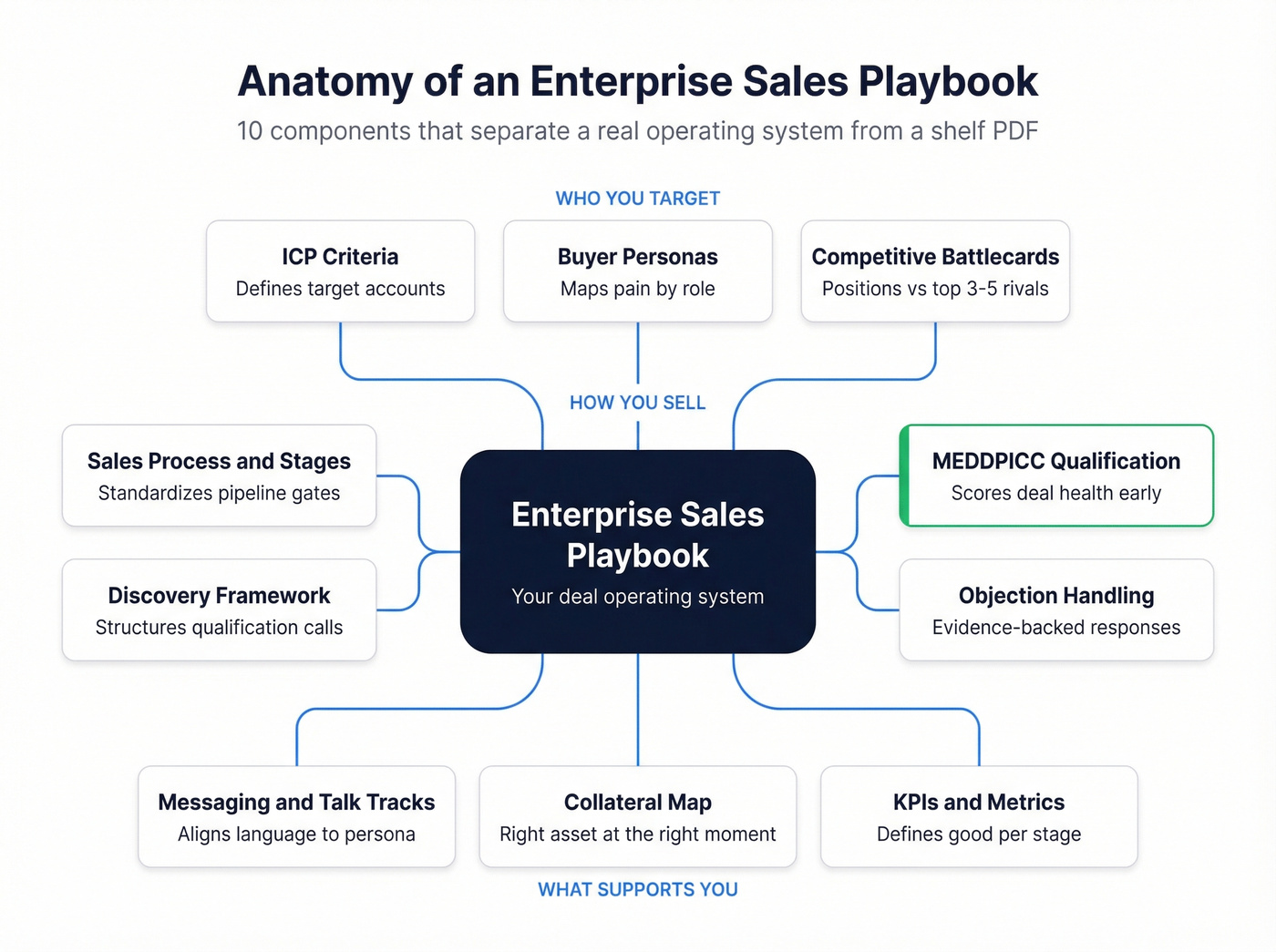
A playbook isn't a strategy doc. It's an operating system for how your team runs deals. Salesforce defines it as a guide covering personas, strategies, and role-specific plays - but the key word is operating. It lives in the workflow, not on a shelf.
A play is a specific scenario with steps, like "competitive displacement targeting CFOs at mid-market fintechs." A playbook is the collection of all plays plus your ICP definition, process, frameworks, and tools.
Here's the thing: enterprise deals now involve 7-10 decision-makers on average, and up to 13 in complex deals. 74% of buying groups experience unhealthy internal conflict. Without that complexity baked in, you've built a script for two-call deals, not enterprise ones. An inside sales playbook designed for transactional velocity won't survive the multi-stakeholder gauntlet - you need frameworks built for longer cycles and bigger committees.
Core Components
| Component | What It Does |
|---|---|
| ICP criteria | Defines target accounts |
| Buyer personas | Maps pain by role |
| Sales process/stages | Standardizes pipeline gates |
| Discovery framework | Structures qualification calls |
| Qualification (MEDDPICC) | Scores deal health early |
| Objection handling | Evidence-backed responses |
| Competitive battlecards | Positions vs. top 3-5 rivals |
| Messaging/talk tracks | Aligns language to persona |
| Collateral map | Right asset, right moment |
| KPIs and metrics | Defines "good" per stage |

Multi-threading 18-20 stakeholders per deal means you need verified contact data for every one of them. Prospeo gives you 300M+ profiles with 98% email accuracy and 125M+ verified mobile numbers - so your reps actually reach the economic buyer, not a dead inbox.
Stop losing six-figure deals to bad contact data.
Frameworks That Drive Results
MEDDPICC isn't the only framework. SPIN Selling was validated across 35,000+ sales calls, and the Challenger Sale was studied across 6,000 reps - both have merit. But MEDDPICC maps cleanest to CRM-enforced stage gates, and it's the one we recommend starting with.
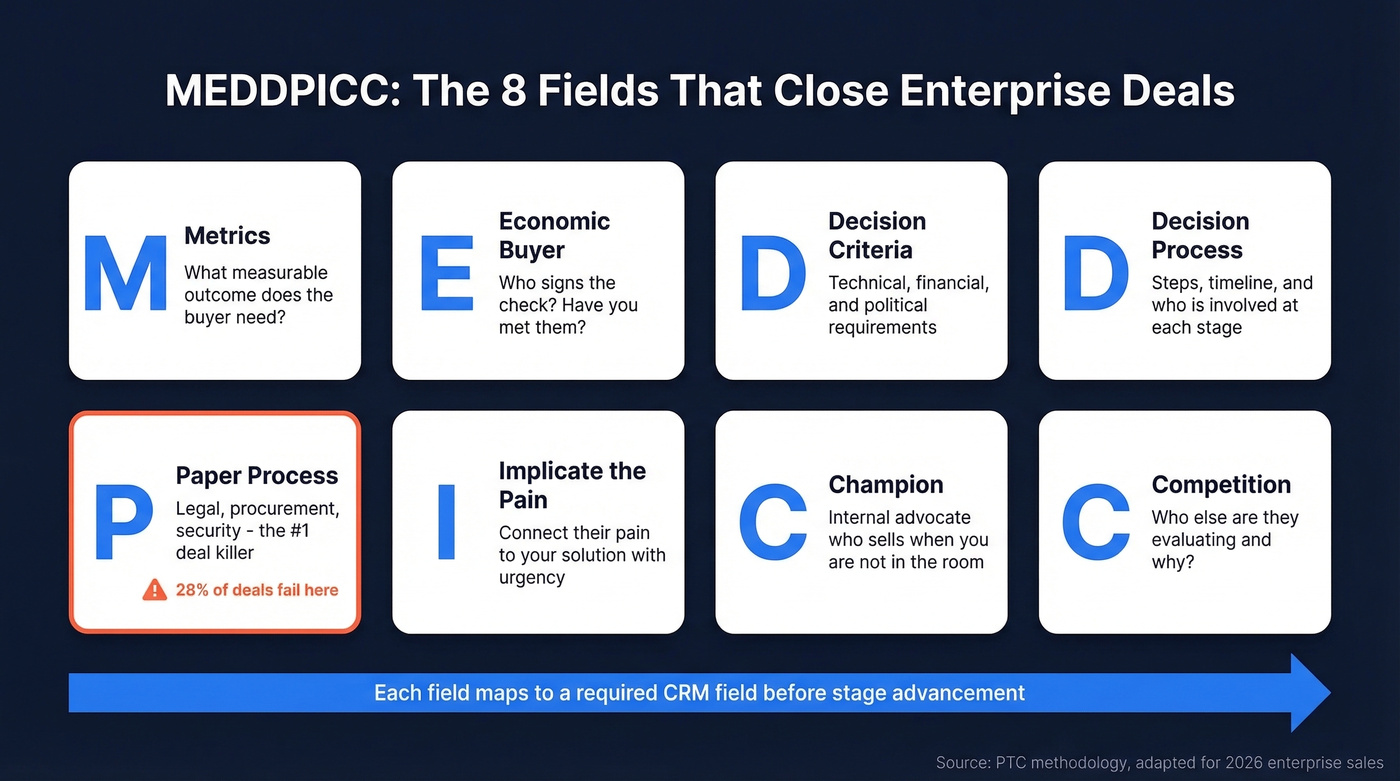
MEDDPICC Qualification
56% of sellers' time is wasted on unqualified, low-potential leads. That's the problem MEDDPICC solves. The framework originated at PTC in 1996, where it helped drive revenue from $300M to $1B in four years. Full adoption correlates with 18% higher win rates and 24% larger deal sizes.
The letters: Metrics, Economic Buyer, Decision Criteria, Decision Process, Paper Process, Implicate the Pain, Champion, Competition. Every one maps to a CRM field your reps fill before advancing a deal.
Paper Process is the one most teams skip, and it's the #1 reason deals slip quarters. Legal review, procurement workflows, security questionnaires - 28% of deals fail when buyers can't secure internal approval. If you don't know the paper process by Stage 3, you're forecasting on hope.
Mutual Action Plans
Use a MAP when the deal is above $50K, involves multiple stakeholders, or has a hard go-live date. The template structure from Outreach: objective, milestones, owners on both sides, deliverables, status. Skip a MAP when the deal is transactional, single-threaded, or under $25K - forcing one on a two-call close just adds friction.
Deals with MAPs show a 26% higher win rate. But the real signal is buyer willingness. If a prospect won't collaborate on a shared timeline, that tells you everything about their commitment level.
Multi-Threading Strategy
Single-threaded enterprise deals die. Period.
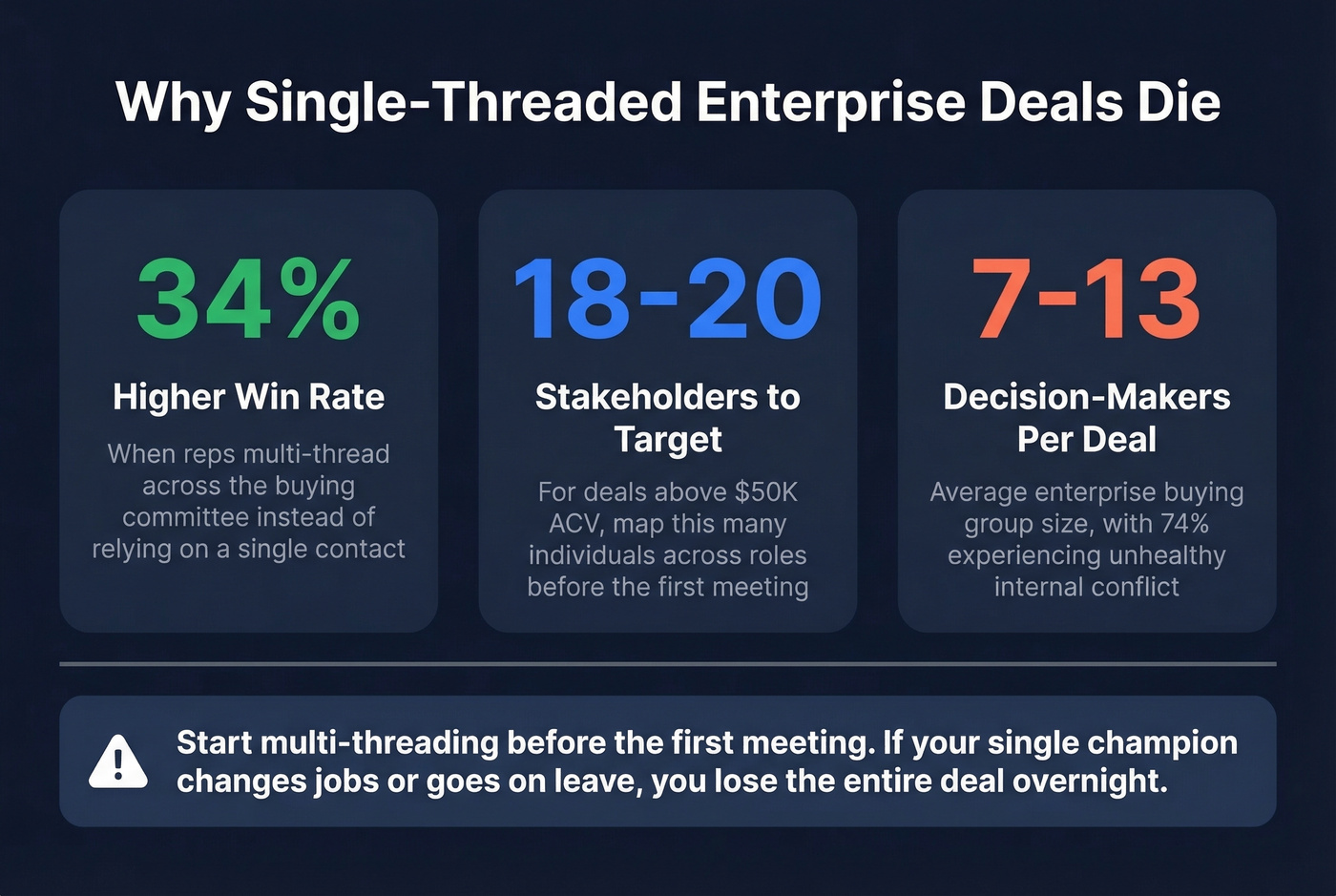
Multi-threading delivers a 34% lift in win rates. For accounts above $50K ACV, target 18-20 individuals across roles. Map the hierarchy of influence early, keep messaging 1:1 per stakeholder, and start multi-threading before the first meeting - not after your single champion goes on parental leave. We've seen teams lose six-figure deals overnight because their one contact changed jobs, and there was nobody else in the account who even knew the evaluation was happening.
Enterprise Cycle Benchmarks
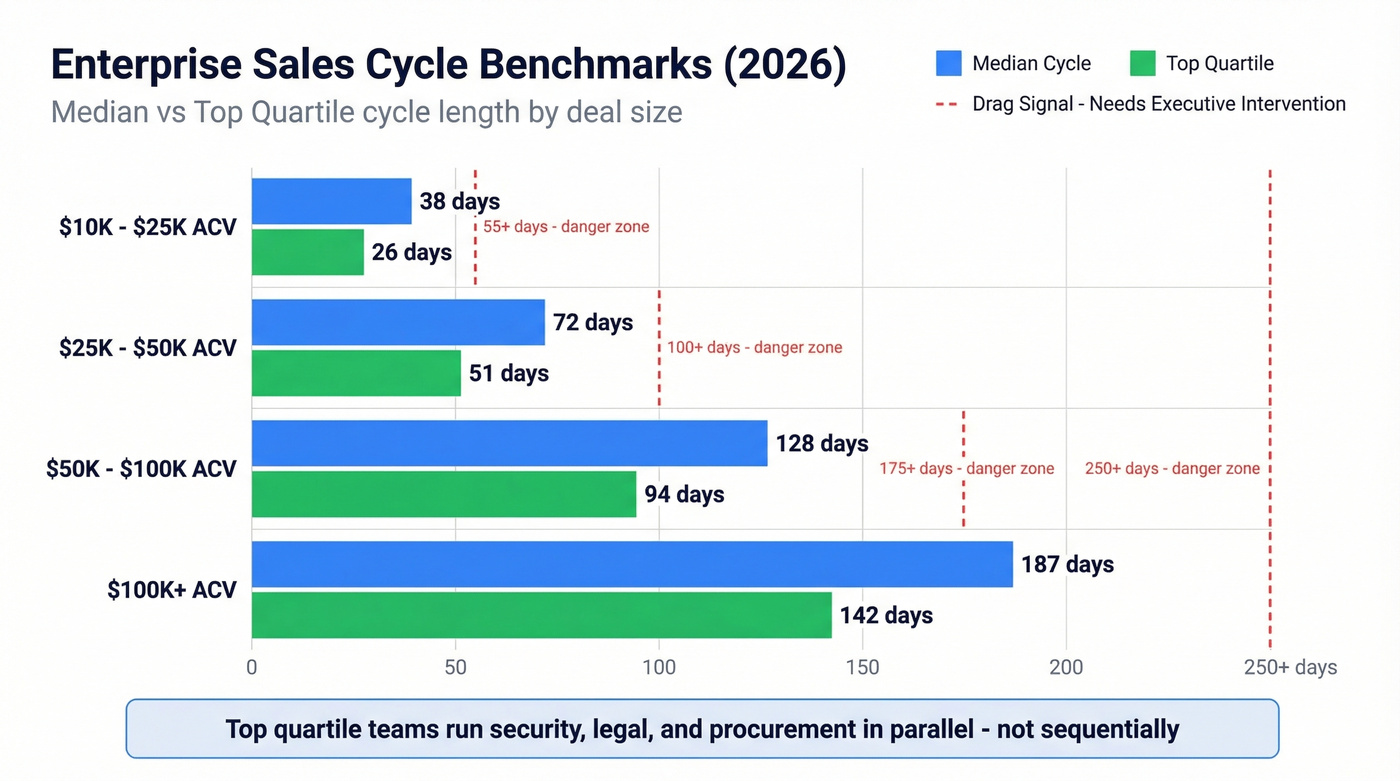
Calibrate your stage durations against these 2026 benchmarks:
| ACV Band | Median Cycle | Top Quartile | Drag Signal |
|---|---|---|---|
| $10K-$25K | 38 days | 26 days | >55 days |
| $25K-$50K | 72 days | 51 days | >100 days |
| $50K-$100K | 128 days | 94 days | >175 days |
| >$100K | 187 days | 142 days | >250 days |
The "drag signal" column is your early warning system. If a $75K deal hits day 175, it's in the danger zone and at minimum needs executive intervention.
Top-quartile teams don't wait for sequential approvals. They start security questionnaires in parallel with business validation and run legal review alongside procurement. That parallel execution is what separates a 94-day close from a 175-day slog - and it's something you can only orchestrate when your playbook explicitly maps which workstreams run concurrently.
Your Minimum Viable Tool Stack
You need four categories covered, not fifteen tools.

CRM. Salesforce or HubSpot. Expect roughly $25-$300+/user/month depending on edition and add-ons. If your playbook isn't reflected in your CRM stages and required fields, it doesn't exist. (If you need a quick refresher on examples of a CRM, start there.)
Conversation intelligence. Gong or comparable. Roughly $100+/user/month depending on package. Teams ramp faster when winning call recordings are searchable and tied to deal stages.
Contact data. Your playbook breaks when half your phone numbers are dead and emails bounce at 15%+. This is where we've seen the biggest ROI gap - a team can have perfect MEDDPICC discipline and still lose deals because they can't reach the economic buyer. Prospeo handles this with 98% email accuracy, 125M+ verified mobile numbers at a 30% pickup rate, and a 7-day data refresh cycle. At roughly $0.01 per email with no contracts, the data quality layer determines whether your multi-threading strategy actually reaches the buying committee. (If you're evaluating vendors, compare data enrichment services and best B2B company data options.) Snyk's team of 50 AEs saw bounce rates drop from 35-40% to under 5% and AE-sourced pipeline jump 180% after fixing their data layer.
Enablement. Highspot or Showpad typically run $30-$100+/user/month. Only add this once you've nailed adoption on the core three.
Rolling Out Without Shelfware
Start with five plays covering 80% of your deals. Build them as one-page reference cards - the format matters more than the content volume. Adding persona-specific question banks drove a 23% increase in qualified opportunities. Enforcing stage exit criteria produced a 30% reduction in stalled deals.
One sales leader on Reddit put it bluntly - senior management kept pushing "a playbook for every channel" while the actual sellers felt success came from consistent qualification, not more documentation. Another founder described paying $10,000/month for six months to a consulting firm that produced nothing usable. That's $60K better spent on tooling and a RevOps hire who knows your deals.
Let's be honest: if your deals close under $50K, you don't need a playbook platform, a consultant, or an enablement tool. You need five play cards in a shared doc, MEDDPICC fields required in your CRM, and a weekly deal review where managers coach on real calls. That's it. The teams that hit 70%+ adoption built plays from their own closed-won data, not from a template someone downloaded off the internet. If you're running lean with no enablement headcount, this is especially critical - every dollar spent on a consultant is a dollar not spent on pipeline.
The Rollout That Works
- Week 1-2: Build five play cards from your last 20 closed-won deals
- Week 3: Embed MEDDPICC fields as required in your CRM stages
- Week 4: Run a 90-minute workshop where reps practice with real pipeline deals; automate call summaries and research briefs to cut admin time around 20%
- Monthly: Review adoption metrics, targeting 70%+ field completion
- Quarterly: Update plays based on win/loss data and assign a playbook owner who isn't carrying a quota - someone in RevOps or enablement who keeps it current
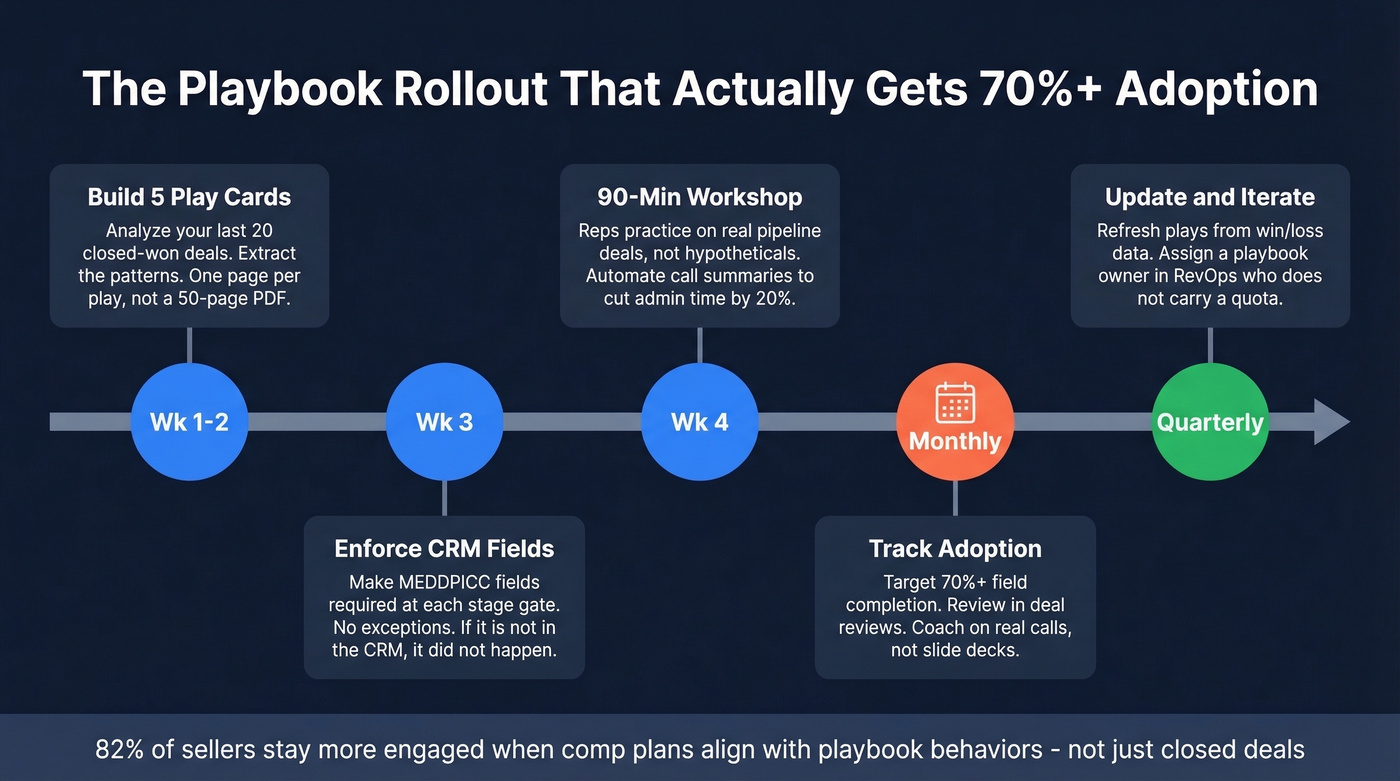
Align comp plans to playbook behaviors. 82% of sellers say incentives tied to outcomes beyond just closing keep them more engaged. If reps get rewarded for filling MEDDPICC fields and building MAPs, they'll do it. This is doubly true for remote teams, where managers can't walk the floor - comp alignment and CRM enforcement become your primary levers for accountability. (To tighten the operating cadence, track pipeline health and standardize sales operations metrics.)
Your playbook maps the process. Your CRM enforces the stages. But none of it matters if reps spend hours hunting for contact info instead of selling. Prospeo's Chrome extension and CRM enrichment return 50+ data points per contact at a 92% match rate - so MEDDPICC fields get filled, not skipped.
Give your reps the data layer your playbook is missing.
FAQ
How long should an enterprise sales playbook be?
One-page play cards per scenario, not a 50-page PDF nobody reads. Start with five plays covering 80% of your deals. Expand only when reps request more - that pull signal means they're actually using the core.
What's the difference between a play and a playbook?
A play is a specific scenario with defined steps - for example, "competitive displacement targeting CFOs at Series C fintechs." A playbook is the full collection of plays plus your ICP definition, sales process, qualification framework, and tool stack. Think of plays as chapters and the playbook as the book.
What tools do you need to execute an enterprise sales playbook?
A CRM for pipeline management, a conversation intelligence tool for coaching, and a verified contact data platform for accurate emails and direct dials. Enablement platforms and intent tools are optional until you've nailed adoption on those three fundamentals.
How do you get reps to actually use the playbook?
Tie comp plans to playbook behaviors - MEDDPICC field completion, MAP creation, multi-threading depth. Teams that enforce required CRM fields at stage gates see 70%+ adoption. Build plays from your own closed-won data, not generic templates, so reps recognize the scenarios as real.