

Enterprise Sales Prospecting: The 2026 Playbook
Enterprise sales prospecting used to be "find the VP, send a sequence, book a disco." That's how you get ignored now. Buyers punish irrelevant outreach fast, and they're doing most of the evaluation without you.
The good news: prospecting into large accounts is very learnable. It's just a different game than SMB - one that rewards depth, not volume. We call this the Depth-First Method, and it's the backbone of everything below.
What Changed in 2026
Gartner found that 61% of B2B buyers prefer a rep-free buying experience, and 73% actively avoid suppliers that send irrelevant outreach. That's not "they didn't like your subject line." That's a mental blocklist.
Meanwhile, buyers define requirements 83% of the time before talking to sales, and 94% now use LLMs during the buying process. Your messaging competes with AI-generated category summaries, not just other vendors. Salesforce's latest State of Sales report paints a bleak picture: 84% of reps missed quota in the last year. When quota attainment drops, teams tend to spray and pray.
Enterprise punishes that harder than any other segment.
The Depth-First Method
Three principles drive everything in this playbook:
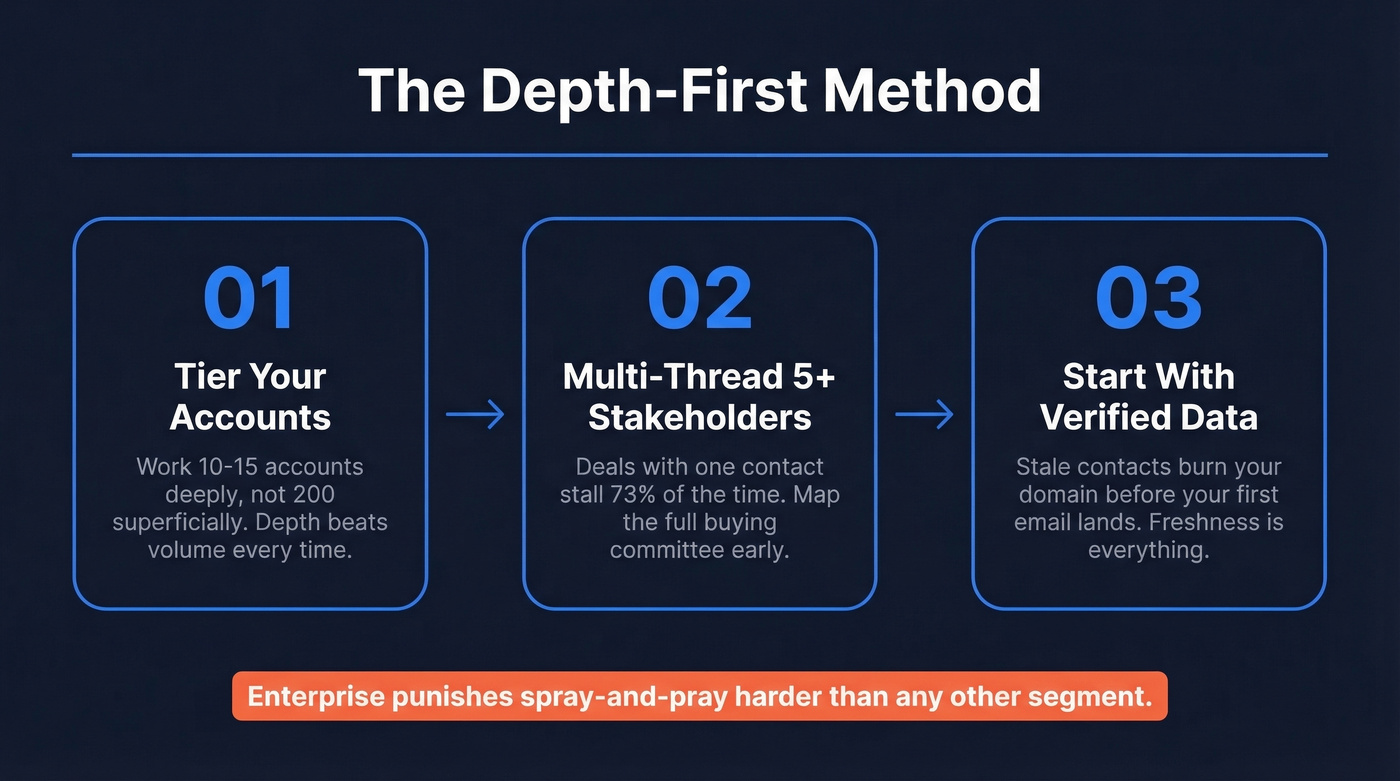
- Tier your accounts and work 10-15 deeply, not 200 superficially.
- Multi-thread into 5+ stakeholders per account - deals with one contact stall 73% of the time.
- Start with verified data - stale contacts burn your domain before your first email lands.

You just read that 2-3 hours of enterprise account research is wasted when contacts are stale. Prospeo refreshes 300M+ profiles every 7 days - not every 6 weeks - so the buying committee you mapped last Monday is still reachable on Friday. 98% email accuracy means your multi-threaded cadence actually lands.
Stop burning domain reputation on data that expired before you hit send.
The Full Prospecting Playbook
Build and Tier Your Account List
Most enterprise teams don't have a prospecting problem. They have a prioritization problem, and it starts with finding leads that actually match your ICP - not just adding logos to a spreadsheet.
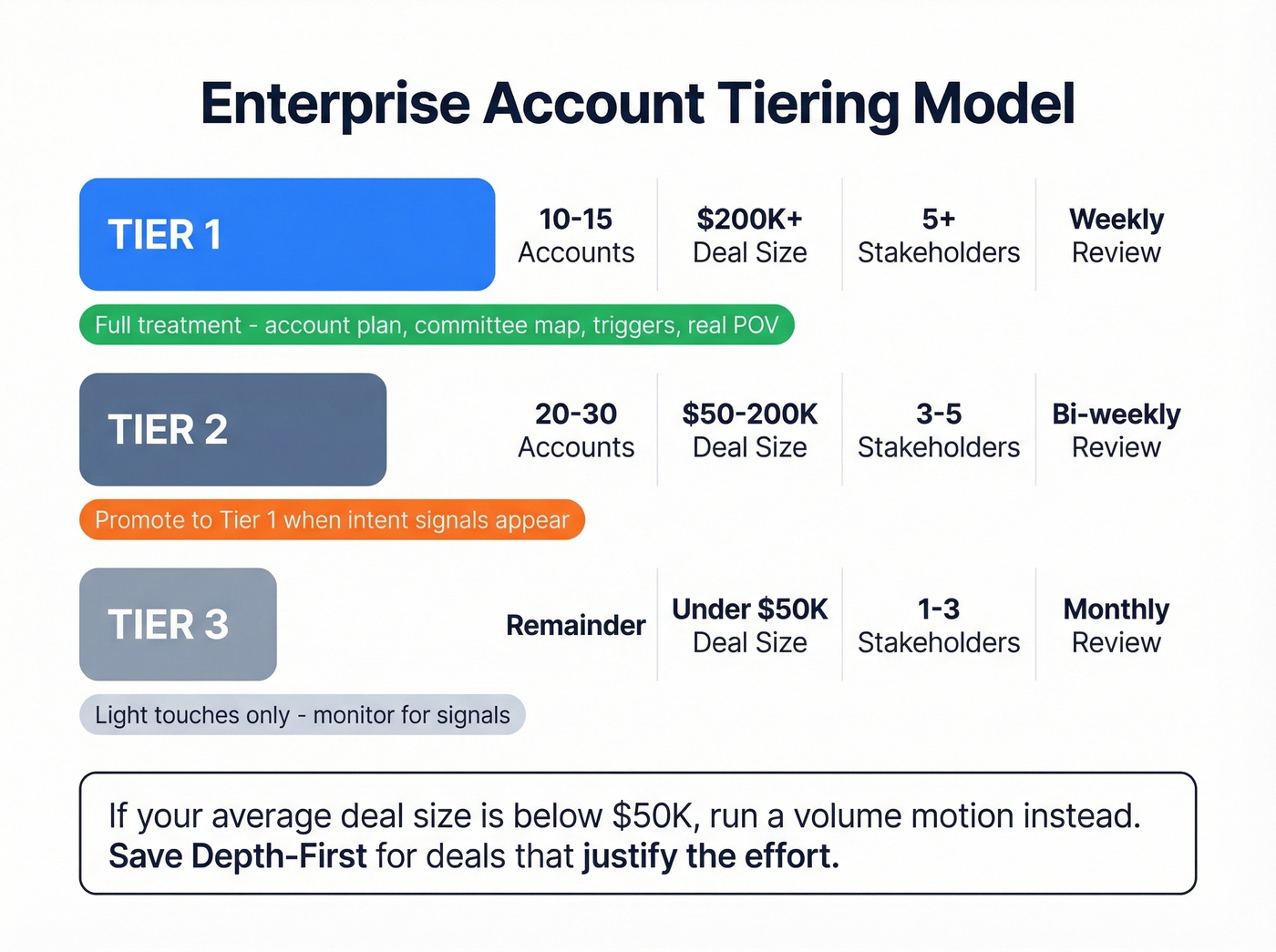
Stop adding accounts. Top reps work 10-15 deeply because enterprise deals are won in the whitespace between stakeholders, not in your "accounts touched" dashboard.
| Tier | # Accounts | Deal Potential | Stakeholders | Review Cadence |
|---|---|---|---|---|
| Tier 1 | 10-15 | $200K+ | 5+ | Weekly |
| Tier 2 | 20-30 | $50-200K | 3-5 | Bi-weekly |
| Tier 3 | Remainder | <$50K | 1-3 | Monthly |
Tier 1 gets the full treatment: account plan, buying committee map, triggers, and a real POV. Tier 3 gets light touches and only gets promoted when intent signals show up.
Here's the thing: if your average deal size sits below $50K, you probably don't need this playbook. Run a volume motion and save the Depth-First Method for the deals that actually justify the effort.
Research Deep, Not Wide
Enterprise research is expensive - 2-3 hours per account across multiple sources just to get a usable brief. Focus on three buckets:
- Org structure - who owns the outcome, the systems, and the budget.
- Tech stack + constraints - what they run today, what's brittle, what's sacred.
- Triggers - hiring, reorgs, new execs, security events, product launches, regional expansion.
Stale data turns those 2-3 hours into trash. You can write a perfect email to someone who left 4 months ago and still "feel productive" while your domain reputation quietly dies. We've seen teams lose weeks of pipeline this way. Prospeo runs a 7-day refresh cycle with 98% email accuracy, so the contacts you research are the contacts you can actually reach.

Map the Buying Committee
Enterprise deals are committee-based. The average buying committee includes 11-13 stakeholders, and that matches real pipelines we've reviewed: the bigger the deal, the more invisible influencers show up late.
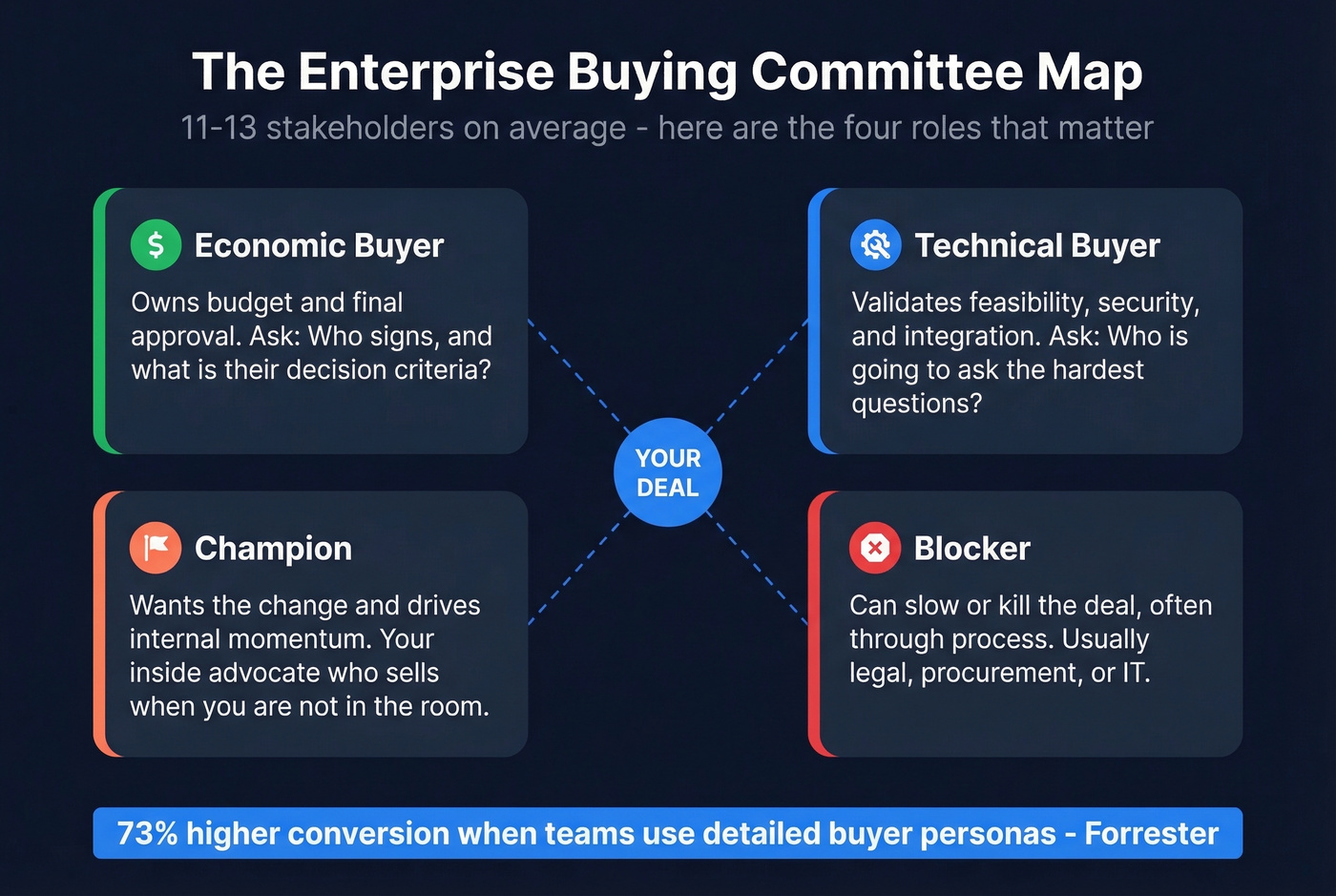
Use a simple role model (roles, not titles):
- Economic Buyer - owns budget and final approval.
- Technical Buyer - validates feasibility, security, integration.
- Champion - wants the change and drives internal momentum.
- Blocker - can slow or kill the deal, often through process.
Three questions that unlock the map: "Who else will be involved before this can be approved?" Then: "Who's going to ask the hardest questions?" And finally: "Who signs, and what's their decision criteria?"
Forrester data shows teams using detailed buyer personas see 73% higher conversion from response to MQL. That lift is the difference between "nice email" and "this is for me."
Multi-Thread or Lose
Multi-threading isn't optional in enterprise. It's the whole job.
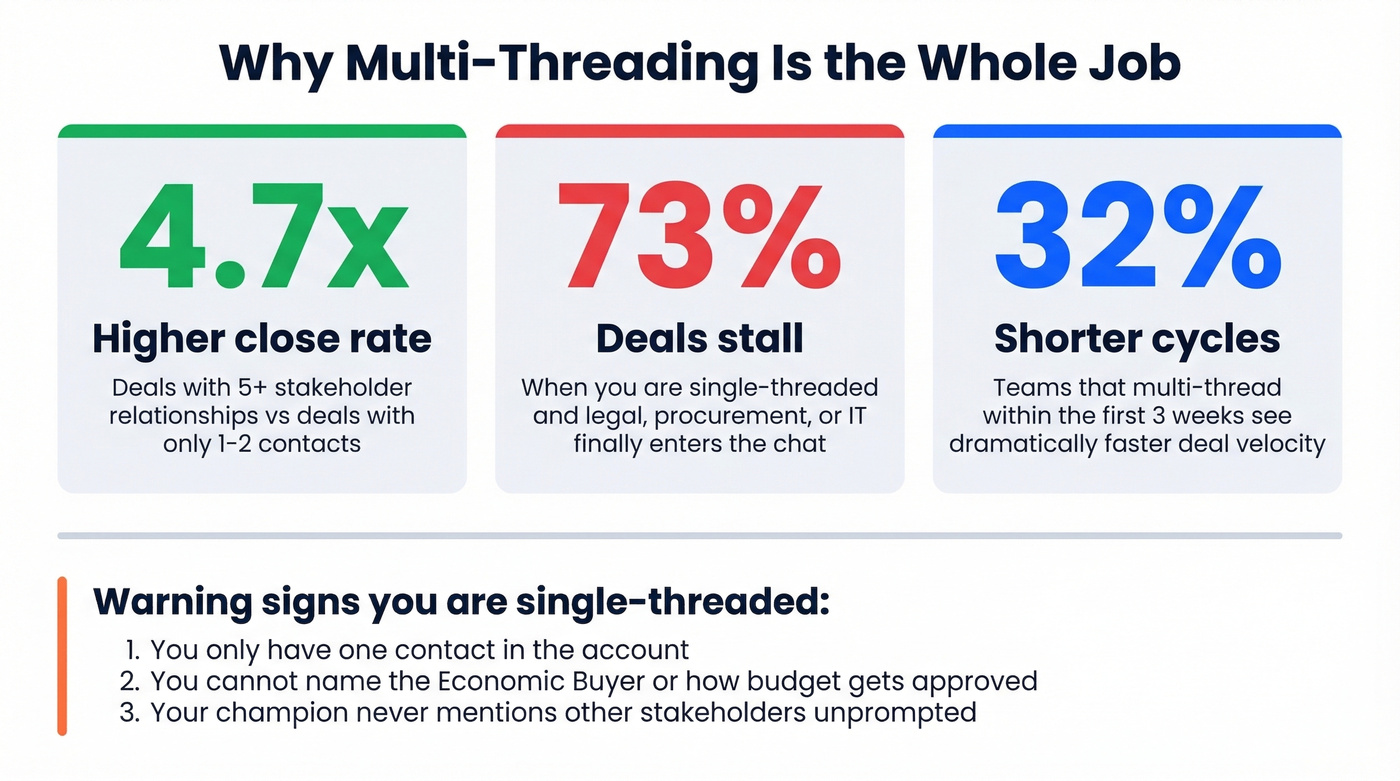
Deals with 5+ stakeholder relationships close at 4.7x the rate of deals with only 1-2 contacts. When you're single-threaded, 73% of deals stall - usually when legal, procurement, or IT finally enters the chat. Teams that multi-thread within the first 3 weeks see 32% shorter cycles.
I've run pipeline reviews where the forecast looked healthy until we asked one question: "Name the Economic Buyer." Half the deals evaporated on the spot.
Warning signs you're single-threaded:
- You only have one contact in the account.
- You can't name the Economic Buyer or how budget gets approved.
- Your champion never mentions other stakeholders unprompted.
Don't "multi-thread" by adding random people who can say no but can't say yes. That's how you create a bigger firing squad. Closed-won deals involve about 3x the people of lost deals - but the right people.
Two tactics that work in practice. First, go sideways: if your contact won't share their boss, approach adjacent departments that touch the project. You're not going over their head; you're building the map. Second, the champion trade - a tactic Al Zia Pervaiz at Cognism advocates - where you offer your champion something concrete like competitive intel, a stakeholder list, or a procurement heads-up in exchange for an intro to the decision-maker. It's a fair trade that respects their internal politics.
Craft Your Outreach Cadence
Enterprise outreach is a cadence problem, not a copywriting problem. Outreach data shows it takes 5 touches on average to engage a prospect, and reaching executives often requires ~9 touches compared to ~4 for lower-level contacts. If you're sending three emails and calling it "a sequence," you're quitting early.
Two rules keep teams honest. Opportunities closed within 50 days win at 47%; after 50 days, win rate drops to 20% or lower. And personalization that's actually relevant - not "Congrats on the Series B" but "You're hiring 12 security engineers in EMEA while running tool X, which usually creates problem Y" - drives a 29% open-rate lift.
Let's be honest about the AI-SDR trend: 45% of teams now run hybrid AI-SDR models. That only works when the underlying contact data isn't garbage. Automation amplifies whatever you feed it.
If you want more tactical patterns, borrow from these sales prospecting techniques and adapt them to a depth-first motion.
Three Mistakes That Kill Enterprise Deals
1. Targeting too many accounts. You can't build conviction across a buying committee when you're context-switching across 120 logos. Enterprise prospecting is closer to account management than lead gen.
2. Focusing on leads, not buying groups. Forrester keynote data shows buying-group focus can drive a 200% win-rate increase. One excited director doesn't equal an opportunity.
3. Sales/marketing misalignment. When marketing runs "ABM" as impressions and sales runs "ABM" as cold outbound, you get two disconnected stories in the same account. Buyers feel that immediately, and the consensus on r/sales is that this misalignment is the number-one reason enterprise ABM programs fail to deliver pipeline.
Your Enterprise Prospecting Stack
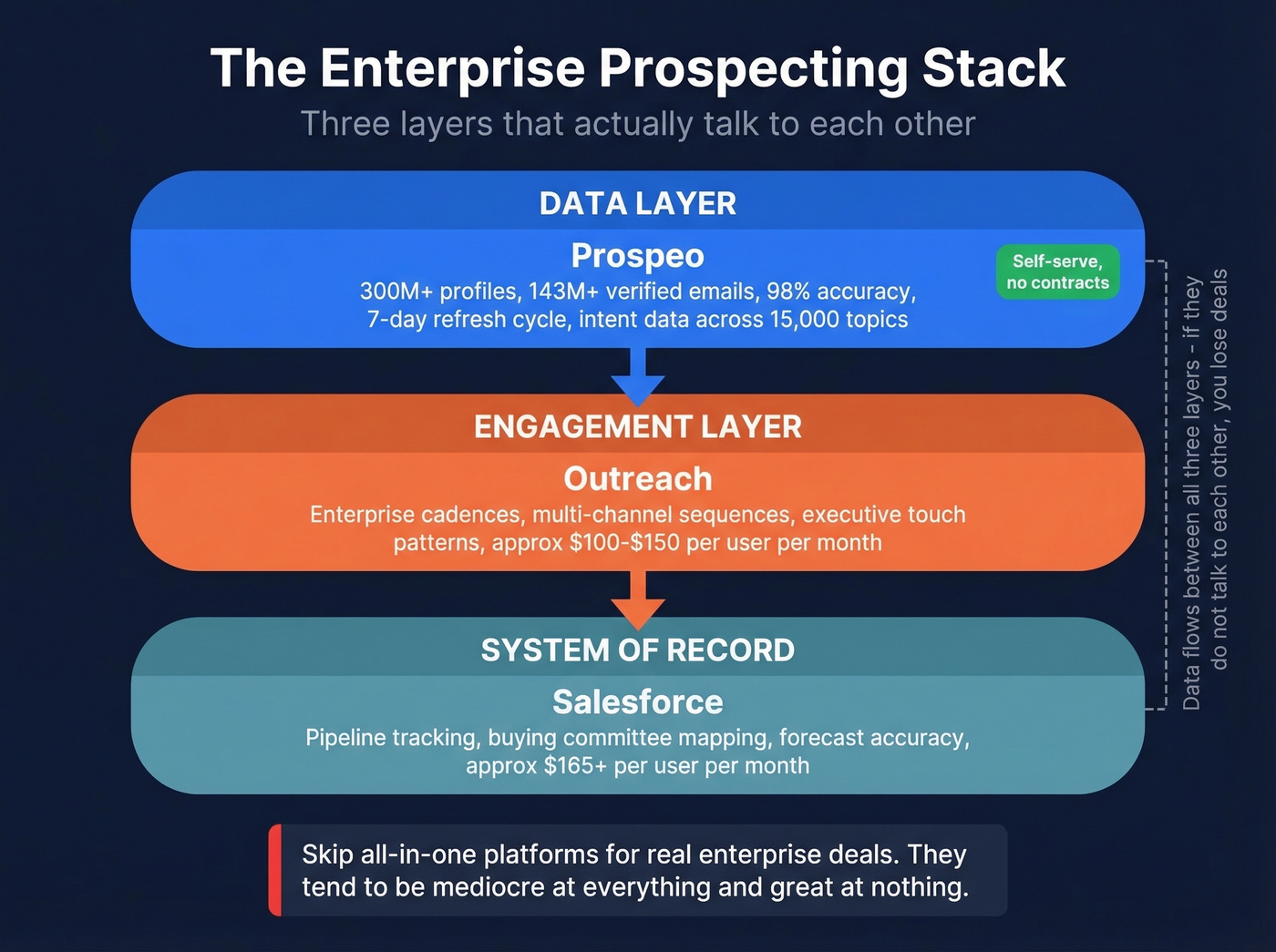
You need three layers that actually talk to each other: data, engagement, and system of record.
| Layer | What It Does | Recommended | Pricing Signal |
|---|---|---|---|
| Engagement | Cadences | Outreach | ~$100-$150/user/mo |
| CRM | System of record | Salesforce | ~$165/user/mo+ |
For the data layer, Prospeo gives you 300M+ profiles and 143M+ verified emails with 98% accuracy, all refreshed every 7 days. It also includes intent data across 15,000 Bombora topics - exactly what you need to decide which Tier 2 accounts deserve Tier 1 effort. Compared to ZoomInfo, which starts around $15K+/year and climbs fast, you get enterprise-grade verified data with self-serve onboarding and no contracts.
For engagement, Outreach has the edge on enterprise workflows over Salesloft, though both sit in a similar ~$100-$150/user/mo range. For CRM, Salesforce is the default at this deal size; HubSpot works if you're earlier-stage with a free tier available and paid plans starting around $20-$100+/user/mo depending on tier.
If you're evaluating the data layer, start with a shortlist of sales prospecting databases and data enrichment services so you can compare coverage, refresh rates, and verification methodology.
Skip the "all-in-one" platforms if you're running real enterprise deals. They tend to be mediocre at everything and great at nothing, and at this deal size, mediocre data costs you real money.

Multi-threading into 5+ stakeholders per account means you need verified emails and direct dials for the Economic Buyer, the Technical Buyer, and every hidden blocker. Prospeo gives you 143M+ verified emails and 125M+ mobile numbers with 30+ filters - including department headcount, job changes, and buyer intent across 15,000 topics - so you build the full committee map, not just the champion.
Map the entire buying committee with contacts that actually connect.
FAQ
How long is an enterprise sales cycle?
Typically 6-18 months. Recent data shows average cycles shortened from 11.3 months to 10.1 months between 2024 and 2026. Deals closed within 50 days win at 47%; after that, win rate drops to 20%.
How many stakeholders are in an enterprise deal?
The average buying committee includes 11-13 stakeholders. Deals with 5+ engaged contacts close at 4.7x the rate of deals with only 1-2 - stakeholder mapping is a first-week activity, not a mid-cycle afterthought.
What tools do enterprise reps need?
Three layers: a verified data source for accurate emails and direct dials, an engagement platform like Outreach or Salesloft for cadences, and a CRM like Salesforce or HubSpot as the system of record. Everything else is optional until these three work together.
What is enterprise sales prospecting?
It's the process of identifying, researching, and engaging buying committees at large organizations - typically deals above $50K ACV with 6+ month cycles and multiple stakeholders. It prioritizes depth per account over volume of outreach.
How does enterprise outbound differ from SMB outbound?
Enterprise outbound replaces high-volume sequences with deep, multi-threaded engagement across a buying committee. Instead of blasting hundreds of contacts, you research fewer accounts thoroughly, personalize every touch to a specific stakeholder's priorities, and run longer cadences - often 9+ touches - to reach senior decision-makers.