

Enterprise Sales Training: What Works, What Doesn't, and What It Actually Costs in 2026
Your CRO just approved $75,000 for training 30 reps, and the deadline is Q3. You've emailed six vendors. Two sent brochures with no pricing. Three want a "discovery call" before they'll share a number. One ghosted you entirely. Meanwhile, the actual problem - your mid-market AEs can't orchestrate a 9-month deal across a 12-person buying committee - isn't getting solved.
That's the enterprise sales training buying experience in a nutshell.
An AE on r/sales nailed it: the hardest part isn't understanding discovery or negotiation in isolation. It's orchestrating legal review, buyer map expansion, infosec, and internal alignment simultaneously, across months, without dropping anything. That's what these programs are supposed to fix. Here's what actually works, what doesn't, and what you should expect to pay.
Quick Recommendations
Best overall for enterprise teams: Sandler (including Sandler Enterprise Selling / SES) - process rigor, qualification depth, long-term behavioral change.
Best on-demand / digital-first: pclub.io - one of the broadest course libraries, self-paced, strong for tactical skill-building.
Best for deal execution and messaging: Force Management (Command of the Message) - sharpens how reps articulate value and run complex deals.
Budget $1,500-$4,000/rep for group programs, $25K-$100K+ for custom engagements. The number that should shape every decision: 85-90% of sales training has no lasting impact after 120 days. The failure isn't content quality - it's reinforcement. Plan your follow-through before you pick a vendor. (If you want reinforcement ideas that actually stick, start with sales training best practices.)
What Makes Enterprise Deals Different
Enterprise sales training isn't "regular sales training, but harder." The Brooks Group defines enterprise selling as targeting organizations with 1,000+ employees, navigating sales cycles of 6-12+ months, and managing multiple stakeholders across procurement, legal, security, and executive leadership.
That means your reps navigate RFPs, legal and infosec reviews that stall deals for weeks, buying committees of 8-15 people with competing priorities, and customization requirements that change deal scope mid-cycle. A mid-market AE who's great at running 60-day deals with two decision-makers will drown in a 9-month cycle with 12 stakeholders. (For a deeper breakdown of the motion, see enterprise B2B sales.)
Here's the thing: knowing how to do discovery is table stakes. Orchestrating discovery, legal review, champion coaching, and executive alignment simultaneously - while keeping your own SE team, legal, and product aligned - is a fundamentally different skill set. If your team’s discovery is the weak link, tighten it with better discovery questions.
Why the Investment Matters
An Objective Management Group analysis of 318 sales teams found that 30% of teams relied on a single salesperson for more than half of their revenue. That's not a sales problem. It's a business continuity risk.
Top producers generate 10x more revenue than bottom producers on average, and U.S. companies spend $15B+ annually on sales training, with the global market projected to hit nearly $19B by 2032.
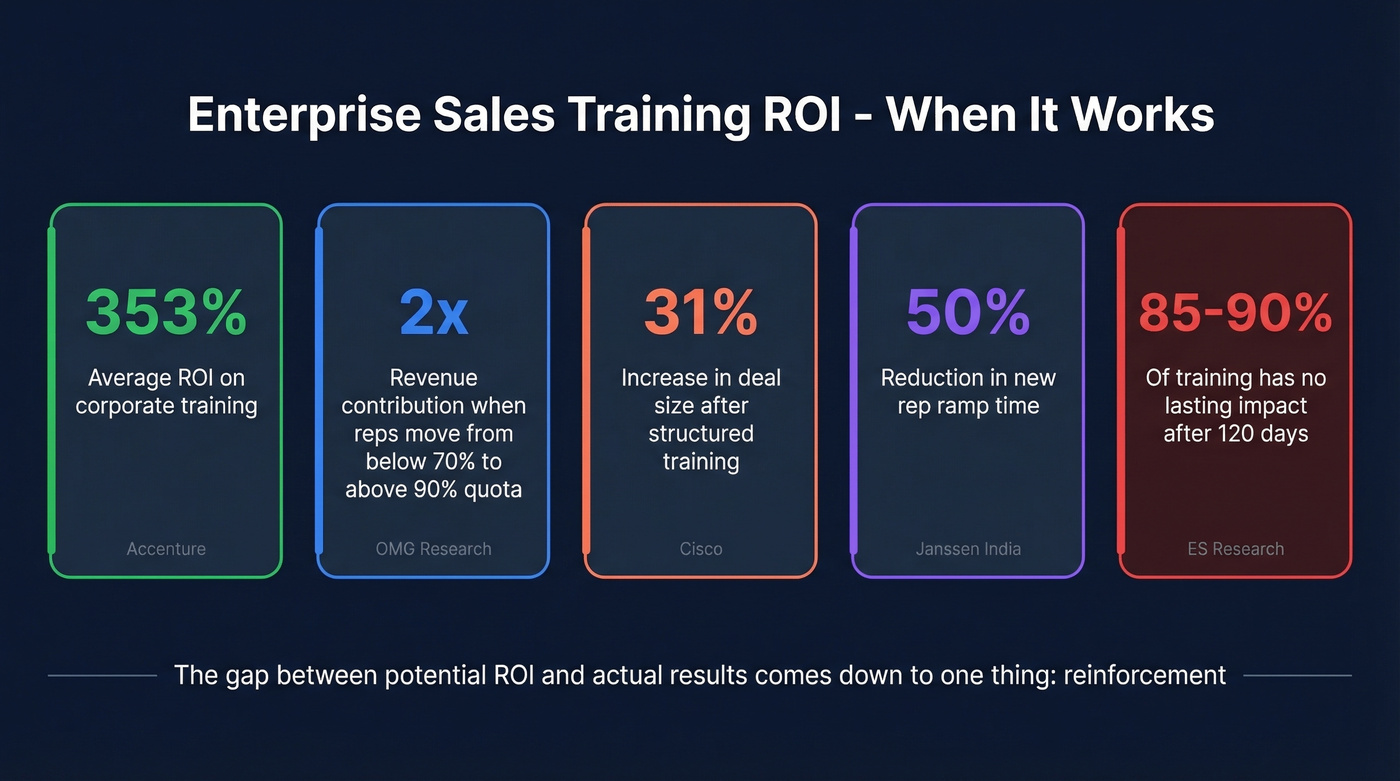
The investment makes sense when it works. Accenture pegs corporate training ROI at 353%. OMG's ROI model shows that moving a rep from below 70% quota attainment to above 90% can double their contribution - from $300K to $600K annually. Cisco saw deal sizes increase 31% after implementing structured training. Janssen India cut new rep ramp time by 50%. At that math, spending $5K-$30K per rep is obvious. The problem is that most programs don't produce that outcome. (To pressure-test impact, track sales conversion rate and pipeline movement.)
Why Most Programs Fail
85-90% of sales training has no lasting impact after 120 days, per ES Research. A separate analysis from pclub.io puts the failure rate at 84%, with most sellers reverting to old behaviors within 90 days.
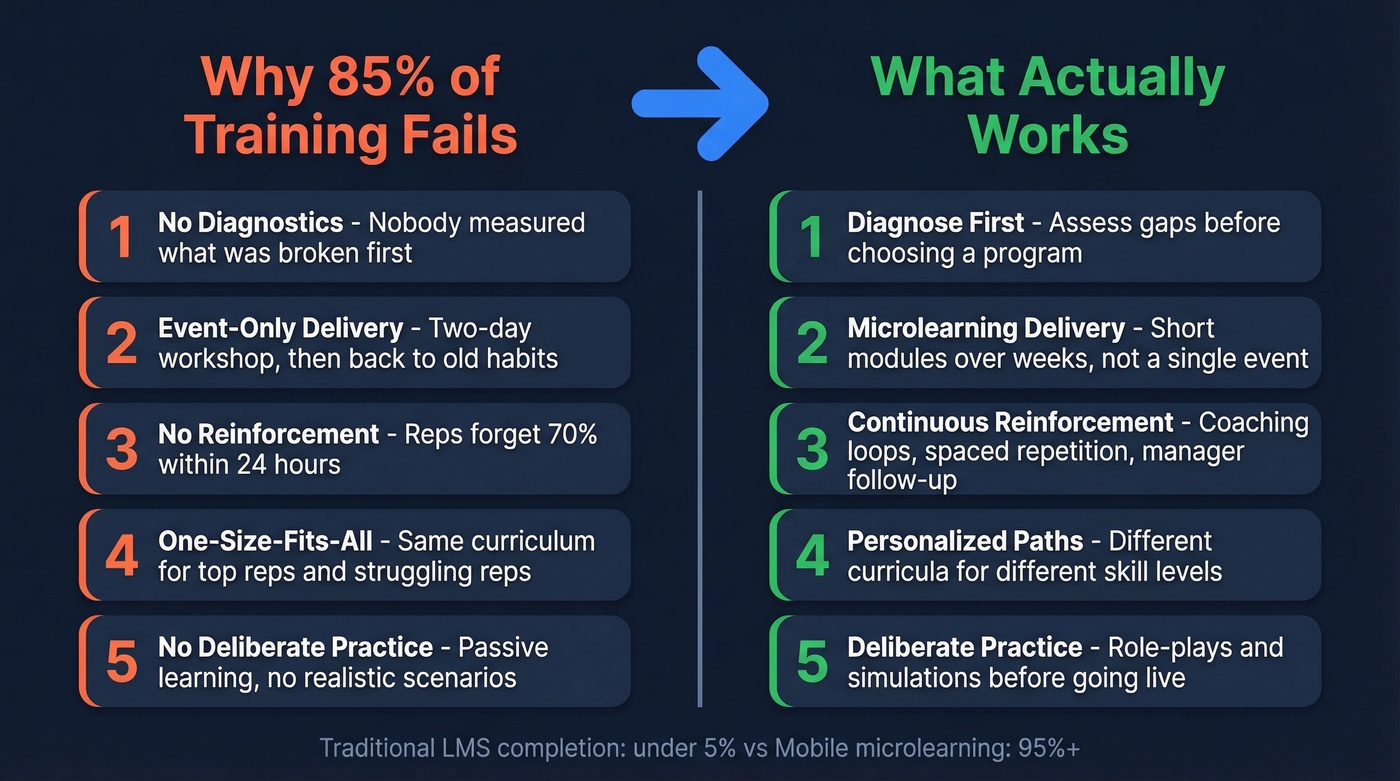
The content usually isn't the problem. The delivery model is. Training fails for predictable reasons:
- No diagnostics. Nobody measured what was actually broken before picking a program. You don't prescribe medicine without a diagnosis.
- Event-only delivery. A two-day workshop feels productive. Then everyone goes back to their desks and nothing changes.
- No reinforcement. Without structured follow-up, reps forget 70% of what they learned in 24 hours. Training and coaching have to be a continuous loop, not a one-time event.
- One-size-fits-all. Your top rep and your struggling rep don't need the same curriculum.
- No deliberate practice. Reps sit through content but never practice skills in realistic scenarios before going live.
The fix: diagnostics first, microlearning delivery, deliberate practice with feedback, clear readiness standards, and ongoing reinforcement. Traditional LMS platforms see completion rates under 5%. Modern mobile-first platforms with microlearning formats hit 95%+. The delivery mechanism matters as much as the curriculum. (If you’re operationalizing this, align it to sales performance management.)
Methodologies Compared
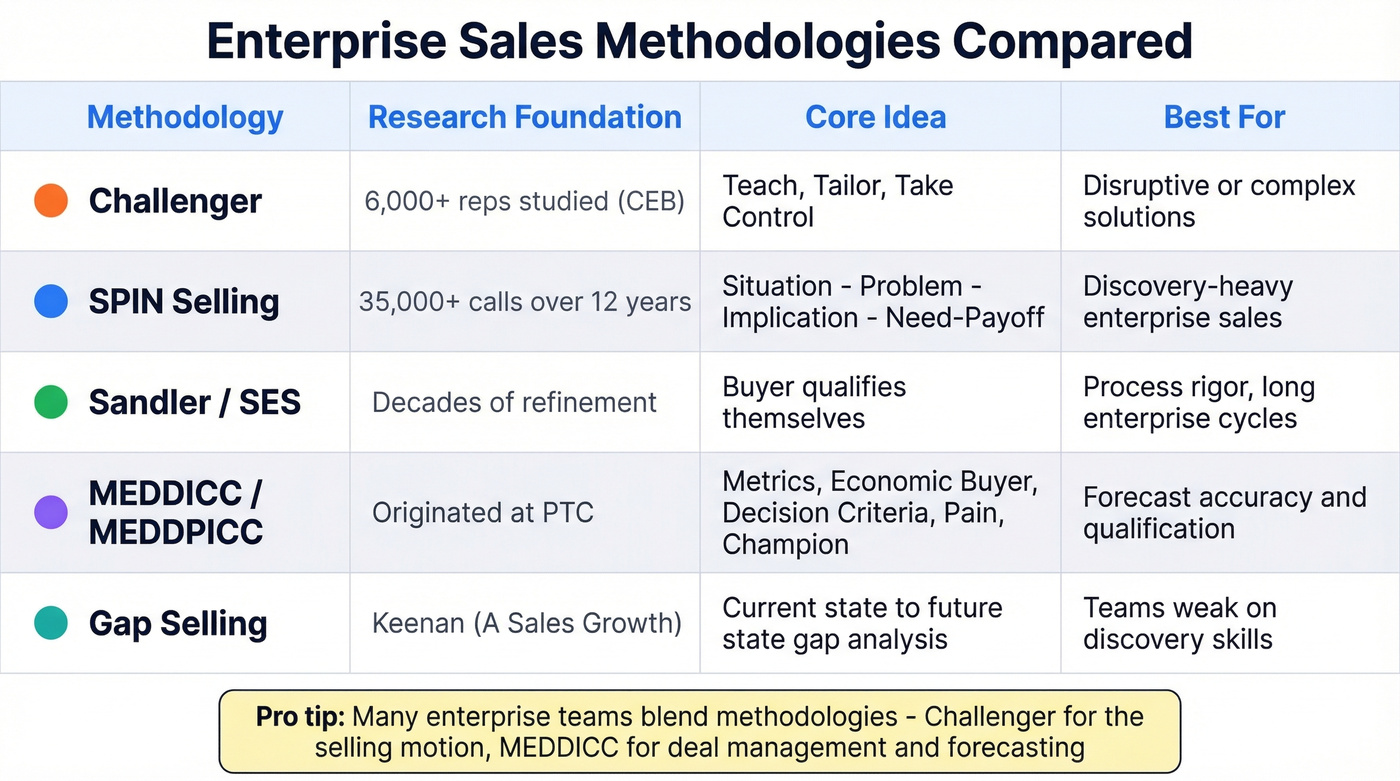
There's a popular sentiment on Reddit that all sales methodologies are basically the same - need, budget, stakeholders, timeline. There's truth in that. The framework matters less than whether your team actually uses it. But the research foundations and ideal use cases differ enough that picking the wrong one wastes months of implementation time.
| Methodology | Research Base | Core Idea | Best For |
|---|---|---|---|
| Challenger | 6,000+ reps (CEB) | Teach, Tailor, Take Control | Disruptive/complex solutions |
| SPIN Selling | 35,000+ calls, 12 years | Situation - Problem - Implication - Need-Payoff | Discovery-heavy sales |
| Sandler | Decades of refinement | Buyer qualifies themselves | Process rigor, enterprise |
| MEDDICC/MEDDPICC | Originated at PTC | Metrics, Economic Buyer, Decision Criteria/Process, Pain, Champion | Forecast accuracy, qualification |
| Gap Selling | Keenan (A Sales Growth) | Current state - future state gap | Teams weak on discovery |
The research anchors matter. Challenger was built on a study of 6,000+ reps. SPIN Selling analyzed 35,000+ sales calls across 20+ countries over 12 years. These aren't frameworks someone sketched on a napkin. Xerox reported a 17% increase in sales and $65M in contract value after implementing Challenger - but they had the organizational commitment to make it stick.
Many enterprise teams end up blending methodologies: Challenger for the selling motion, MEDDICC for deal management and forecasting. That works. The mistake is forcing a methodology before reps have the fundamentals down - it's like teaching a triple-option offense before players can tackle. (If MEDDICC is your gap, start with MEDDIC sales qualification.)

You're investing $1,500-$4,000/rep on training. Don't let freshly skilled AEs waste hours hunting for bad contact data. Prospeo gives your enterprise team 98% accurate emails and 125M+ verified mobile numbers - so trained reps spend time selling to 12-person buying committees, not bouncing emails.
Give your trained reps data that actually connects them to decision-makers.
What Enterprise Sales Training Costs
Most training vendors won't publish pricing. One buyer summed it up: none of these vendors will disclose pricing. Let's fix that.
Pricing by Format
| Format | Cost Range |
|---|---|
| On-demand (pclub.io, Coursera) | $100-$1,000/rep |
| Cohort/group programs | $1,500-$4,000/rep |
| On-site workshops | $5,000-$15,000+/day |
| Custom enterprise (Sandler, Force Mgmt, RAIN) | $25,000-$100,000+ |
| Enterprise enablement (100+ reps) | $250K+ annually |
For reference: Kellogg's "Mastering Sales" runs $2,470, Cornell's Sales Growth Certificate is $3,900, and Dale Carnegie's "Winning with Relationship Selling" costs $2,195.
Hidden Costs Below the Surface
The program fee is the tip of the iceberg.
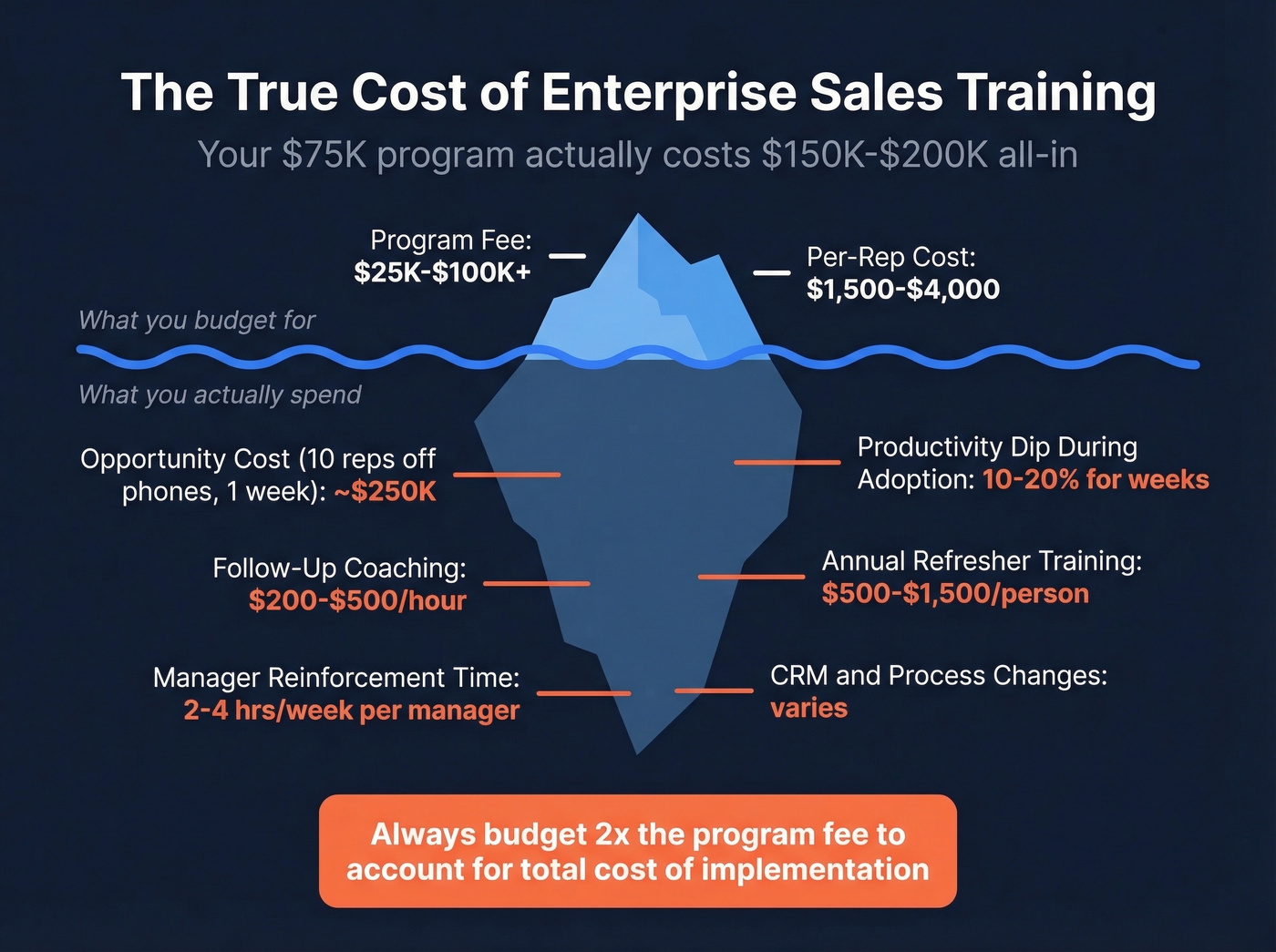
| Hidden Cost | Estimate |
|---|---|
| Opportunity cost (10 reps off phones, 1 week) | ~$250K in lost pipeline |
| Productivity dip during adoption | 10-20% for weeks |
| Follow-up coaching | $200-$500/hour |
| Annual refresher training | $500-$1,500/person |
| Manager reinforcement time | 2-4 hrs/week per manager |
If your team generates $1M/month and you pull 10 reps for a week, you're looking at roughly $250K in potential lost revenue. Add CRM changes, the productivity dip while reps adopt new behaviors, and ongoing coaching - your $75K program actually costs $150K-$200K all-in. (This is also why it helps to monitor pipeline health during rollout.)
Top Programs Worth Evaluating
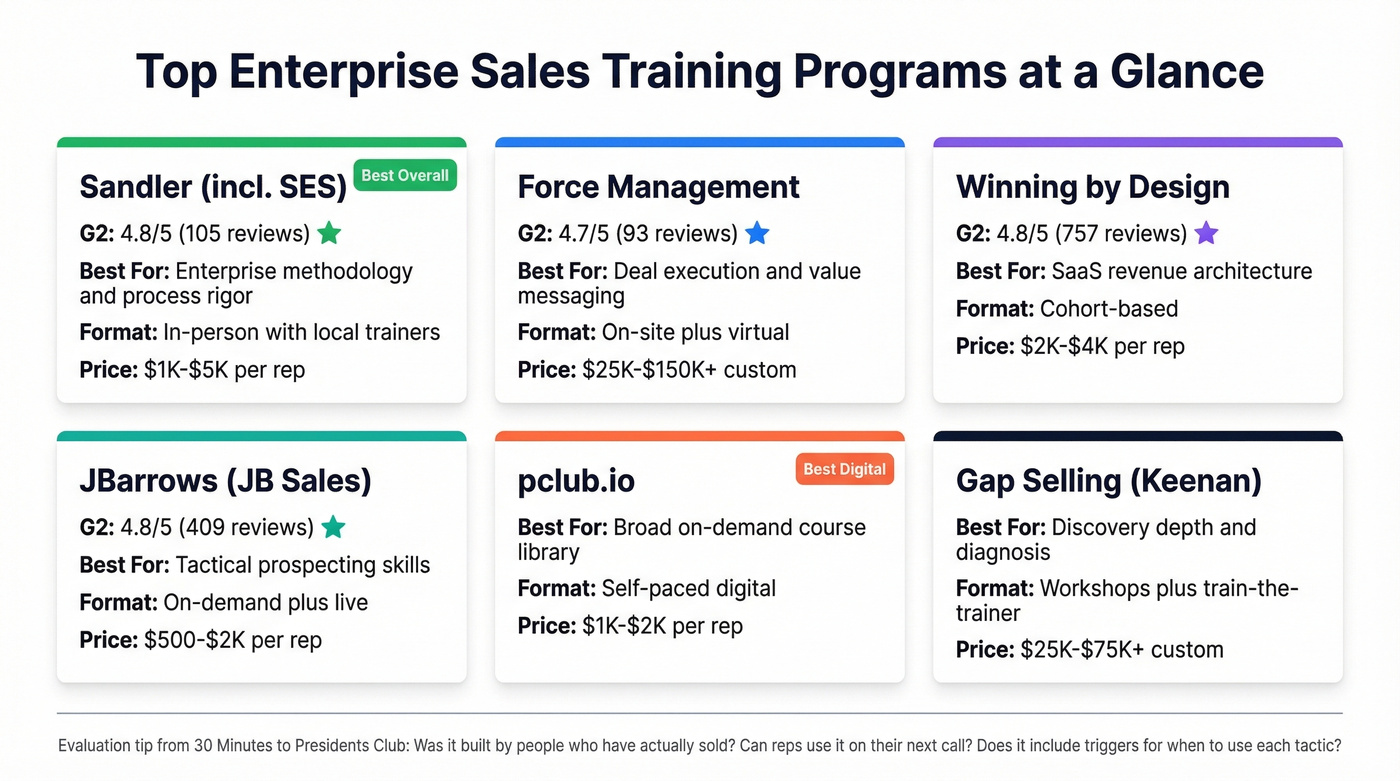
Before evaluating any program, apply the 30 Minutes to President's Club rubric: was it built by people who've actually sold, can reps use it on their next call, and does it include triggers for when to use each tactic? If a program fails any of these, skip it.
One more warning: free "academies" from vendors like Apollo are marketing funnels disguised as training. The content is real, but the goal is product adoption, not skill development. Know the difference.
| Provider | G2 Rating | Best For | Format | Est. Pricing |
|---|---|---|---|---|
| Sandler | 4.8/5 (105 reviews) | Enterprise methodology | In-person, local trainers | $1K-$5K/rep |
| Force Management | 4.7/5 (93 reviews) | Deal execution + messaging | On-site + virtual | $25K-$150K+ |
| Winning by Design | 4.8/5 (757 reviews) | SaaS revenue architecture | Cohort-based | $2K-$4K/rep |
| JBarrows (JB Sales) | 4.8/5 (409 reviews) | Tactical prospecting | On-demand + live | $500-$2K/rep |
| pclub.io | N/A | Broad on-demand library | Self-paced digital | $1K-$2K/rep |
| Gap Selling | N/A | Discovery depth | Workshops + TTT | $25K-$75K+ |
Sandler (Including SES)
The gold standard for enterprise methodology. Sandler's approach - where the buyer qualifies themselves through upfront contracts - builds genuine process rigor that sticks. It's expensive, takes months to implement, and is delivered through local trainers who vary in quality. But reps own the process rather than memorizing scripts.
We've seen teams that commit to the full Sandler implementation come out the other side with a shared language that actually changes how deals move through the pipeline. Best for teams that can commit to the timeline and want long-term behavioral change, not a quick fix.
Force Management
G2 reviewers consistently praise the engaging instructors and deal-focused breakout sessions. "The breakout exercises changed how I run discovery," one reviewer wrote. This is the program for teams that need to sharpen how they articulate value and execute complex deals.
One caveat: online sessions are noticeably less effective than in-person delivery. At $25K-$150K+, it's a serious investment - but the deal execution focus makes it worth evaluating for any team running six-figure+ deals.
Winning by Design
757 G2 reviews and a 4.8/5 rating - the highest review volume in the space. Winning by Design covers the full revenue architecture: not just closing, but the entire customer lifecycle from first touch through expansion. For B2B SaaS companies, this should be on your shortlist.
JBarrows (JB Sales)
Skip this if your team's problem is deal orchestration. JBarrows is built for prospecting and top-of-funnel execution. But when your reps can't book meetings or write emails that get replies, this is the most practical, immediately applicable option available. John Barrows built it from years of training Salesforce's SDR teams, and it shows. The on-demand library plus live sessions hit a sweet spot between affordability and accountability. (If you need quick wins here, use these sales prospecting techniques.)
pclub.io
One of the broadest on-demand libraries in the space - 50+ programs. Start with the Discovery Masterclass and Multithreading Masterclass before exploring further. Priced at the high end for digital content, but the self-paced format means zero opportunity cost from pulling reps off the phones.
Gap Selling
Keenan's methodology is the best framework for teams whose discovery calls are shallow. The current state to future state gap analysis forces reps to understand the buyer's world before pitching. The train-the-trainer model at $25K-$75K+ makes it scalable for larger orgs, but it requires a strong internal champion to sustain adoption.
Boot Camp vs. Ongoing Programs
One of the biggest decisions isn't which vendor to pick - it's whether to run an intensive boot camp or invest in a longer-term program.
Boot camps compress weeks of content into 3-5 days of immersive, high-intensity sessions. They're great for onboarding new enterprise AEs quickly or aligning a team around a new methodology before a product launch. The downside: without follow-up coaching, the 120-day forgetting curve hits boot camp graduates just as hard as anyone else.
Ongoing programs - monthly cohorts, weekly coaching sessions, or always-on digital platforms - sacrifice intensity for durability. The best approach for most teams is a hybrid: kick off with an intensive boot camp to build shared language and frameworks, then sustain momentum with ongoing coaching cadences that reinforce skills in live deal reviews and role plays.
AI and Tech in Sales Training
The AI coaching market surpassed $62B in 2025 and is growing at 28.3% CAGR. AI-coached teams achieve 37% faster onboarding and 24% higher win rates per Gartner's 2026 data.
Let's be honest: if your average deal size is under $25K, you probably don't need a $100K custom engagement. Pair a $1K/rep on-demand program with an AI coaching platform and you'll get 80% of the outcome at 20% of the cost.
The tool landscape is maturing fast. Mindtickle runs ~$45K/year for 100 users. Highspot costs ~$91K/year. Chorus.ai charges ~$100/user/month. SalesHood starts at $45/user/month. HubSpot Sales Hub ranges from $20-$150/seat/month. Lessonly (now Seismic Learning) runs $200-$1,000/month depending on team size. Compare any of these to a two-day workshop that 85-90% of reps forget within four months. (If you’re building a stack around this, see generative AI sales tools.)
The biggest impact comes from pairing methodology training with AI reinforcement. The methodology gives reps a framework; the AI platform provides ongoing practice, call analysis, and coaching at scale.
The Data Problem Nobody Mentions
Here's a scenario we see constantly: a company invests $50K-$100K in enterprise sales training, reps learn MEDDICC and multi-threading, they map out a 12-person buying committee - and then they can't find verified contact information for half the stakeholders. The training taught them to multi-thread. The data gap makes it impossible to execute.
This is where training ROI quietly dies. Your reps know they need to reach the VP of Security, the procurement lead, and the CFO's chief of staff. But when bounce rates run high, reps lose confidence, revert to single-threading, and the money you spent on methodology training delivers nothing. (If this is happening, start by fixing email bounce rate and list quality.)
We've seen this play out with our own customers. Meritt cut their bounce rate from 35% to under 4% after switching to Prospeo, and Snyk's 50-person AE team reduced bounce rates from 35-40% to under 5% while growing AE-sourced pipeline 180%. With 98% email accuracy, 125M+ verified mobile numbers refreshed every 7 days, and 30+ search filters, your reps can find verified contact data for every stakeholder by role, department, and seniority - no manual research, no guessing. The training investment finally pays off because the data layer supports the execution. (If you’re evaluating vendors, compare data enrichment services and how they impact deliverability.)
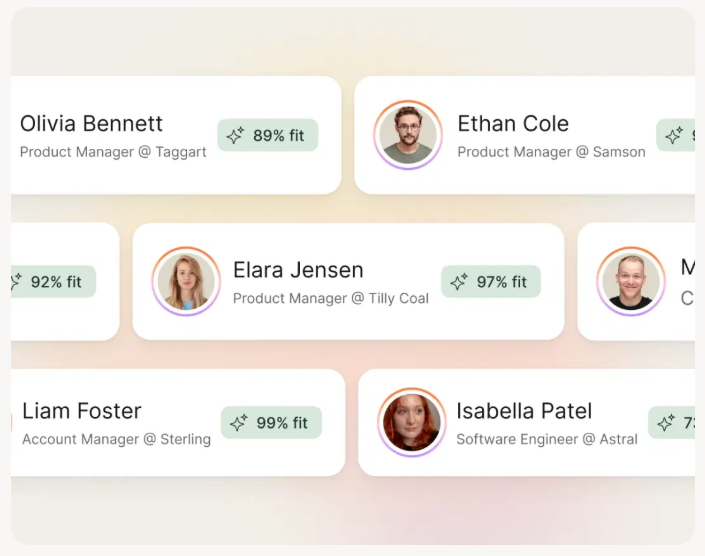
85-90% of sales training fails after 120 days. One reason? Reps can't practice new skills if they can't reach real buyers. Prospeo's 30+ filters - including buyer intent, department headcount, and job changes - let enterprise AEs target the exact buying committee members they're now trained to navigate.
Map the entire buying committee before your next enterprise deal stalls.
FAQ
How long does enterprise sales training take to show results?
Initial behavior change appears in 30-60 days, but lasting impact requires 90+ days of reinforcement. Without structured follow-up, 85-90% of training has no measurable impact after 120 days. Budget for at least six months of coaching alongside the program itself.
What's the difference between enterprise and SMB sales training?
Enterprise programs focus on complex deal orchestration - multi-stakeholder buying committees, 6-12+ month cycles, procurement and legal reviews, and strategic account planning. SMB training emphasizes speed and volume. The foundational skills overlap, but enterprise adds layers of stakeholder management and process rigor that SMB reps never encounter.
Is MEDDICC or Challenger better for enterprise teams?
MEDDICC excels at deal qualification and forecast accuracy - it tells you whether a deal is real. Challenger works best when selling disruptive solutions that require teaching buyers something new. Many teams use both: Challenger for the selling motion, MEDDICC for deal management. Pick based on your biggest gap.
How do you measure training ROI?
Track leading indicators first: discovery call quality scores, multi-threading depth (contacts per opportunity), pipeline velocity, and win rate by deal size. Lagging indicators follow: quota attainment, average deal size, and ramp time. A realistic target is moving reps from below 70% to above 90% quota attainment within two quarters.
What free tools help reps apply training faster?
Prospeo's free tier - 75 emails plus 100 Chrome extension credits per month - lets reps immediately practice multi-threading by finding verified contacts for every stakeholder on a buying committee. Pair it with free call-recording tools like Fireflies.ai and a shared deal-review cadence to reinforce methodology adoption without additional budget.