

150+ Examples of Open-Ended Questions (Plus Frameworks That Actually Work)
Your last 1-on-1 meeting ended in twelve minutes. You asked "Is everything going okay?" and got "Yep." You asked "Any blockers?" and got "Nope." You stared at each other. Meeting over.
The problem wasn't your direct report - it was your questions. Open-ended questions can't be answered with a yes or no; they invite explanation, reflection, and actual conversation. But memorizing a list won't fix a twelve-minute 1-on-1. Learning why certain questions unlock better answers - and which mistakes kill them - will.
What You Need (Quick Version)
- Need examples fast? Jump to the 150+ example bank below.
- Want to get better at asking them? Read the Socratic framework and mistakes section.
- Just need the definition? An open-ended question is any question that can't be answered with "yes," "no," or a single word - it invites the respondent to explain, describe, or reflect.
Why Open-Ended Questions Work
The intuition is obvious: ask better questions, get better answers. But the research backs it up in ways that matter for anyone designing surveys, running meetings, or doing therapy.
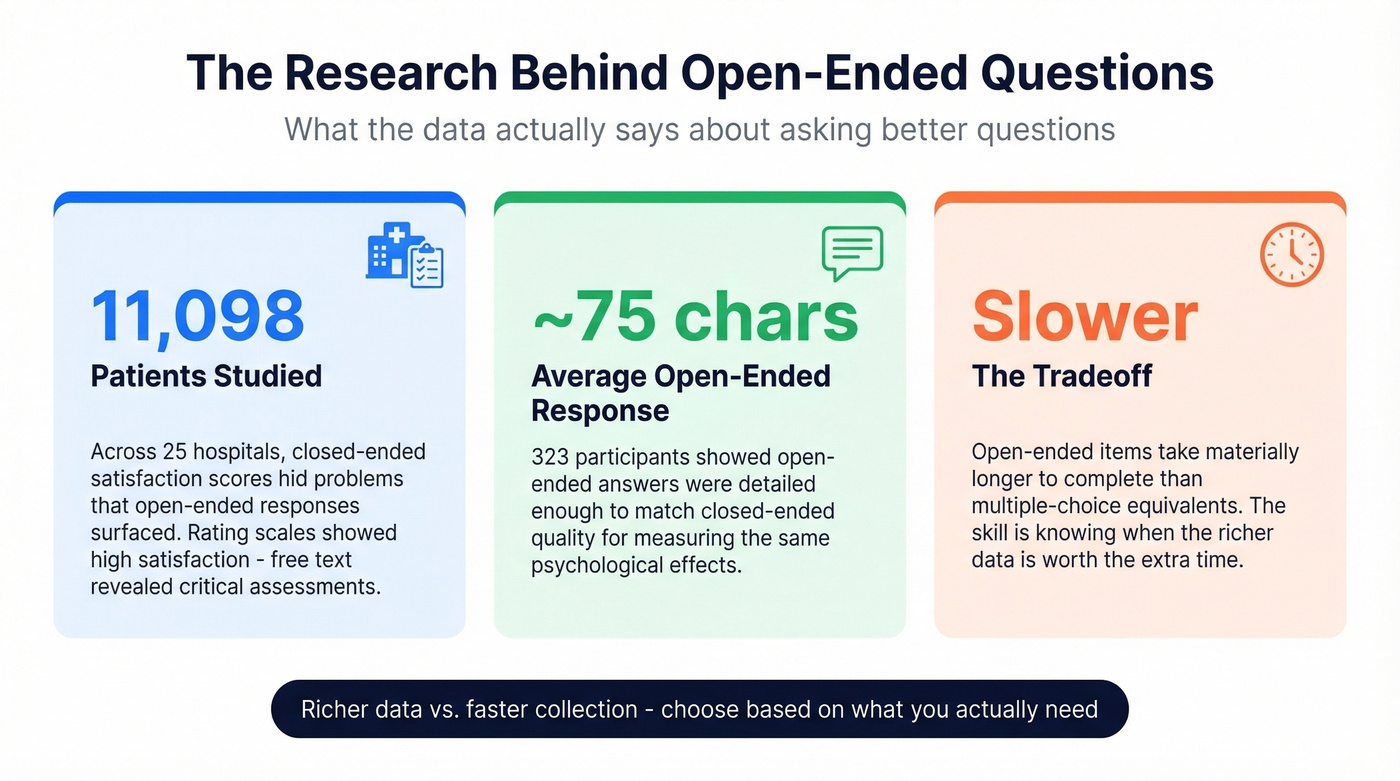
A 2021 study of 11,098 patients across 25 hospitals found that closed-ended satisfaction scores showed very high satisfaction with low variance - everything looked great. But when researchers analyzed the open-ended responses from the same patients, they found considerably more critical assessments of the hospitalization experience. Rating scales hid problems. Open-ended questions surfaced them.
In a separate online experiment with 323 participants, open-ended responses averaged about 75 characters per answer - detailed enough to match closed-ended quality for measuring the same psychological effect. The tradeoff? Speed. Closed-ended responses were faster. As a practical rule, open-ended items take materially longer to complete than a multiple-choice equivalent.
That's the core tension. Open-ended questions produce richer, more honest, more nuanced data. They also cost more time and effort. The skill isn't choosing one format over the other - it's knowing when each one earns its place.
Open-Ended vs. Closed-Ended (Side-by-Side Rewrites)
The fastest way to internalize the difference is to see the same intent expressed both ways. Here are 20 paired rewrites across contexts.
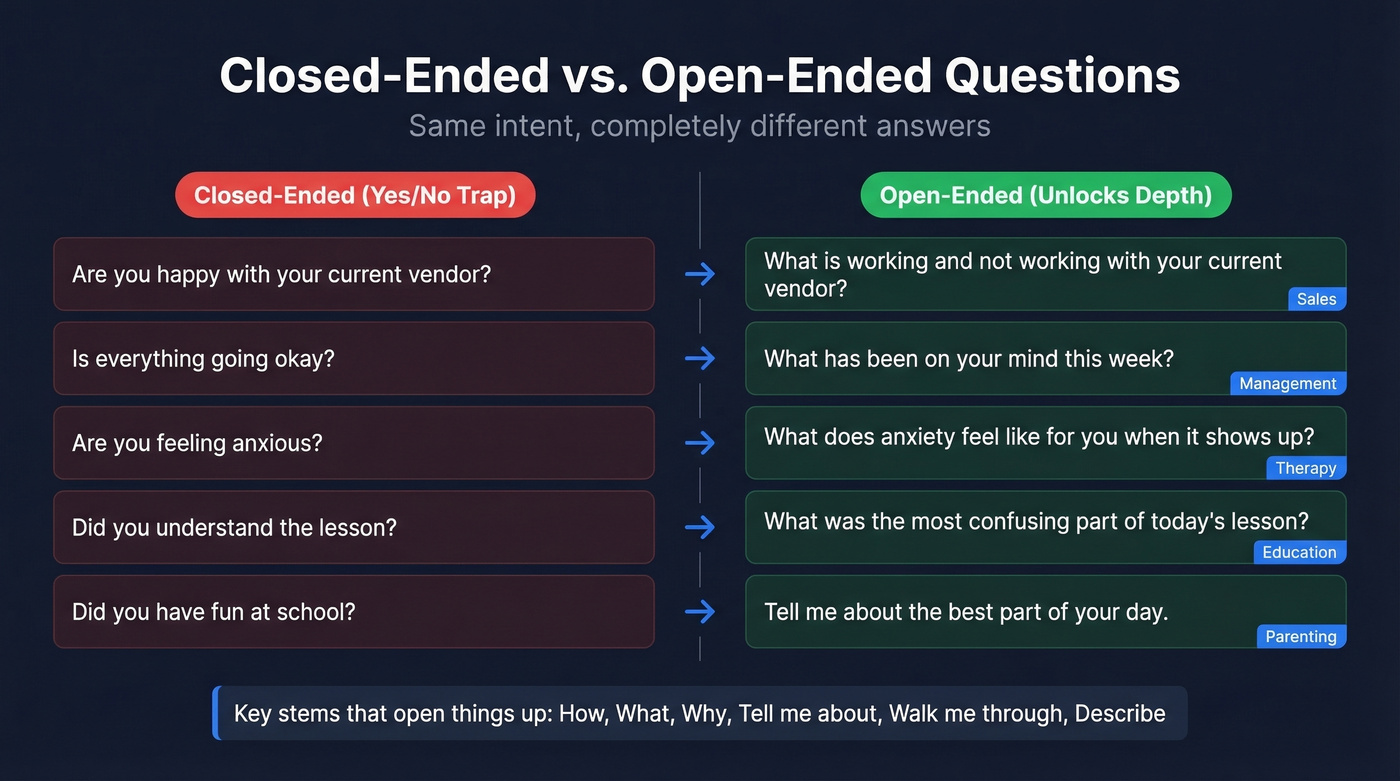
Question stems that reliably open things up: How, What, Why, Tell me about, Walk me through, In what way, Describe, What would happen if.
| Context | Closed-Ended | Open-Ended |
|---|---|---|
| Sales | "Are you happy with your current vendor?" | "What's working and not working with your current vendor?" |
| Sales | "Do you have budget for this?" | "Walk me through how budget decisions get made on your team." |
| Therapy | "Are you feeling anxious?" | "What does anxiety feel like for you when it shows up?" |
| Therapy | "Did that make you angry?" | "How did that situation affect you emotionally?" |
| Management | "Is everything going okay?" | "What's been on your mind this week?" |
| Management | "Do you like your role?" | "What parts of your role energize you, and what drains you?" |
| Education | "Did you understand the lesson?" | "What was the most confusing part of today's lesson?" |
| Education | "Is this a good book?" | "What would you tell a friend about this book?" |
| Parenting | "Did you have fun at school?" | "Tell me about the best part of your day." |
| Parenting | "Are you sad?" | "What's making you feel that way right now?" |
| Surveys | "Would you recommend us? (1-10)" | "What would make you more likely to recommend us?" |
| Surveys | "Was the support helpful?" | "Describe your experience with our support team." |
| Interviews | "Can you work under pressure?" | "Tell me about a time you had to deliver under a tight deadline." |
| Interviews | "Do you like teamwork?" | "What role do you naturally take in a team setting?" |
| Conversation | "How was your day?" | "What was the highlight of your day?" |
| Conversation | "Did you like the movie?" | "What stuck with you after watching it?" |
| Feedback | "Was the training useful?" | "What will you do differently after this training?" |
| Feedback | "Do you agree with the decision?" | "What concerns do you have about this direction?" |
| Coaching | "Are you making progress?" | "What progress are you most proud of this month?" |
| Coaching | "Do you need help?" | "What would make the biggest difference for you right now?" |
One important nuance: open-ended doesn't guarantee a long answer. "How was your vacation?" can still get "Fine." The question structure creates the opportunity for depth - but trust, timing, and follow-up determine whether you actually get it.

Open-ended questions only work when you're asking the right person. Prospeo gives you 98% accurate emails and 125M+ verified mobile numbers so your discovery calls actually reach decision-makers - not gatekeepers.
Stop wasting great questions on the wrong contacts.
150+ Examples of Open-Ended Questions by Context
Sales & Discovery Calls
The best sales discovery questions follow a natural arc: rapport, qualification, pain, objection handling, close. Here's the progression.
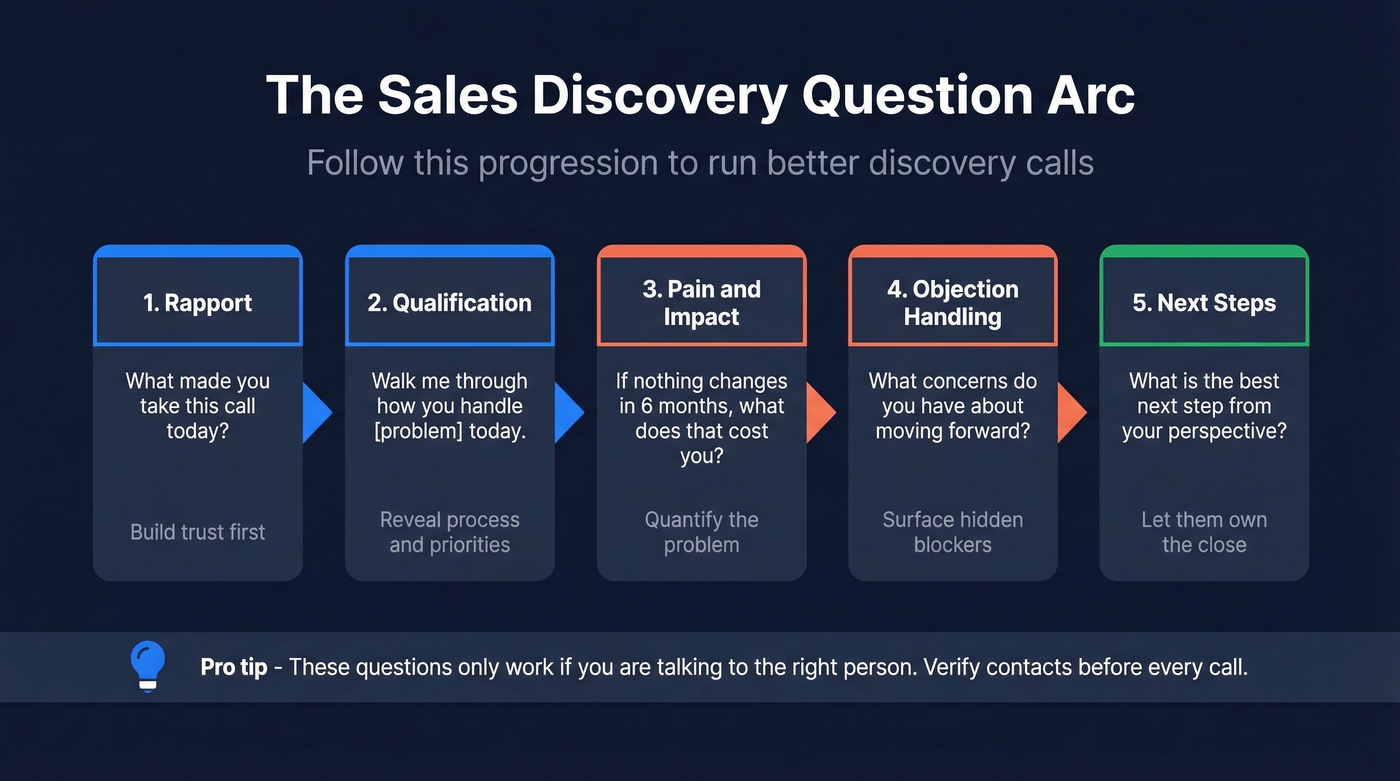
Rapport & opening:
- "What made you take this call today?"
- "What's keeping your team busy this quarter?"
Qualification & discovery:
- "Walk me through how you're handling [problem] today." We've seen this single question outperform every other opener in B2B discovery. It's open, non-threatening, and reveals process, pain, and priorities in one answer.
- "What does your current workflow look like from lead to close?"
- "How do you measure success for this initiative?"
- "What would need to be true for this to be worth your time?"
- "Who else is involved in evaluating something like this?"
Pain & impact:
- "What happens when [current process] breaks down?"
- "How is this problem affecting your team's numbers?"
- "What have you already tried that didn't work?"
- "If nothing changes in the next 6 months, what does that cost you?"
Objection handling & close:
- "What concerns do you have about moving forward?"
- "What would need to change about our proposal for this to be a yes?"
- "What would a successful pilot look like for your team?"
- "What's the best next step from your perspective?"
- "What information do you need to bring this to your team?"
These questions only work if you're talking to the right person. A brilliant discovery question asked to a gatekeeper is a wasted question. Before any discovery call, verify your prospect's contact data with a tool like Prospeo so your calls actually connect with decision-makers instead of bouncing or going to voicemail.
If you want a deeper breakdown of what to ask (and when), start with our guide to discovery questions.
Therapy & Counseling
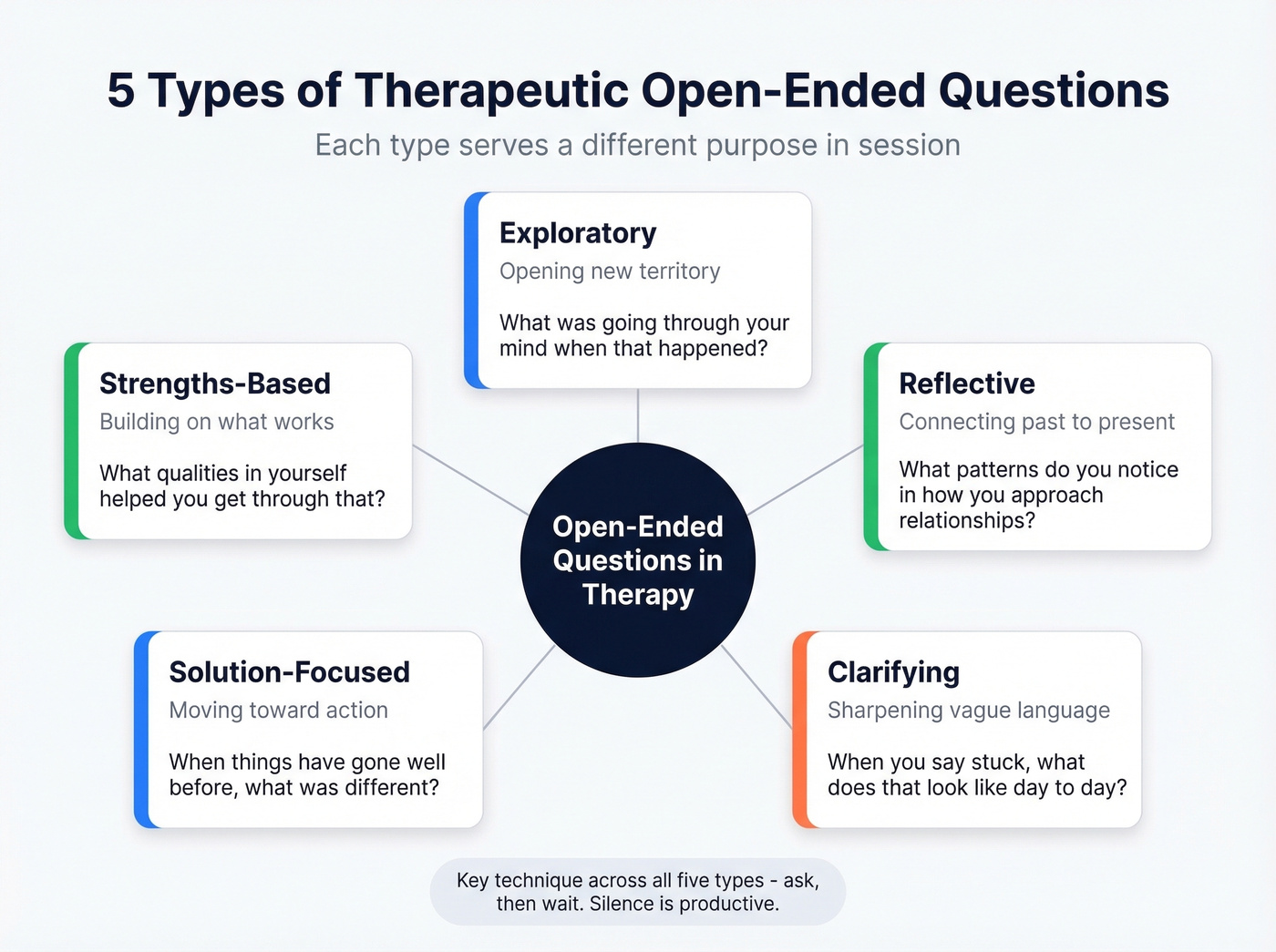
One useful taxonomy breaks therapeutic open-ended questions into five types, each serving a different purpose in session.
| Type | Purpose | Example |
|---|---|---|
| Exploratory | Opening new territory | "What was going through your mind when that happened?" |
| Reflective | Connecting past to present | "What patterns do you notice in how you approach relationships?" |
| Clarifying | Sharpening vague language | "When you say 'stuck,' what does that look like day to day?" |
| Solution-focused | Moving toward action | "When things have gone well before, what was different?" |
| Strengths-based | Building on what works | "What qualities in yourself helped you get through that?" |
More across all five types:
- "Can you tell me more about what led you to feel that way?"
- "What does a typical day look like when you're struggling?"
- "How do you think your past experiences influence how you handle conflict today?"
- "Can you help me understand what you mean by 'feeling overwhelmed'?"
- "What does 'better' look like in your mind?"
- "What small steps could you take to feel more in control?"
- "What would a positive outcome look like for you?"
- "What coping strategies have worked for you in the past?"
Motivational Interviewing uses many of these same structures to help clients resolve ambivalence. The key technique across all five types: ask, then wait. Silence after an open-ended question isn't awkward - it's productive. The best therapists resist the urge to fill it.
Manager 1-on-1 Meetings
Most guides only cover what managers should ask. Let's do both sides.
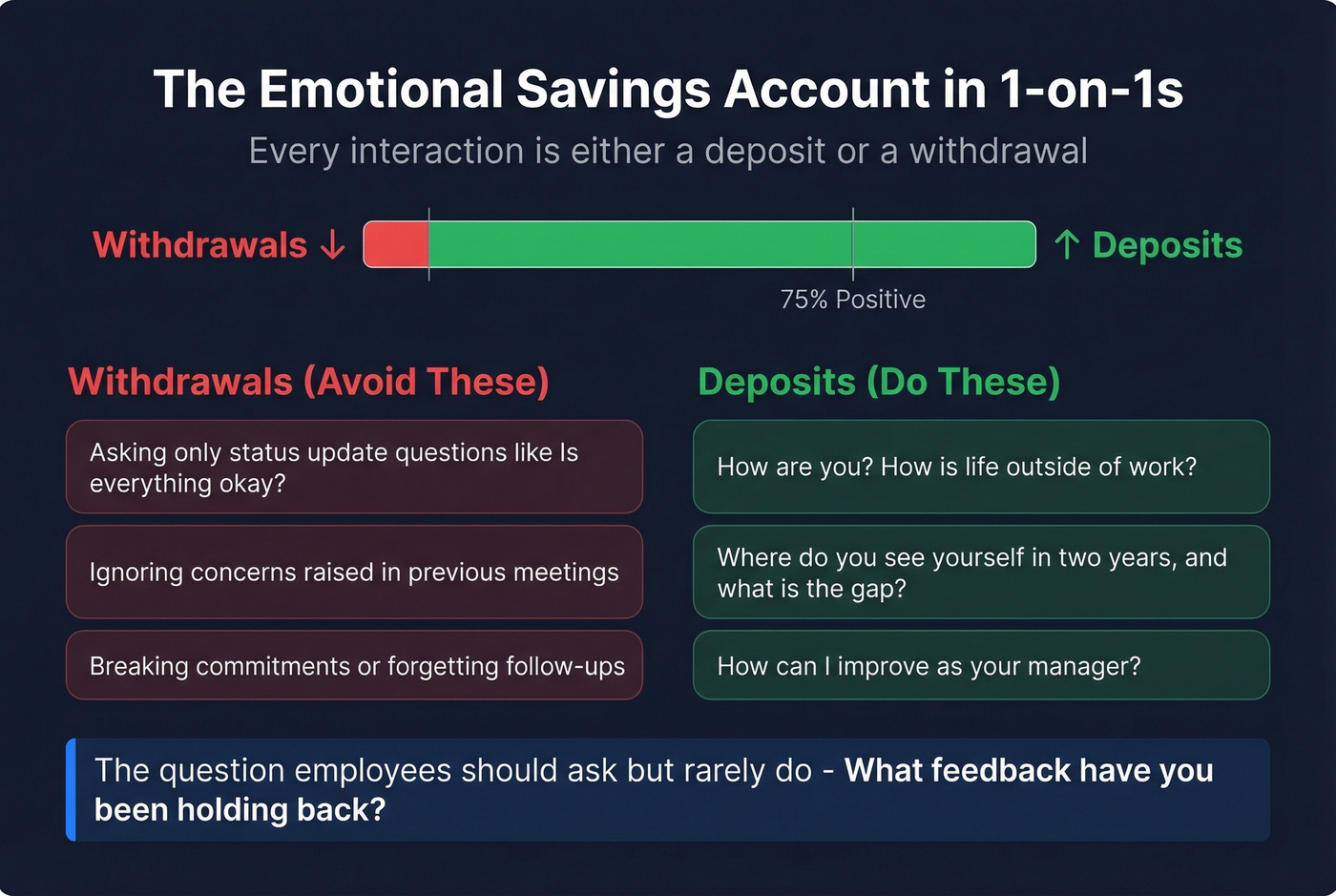
The Emotional Savings Account metaphor is useful: every positive interaction is a deposit, every ignored concern or broken commitment is a withdrawal. Open-ended questions in 1-on-1s are deposits. They signal that you care about the answer, not just the status update.
If you're running structured check-ins, you may also want a bank of QBR questions for longer review meetings.
Rapport & trust (manager asks):
- "How are you? How is life outside of work?"
- "How do you feel your work/life balance is right now?"
- "What drives you? What motivates you to come to work each day?"
Career development:
- "Where do you see yourself in two years, and what's the gap between here and there?"
- "Which skills are you most excited about developing?"
- "What kind of work do you wish you got to do more of?"
Feedback & communication:
- "How can I improve as your manager?"
- "What's something I do that's helpful, and something that gets in your way?"
- "When was the last time you felt really heard on this team?"
Happiness & engagement:
- "What's been the highlight of your last two weeks?"
- "Have you felt overwhelmed lately, and if so, what would help?"
- "What would make this job a 10 out of 10 for you?"
Questions employees should ask their managers:
- "How will my success be measured this quarter?"
- "Are there patterns in my performance that stand out to you?"
- "What's one thing I could do differently that would make the biggest impact?"
- "What feedback have you been holding back?"
That last one takes courage. It also tends to produce the most useful answers.
Classroom & Education
Good classroom questions map to Bloom's Taxonomy - moving students from recall to analysis to creation.
Knowledge & comprehension:
- "What do you already know about this topic?"
- "How would you explain this concept to a younger student?"
- "What connections do you see between this and what we learned last week?"
Application & analysis:
- "How would you solve this problem using a different method?"
- "What evidence from the text supports your interpretation?"
- "Why do you think the author made that choice?"
Evaluation & creation:
- "If you could redesign this experiment, what would you change?"
- "What's the strongest argument against your own position?"
- "How would this story be different if told from another character's perspective?"
- "What questions do you still have after today's lesson?"
Higher education:
- "What assumptions is this theory built on, and do they hold?"
- "How would a practitioner in [field] apply this research?"
- "What's missing from this analysis?"
Don't call on students cold after asking an open-ended question. Give think time - even 10 seconds changes the quality of responses dramatically.
Kids & Parenting
Open-ended questions with young children serve a developmental purpose beyond conversation. They support language acquisition, sentence construction, and social-emotional reasoning. For preschoolers especially, the act of forming a multi-word answer builds cognitive and linguistic skills that yes/no questions simply don't exercise.
Here's an interesting nuance: "why" questions work beautifully with young children, even though facilitation experts warn against overusing "why" with adults, where it can feel interrogative. Kids don't carry that baggage. "Why do you think the sky is blue?" is an invitation to wonder, not a cross-examination.
A practical tip from early childhood research: start with a closed-ended question to warm up, then follow with an open-ended one. "What is your favorite sport?" then "Why do you like it?" then "How do you feel when you play?" This progression gives kids a concrete anchor before asking them to elaborate.
For younger kids (ages 3-7):
- "Tell me about the best and worst parts of your day."
- "If you could be any animal, what would you be and why?"
- "What do you do when you're afraid?"
- "What makes someone a good friend?"
- "What are you thinking about right now?"
- "If you could make up a new holiday, what would it celebrate?"
- "What would you do if you were invisible for a day?"
For older kids (ages 8-12):
- "What's something you learned recently that surprised you?"
- "If you could change one rule at school, what would it be and why?"
- "What do you think is the hardest thing about being a kid?"
- "How would you solve [current family problem] if you were in charge?"
- "What's something you wish adults understood about your life?"
Many of these are adapted from Alberta Health's conversation prompts for kids - a surprisingly rich resource from a public health agency.
Surveys & Customer Feedback
NPS, CSAT, and CES scores are closed-ended metrics. They tell you what the number is. They don't tell you why. That's where open-ended follow-ups matter most.
Remember the hospital study? Closed-ended satisfaction scores looked great. Open-ended responses revealed critical problems the ratings completely missed. This pattern repeats across industries - rating scales suffer from positivity bias and ceiling effects that mask real issues.
If you're tying feedback to retention, pair these questions with a simple churn analysis workflow.
Post-NPS:
- "What's the primary reason for your score?"
- "What would we need to change to earn a higher rating next time?"
Post-purchase:
- "Describe your experience finding what you needed on our site."
- "What almost stopped you from completing your purchase?"
- "What were you hoping this product would do for you?"
Post-support:
- "Walk us through what happened during your support interaction."
- "What could we have done differently to resolve your issue faster?"
Product feedback:
- "What's the one feature you wish we'd build next?"
- "How has this product changed your workflow, if at all?"
- "What's the most frustrating part of using [product]?"
The tradeoff is real: open-ended survey items take longer to complete, and surveys with many open-ended questions usually have lower completion rates. The practical guidance from Qualtrics is consistent - limit open-ended questions, place them after the quantitative items, and make them optional if survey length is a concern.
Job Interviews
Behavioral interview questions are open-ended by design. The "Tell me about a time when..." structure forces candidates past rehearsed answers and into specific examples. Here are the five we'd prioritize if we were running the interview:
- "Tell me about a time you had to deliver results with incomplete information." This reveals how someone handles ambiguity, which matters more than any technical skill in most roles.
- "Walk me through a project that didn't go as planned." Failure stories are where you learn the most about a candidate. Anyone can narrate a win.
- "What's the most difficult feedback you've received, and what did you do with it?" Self-awareness is nearly impossible to fake.
- "Describe a situation where you disagreed with your manager. How did you handle it?" Tests both conflict resolution and honesty.
- "How do you decide what to prioritize when everything feels urgent?" Reveals actual decision-making frameworks vs. generic "I'm organized" answers.
If you're hiring for quota-carrying roles, align these with a clear 30-60-90 day plan so expectations are explicit.
For candidates to ask:
- "What does success look like in this role after 90 days?"
- "What's the biggest challenge the team is facing right now?"
- "How would you describe the team's culture in a way that a job posting can't?"
- "What's something you wish you'd known before joining?"
Everyday Conversation
The classic "How was your day?" almost always gets "Fine." The fix isn't asking a more open-ended question - it's asking a more specific one. "How was your day?" is technically open-ended, but it's so broad that autopilot kicks in. "What surprised you today?" forces the brain to scan for something concrete. "What's been on your mind this week?" invites reflection instead of a status report.
Better alternatives for social, dating, and friendship contexts:
- "What's the best thing you've watched or read recently?"
- "If you could have dinner with anyone, living or dead, who and why?"
- "What's a skill you'd love to learn if time and money weren't factors?"
- "What's something most people don't know about you?"
- "What's a strong opinion you hold that most people would disagree with?"
- "What's the most interesting conversation you've had recently?"
- "What's something you changed your mind about recently?"
- "What's a small thing that made your week better?"
The Socratic Questioning Framework
If you learn one framework from this article, learn this one.
Socratic questioning is designed to create productive discomfort - the kind that comes from examining your own thinking, not from feeling attacked. It dates back to classical Greek philosophy and remains a core technique in Cognitive Behavioral Therapy, coaching, education, and effective leadership conversations.
If you're using this in sales, it pairs well with structured sales communication talk tracks.
The six types of Socratic questions:
- Clarification - "What do you mean when you say...?" / "Can you give me an example?"
- Challenge assumptions - "What are you assuming here?" / "What if the opposite were true?"
- Evidence and reasoning - "What evidence supports that?" / "How do you know this is accurate?"
- Alternative perspectives - "How might someone else see this situation?"
- Consequences and implications - "What would happen if...?" / "What are the long-term effects?"
- Questioning the question - "Why do you think I asked that?"
The magic isn't in any single question type - it's in the four-stage cycle of guided discovery. Ask an open-ended question to receive information. Listen and reflect back what you heard. Summarize the key points. Then ask a deeper question that applies the answers to the original problem. Each cycle goes deeper.
A therapist uses this to help a client examine a belief they've never questioned. A manager uses it to help a report think through a decision instead of just handing them the answer. I've watched leaders transform their teams by replacing "Here's what I'd do" with one more Socratic cycle. It takes patience, but the payoff is people who think for themselves.
Mistakes That Kill Open-Ended Questions
You can have the perfect question and still get a one-word answer. Here are nine pitfalls that sabotage even the best-crafted open-ended questions.
1. Asking multiple questions at once. "What did you think about the presentation, and how do you feel about the timeline, and do you have concerns about the budget?" We've watched managers ask five questions in a row and wonder why they got silence. Pick one. Let them answer. Then ask the next.
2. Overusing "why" with adults. "Why did you do that?" triggers defensiveness. It sounds like an accusation. Swap "why" for "what":
- Before: "Why do you think that?"
- After: "What do you see that makes you say that?"
This single rewrite is worth the entire article. It transforms interrogation into curiosity.
3. Leading questions disguised as open-ended. "Don't you think we should go with Option A?" isn't open-ended - it's a closed question wearing a costume. Real open-ended: "What are the tradeoffs between Option A and Option B?"
4. Not allowing silence. Ask your question, then wait. Count to ten in your head if you have to. The discomfort of silence is yours to manage, not theirs.
5. Pitching questions at the wrong level. Asking a new hire "What's your vision for the department's strategic direction?" is too complex. Asking a VP "What tasks did you complete today?" is too simple. Match the question to the person's context.
6. Pseudo open-ended questions. "What do you think is the right thing to do here?" - when there's clearly only one acceptable answer and everyone knows it. If you've already decided, don't pretend to ask.
7. Ignoring the response. The fastest way to kill future open-ended answers is to ask a great question, get a thoughtful response, and then move on without acknowledging it. Reflect back. Ask a follow-up. Show that the answer mattered.
8. Putting people on the spot. "Sarah, what do you think?" in front of 20 people, with no warning, on a topic Sarah hasn't prepared for. Give people the option to think first, or pose the question to the group and let volunteers respond.
9. Letting the discussion drift. Open-ended questions can spark great exploration - but someone still has to steer. If the conversation wanders, summarize what you heard and bring it back to the decision or goal.
Look, if your open-ended questions still get one-word answers, the problem usually isn't the question. It's the timing, the trust, or the phrasing. Fix those three, and almost any open-ended question will work.
One more thing: if your deal sizes are under five figures, the quality of your discovery questions matters more than any tool in your stack. Most teams obsess over CRMs and sequences while asking the same five generic questions on every call. Flip that priority. (If you want to systematize the rest of the motion, see our sales prospecting techniques guide.)
You just learned 150+ questions that unlock real conversations. Now make sure those conversations happen. Prospeo's 30+ search filters - including buyer intent and job changes - connect you with prospects who are ready to talk.
Find in-market buyers before your competitors ask the first question.
FAQ
What makes a question open-ended?
An open-ended question requires the respondent to explain, describe, or reflect - it can't be answered with "yes," "no," or a single word. If someone can respond with one word and be done, it's closed-ended. The question stems "How," "What," and "Tell me about" almost always produce open-ended responses.
What are the best question starters?
The most reliable stems are How, What, Tell me about, Walk me through, Describe, and In what way. "Why" works well with children but can feel confrontational with adults - swap it for "What led you to..." instead. These starters generated the strongest responses across all 150+ examples in this guide.
Why do open-ended questions sometimes get short answers?
Three reasons: low trust, bad timing, or weak phrasing. "How's everything?" is technically open-ended but too broad - autopilot kicks in. Specificity fixes this. "What's been the hardest part of this project?" gives something concrete to react to. Follow-up questions matter as much as the opener.
When should you use closed-ended questions instead?
Use closed-ended questions when you need quantitative data like NPS scores and survey scales, when triaging urgency ("Is this blocking your work?"), when confirming facts ("Is your contract up in Q3?"), or as warm-ups before open-ended follow-ups. The hospital study showed both formats together produce the most complete picture.
What tools help with B2B sales discovery calls?
Conversation intelligence platforms like Gong or Chorus analyze which open-ended questions correlate with higher close rates on your team. For contact data, Prospeo verifies emails at 98% accuracy so your discovery calls connect with decision-makers - not gatekeepers or dead numbers.