

How to Find Email Addresses That Actually Work
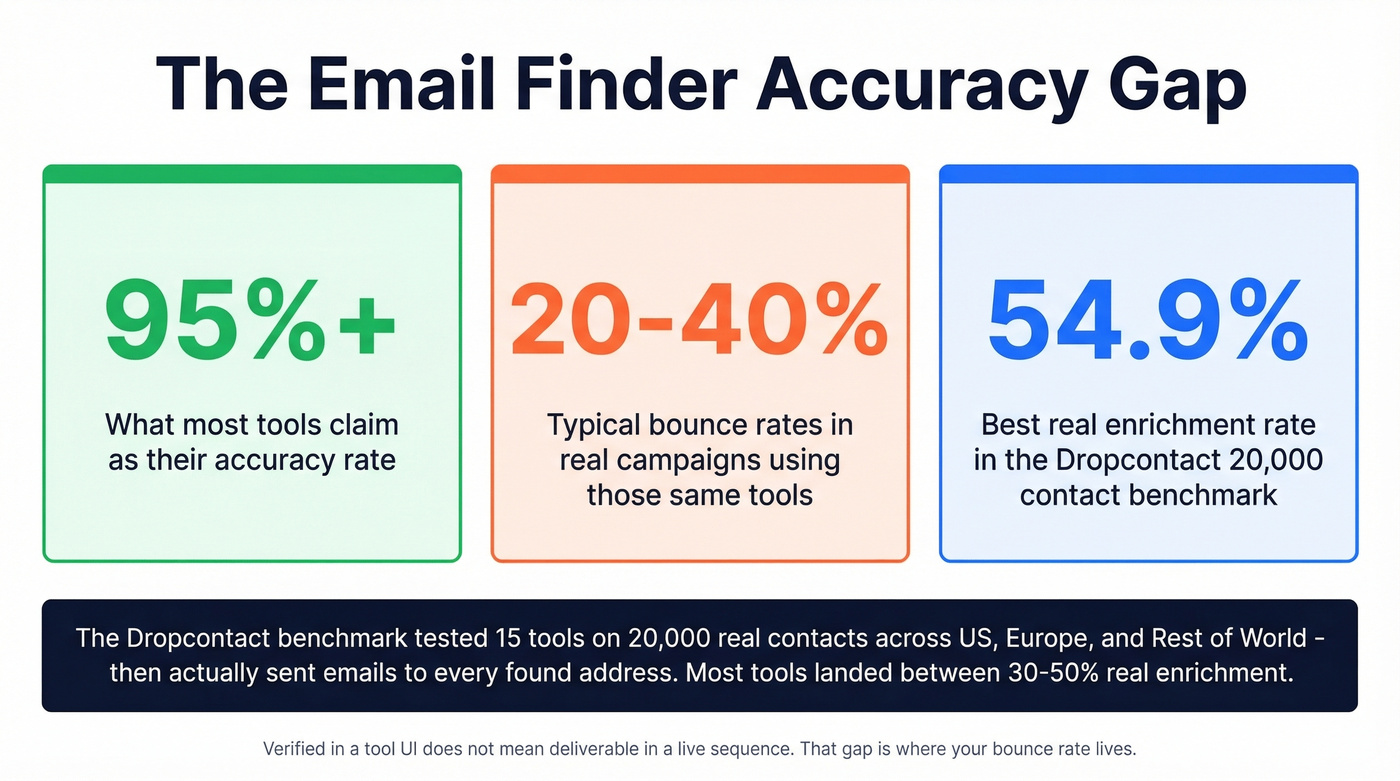
Most email finders claim 95%+ accuracy. In practice, when you actually send to those addresses, bounce rates between 20% and 40% are common. Benchmarks and real campaigns show the same pattern: "verified" in a tool UI doesn't always mean "deliverable" in a live sequence. That gap between vendor promises and real-world deliverability is where most teams get burned - and where we've spent the most time testing.
What You Need (Quick Version)
Three picks based on what actually matters:
- Best free tier: Hunter.io - up to 50 free searches/month, solid as a verification layer even if the database runs thin.
- Best for international leads: Snov.io - affordable credits starting at $39/mo, built-in automation features, strong outside North America.
If you just need one or two emails right now, skip the tools. The free methods below work fine for small volumes.
How Email Finders Actually Work
Every email address finder runs some version of the same pipeline. Understanding it helps you spot inflated accuracy claims.
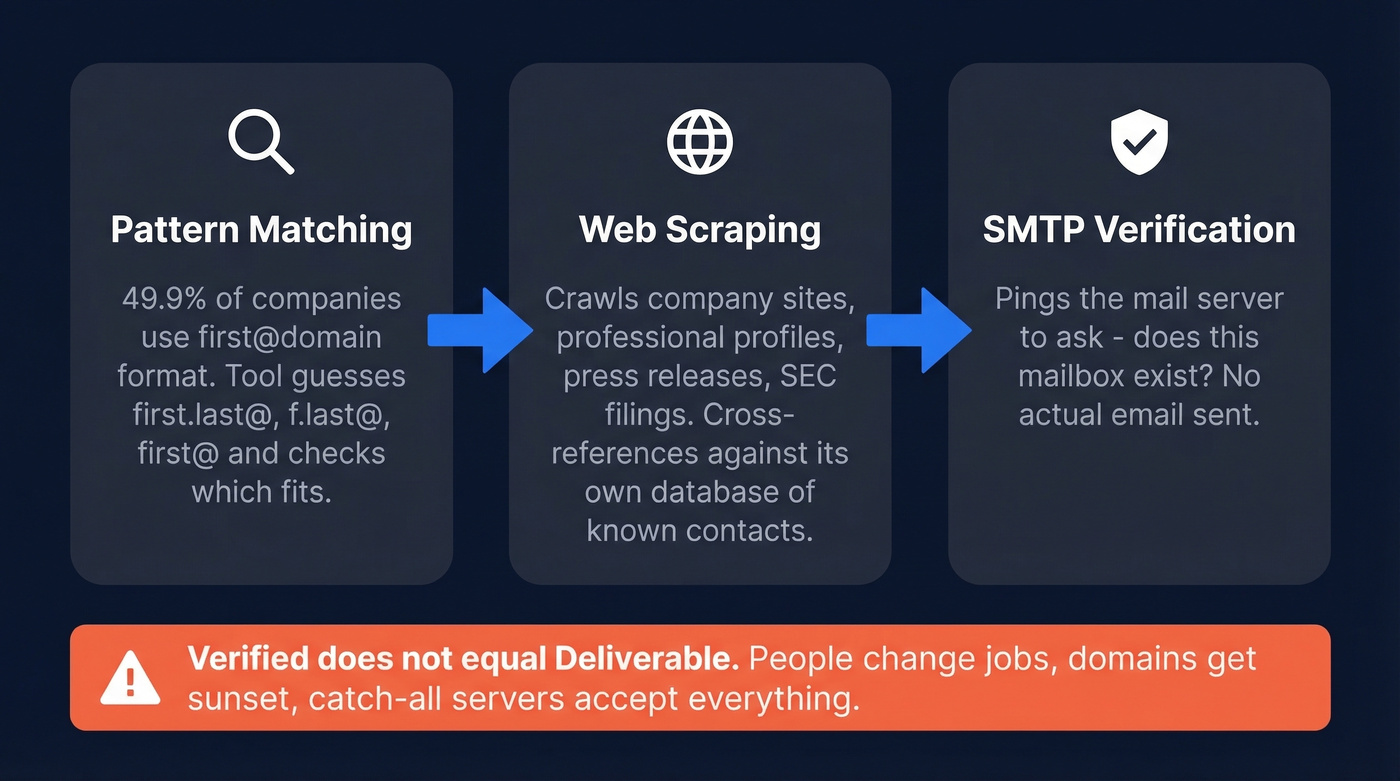
It starts with pattern matching. A Hunter analysis of 12M+ email addresses found that 49.9% of companies use the {first}@domain format. If you know someone's name and company domain, the tool guesses the most likely format - first.last@, f.last@, first@ - and checks which one sticks.
Next comes web scraping. The tool crawls public sources - company websites, professional profiles, press releases, SEC filings - looking for addresses associated with that person, then cross-references against its own database of previously found contacts. The final step is SMTP verification: the tool pings the mail server to ask "does this mailbox exist?" without actually sending an email.
Here's the thing. A server saying "yes" today doesn't mean the address will work tomorrow. People change jobs. Companies sunset domains. Catch-all servers accept everything, including addresses that don't belong to real humans. That's why "verified" doesn't equal "deliverable" - the gap between those two words is where your bounce rate lives.
Free Ways to Find Email Addresses
You don't always need a paid tool. For small volumes or one-off research, these manual methods are surprisingly effective.
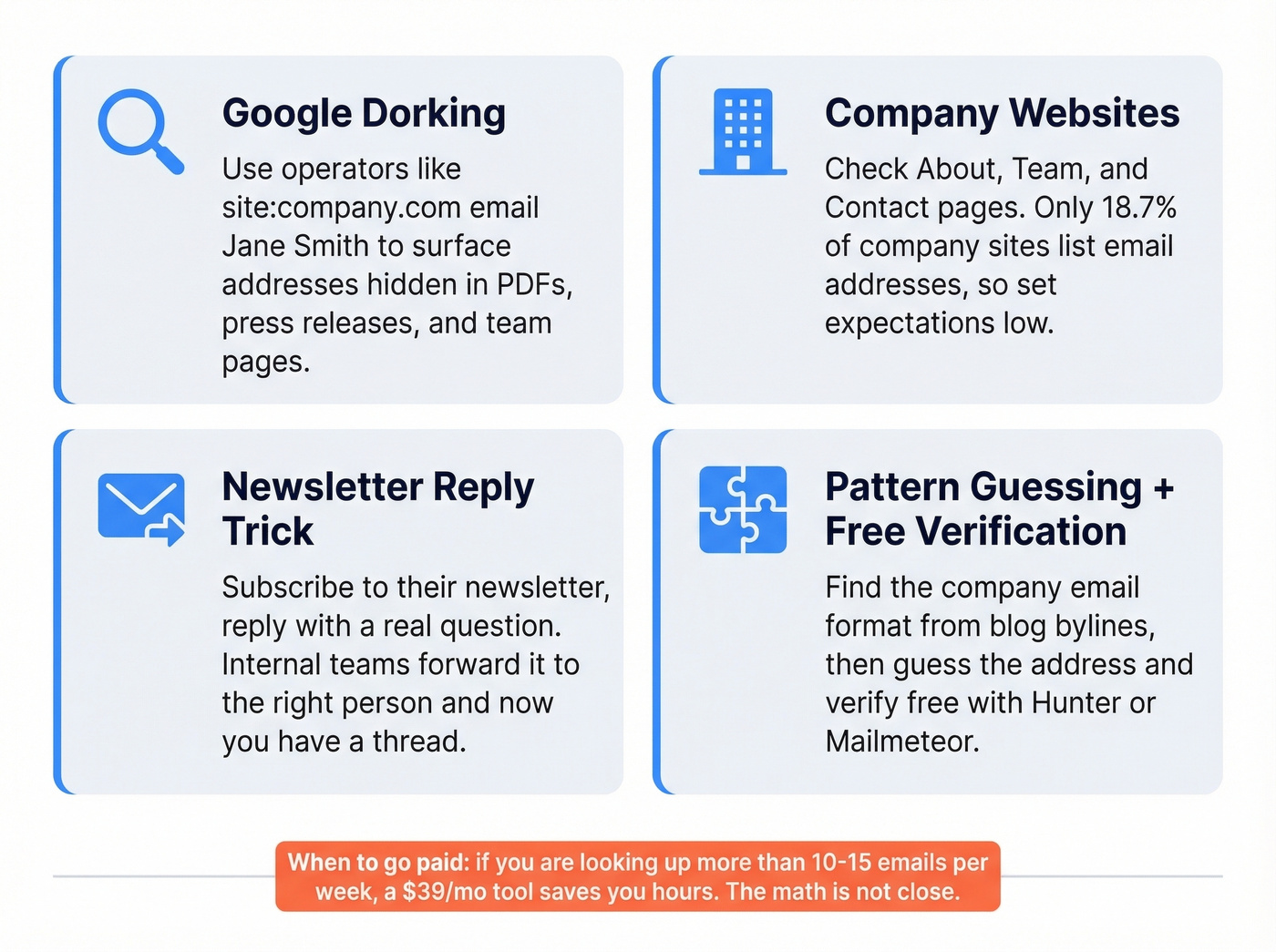
Google Dorking
Use targeted search operators: site:company.com "email" "Jane Smith" or "@company.com" "VP Sales". This surfaces addresses published on team pages, press releases, and PDF documents that regular Google searches miss entirely.
Company Websites
Check About, Team, and Contact pages directly. Don't expect too much - across roughly 905,000 company websites, only 18.7% mentioned at least one email address. Smaller companies are more likely to list them than enterprise orgs.
The Newsletter Reply Trick
Subscribe to the target company's newsletter, then reply to a received email with a genuine question. Internal teams often forward these to the relevant person, and now you've got a thread going with the right contact. This works better than it has any right to.
Pattern Guessing + Free Verification
Once you know a company's email format from blog author bylines or press mentions, guess the address and run it through a free verifier. Hunter's free plan includes up to 50 searches per month. Mailmeteor is free and doesn't require signing up - worth bookmarking.
When to stop doing this manually: if you're looking up more than 10-15 emails a week, you're burning time that a $39/mo tool would save. The math isn't close.
Best Tools to Find Email Addresses
Here are the tools worth your time, organized by what they're actually best at. We've tested most of these across real campaigns, and the consensus on r/coldemail lines up with our experience more often than not.
Prospeo
Use this if: You can't afford bounces - you're running outbound at scale and your domain reputation is on the line. (If you're building a broader stack, start with these sales prospecting techniques to keep volume and quality aligned.)
Skip this if: You only need 5 emails a month and don't want to sign up for anything.
Prospeo's database covers 300M+ professional profiles with 143M+ verified emails, and the accuracy numbers hold up. The 98% email accuracy rate comes from a proprietary 5-step verification process that includes catch-all handling, spam-trap removal, and honeypot filtering. Unlike most finders that rely on third-party email providers, Prospeo runs its own infrastructure end-to-end.
The 7-day data refresh cycle is the real differentiator. Most databases refresh every four to six weeks, which means they're serving you emails for people who changed jobs a month ago. Customer results back this up - Snyk saw bounce rates drop from 35-40% to under 5% after switching, and Meritt reported similar drops from 35% to under 4%.
The free tier gives you 75 verified emails per month. Paid plans run about $0.01 per email on a pay-for-valid model, meaning you don't get charged for addresses that fail verification. No contracts, self-serve onboarding, and native integrations with Salesforce, HubSpot, Lemlist, Instantly, and Clay list building.
Hunter.io
Hunter is probably the most recognized email lookup tool, and the free tier - up to 50 searches per month - is genuinely useful. The domain search feature is excellent for mapping out a company's email structure quickly.

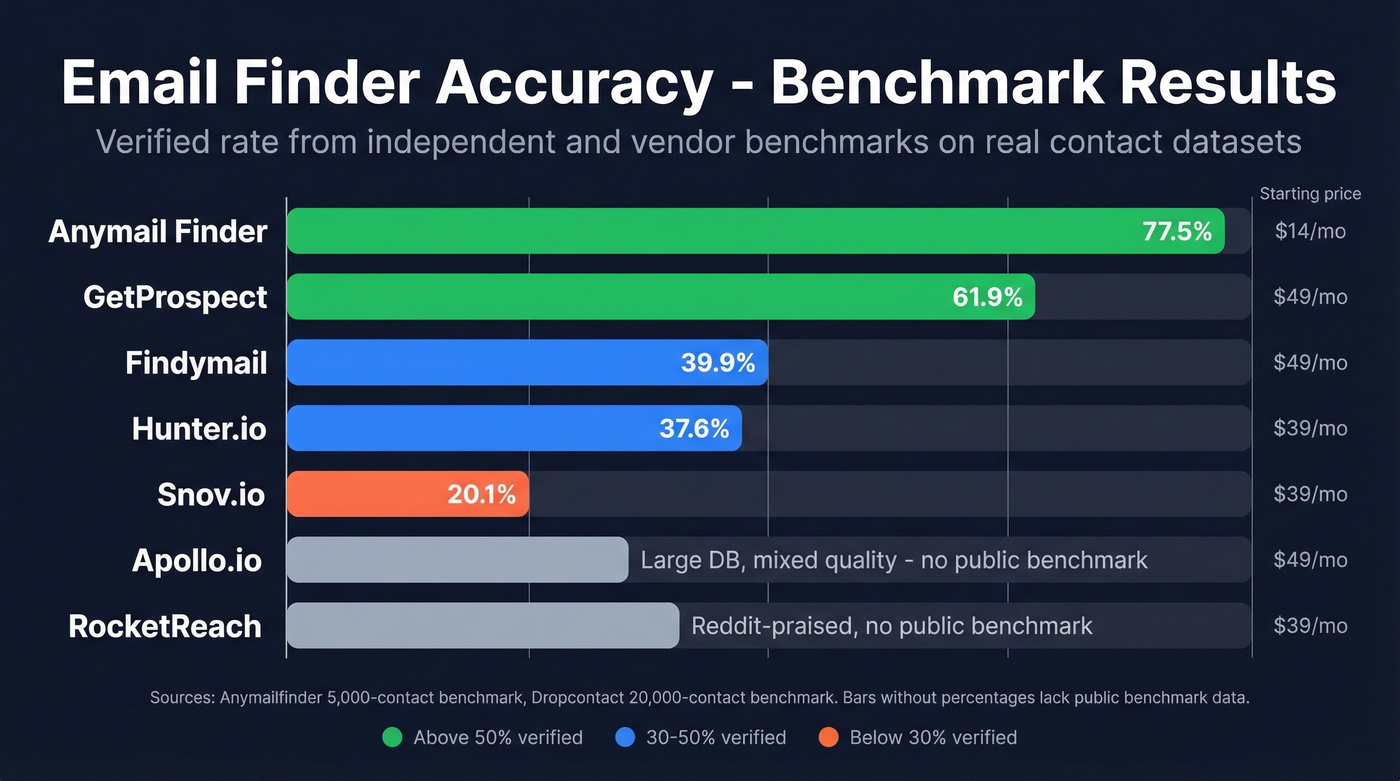
The honest assessment: Hunter works better as a verification layer than a primary source. The r/coldemail community describes the database as pretty small, and benchmark testing backs that up - Hunter hit a 37.6% verified rate on a 5,000-contact test, putting it in the bottom half of tools tested. Paid plans start around $39/mo for ~1,000 requests. Pair it with a larger database and it's great. Rely on it alone and you'll run dry fast. (If you're comparing options, see our Hunter alternatives.)
Snov.io
Snov.io works well for teams prospecting outside North America. Reddit users consistently praise it for international leads and affordable credit pricing. The built-in automation features mean you don't need a separate outreach platform, which saves both money and integration headaches. For enterprise budgets focused specifically on EU/UK data, Cognism is also worth evaluating - but at a much higher price point.
The free tier offers 50 email searches per month. Plans start at $39/mo. Benchmark testing showed a 20.1% verified rate on a larger dataset, so real-world performance depends heavily on your target geography.
Apollo.io - The Elephant in the Room
You can't write about email finding without mentioning Apollo. It has one of the largest databases in the space at 250M+ contacts, and it has a free tier.
But Reddit sentiment tells a consistent story: "big database" paired with "data feels bad sometimes." Multiple users in r/coldemail report high bounce rates despite Apollo's volume. If your deal sizes are small and you need quantity over precision, Apollo works. For anything where deliverability matters, the data quality gap catches up with you. Plans start at $49/mo.
RocketReach
A user in r/coldemail tested multiple tools and landed on RocketReach as their pick, reporting that bounces "dropped a lot" compared to alternatives. Where RocketReach shines is with limited input data - just a name and company - which matters when you're prospecting outside well-documented enterprise accounts. Plans typically run $39-99/mo depending on volume.
Anymail Finder
The standout feature: pay-only-for-valid billing. You get free credits to try the service, and plans start at $14/month. In a 5,000-contact benchmark, Anymail Finder topped the chart at a 77.5% verified rate. Yes, it's a vendor-run benchmark, but the methodology is transparent and the dataset is large enough to be meaningful. Strong catch-all handling makes it a reliable secondary source alongside a larger database.
Findymail
Findymail chains multiple data sources together in a waterfall enrichment approach to maximize coverage. In the Dropcontact benchmark of 20,000 real contacts, Findymail hit a 39.9% real enrichment rate with just a 1.1% hard bounce rate - strong deliverability numbers. The wrong-domain rate of 5.2% is worth watching, though. Basic plans start at $49/mo for 1,000 credits, Starter at $99/mo for 5,000.
Budget Options
GetProspect offers 50 free emails per month and hit a 61.9% verified rate in benchmark testing. Paid plans start at $49/month. Skrapp.io scored 42.8% in the same benchmark; it handles catch-all domains but you'll want a secondary verification step (see our guide to Bouncer alternatives), with plans around $39/mo. For the truly budget-conscious, Vocus.io starts at just $5/mo and includes basic email finding alongside its outreach features.
Tool Comparison
| Tool | Best For | Accuracy Signal | Starting Price | Billing |
|---|---|---|---|---|
| Hunter.io | Free verification | 37.6% (benchmark) | ~$39/mo | Per-request |
| Snov.io | International leads | 20.1% (benchmark) | $39/mo | Per-credit |
| Apollo.io | High-volume prospecting | Large DB, mixed quality | $49/mo | Per-seat |
| RocketReach | Sparse contact data | Reddit-praised | $39/mo | Per-lookup |
| Anymail Finder | Pay-for-valid model | 77.5% (benchmark) | $14/mo | Pay-for-valid |
| Findymail | Max coverage | 39.9% enrichment, 1.1% bounce | $49/mo | Per-credit |
| GetProspect | Budget prospecting | 61.9% (benchmark) | $49/mo | Per-email |

You just read that most email finders deliver 20-40% bounce rates despite claiming 95%+ accuracy. Prospeo's 5-step verification - with catch-all handling, spam-trap removal, and honeypot filtering - delivers 98% email accuracy. Snyk dropped from 35-40% bounces to under 5%. Meritt went from 35% to under 4%.
Find email addresses that actually survive a live send.
Manual methods work for 10-15 lookups a week. After that, you're burning hours on Google dorking and newsletter tricks. Prospeo covers 143M+ verified emails across 300M+ profiles, refreshed every 7 days - not the 4-6 week industry average. At $0.01 per verified email with no contracts, the math isn't close.
Stop guessing patterns. Start sending to verified addresses.
How Accurate Are Email Finders, Really?
Let's be honest: the accuracy claims in this space are a mess.

The Dropcontact benchmark tested 15 tools on 20,000 real contacts (9,800 US / 9,700 Europe / 500 RoW) and actually sent emails to every found address. The top performer hit 54.9% real enrichment. Most tools landed between 30-50%. That "real enrichment rate" already subtracts hard bounces and wrong-domain emails, meaning the raw numbers looked even worse before cleanup.
A separate 5,000-contact benchmark showed verified rates ranging from 16.9% all the way to 77.5% depending on the tool. The spread is enormous, and it highlights something important: benchmark methodology matters as much as the results. Tools that use proprietary verification infrastructure and weekly data refreshes perform differently under third-party test conditions than they do in production, where their own verification pipeline handles each lookup in real time.
The wrong-domain problem deserves more attention than it gets. This is when a tool finds a valid email - just not at the right company. Findymail showed 5.2% wrong-domain emails in the Dropcontact benchmark. Fullenrich hit 11.7%. Your message lands in someone's inbox, but it's the wrong someone. Most people never check for this.
Here's what matters when you're evaluating these numbers: email finders typically return three statuses - valid (the mailbox exists and accepts mail), risky/catch-all (the server accepts everything, so the tool can't confirm the specific address), and invalid (the mailbox doesn't exist). A tool that counts catch-all results as "verified" will always show inflated accuracy. Look for tools that handle catch-all domains separately and don't charge you for risky results. (More on this in our email deliverability guide.)
Reddit threads in r/coldemail echo this reality. One user reported that tools showing "verified" status still produced 20%+ bounce rates in live campaigns. The label "verified" means the mailbox existed at the moment of lookup. It doesn't account for job changes, domain shutdowns, or catch-all servers that accept everything.
Data freshness matters more than initial accuracy. A tool with 70% accuracy on a weekly refresh will outperform a tool with 90% accuracy on a six-week refresh within a month. Stale data is the silent killer of outbound campaigns, and most teams don't realize it until their domain reputation is already damaged. (If you're tracking this, start with email bounce rate benchmarks and fixes.)
Pricing Breakdown
| Tool | Free Tier | Starter Price | Credits Included | Billing Model |
|---|---|---|---|---|
| Prospeo | 75 emails/mo | ~$0.01/email | Flexible | Pay-for-valid |
| Hunter.io | Up to 50 searches/mo | ~$39/mo | ~1,000 requests | Per-request |
| Snov.io | 50 searches/mo | $39/mo | 1,000 credits | Per-credit |
| Apollo.io | Free tier | $49/mo | Varies by plan | Per-seat |
| RocketReach | None | $39/mo | Varies by plan | Per-lookup |
| Anymail Finder | Free credits | $14/mo | Varies by plan | Pay-for-valid |
| Findymail | None | $49/mo | 1,000 credits | Per-credit |
| Vocus.io | Trial available | $5/mo | Daily credits + validations | Flat rate |
| Mailmeteor | Free (no sign-up) | Free | Free | Free |
Pay-for-valid billing is objectively better. If a tool charges you for emails that bounce, you're subsidizing their bad data. Over a year of outbound at scale, the savings compound fast.
Choosing the Right Tool
Stop testing 10 tools. You need one good database and one good verifier. That's it.
Solo founder or early-stage: Start with free tiers. Hunter for verification, Prospeo's 75 free emails for finding. Supplement with Google dorking and the newsletter trick. You don't need a paid plan until you're sending more than 50 emails a week.
SDR team running outbound: You need bulk enrichment with CRM integration. A 7-day data refresh means your sequences aren't hitting dead addresses, and at $0.01 per email, the unit economics work even for teams sending thousands of emails monthly. Look for native Salesforce and HubSpot integrations that push verified contacts directly into your workflows. (If you're standardizing your stack, start with the best SDR tools.)
Agency at scale: You need an API, a verification layer, and probably a waterfall approach. Use a high-accuracy enrichment backbone, then layer Findymail or Anymail Finder as a secondary source for coverage gaps. Your clients' domain reputation depends on your data quality - bounce rates above 5% will get noticed. (For more, see data enrichment services.)
Compliance Basics
Finding someone's email is legal in most B2B contexts. Under GDPR's legitimate interest basis, you can email business contacts as long as you offer a clear opt-out mechanism. CAN-SPAM requires a physical mailing address and a working unsubscribe link in every email.
The bigger risk isn't legal - it's deliverability. Sending to bad data damages your sender reputation, which affects every email you send afterward, including replies to existing customers. Following Google's bulk sender guidelines is non-negotiable if you're sending at any volume. A weekly data refresh cycle isn't a nice-to-have; it's the difference between reaching someone at their current company and bouncing off their old one. (If you're seeing issues, start with how to improve sender reputation.)
FAQ
Is it legal to find someone's email address?
Yes, in most B2B contexts. Under GDPR, you can contact business professionals under legitimate interest if you provide a clear opt-out. CAN-SPAM requires a physical address and unsubscribe link in every outbound email. Always honor opt-out requests immediately.
What's the most accurate email finder in 2026?
Benchmarks show massive variance - from 16.9% to 77.5% verified rates depending on the tool and test methodology. Tools with proprietary verification infrastructure and weekly data refreshes tend to outperform in real campaigns even when third-party tests show mixed results.
How can I find email addresses for free?
Google dorking, company websites, and the newsletter reply trick work for small volumes. For tool-assisted free lookups, Mailmeteor requires no signup. Hunter gives 50 free searches per month, Prospeo provides 75 free verified emails, and Snov.io offers 50 free searches.
Why do "verified" emails still bounce?
Most tools verify that a mailbox exists at the moment of lookup, but people change jobs, companies shut down domains, and catch-all servers accept everything indiscriminately. Weekly data refresh cycles and proper catch-all handling reduce this significantly - stale data is the primary culprit behind post-verification bounces.
Can I find personal email addresses with these tools?
Most B2B email finders focus on professional work emails. Locating personal Gmail or Yahoo addresses is possible with some tools but raises stronger privacy concerns and delivers lower response rates for business outreach. Stick to work emails for B2B campaigns.