

FINTRX vs Apollo.io: Different Tools for Different Jobs
Family office AUM is projected to grow from $3.1T to $5.4T by 2030. The data tools serving this market matter more every year - and the FINTRX vs Apollo.io question comes up every renewal cycle. Your fund's distribution team gets the FINTRX quote, someone on the sales floor asks "Can't we just use Apollo for $50 a month?", and the conversation stalls.
Here's the thing: these tools don't do the same thing. One is a wealth intelligence platform for a narrow vertical. The other is a horizontal B2B prospecting engine built for volume outbound. Comparing them head-to-head is a bit like comparing a scalpel to a Swiss Army knife - both cut, but that's where the similarity ends.
30-Second Verdict
- Pick FINTRX if you sell into RIAs, family offices, or wealth advisors and need relationship mapping, AUM data, and custodian filters. Nothing else goes this deep on the wealth vertical.
- Pick Apollo.io if you run general B2B outbound and need a 210M+ contact database plus outbound workflows at a fraction of the cost.
Side-by-Side Comparison
| Dimension | FINTRX | Apollo.io |
|---|---|---|
| Data Focus | Wealth management | General B2B |
| Database Size | 780,000+ registered reps | 210M+ contacts |
| Pricing | ~$5K-$20K/yr | $49-$119/user/mo (annual billing) |
| Contracts | Annual mandatory | Month-to-month available |
| CRM Integrations | Salesforce, HubSpot, Microsoft Dynamics, Snowflake, API feeds | Salesforce, HubSpot, and others |
| G2 Rating | 0.0/5 (1 review) | 4.7/5 (9,510 reviews) |
| Best For | Wealth distribution | General B2B outbound |
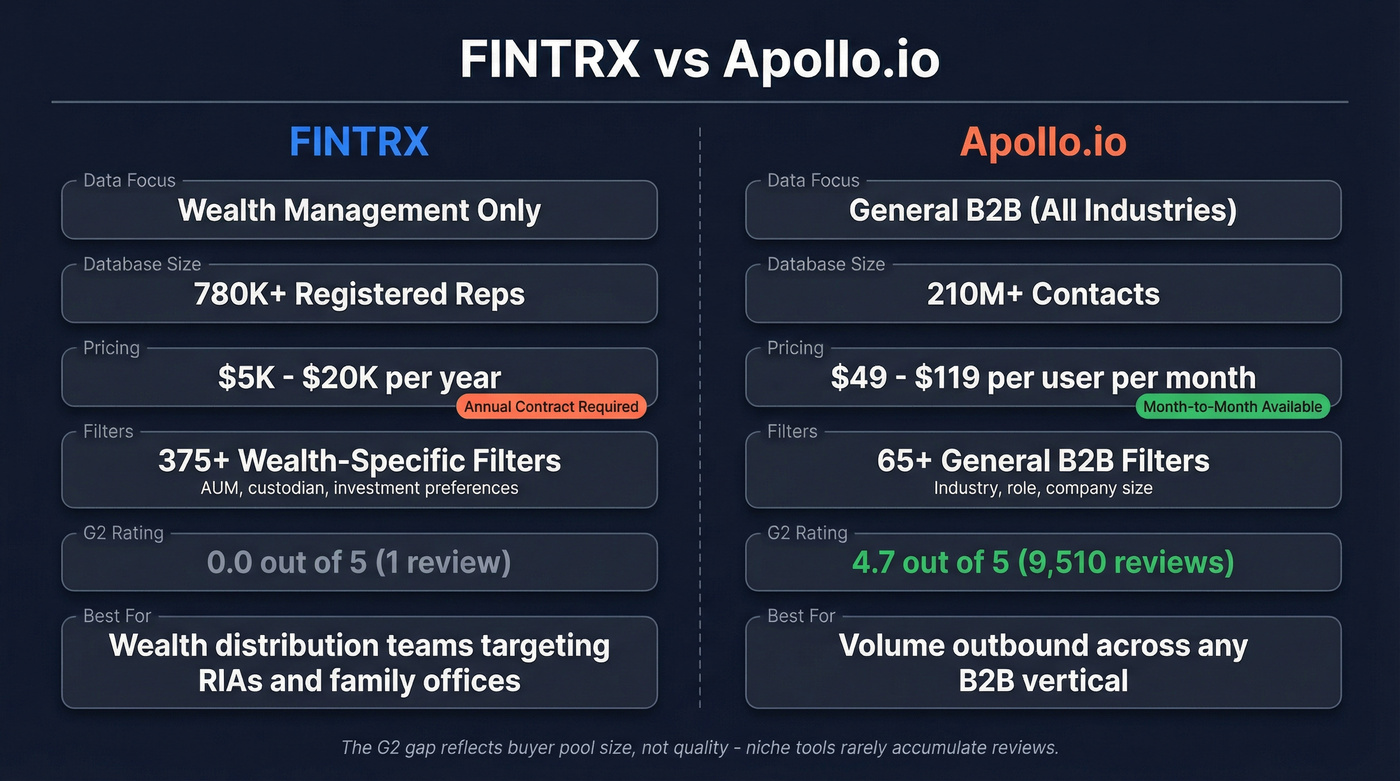
The G2 gap reflects buyer pool size, not quality - niche tools rarely accumulate reviews.
Data Coverage & Depth
FINTRX tracks 44,000+ RIAs and broker-dealers, 4,400+ family offices, and 780,000+ registered reps. It offers 375+ filtering options - AUM ranges, custodian relationships, investment preferences, firm structure - with a 75+ person research team validating records daily. The platform added 440+ family offices in the past year alone and tracks $144T+ in RIA assets. For wealth distribution teams, that level of specificity is the whole point.
If you're building lists from a narrow vertical, it helps to start with clear firmographic filters before you export anything.
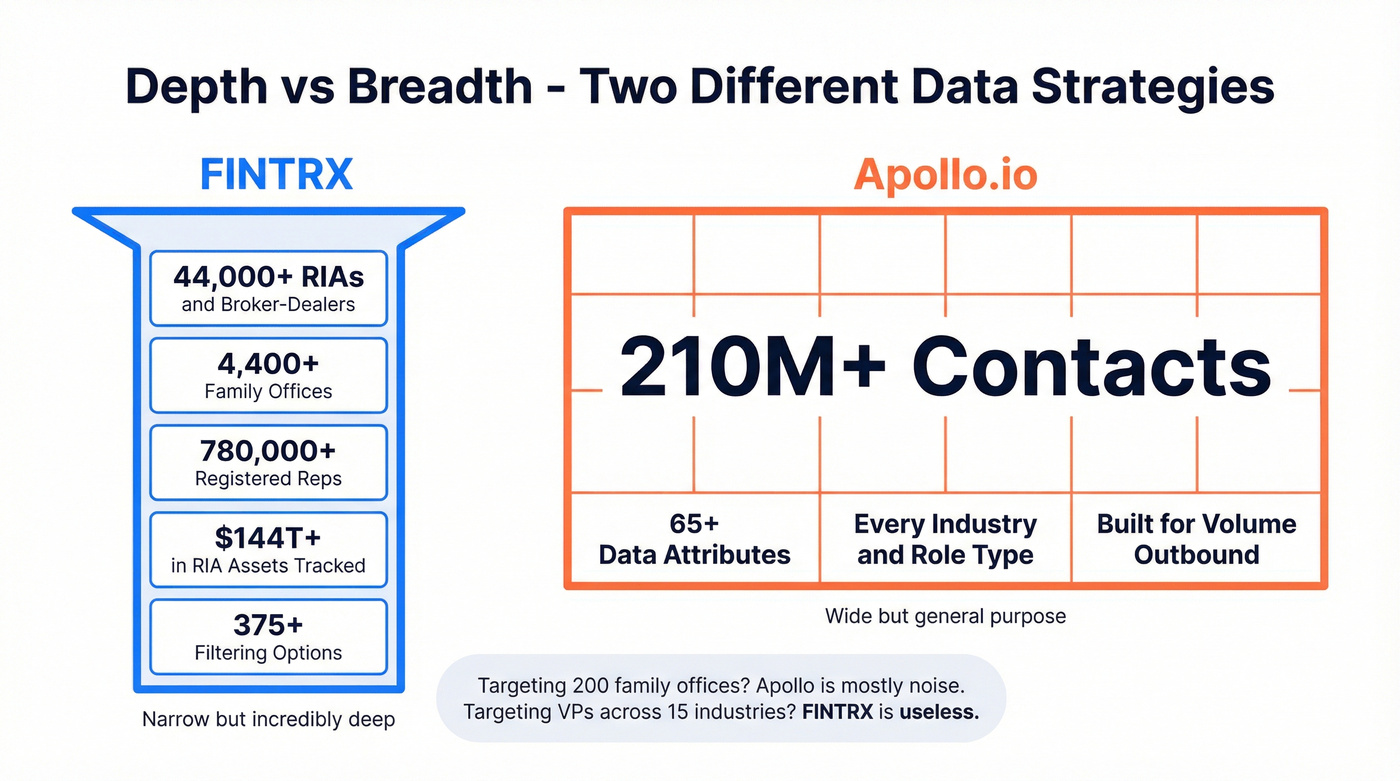
Apollo's 210M+ contacts span every industry and role type with 65+ data attributes and filters. It's built for breadth, not vertical depth.
If you're targeting 200 specific family offices, Apollo's 210M contacts are mostly noise. If you're targeting VP-level buyers across 15 industries, FINTRX is useless. Simple as that.
If you want a broader view of what’s out there, compare options in our guide to sales prospecting engine tools.

Whether you pull contacts from FINTRX or Apollo, neither guarantees deliverable emails. Prospeo's 5-step verification catches bad addresses both platforms miss - 98% accuracy, 7-day data refresh, and $0.01 per email. No annual contracts like FINTRX. No credit overages like Apollo.
Clean your wealth and B2B lists before they wreck your domain.
Data Accuracy
FINTRX's lone G2 reviewer called it "a waste of money," citing miscategorized organizations and inaccurate contacts. The same reviewer described the sales process as "buying a used car." One review isn't a trend, but it's the only independent signal available. An older Capterra review praised it as "the most detailed family office directory we have seen," so the experience clearly varies.
Apollo has enough reviews to spot patterns. On G2, "Inaccurate Data" and "Data Inaccuracy" tags appear across roughly 10% of its 9,510 reviews - that's nearly a thousand people flagging the same problem.
We've seen this play out firsthand with clients: both tools can surface great leads, but you still need to verify contact data before you send. Bounce rates above 5% wreck sender reputation fast, and neither platform guarantees the kind of real-time verification that keeps you safe. If you’re troubleshooting this, start with email bounce rate benchmarks and fixes.
Pricing & Contracts
FINTRX doesn't publish pricing. Expect a mandatory annual contract. Third-party estimates from Dakota's advisor database roundup place costs at $5,000-$20,000/year depending on modules and seats, with access limited to 10 seats per company. No public pricing is a red flag for smaller teams who want to evaluate before committing.
If you’re comparing vendors, it’s worth pressure-testing the total cost against other data enrichment services you may already pay for.
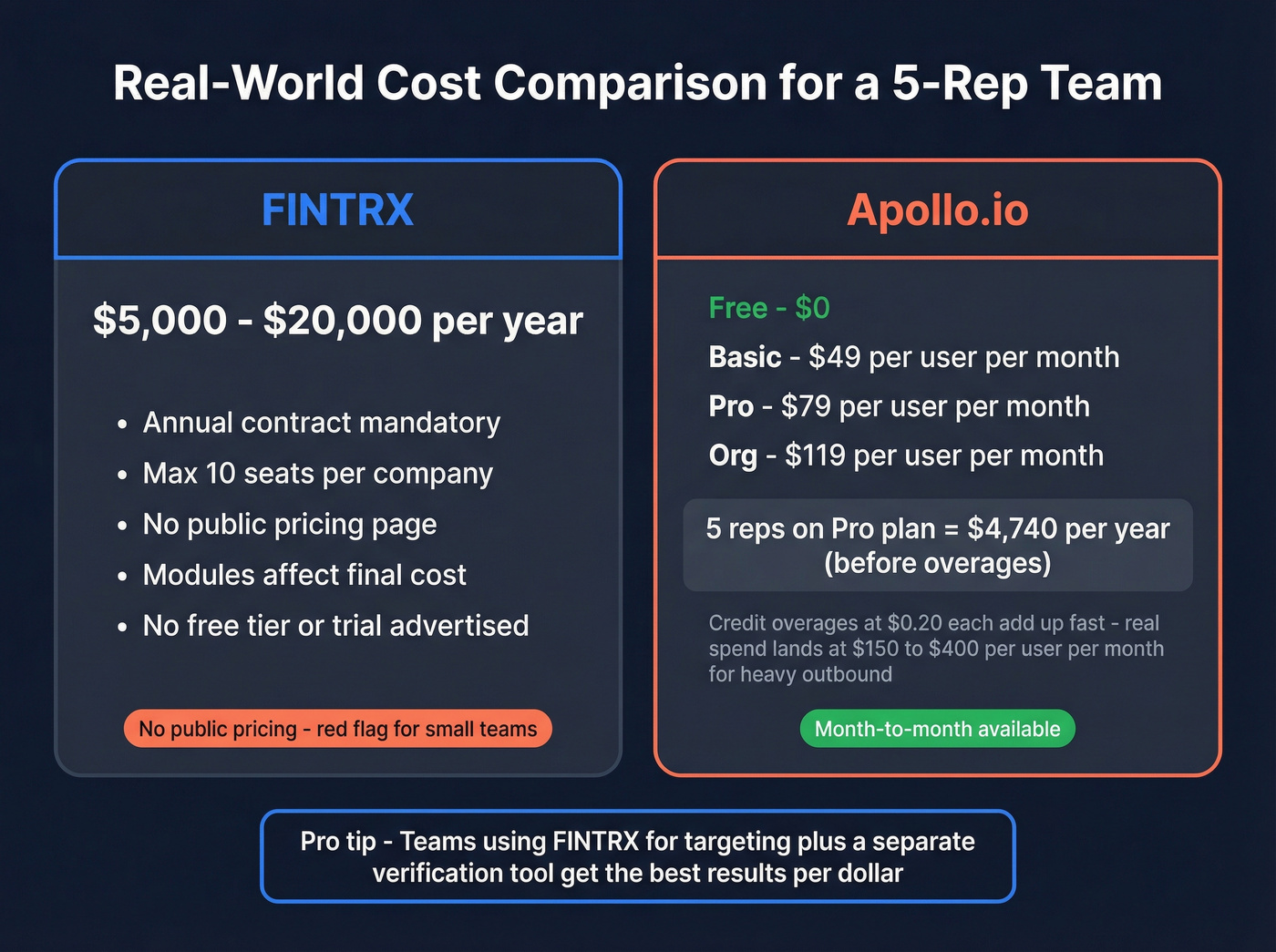
Apollo plans run Free, Basic at $49, Professional at $79, and Organization at $119 per user per month on annual billing. Credits complicate the math: Basic gives 75 mobile credits/month, Pro gives 100, Org gives 200. Overages cost $0.20/credit with a 250-credit minimum, so for heavy outbound teams, real-world spend lands at $150-$400/user/month once you factor in the extras.
A 5-rep team on Apollo Pro runs $4,740/year before overages. FINTRX is commonly budgeted in the $5K-$20K/year range. In our experience, teams that use FINTRX for targeting and verify contacts through a separate tool get the best results per dollar spent.
Which One Do You Need?
Wealth distribution team selling into RIAs and family offices? FINTRX, no contest. The relationship mapping, AUM filters, and custodian data are exactly what it's built for. If FINTRX is too expensive, look at Discovery Data or AdvizorPro as wealth-vertical alternatives.
If you’re running a tighter list-based motion, you’ll get more mileage from account-based selling than pure volume outbound.
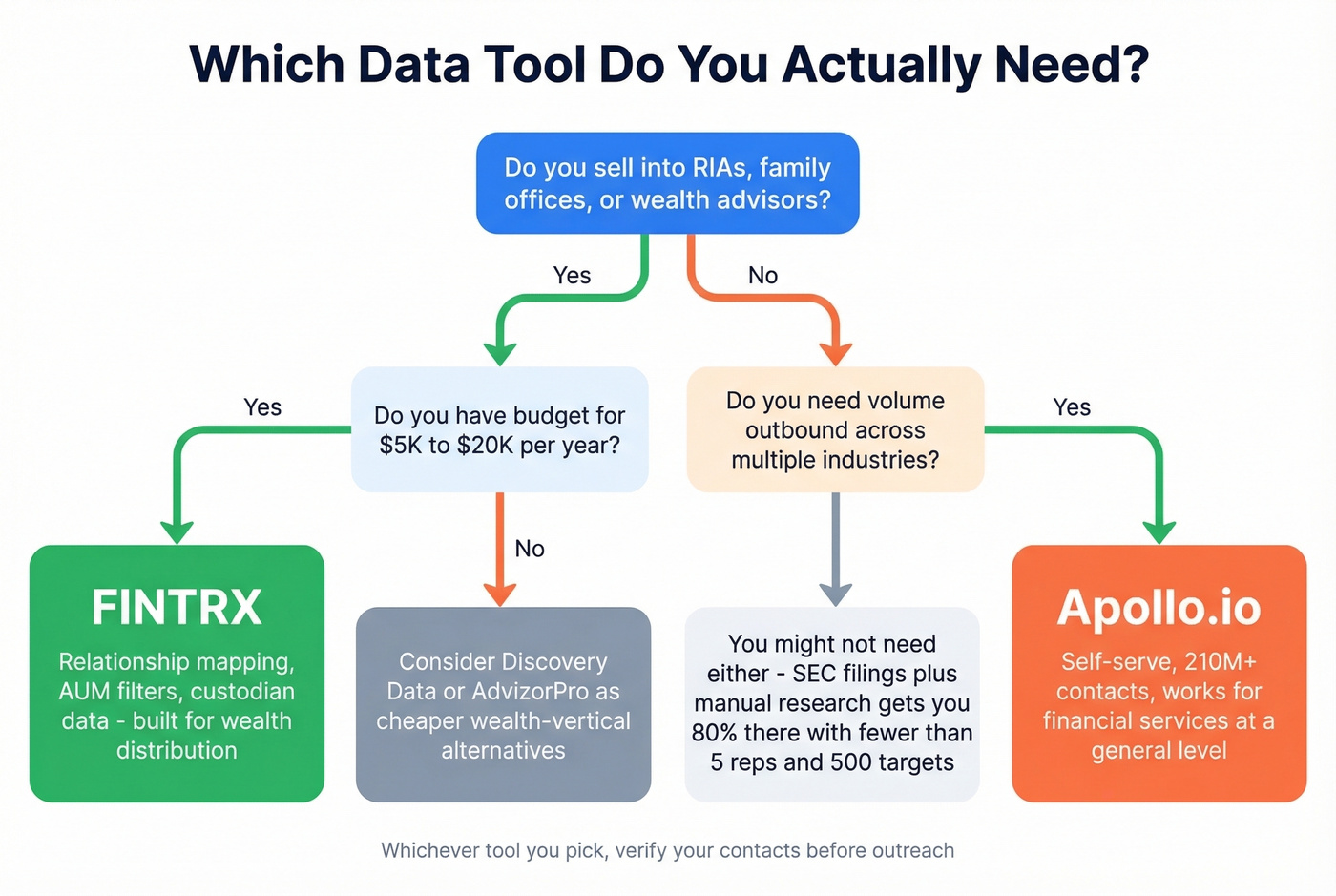
General B2B outbound that includes some financial services contacts? Apollo. It's cheaper, self-serve, and 389 financial services reviewers on G2 confirm it works for the sector - just not at FINTRX's level of wealth-specific targeting.
If you’re building a repeatable outbound motion, pair your database with proven sales prospecting techniques so reps don’t waste credits.
Let's be honest: if you have fewer than 5 reps targeting fewer than 500 wealth firms, you probably don't need either platform. SEC filings plus a solid B2B data tool plus manual research gets you 80% there.
Verify Before You Outreach
Both FINTRX and Apollo.io have documented accuracy issues, and we've watched teams burn through domains because they skipped verification. Before launching any campaign, run your list through Prospeo's email verification - 300M+ profiles, 98% email accuracy, and a 7-day data refresh cycle versus the 6-week industry average. It integrates natively with Salesforce and HubSpot, costs about $0.01 per email, and offers a free tier starting at 75 emails/month. No contracts, no sales calls. Upload a CSV, get verified results in minutes, and protect your sender reputation before you hit send.
If you’re scaling volume, also watch email velocity so verification gains don’t get erased by sending behavior.

Running a bake-off between FINTRX and Apollo? Export both lists and verify them through Prospeo first. 300M+ profiles, 98% email accuracy, and bounce rates under 4% - proven across 15,000+ companies. Start with 75 free verifications, no credit card required.
One bad list costs more than a year of verification. Start free.
FAQ
Can Apollo.io replace FINTRX for wealth management prospecting?
No. Apollo covers broad B2B prospecting, while FINTRX is purpose-built for wealth intelligence - including relationship mapping and wealth-specific filters like AUM and custodian data. You'll find contacts at financial firms in Apollo, but not the depth distribution teams rely on FINTRX for.
Does FINTRX offer a free trial?
FINTRX doesn't advertise a free trial. Expect a mandatory annual contract budgeted around $5,000-$20,000/year depending on modules and seats, with access limited to 10 seats per company. Request a demo directly to negotiate terms.
How do I verify contacts exported from either platform?
Upload your CSV to a verification tool like Prospeo, which checks emails in real time with 98% accuracy and a 7-day refresh cycle. This catches bounces before they damage your sender reputation - results come back in minutes so you're only sending to verified addresses.