

Firmographic Targeting: The Practitioner's Guide to Getting It Right
88% of B2B marketers already use third-party firmographic data. The other 12% are either pre-revenue or leaving money on the table.
The U.S. alone has over 70 million businesses - without firmographic targeting, you're marketing to all of them, which is the same as marketing to none of them. The concept is straightforward: filter companies by attributes like industry, headcount, revenue, and location to focus sales and marketing on accounts that actually look like your best customers. The variables that matter most? Start with three or four - not twelve. Tightening firmographic filters can drive conversion rates up to 40% higher than broad-market campaigns, and bad data costs the average company $12.9M per year.
What Is Firmographic Targeting in B2B?
Think of it as the B2B equivalent of demographic targeting. Instead of segmenting people by age, income, or location, you're segmenting companies by characteristics like industry classification, employee count, annual revenue, and headquarters location. It's the foundation of any account-based or outbound strategy.
One distinction worth making early: firmographics tell you who a company is. Technographics tell you what tools they use. Intent data tells you when they're actively researching. Combining technographics and firmographics gives you a far more complete picture, but firmographics come first - they define the universe you're working within.
Core Firmographic Variables
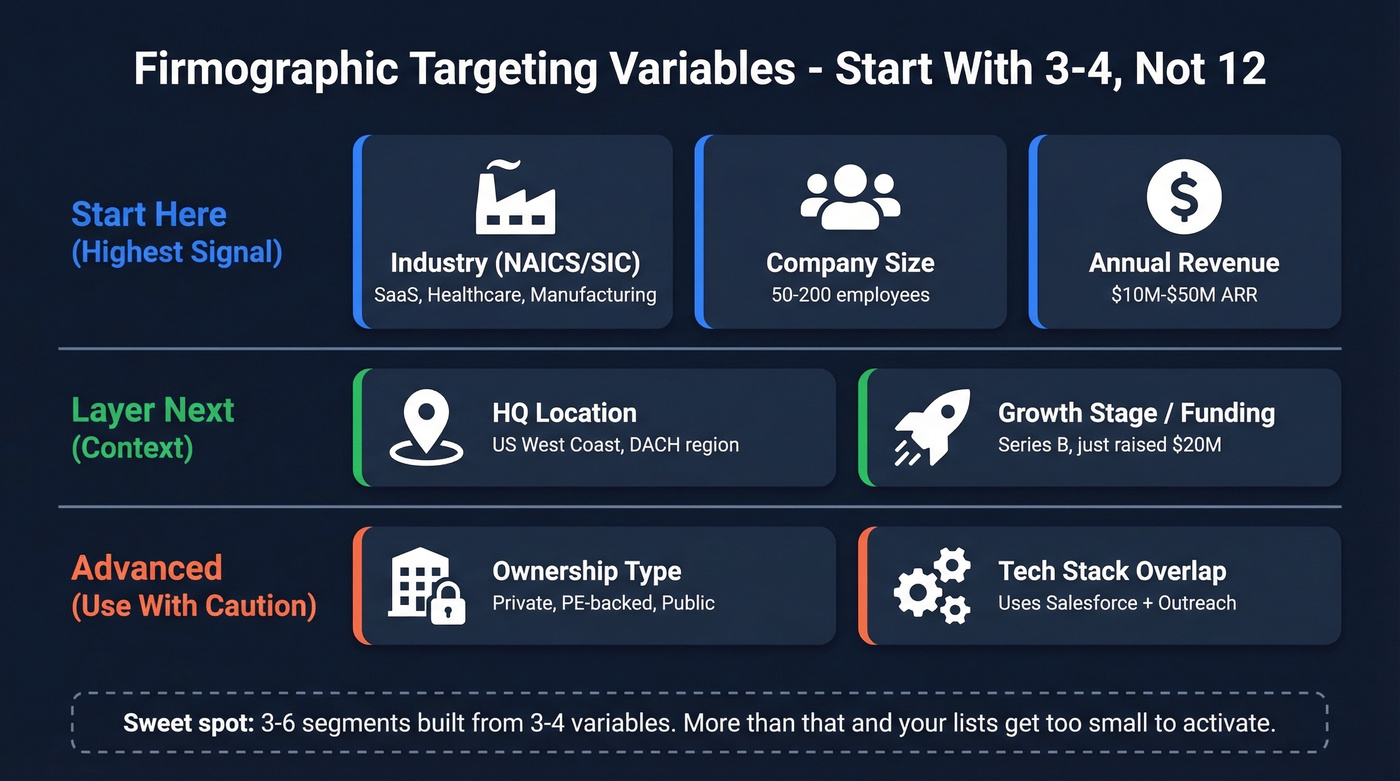
Over-segmentation kills more campaigns than under-segmentation. Start with three or four variables most predictive of conversion for your business, then layer more as your data matures.
| Variable | Description / Example |
|---|---|
| Industry (NAICS/SIC) | Market vertical - SaaS, manufacturing, healthcare |
| Company size | Scale and complexity - 50-200 employees |
| Annual revenue | Budget capacity - $10M-$50M ARR |
| HQ location | Geo relevance, compliance - US West Coast, DACH region |
| Growth stage / funding | Buying readiness - Series B, just raised $20M |
| Ownership type | Decision structure - private, PE-backed, public |
| Tech stack overlap | Solution fit - uses Salesforce + Outreach |
Here's the thing: the temptation is to use all seven at once. Don't. A RevOps team we worked with spent weeks building 24 micro-segments and ended up with lists too small to run meaningful campaigns against. Three to six segments built from three to four variables is the sweet spot for most teams, and we've seen this pattern repeat across dozens of engagements.
Why Data Quality Makes or Breaks It
The conversion lift from firmographic segmentation isn't uniform across industries. B2B SaaS sees 20-35% opportunity-to-close rates; industrial manufacturing hits 25-45%. Accurate firmographic data ensures you're benchmarking against the right vertical, not an average that obscures what's actually working.
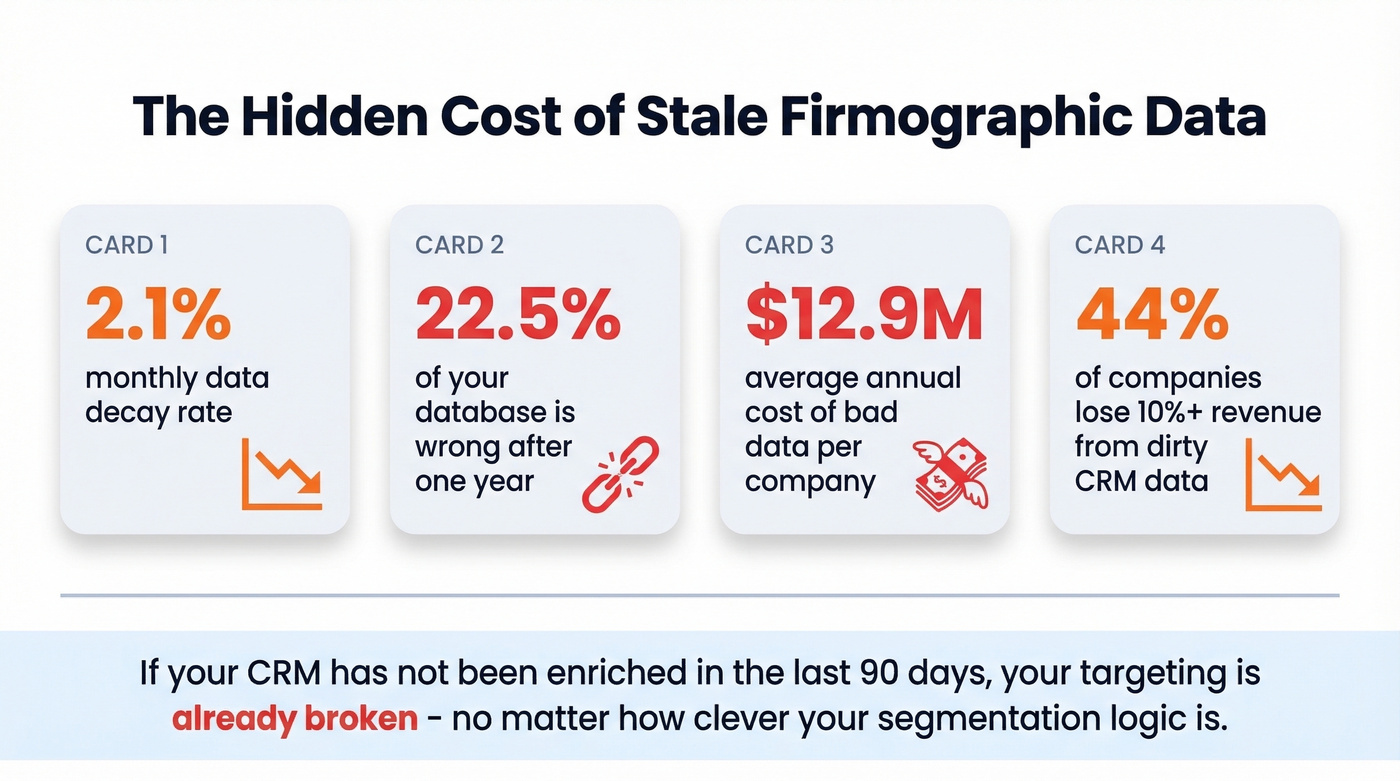
The decay problem is equally real. B2B contact data erodes at 2.1% per month - 22.5% annually. In extreme cases, datasets deteriorate up to 70.3% per year. And 44% of companies lose more than 10% of annual revenue from low-quality CRM data. Even if your segmentation was perfect six months ago, a quarter of your data is already wrong.
Most teams over-invest in finding new leads and under-invest in keeping existing data clean. If your CRM hasn't been enriched in the last 90 days, your targeting is already broken - no matter how clever your segmentation logic is.
Building Your Strategy Step by Step
Here are the actual steps, in order.
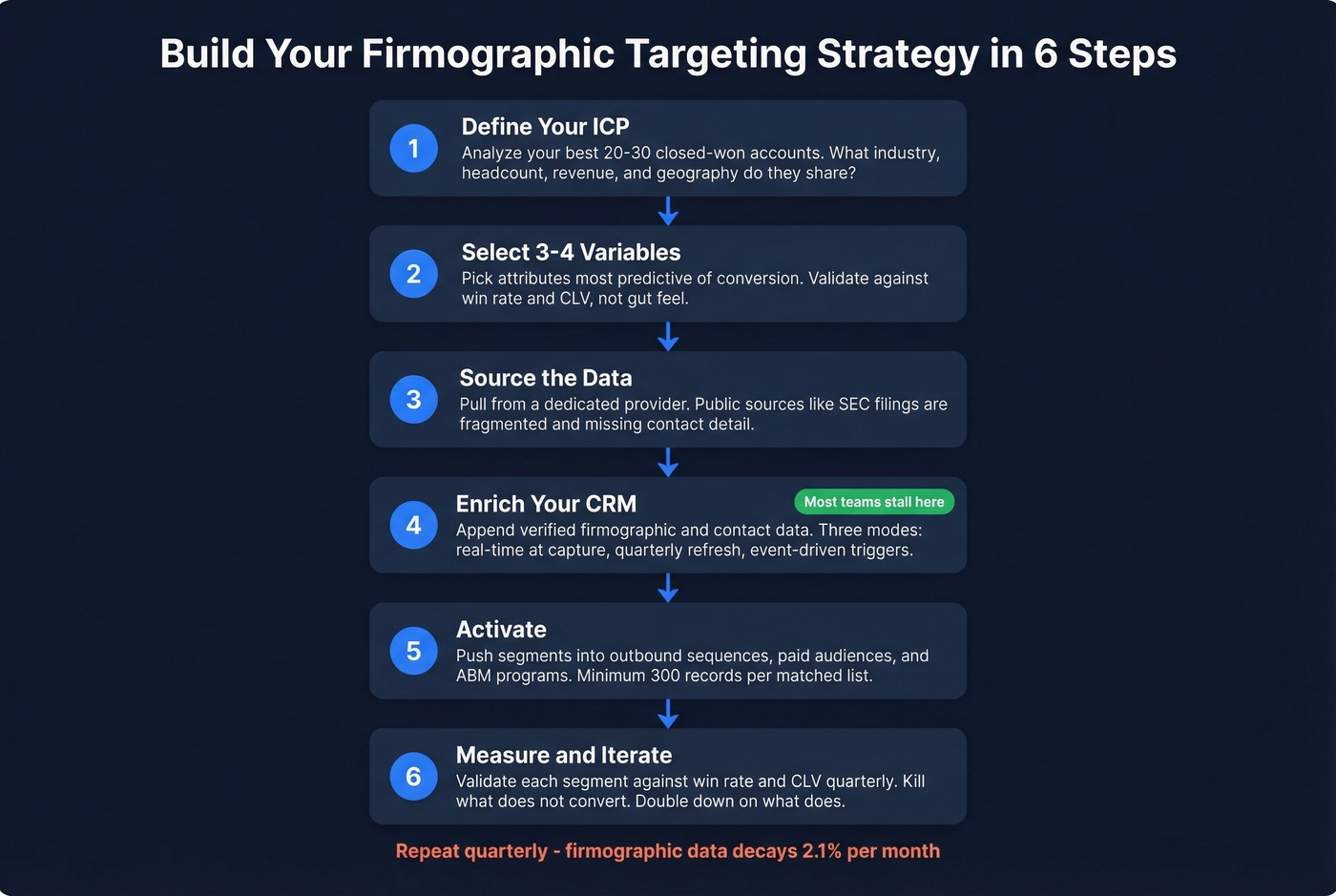
1. Define your ICP. Look at your best 20-30 closed-won accounts. What do they have in common? Industry, headcount range, revenue band, and geography are the usual starting points. You want to find companies by industry and size that mirror your top customers. (If you need a template, start with an Ideal Customer Profile.)
2. Select three to four variables. Pick the attributes most predictive of conversion. In our experience, three variables is enough to start - validate against win rate and customer lifetime value, not gut feel.
3. Source the data. Pull firmographic data from a dedicated provider. Public sources like SEC filings and SBA databases exist, but they're fragmented and missing contact-level detail. If you're comparing vendors, start with a ranked list of the best B2B database options.
4. Enrich your CRM. This is where most teams stall. You need an enrichment workflow that appends verified firmographic and contact data to existing records - and refreshes it on a cadence that outpaces decay. Think about enrichment timing in three modes: real-time enrichment that fires at lead capture, scheduled quarterly refreshes that keep your active pipeline clean, and event-driven enrichment that triggers when signals like funding rounds or leadership changes hit. (More on why this matters in the benefits of data enrichment.)
5. Activate. Push enriched segments into outbound sequences, paid audiences, and ABM programs. For paid channels, upload matched audience lists with a minimum of 300 records. Matched lists consistently outperform native platform filters on channels like LinkedIn. If you're building outbound motions, align this with your broader B2B prospecting strategies.
6. Measure and iterate. Validate each segment against win rate and CLV quarterly. Kill segments that don't convert. Double down on the ones that do.

Your firmographic targeting is only as good as your data. With 22.5% annual decay, stale records silently destroy even the best segmentation. Prospeo refreshes all 300M+ profiles every 7 days - not every 6 weeks - so your ICP filters actually hit real, reachable buyers. Enrich your CRM with 50+ data points per contact at 98% email accuracy for ~$0.01/email.
Stop targeting ghost accounts. Get data that's less than a week old.
Where to Get Firmographic Data
A common question in practitioner communities: which third-party data sources are legitimate? The vendor landscape is genuinely confusing - one Reddit poster noted that even Dun & Bradstreet's offerings feel "very complicated."
| Provider | Database Size | Starting Price | Best For |
|---|---|---|---|
| Prospeo | 300M+ profiles | Free tier; ~$0.01/email | Email accuracy + freshness |
| Apollo.io | 275M+ contacts | $49/user/mo | SMB all-in-one |
| Lusha | 100M+ profiles | $29.90/mo | Small team entry point |
| Cognism | 400M+ contacts | ~$1K-$3K/mo | EMEA + verified mobiles |
| ZoomInfo | 410M+ contacts | ~$15K-$40K/yr | Enterprise prospecting |
| Clearbit (Breeze) | 350M+ contacts | $30-$700/mo | HubSpot enrichment workflows |
| 6sense | 1T+ signals/day | Not public | Enterprise ABM + intent |
Prospeo's B2B database lets you search prospects by company size, funding stage, revenue, technographics, and intent data across 15,000 topics - over 30 filters in total. Email accuracy runs 98% on a 7-day refresh cycle, compared to the industry average of six weeks. Self-serve, no contracts, so you can test it against your ICP in an afternoon.

You defined your ICP. You picked three firmographic variables. Now you need a database that actually lets you filter by all of them - industry, headcount, revenue, funding stage, technographics, and buyer intent across 15,000 topics. Prospeo gives you 30+ filters, 98% verified emails, and self-serve access with no contracts or sales calls required.
Build your firmographic target list in an afternoon, not a quarter.
Beyond Static Firmographics
Firmographic targeting without intent data is like fishing with a map but no sonar. You know where the fish live, but not which ones are hungry right now.
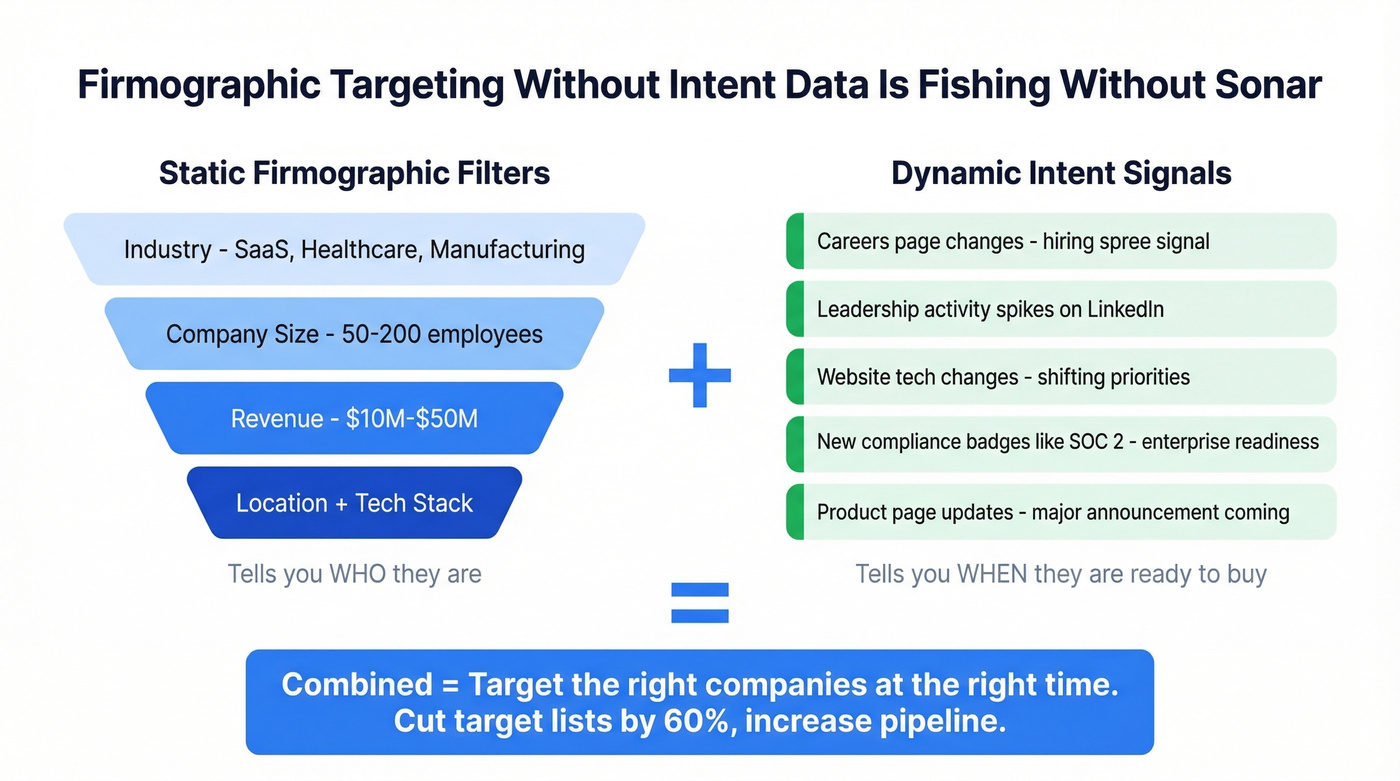
The consensus on r/LeadGeneration is that standard firmographic filters - industry, employee range, tech stack - often produce "meh" results on their own. What separates good targeting from great is layering in dynamic micro-signals: careers page changes that signal hiring sprees, leadership activity spikes on professional networks, website tech changes indicating shifting priorities, new compliance badges like SOC 2 hinting at enterprise readiness, and product page updates that often precede major announcements. If you want a framework for this layer, use a checklist of buyer intent signals.
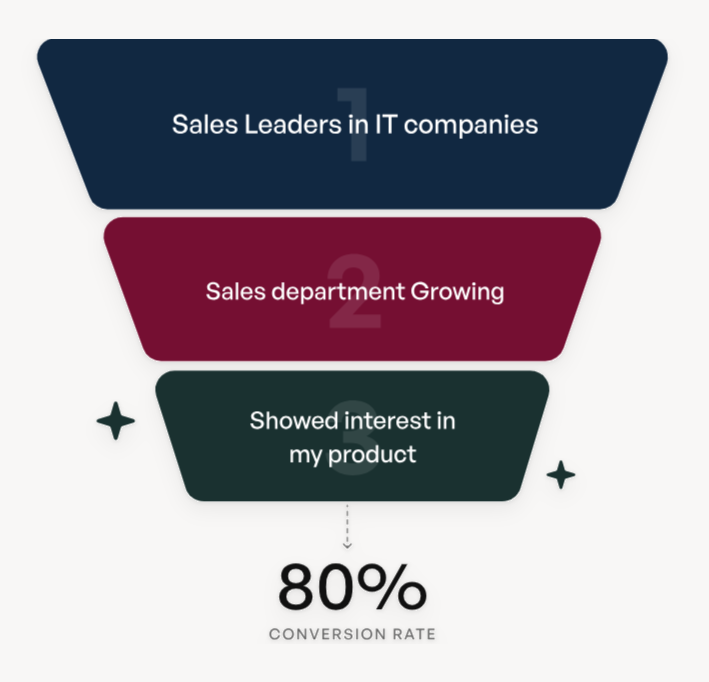
The best strategies treat company attributes as the filter and timing signals as the trigger. Skip the intent layer only if you're running pure awareness campaigns where timing doesn't matter - and let's be honest, when does timing not matter?
Real-World Use Cases
ABM powered by firmographics. Account-based marketing lives or dies by list quality. An ABM strategy built on firmographic segmentation starts with a tightly defined ICP - industry, headcount, revenue - then layers intent signals to prioritize which accounts get personalized outreach this quarter versus next. We've seen teams cut their target account lists by 60% and increase pipeline by focusing only on accounts showing active buying signals within their firmographic sweet spot. To operationalize this, map it to an account-based marketing project plan.
Paid audience building. Upload firmographic segments as matched audiences on LinkedIn or programmatic platforms to run hyper-targeted campaigns. This is one of the highest-ROI use cases because you're paying per impression - wasting budget on out-of-ICP companies is expensive.
Territory and quota planning. Sales leaders use firmographic data to size markets, assign territories fairly, and set quotas grounded in the actual number of ICP-fit accounts in each region. This is much easier when you’ve already defined your addressable market.
Competitive displacement campaigns. Filter by tech stack to find companies running a competitor's product, then target them with migration-focused messaging. If your tool integrates with Wappalyzer data or live job posting signals, you can catch companies mid-evaluation.
Common Pitfalls
Data decay without a refresh cadence. Your firmographic data loses 2.1% accuracy every month. Refresh quarterly at minimum, weekly if your tool supports it.
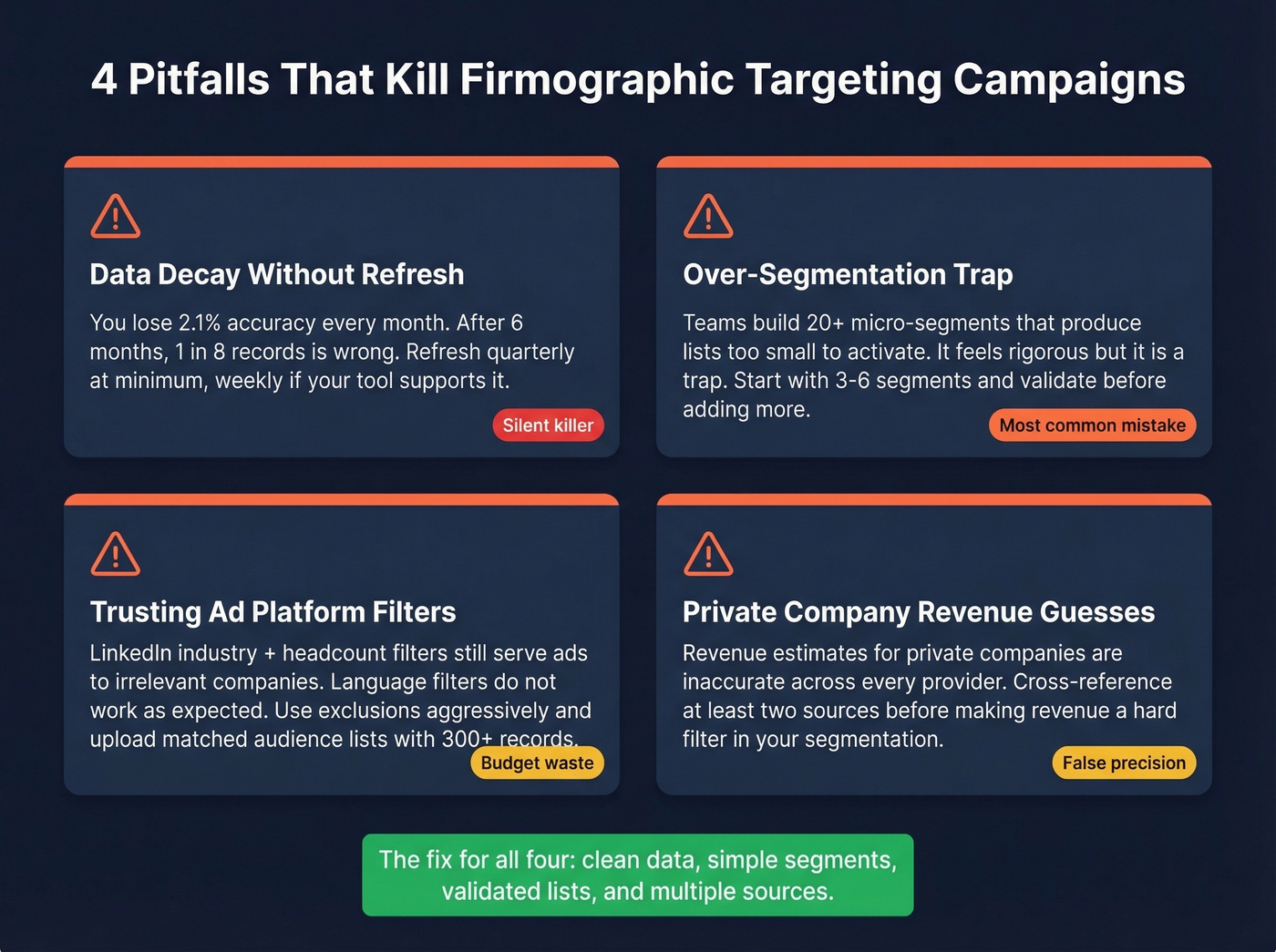
Over-segmentation. We've seen teams burn weeks building 20+ micro-segments that produce lists too small to activate. It feels rigorous. In practice, it's a trap. Start with three to six segments, validate before adding complexity, and resist the urge to slice further until you have conversion data backing the decision.
Trusting ad platform filters blindly. One LinkedIn Ads user reported setting industry + headcount + location filters and still getting clicks from irrelevant companies. Another gotcha: selecting "English" for Sponsored Content doesn't filter by language - it reaches all members in your targeted locations regardless of profile language. Use exclusions aggressively, validate with matched audience uploads, and maintain a minimum of 300 records per list.
Private company revenue estimates are notoriously inaccurate across every provider. Cross-reference at least two sources before making revenue a hard filter. If you can't verify revenue from multiple angles, use headcount as a proxy instead - it's more reliably reported and correlates well enough for initial segmentation.
FAQ
What's the difference between firmographic and demographic data?
Firmographics describe companies - industry, size, revenue, location. Demographics describe individuals - age, gender, income. In B2B, firmographic segmentation is the account-level equivalent of consumer demographic targeting.
How often should I refresh firmographic data?
Quarterly at minimum. B2B data decays 2.1% per month - 22.5% annually. Weekly refreshes prevent stale outbound data from inflating bounce rates and tanking your domain reputation.
How many segments should I create?
Three to six segments built from three to four variables. Validate each against win rate and CLV before adding complexity. More segments isn't better - actionable segments are.
Can I use firmographic targeting for LinkedIn ads?
Yes, and it's one of the most effective applications. Upload matched audience lists built from your firmographic segments rather than relying solely on LinkedIn's native filters, which can be imprecise. Minimum list size is 300 records, but aim for 1,000+ for reliable delivery and optimization.