

Firmographic vs Demographic Data: Key Differences in 2026
81% of B2B marketers use firmographic segmentation, but fewer than 25% feel they're doing it well. The core problem isn't the data itself - it's that most teams treat firmographic and demographic data as interchangeable, or pick one and ignore the other entirely. The question "does demographic data even matter in B2B, or is firmographics all I need?" keeps surfacing in r/sales and RevOps communities, and the honest answer is more nuanced than either camp admits.
Firmographics vs Demographics at a Glance
| Dimension | Firmographic | Demographic |
|---|---|---|
| Definition | Company-level traits | Individual-level traits |
| Data level | Organization | Person |
| Key variables | Industry, revenue, headcount, location | Title, seniority, department |
| Primary use | Account targeting, TAM, territory planning | Stakeholder targeting, personalization |
| Volatility | Revenue and headcount shift often; industry is stable | Job changes are frequent |
| Best for | B2B account selection | B2B buyer ID; B2C segmentation |
The one-line version: firmographics tells you which companies to pursue, demographics tells you which people inside those companies to talk to. Get one wrong and the other can't save you.
What Is Demographic Data?
Demographic data describes individuals - their personal and professional characteristics. In B2C, that's age, gender, income, education, marital status. In B2B, the variables shift toward professional attributes: job title, seniority level, department, decision-making authority, and years of experience.
This is the data that turns a faceless company into a real conversation. You're not emailing "Acme Corp" - you're emailing the VP of Engineering who's been in the role for 18 months and reports to the CTO. That distinction matters for personalization, messaging, and knowing whether you're even reaching someone who can sign a contract. And because demographic data is personal, it falls squarely under GDPR and CCPA compliance requirements.
What Is Firmographic Data?
Firmographic data describes companies the way demographics describe people. Core variables include industry (via NAICS or SIC codes), employee count, annual revenue, headquarters location, ownership structure, and years in business.
Think of it as the qualifying layer before you ever look at a person. A simple size banding - Small (<50 employees), Medium (50-500), Large (>500) - already filters your total addressable market dramatically. But firmographics goes beyond lead gen. It's foundational for TAM analysis, territory planning, lead routing rules, and strategic account prioritization. If your CRM segments don't start with firmographic filters, you're building on sand.

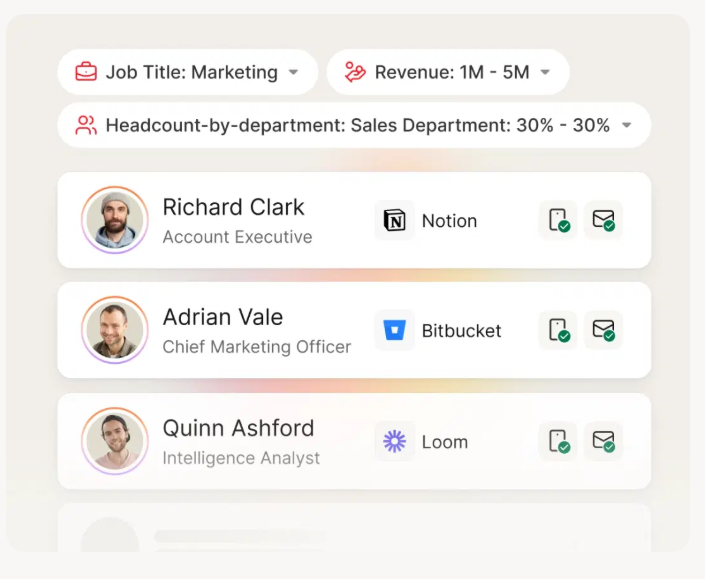
Most teams stop at firmographic filters and wonder why reply rates stall. Prospeo combines 30+ firmographic and demographic filters - industry, headcount, revenue, seniority, department - with buyer intent across 15,000 topics. All on a 7-day refresh cycle so your segments don't decay before you hit send.
Layer firmographics, demographics, and intent in one search - starting free.
Key Differences in Practice
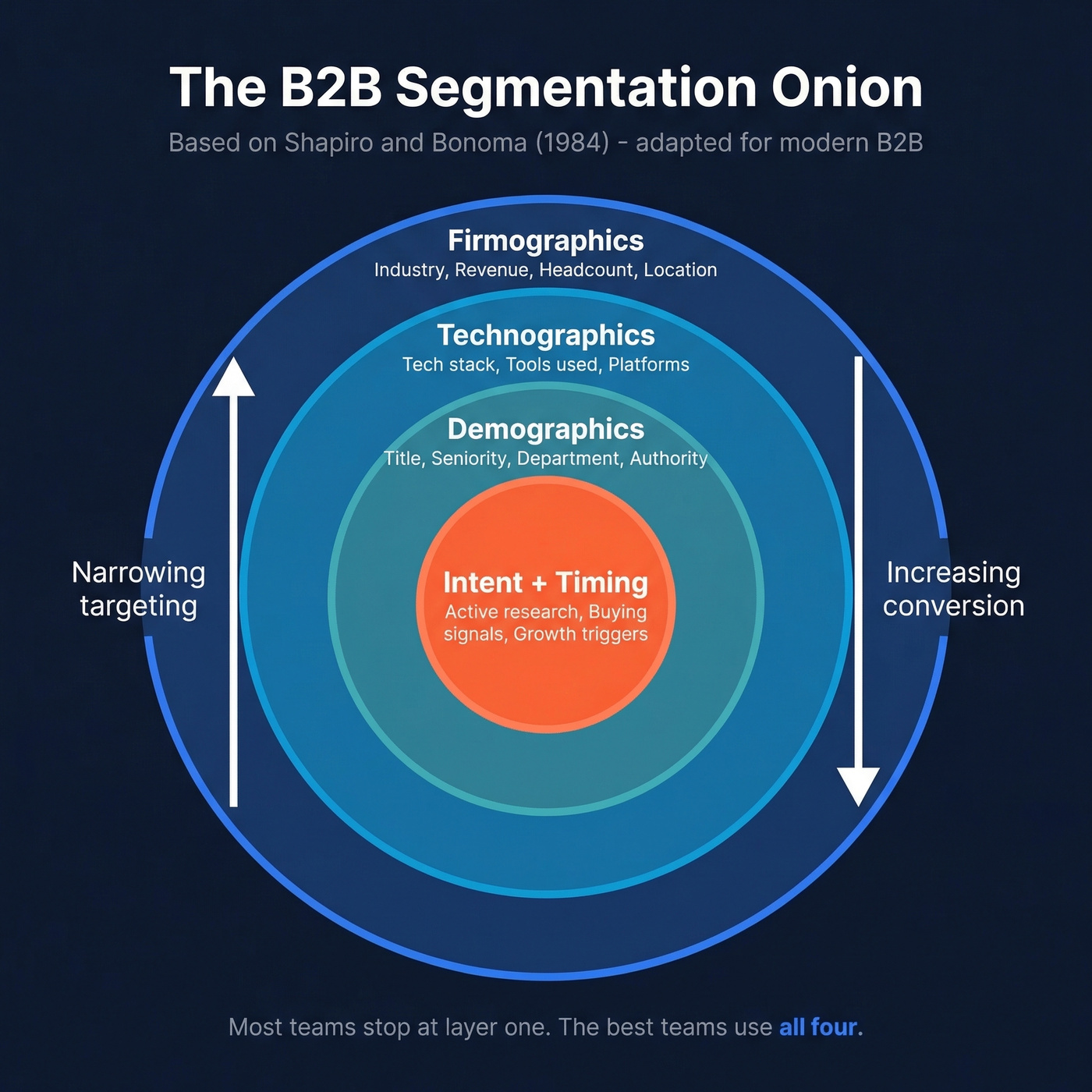
The classic framework comes from Shapiro & Bonoma's (1984) "onion" model: you start broad with firmographics, then peel inward through technographics, and finally reach demographics - who the actual buyers are. Each layer narrows your targeting. Understanding the relationship between technographics and firmographics matters here because they serve different but complementary roles in this model.
Here's where it breaks down in practice. An SDR blasts the same email to every 50-500 employee SaaS company in North America. Firmographics got them the list. But without demographic filtering - seniority, department, decision-making role - the email hits a mix of interns, individual contributors, and executives. The list looked right on paper. The people were wrong.
Technographic data acts as a critical third layer, sourced from job postings, website source code analysis, and databases like BuiltWith. Company technographics and firmographics together reveal not just who a company is but what tools they already use, so you can position around solution alignment or competitive displacement. Intent data adds timing - which of those ICP-matching accounts are actively researching your category right now.
A practical stack looks like this: firmographic, then technographic data, then demographic, with intent and timing signals layered on top. Most teams stop at layer one.
Why Most Segmentation Fails
Here's the thing: segmentation based purely on attributes - industry, title, company size - ignores the single most important variable. Timing.
The Minimum Viable Segment concept nails this. Your segment isn't "mid-market SaaS companies." It's "mid-market SaaS companies whose headcount just grew 30% and are actively evaluating your category." That's a fundamentally different list, and it converts at a fundamentally different rate.
We've seen this play out with our own outbound. If your average deal size is under five figures, you probably don't need ZoomInfo-level data infrastructure. What you do need is accurate contacts layered on top of basic firmographic filters, refreshed often enough to actually trust.
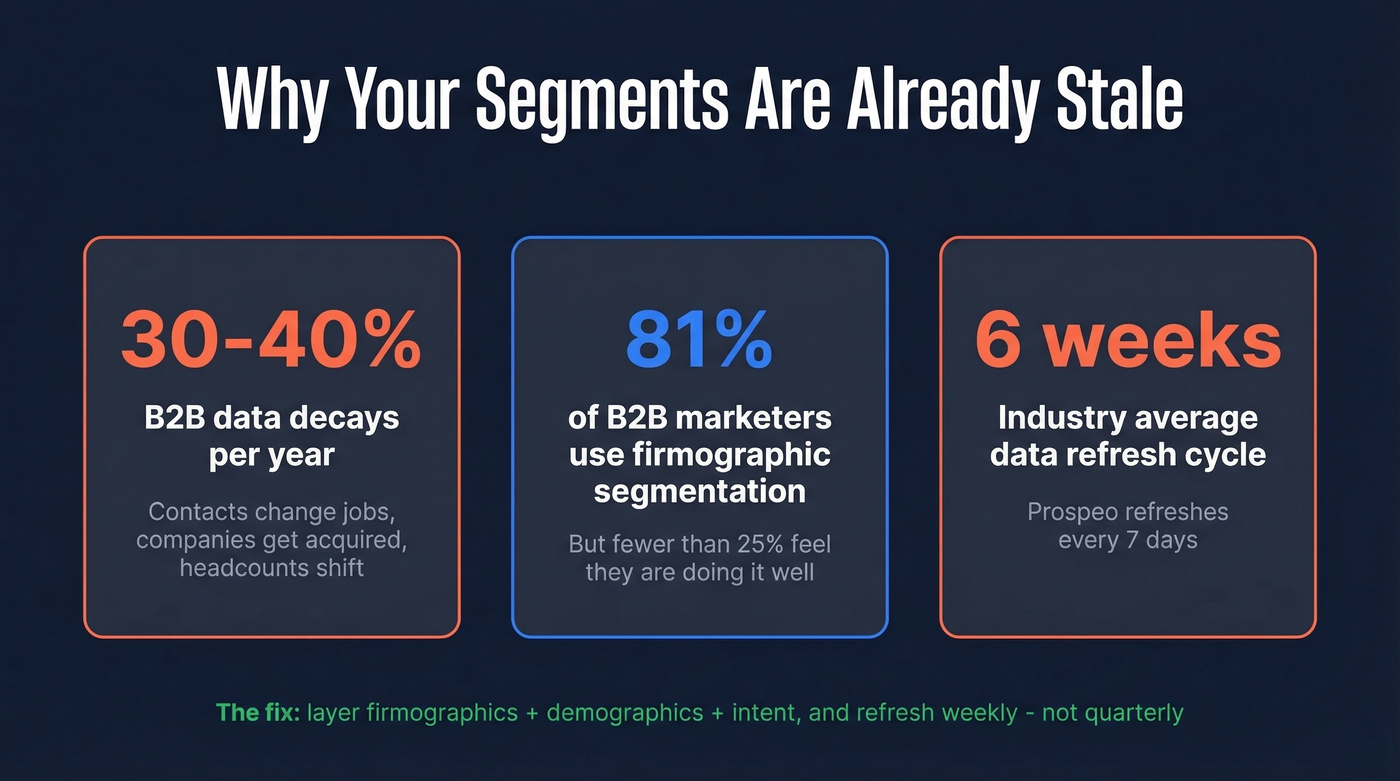
Without timing signals, even the best company-vs-person segmentation becomes spreadsheet decoration. And there's a compounding problem: B2B data decay 30-40% per year. You exported 5,000 ICP-matching accounts six months ago, but a significant chunk of those contacts have changed roles and you've got no idea which accounts are in-market.
How to Collect and Enrich This Data
For most teams under 50 reps, you don't need an enterprise data contract. You need a platform that combines firmographic filters with verified contact data and intent signals in one workflow - not three tools stitched together with CSV exports.

Prospeo
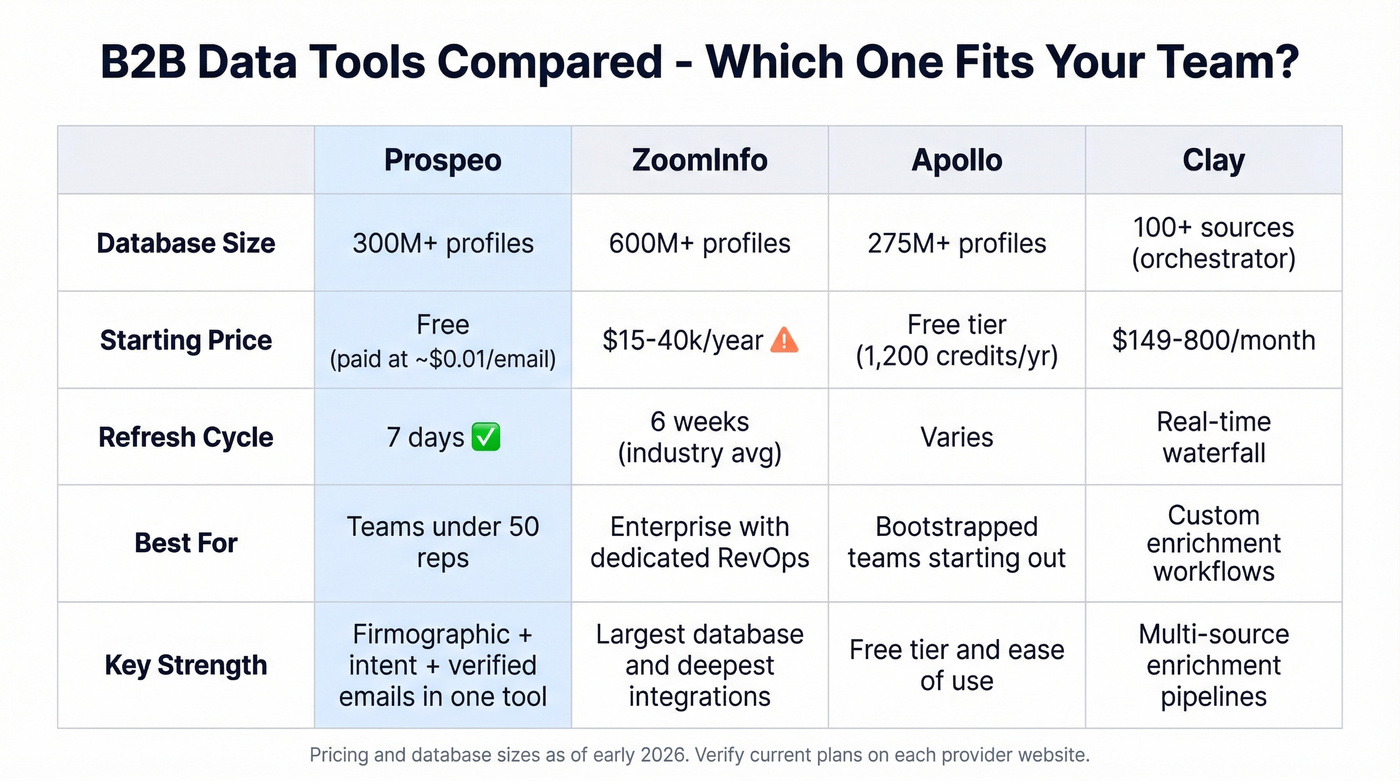
Prospeo operationalizes layered segmentation in a single self-serve platform. The database covers 300M+ professional profiles with 30+ search filters spanning industry, headcount, revenue, technographics, and buyer intent across 15,000 topics via Bombora. Email accuracy runs 98% on a a 7-day refresh cycle - compared to the industry average of six weeks. That freshness gap matters when you're building segments that depend on current headcount, recent job changes, or active buying signals. Pricing starts free, with paid plans at roughly $0.01 per email. No contracts, no sales calls required.
If you're evaluating providers, start with accuracy and refresh rate - not just record count - and compare options against a short list of the best B2B databases.
ZoomInfo
The enterprise standard. ZoomInfo has one of the largest databases at 600M+ profiles and 1.3B company records, and it's priced accordingly - expect $15-40k/year depending on tier and seats, with renewals that can jump 30-50%. Best for large organizations with dedicated RevOps teams and budget to match. Skip this if you're a team of five running lean outbound.
Apollo
The obvious starting point for bootstrapped teams. Apollo's free tier gives you 1,200 credits per year, and paid plans start at $49/user/month. The database is solid for North America, but if deliverability is a priority, it's smart to run verification on top of any contact source - in our experience, raw accuracy from most providers doesn't match what they advertise.
Clay
Building custom enrichment workflows? Clay orchestrates enrichment across 100+ data sources using "waterfalls" - you define the priority order and it fills gaps automatically. Plans run $149-$800/month. Skip this if you just need a contact database; choose it if you want to blend multiple providers into a single pipeline. If you're going this route, it's worth mapping your workflow against the best data enrichment tools first.
You just read that B2B data decays 30-40% per year. That means the firmographic and demographic segments you built last quarter are already rotting. Prospeo refreshes all 300M+ profiles every 7 days - not every 6 weeks - with 98% email accuracy at $0.01 per lead. No contracts, no sales calls.
Stop emailing segments built on stale data. Refresh your lists weekly.
FAQ
What's the difference between firmographic and demographic data in B2B?
Firmographic data describes companies - industry, revenue, headcount, location - while demographic data describes individuals - job title, seniority, department, decision-making authority. In B2B, you need both: firmographics identifies the right accounts and demographics identifies the right people within those accounts. Skipping either layer tanks conversion rates.
How do firmographics, technographics, and psychographics differ?
Firmographics profiles the company (size, industry, revenue), technographics profiles its tech stack (CRM, cloud provider, marketing tools), and psychographics profiles buyer motivations and decision-making style. The strongest segmentation models layer all three. Each dimension sharpens targeting further rather than replacing the others.
When should I combine technographic and firmographic data?
Whenever you sell into a market where tech stack compatibility matters - which is most of B2B SaaS. Firmographics confirms a company fits your ICP on paper; technographic data confirms whether they use complementary tools or a competitor you can displace. Combining both before pulling a contact list dramatically improves conversion rates.
How often should you refresh segmentation data?
At minimum quarterly. High-velocity outbound teams refresh monthly. B2B data decays 30-40% per year - contacts change jobs, companies get acquired, headcounts shift. The consensus on r/outbound is that stale data is the number-one killer of reply rates, ahead of bad copy or wrong channels.