

Every First-Party Data Source Worth Collecting in 2026
Marketing ops teams don't need another 800-word explainer on what first-party data is. They need the complete list of first-party data sources - all ten categories - with activation details and the implementation specifics that actually move numbers. That's this article.
Where to Start
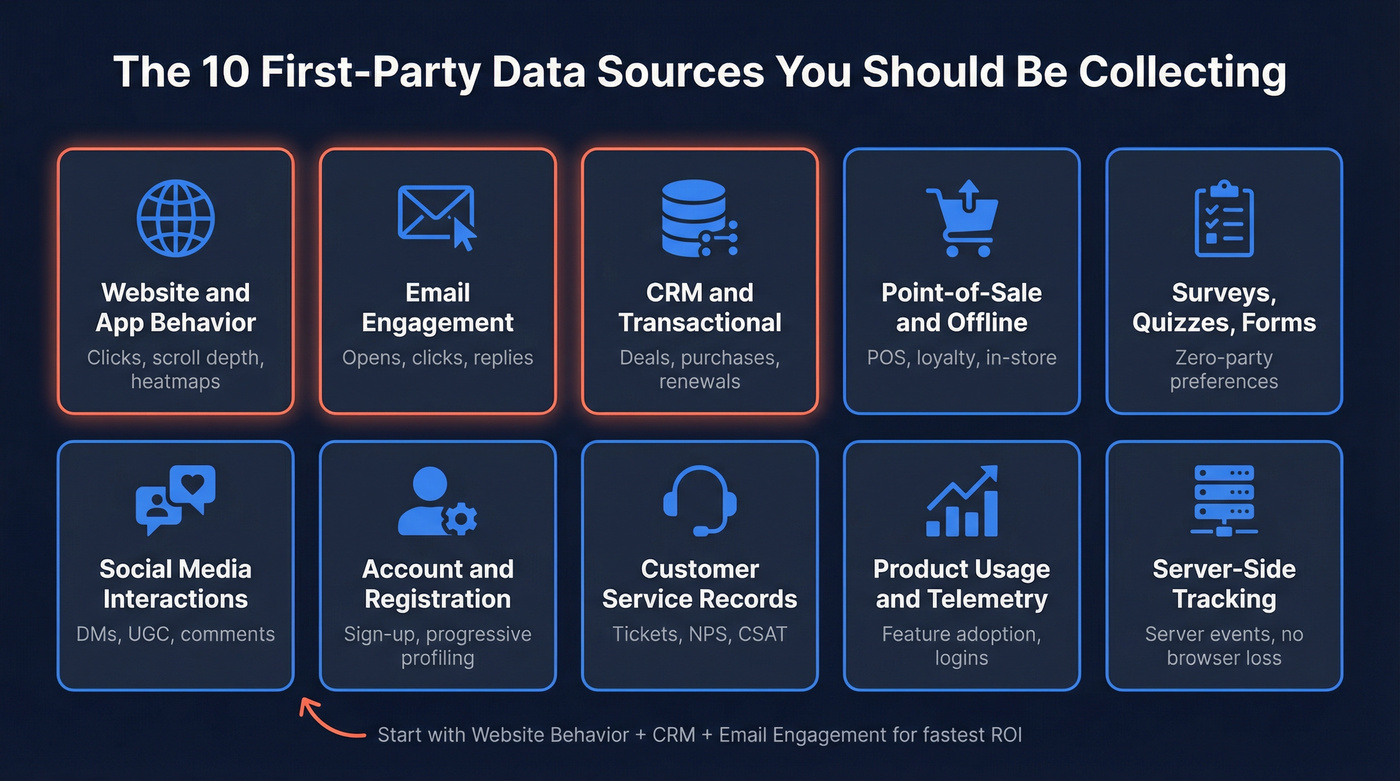
If you're building from zero, prioritize three sources first:
- Website behavior - GA4 plus server-side tagging delivers the richest behavioral signal.
- CRM and transactional data - purchase history, deal stages, and support interactions already live in your systems.
- Email engagement - opens, clicks, and reply behavior reveal who's warm and who's ghosting.
For B2B teams specifically: enrich your CRM records early. Incomplete contact data kills activation before it starts, and we've watched teams burn weeks building segments on top of records where half the emails bounce.
The Complete List of First-Party Data Sources
Website and App Behavior
Pageviews and clicks are table stakes. The real value sits in scroll depth, session recordings, and heatmaps - tools like Hotjar and Crazy Egg surface where users hesitate, rage-click, or drop off entirely. Pair this with GA4 event tracking and you've got the richest behavioral dataset most companies will ever need. Don't sleep on custom events either: tracking specific button clicks, video plays, and calculator interactions gives you intent signals that generic pageview data never will.
Email Engagement
Opens, clicks, unsubscribes, and reply behavior. This isn't just marketing automation data - it's an intent signal you can act on immediately. Someone who opens three emails in a week and clicks your pricing page is telling you something. Track reply behavior in outbound sequences too, not just newsletter metrics.
If you're running outbound sequences at scale, keep your copy and cadence tight with an email blast templates library your team can reuse.
CRM and Transactional Data
Purchase history, deal stage progression, support ticket volume, renewal dates. This is the backbone of any first-party strategy because it connects behavior to revenue. Most teams already have this data. They just don't activate it beyond basic reporting.
If your CRM is messy, start with CRM automation to standardize fields, routing, and lifecycle stages.
Point-of-Sale and Offline Data
POS systems capture items purchased, payment type, discounts applied, time/date, store location, and loyalty identifiers. When tied to a loyalty program, this links anonymous transactions to individual profiles. PepsiCo grew its first-party data stores by more than 50% through integrated POS systems - any brand with physical retail is sitting on this goldmine and most aren't touching it.
Surveys, Quizzes, and Forms
This is where first-party collection crosses into zero-party territory. Forrester defines zero-party data as information customers proactively share - purchase intent, preferences, persona details. Product recommendation quizzes and post-purchase surveys are the most common collection mechanics. The consensus on r/ecommerce is that interactive quizzes consistently outperform static forms for both completion rates and data quality.
Social Media Interactions
Engagement metrics, DMs, UGC, and comment sentiment from your owned profiles. Less structured than other sources, but valuable for identifying advocates and understanding brand perception at scale.
To turn those signals into pipeline, map them to buyer intent signals you can score and route.
Account and Registration Data
What users tell you when they sign up - and what you learn over time through progressive profiling. Gate additional questions behind value exchanges like content downloads or feature unlocks instead of asking for 12 fields on day one. Nobody fills out a 12-field form.
This is also where a clear Ideal Customer Profile helps you decide which fields are actually worth collecting.
Customer Service Records
Call logs, chat transcripts, NPS scores, CSAT responses. A customer who calls twice about the same issue is signaling churn risk. That's a data point worth capturing and acting on, not burying in a support ticket queue.
If you're using this data to reduce churn, align it with a concrete how to prevent churn playbook (health scoring, triggers, and save motions).
Product Usage and Telemetry
Primarily a B2B SaaS play. Feature adoption rates, login frequency, time-in-app, and workflow completion tell you which accounts are healthy and which are at risk. This data is arguably the strongest predictor of renewal and expansion revenue, yet it's often siloed in product analytics tools that the go-to-market team never sees.
Server-Side Tracking
Events processed on your server infrastructure rather than in the browser. This is the source most teams miss - and it solves the data-loss problem that browser restrictions create. More on this below.
First-Party vs. Zero, Second, and Third-Party Data
| Type | Definition | Example | Who Controls It |
|---|---|---|---|
| First-party | Data you collect from your own channels | Website clicks, purchases | You |
| Zero-party | Data customers proactively share | Quiz answers, preferences | You (given by user) |
| Second-party | Someone else's first-party, shared with you | Partner data exchange | Shared |
| Third-party | Aggregated/purchased from external sources | Data broker lists | Vendor |
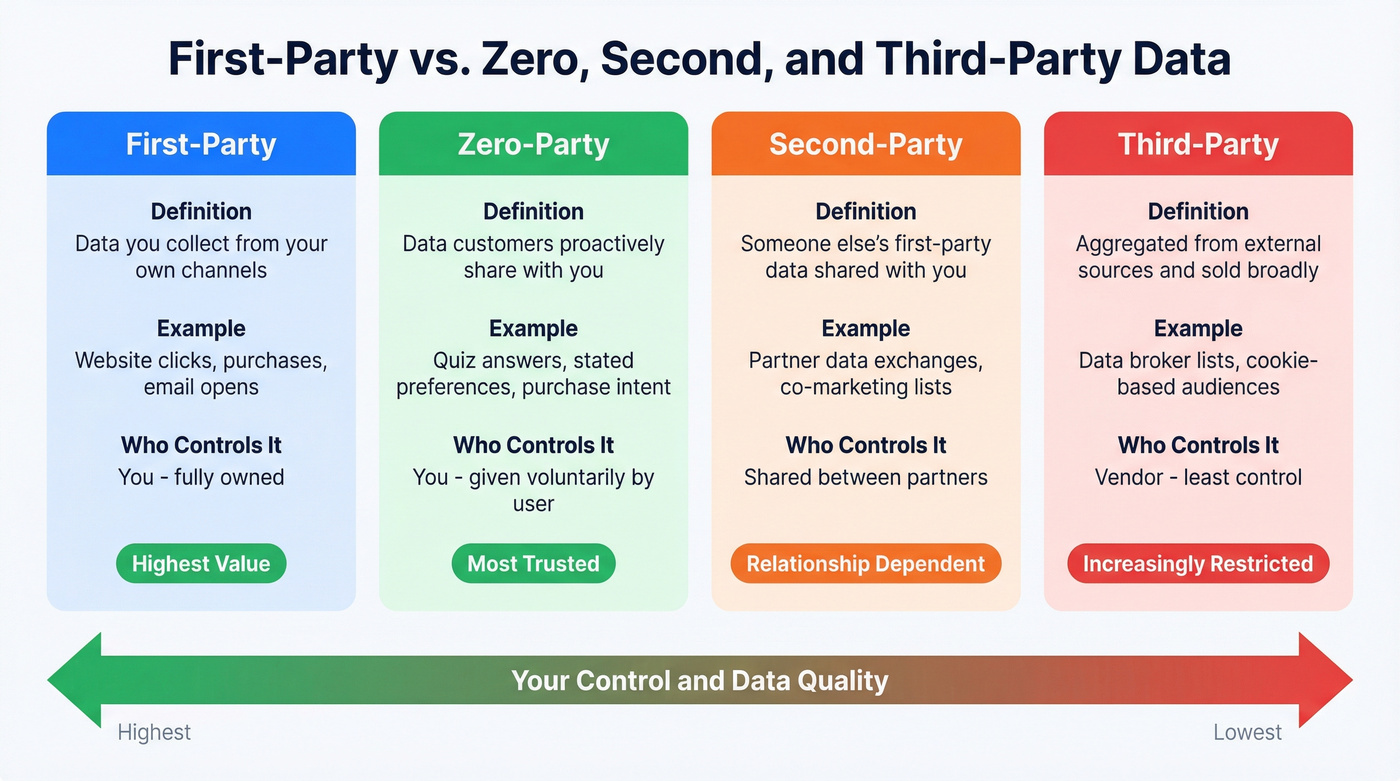
Second-party data is just someone else's first-party data shared through a direct relationship. Third-party data is aggregated from multiple sources and sold broadly - the least differentiated and increasingly restricted.

First-party data loses all its value when half your CRM emails bounce. Prospeo enriches your records with 50+ verified data points at a 92% match rate - emails, mobiles, company data - refreshed every 7 days so your segments actually reach real people.
Stop building segments on stale data. Enrich your CRM for $0.01 per email.
Why First-Party Data Still Matters in 2026
There isn't a single "cookieless future." It's a fragmented reality. Google confirmed in April 2025 that Chrome will retain third-party cookies. But Safari and Firefox already block them by default, and only 15% of publishers effectively reach audiences across all browsers without workarounds.
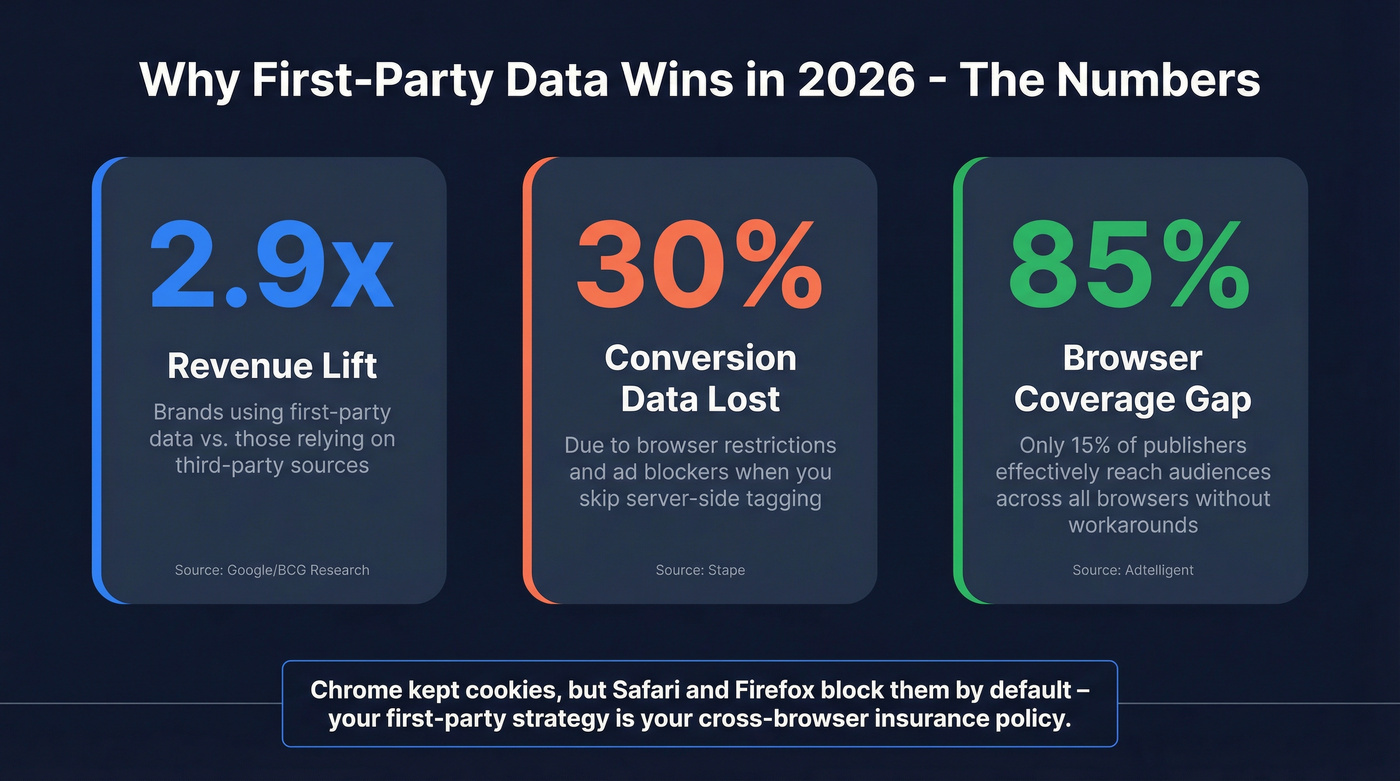
The business case is clear: Google/BCG research found that brands using owned data saw a 2.9x revenue lift versus companies relying on third-party sources. That advantage compounds over time. The earlier you invest in collection infrastructure, the wider the gap between you and competitors still dependent on external data.
Benefits in Practice
Collecting is easy. Activation is where teams stall - and where the real benefits become tangible.
BrandAlley unified behavioral and purchase data with AI lifecycle campaigns, winning back 24% of at-risk customers and generating £9.6M in new revenue. Hobbii built segmentation from pattern downloads and loyalty preferences, driving 20% of revenue from personalized automations across 1.1M members. These aren't edge cases. They're what happens when first-party data actually gets connected to execution.
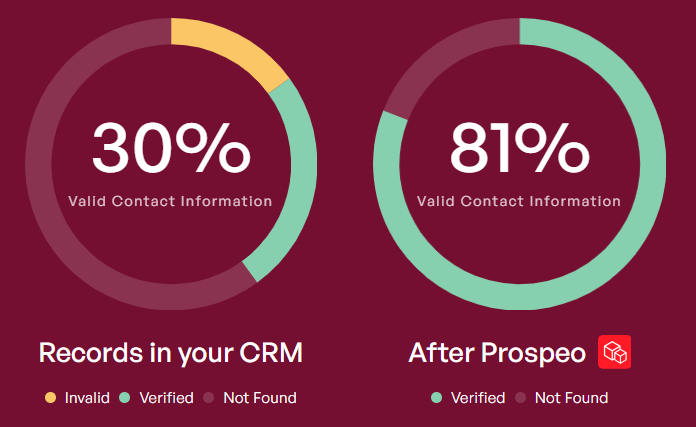
Here's the thing: none of this works if your underlying contact records are garbage. We've seen teams build sophisticated segmentation on CRM data where 40% of email addresses are stale. The segments look great in the dashboard; the campaigns bounce. For B2B teams, tools like Prospeo fill this gap - enriching CRM or CSV records with 50+ verified data points per contact at an 83% match rate, refreshed every 7 days rather than the 6-week industry average.
If you're evaluating vendors, compare options in our roundup of data enrichment tools.
Server-Side Tagging - The Source Most Teams Miss
Marketers lose up to 30% of conversion data due to browser restrictions and ad blockers. server-side tagging routes events through a controlled server layer you own before forwarding them to analytics and ad platforms.
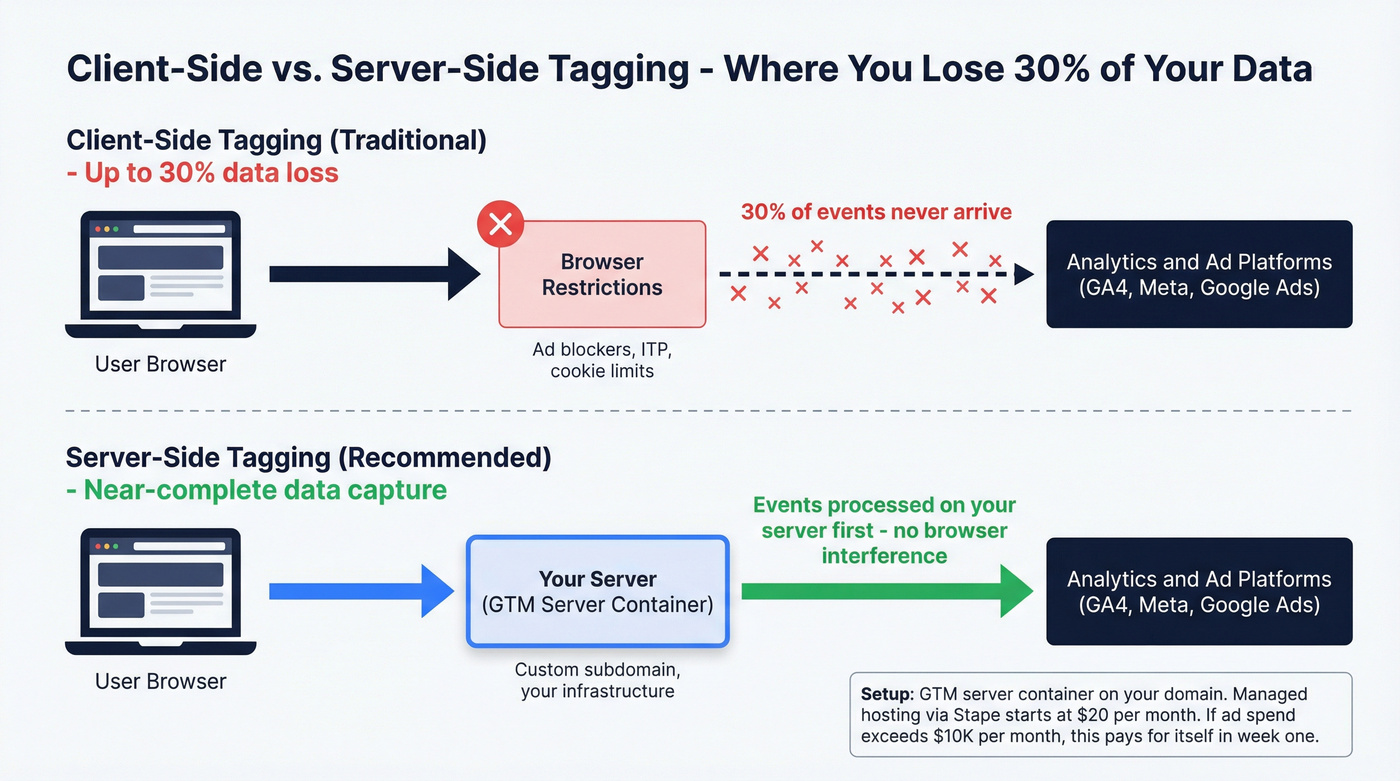
We've deployed this for paid acquisition clients and the data recovery alone justified the infrastructure cost within the first month. Setup runs through GTM's server container, deployed on your infrastructure with a custom subdomain. Managed hosting through Stape starts at $20/mo.
Let's be honest: if your monthly ad spend exceeds $10K and you haven't set up server-side tagging, you're flying blind on up to 30% of your conversions. Fix this before you invest in another attribution tool.
Mistakes That Kill First-Party Strategies
Warehouse dumping into MarTech. Loading your entire data warehouse into marketing tools creates duplicated silos. Keep a central source of truth and sync only what's needed.
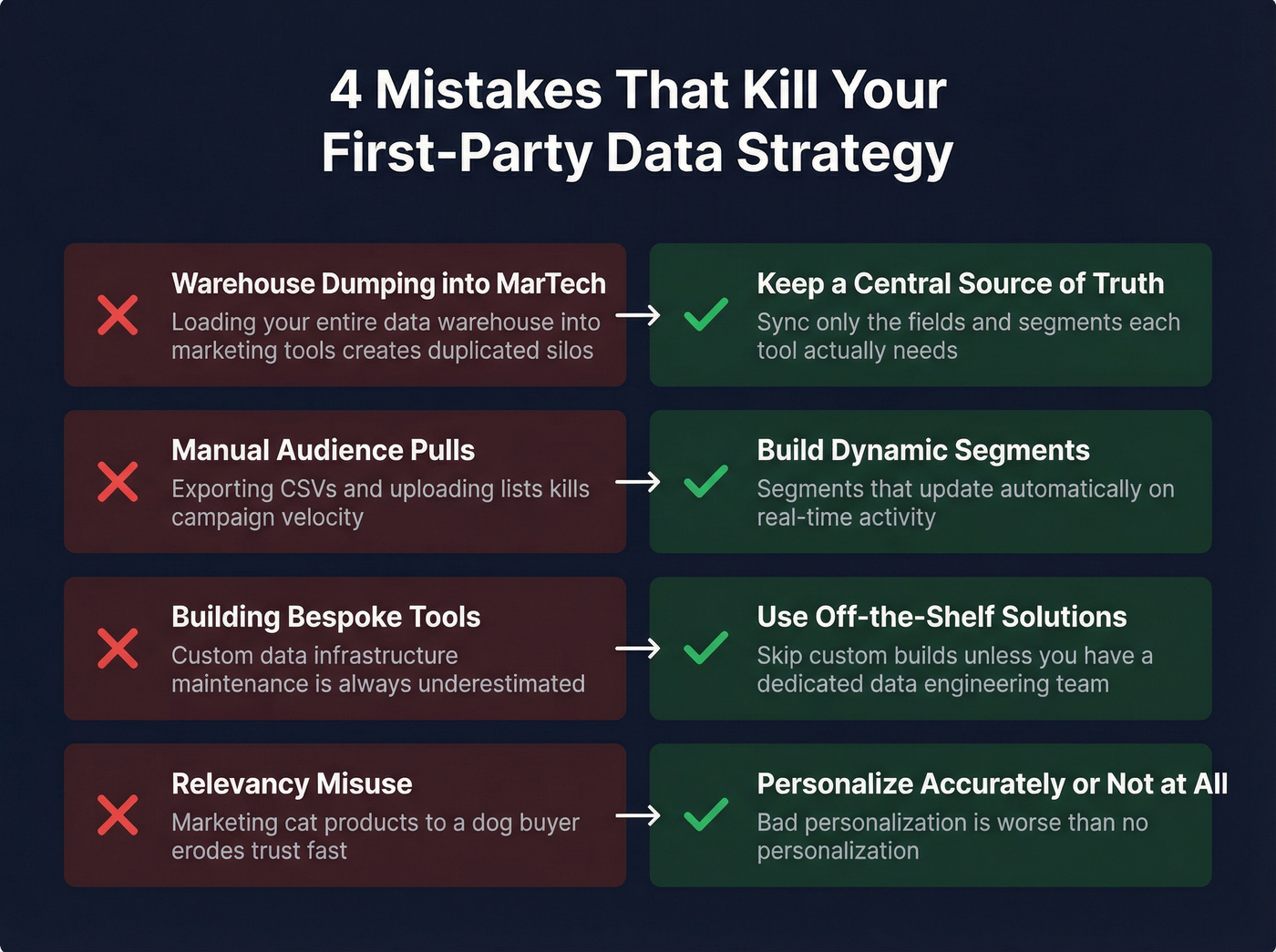
Manual audience pulls. Exporting CSVs and uploading lists kills campaign velocity. Build dynamic segments that update on real-time activity. If your team is still doing manual list pulls in 2026, that's a process problem, not a data problem.
If list quality is the root issue, start with a best B2B database that’s ranked on accuracy - not just record count.
Building bespoke tools when off-the-shelf exists. The maintenance burden of custom data infrastructure is consistently underestimated. Skip this unless you have a dedicated data engineering team with bandwidth to spare.
Relevancy misuse. Marketing cat products to a dog buyer erodes trust faster than no personalization at all. If you're going to personalize, get it right - or don't do it.
You've collected the behavioral signals, the engagement data, the purchase history. Now make sure you can actually reach those contacts. Prospeo's 5-step verification delivers 98% email accuracy and 125M+ verified mobile numbers - so your first-party activation campaigns land, not bounce.
Great first-party data deserves contact records that actually work.
FAQ
What's the difference between first-party and zero-party data?
First-party data is observed behavior - clicks, purchases, page views collected on your own channels. Zero-party data is information customers proactively share, like quiz answers or stated preferences. Both are collected directly, but zero-party requires explicit, voluntary input from the user.
Are data clean rooms a first-party data source?
No - they're a collaboration method, not a source. Clean rooms let two parties analyze combined datasets without exposing raw personal data. 66% of organizations already use them and adoption is accelerating, but the underlying data still has to originate from your own channels.
How do I enrich incomplete CRM records?
Use a B2B data enrichment platform to match CRM or CSV records against verified databases. Prospeo returns 50+ data points per contact - including verified emails and direct dials - with an 83% enrichment match rate and a 7-day refresh cycle. The free tier includes 75 emails per month, so you can test it without a commitment.