

How to Write a Follow Up Email After Meeting With a Client
You had a great meeting. The client was nodding, asking smart questions, maybe even talking timelines. Then you send a vague "great chatting!" email - and hear nothing for two weeks.
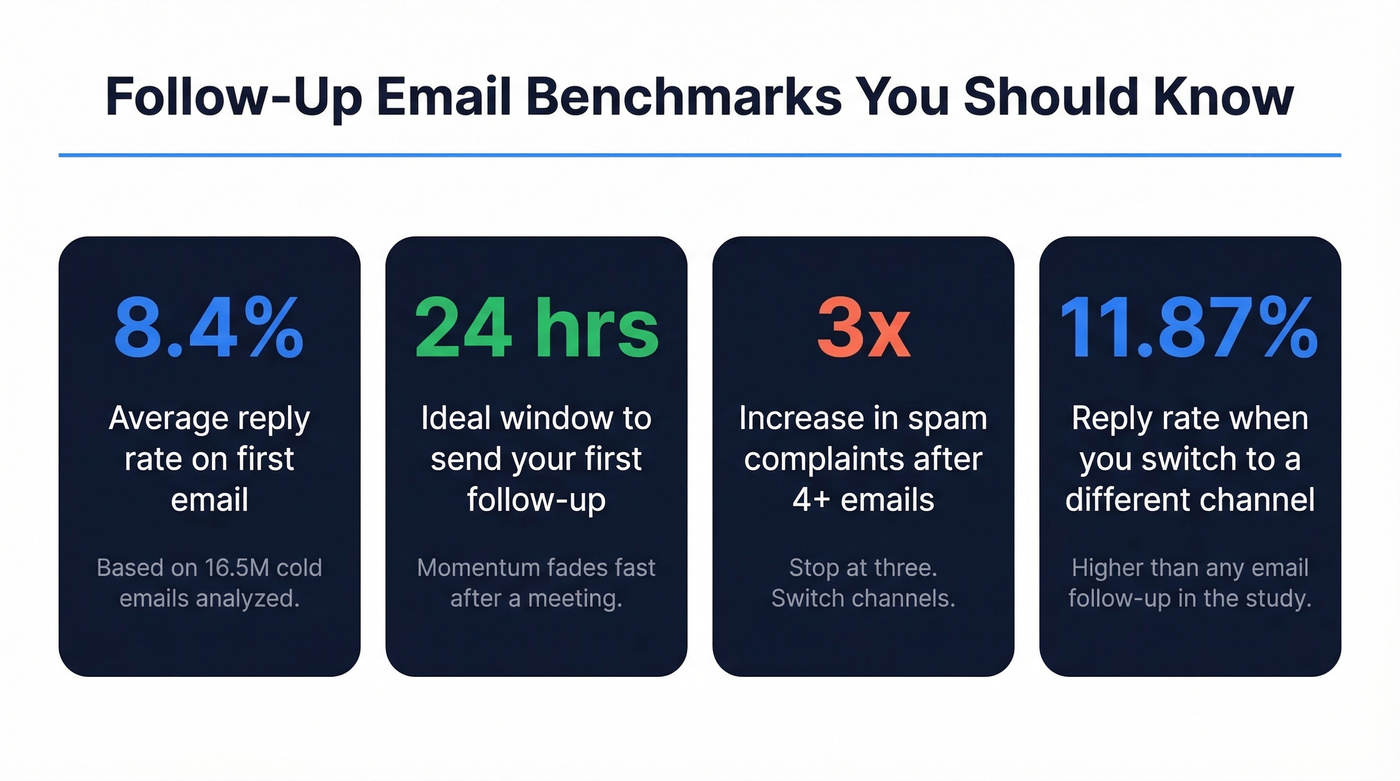
An analysis of 16.5M cold emails found the highest reply rate sits at just 8.4% on the first message. A commonly cited sales benchmark puts 35-50% of deals in the hands of the vendor that responds first. Your follow up email after meeting with a client isn't a courtesy. It's a competitive weapon.
What Every Post-Meeting Email Needs
Every effective post-meeting follow-up has five parts:
- Thank you - brief, genuine
- Recap - what you discussed
- Action items - with owners
- Deadline - a specific date
- Single CTA - one clear ask (see Email Call to Action)
Send it within 24 hours. Pro move: draft your follow-up skeleton before the meeting so you walk out with a near-finished email instead of staring at a blank screen.
Here's a take most guides won't give you: keep the email under 100 words. Your client already sat through the meeting - they don't need to re-read it.
The 5-Part Follow-Up Email Structure
1. Appreciation. One sentence. "Thanks for making time today" works. Don't overthink it.
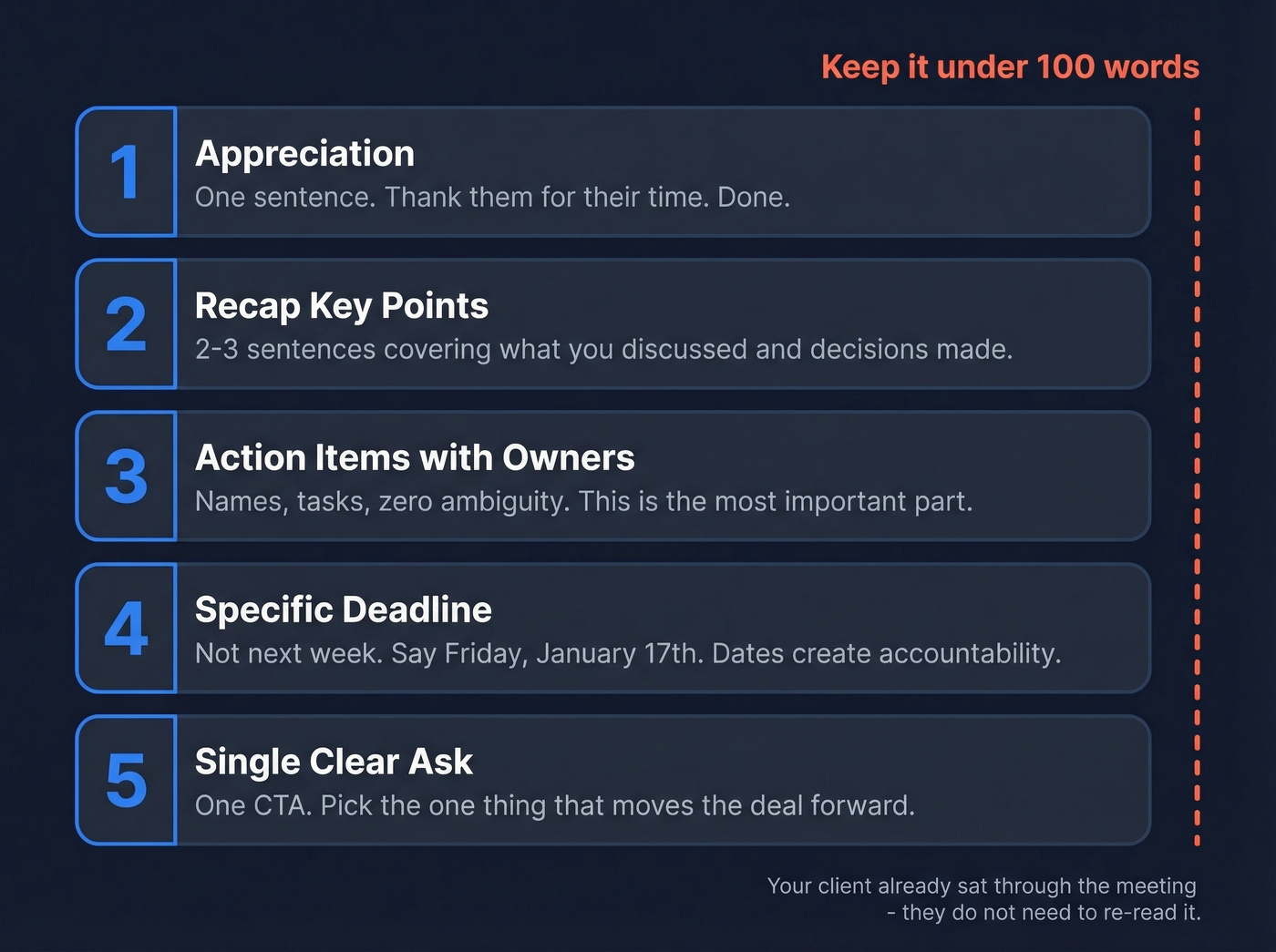
2. Recap of key points. Two to three sentences covering what you discussed and any decisions made. This proves you were listening and creates a shared record both sides can point back to.
3. Action items with owners. The most important part. "You'll send the Q2 budget numbers by Thursday; we'll have the revised proposal back by Monday." Names and tasks, no ambiguity.
4. Specific deadline or date. "Next week" is useless. "By Friday, January 17th" is useful. Dates create accountability on both sides.
5. Single clear ask. One CTA. Not "let me know your thoughts and also could you loop in Sarah and also here's a link to our case study." Pick the one thing that moves the deal forward.
That 100-word constraint forces clarity. If you can't summarize the meeting and next steps in 100 words, you probably didn't leave the meeting with clear enough outcomes. (If you want more ready-to-send options, see Sales follow-up templates.)
When to Send
| Scenario | Send Within | Why |
|---|---|---|
| Post-meeting follow-up | 24 hours | Momentum is fresh |
| Proposal/deal follow-up | 3-5 days | Give them time to digest |
| Reminder after no response | 1 week | Polite nudge, not pressure |
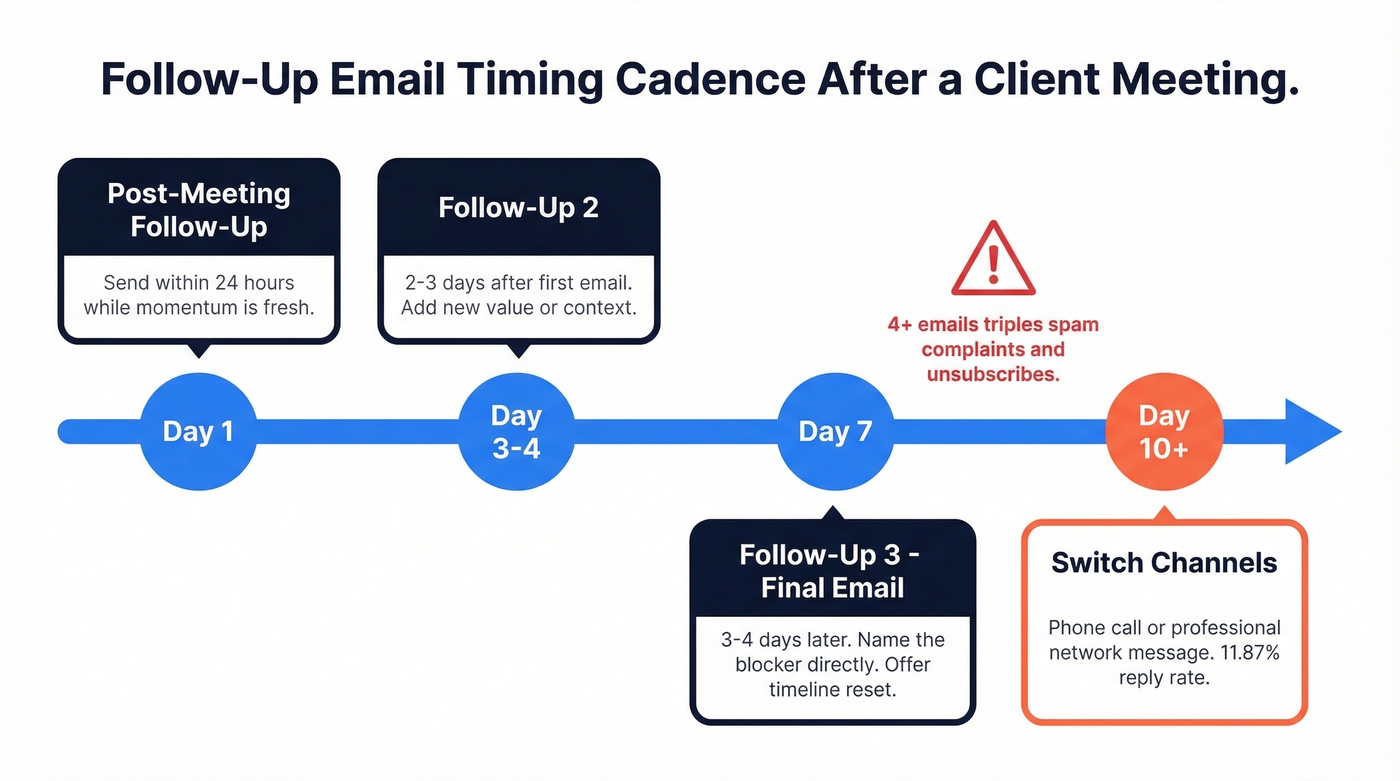
For multi-touch sequences, space your emails out: 2-3 days after the first, then 3-4 days, then another 3-4 days. That's your ceiling for email-only persistence. The same 16.5M-email dataset shows that sending 4+ emails in a sequence more than triples spam complaints and unsubscribe rates.
Enterprise contacts at 1,000+ employee companies ghost quickly. If you're selling into enterprise, keep your follow-ups tighter and more value-dense (more on that in Enterprise B2B sales).
When email stops working, switch channels. That same dataset found a message on a professional networking platform paired with a profile visit hits an 11.87% reply rate - higher than any email follow-up in the study. After three email touches with no response, move to a different medium. (If you're unsure about timing, use this when to follow up guide.)

A perfect follow-up email means nothing if it bounces. Prospeo's 98% email accuracy and 7-day data refresh ensure every post-meeting follow-up lands in the right inbox - not a dead address or spam folder.
Stop crafting great follow-ups that never get delivered.
Client Follow-Up Email Templates by Meeting Type
After a Kickoff Meeting
Subject: Next steps from our kickoff - [Project Name]
Hi [Name],
Thanks for a productive kickoff today. To recap: we aligned on [key deliverable] with a target date of [date]. [Their name] will share [specific item] by [date], and we'll have [our deliverable] ready by [date].
Any questions before we get moving? Happy to jump on a quick call.
Best, [You]
After a Proposal Discussion
The tone here is the biggest challenge. How do you follow up without sounding desperate or pushy? Anchor to their timeline, not yours. That reframes the email from "I want something" to "here's what we agreed." (If you need better phrasing, see Email copywriting.)
Subject: Proposal recap + next steps
Hi [Name],
Great discussion on the proposal today. Based on your feedback, we'll revise [specific section] and send an updated version by [date]. On your end, [their action item] by [date] would keep us on track for a [target milestone].
Worth a 15-minute check-in on [specific day]?
[You]
After No Response to First Follow-Up
Most people write the gentle nudge wrong. Let's compare:
Bad: "Just wanted to circle back and see if you had a chance to review my previous email. No rush at all!"
Good:
Subject: Quick check - [Project/Topic]
Hi [Name],
Wanted to make sure my last note didn't get buried. We're still planning to [deliverable/next step] - just need [their specific action] to move forward.
Is [date] still realistic on your end, or should we adjust the timeline?
[You]
The good version names the blocker, offers a specific date, and gives them an easy out to reset expectations. Zero guilt-tripping.
After a Stalled Project Meeting
Use this when the project has gone quiet for 2+ weeks, you've already sent a gentle nudge, and you need to name the blocker directly. This is your firmest template.
Subject: [Project Name] - where we stand
Hi [Name],
It's been [timeframe] since our last sync on [project]. We're ready to move on [specific next step] as soon as we have [their blocker item].
Can we lock in 15 minutes this week to get this unstuck? I'm open [two specific times].
[You]
Subject Lines That Get Opened
Generic subject lines like "Following up" or "Checking in" are the fastest way to get ignored. NetHunt's research flags generic "follow-up" phrasing as a common mistake - it gives the recipient zero reason to open.
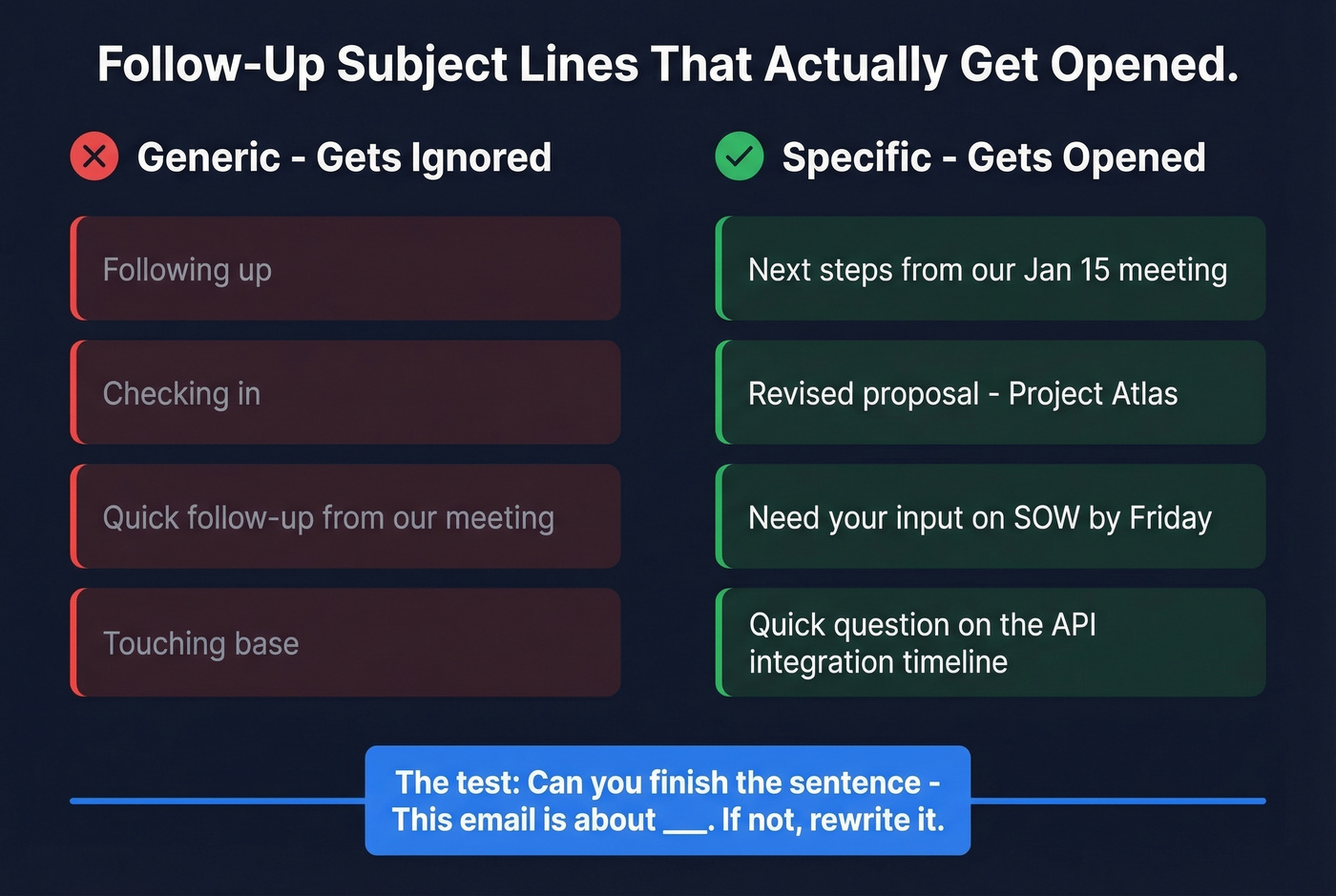
Specificity wins. Reference the meeting, the project, or the next step:
- "Next steps from our [date] meeting"
- "Revised proposal - [Project Name]"
- "[Their action item] + our timeline"
- "Quick question on [specific topic discussed]"
- "[Project Name] - need your input by [date]"
- "Following up on [specific deliverable]"
- "Where we stand on [topic]"
Every subject line should tell the client exactly what's inside and why it matters to them right now. If you can't finish the sentence "This email is about ___," the subject line needs work. (For more ideas, pull from these email subject line examples.)
Mistakes That Kill Your Follow-Up
Bad: "Just checking in to see if you had any thoughts on our last conversation." Good: "We're ready to start on the integration. Need your sign-off on the SOW by Friday to hit the March 1 launch."
The first version says nothing. The second gives them a reason to act and a deadline to act by.
Bad: "I wanted to follow up on our meeting and share some additional resources that might be helpful as you evaluate options going forward." Good: "Attached: the ROI calculator we discussed. Let me know if the assumptions look right."
Cut every sentence that doesn't move the conversation forward. Filler language like "touching base" and "circling back" signals you don't have anything new to say. (More alternatives here: How to say just checking in professionally.)
Bad: Sending follow-up #4, #5, #6 because "persistence wins." Good: Stopping at three and switching to another channel.
Look - 4+ emails in a sequence more than triples spam complaints and unsubscribe rates. Persistence has a ceiling, and most people blow past it. In our experience, the teams that get the best results aren't the ones who send the most follow-ups. They're the ones who know when to change the channel.
One failure nobody talks about: the email bounces. Your client changed roles, the domain got restructured, or the address you have is just wrong. Prospeo's email finder catches dead addresses before you hit send - 98% accuracy across 143M+ verified emails. Verify first, then worry about the copy. (If you want to go deeper on bounce prevention, start with Email bounce rate.)
Most follow-up problems aren't copywriting problems. They're data problems. You can write the perfect 80-word post-meeting email with a specific deadline and a clear CTA, and it won't matter if it bounces. Fix your data hygiene before you A/B test your subject lines. (This email deliverability guide is a good next read.)
FAQ
How many follow-up emails should I send after a client meeting?
Two to three maximum. Four or more emails in a sequence more than triples spam complaints and unsubscribe rates. After three with no response, switch channels - try a phone call or a message on a professional networking platform.
What's the best time to send a post-meeting follow-up?
Within 24 hours of the meeting for the first touch. Mid-morning on weekdays - Tuesday through Thursday, 9-11 AM in the recipient's time zone - consistently outperforms other windows for B2B follow-ups.
How do I follow up without sounding pushy?
Anchor to their timeline and their action items, not yours. Naming specific deliverables and dates reframes the message from "I want something" to "here's what we agreed." Give them an easy out to adjust the timeline if needed.
What if my follow-up email bounces?
The contact data is outdated. Use a real-time verification tool to confirm the address before resending. Find the correct email and resend within 24 hours to preserve momentum.
When three follow-up emails get no response, switch channels. Prospeo gives you 125M+ verified mobile numbers with a 30% pickup rate - so you can call the client directly instead of sending follow-up #5.
Get direct dials for the clients who stopped replying.