

How to Write a Follow Up Email After a Business Proposal (Without Sounding Desperate)
You sent the proposal on Monday. It's Thursday. Your inbox is empty. You spent three hours customizing that deck - tailored pricing, specific pain points, the whole thing - and then nothing.
That follow up email after a business proposal is now the most important message you'll write all week.
A single email can get roughly a 16% response rate, but one follow-up bumps that to 27%. The gap between "sent a proposal" and "closed the deal" isn't your pricing or your pitch. It's what you do in the silence. Stop thinking about follow-up emails. Start thinking about follow-up campaigns.
What You Need (Quick Version)
- Wait 3 business days, then send a follow-up with a short, personalized subject line (2-4 words).
- Each follow-up targets a different reason for silence - not just "checking in." This is a campaign, not a single nudge. If you need swipeable copy, start with these sales follow-up templates.
- Verify the email address first. Bad data is one of the biggest invisible reasons follow-ups fail. Prospeo's email finder catches dead addresses before they tank your deliverability - 98% accuracy, free tier included.
Why Proposals Go Unanswered
Silence rarely means "no." We've sent hundreds of proposals over the years, and the ones that close almost always involve a structured follow-up sequence. The ones that die? Usually one of these five reasons:
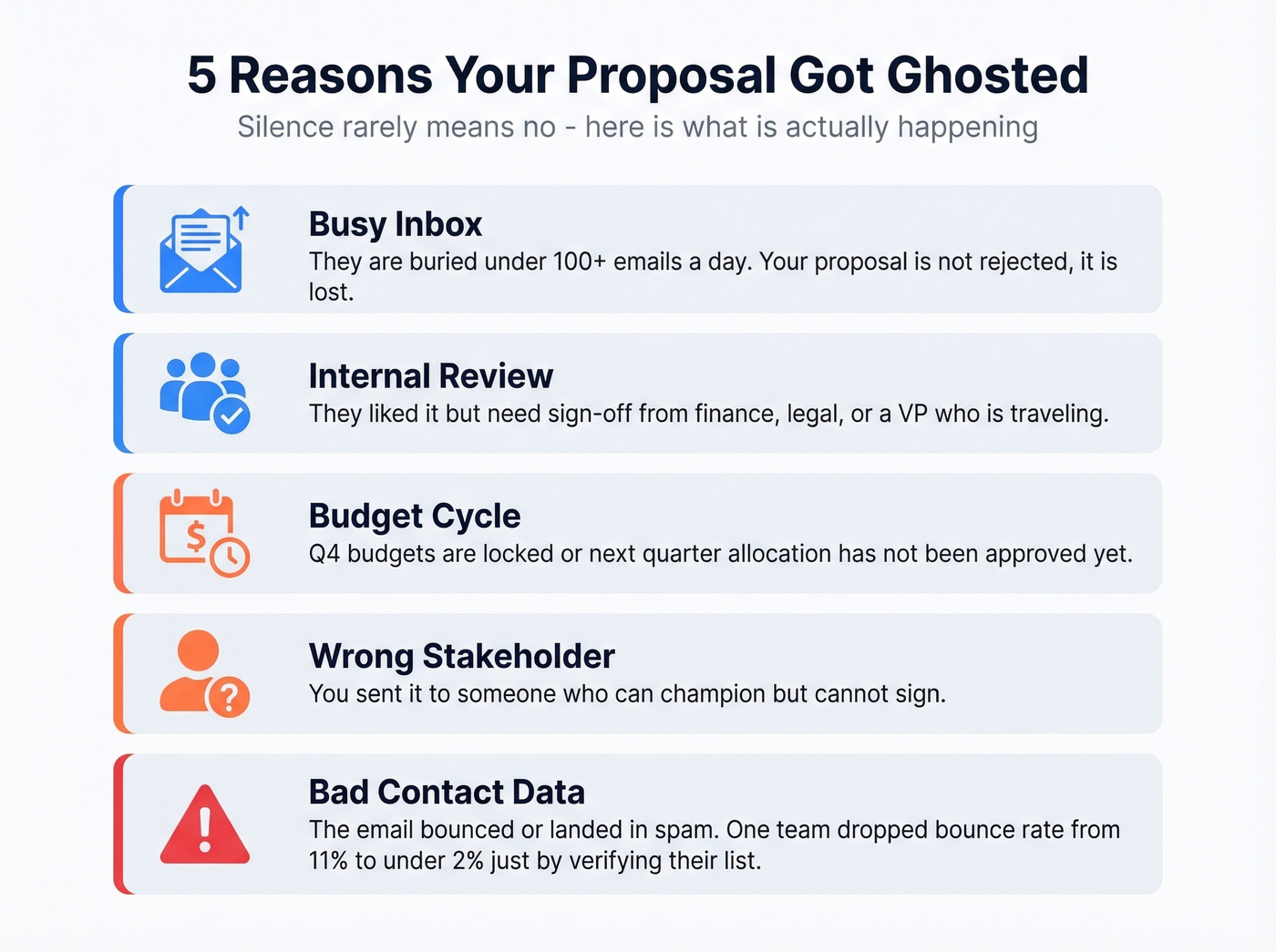
- Busy inbox. Your prospect isn't ignoring you - they're buried under 100+ emails a day.
- Internal review. They liked it, but they need sign-off from finance, legal, or a VP who's traveling.
- Budget cycle. Q4 budgets are locked, or next quarter's allocation hasn't been approved yet.
- Wrong stakeholder. You sent it to someone who can champion but can't sign. (This is where MEDDPICC thinking helps.)
- Bad contact data. The email bounced or landed in spam. One Reddit practitioner dropped their bounce rate from 11% to under 2% just by verifying their list - and suddenly, emails that "weren't getting responses" started getting responses.
When to Send (And How Many Times)
Three business days after sending the proposal is the sweet spot. Sooner feels pushy, later risks being forgotten.
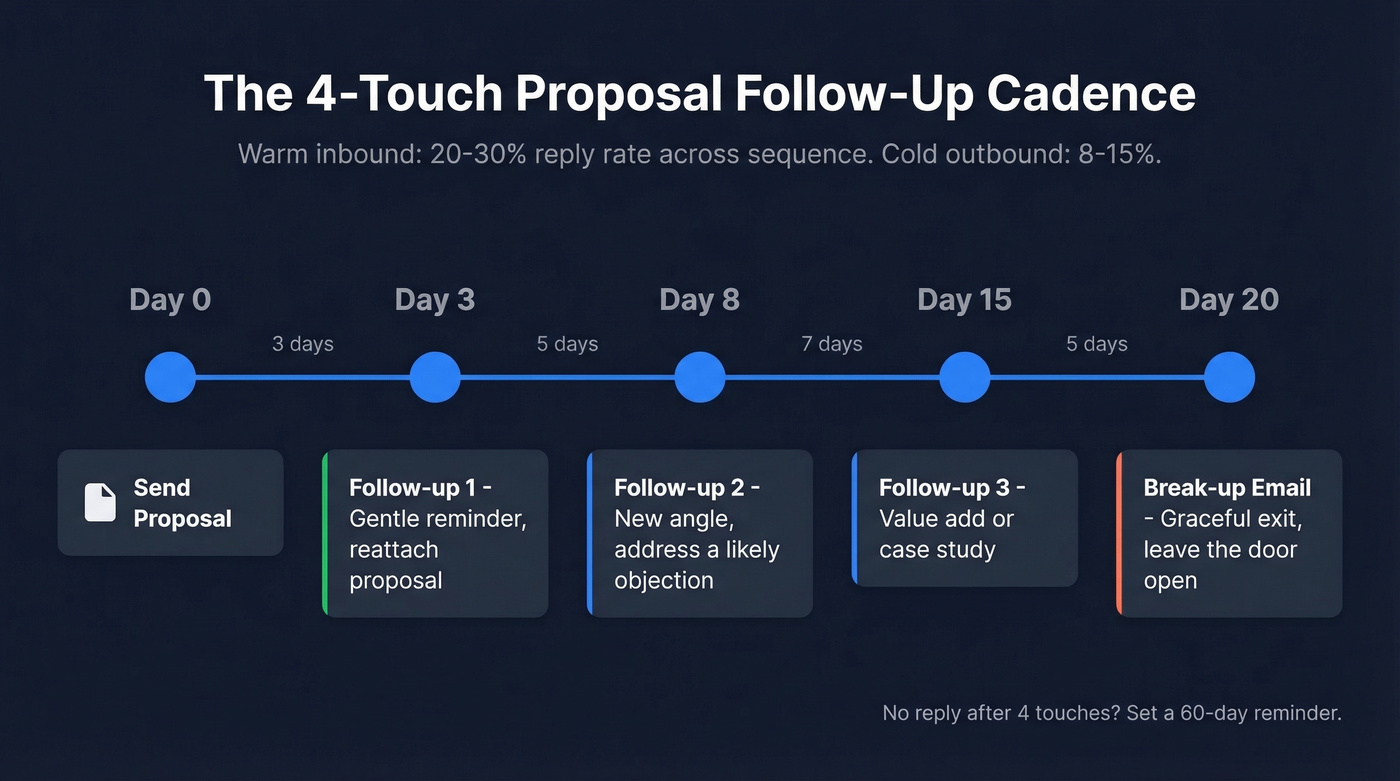
After that first touch, space things out:
- Day 3: Follow-up #1 - gentle reminder, reattach the proposal
- Day 8: Follow-up #2 - new angle (address a likely objection)
- Day 15: Follow-up #3 - final value add or case study
- Day 20: Break-up email - graceful exit, leave the door open
For warm inbound opportunities, expect 20-30% reply rates across the sequence. Cold outbound? More like 8-15%. That lines up with Outreach's sequence benchmarks.
If your proposal tool shows view tracking, time your follow-up for within hours of a view so you catch the prospect while it's fresh in their mind. (If you’re building this into a repeatable process, use a simple sequence management checklist.)
Here's the thing: if you haven't heard back after four well-crafted emails, the deal is dead or dormant. Move on. Set a calendar reminder for 60 days out.

Bad contact data is the #1 invisible reason follow-ups fail. Prospeo's email finder verifies addresses before you send - 98% accuracy, so your carefully crafted proposal follow-up actually lands in the inbox, not a bounce folder.
Stop following up on dead addresses. Verify first at $0.01 per email.
Subject Lines That Get Opened
A Belkins study of 5.5 million emails found that subject line mechanics matter more than most people think:
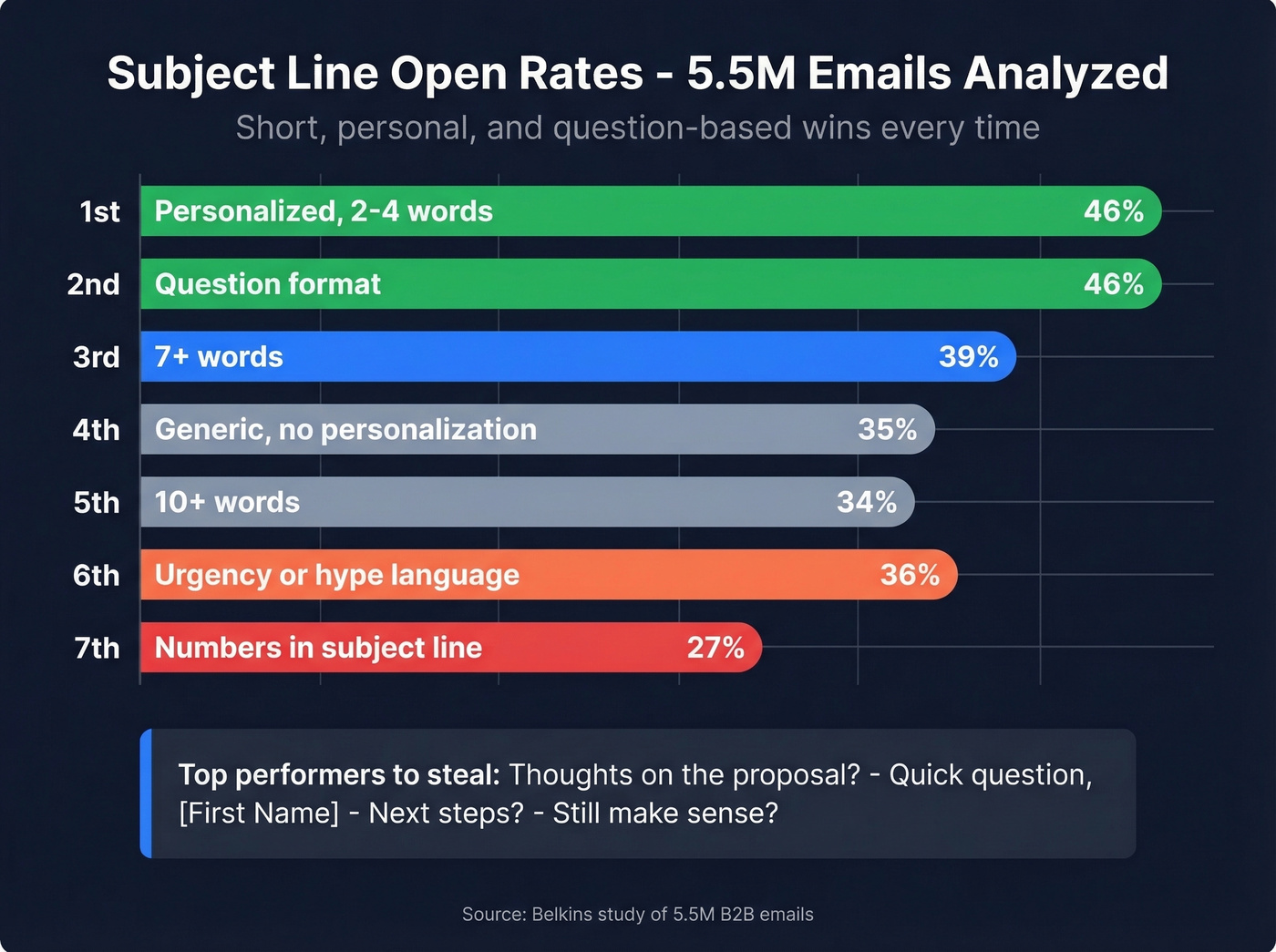
| Approach | Open Rate |
|---|---|
| Personalized, 2-4 words | 46% |
| Question format | 46% |
| 7+ words | 39% |
| Generic, no personalization | 35% |
| 10+ words | 34% |
| Urgency/hype language | <36% |
| Numbers in subject line | 27% |
Short, personal, and question-based wins every time. One Reddit practitioner reported "Quick question" pulling 39% opens while "Partnership opportunity" landed below 19%. If you want more options, pull from these email subject line examples.
Five subject lines worth stealing for your proposal follow-up:
- "Thoughts on the proposal?"
- "Quick question, [First Name]"
- "Next steps?"
- "[Company] + [Your Company]"
- "Still make sense?"
Anything that sounds like a marketing blast - "EXCITING PROPOSAL INSIDE" or "Don't miss out!" - will get you filtered, not opened. Skip the caps lock entirely.
Templates Mapped to Objections
Stop writing three versions of "just checking in." Your prospect has seen that email 200 times. A real follow-up campaign maps each message to a specific reason for silence, following PandaDoc's 6-element structure - subject line, direct address, concise reminder, value restatement, interest gauge, and courteous close. (If you’re doing this for outbound too, build it like a B2B cold email sequence.)
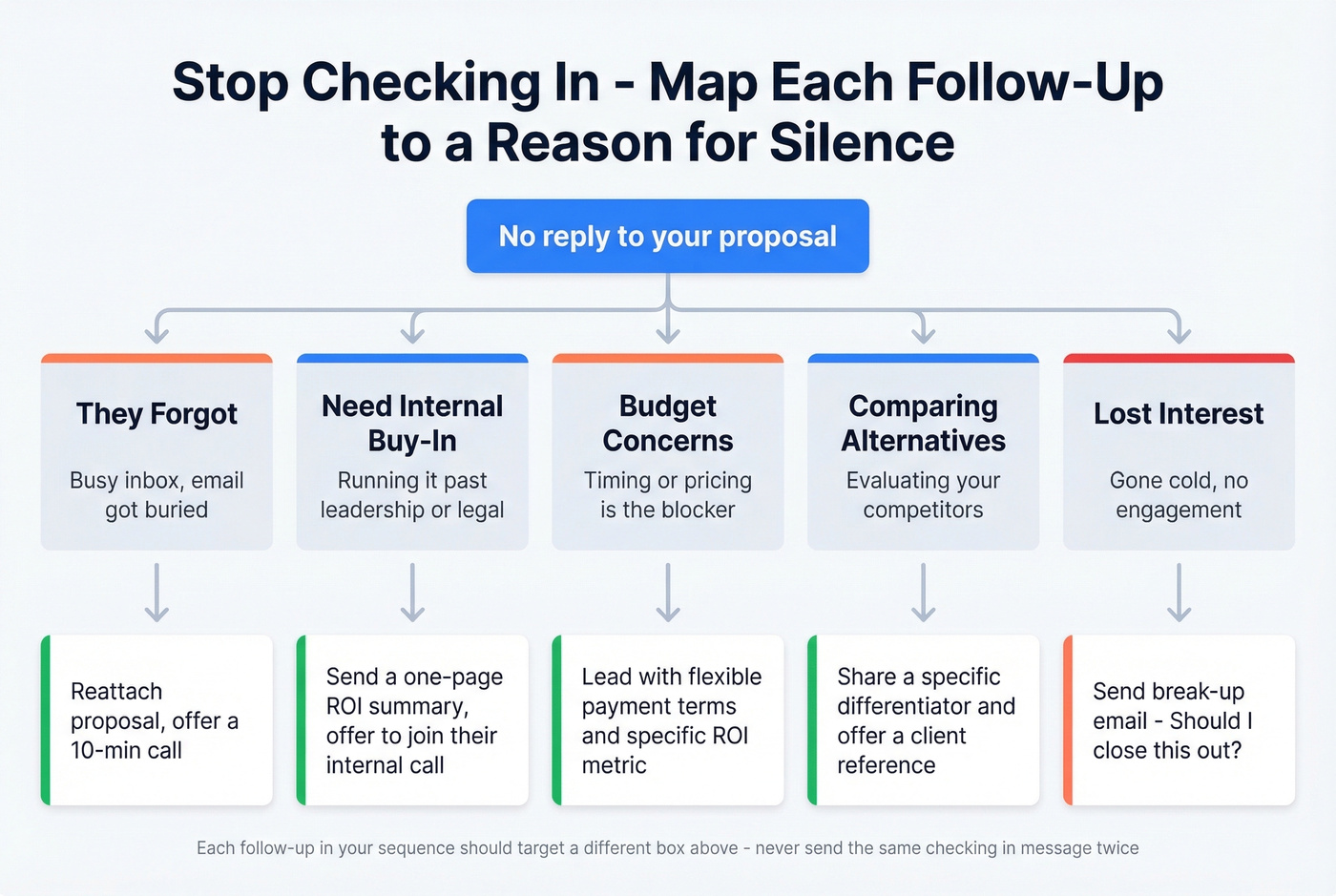
They Forgot (Busy Inbox)
Subject: Quick follow-up on [Project Name]
Hi [Name], wanted to make sure the proposal didn't get buried. Reattached here for easy reference. Happy to jump on a 10-minute call Thursday if questions came up.
Short. No guilt trip. Just make it easy for them.
They Need Internal Buy-In
Subject: ROI summary for your team
Hi [Name] - if you're running this past leadership, I put together a one-page ROI summary (attached). I'm also happy to join a call with your team to walk through the numbers directly.
Budget Concerns
Instead of another paragraph, lead with flexibility:
Subject: Flexible on timing
Hi [Name] - we can structure payments quarterly instead of upfront, and [specific ROI metric] typically covers the investment within [timeframe]. Worth a quick conversation?
Comparing Alternatives
Subject: One thing we do differently
Hi [Name], if you're evaluating options, here's what clients say sets us apart: [specific differentiator - e.g., "Company X saw a 34% reduction in onboarding time within 60 days"]. Happy to connect you with a reference.
Lost Interest (Break-Up)
Subject: Should I close this out?
Hi [Name] - haven't heard back, so I'll close this out on my end. If things change, you know where to find me.
The Break-up email is the most underrated message in the sequence. In our experience, it generates more replies than follow-up #2 or #3 because it removes pressure entirely. Don't skip it.
Mistakes That Kill Follow-Ups
Bumping without new information. "Just checking in" adds zero value. Every follow-up needs something new - a case study, an ROI number, a flexible term. Sending the same message again won't compel action. If you need better phrasing, see how to say just checking in professionally.
Not addressing objections. If you're not mapping follow-ups to specific reasons for silence, you're guessing. And guessing at scale is expensive.
HTML formatting. Rich templates with logos and colored buttons scream "mass email." Plain text, sent as a reply in the same thread, feels like a real conversation. We've tested this across dozens of campaigns and the difference is stark - plain text consistently outperforms.
Wrong frequency. Three emails in three days is harassment. One email every three weeks is forgettable. A 3-5-7 spacing (3 business days, then ~5 days, then ~7 days) is a solid default. If you want more timing data, use this guide on when you should follow up on an email.
Following up on a dead address. People change jobs, companies restructure, and email addresses go stale fast. Before you agonize over your subject line, check whether the email is even valid. Prospeo verifies emails in real time with 98% accuracy, catching invalid addresses and spam traps before they wreck your sender reputation. The free tier covers 75 emails plus 100 Chrome extension credits per month - enough to verify every proposal recipient before you hit send. If you’re troubleshooting bounces, start with email bounce rate benchmarks and fixes.
You mapped the objections, nailed the cadence, wrote the perfect break-up email - then it bounced. Prospeo catches dead addresses with 5-step verification and a 7-day data refresh cycle, so every follow-up in your sequence reaches a real person.
Your follow-up sequence deserves data that actually connects. 75 free emails to start.
Enterprise Proposal Follow-Ups
Enterprise proposals involve procurement teams, legal reviews, and evaluation committees that stretch timelines to weeks or months. A follow up letter for a project proposal at this level requires a few adjustments.
Follow up with your champion and the decision-maker separately. Your champion needs ammunition - ROI docs, competitive comparisons, internal-facing summaries they can forward without editing. The decision-maker needs brevity and a clear ask, ideally in three sentences or fewer. (This is classic enterprise B2B sales.)
Offer to join internal review calls. Don't make your champion present your proposal alone. Volunteer to answer questions directly so the message doesn't get diluted through a game of telephone.
Use version-controlled documents. A shared link that always reflects the current proposal eliminates "which version is latest?" confusion. This sounds minor. It isn't.
Set idle triggers. If the proposal hasn't been opened in 10 days, re-engage with your champion proactively. Don't wait for them to come to you - they've got their own fires to fight.
FAQ
How long should I wait before following up on a business proposal?
Three business days is the standard. After the first follow-up, space emails 5-7 days apart and cap your sequence at four total touches including a break-up email. Sending sooner than 48 hours risks coming across as pushy.
How many follow-up emails is too many?
Three plus a break-up email - four total. After that, returns drop sharply and you risk annoying the buyer. Set a reminder to re-engage in 60 days if the deal goes dormant.
What's the best way to follow up without being pushy?
Lead with new value in every message - a case study, an ROI figure, or a flexible payment option. Each touch should give the recipient a reason to re-engage rather than just reminding them you exist. Plain-text replies in the same thread feel conversational, not salesy.
What if my follow-up emails aren't getting any response at all?
Check deliverability first. If your bounce rate is above ~3%, you likely have a data quality problem, not a copywriting problem. After fixing data, revisit subject lines and email length - 50-125 words tends to perform best for follow-ups.
The difference between a lost proposal and a closed deal is almost never the proposal itself. It's whether you built a follow-up campaign around it - one that treats silence as a signal, not a verdict. The right timing, the right message for each stage of silence, and verified contact data: that's what separates reps who close from reps who wonder what went wrong.