

How to Write a Follow Up Email for a Quotation Request (With Templates)
You sent the quote three days ago. Radio silence. You start typing "Hey, just following up..." and delete it because it sounds desperate.
We've sent hundreds of these, and the follow-up emails for quotation requests that actually work all share one trait: they add something new every time. The goal isn't more follow-ups. It's better ones.
What You Need (Quick Version)
- Follow up 2 days after sending the quote - not a week later.
- Add new information in every email - never "just checking in." (If you need alternatives, see just checking in.)
- Cap it at 5 touches - 4+ emails in a sequence more than triple unsubscribe and spam complaint rates across a dataset of 16.5M cold emails.
The Best Follow-Up Cadence for Quotes
Salesforce research found that 77% of customers expect immediate interaction when they contact a company. Your Day 2 follow-up isn't pushy - it's expected.
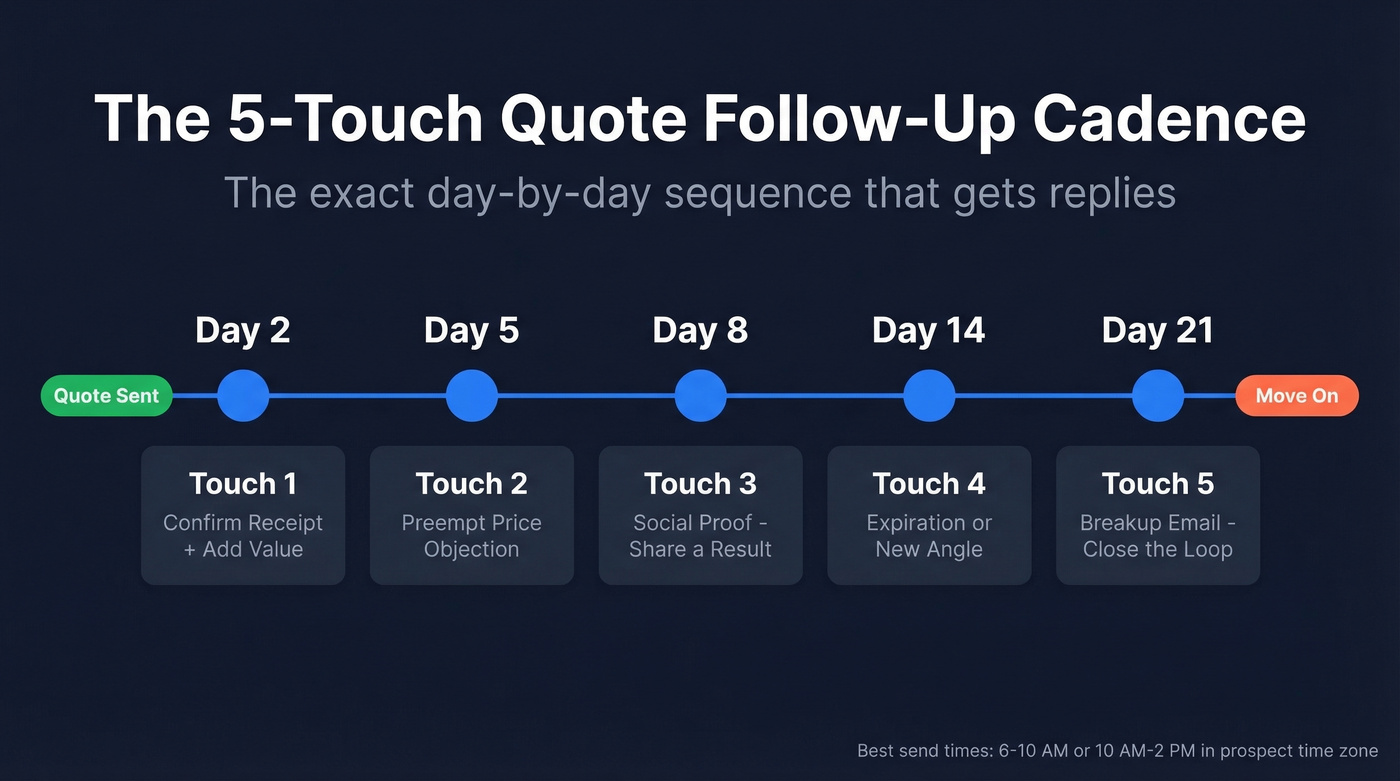
| Touch | Day | Purpose |
|---|---|---|
| 1 | Day 2 | Confirm receipt, add value |
| 2 | Day 5 | Address price objection |
| 3 | Day 8 | Social proof |
| 4 | Day 14 | New angle or expiration |
| 5 | Day 21 | Breakup email |
Cold outreach data shows an 8.4% reply rate on the first email, declining with each touch. For warm quote follow-ups, expect higher - but the declining curve still applies. Two send-time windows consistently perform: 6-10 AM and 10 AM-2 PM in the prospect's time zone (more data here: best time to send).
Reply rates also vary by industry. In cold email benchmarks, manufacturing holds roughly 6.67%-6.77% through the first two follow-ups, and transportation and logistics stays around 6.46%-6.66% on early touches, while tech and healthcare tend to drop off faster. Adjust your cadence accordingly.
5 Templates That Get Replies
Template 1 - Day 2: Confirm Receipt
Subject: Quick note on your quote
Hi [Name],
Wanted to confirm the quote landed. I included [specific scope detail] based on [their stated need].
If anything looks off, happy to jump on a 10-minute call this week.
[Your name]
Template 2 - Day 5: Preempt the Price Objection
By Day 5, they're comparing your quote against competitors. Get ahead of "too expensive" before it solidifies. This is the most critical touch after sending a proposal, because pricing concerns harden fast - and once a buyer mentally labels you as "the expensive option," no amount of follow-up undoes it. (If you want a framework for handling pushback, use these sales objections.)
Subject: A note on the pricing
Hi [Name],
The biggest variable when comparing [project type] quotes is what's included vs. what becomes a change order. Our quote covers [specific inclusion] - which some vendors bill separately.
Happy to walk through the line items if it'd help.
[Your name]
If email alone isn't getting traction, consider pairing it with a LinkedIn message. Data from the same 16.5M-email study shows a LinkedIn message-plus-visit combo pulls an 11.87% reply rate - higher than any email-only sequence. If you're building a full sequence, borrow from these sales follow-up templates.
Template 3 - Day 8: Social Proof
One specific number beats a 12-page case study. Lead with the result.
Subject: How [similar company] handled this
Hi [Name],
We helped [similar company/industry] with a similar scope - they saw [specific result, e.g., "30% lower implementation cost"]. Happy to share details if relevant.
[Your name]
Template 4 - Day 14: Expiration Reminder
If your quote has a validity window, mention it here - without manufacturing fake urgency.
Subject: Quote valid through [date]
Hi [Name],
Pricing holds through [date]. After that, [rates/materials/availability] may shift. If timing has changed, let me know and I'll update the quote when you're ready.
[Your name]
Template 5 - Day 21: The Breakup
Give them permission to say no. It removes pressure and often gets a reply.
Subject: Should I close this out?
Hi [Name],
Haven't heard back, so I'll assume timing isn't right. I'll close this out on my end. If things change, you've got my info.
[Your name]
In our experience, the breakup email has the highest reply rate of any template in the sequence. People who were too busy to respond suddenly find 30 seconds when they think the door is closing.

You just built a 5-touch follow-up cadence for your quotes. Now imagine 35% of those emails bouncing because the contact data is stale. Prospeo verifies emails at 98% accuracy on a 7-day refresh cycle - so every follow-up actually lands in the inbox, not a dead address.
Don't waste a perfect cadence on bad data. Start verifying for free.
Following Up on an RFQ
RFQs - common in manufacturing, healthcare, and government - are a different animal. You're one of five bidders, and the buyer cares about pricing clarity above everything else. Your follow-up should reduce evaluation friction, not add charm.
Subject: Clarification on our RFQ response
Hi [Name],
I've attached a one-page summary with pricing, delivery timeline, and scope inclusions side by side to make comparison easier. If any line item needs clarification, I can turn it around same-day.
[Your name]
5 Mistakes That Kill Your Follow-Up
1. Bumping with no new information. "Just wanted to check if you saw my last email" tells the prospect nothing. Attach a comparison, share a relevant stat, or adjust the scope.
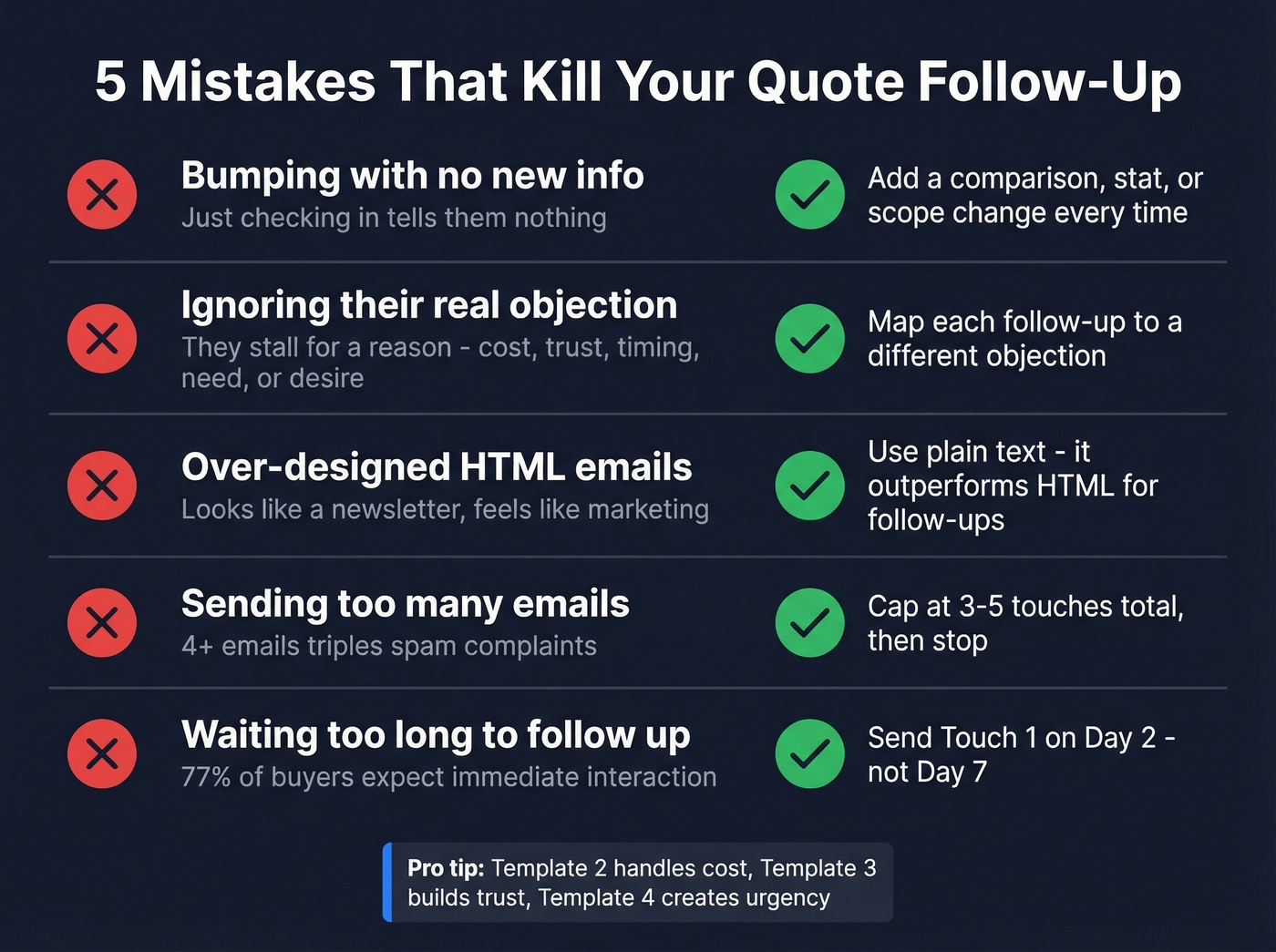
2. Ignoring objections. Prospects stall for five reasons: no need, cost concerns, no urgency, don't want it, or don't trust you. Each follow-up should tackle a different one.
3. Over-designed emails. Plain-text outperforms HTML for follow-ups. If it looks like a newsletter, it feels like marketing.
4. Sending too many. Four or more emails in a sequence triples spam complaints. Three to five touches is the ceiling.
Map your templates to objections: Template 2 tackles cost, Template 3 builds trust, Template 4 creates urgency.
Quotation Follow Up Email Format
35% of recipients open emails based on the subject line alone. But format matters beyond the subject line. If you want more options, pull from these email subject line ideas.
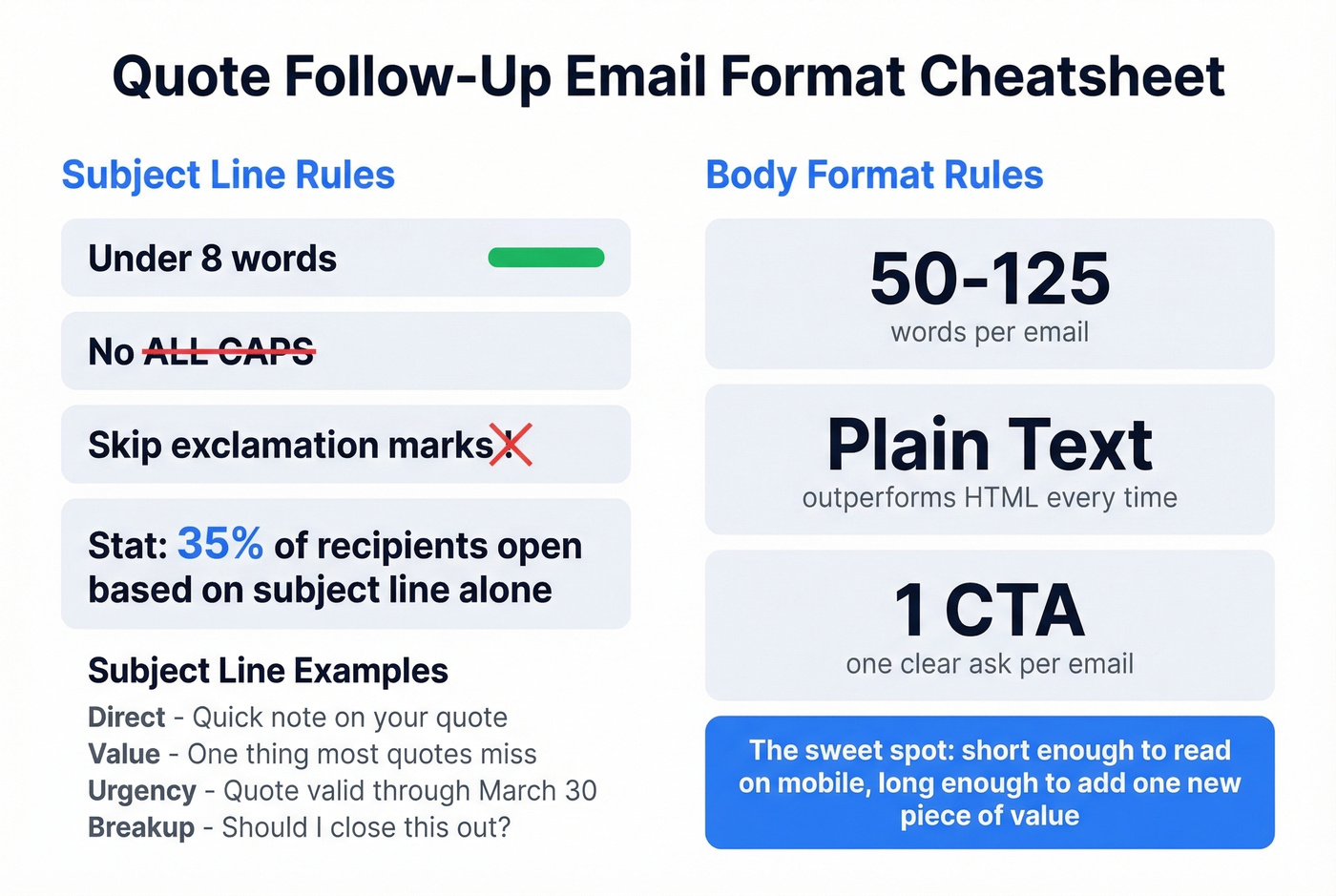
For subject lines, keep them under 8 words, skip ALL CAPS, and drop the exclamation marks. A few approaches that work:
- Direct: "Quick note on your quote" / "Following up on your [project] estimate"
- Value-driven: "One thing most [industry] quotes miss"
- Urgency: "Quote valid through [date]"
- Question: "Should I close this out?"
For the body, stick to plain text, one clear CTA, and 50-125 words. That's the format that consistently earns replies. (More on writing CTAs: clear CTA.)
When to Stop Following Up
Here's the thing: the "80% of sales require 5+ follow-ups" stat everyone cites comes from cold outreach. Your prospect asked for this quote - that's warm. The math is different.
The real issue isn't whether to follow up. It's how to do it without sounding desperate. After 5 touches with zero engagement signal - no opens, no clicks, no replies - you're hurting your sender reputation more than helping your pipeline. Close the loop and move on.
Let's be honest: if your quote is under $2K, three follow-ups is plenty. The prospect either wants it or they don't. Save the five-touch cadence for deals worth chasing. And if they reject you, ask what tipped the decision - it's free market research that costs you nothing but a sentence.
Following up on quotes only works when you're emailing the actual decision-maker. Prospeo's 300M+ verified profiles and 30+ filters let you find the right buyer before you send the quote - so your follow-ups reach someone who can actually sign off. At ~$0.01/email, a bounced follow-up sequence costs you more in reputation than Prospeo costs in credits.
Send your quote follow-ups to verified buyers, not dead inboxes.
FAQ
How long should a follow-up email be?
50-125 words. That's short enough to read on mobile and long enough to introduce one new piece of information - a comparison, a case study result, or a deadline - per touch.
Should I call instead of emailing?
If two emails get no response, call on Day 8 - especially for quotes over $5K. Multichannel sequences combining email, calls, and social touches pull an 11.87% reply rate versus email-only cadences.
What if my follow-up emails bounce?
Bounced emails damage sender reputation and can land your domain on blocklists. Verify addresses before your sequence starts so every touch actually reaches the inbox. We use Prospeo's verification for this - 98% accuracy and the free tier handles 75 checks per month.
When should I send the first follow up email for a quotation request?
Wait two business days. That gives the prospect enough time to review without letting your quote go cold. If the deal involves multiple stakeholders, Day 3 is acceptable - but never wait longer than five days for your first touch.