

How to Write a Follow Up Proposal Email (Without Sounding Desperate)
You sent the proposal Monday. It's Thursday. You've refreshed your inbox 47 times, and the silence is deafening.
Here's the thing: 75% of buyers expect 2-4 follow-ups before making a decision. Silence isn't rejection - it's the default state of every busy decision-maker's inbox. Your follow up proposal email strategy matters more than the proposal itself, and we've seen this play out across hundreds of outbound campaigns.
The short version: Follow up 2-3 business days after sending, then space touches over 17-21 days across 8-12 touchpoints. Every follow-up must add something new (here’s a deeper guide on how to add value in sales). And verify your prospect's email before you start - a bounced follow-up kills your sender reputation and your entire sequence.
Why Follow-Ups Close Deals
42% of all email replies come from follow-up steps, not the initial send. The average cold email reply rate sits at 3.43%, with top performers hitting 10.7%+. Meetings require roughly 8 touches on average, per RAIN Group research. And when multiple stakeholders view a proposal, the close rate doubles.
The math is brutal. If you send one email on proposal day and stop, you're leaving almost half your potential replies on the table.
The Proposal Follow-Up Cadence
The sweet spot is 17-21 days with 8-12 touchpoints. Start tight, then expand spacing to avoid fatigue.
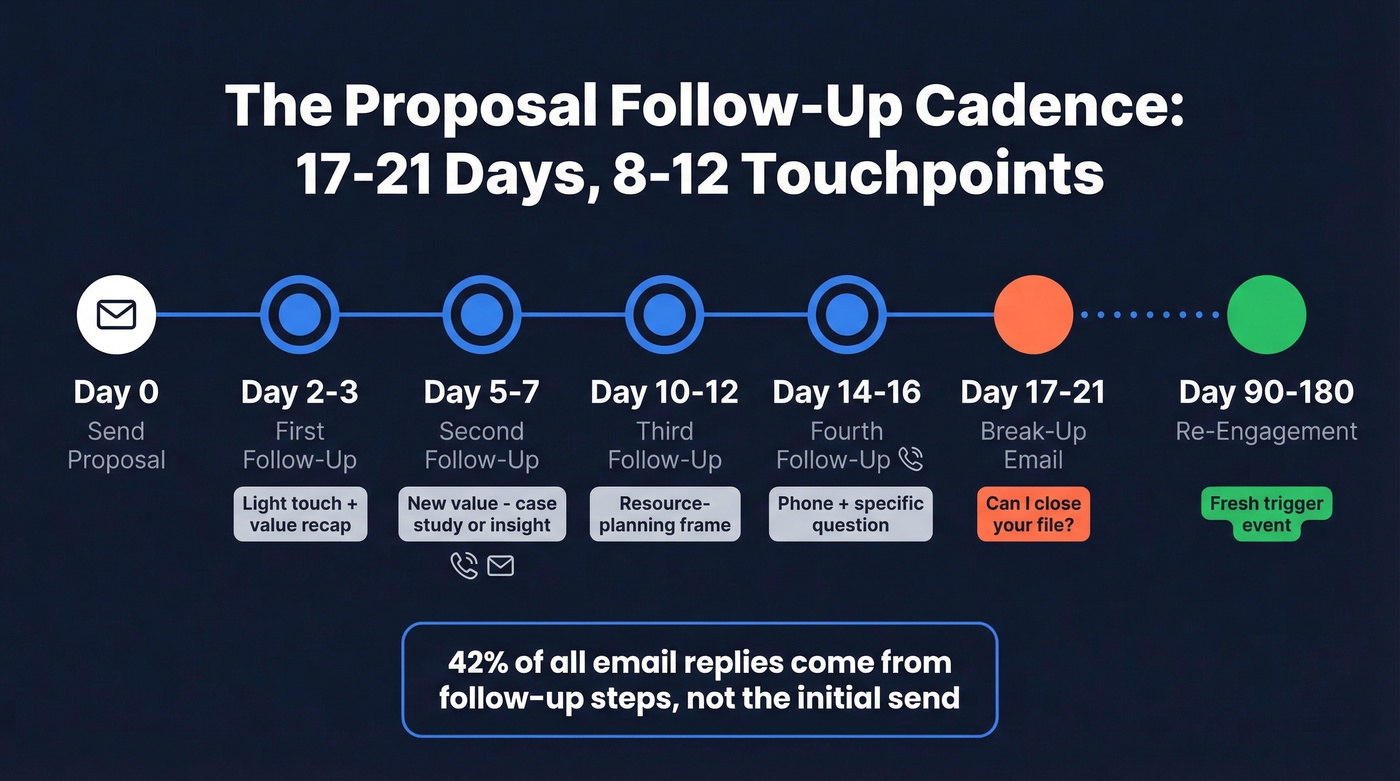
| Day | Action | Channel | What to Say |
|---|---|---|---|
| 0 | Send proposal | - | |
| 2-3 | First follow-up | Light touch + value recap | |
| 5-7 | Second follow-up | Email + phone | New value (case study, insight) |
| 10-12 | Third follow-up | Resource-planning frame (timeline + next step) | |
| 14-16 | Fourth follow-up | Phone + message | Quick check + specific question |
| 17-21 | Break-up email | "Can I close your file?" | |
| 90-180 | Re-engagement | Fresh trigger event |
After 3-4 unanswered emails, pause the sequence. Circle back in 3-6 months with a fresh trigger. Persistence works; pestering doesn't.
Always reply in the original thread for your first 2-3 follow-ups. Starting a new thread loses context and makes it harder for the prospect to reference the proposal (and it can also complicate sequence management in your sales engagement tool).
8 Templates for Every Stage
Most follow-up advice tells you to be patient and polite. That's half right. You should be polite - but patience without a system is just hoping. These templates give you the system (and if you want more variations, see these sales follow-up templates).
First Follow-Up (Day 2-3)
Subject: Quick thought on [project name]
Hi [Name],
Wanted to make sure the proposal landed and see if any questions came up. The [specific deliverable or timeline] section is where most clients want to dig in - happy to walk through it live if that's easier.
Talk soon, [Your name]
Keep it short, plain-text, and sent as a reply to the original thread.
Add New Value (Day 5-7)
Use this when they haven't replied but you have something genuinely useful to share.
Subject: [Relevant insight] for [their company]
Hi [Name],
Came across [case study / article / data point] that's directly relevant to what we discussed. [One sentence summarizing the insight.] Thought it'd be useful as you're evaluating next steps.
Any questions on the proposal I can clear up?
The Resource-Planning Frame (Day 10-12)
This template shifts the dynamic entirely. You're not asking them to buy - you're asking them to help you plan. It creates urgency without pressure, and in our experience it's the single most effective follow-up for proposals over $10K.
Subject: Team allocation for [project name]
Hi [Name],
We're mapping out our team for [next quarter/month] and want to make sure we reserve the right people for your initiative. Could you let me know by [specific date] whether you'd like to move forward?
No pressure either way - just want to plan accordingly.
Multi-Stakeholder Follow-Up
Subject: Anyone else who should weigh in?
Hi [Name],
Totally understand if this decision involves other folks on your team. Happy to put together a brief summary doc or jump on a quick call with whoever else needs to evaluate. Who should I loop in?
When more than one stakeholder views a proposal, the close rate doubles. This email expands the buying committee rather than waiting for your single contact to sell internally.
The Objection-Addressing Follow-Up
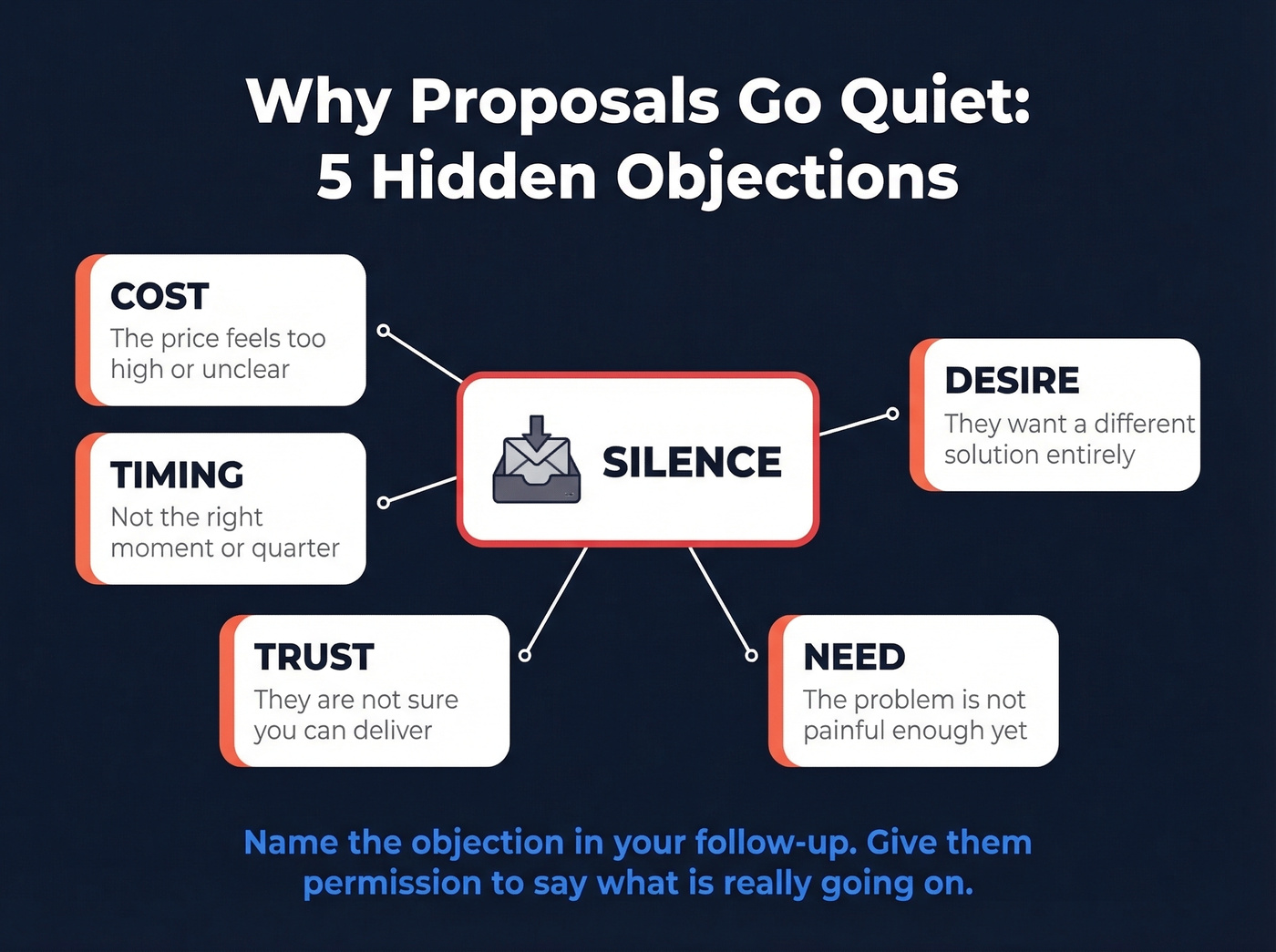
Silence almost always means an unspoken objection - cost, timing, trust, need, or desire. This email gives them permission to voice it.
Subject: Wanted to address something
Hi [Name],
When proposals go quiet, it's usually one of a few things: the timing isn't right, the pricing needs adjusting, or the scope doesn't quite fit. If any of those apply, I'd rather talk it through than let it sit. Which one's closest?
The "I Know You Opened It" Follow-Up
Subject: Thoughts on the [pricing/timeline] section?
Hi [Name],
I noticed you had a chance to review the proposal - curious if the [specific section] raised any questions. Happy to adjust anything that doesn't fit.
If your proposal tracking shows they've opened it three times but haven't replied, stop playing dumb. Acknowledge the engagement and ask about the section they likely focused on.
The Break-Up Email (Day 17-21)
Subject: Should I close your file?
Hi [Name],
Haven't heard back, so I'm guessing the timing isn't right. I'll close out your file for now - but if things change down the road, I'm an email away.
Break-up emails often pull responses from prospects who ignored every previous touch. They make it easy to say "yes," "no," or "not now" - and that low-friction ask is exactly why they work.
The 3-6 Month Re-Engagement
Subject: [Their company] + [your company] - worth revisiting?
Hi [Name],
Saw [company news / trigger event]. Since we last spoke, we've [new case study / updated pricing / new capability]. Worth a fresh conversation?
Circle back with a reason. Company news, a new case study, or updated pricing gives you a legitimate excuse to re-open the thread.

A perfect follow-up cadence means nothing if your proposal bounces. Prospeo's 98% email accuracy and 5-step verification ensure every follow-up lands in the right inbox - not a spam trap, honeypot, or dead address.
Stop refreshing your inbox. Start reaching verified decision-makers.
Subject Lines That Get Opened
Never put "follow-up" in your subject line - it screams "you ignored me." Kill "touching base," "just checking in," and "circling back" while you're at it. Beyond the lines used in the templates above, here are four more that work:
- After a call: "Next steps from our [day] conversation"
- Deadline-driven: "[Date] is coming up - quick question"
- Social proof: "[Similar company] saw [result] - relevant for you?"
- Direct: "Still interested in [project name]?"
Short, specific, and giving the recipient a reason to open beyond curiosity. (If you need more options, pull from these email subject line examples.)
5 Mistakes That Kill Your Proposal Follow-Up
1. Bumping with no new information. "Just making sure you saw this" adds zero value and signals you have nothing else to offer. Every follow-up needs a new angle - a case study, a question, a deadline, something.
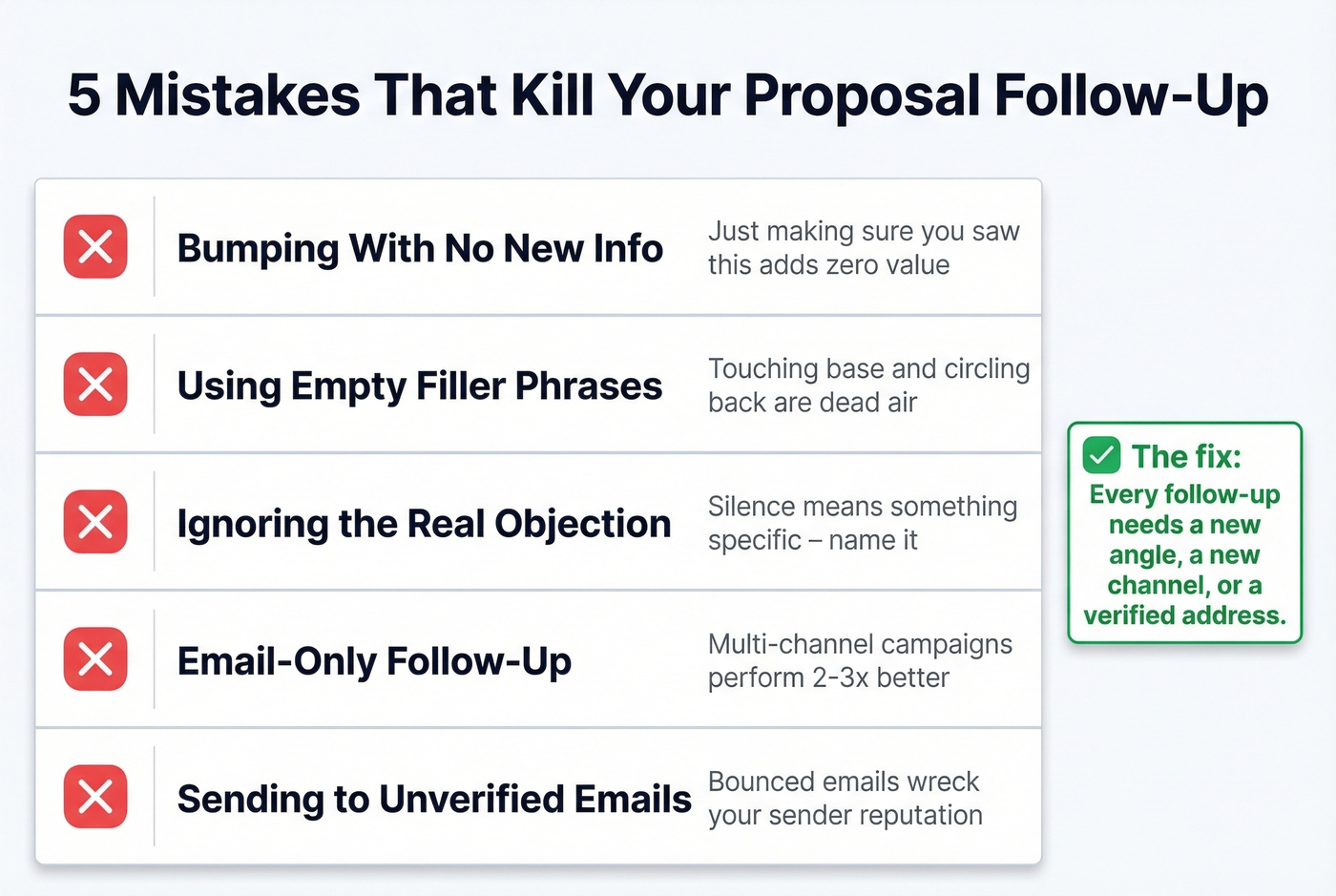
2. Using empty filler phrases. "Touching base," "circling back," "checking in" - these are the email equivalent of dead air. If you can't articulate why you're emailing, don't send it.
3. Not addressing the real objection. Silence means something specific: cost, timing, trust, need, or desire. If you're not naming the likely objection, you're just adding noise to their inbox (this is also where better sales communication makes a measurable difference).
4. Following up only by email. Multi-channel campaigns perform 2-3x better than single-channel. Add phone and direct messages to your cadence - email alone isn't enough for high-stakes proposals.
5. Sending to an unverified email address. Your entire follow-up sequence dies on arrival if the email bounces. Worse, bounced emails damage your sender reputation and tank deliverability for every future message you send. We've seen teams lose months of domain warming because they skipped verification. Tools like Prospeo catch bad addresses with 98% accuracy before they wreck your domain - it's the cheapest insurance you'll buy (especially if you’re tracking email bounce rate and deliverability over time).
Advanced Moves for High-Stakes Proposals
Present the proposal live. Don't email a PDF and pray. Get on a call, walk through the key sections, and aim for verbal sign-off before you hang up. One agency founder reported 28-33% close rates on outbound after switching from emailed PDFs to live presentations. That's a massive jump for a simple process change.
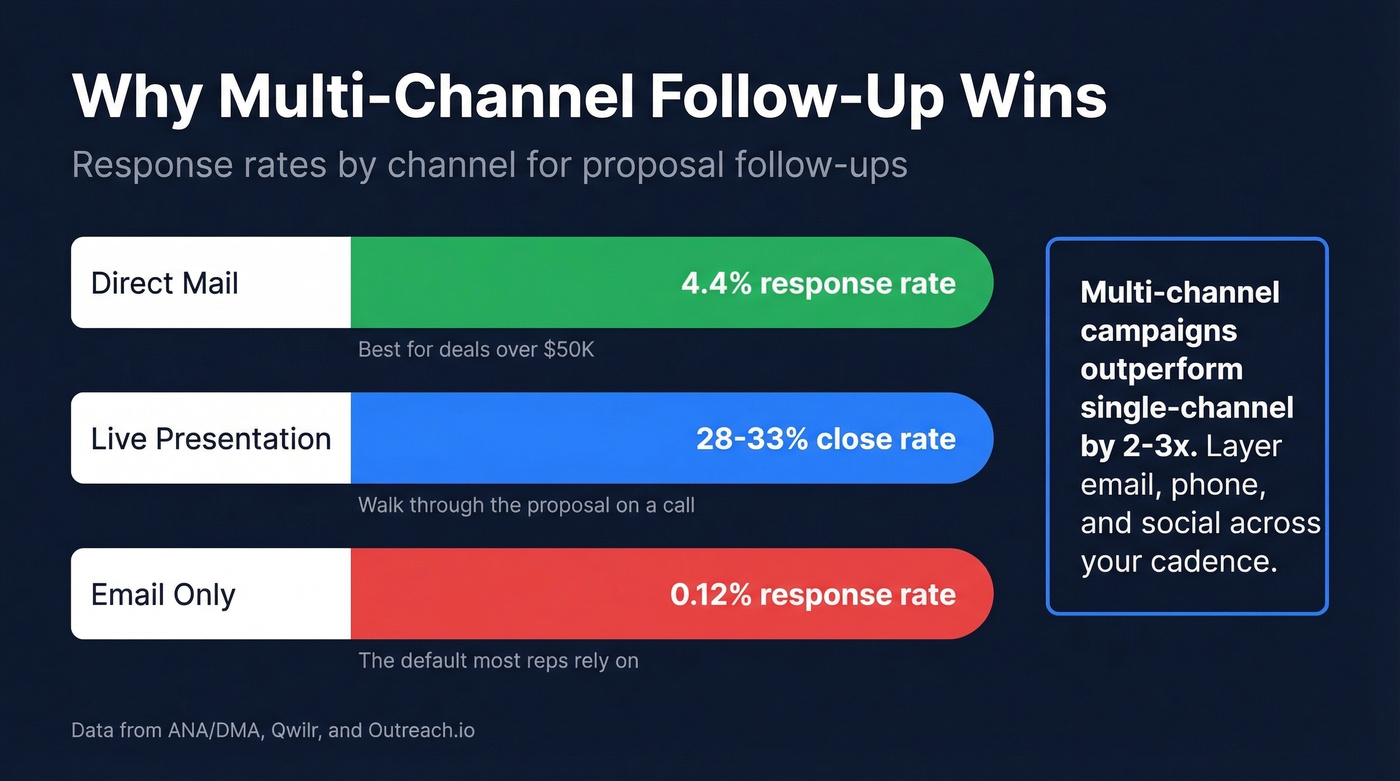
Go multi-channel. Phone drives disproportionate responses even when it's only 20-30% of your touches. Layer email, phone, and social messages across your cadence. If your cadence includes phone touches - and it should - you need verified direct dials, not switchboard numbers that route to voicemail trees (more on building a repeatable system in our cold calling system guide).
Send something physical for $50K+ deals. A handwritten note or a relevant book cuts through digital noise in a way no email can. Direct mail averages a 4.4% response rate versus email's 0.12%, per the latest ANA/DMA data. For enterprise proposals, the ROI on a $15 book and a handwritten card is absurd.
Let's be honest: if you're chasing a six-figure deal and your follow-up strategy is "send three emails and hope," you're leaving money on the table. The reps who close these deals are the ones mixing channels, adding value at every touch, and making it ridiculously easy for the prospect to say yes.
When your break-up email goes unanswered, re-engagement depends on fresh data. Prospeo refreshes 300M+ profiles every 7 days - so when you circle back in 3-6 months, you're reaching the right person at the right address, even if they changed roles.
Stale data kills re-engagement. Weekly-refreshed data closes deals.
FAQ
How long should I wait before following up on a proposal?
Send your first follow up proposal email two to three business days after the initial send. That's long enough for the prospect to review but short enough to stay top of mind. Space subsequent touches 3-7 days apart, expanding the gap as you move deeper into the cadence.
How many follow-up emails should I send after a proposal?
Plan for 8-12 touchpoints over 17-21 days across email, phone, and direct messages. 42% of all email replies come from follow-up steps, not the initial send. Stop after 3-4 unanswered emails, then re-engage in 3-6 months with a fresh trigger event.
What should I include when following up on an unanswered proposal?
Every message needs a new angle - a case study, a specific question about scope, or a resource-planning frame that creates urgency without pressure. Never send a bare "just checking in." The objection-addressing template above works especially well for proposals that have gone silent past day 10.
What if they opened my proposal but didn't respond?
Acknowledge it directly - "I noticed you had a chance to review the proposal" - and ask a specific question about the section they likely focused on, whether that's pricing, timeline, or scope. Don't pretend you don't know they've looked at it; proposal tracking tools make this easy, and prospects expect you're using them.