

How to Write Follow Up Emails That Actually Get Replies
44% of salespeople quit after one follow-up. Meanwhile, 80% of sales require 5-12 follow-up attempts to close. The average cold email response rate? Just 5.1%. Every follow up email you skip is revenue you forfeit.
Here's the thing: most follow-up advice focuses on clever subject lines and "just checking in" templates. That's the easy part. The hard part - the part nobody talks about - is building a system where each touch has a job, your data doesn't bounce, and your sequence actually earns replies instead of annoying people. Let's fix that.
Fix Your Data Before You Write a Word
Most follow-up guides jump straight to copywriting. But we've watched teams burn through entire sequences only to discover a third of their list was dead addresses. One team we worked with cut bounce rates from 35% to under 4% just by running their list through Prospeo's email verification before writing a single word. With 98% email accuracy and a 5-step verification process that catches spam traps and honeypots, you're not wasting sequences on addresses that don't exist.
Fix your data first. Fix your copy second.

8 Follow Up Email Templates That Work
81% of emails get opened on mobile, so keep every template between 50 and 125 words. Walls of text die on a phone screen.
If you want more plug-and-play options, start with these follow-up templates and adapt them to your sequence.
After No Response (Polite)
Subject: Quick question about [topic]
Hi [Name], I sent a note last [day] about [specific topic]. Would it make sense to reconnect in [timeframe], or is this off the table? Either way, happy to hear back.
After No Response (Direct)
Subject: [Name] - still relevant?
[Name], I'll keep this short. [One-sentence value prop]. If there's zero interest, just say the word. If there is, let's find 15 minutes this week.
After a Meeting
Subject: Next steps from [day]'s call
Hi [Name], great speaking today. To recap: [one key takeaway]. I'll send over [deliverable] by [date]. Does [proposed next step] work on your end?
After a Demo or Call
Subject: [Product] + [their company] - recap
[Name], based on what you shared about [pain point], here's how [product] addresses it: [one sentence]. I've attached [resource]. Want to loop in [stakeholder]?
After Sending a Quote
Subject: Any questions on the proposal?
Hi [Name], did the proposal cover everything you need? If pricing or scope needs adjusting, I'm happy to revisit. What's the best next step?
After a Networking Event
Subject: Good meeting you at [event]
[Name], enjoyed our conversation about [topic]. You mentioned [specific challenge] - I think [resource or idea] could help. Worth a quick call this week?
The Breakup Email
Subject: Should I close your file?
[Name], I've reached out a few times without hearing back. I'll assume the timing isn't right and close this out. If anything changes, reply here and we'll pick right back up.
In our experience, the breakup email generates more replies than any other touch in the sequence. People respond to the threat of losing access more than to any value prop you'll ever write. The consensus on r/sales backs this up - breakup emails consistently outperform "just bumping this" messages because they flip the dynamic from chasing to walking away.
Invoice or Payment Reminder
Subject: Invoice #[number] - quick reminder
Hi [Name], invoice #[number] for [amount] was due on [date]. If it's already processed, disregard. Otherwise, could you confirm the expected payment date?

Every follow-up you send to a dead address is a wasted touch - and a hit to your domain reputation. Prospeo's 5-step email verification catches spam traps, honeypots, and catch-all domains before your sequence even starts. At 98% accuracy and ~$0.01/email, cleaning your list costs less than one bounced campaign.
Fix your data first. Your follow-up sequence will thank you.
Build a Sequence, Not a Single Email
A single follow-up isn't a strategy. 80% of positive replies come from follow-ups, not the initial send. Knowing when and how to send each message is what separates consistent pipelines from one-and-done outreach.
If you're building this into outbound, it helps to think in terms of a full B2B cold email sequence rather than isolated messages.
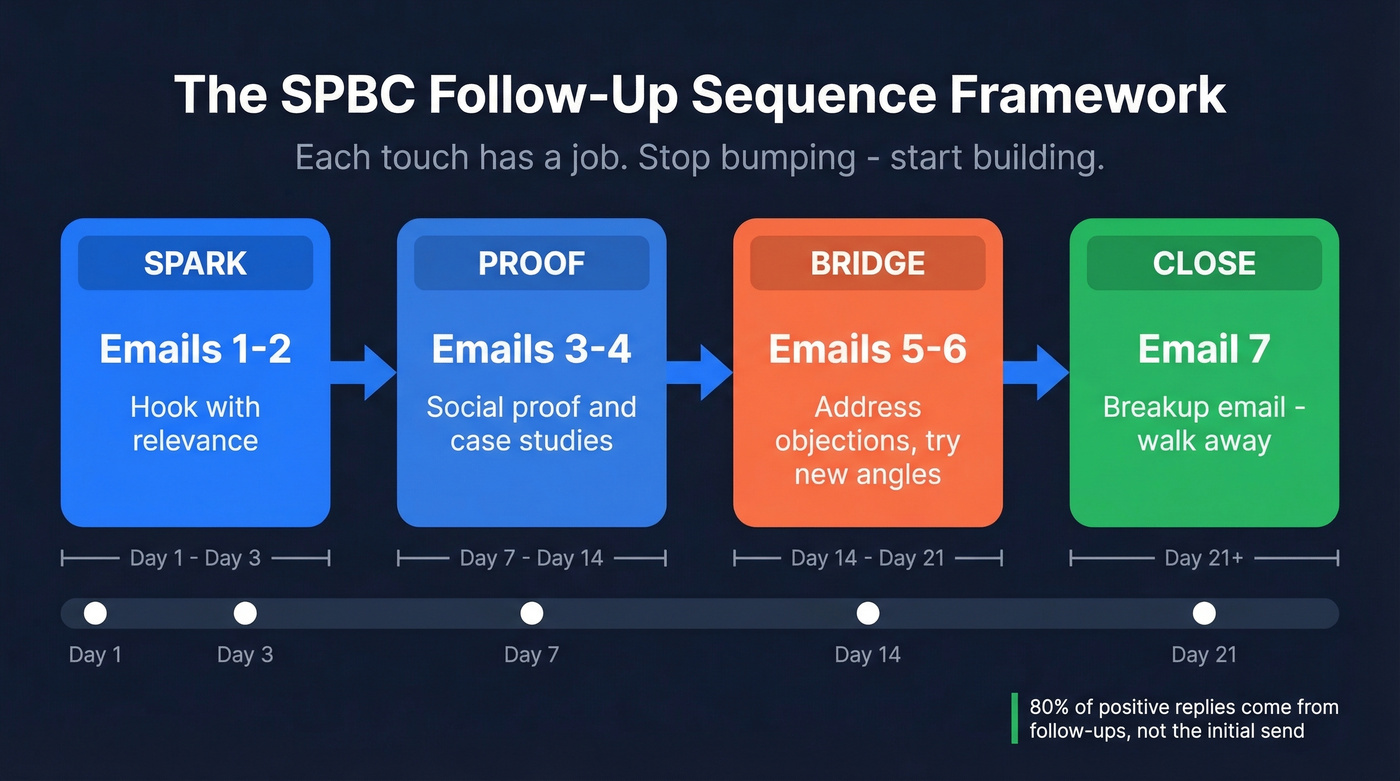
The SPBC framework gives each touch a distinct job:
| Phase | Emails | Purpose |
|---|---|---|
| Spark | 1-2 | Hook with relevance |
| Proof | 3-4 | Social proof, case studies |
| Bridge | 5-6 | Address objections, try a new angle |
| Close | 7 | Breakup email |
Space your touches with widening gaps: Day 1, Day 3, Day 7, Day 14, Day 21. For high-intent prospects who've already engaged with your content or visited your pricing page, 7-10 touches over 10-14 days can work. But for cold outreach where you haven't earned attention yet, the widening cadence above is less likely to get you flagged as spam.
Each follow-up should rotate through a different objection - no need, no perceived value, no urgency, or no trust. That rotation keeps every email fresh instead of just "bumping" the thread with the same pitch reworded five times.
To keep the messaging tight, borrow a few principles from email copywriting and apply them across the whole cadence.
Subject Lines: What the Data Says
Based on 5.5M emails analyzed by Belkins:
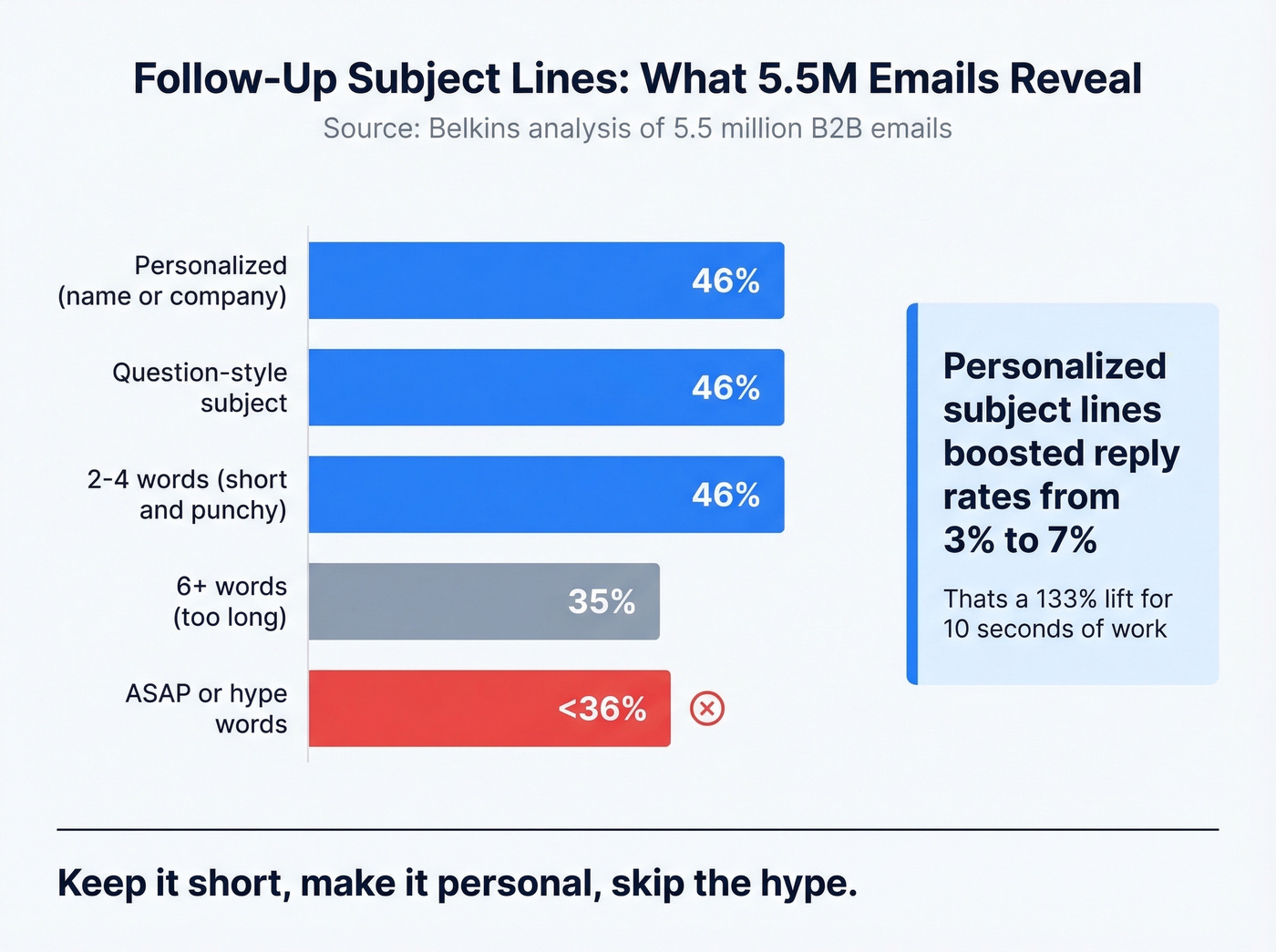
| Style | Open Rate | Notes |
|---|---|---|
| Personalized | 46% | +31% vs generic |
| Question-style | 46% | Top performer |
| 2-4 words | 46% | Brevity wins |
| 6+ words | ~35% | Performance drops |
| "ASAP" / hype | <36% | Avoid urgency spam |
If you need more ideas, pull from these email subject line examples and test them against your audience.
Reply rates tell the same story. Personalized subject lines jumped reply rates from 3% to 7% - a 133% lift - just from including a name or company. That's the single highest-ROI change you can make to a follow up email, and it takes about ten seconds per message.
Mistakes That Kill Follow Ups
"Just checking in" with no new value. Every follow-up needs a reason to exist. If you can't articulate what's new since your last email, don't send it. (If you’re stuck, here are better ways to say “just checking in” professionally.)
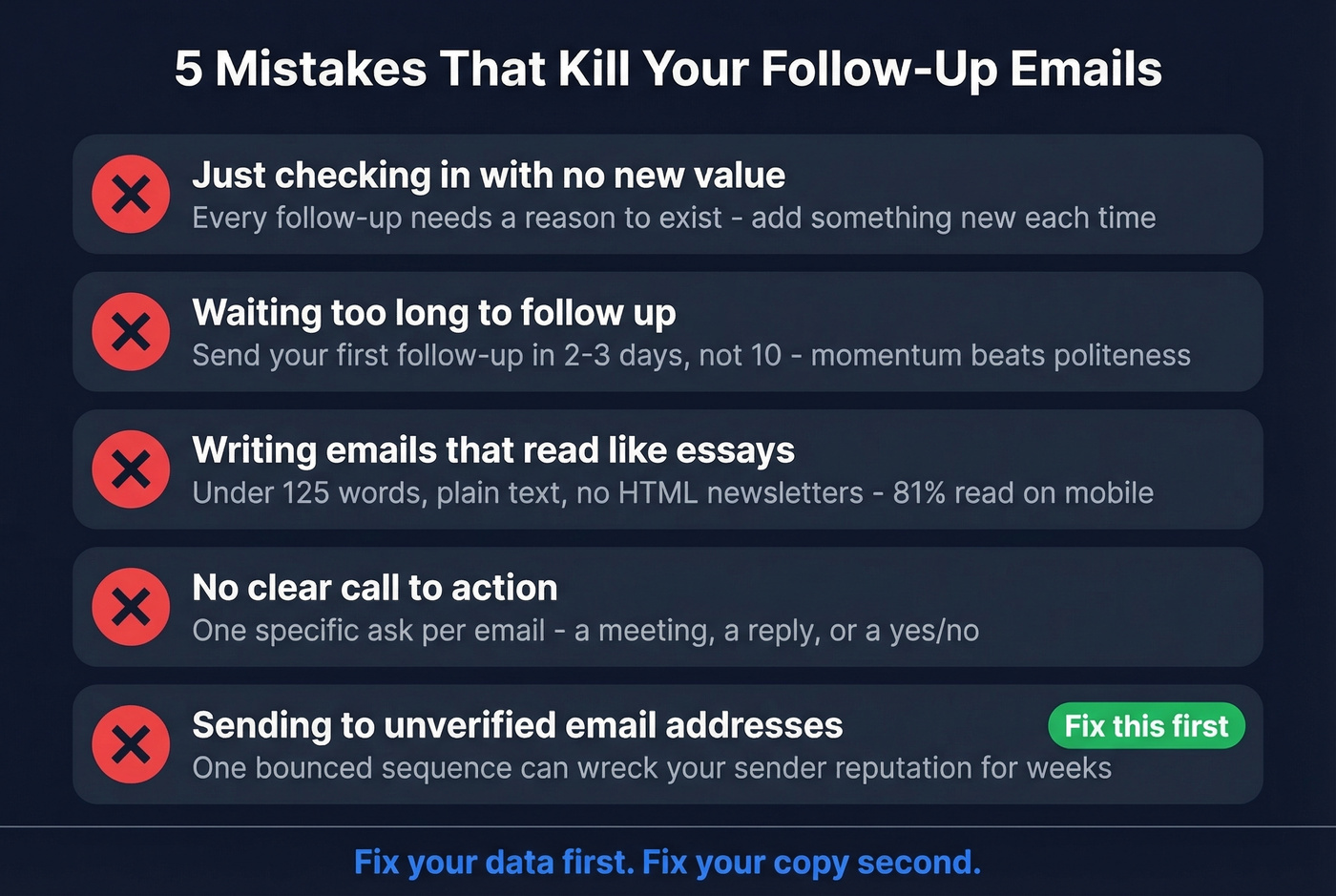
Waiting too long. Send the first follow-up in 2-3 days, not 10. Momentum matters more than politeness. (For more timing guidance, see when you should follow up on an email.)
Emails that read like essays. Under 125 words, plain text, no HTML newsletters. Your prospect isn't reading your quarterly report on their phone at a stoplight.
No clear CTA. One specific ask per email - a meeting, a reply, a yes/no. Two asks means neither gets answered. If you want a tighter ask, use these email call to action rules.
Sending to unverified addresses. Skip this one if you want your domain reputation torched. One bounced sequence can wreck your sender reputation for weeks. We've seen it happen to teams running campaigns off scraped lists they never bothered to verify - they spent more time recovering deliverability than they would've spent cleaning the list in the first place. (If you’re troubleshooting, start with email bounce rate benchmarks and fixes.)
You just built a 7-touch follow-up sequence. Now make sure every email lands. Prospeo refreshes 300M+ profiles every 7 days - not every 6 weeks like other providers. That means the contacts you're sequencing today are verified this week, not last quarter.
Stop following up with ghosts. Start with verified contacts.
FAQ
How long should I wait before following up?
Two to three business days after your initial send, then widen gaps: +4 days, +7, +14. After a demo or sent quote, follow up within 24 hours while context is fresh.
How many follow up emails should I send?
Four to seven. Data shows 80% of positive replies come from follow-ups, with most incremental replies arriving between touches #2-4. Always end with a breakup email.
What time of day works best?
9 AM-12 PM in the prospect's time zone, Tuesday through Thursday. That said, a trigger-based follow-up - sent after a page visit or email open - beats any calendar trick.
How do I avoid bounces ruining my sender reputation?
Run your list through a verification tool before launching any sequence. Keeping bounces below 2% is the threshold most ESPs require to maintain good deliverability, and it's the single easiest variable in your outreach stack to control.