

The Best Free B2B Platforms in 2026 - And What "Free" Actually Costs
A Shopify store owner realizes they need organization-level customer accounts with multiple buyers. They check Shopify Plus pricing: $2,300/month. That's roughly an 8x jump from Advanced, and it's a common complaint on r/ecommerce. With the B2B ecommerce platform market approaching $10.7 billion in 2026, buyers now routinely self-serve on orders above $500,000, and every free B2B platform comes with tradeoffs nobody puts on the landing page.
Here's the problem: "free B2B platform" means three completely different things depending on who's searching. Some people want a marketplace to list products and find buyers. Others want open-source ecommerce software they can self-host. And a growing chunk just need a tool to find B2B contact data - verified emails and phone numbers - without paying ZoomInfo prices. We've broken down all three categories below, with real pricing for every option.
Our Picks (TL;DR)
| Category | Tool | Why |
|---|---|---|
| Find B2B buyers | Prospeo | 75 free verified emails/mo, 98% accuracy, no credit card |
| Build a B2B store | WooCommerce + B2BKing | Lowest barrier, largest plugin market |
| Join a B2B marketplace | Alibaba | Largest global reach, free to join |
Which Type Do You Need?
Before picking tools, nail down your actual problem. The wrong category wastes months.
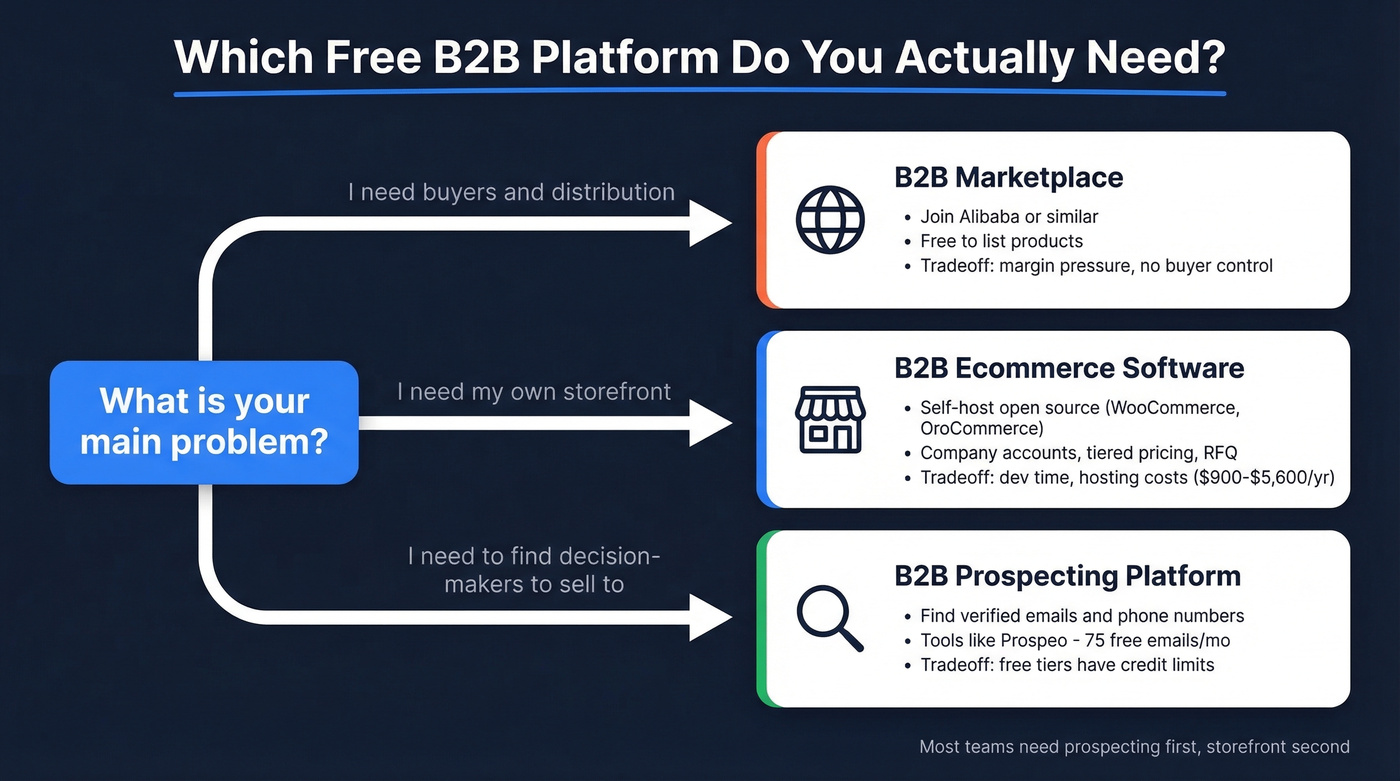
You need a B2B marketplace if you want distribution and don't want to build anything. You're a manufacturer or wholesaler looking for buyers globally. You'll join a platform like Alibaba, list products, and pay for visibility when you're ready to scale. The tradeoff: margin pressure and zero control over the buyer relationship.
You need B2B ecommerce software if you want your own storefront with features like company accounts, tiered pricing, RFQ workflows, approval chains, bulk ordering, and API access. You'll self-host open-source software and customize it. The tradeoff: dev time and hosting costs that make "free" a relative term.
You need a B2B prospecting platform if your problem isn't building a storefront - it's finding the right people to sell to. When your bottleneck is verified emails and direct dials for decision-makers, you need a data platform, not infrastructure.
Free B2B Prospecting & Data Tools
Every tool here offers a free tier, but the limits and data quality vary wildly.
Prospeo
Use this if you need verified B2B emails and mobile numbers with the highest accuracy on the market, and you want to start free without talking to sales.
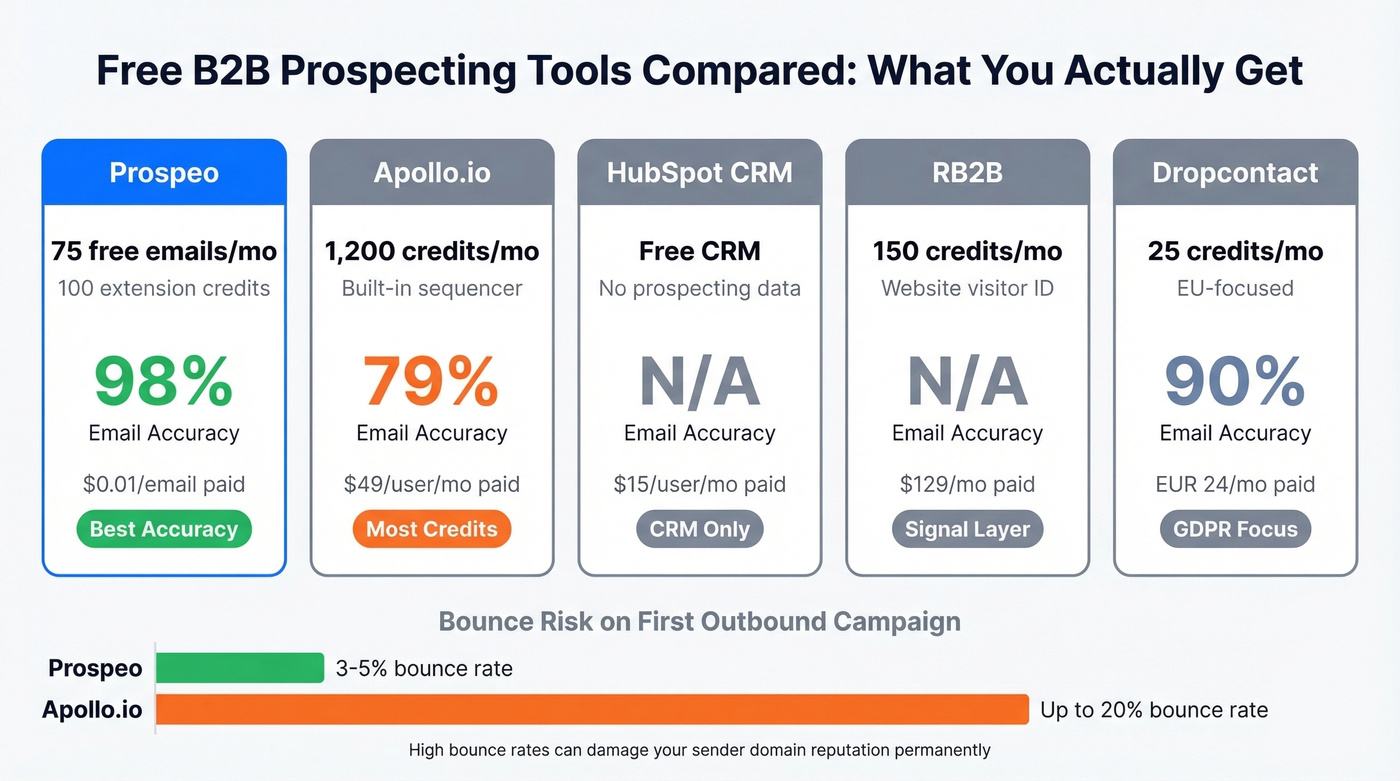
Prospeo's database covers 300M+ professional profiles, 143M+ verified emails, and 125M+ verified mobile numbers. The free tier gives you 75 verified emails and 100 Chrome extension credits per month - no credit card required. That's enough to run a meaningful test before committing a dollar.
The accuracy gap matters more than the credit count. Prospeo hits 98% email accuracy versus Apollo's 79%. In practice, that translates to roughly a 3-5% bounce rate versus ~20% bounce risk on your first outbound sequence - a difference that can wreck your domain reputation before you've even warmed it up. Data refreshes every 7 days, compared to the 6-week industry average, so you're not emailing people who changed jobs two months ago. (If you're trying to reduce bounces fast, see our guide to email bounce rate.)
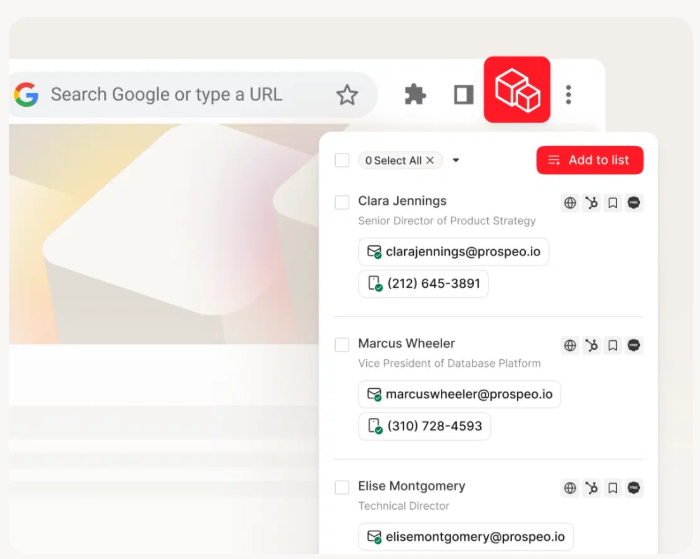
On paid plans, you're looking at roughly $0.01 per email. The 30+ search filters - including buyer intent powered by Bombora, technographics, job change signals, and funding signals - make it a genuine prospecting platform, not just an email finder. Native integrations push contacts straight into Salesforce, HubSpot, Lemlist, Instantly, and Clay, so it slots into your existing stack rather than replacing it. If you want more ways to build pipeline without budget, start with these free lead generation tools.
Apollo.io
Apollo's free tier is the most generous on paper: 1,200 credits per user per month, including basic email and phone lookups plus a built-in sequencer. Paid plans start at $49/user/month. The workflow tools - sequences, dialer, task management - make it a solid starting point for teams that don't have a separate outreach tool yet. (For more options in this category, compare sales prospecting databases.)
The catch: We've run bake-offs where Apollo's volume advantage disappeared once we factored in bounces and spam-folder rates. If your deal sizes are large enough that every contact matters, accuracy beats volume every time. If you're running cold outreach, pair any database with a solid email deliverability guide.
HubSpot CRM Free Tier
HubSpot's free CRM is genuinely useful for pipeline management, but it's a CRM, not a prospecting database. Paid plans start at $15/user/month. Use it to manage contacts you've already found, not to find new ones. If you're evaluating CRMs broadly, here are more examples of a CRM.
RB2B
RB2B identifies anonymous website visitors - 150 free credits per month, Pro+ at $129/month. It's a signal layer ("who's visiting my pricing page?") but won't replace a prospecting database. Pair it with a data tool to actually reach those visitors. To operationalize those signals, build a simple lead generation workflow.
Dropcontact
EU-focused enrichment tool with 25 free credits per month (50 in your first month), then roughly EUR24/month. About 90% email accuracy. Worth considering if your target market is primarily European and GDPR compliance is your top concern. If you're enriching lists at scale, also review these data enrichment services.
| Tool | Free Tier | Paid From | Email Accuracy | Best For |
|---|---|---|---|---|
| Prospeo | 75 emails, 100 ext. credits | ~$0.01/email | 98% | Verified emails & mobiles |
| Apollo.io | 1,200 credits/user/mo | $49/user/mo | ~79% | All-in-one prospecting |
| HubSpot CRM | Free CRM (no prospecting) | $15/user/mo | N/A | Pipeline management |
| RB2B | 150 credits/mo | $129/mo | N/A | Website visitor ID |
| Dropcontact | 25 credits/mo | ~EUR24/mo | ~90% | EU-focused enrichment |
Look, if your average deal is under five figures, you probably don't need ZoomInfo-level data. A free tier from any of these tools paired with a good sequencer will get you further than a $15,000/year data contract you'll underuse. If you're building outbound from scratch, start with these sales prospecting techniques.

Most "free" B2B platforms cost you in bad data - bounced emails, burned domains, wasted hours. Prospeo's free tier gives you 75 verified emails and 100 Chrome extension credits every month at 98% accuracy. No credit card. No contract. No sales call.
Find out what free B2B data looks like when it actually works.
Your competitors are paying $1/lead on ZoomInfo for 87% accuracy. Prospeo delivers 98% accuracy at $0.01/email with data refreshed every 7 days - not every 6 weeks. 30+ filters including buyer intent, technographics, and funding signals turn a contact database into a prospecting engine.
Pay 90% less for data that's 11 points more accurate.
Free B2B Ecommerce Platforms
This is where "free" gets complicated. Every platform below has a free license. None of them are free to run.
WooCommerce + B2B Plugins
WooCommerce is a B2C platform by default. It becomes a B2B storefront through plugins, and that plugin stack is where the real cost lives. You'll need add-ons for role-based pricing, tiered discounts, quote workflows, quick order forms, and catalog visibility controls. The key plugins: B2BKing (the most popular all-in-one B2B plugin), Wholesale Suite (from $49.50/year), and ELEX Catalog Mode for hiding prices from non-logged-in visitors.
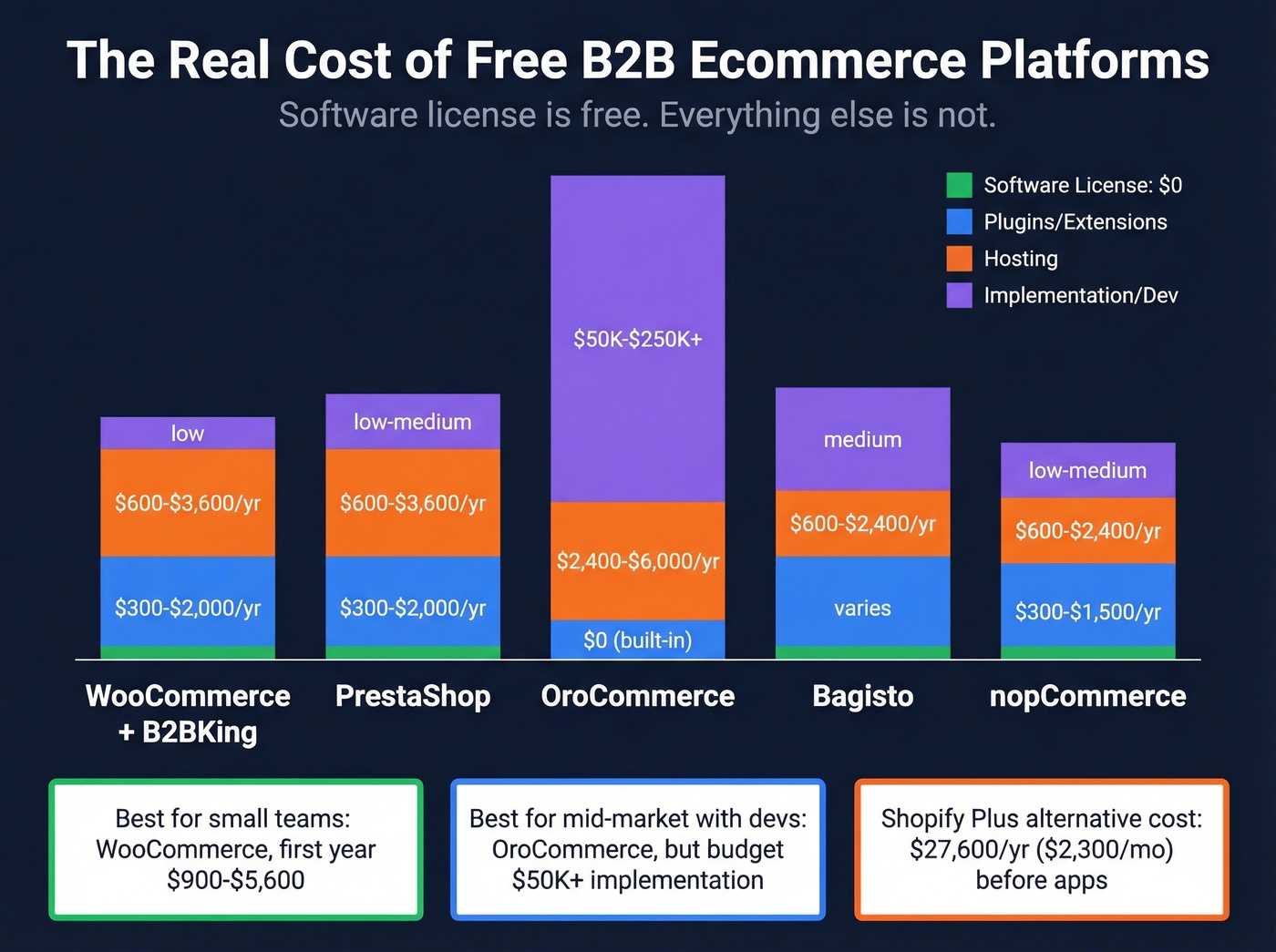
Expect to spend $300-$2,000/year on plugins, plus $50-$300/month on hosting. First-year cost lands around $900-$5,600 - not free, but dramatically cheaper than Shopify Plus. WordPress has the largest developer community in ecommerce, which means more tutorials, more plugins, and more help when things break at 2 AM. For teams that want maximum flexibility without writing code from scratch, WooCommerce is the obvious starting point.
The downside is maintenance. You're responsible for updates, security patches, and plugin compatibility. We've seen WooCommerce B2B stores work beautifully at launch and become a headache 18 months later when three plugins conflict after an update. Budget for ongoing dev time or you'll regret it.
PrestaShop
PrestaShop has a built-in B2B mode - toggle it on under Shop settings, Customers, General settings. You get customer groups, segmented pricing by group/country/currency, and bulk discount rules without installing anything extra. Quote requests and advanced inventory management still require third-party modules ($300-$2,000/year), but the baseline B2B functionality is stronger than WooCommerce's out of the box. GetApp rates it 4.3/5 across 331 reviews. No monthly fees, no commission on sales.
Skip this if you need a large English-speaking developer community. PrestaShop's community skews European, and finding US-based PrestaShop developers is harder than finding WordPress ones.
OroCommerce
OroCommerce is the only platform on this list purpose-built for B2B from day one. Native RFQ workflows, company hierarchies with multiple buyer roles, punchout catalogs for SAP Ariba and Coupa, tiered and volume pricing, approval workflows - all there without plugins. The open-source edition is free. The tech stack runs Symfony/PHP with PostgreSQL or MySQL, Redis for caching, and Elasticsearch for search.
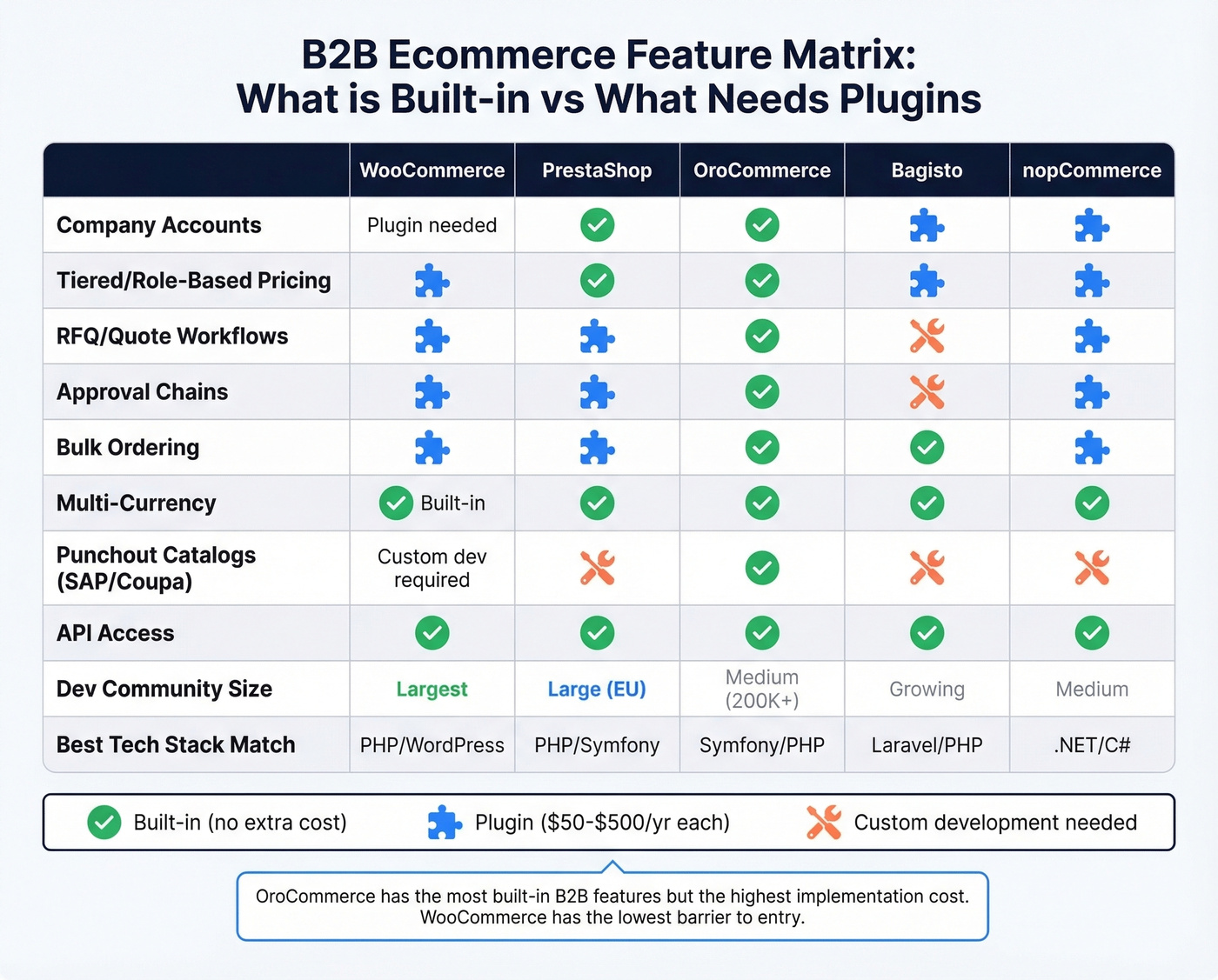
Here's the thing: OroCommerce is arguably the strongest open-source B2B ecommerce option if you have developers. It's the most expensive "free" software if you don't. Implementation runs 6-12 months and requires a dedicated dev team. Typical implementation plus customization TCO lands between $50,000 and $250,000+ once you factor in integrations and ongoing maintenance. The open-source community includes 200,000+ developers across 100+ countries, but you'll still need internal expertise.
If you're a mid-market manufacturer with an IT team and complex B2B workflows, OroCommerce is the right choice. A 5-person wholesale operation? It'll bury you.
Bagisto
Bagisto is lighter-weight than OroCommerce and more developer-friendly for teams already in the Laravel world. Multi-warehouse support, multi-currency, and a modular architecture make it a solid middle ground between WooCommerce's plugin dependency and Oro's enterprise complexity. Hosting runs $50-$200/month. The B2B feature set isn't as deep as Oro's - you'll build some workflows yourself - but the codebase is cleaner and faster to extend.
nopCommerce
Free, open-source, and built on .NET. GetApp rates it 4.7/5 across 106 reviews. If your team lives in the Microsoft stack, nopCommerce is the natural choice. B2B features require extensions, similar to WooCommerce's plugin model. Expect $300-$1,500/year for extensions plus $50-$200/month hosting.
Saleor
Headless, GraphQL-first, built on Python/Django. Saleor is for teams building composable MACH architecture who want total frontend control. The tradeoff: you're building the entire storefront yourself. Expect $200-$500/month minimum for infrastructure plus significant frontend dev time. Not a "free platform" in any practical sense unless you already have developers on staff.
Other options worth knowing about: Spree Commerce (Ruby on Rails) and Drupal Commerce (PHP/Drupal) are viable open-source alternatives for teams already committed to those tech stacks. WizCommerce is an emerging AI-powered B2B-only option with a plugin-free architecture - worth watching but still early.
| Platform | License | B2B Out-of-Box | Plugin Cost | Hosting Cost | Best For |
|---|---|---|---|---|---|
| WooCommerce | Free | Low (needs plugins) | $300-$2K/yr | $50-$300/mo | Max flexibility |
| PrestaShop | Free | Medium (built-in mode) | $300-$2K/yr | $50-$200/mo | EU-focused stores |
| OroCommerce | Free | High (purpose-built) | $0 (native) | $200-$500/mo | Enterprise B2B |
| Bagisto | Free | Medium | $100-$500/yr | $50-$200/mo | Laravel teams |
| nopCommerce | Free | Low (needs extensions) | $300-$1.5K/yr | $50-$200/mo | .NET teams |
| Saleor | Free | Low (headless) | $0 (build custom) | $200-$500/mo | MACH architecture |
Free B2B Marketplaces
Marketplaces flip the model. Instead of building your own storefront, you list products on someone else's platform and tap into their buyer traffic. Most major B2B marketplaces are free to join. None are free to succeed on.
Alibaba
Alibaba is the largest B2B marketplace globally - and the gap isn't close. Free to create a seller account. But the Standard seller plan runs $299/month, and serious visibility requires pay-per-click advertising on top of that. Think of the free tier as a business card, not a sales channel.
Traffic dividends on B2B marketplaces are declining. Organic reach shrinks every year as platforms push sellers toward internal advertising - a pattern Alibaba pioneered. Beyond the subscription, budget for returns handling, buyer disputes, and the margin compression that comes from sitting next to 50 competitors selling similar products. The platform works best for manufacturers targeting international buyers, especially in APAC, which accounts for roughly 80% of global B2B ecommerce volume.
Other B2B Marketplaces
| Marketplace | Free to Join | Paid Plans | Best For |
|---|---|---|---|
| Alibaba | Yes | From $299/mo | Int'l wholesale |
| TradeWheel | Yes | ~$200-$600/yr | Emerging markets |
| Global Sources | Yes | ~$3,000-$8,000/yr | Electronics, fashion |
| IndiaMART | Yes | From ~$335/yr | Indian suppliers |
| ThomasNet | Yes | ~$2,000-$5,000/yr | US manufacturing |
All five are free to join. All five gate real visibility behind paid tiers. Free gets you listed; paid gets you found.
The Real Cost of "Free"
Let's be honest about what the non-free alternatives charge, so you can calibrate what "free" actually saves you.
| Platform | Starting Price | What You Get |
|---|---|---|
| Adobe Commerce | $22,000/yr | Full enterprise B2B suite |
| Salesforce B2B | 1-2% of GMV | CRM-native commerce |
| Shopify Plus | $2,300/mo | Hosted B2B with org accounts |
Open-source "free" platforms carry hidden costs: hosting ($50-$300/month), plugins ($300-$2,000/year), and implementation ($5,000-$250,000+ depending on complexity). The license fee is the visible tip of the iceberg; everything underneath is what actually determines your budget.
Compare that to B2B prospecting: a free tier gives you 75 verified emails monthly, and paid plans run roughly $0.01 per email. No implementation project, no dev team, no six-month timeline. Sometimes the cheapest path to B2B revenue isn't building a platform - it's finding the right buyers directly.
FAQ
Is there a truly free B2B ecommerce platform?
WooCommerce and PrestaShop cores are genuinely free - no license fees, no commissions. But real B2B functionality requires paid plugins ($300-$2,000/year) plus hosting ($50-$300/month). No platform is completely free once you need actual B2B workflows like tiered pricing or RFQ management.
What's the best free B2B platform for small teams?
For selling online: WooCommerce with B2BKing on a $50/month host gets you running for under $1,000 in year one. For finding buyers: Prospeo's free tier (75 verified emails/month at 98% accuracy) or Apollo's 1,200 credits let you prospect without spending anything upfront.
Can I use a free B2B platform for lead generation?
Yes. Prospeo offers 75 free verified B2B emails per month at 98% accuracy. Apollo.io gives 1,200 free credits per user. Both work without a credit card and feed contacts directly into your CRM via native integrations.
Is OroCommerce really free?
The open-source license costs nothing. Implementation typically runs $50,000-$250,000+ and takes 6-12 months with a dedicated dev team. It's free software with enterprise-grade build costs - ideal only if you have in-house developers.
What B2B features should I look for in any platform?
Company accounts with multiple buyers, customer-specific pricing, RFQ workflows, bulk ordering, approval chains, and robust API access for ERP and CRM integrations. These six capabilities separate real B2B tools from B2C platforms with a wholesale label slapped on.