

Funny Follow-Up Emails: Templates, Timing, and the Data Behind Why They Work
A RevOps lead we know ran a humor-heavy cold sequence last quarter - funny GIF in email three, self-deprecating breakup email in email five. The result: a 67% open rate, 33% reply rate, and 12 booked meetings from 36 contacts. The "professional" sequence running in parallel pulled a 4% reply rate. Same ICP, same offer, wildly different energy.
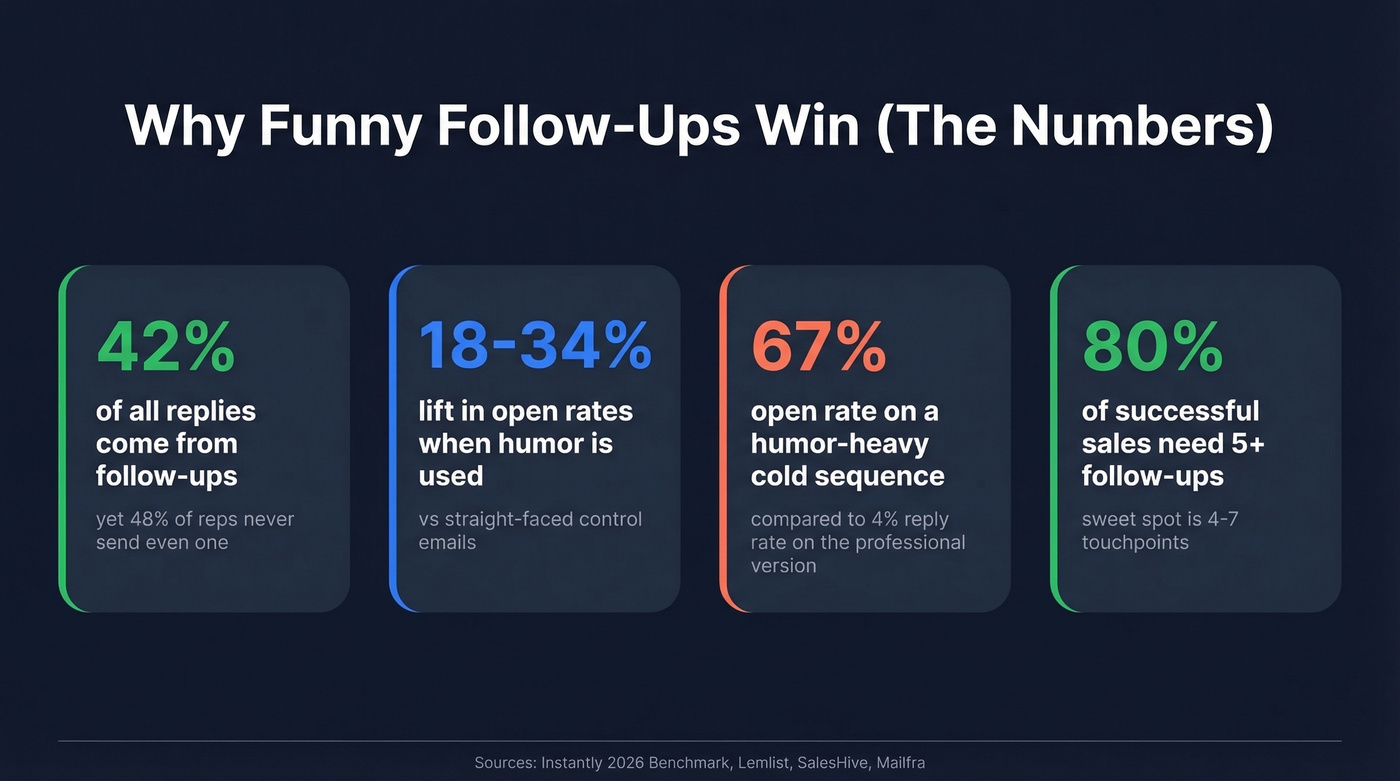
42% of all replies come from follow-ups, yet 48% of sales reps never send a single one. Funny follow-up emails are one of the fastest ways to close that gap.
Before You Touch a Template
Three rules:
- Don't use humor in email #1. Deploy it in follow-ups 2-4 after you've established value.
- Keep funny follow-ups under 80 words. If your joke needs a setup paragraph, it's not a good joke.
- Verify every email address before sending. A funny email that bounces is a wasted joke - Prospeo catches invalid addresses and spam traps with 98% accuracy on the free tier.
Why Humor Works (and When It Backfires)
Research from Wharton explains the mechanism: attempted humor signals confidence, and confidence signals competence. When a prospect reads a genuinely funny follow-up, they unconsciously assign you higher status. You seem like someone worth talking to.
Humor in outreach lifts open rates by roughly 18-34% when tested against straight-faced controls. That's the difference between a 22% open rate and a 30% one - not trivial at scale.
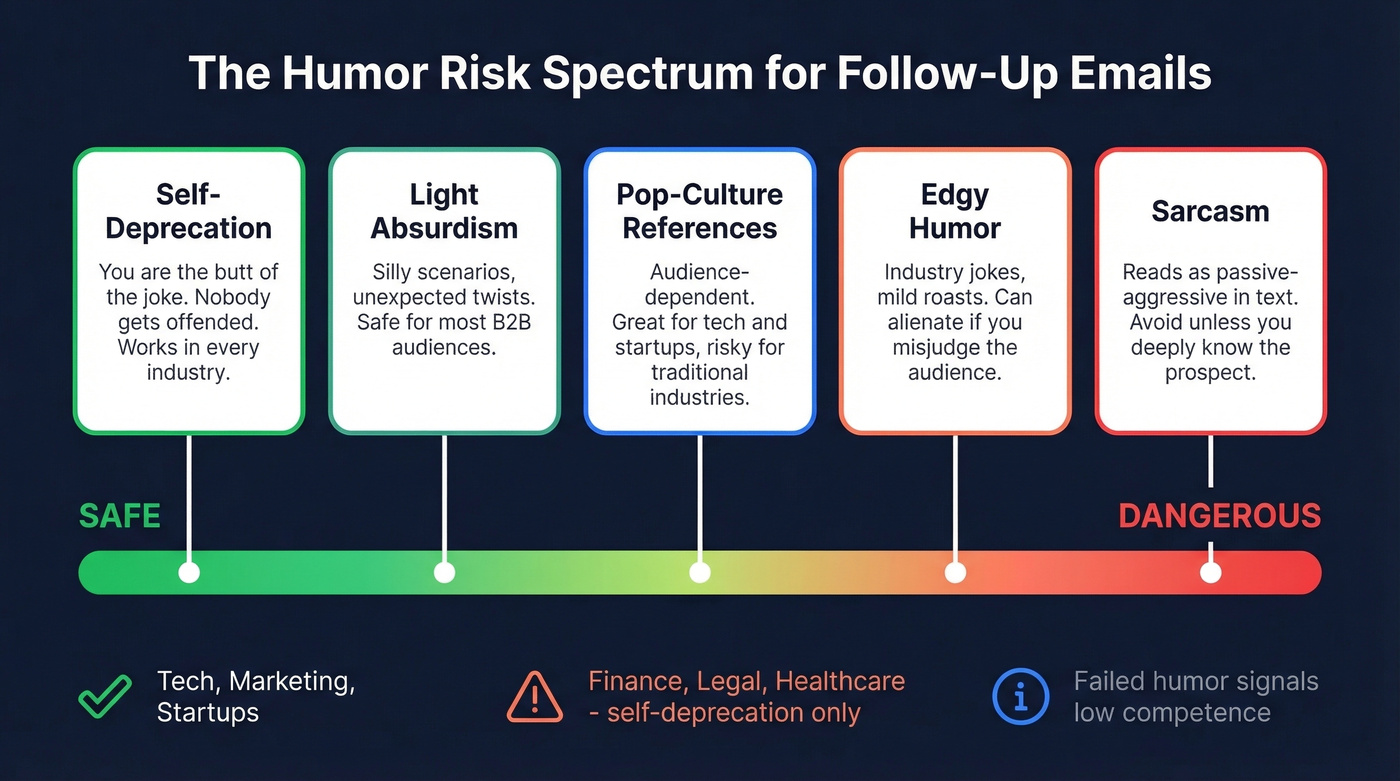
But failed humor signals low competence. A joke that lands wrong doesn't just miss; it actively hurts your credibility. The prospect decides you're not serious enough to solve their problem.
Self-deprecation sits at the safe end of the humor spectrum - you're the butt of the joke, nobody gets offended. Light absurdism is next. Pop-culture references carry moderate risk because they're audience-dependent. Some of the best funny sales pitch lines fall into the self-deprecating category precisely because they lower the prospect's guard. Sarcasm sits at the dangerous end. It frequently reads as passive-aggressive in text. Stay on the safe side unless you deeply understand your prospect's personality.
Industry matters too. Humor lands well in tech, marketing, and startup environments. Selling to legal, finance, or healthcare? Dial it back to self-deprecation only. No absurdism, no memes, no GIFs of confused cats.
Templates That Actually Get Replies
Each template assumes email #1 was a straight, value-first cold email with no humor.
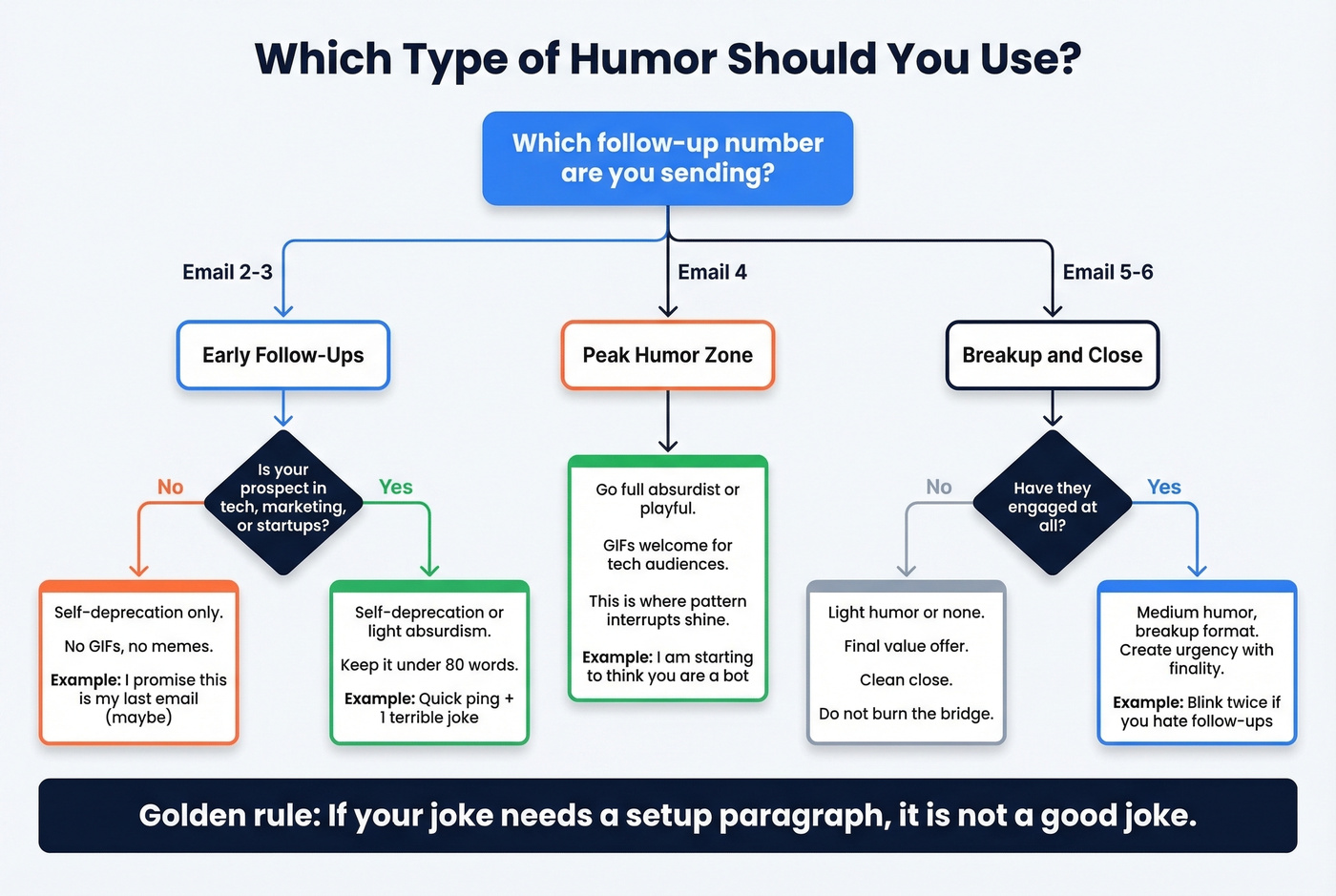
Follow-Up #2: Light Humor
Subject: Quick ping + 1 terrible joke
Body: Hey {{firstName}},
Sent you a note on {{day}} about {{value prop}}. No worries if it got buried - my inbox is a war zone too.
Here's my terrible joke as promised: Why don't cold emails ever win awards? Too many unsubscribes in the acceptance speech.
Worth a 15-min call this week?
Self-deprecating, acknowledges the awkwardness of follow-ups, and the joke is intentionally bad - which is disarming. Under 70 words.
Follow-Up #3: The Pattern Interrupt
Most reps write follow-up #3 as a polite nudge. That's exactly why this one works.
A cold email that circulated on r/sales used a fake-out opening that generated a ton of discussion. Here's the structure:
Subject: Did my email fall into a black hole?
Body: Hi {{firstName}}... just kidding. I am a real human, unless this is all just a simulation.
Real talk: I think {{company}} could cut {{pain point}} by {{specific benefit}}. I've got a 12-minute walkthrough that shows how.
If you're interested, I'll send it. If not, I'll assume the simulation ended.
Follow-up #3 is the sweet spot for humor - you've already established value, now you're making yourself memorable.
Follow-Up #4: Playful Callback
Subject: I'm starting to think you're a bot
Body: {{firstName}}, this is email #4. At this point I feel like I'm texting someone who lost their phone.
Quick recap: {{one-line value prop}}. If that's not relevant, just reply "stop" and I'll vanish like a polite ghost.
If it IS relevant - 15 minutes this week?
Callbacks to the relationship you've been building (even a one-sided one) create a micro-narrative. The "polite ghost" line gives them an easy out, which paradoxically increases replies.
The Breakup Email
Subject: Blink twice if you hate follow-ups
Body: {{firstName}}, I've officially run out of clever things to say. (My team would argue I never had any.)
I'll leave you with this: {{company}} is spending {{estimated cost/time}} on {{problem}}. We've helped {{similar company}} cut that by {{result}}.
This is my last email. If you ever want to chat, I'm here. If not - no hard feelings, and I hope your Q3 is great.
The breakup email is the highest-impact spot for full humor. You've got nothing to lose, and the finality creates urgency.
No-Show Follow-Up
Subject: I waited for you ☕
Body: Hey {{firstName}}, looks like our call didn't happen today. No stress - calendars are chaos.
I saved my best material for the meeting, so you missed out. (It involved a slide with a pie chart. Riveting stuff.)
Want to reschedule? Here are a few times: {{times}}.
No-shows feel awkward for both sides. Humor defuses the tension immediately.
Ghosting Recovery
Here's what NOT to send after extended silence: "Just circling back on my previous email." That's the cold email equivalent of "per my last email" - passive-aggressive and instantly deletable.
Subject: If this flops, I'll switch to interpretive dance
Body: {{firstName}}, it's been a while. I'm not going to pretend I haven't noticed.
I still think {{value prop}} is worth 15 minutes of your time. But if the timing is off, just say so - I'd rather hear "not now" than wonder if my emails are being used as spam filter training data.
The spam-filter line is self-deprecating enough to land safely, and the explicit "not now" option gives them a low-friction reply path. This is one of those funny sales pitch examples that works because it's honest about the situation rather than pretending the silence didn't happen.
Conference Follow-Up
Subject: The one where we almost met at {{event}}
Body: {{firstName}}, I was at {{conference}} last week and somehow didn't run into you - which is impressive given the size of the coffee line.
I noticed {{company}} is tackling {{pain point}}. We helped {{similar company}} solve that in {{timeframe}}. Worth a quick chat before the post-conference amnesia kicks in?
Conference follow-ups have a built-in warmth advantage. The shared-experience humor makes this feel personal without trying too hard.
The Objection Defuser
Subject: I hear you (and I brought data)
Body: {{firstName}}, totally get that {{objection - e.g., "budget is locked for Q3"}}. I've heard that from about 80% of the people I talk to. The other 20% are lying.
Quick thought: {{one-line reframe - e.g., "most teams recoup the cost in 6 weeks"}}. Happy to show the math if you've got 10 minutes.
Use this when a prospect has given you a soft objection. The "20% are lying" line acknowledges the objection without accepting it as final.
What a Good Reply Looks Like
When humor lands, replies tend to be short and warm. Here's a composite based on real responses we've seen across client campaigns:
"Ha - the interpretive dance threat got me. Let's do Thursday at 2pm. And for the record, I did read your first email."
That's the goal: a reply that feels like a conversation, not a transaction. If your humor is generating one-word "unsubscribe" replies, you've miscalibrated. Pull back to self-deprecation and test again.

A funny follow-up that bounces isn't funny - it's a wasted joke and a hit to your domain reputation. Prospeo's 5-step verification catches invalid addresses, spam traps, and honeypots with 98% accuracy. At $0.01 per email, verifying your entire sequence costs less than a bad cup of coffee.
Protect your punchlines. Verify every address before you send.
Subject Lines That Drive Opens
Zeliq's research found that 5-8 word subject lines perform best. Avoid exclamation marks, all caps, and anything that reads like a newsletter.
If you want more options to test, pull from a bigger swipe file of subject lines.
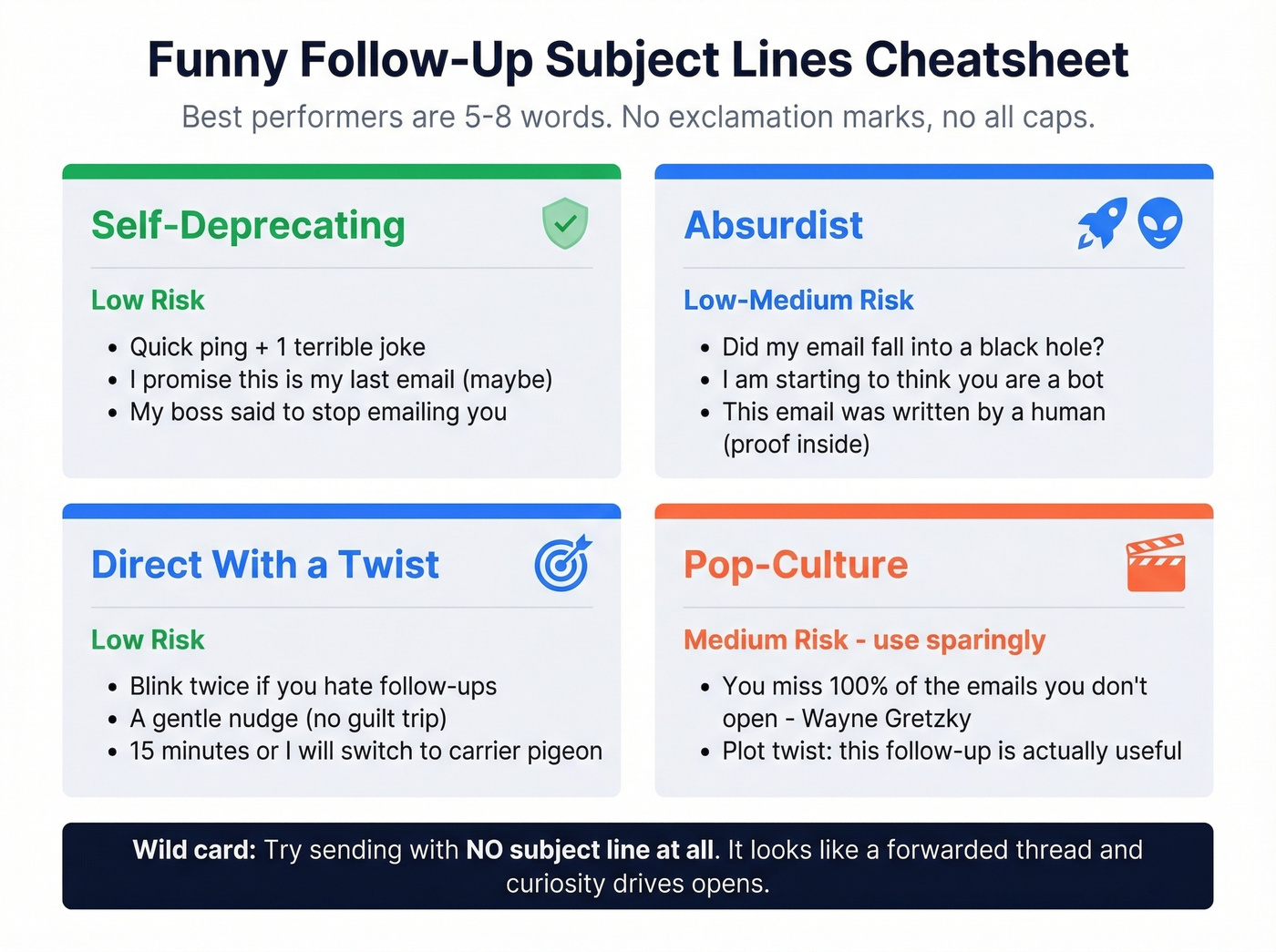
Self-deprecating:
- "Quick ping + 1 terrible joke"
- "I promise this is my last email (maybe)"
- "My boss said to stop emailing you"
Absurdist:
- "Did my email fall into a black hole?"
- "I'm starting to think you're a bot"
- "This email was written by a human (proof inside)"
Direct with a twist:
- "Blink twice if you hate follow-ups"
- "A gentle nudge (no guilt trip)"
- "15 minutes or I'll switch to carrier pigeon"
Pop-culture (use sparingly):
- "You miss 100% of the emails you don't open - Wayne Gretzky"
- "Plot twist: this follow-up is actually useful"
One tactic from a Reddit practitioner worth testing: send the email with no subject line at all. It looks like a forwarded thread or an accidental send, and curiosity drives opens. Unconventional, but they found it outperformed conventional sales subject lines.
When to Send Each Follow-Up
80% of successful sales require five or more follow-up touches, yet 48% of reps never send even one. That split between first-touch and follow-up replies means you're leaving almost half your potential responses on the table by stopping after email one.
If you need a deeper breakdown of timing, see best time to send cold emails.
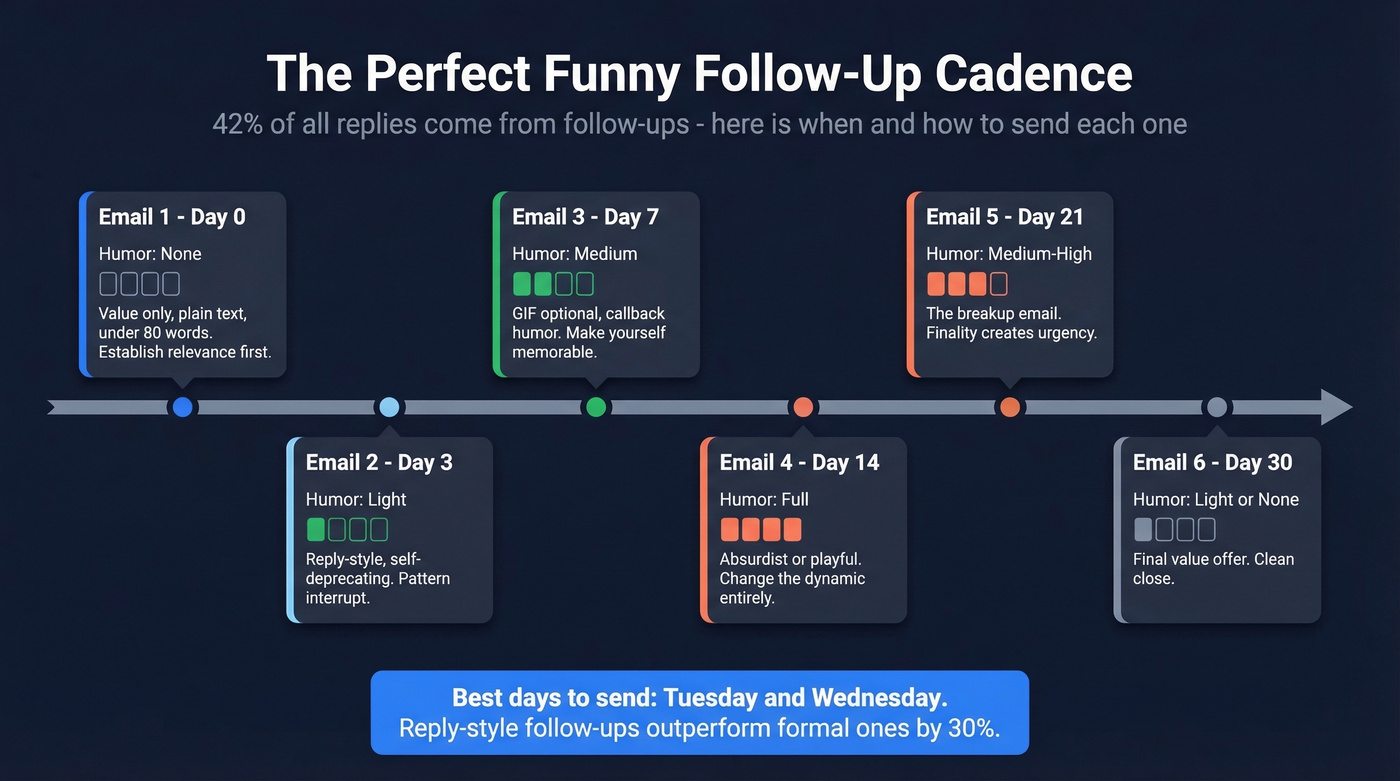
Instantly's 2026 benchmark data and cadence guidance recommend 4-7 touchpoints as the sweet spot. Tuesday and Wednesday pull the highest reply rates, with Wednesday edging ahead.
Here's the framework we use:
| Email # | Day | Humor Level | Format | Goal |
|---|---|---|---|---|
| 1 | Day 0 | None - value only | Plain text, <80 words | Establish relevance |
| 2 | Day 3 | Light | Reply-style, self-deprecating | Pattern interrupt |
| 3 | Day 7 | Medium | GIF optional, callback | Memorable touch |
| 4 | Day 14 | Full | Absurdist/playful | Change the dynamic |
| 5 | Day 21 | Medium-high | Breakup email | Last chance |
| 6 | Day 30 | Light or none | Final value offer | Clean close |
"Reply-style" follow-ups - short, conversational, no formal greeting - outperform formal follow-ups by ~30%. Your follow-up should read like you're bumping a thread, not writing a new letter.
If you want more non-humor options to rotate in, use these sales follow-up templates.
How to A/B Test Your Humor
Don't guess whether your jokes are working. Measure it. Run a humor variant against a straight-faced control for at least two weeks, testing one variable at a time: subject line humor, body humor, or GIF vs. plain text. Measure positive reply rate, not just opens. Keep the control sequence running permanently so you always have a baseline. A two-week window with 100+ sends per variant gives you enough signal to make a call.
Here's the thing: most teams overthink the humor and underthink the testing. A mediocre joke sent to a verified list with proper timing will outperform a brilliant joke sent to stale data every single time. Fix your list quality first, then worry about being funny.
If you're automating follow-ups, compare AI tools for automating sales follow-ups.
Using GIFs Without Killing Deliverability
GIFs can make a follow-up unforgettable, but they'll hurt deliverability if you're sloppy.
Keep GIFs under 1MB when you can, and treat 2MB as a hard upper bound. Total email weight should stay under 125KB, especially for cold outreach. Host images on your branded domain, not third-party image hosts, and always add alt text so the message works even when images are blocked - because they will be blocked for many recipients.
Design the first frame to stand alone. Many email clients don't fully support animated GIFs. Search GIPHY by the feeling you want to convey, not the topic. "Confused" or "waiting patiently" beats "sales meeting." Animal GIFs - confused pugs, unimpressed cats - consistently outperform corporate stock imagery.
One GIF per email, max. Multiple GIFs spike your image-to-text ratio and look like a marketing blast.
If you’re struggling with inboxing, start with an email deliverability guide.
Deliverability Rules for Humorous Outreach
The funniest follow-up in the world is worthless if it lands in spam. These aren't optional:
- No links in your first email. Calendly is still a link. Save it for email two or three.
- No tracking pixels. They increase spam risk. Use your sequencer's built-in tracking sparingly.
- No attachments. Use a plain-text link to a Google Doc if you must share something.
- Keep emails under 60 words as a deliverability best practice. 80 is the ceiling, but shorter is better.
- Respect Google's 0.3% spam complaint threshold. Three complaints per 1,000 emails and Google starts throttling your entire domain.
- Warm up new domains before sending at volume. Going from 50 to 5,000 emails overnight is a fast track to the spam folder.
Before launching any sequence, verify every address. Prospeo's 5-step verification catches spam traps and honeypots with 98% accuracy and refreshes data every 7 days, so you're not emailing someone who changed jobs last month.
If you’re seeing bounces, use these email bounce rate benchmarks to diagnose what’s normal vs. dangerous.
Your breakup email won't land if you're sending it to the wrong person. Prospeo's database gives you 300M+ verified contacts with 30+ filters - so your funniest follow-ups reach actual decision-makers, not dead inboxes. Data refreshed every 7 days, not 6 weeks.
Find the right inbox first, then send the joke.
FAQ
Do funny follow-ups actually work?
Yes - when matched to audience and sequence position. One documented campaign using humor pulled a 33% reply rate and 12 booked meetings from 36 contacts. Humor lifts open rates 18-34% and positive reply rates roughly 10-30%. Deploy it after establishing value, not as your opener.
What's the best timing for humor in a cold sequence?
Introduce light humor in follow-up #2 or #3 after you've established relevance. The breakup email (follow-up #4 or #5) is the highest-impact spot for full humor - finality creates urgency that pairs well with a lighter tone.
How do I keep humorous emails out of spam?
Keep emails under 60 words, avoid links and attachments in early touches, skip tracking pixels, and verify every address before sending. Prospeo's free tier includes 75 email verifications per month with spam-trap removal - enough to validate a small campaign before scaling.
Can I use funny sales pitch lines in follow-ups?
Absolutely - they work best in follow-ups #3 through #5, where the prospect already knows who you are. Self-deprecating lines are universally safe, while absurdist or pop-culture references should be reserved for tech and startup prospects who appreciate that tone. Skip the humor entirely if you're selling into regulated industries like healthcare or financial services.