


G-Lock EasyMail7 vs Salesbot: Different Tools for Different Jobs
Comparing G-Lock EasyMail7 to Salesbot is like comparing a forklift to a fishing rod. One moves heavy loads you've already got; the other goes out and catches new ones. If you expected a feature-by-feature shootout, the honest answer is simpler: these tools solve different problems entirely. We've dug into both platforms, and the real question isn't which is "better" - it's which stage of your pipeline needs fixing.
30-Second Verdict
Pick EasyMail7 if you already have a contact list and need to blast high-volume campaigns cheaply through your own SMTP or Amazon SES setup.
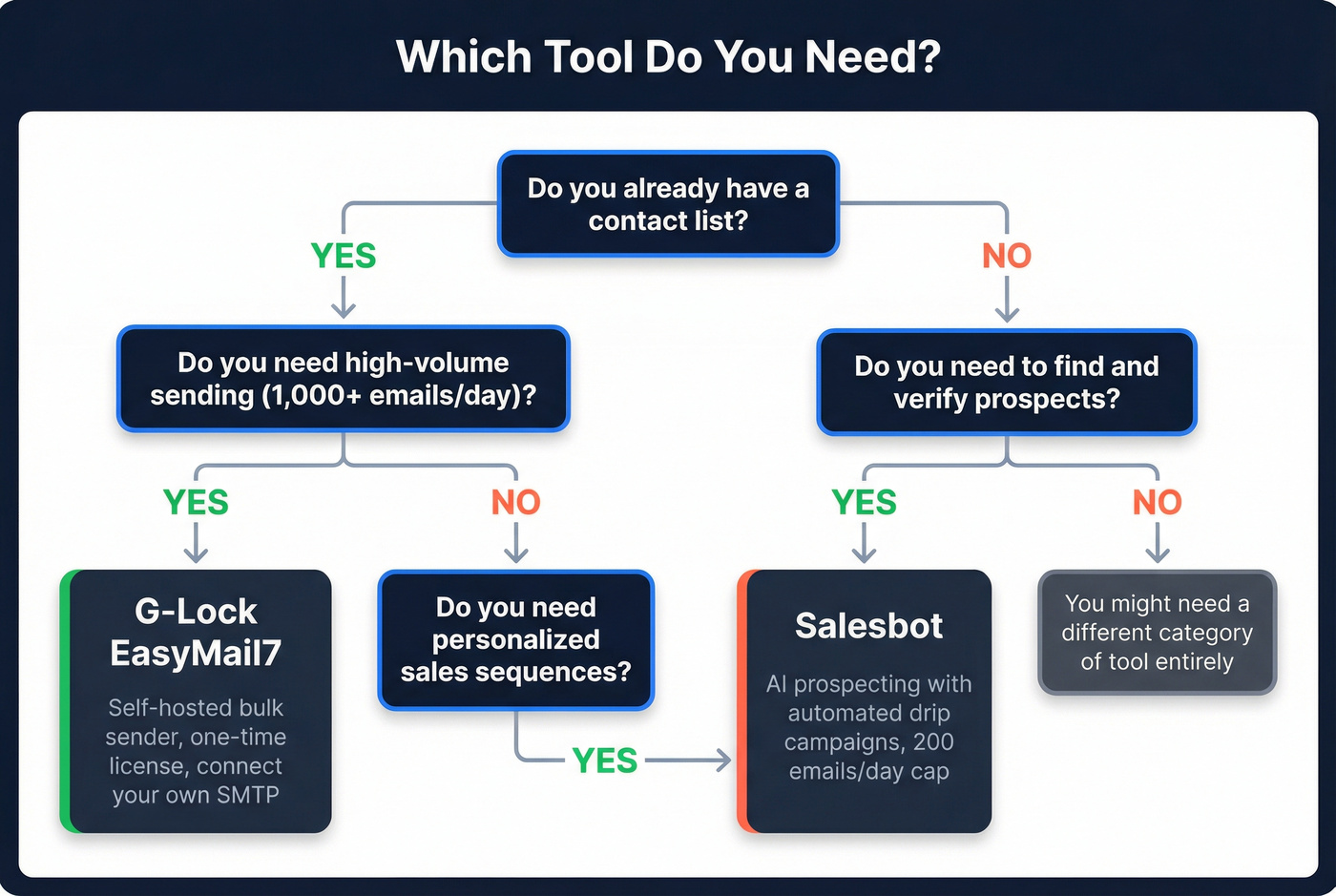
Pick Salesbot if you need to find prospects from scratch and run personalized outbound sequences with built-in contact data.
What Each Tool Actually Does
G-Lock EasyMail7
EasyMail7 is a Windows-based, in-house email marketing platform built on a client-server model. You run it on your own Windows machine or Windows Server environment, connect it to an SMTP relay or Amazon SES, and manage lists, campaigns, and sending from your own setup. No cloud dashboard. No monthly login.
If you're evaluating it specifically for high-volume sending, it helps to understand email velocity and how infrastructure choices affect deliverability.
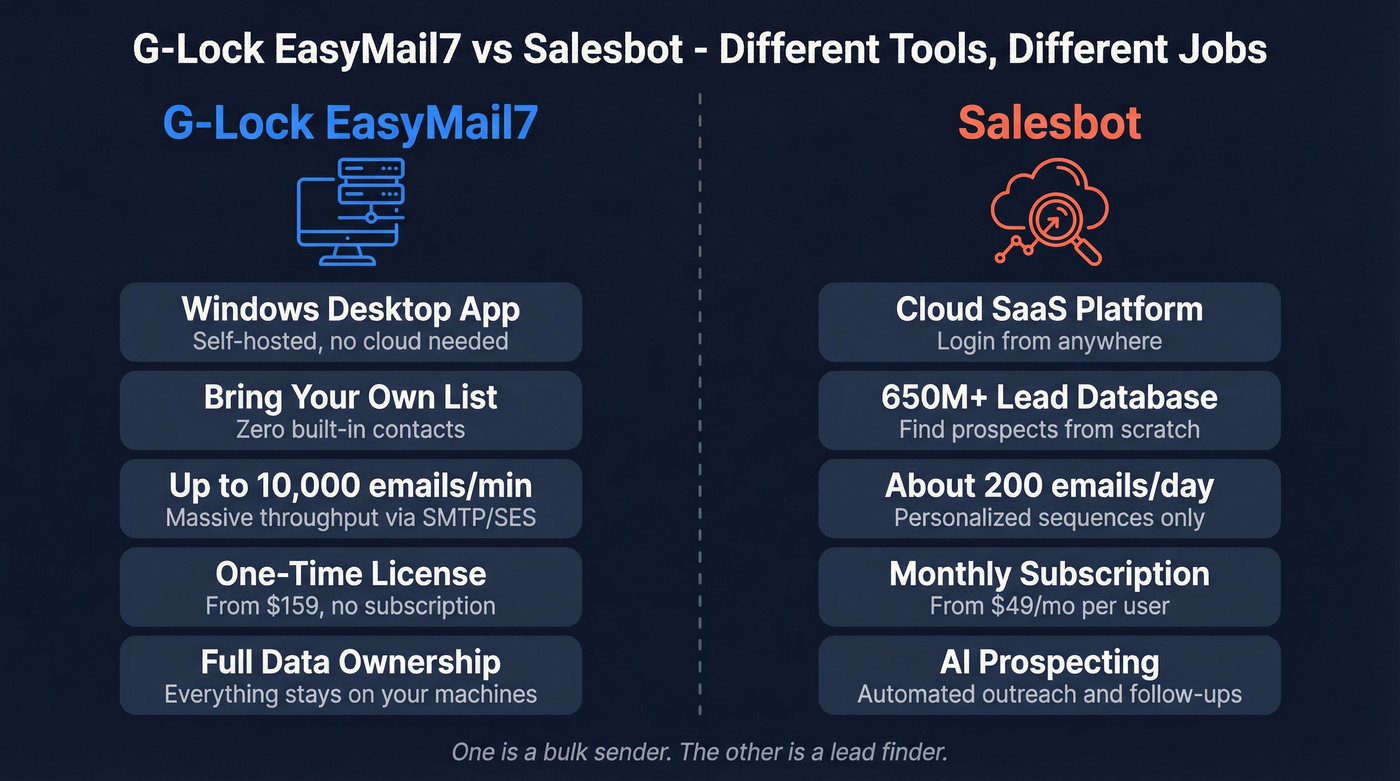
There's no built-in contact database - you bring your own list. The value proposition is control, cost, and data ownership: a one-time license fee, no monthly platform fee, and no per-email charges beyond what your SMTP provider bills you. Because lists and messages live on your own machines rather than third-party storage, it's a strong fit for teams that care about where subscriber data physically resides.
Salesbot
Salesbot is a cloud-based AI prospecting platform that combines a 650M+ verified lead database with automated outreach sequences. Reps find prospects, build lists, and launch personalized drip campaigns from one dashboard.
This is closer to a modern SDR tool than a traditional bulk email platform.
A built-in safeguard limits outreach to 5 contacts per company, which protects deliverability but also means this isn't a bulk sender. Daily sending caps sit at around 200 emails. Salesbot is built for targeted sales outreach where personalization matters more than raw volume, and a free trial is available with no credit card required.
Feature-by-Feature Comparison
| Feature | EasyMail7 | Salesbot |
|---|---|---|
| Deployment | Windows client-server (self-hosted) | Cloud SaaS |
| Contact database | ❌ Bring your own | ✅ 650M+ verified leads |
| Sending volume | Up to 10,000/min (with sufficient infrastructure) | ~200/day |
| Automation | Campaigns + autoresponders/drip | Automated outreach & follow-up sequences |
| Deliverability tools | Inbox placement testing, DKIM/SPF checks | Real-time contact verification, 5/company safety limit |
| CRM integration | ODBC direct connect | API & CRM integrations (Enterprise tier) |
| API | None | Enterprise only |
One is a firehose; the other is a sniper rifle. EasyMail7 can push up to 10,000 emails per minute through setups like Amazon SES, but it has zero prospecting capability. Salesbot caps you at around 200 emails a day but hands you hundreds of millions of contacts to work with. They aren't competing - they're solving different stages of the pipeline.
The decision framework is straightforward. If you already own your data and need a self-hosted sender with maximum throughput, EasyMail7 wins. Starting from zero contacts and need an all-in-one prospecting-to-outreach tool? Salesbot wins.
If you're building outbound from scratch, it also helps to align your approach with proven sales prospecting techniques.

EasyMail7 needs a list. Salesbot caps you at 12,000 verified credits per year. Prospeo gives you 300M+ profiles with 98% email accuracy and 30+ filters - buyer intent, technographics, job changes - so you build the exact list both tools need.
Start with 75 free verified emails and see the difference clean data makes.
Pricing Breakdown
| EasyMail7 | Salesbot | |
|---|---|---|
| Entry tier | $159 Personal (one-time) | $49/mo Basic (1 user) |
| Mid tier | $259 Business (one-time) | $99/mo Professional (per user) |
| Top tier | $1,569 Enterprise (one-time) | Custom Enterprise |
| Renewal model | Optional maintenance at 50% of license price | Monthly subscription |
| Credits included | N/A - depends on your SMTP | 12,000/yr verified email credits + 900/yr mobile credits (Basic) |
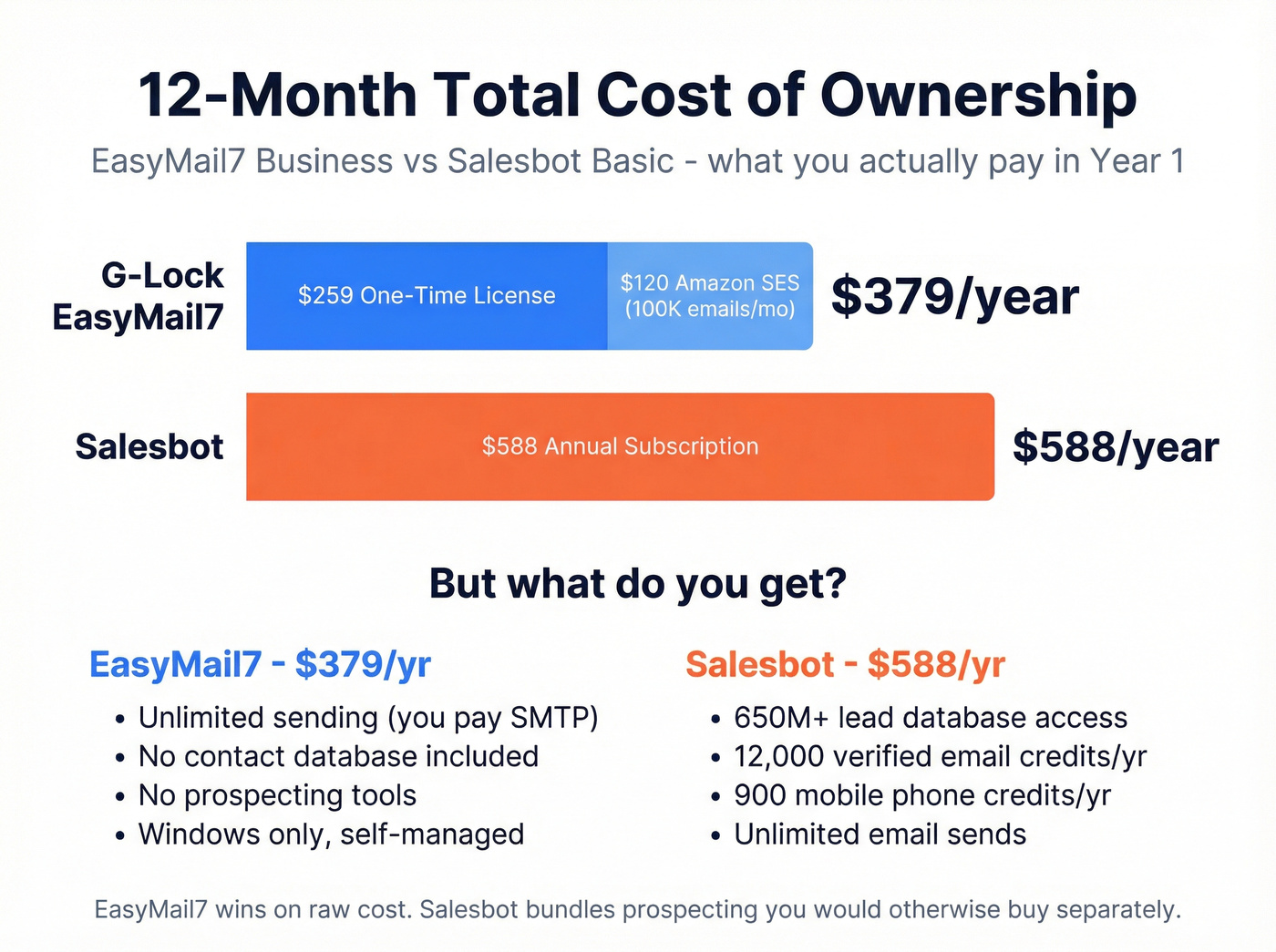
The 12-month total cost of ownership tells the real story. EasyMail7 Business at $259 one-time, plus Amazon SES at 100,000 emails per month, comes out to roughly $379 for the year - using the common SES benchmark of about $1 per 10,000 emails, that's around $120/yr in sending costs plus the license.
Salesbot Basic runs $588/year and includes unlimited email sends, plus 12,000 verified email credits per year (about 1,000/month) and 900 mobile phone credits. EasyMail7 is cheaper for pure bulk sending, no question. But Salesbot's value isn't volume - it's the prospecting database and workflow you'd otherwise need separate tools for.
If you're comparing stacks, it can be useful to benchmark against other outbound lead generation tools and sales prospecting databases.
What Users Say
EasyMail7 (4.8/5 on Capterra from 33 reviews; 5.0/5 on G2 from 3 reviews):
- ✅ One-time pricing consistently praised - no subscription fatigue
- ✅ One reviewer reports sending 65,000 emails/day via Amazon SES with monthly costs in the low hundreds
- ❌ Setup is more involved than typical SaaS onboarding - budget extra time for SMTP configuration
Salesbot (4.8/5 on G2 from 3 reviews):
- ✅ Reviewers mention launching target lists and drip campaigns in around 15-20 minutes
- ❌ CRM integration described as "a hassle" by one reviewer
- ❌ Can't attach files in drip campaigns
Let's be honest: both products only have 3 G2 reviews, so treat the ratings as directional rather than definitive. We didn't find much usable Reddit discussion for either tool, either.
Solving the Data Quality Gap
Neither tool fully solves data quality on its own.
EasyMail7 is a sending platform. You bring the list, and while it supports inbox placement and authentication testing, it doesn't give you a prospecting database or real-time contact verification. Salesbot gives you a massive database, but on Basic you're working within 12,000 verified email credits per year - roughly 1,000 per month for unlocking verified contact data.
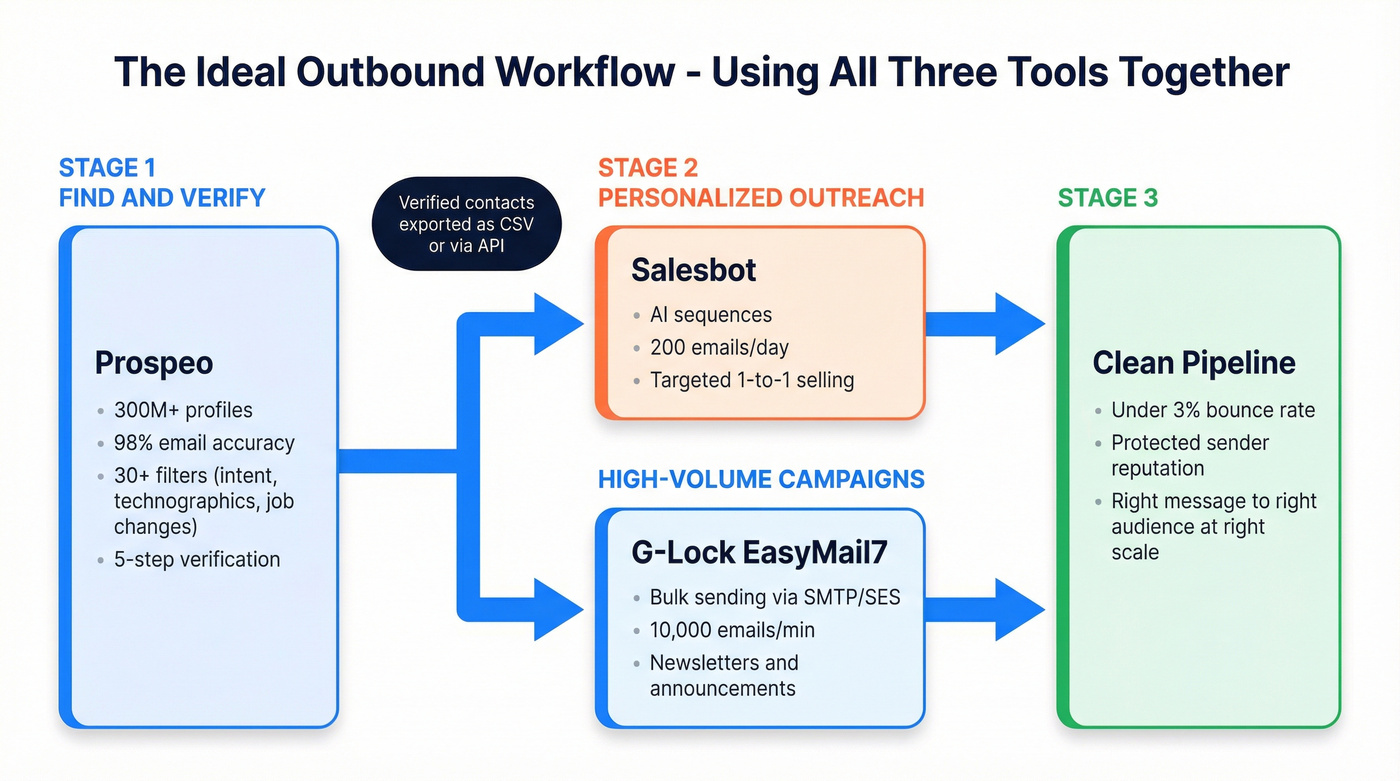
For teams running both tools, the workflow is clean. Use Prospeo's 30+ search filters - buyer intent, technographics, job changes, headcount growth - to build targeted lists. Verify everything at the source. Then route contacts to Salesbot for personalized sequences or EasyMail7 for high-volume campaigns.
If you want to go deeper on list hygiene and outcomes, see email bounce rate and the broader email deliverability guide.

Neither tool solves data quality alone. Prospeo's 7-day refresh cycle and 5-step verification keep bounce rates under 3% - whether you're sending 200 personalized sequences through Salesbot or 10,000/min through EasyMail7.
Stop feeding stale data into good tools. Verify at the source for $0.01/email.
FAQ
Can I use EasyMail7 and Salesbot together?
Yes - use Salesbot to find prospects and EasyMail7 to send bulk campaigns. Adding a dedicated verification layer between them keeps bounce rates under 3-4%, which protects your sender reputation across both platforms.
Is Salesbot good for bulk email marketing?
No. Salesbot caps outreach at roughly 200 emails per day and limits contacts to 5 per company. It's designed for personalized sales sequences, not newsletter-scale volume. EasyMail7 or a dedicated ESP handles bulk sending far better.
Does EasyMail7 work on Mac?
No. EasyMail7 is Windows-only desktop software requiring a Windows Server or Windows desktop environment. Mac users need a virtual machine like Parallels or should consider a cloud-based alternative.
Which tool is better for outbound prospecting from scratch?
Salesbot wins here - it includes a 650M+ contact database so you can build lists without a separate data provider. EasyMail7 has zero prospecting capability. You'd need an external source like Prospeo's email finder to generate and verify lists before importing them.