

Generect vs Kitt AI: Features, Pricing, and Verdict
One's a scalpel. The other's a workbench. Both Generect and Kitt AI find B2B emails, but they're solving fundamentally different problems - and the real decision comes down to whether you're buying deliverability-grade email verification or a broader prospecting and enrichment workflow. Pick the wrong one and you'll spend more on workarounds than you saved on the subscription.
30-Second Verdict
For email-only verification on a tight budget: Kitt AI. The free tier for individuals includes unlimited searches and verifications, and per-email costs start at $0.005/found email - one of the cheapest entry points in this category.
For a full lead-gen platform with enrichment and signals: Generect. It covers email finding, phone numbers, data enrichment, and signal tracking, with a 5.0/5 on G2 across 32 reviews.
What Each Tool Does
Generect
Generect is a real-time B2B lead generation search engine. You're not just finding emails - you're building target lists with advanced filters for role, industry, company size, revenue, and tech stack, then enriching contacts with phone numbers and tracking hiring signals and new startups.
Instead of relying on static lists, Generect runs real-time lead search and real-time email validation. CRM sync with HubSpot and Salesforce comes standard, and MCP connectivity for AI agent workflows puts it in a different category than most email finders. Pricing is pay-as-you-go: free searches, a $5 onboarding grant, $0.03 per valid email found, and $0.02 per export, with a $20 minimum deposit to get started.
Kitt AI
Kitt AI is a specialist - email finding and verification, full stop. It claims an up to 78% find rate against professional profile data and a <0.1% bounce rate on verified emails, based on what they describe as a two-year deliverability study.
Here's what makes the verification approach interesting: rather than just SMTP checks, Kitt AI verifies against enterprise identity servers and includes catch-all busting behind Proofpoint, Mimecast, and Barracuda firewalls - which also detects job changes. Access methods include Google Sheets, CSV upload, CRM integrations with Salesforce, HubSpot, and Clay, plus a full API. No phone numbers, no enrichment, no intent data. Just emails.
Feature-by-Feature Comparison
| Feature | Generect | Kitt AI |
|---|---|---|
| Email finding | ✅ | ✅ (78% find rate) |
| Email verification | ✅ (real-time validation) | ✅ (<0.1% bounce, vendor-reported) |
| Catch-all busting | ✅ | ✅ (incl. Proofpoint/Mimecast/Barracuda) |
| Phone numbers | ✅ | ❌ |
| Data enrichment | ✅ | ❌ |
| Intent / signals | Signal tracking | ❌ |
| CRM integrations | HubSpot, Salesforce | Salesforce, HubSpot, Clay |
| API access | ✅ (MCP) | ✅ |
| Chrome extension | - | ✅ |
| G2 rating | 5.0/5 (32 reviews) | Not listed |
| Data refresh | Real-time search + refresh triggers | Not disclosed |
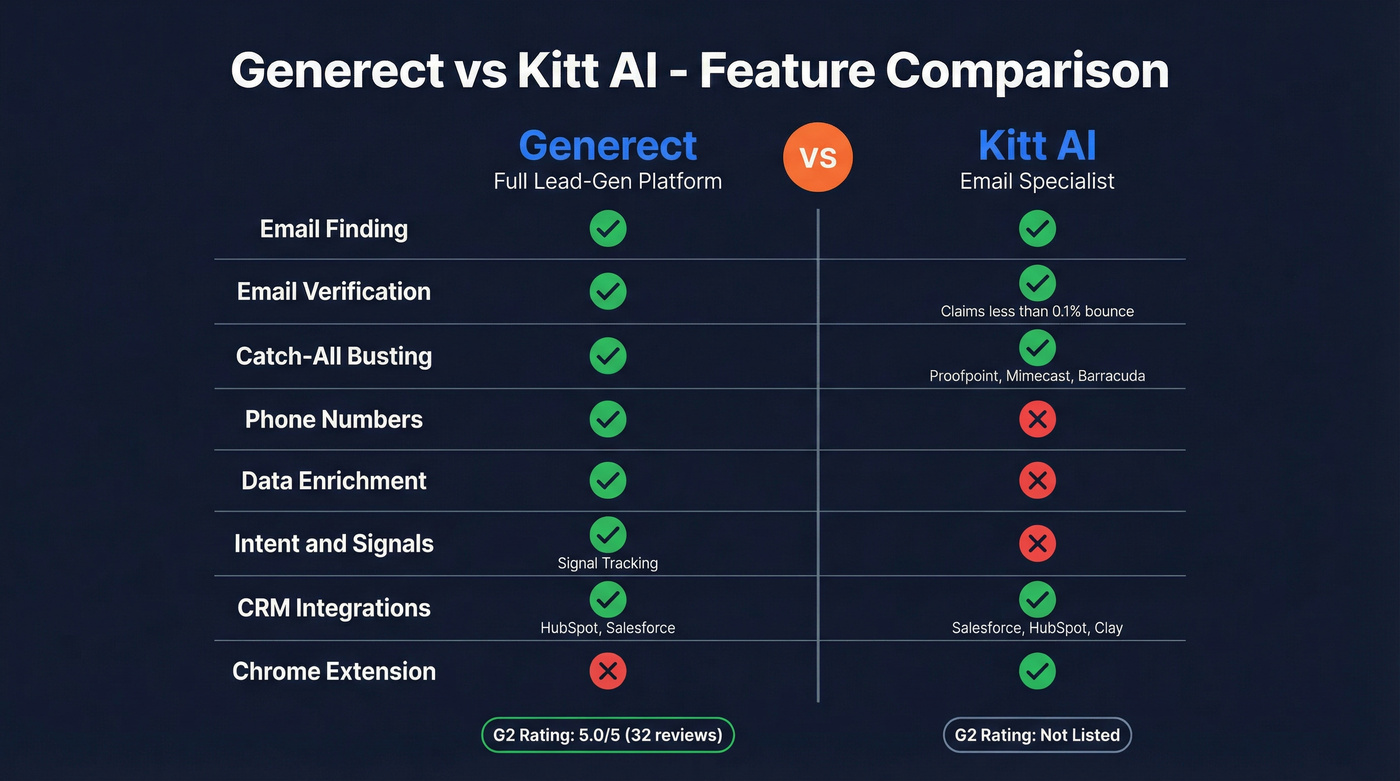
The pattern is clear. Kitt AI is an email specialist with strong verification claims, while Generect is a broader platform. If all you need is verified emails at the lowest possible cost, Kitt AI wins on price. The moment you need phone numbers, enrichment, or intent signals, you're looking at Generect - or a platform that covers all three.
Pricing Breakdown
| Generect | Kitt AI | |
|---|---|---|
| Free tier | Free searches + $5 onboarding grant | Unlimited (individuals) |
| Per email found | $0.03 | Starting at $0.005 |
| Verification | Included with email finding | $0.0015/each (BYO lists) |
| Per user | - | $5/user |
| Min. spend | $20 deposit | $0 |
| Promo credits | - | Up to $1,500 (API partners) |
Found emails through Kitt AI's finder are automatically verified - the $0.0015 verification fee only applies when you bring your own email lists for cleaning.
What You'll Actually Pay
| Volume | Kitt AI (finder) | Generect (email found) |
|---|---|---|
| 1,000 emails | ~$5 | ~$30 |
| 5,000 emails | ~$25 | ~$150 |
| 10,000 emails | ~$50 | ~$300 |
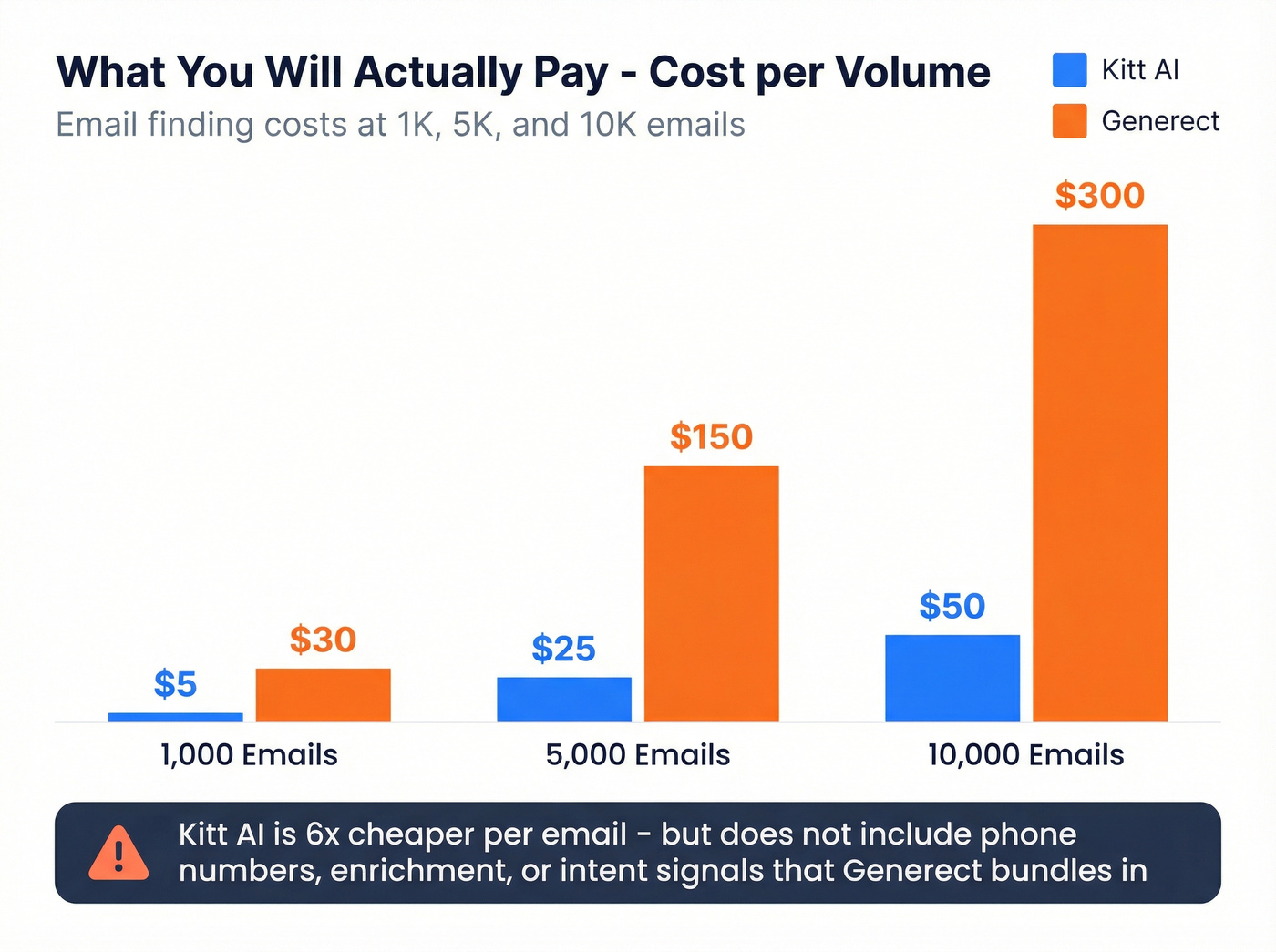
Kitt AI is the cheapest per-email by a wide margin. But that comparison falls apart if you also need phone numbers and enrichment data - Generect's per-email cost is attached to a full lead-gen platform with phone numbers and signal tracking. You're comparing a gym membership to a personal trainer session. The unit economics only make sense in context.
Which One Fits Your Workflow?
Solo sender running cold email: Kitt AI's free tier. Verify everything, pay nothing until you scale. If you're building a full outbound motion, pair this with proven sales prospecting techniques.
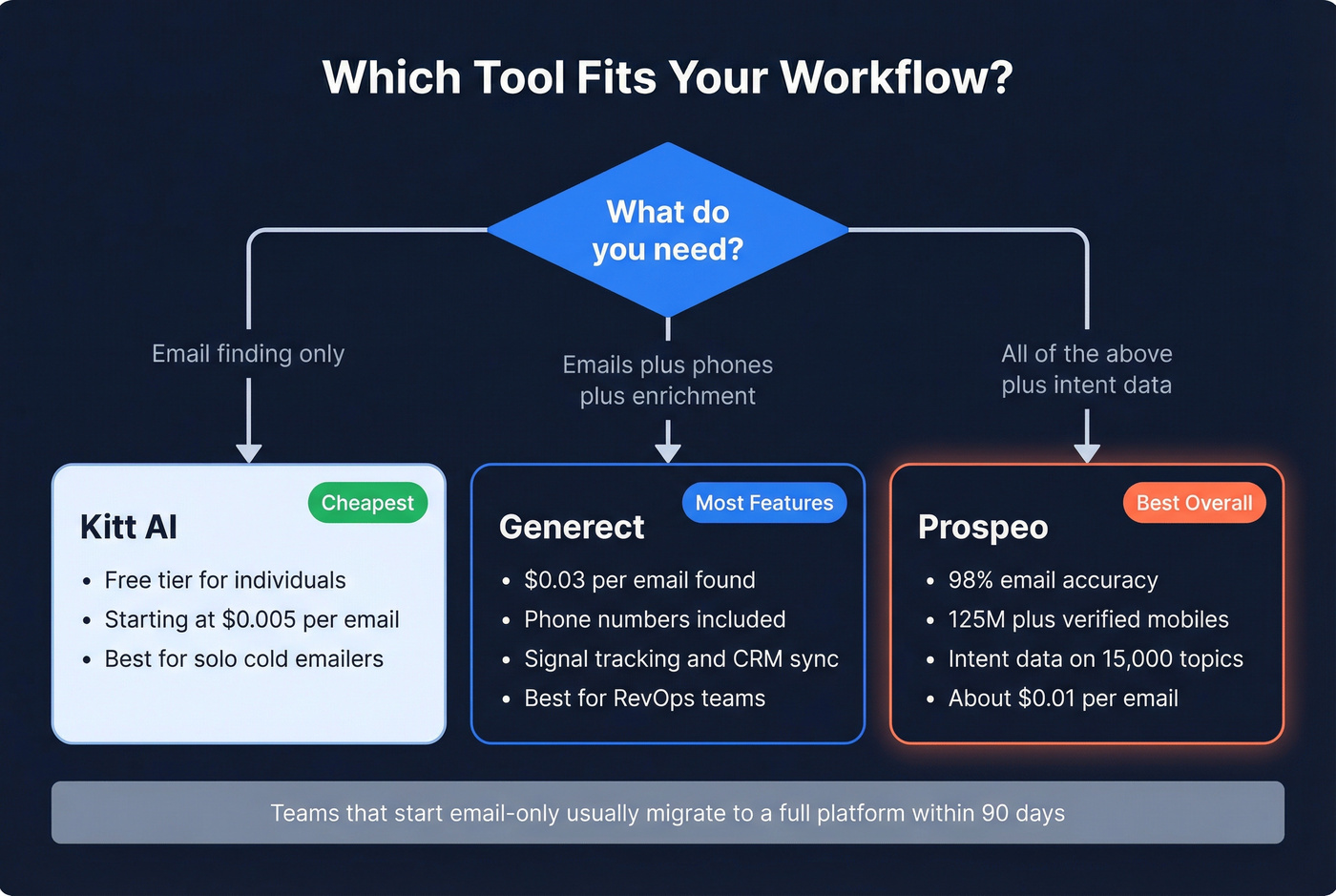
RevOps team enriching CRM data: Generect. You need phone numbers, company signals, and CRM sync - email-only tools create more work than they save. (If you're hiring for this function, see what a RevOps team typically owns.)
Developer building agent workflows: Generect's MCP connectivity. Kitt AI has an API, but Generect is purpose-built for AI agent pipelines. If you're evaluating automation options, compare against AI agents for sales.
Let's be honest about something we've seen play out dozens of times: teams underestimate how fast "email-only" turns into "we also need phones and enrichment." If your average deal size clears $5k and you're running multi-touch sequences, starting with an email-only tool usually means migrating within 90 days. Buy the platform you'll need in three months, not the one that's cheapest today.

You shouldn't have to pick between cheap email verification and a full lead-gen platform. Prospeo gives you 98% email accuracy, 125M+ verified mobiles with a 30% pickup rate, and intent data across 15,000 topics - all at ~$0.01/email with no contracts.
Stop migrating tools every 90 days. Start with the platform you'll keep.
Verification Deep Dive
Both tools take verification seriously, but their approaches differ in ways that matter.
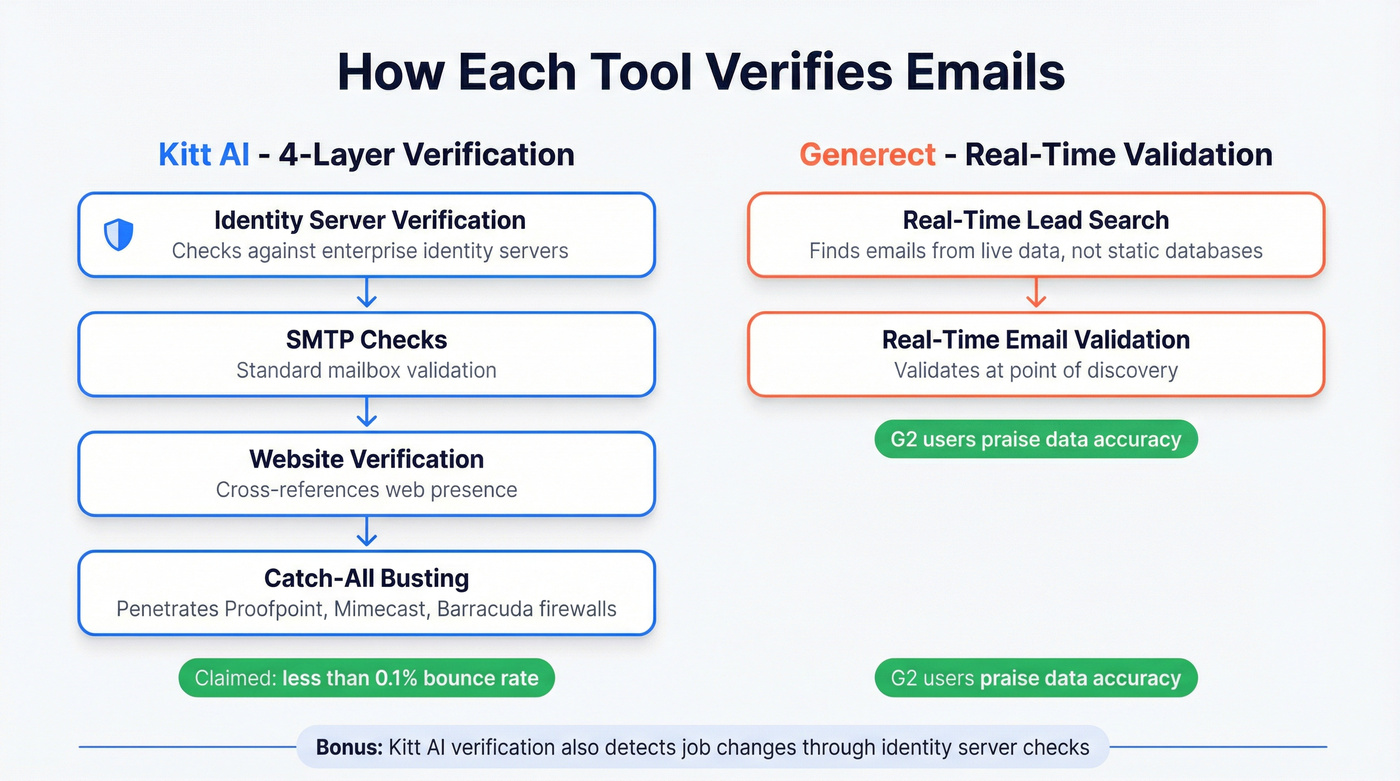
Kitt AI runs a 4-layer process: identity server verification, SMTP checks, website verification, and catch-all busting - including domains protected behind Proofpoint, Mimecast, and Barracuda firewalls. That identity-server layer is the standout; it's what enables job-change detection and the claimed <0.1% bounce rate. Generect pairs email finding with real-time email validation, and G2 reviews commonly highlight data accuracy as a strength.
For context, we've seen deliverability improve more from rigorous verification and list hygiene than from swapping email sequencers. The tool that catches bad addresses before they hit your sending infrastructure is the one that protects your domain reputation - and that matters more than most teams realize until they've already burned a domain. If you want the full playbook, start with an email deliverability guide and track your email bounce rate.

Social Proof and Reviews
Generect has a 5.0/5 on G2 across 32 reviews, with users praising data accuracy and ease of use. G2's Value at a Glance shows time to implement is under a month, and ROI at 10 months.
Public third-party validation for Kitt AI is thin. No relevant G2 listing surfaced in our research - search results returned unrelated products - and public Reddit discussion is minimal, mostly referencing Knight Rider's KITT rather than the email tool. For a product making bold accuracy claims, the absence of independent reviews is the biggest gap in their story.
Consider Prospeo Instead
If neither tool fully fits - maybe you want Kitt AI's verification depth but also need phone numbers, or you like Generect's breadth but want tighter email accuracy - Prospeo covers both gaps.
The numbers: 300M+ professional profiles, 98% verified email accuracy across 143M+ verified emails, 125M+ verified mobile numbers with a 30% pickup rate, and intent data tracking 15,000 topics via Bombora. Used by 15,000+ companies, Prospeo refreshes records on a 7-day cycle versus the roughly 6-week industry average, so lists don't quietly decay between campaigns. It's self-serve with no contracts, starts free with 75 emails per month, and scales at roughly $0.01 per email.
Real results back this up: Snyk's 50 AEs cut bounce rates from 35-40% to under 5% and grew AE-sourced pipeline 180% after switching. Stack Optimize built to $1M ARR with 94%+ client deliverability and zero domain flags across all clients.
Explore the email finder, mobile finder, or intent data to see what fits your workflow.

Kitt AI's catch-all busting is solid, but Prospeo's 5-step verification - including spam-trap removal, honeypot filtering, and catch-all handling - delivers 98% accuracy on 143M+ emails with a 7-day data refresh cycle. No stale records, no burned domains.
Verification that protects your domain reputation from day one.
Final Verdict
Kitt AI is a scalpel - sharp, cheap, and purpose-built for email finding and verification. If that's genuinely all you need, it's hard to beat starting at $0.005 per found email with an unlimited free tier. Generect is a workbench - email finding plus phone numbers, enrichment, signal tracking, and MCP-powered automation for technical teams building custom workflows.
If you're still comparing options, it can help to benchmark against other outbound lead generation tools and dedicated email verification tools.
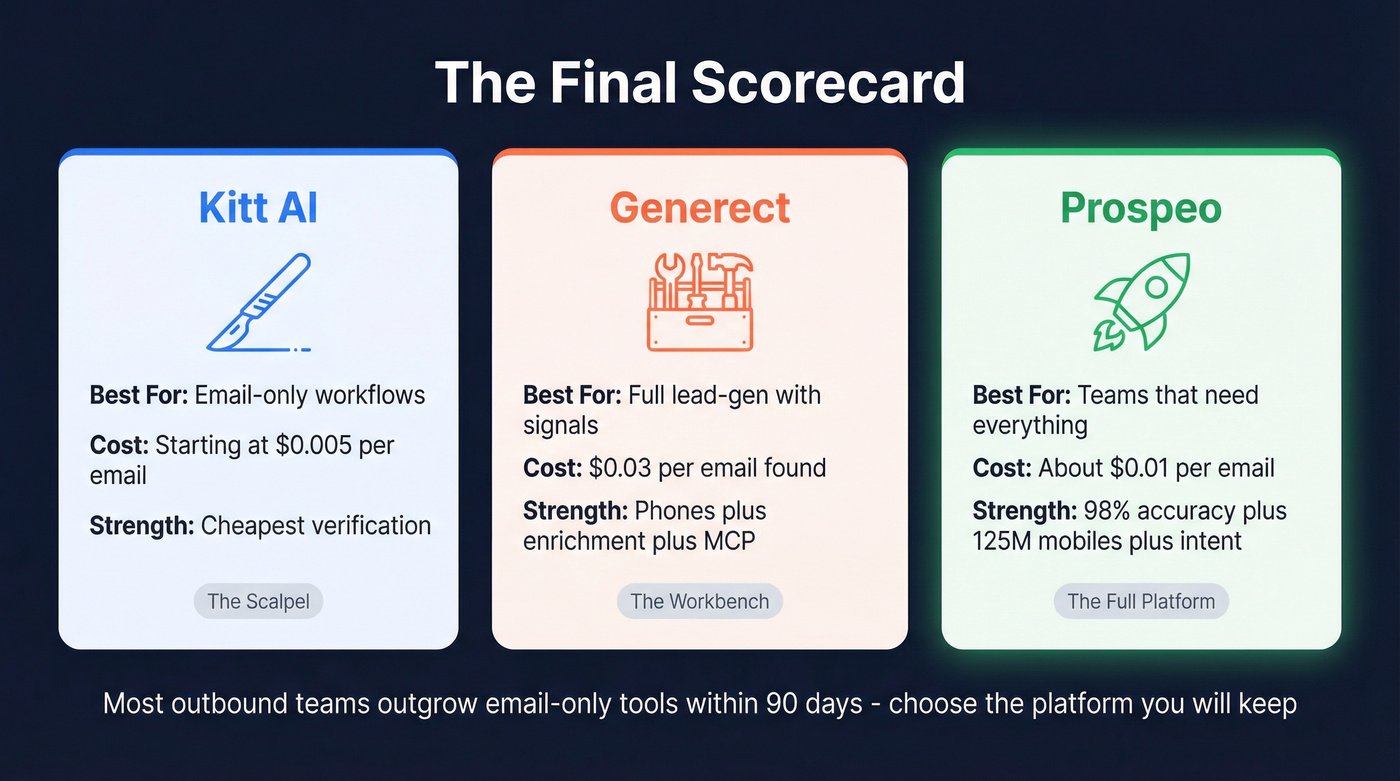
For most outbound teams weighing Generect vs Kitt AI in 2026, the smarter bet is a platform that handles verified emails, direct dials, and intent data without stitching tools together. That's the gap both leave open.
FAQ
Is Kitt AI really free?
Yes, for individuals. The free tier includes unlimited searches and verifications with no credit card required. Teams pay per found email starting at $0.005, plus $5 per user, with verification at $0.0015 for imported lists. API partners can get up to $1,500 in credits. Check Kitt AI's pricing page for current rates.
Does Generect have a free plan?
Generect offers free searches and a $5 onboarding grant, then switches to pay-as-you-go with a $20 minimum deposit. Usage pricing is $0.03 per valid email found and $0.02 per export - no monthly subscription required.
Does Kitt AI have G2 reviews?
No relevant G2 listing surfaced in our research - search results returned unrelated products. Generect has 32 reviews at 5.0/5 on G2, making it the only one of the two with substantial third-party review coverage.