

Stop Saying "Gentle Reminder" - How to Write a Gentle Nudge Email That Gets Replies
"Just a gentle reminder..." You've typed it. We've all typed it. And every time the recipient reads it, they hear something closer to "I know you're ignoring me." The phrase is so universally loathed that Reddit threads routinely call it passive-aggressive, ominous, or both.
Follow-ups aren't the problem. Depending on the dataset, they generate 20.6-42% of replies - skip them and you're leaving responses on the table. The problem is how most people write them. A good gentle nudge email gets replies without guilt trips, and the principles behind it work across email, chat, and DMs alike.
What You Need (Quick Version)
- Drop "gentle reminder." It reads as passive-aggressive. Be direct and warm instead.
- Keep nudges under 80 words, add something new every time, and follow the 3-7-7 cadence (Day 0, 3, 10, 17).
- Verify the email address is live before you send. A perfect nudge to a dead inbox is wasted effort.
Why Nudge Emails Work
Nudge theory - popularized by behavioral economists Richard Thaler and Cass Sunstein - defines a nudge as a change in choice architecture that influences behavior predictably without restricting options. Nudges are easy to ignore and aren't mandates. That maps directly to how you should write follow-ups.
Defaults become "If I don't hear back by Friday, I'll send the invoice to accounting." Simplification becomes a one-click calendar link instead of asking someone to propose a time. Framing becomes leading with the recipient's benefit, not your ask. Social norms become "Most teams in your space are already doing X." And commitment devices become referencing something they already agreed to - "You mentioned wanting to revisit this in Q2."
Every template below uses at least one of these mechanisms. When you understand why nudges work, you stop relying on guilt and start engineering replies.
What the Data Says
Two large datasets paint a clear picture of what drives replies.
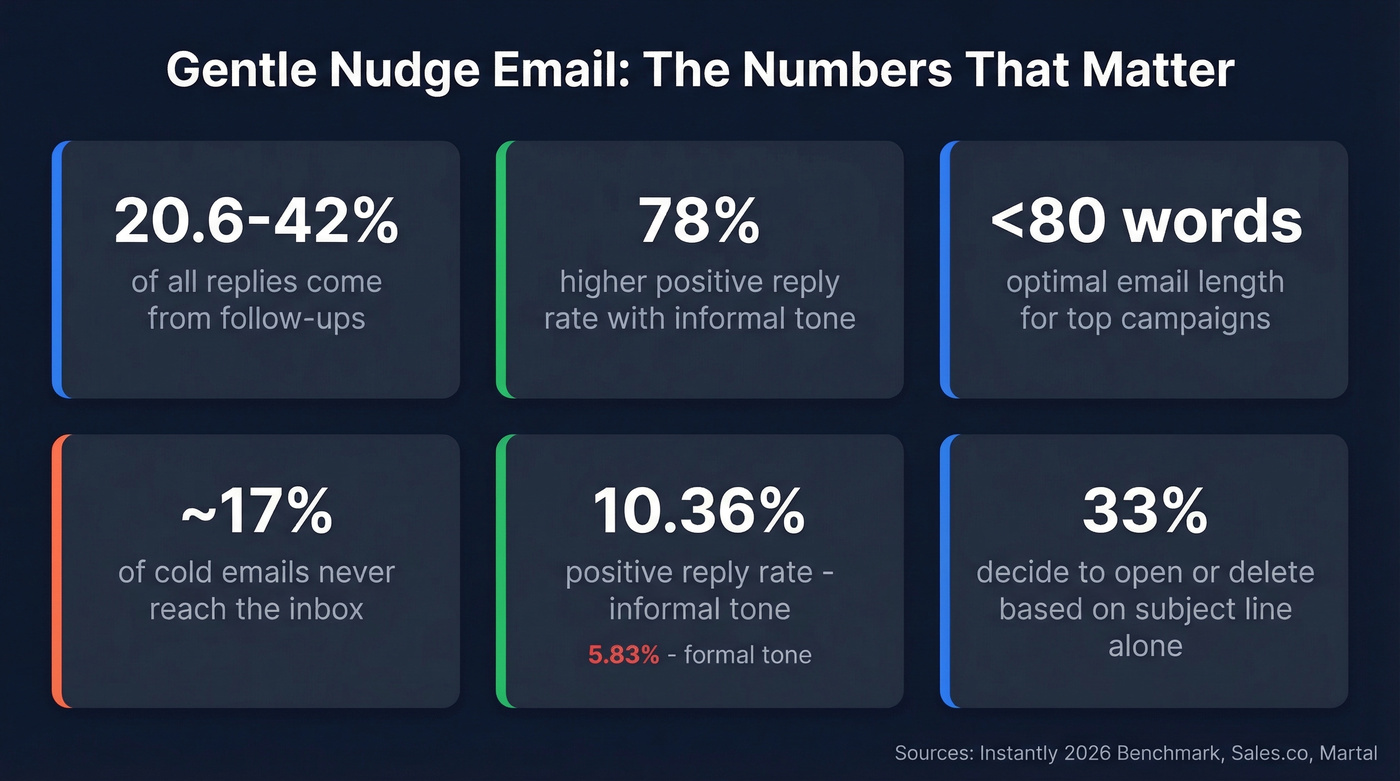
| Metric | Value | Context |
|---|---|---|
| Avg reply rate | 3.43% | Instantly 2026 benchmark |
| Replies from follow-ups | 20.6-42% | Range across datasets |
| Positive reply rate | 14.1% of replies | Effective: ~1 in 157 contacts |
| Informal vs formal tone | 78% higher positive rate | 10.36% vs 5.83% |
| Optimal email length | <80 words | Top-performing campaigns |
| Never reach inbox | ~17% | Bounces + spam filtering |
Here's the stat most people miss. Across 2M+ emails analyzed, informal emails produced a 10.36% positive reply rate versus 5.83% for formal ones. That's a 78% lift. Write like a human, not a legal department.

The article says it: ~17% of cold emails never reach the inbox. A perfectly crafted nudge to a dead address is wasted effort. Prospeo's 5-step email verification delivers 98% accuracy - so every follow-up lands where it should.
Stop nudging dead inboxes. Verify first, send second.
Templates That Get Replies
Each template stays under 80 words, uses an informal tone, and applies at least one nudge mechanism. Steal freely - and adapt each nudge email example to your own voice and context.
If you want more plug-and-play options, these follow-up templates cover common scenarios.
No Response - Cold Outreach
Subject: Re: {{previousSubject}}
Hey {{firstName}}, quick follow-up on my note below - worth a look? I found a stat on {{relevantTopic}} that might change how you're thinking about {{painPoint}}. Happy to share if useful.
Sending as a reply in the same thread makes it feel like a conversation, not a new pitch. Adding new value avoids the "just checking in" trap.
No Response - Warm or Internal
Subject: {{firstName}}, should I circle back later?
Hey {{firstName}}, I know things get buried. Should I circle back another time, or is this off the table? Either way is totally fine - just want to close the loop.
The easy-out framing - "either way is fine" - reduces guilt and gives the recipient a graceful exit. Paradoxically, that often triggers a reply. People respond when they don't feel cornered. This approach works equally well for internal requests and external conversations.
Payment or Invoice Reminder
Don't say this: "Just a gentle reminder that your invoice is overdue."
Say this instead:
Subject: {{firstName}}, before Friday
Hi {{firstName}}, just a heads-up - if I don't hear back by Friday, I'll resend the invoice to accounting directly. No rush on your end if that works.
This is nudge theory's "defaults" in action. The next step happens automatically unless they intervene, removing the friction of deciding.
Meeting or Deadline Reminder
Subject: Tomorrow at 2 PM - one click to confirm
Hi {{firstName}}, quick reminder we're set for tomorrow, {{date}} at 2 PM. Join here. Let me know if anything changed.
Use a scheduling tool that auto-generates the join link. The fewer clicks between reading and confirming, the higher your show rate. If you're tightening your process, sequence management helps keep timing consistent across reps.
Proposal or Post-Demo Follow-Up
Subject: FYI: {{competitor}} just launched {{feature}}
{{firstName}}, saw that {{competitor}} just rolled out {{feature}} - thought it was relevant to what we discussed. Our approach handles this differently (here's a 2-min breakdown). Want to see it in action?
Competitor news creates urgency without you having to manufacture it. The CTA "Want to see it in action?" also performs well - demo/video CTAs hit a 30.05% positive reply rate across the datasets we've reviewed.
The "Close the Loop" Email
Loss aversion kicks in when something's being taken away. This email consistently produces the highest reply rate in a sequence because it signals finality without burning the bridge.
Subject: Closing the loop
{{firstName}}, I'll assume this isn't a priority right now and close the loop on my end. Zero pressure - happy to revisit anytime if things change. Just reply to this thread.
Subject Lines That Work
33% of recipients decide to open or delete based on the subject line alone, and 69-70% will mark spam based on it. Personalized subject lines drive roughly 50% higher open rates. Never use "follow-up," "checking in," or "touching base" - they signal zero new value. And avoid all caps, which can drop response rates by 30%.
For more ideas you can swipe, use these email subject line examples to test hooks by persona and intent.
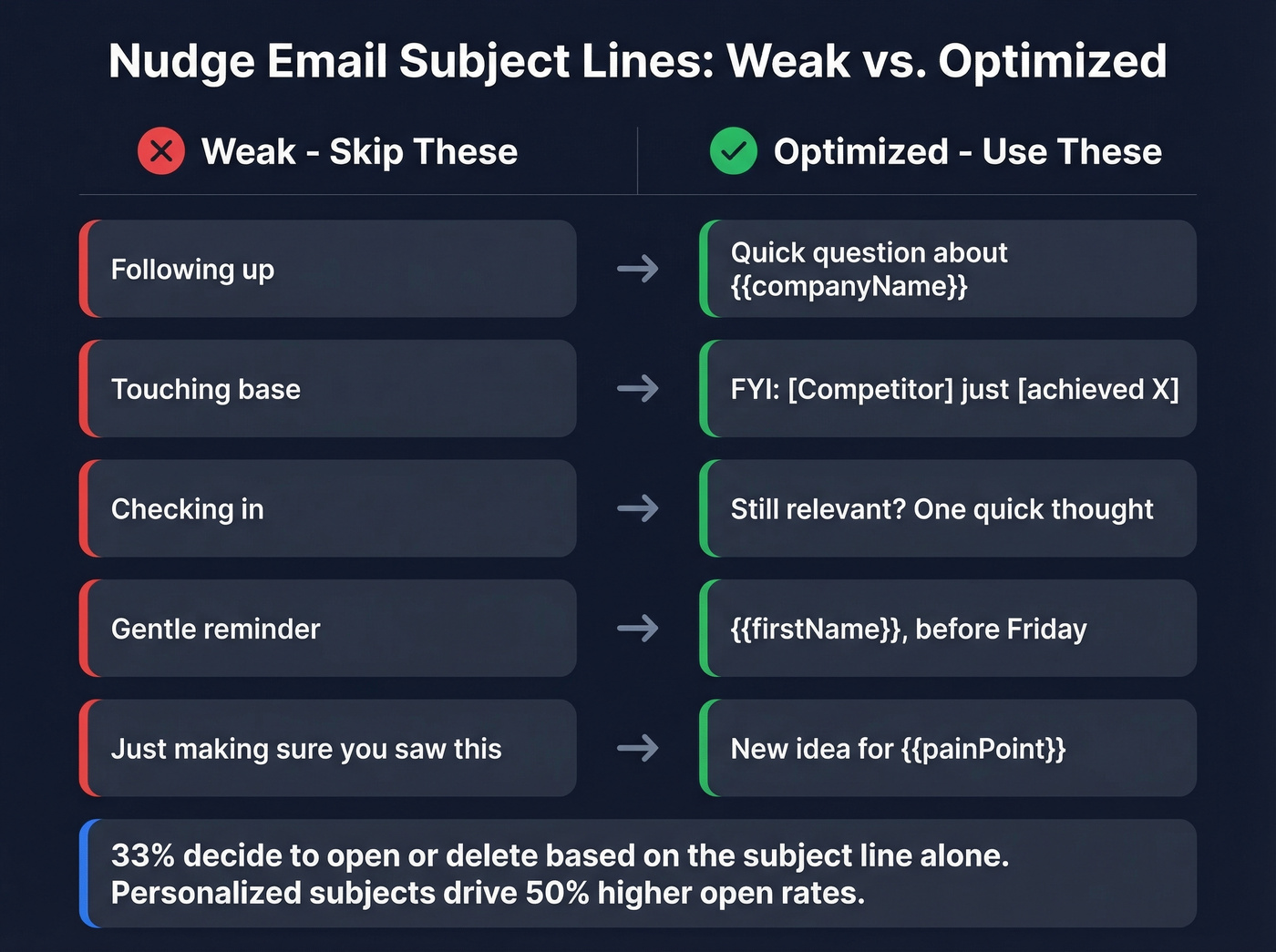
| Weak Subject Line | Optimized Version |
|---|---|
| Following up | Quick question about {{companyName}} |
| Touching base | FYI: [Competitor] just [achieved X] |
| Checking in | Still relevant? One quick thought |
| Gentle reminder | {{firstName}}, before Friday |
| Just making sure you saw this | New idea for {{painPoint}} |
The 3-7-7 Cadence Rule
The simplest cadence that works: send your initial email on Day 0, first follow-up on Day 3, second on Day 10, third on Day 17. That's the 3-7-7 framework - tight early spacing to catch momentum, then wider gaps to avoid fatigue.
If you're still deciding timing, this guide on the best time to send cold emails pairs well with the cadence rule.
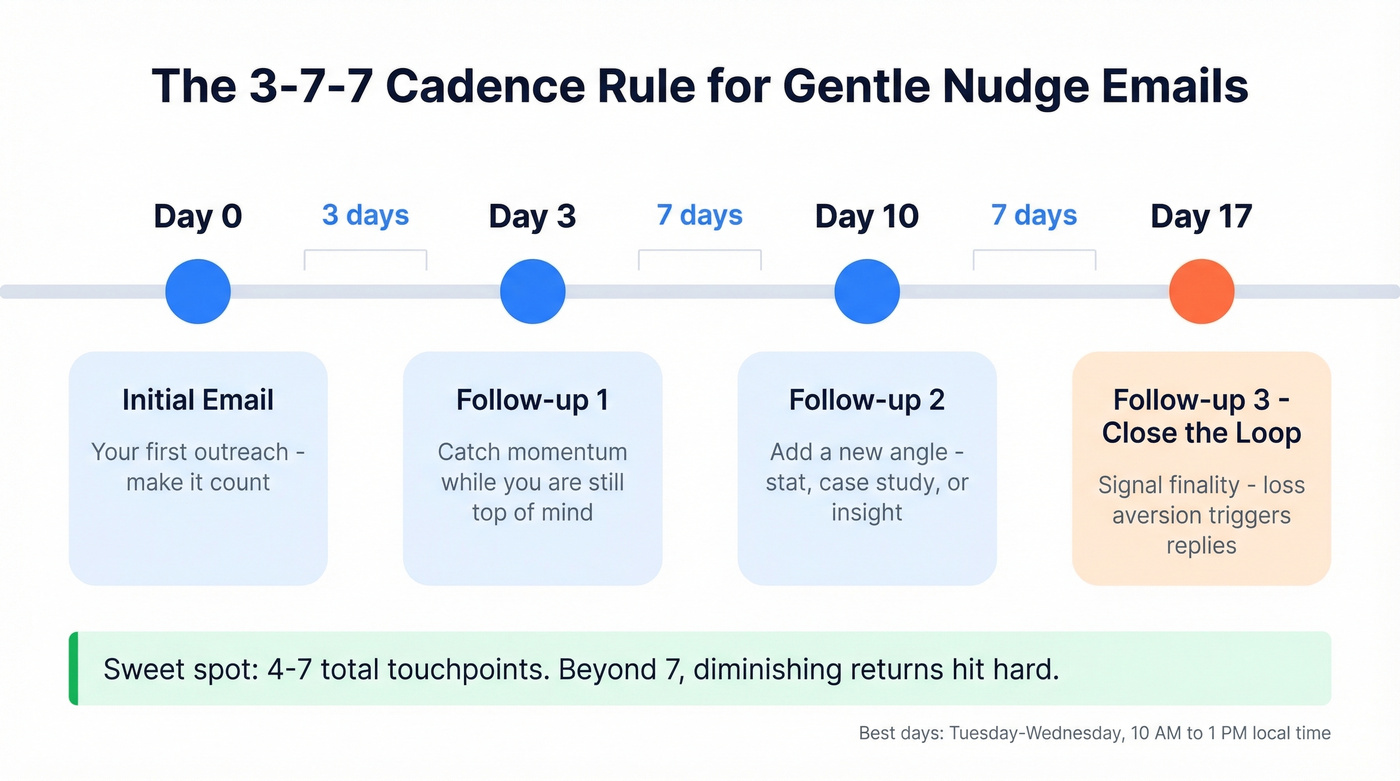
The sweet spot is 4-7 total touchpoints. Beyond 7, diminishing returns hit hard. Mid-week sends - Tuesday through Wednesday, with Wednesday peaking highest - tend to perform best, and a common recommended window is 10 AM to 1 PM local time.
And yet, 48% of reps never send a second message. Half the competition quits after one email. Don't be that half.
Mistakes That Kill Replies
We've seen campaigns with perfect copy tank because ~17% of the list never reached the inbox. Bad data is just one of five things that'll kill your follow-ups:
If deliverability is the bottleneck, start with an email deliverability guide and then work backward into list quality.
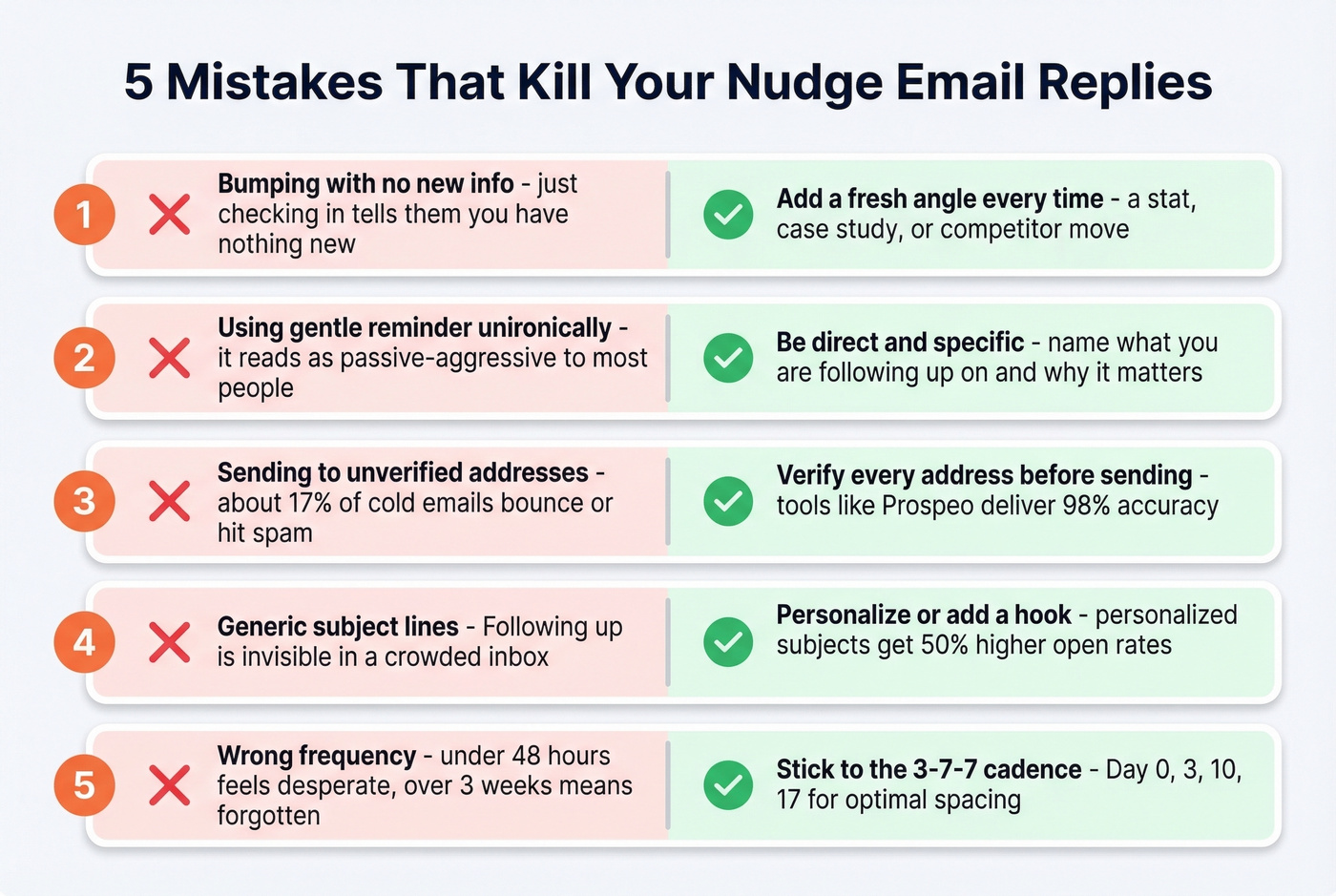
- Bumping with no new info. "Just making sure you saw this" tells the recipient you have nothing new to say. Every follow-up needs a fresh angle - a stat, a case study, a competitor move.
- Using "gentle reminder" unironically. It's the email equivalent of "per my last email." Be direct instead.
- Sending to unverified addresses. About 17% of cold emails never reach the inbox due to bounces and spam filtering. Tools like Prospeo verify emails in real time with 98% accuracy, so you're not nudging a spam folder. (If you're troubleshooting, check your email bounce rate and fix the root cause.)
- Generic subject lines. "Following up" is invisible in a crowded inbox. Personalize or add a hook.
- Wrong frequency. Under 48 hours feels desperate. Over 3 weeks means they've forgotten you. Stick to the 3-7-7 cadence.
Let's be honest: if your deals typically close under five figures, you probably don't need a 12-step sequence with multichannel touchpoints. Four well-timed nudge emails with fresh value in each will outperform a bloated cadence every time. If you're building a full outbound motion, a solid B2B cold email sequence matters as much as any single follow-up.
You've nailed the 3-7-7 cadence and written a killer nudge. Now you need the right contact. Prospeo gives you 143M+ verified emails with a 7-day refresh cycle - so you're never following up with outdated data.
Great follow-ups deserve fresh, verified email addresses.
FAQ
How many follow-up nudges should I send?
Four to seven touchpoints is the sweet spot backed by multiple datasets. Beyond seven, diminishing returns kick in sharply. Each follow-up must add new value - a fresh stat, case study, or relevant insight. If you've got nothing new to say, stop sending.
Is "gentle reminder" passive-aggressive?
For many recipients, yes - the phrase triggers annoyance rather than warmth. Use direct, specific language instead: name what you're following up on and why it matters to them. "Quick question about your Q3 timeline" beats "gentle reminder" every time.
What's a good nudge email example for a silent prospect?
Lead with a relevant industry development or competitor move, then tie it back to your conversation. The "Proposal or Post-Demo Follow-Up" template above uses this approach. The key is giving them a reason to re-engage rather than simply asking if they're still interested.
How do I confirm my nudge actually reached their inbox?
You can't - unless you verify the address first. About 17% of cold emails bounce or hit spam. Running your list through a verification tool before sending confirms deliverability, so your follow-up actually lands where it should.
Every gentle nudge email comes down to two things: say something new, and make it easy to reply. Get those right, and you'll never need to type "gentle reminder" again.