

GetProspect vs Nymeria: Which Email Finder Actually Delivers?
B2B contact data decays at roughly 2% per month - that's a quarter of your list going stale every year. So the real question when weighing GetProspect against Nymeria isn't features. It's which tool keeps you out of the bounce folder.
30-Second Verdict
Pick GetProspect if you want an all-in-one prospecting workflow - find, verify, sequence - with a generous free tier and a familiar browser extension plus a Google Sheets add-on.
Pick Nymeria if you need API-driven enrichment with "successful lookups only" credit mechanics and developer-grade controls.
Skip both if email accuracy is non-negotiable. Prospeo delivers 98% email accuracy on a 7-day refresh cycle with 143M+ verified emails - a different tier of data quality entirely.
Feature Comparison at a Glance
| Feature | GetProspect | Nymeria | Edge |
|---|---|---|---|
| G2 Rating | 4.0/5 (41 reviews) | 4.7/5 (6 reviews) | GetProspect (more data) |
| Free Plan | 50 emails + 100 verifs/mo | 5 credits/mo, no card | GetProspect |
| Starting Price | $49/mo | $39/mo Nano | Nymeria |
| Credit Policy | Valid-email allowance | Successful enrichments only | Nymeria |
| Data Types | Work emails, verification, phones (limited on Starter) | Personal + work emails, mobile/direct dials | Nymeria |
| Browser Extension | Yes + Google Sheets add-on | Yes, all major browsers | Tie |
| API | Available | REST with bulk + credit headers | Nymeria |
| Best For | All-in-one prospecting | API enrichment, dev workflows | - |
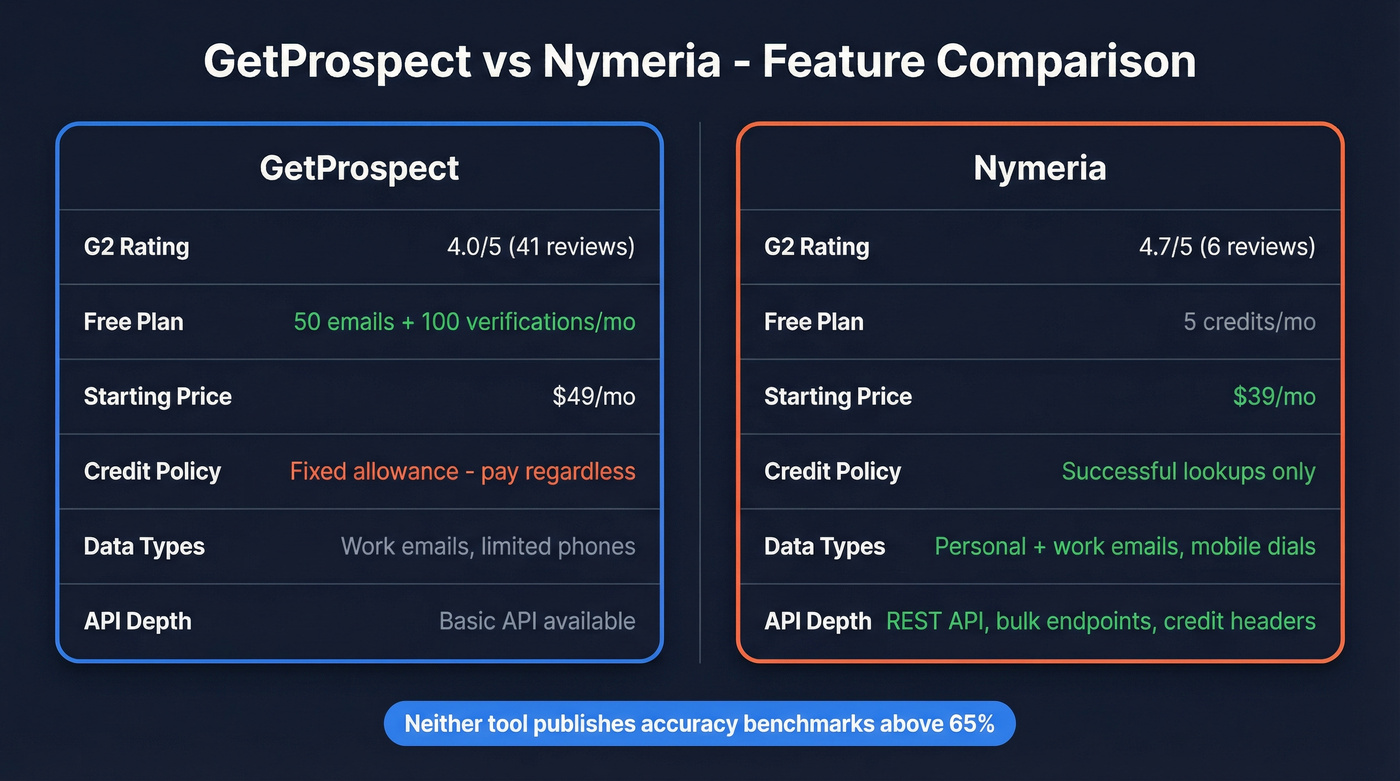
Nymeria's 4.7 rating looks impressive until you notice it's built on just 6 reviews. GetProspect's 4.0 across 41 reviews gives you a more reliable signal, and the complaint patterns are clear enough to act on.
Pricing and Credit Mechanics
GetProspect's Starter plan at $49/mo gives you 1,000 valid emails and 2,000 verifications. Predictable, straightforward. The tradeoff: you pay for the plan's allowance whether lookups succeed or not.
If you're comparing other options in this category, it helps to scan a broader list of data enrichment services first.
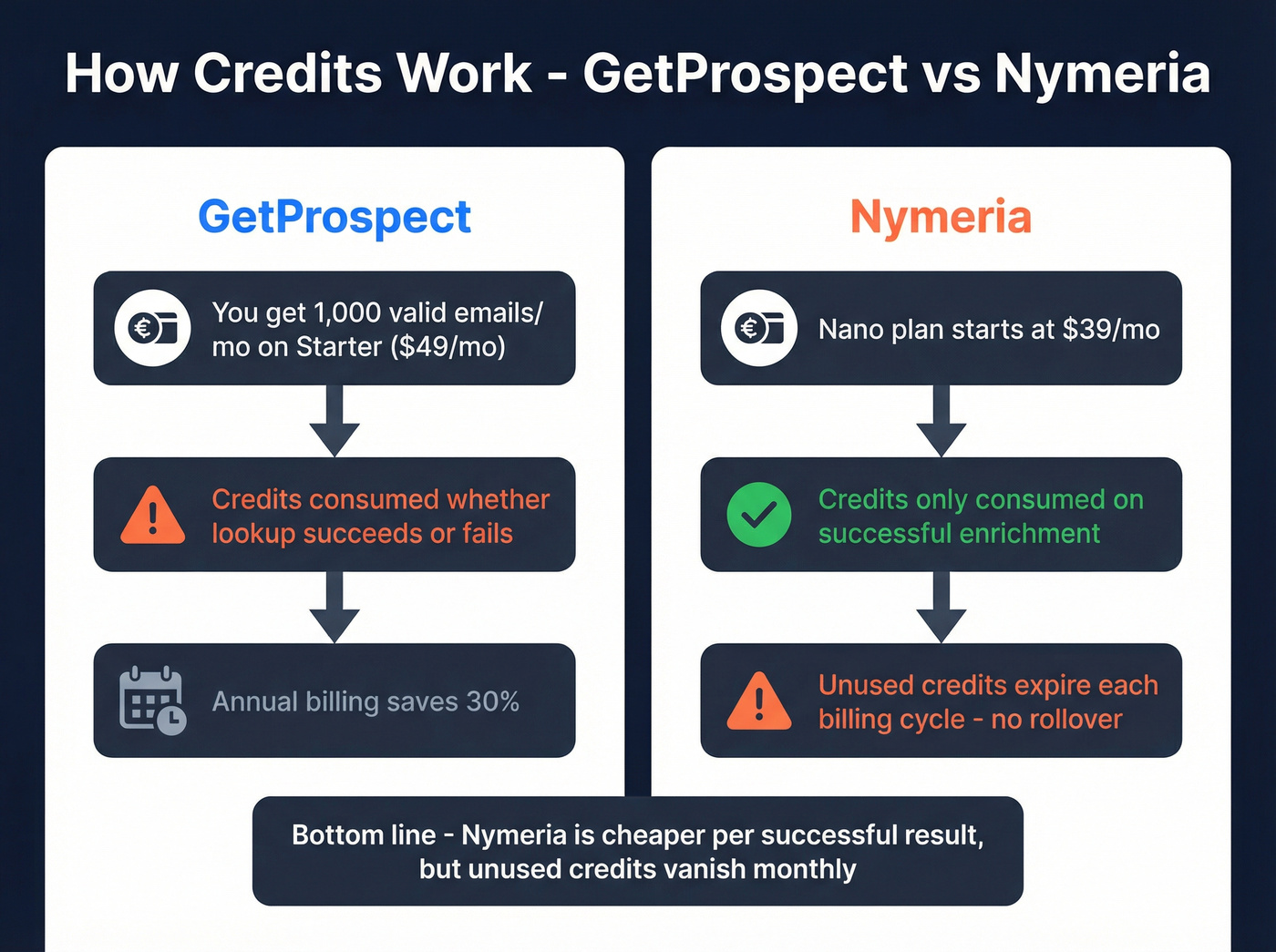
Nymeria flips the model. A credit is consumed only when you successfully enrich a record with new contact data or run an email verification request - failed lookups cost nothing. That's genuinely useful when you're enriching messy lists where hit rates vary wildly. Credits don't roll over, though, so unused ones vanish at the end of each billing cycle unless you've negotiated a custom plan.
For budget-conscious teams, Nymeria's Nano tier at $39/mo is the cheaper entry point. Both tools offer annual billing discounts: Nymeria advertises 20% savings on yearly plans, and GetProspect's annual billing saves 30%.
Accuracy and Data Freshness
Here's where things get uncomfortable.
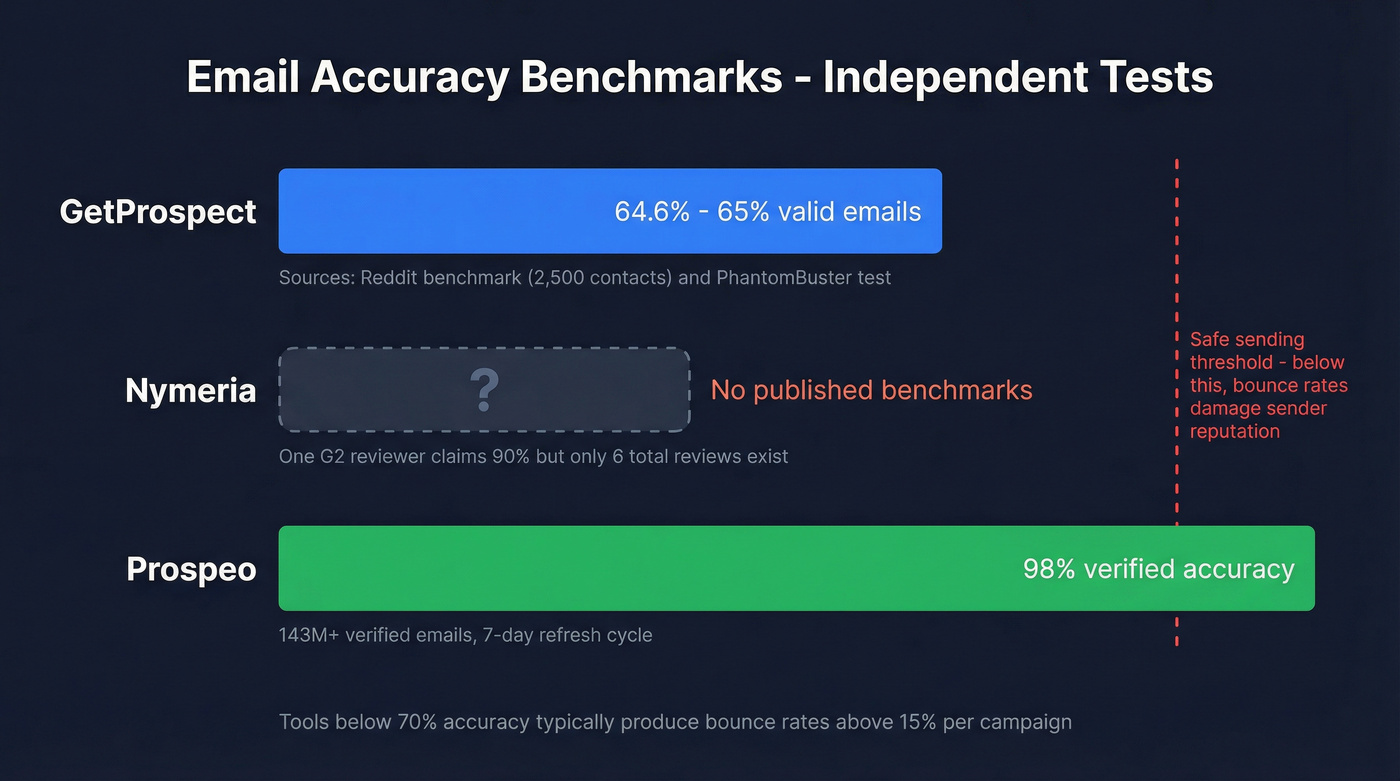
A Reddit benchmark test on 2,500 contacts put GetProspect at 64.6% valid emails. A separate PhantomBuster test landed at 65%. Two independent tests, same ballpark - roughly a third of your lookups won't return a usable email. In our experience, tools below 70% accuracy consistently produce bounce rates above 15%, which is enough to damage your sender reputation over a single campaign.
If you're trying to quantify the risk, start with your email bounce rate and work backward into list quality and verification coverage.
Nymeria has no published accuracy benchmarks. One G2 reviewer says it's helpful "90% of the time" but also flags that contact information can be outdated. And because the public review footprint is tiny, Nymeria's track record is hard to audit - which is itself a buying signal worth weighing.
Neither tool discloses a data refresh cycle. If deliverability is a priority, it's worth reviewing an email deliverability guide before you commit to any data provider.

GetProspect benchmarks at 65% accuracy. Nymeria has no published benchmarks at all. Prospeo's 98% email accuracy is verified across 143M+ emails on a 7-day refresh cycle - not the 6-week industry average. At $0.01/email, one bounced campaign with either tool costs more than switching.
Run 75 free lookups against your own list and see the difference.
API and Automation
Use Nymeria if you're building enrichment into a product or automated pipeline. Its REST API is genuinely well-designed: bulk enrichment endpoints, X-Total-Limit-Remaining credit headers for monitoring usage programmatically, and require filters that return a 404 if the record lacks the data type you need. That last feature alone saves credits and keeps your pipeline clean.
If you're evaluating this for outbound infrastructure, it can help to compare against other outbound lead generation tools and decide where enrichment should sit in your stack.
Skip Nymeria's API if you just need a browser extension and CSV exports. You'd be paying for infrastructure you won't touch.
GetProspect has an API, but the documentation doesn't approach Nymeria's depth. For teams that live in code, Nymeria wins this category cleanly.
Risks Worth Knowing
GetProspect carries a recurring theme in G2 reviews: email bounces and account risk. One reviewer titled their review "Easy way to get your LinkedIn account shut down" - dated 2023, though the underlying risk hasn't changed. A more recent reviewer called it "affordable vs Apollo/ZoomInfo" but noted real data gaps on smaller companies.
If you're building a repeatable outbound motion, these issues tend to show up as sales pipeline challenges (low connect rates, wasted sequences, and deliverability drag).
Nymeria has a different problem: insufficient social proof. Six G2 reviews aren't enough to trust the 4.7 rating at face value. Reviewers flag outdated contacts, and Nymeria has fewer native integrations than all-in-one sales suites, which can mean more manual work depending on your stack.
Best Pick by Scenario
The right choice depends entirely on your workflow:
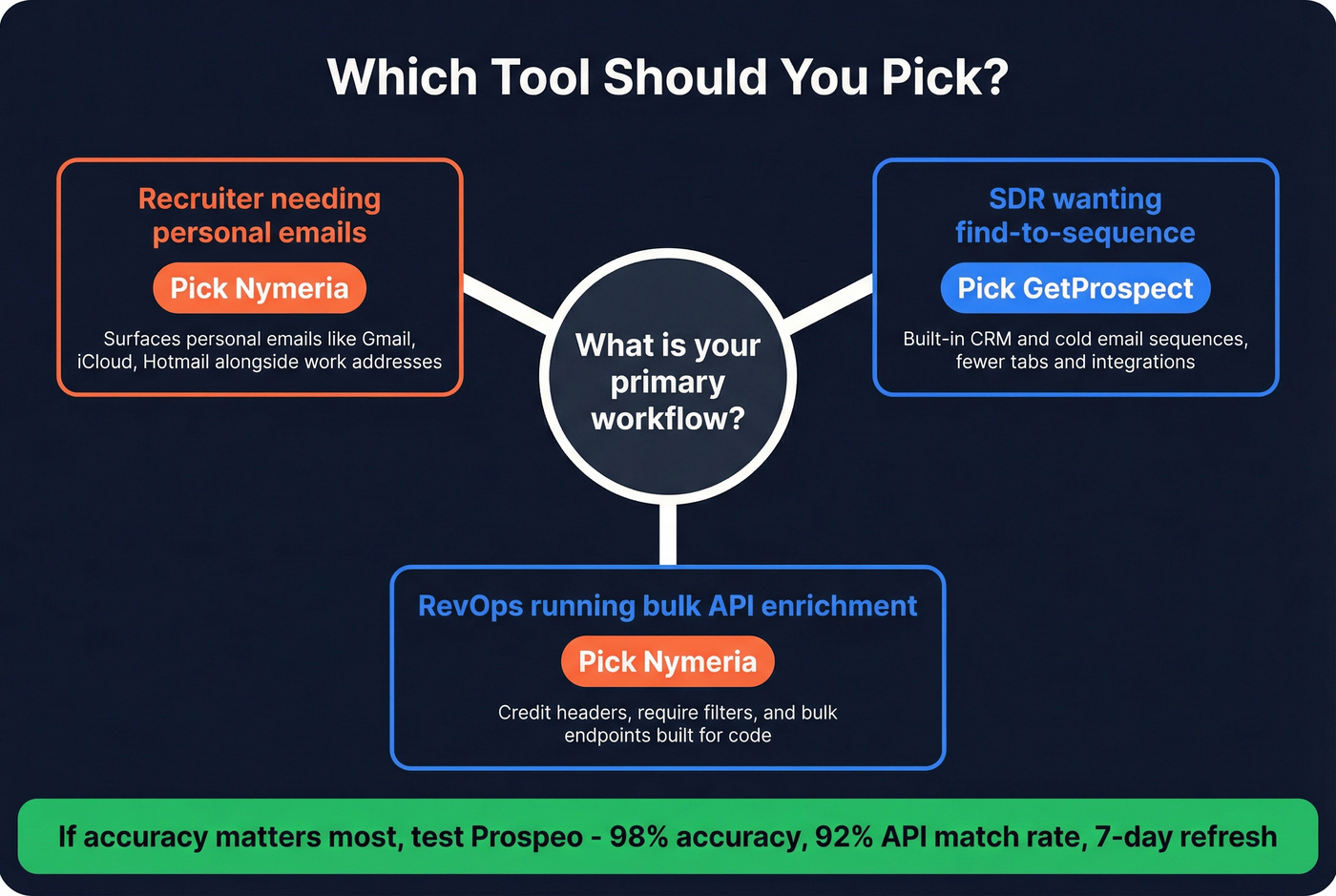
- Recruiter who needs personal emails - Nymeria. It surfaces personal emails (Gmail, iCloud, Hotmail) alongside work addresses, which most B2B tools skip entirely.
- SDR who wants find-to-sequence in one tool - GetProspect. The built-in CRM and cold email sequences mean fewer tabs and fewer integrations to manage (especially if you're standardizing on a set of SDR tools).
- RevOps running bulk API enrichment - Nymeria. The credit headers, require filters, and bulk endpoints are built for programmatic workflows.
Let's be honest: if your average deal size is under $5K, neither tool's accuracy is good enough to justify the bounce risk. You need verified data, not volume.
A Stronger Alternative to Both
We've compared dozens of email finders, and the pattern is consistent - most tools in this price range hover around 60-70% accuracy. Prospeo solves this directly with 98% email accuracy, 143M+ verified emails, 125M+ verified mobiles, and a 7-day data refresh cycle compared to the industry average of six weeks. The 92% API match rate means enrichment workflows actually return usable data. Self-serve, GDPR compliant, no contracts, with a free tier of 75 emails/month. For teams that have been burned by stale data, it's worth running a head-to-head test on your own list.
If you're still shopping, a roundup of email search tools can help you sanity-check accuracy claims and pricing models.

Nymeria's API is solid, but a 92% match rate with 50+ data points per enrichment changes the math on bulk workflows. Prospeo's enrichment API returns verified emails, direct dials, and firmographics - no mystery hit rates, no undisclosed refresh cycles.
Stop enriching against stale data. Get results you can actually send to.
FAQ
Does Nymeria charge for failed lookups?
No. Credits are only consumed when enrichment successfully adds new contact data or when you run an email verification request. Failed lookups cost nothing - useful when enriching messy or incomplete lists where hit rates are unpredictable.
What if neither tool meets my accuracy needs?
Run a side-by-side test. Pull a list of 100 contacts you already know are valid, then check each tool's hit rate against that ground truth. Most teams that do this end up switching to a provider with verified data and a weekly refresh cycle - bounce rates typically drop below 4% once you do.