

Go-to-Market Strategy Definition: What It Actually Means (and Why Every Other Guide Gets It Wrong)
There's a Reddit post in r/FPandA that sums up the problem perfectly: "every time I try to read about it, it just sounds like marketing... what is the difference?" That confusion isn't the poster's fault - it's the content's fault. If you've searched for a go-to-market strategy definition and left more confused than when you started, you're in good company. Somewhere between 40% and 95% of new products fail to meet their targets, and a vague understanding of GTM is a big reason why.
The Short Answer
So what's a go-to-market strategy in plain language? It's a cross-functional plan for how you'll launch a specific product or enter a specific market - covering who you're selling to, how you'll reach them, and what success looks like.
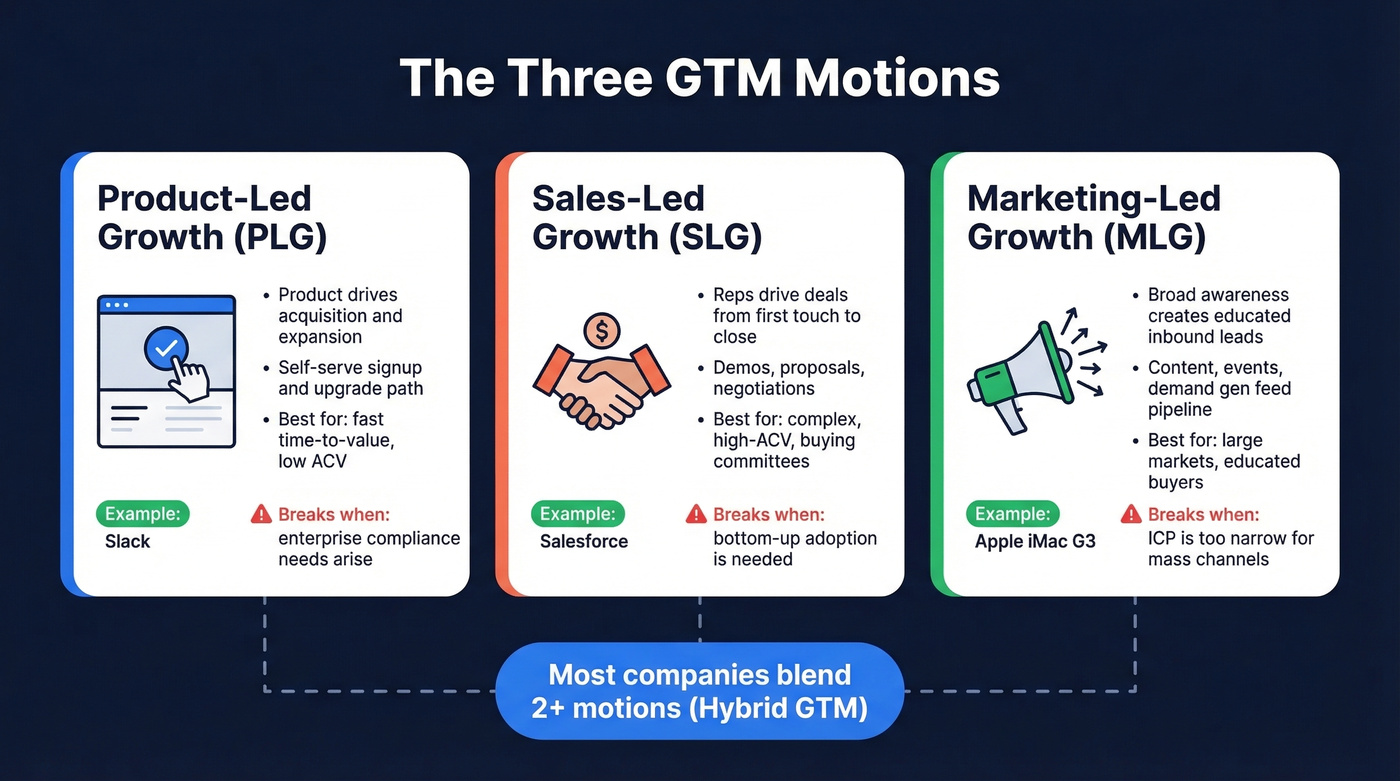
The biggest misconception? It's not marketing. Marketing is one function inside a GTM strategy; GTM aligns product, sales, marketing, and customer success around a specific launch or market entry. The three core motions are product-led growth (PLG), sales-led growth (SLG), and marketing-led growth (MLG) - most companies blend at least two.
What Does GTM Strategy Actually Mean?
A go-to-market strategy is a time-bound, cross-functional plan that aligns every customer-facing team around a specific product launch or market entry.
The key word is time-bound. A GTM strategy isn't your ongoing marketing playbook or your five-year business plan. It's the coordinated effort to take something specific - a new product, a new pricing tier, an expansion into EMEA - and get it into the hands of paying customers. It has a timeline and a set of metrics that tell you whether it worked. Once the launch stabilizes, the GTM strategy hands off to your ongoing operations.
Think of it as the playbook for a specific market moment, not a permanent operating document. The best GTM teams treat it as a living system, not a slide deck someone builds once and archives.
GTM vs. Marketing vs. Business Plan
| GTM Strategy | Marketing Strategy | Business Plan | |
|---|---|---|---|
| Scope | One launch or market entry | All marketing efforts | Entire business |
| Timeframe | Weeks to months | Long-term | Company-level, multi-year |
| Owner | Typically PMM/RevOps with cross-functional leaders | Marketing leadership | Executive leadership |
| Focus | Launch alignment | Brand, demand, loyalty | Revenue, ops, funding |
| Deliverable | Launch playbook | Channel & campaign plan | Investor deck / ops plan |
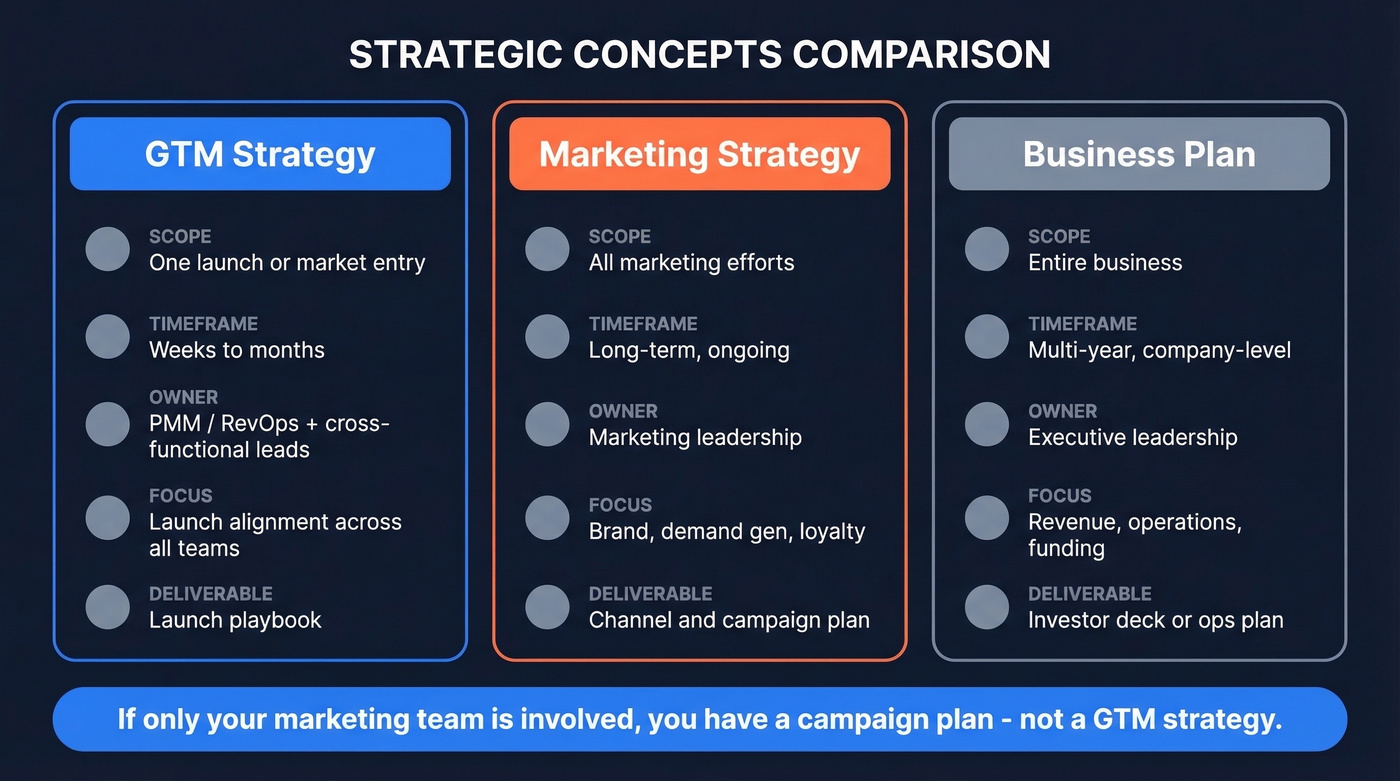
GTM is cross-functional. It pulls in product, sales, marketing, support, and sometimes legal and finance. A marketing strategy lives inside one department. A business plan lives at the company level but doesn't tell you how to actually get a product into a customer's hands next quarter.
If only your marketing team is involved, you don't have a GTM strategy - you have a campaign plan. Understanding this distinction is what separates teams that launch well from teams that launch into a void.
Why GTM Strategy Matters
The cost of getting GTM wrong isn't abstract. IDC estimates that 10%+ of all revenue is lost during the go-to-market phase. For a $50M company, that's $5M+ evaporating because teams weren't aligned on who they're selling to, how, and when. Flip that around: getting GTM right can boost revenue growth rates by 1.5-2x.
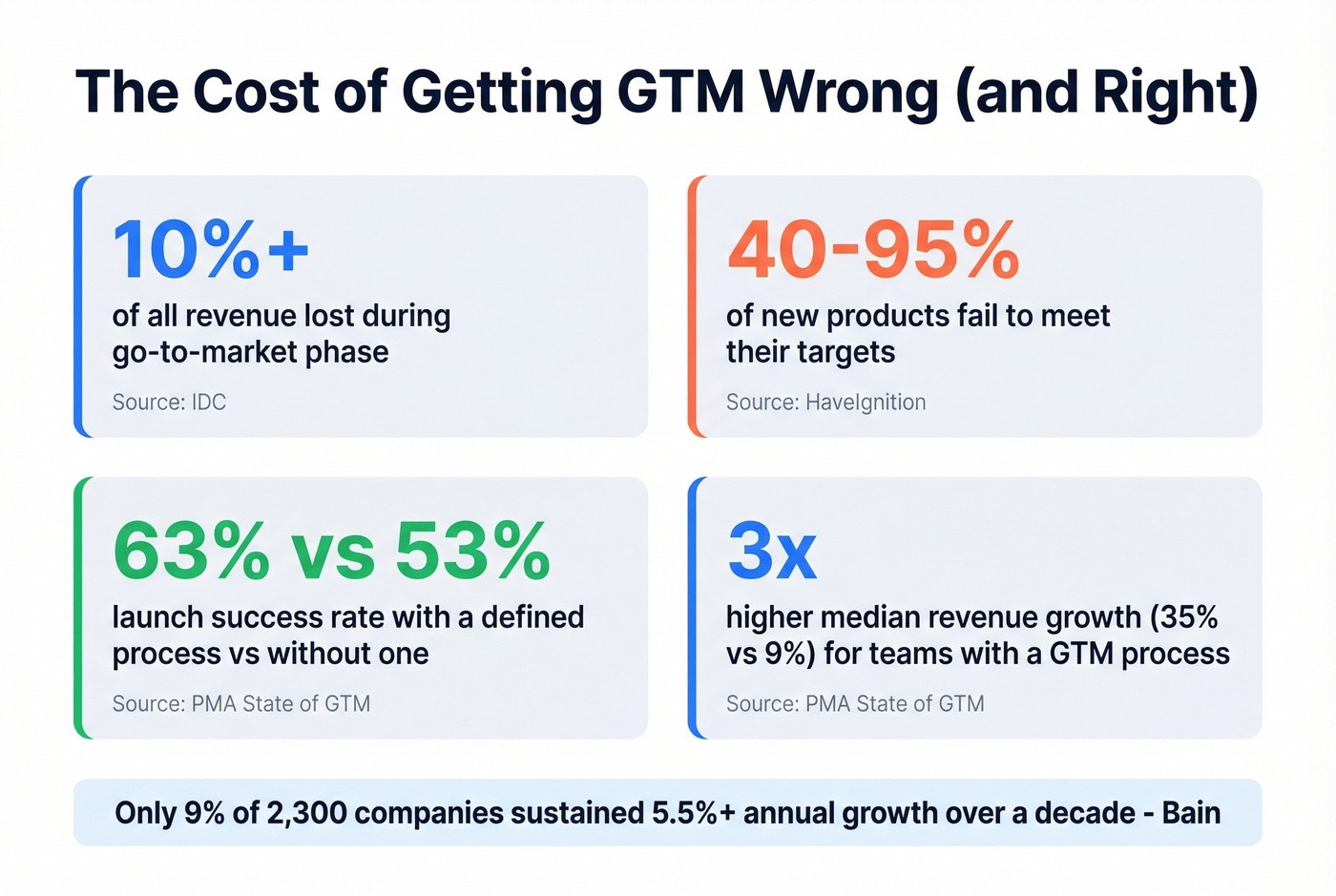
Bain studied 2,300 global companies and found that only 9% achieved 5.5%+ annual revenue and profit growth sustained over a decade. The companies that did treated GTM as an adaptive system - they built repeatability into launches, eliminated silo walls between functions, and made fast decisions without waiting for quarterly reviews.
PMA's State of GTM report reinforces this: companies with a defined launch process hit 63% launch success rates versus 53% for those without one, and saw 3x higher median revenue growth (35% vs. 9%). The gap between "we have a process" and "we wing it" is measurable and enormous.

A GTM strategy fails when sales can't reach the right buyers. Prospeo gives you 300M+ profiles with 30+ filters - buyer intent, technographics, headcount growth, funding - so your launch targets the exact ICP you defined. 98% email accuracy means your outbound actually lands.
Stop launching into a void. Start launching into verified inboxes.
The Three GTM Motions
Product-Led Growth (PLG)
Slack is the canonical example. The product drives acquisition, activation, and expansion. Users sign up, experience value, and upgrade - often before talking to a human. PLG works when your product delivers value quickly and the buyer can self-serve without procurement approval. It breaks when enterprise customers show up with legal, security, and compliance requirements that a self-serve flow can't handle. We've watched teams try to replicate Slack's PLG without the product quality to back it up. It doesn't end well.
Sales-Led Growth (SLG)
Reps drive the deal from first touch to close - demos, proposals, negotiations, procurement. This is the motion for complex, high-ACV products sold to buying committees. But it's too slow for bottom-up adoption or developer traction, which is why companies like Temporal eventually opened a PLG path alongside it.
Marketing-Led Growth (MLG)
This one's for teams with a large enough market for broad awareness campaigns and a sales cycle that benefits from educated inbound leads. Demand generation, content, events, and brand awareness create pipeline that sales closes.
Apple's 1998 iMac G3 launch was pure MLG - bold design, a massive ad campaign, and retail distribution that put the product in front of consumers who'd never considered a Mac. MLG breaks when your ICP is so narrow that mass-market channels waste budget.
The Hybrid Reality
Almost nobody runs a pure motion anymore. Zapier grew with self-serve adoption, then layered enterprise sales when customers hit procurement walls. HubSpot's hybrid creates its own friction: a steep price step between Starter and Pro tiers that they've been working to reduce with credits-style hybrid pricing.
Here's the thing: hybrid isn't just "do both." It requires shared systems, a single source of truth for pricing and usage data, and clear rules for when a self-serve user gets handed to sales. Without that infrastructure, you end up with two motions fighting each other instead of reinforcing each other. In our experience, the hybrid transition is where most teams underestimate the systems work required - and where the most promising launches stall out.
How to Build a GTM Strategy
Now that the go-to-market strategy definition is clear as a concept, let's walk through actually building one.
Define What Failure Looks Like
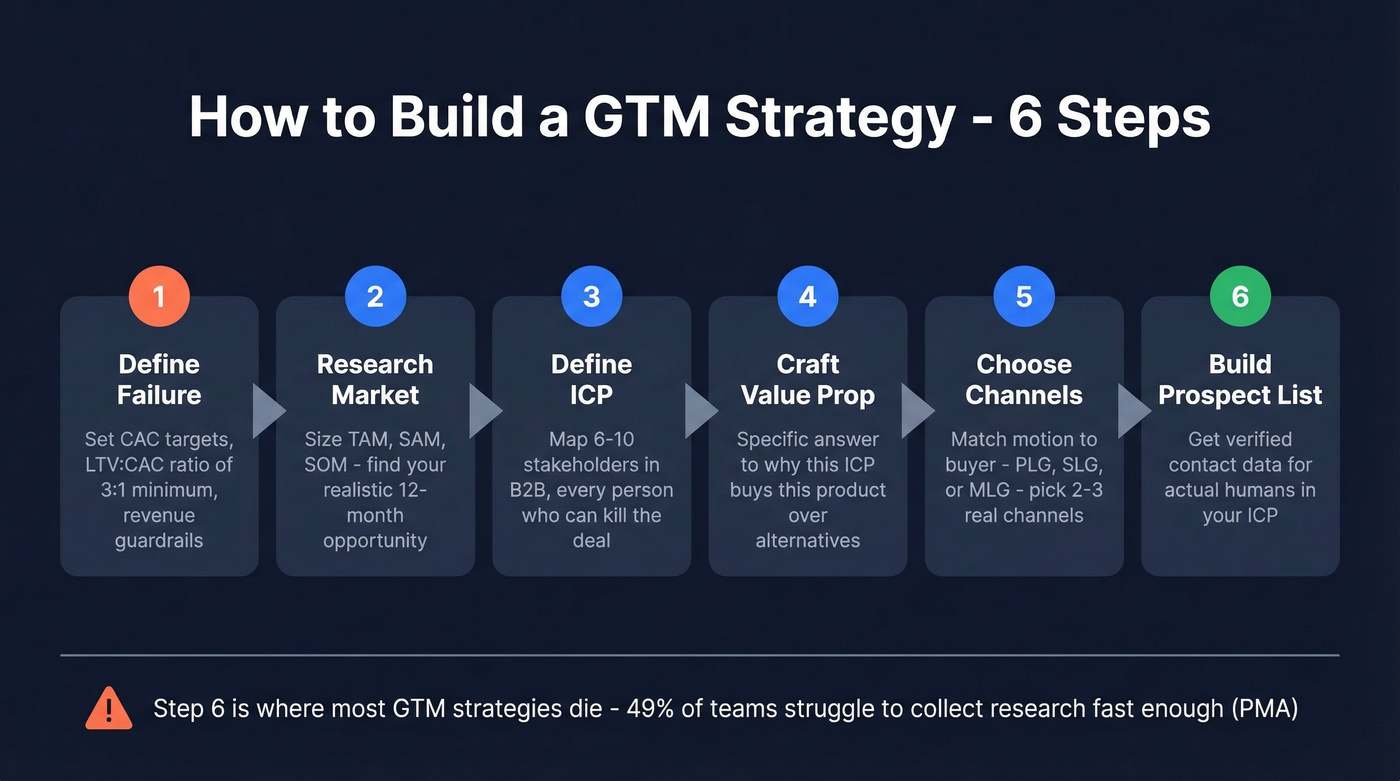
Start with the economics. If you don't know what a customer costs to acquire, you can't evaluate whether your GTM is working. CAC benchmarks vary wildly by industry: $239 for B2B SaaS, $86 for ecommerce, $784 for financial services. Your target LTV:CAC ratio should be at least 3:1. Define these numbers before you build anything else - they're your guardrails.
Research Your Market
Size your opportunity with TAM, SAM, and SOM. TAM is the dream. SOM is the reality for your first 12 months. We've seen teams skip this step and end up building GTM plans for markets that are either too small to justify the investment or too large to attack without a focused wedge. Neither ends well.
Define Your ICP
In B2B, you're selling to a committee of 6-10 stakeholders across a 6-12 month cycle driven by ROI calculations. In B2C, you're convincing one person in minutes. Your ICP definition needs to account for every stakeholder who can kill the deal, not just the person who signs the contract.
Craft Your Value Proposition
Your value prop isn't your tagline. It's the specific answer to "why should this ICP buy this product instead of the alternative - including doing nothing?" Make it concrete. "We save mid-market finance teams 15 hours per month on reconciliation" beats "we streamline financial operations" every single time.
Choose Channels and Motion
Match your motion to your buyer. PLG for fast time-to-value products. SLG for complex, high-ACV deals. MLG for broad markets with educated buyers. Account-based marketing isn't a separate motion - it's a channel strategy that layers on top of SLG or MLG when your ICP is narrow enough to target by name. Pick 2-3 channels where your ICP actually spends time, not where you wish they did.
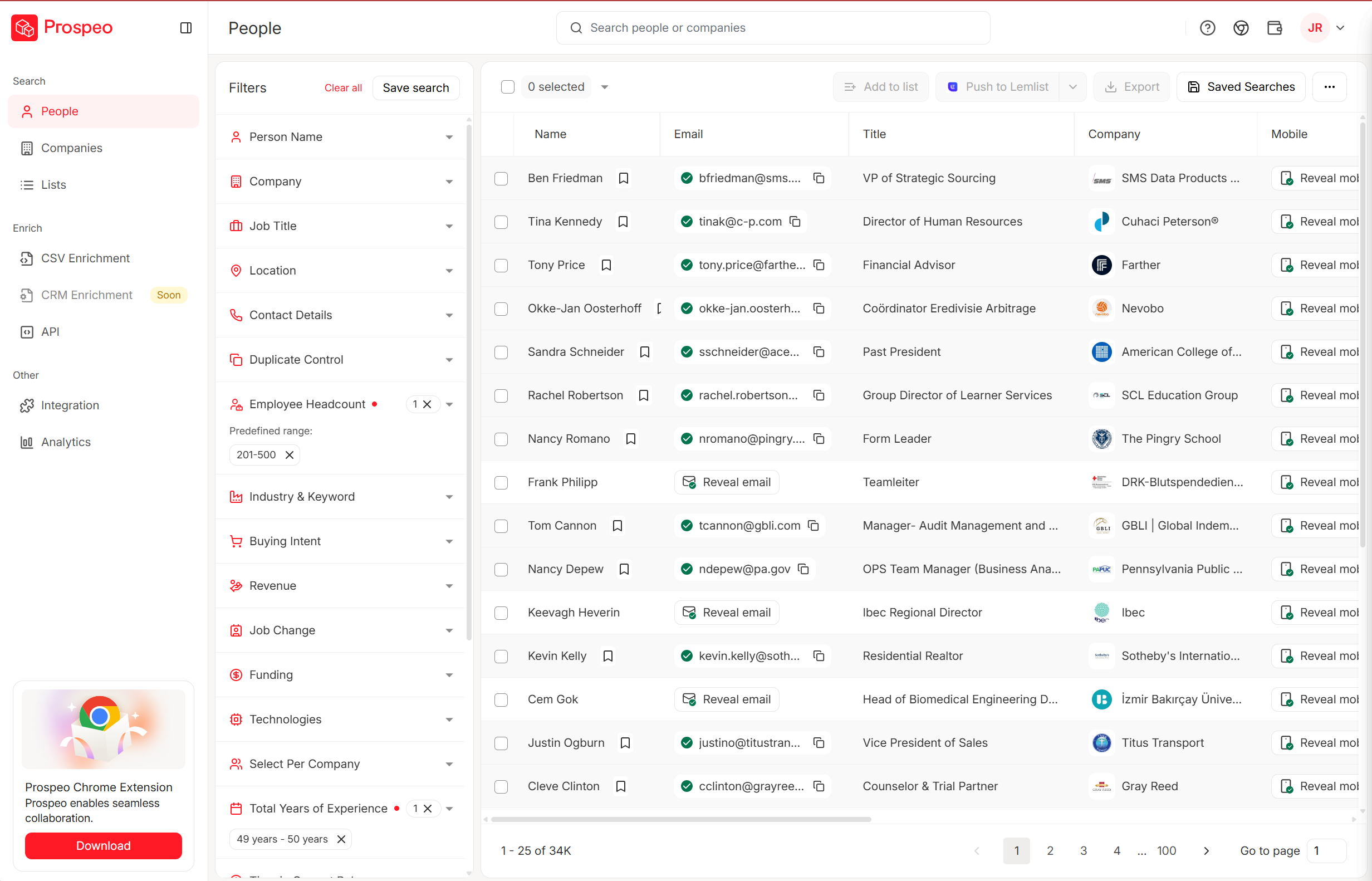
Build Your Prospect List
This is where GTM strategies die. You've defined your ICP on paper - titles, industries, company sizes. Now you need verified contact data for those actual humans. PMA found that 49% of GTM teams struggle to collect research fast enough, and the gap between "we know who we're targeting" and "we have 5,000 verified emails ready for outreach" is where weeks get wasted.
Tools like Prospeo close that gap with 300M+ professional profiles, 143M+ verified emails, and 30+ search filters including buyer intent data and technographics. Emails are 98% accurate on a 7-day refresh cycle, which matters because your GTM strategy is only as good as your ability to reach the people in it.
If you're building lists from multiple sources, data enrichment can help you standardize fields and fill gaps before outreach, and email verification helps protect deliverability when you're moving fast.
GTM Strategy Template
The typical product marketing manager launches 10-16 products per year, spends 50+ hours per launch, and involves 10+ stakeholders. You need a repeatable framework, not a blank Google Doc. Here's one you can steal.
Preparation:
- Business goals - Revenue target: $___ / Market share target: ___% / Adoption metric: ___ users by ___
- Ideal Customer Profile - Target titles, industries, company size range, and top 3 pain points
- Buyer journey mapping across awareness, consideration, and decision stages
- Competitive analysis covering positioning gaps, pricing comparison, and feature differentiation
- GTM messaging with value prop per persona, objection handling, and proof points
Execution:
- Marketing and sales channels ranked by expected ROI
- Launch activities sequenced across pre-launch, launch day, and post-launch
- Pricing strategy including model, tiers, and competitive positioning
Monitoring:
- Performance metrics: CAC, pipeline velocity, conversion rates, churn
- Product roadmap alignment with feedback loops from launch back to product
Skip the monitoring phase at your own risk. We've seen teams nail the launch and then have zero visibility into whether it actually worked because nobody set up tracking before day one. If you want a tighter measurement layer, start with funnel metrics and a simple pipeline health dashboard.
GTM Examples That Worked
Slack: Product-Led Growth
Free product, viral word-of-mouth within teams, and a freemium model that converted usage into revenue. They tracked DAU, free-to-paid conversion rates, and usage expansion within organizations. The results: 8M+ daily active users, 3M paid users by 2019, and a $27.7B acquisition by Salesforce. The lesson isn't "be like Slack" - it's that they picked one motion, measured the right things, and didn't bolt on enterprise sales until the product had already won.
Zapier: PLG to Hybrid
Zapier started with transparent self-serve pricing and a product that sold itself to individual users. When enterprise customers hit the procurement wall, Zapier's smart move was layering sales on top of the existing self-serve model rather than replacing it. That's a hybrid that didn't cannibalize the self-serve engine - and it's the model most B2B companies should study before attempting their own hybrid transition.
If you're building this inside a product org, the go-to-market strategy process looks a little different than it does in sales-led orgs.
Whether you run PLG, SLG, or a hybrid motion, every GTM strategy needs accurate contact data to execute. Teams using Prospeo book 26% more meetings than ZoomInfo users and 35% more than Apollo - at 90% lower cost. That's the difference between a GTM plan and GTM results.
Align your teams around data that actually connects to real buyers.
FAQ
Is GTM strategy just marketing?
No. A go-to-market strategy is cross-functional - it aligns product, sales, marketing, and customer success around a specific launch. Marketing is one input. If only your marketing team is involved, you have a campaign plan, not a GTM strategy.
Who owns the GTM strategy?
The product marketing manager typically owns it, with RevOps coordinating execution across sales, marketing, and customer success. The worst outcomes happen when nobody owns it and each function builds their own plan in isolation.
How long should a GTM plan take to build?
Most effective GTM plans take 4-8 weeks from ICP research through channel selection and launch sequencing. PMA data shows PMMs spend 50+ hours per launch - rushing below that threshold correlates with lower success rates and misaligned teams.
How do I find contacts for my GTM launch?
Define your ICP first, then use a B2B data platform to build a verified prospect list using intent signals, technographic filters, and job-change data. Unverified data tanks deliverability and wastes your launch window - aim for 98%+ email accuracy to protect your domain.