

How to Develop a Go-to-Market Strategy That Doesn't Fail
You're in the board meeting. Someone asks, "What's your target CAC?" and the room goes quiet. That silence is where most go-to-market strategy development goes wrong - not from bad ideas, but from zero benchmarks and untested assumptions.
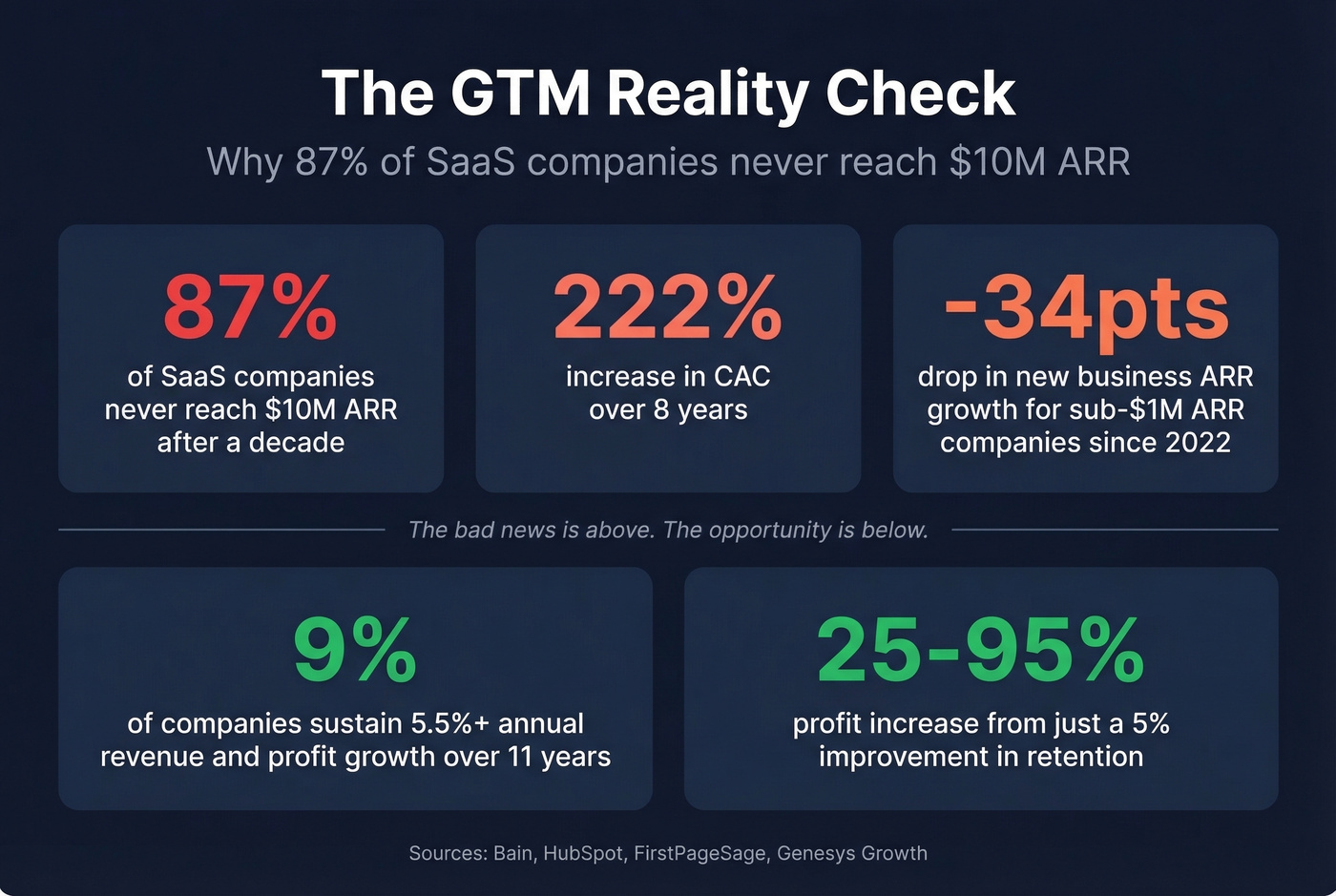
Only 9% of companies achieved 5.5%+ annual revenue and profit growth over 11 years, per Bain's research across 2,300 global companies. Only 13% of SaaS companies ever reach $10M ARR after a decade. The other 87% built strategies that looked great on slides and collapsed on contact with the market.
The Non-Negotiable Foundation
Before anything else, three things:
- Talk to 50 potential customers.
- Pick your growth motion based on ASP - below $25, go pure PLG; around $100+, plan to add sales support.
- Benchmark your CAC against industry data and iterate every 6-8 weeks for the first six months.
That's the skeleton. Everything below is the muscle and connective tissue.
Why Most GTM Strategies Fail
GTM strategies don't fail from lack of effort. They fail because execution fragments the moment it leaves the strategy deck - marketing runs one playbook, sales runs another, and product ships features nobody asked for. CAC has increased 60% over five years and 222% over eight, and new business ARR growth dropped 34 percentage points for sub-$1M ARR companies since early 2022. The margin for strategic error keeps shrinking every quarter.
We've watched this pattern repeat across dozens of launches. The consensus on r/startups and r/SaaS threads is brutally consistent - founders ask "What actually worked?" and the answers always circle back to avoiding these five mistakes:
Launching without validated insights. Even 20-30 structured interviews reveal what users actually value. Most teams skip this entirely.
Premature scaling. Hiring reps and cranking ad spend before your sales motion is consistent is the fastest way to burn cash. Don't do it.
Sales-marketing misalignment. Functional teams operating as fiefdoms instead of an integrated system. We've seen this kill more launches than bad product-market fit.
Pricing by guesswork. One-third of companies now use hybrid pricing models, yet most startups pick a number and hope for the best.
Measuring activity, not impact. Pipeline meetings full of vanity metrics while CAC quietly spirals. And 75% of software companies saw declining retention recently - a 5% improvement in retention drives 25-95% profit increases, yet nobody's tracking it.
Choose Your Growth Motion
This is the highest-leverage decision in your entire GTM plan.
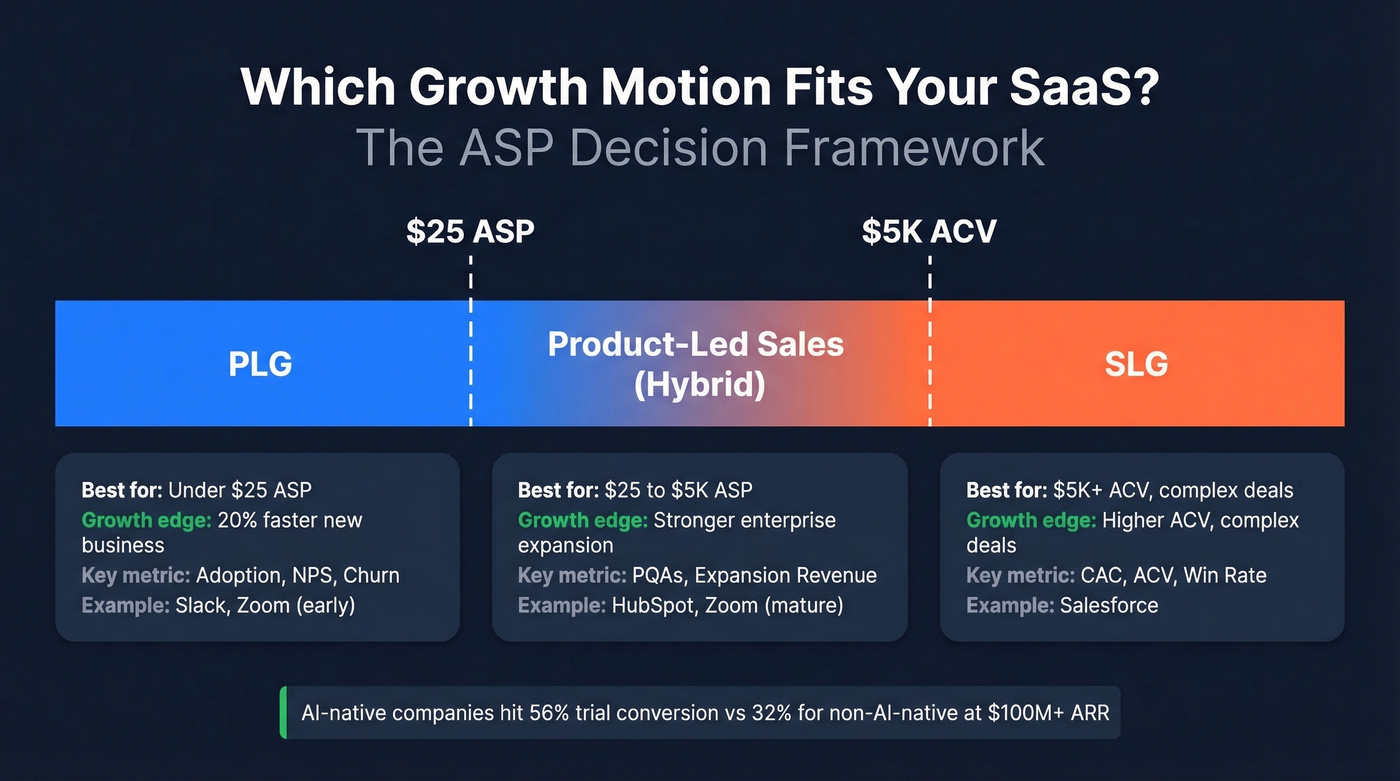
ChartMogul's analysis of 2,500 SaaS companies found that below $25 ASP, pure PLG companies grow new business 20% faster than those layering in sales too early. Starting at $100 ASP, most B2B PLG companies begin adding sales support. The threshold is remarkably consistent across verticals.
Here's the thing: PLG isn't automatically better. McKinsey's analysis of 107 publicly listed B2B SaaS providers shows that only a select subset of PLG outperformers account for the valuation premium. Average-performing PLG businesses spend significantly more on OpEx than average SLG peers but fare only marginally better. The real winners run Product-Led Sales - a hybrid where bottom-up adoption feeds top-down enterprise selling through Product Qualified Accounts.
In our experience, ASP is the single most reliable predictor of which motion works. AI-native companies are accelerating this further: ICONIQ's 2025 data shows they hit 56% conversion rates from free trial/POC phases versus 32% for non-AI-native companies at $100M+ ARR.
| Factor | PLG | SLG | Hybrid (PLS) |
|---|---|---|---|
| Best when ASP is | Under $25 | $5K+ ACV, complex deals | $25-$5K |
| Growth edge | 20% faster new biz | Higher ACV, complex deals | Stronger enterprise expansion |
| Key metric | Adoption, NPS, churn | CAC, ACV, win rate | PQAs, expansion rev |
| Example | Slack, Zoom (early) | Salesforce | HubSpot, Zoom (mature) |
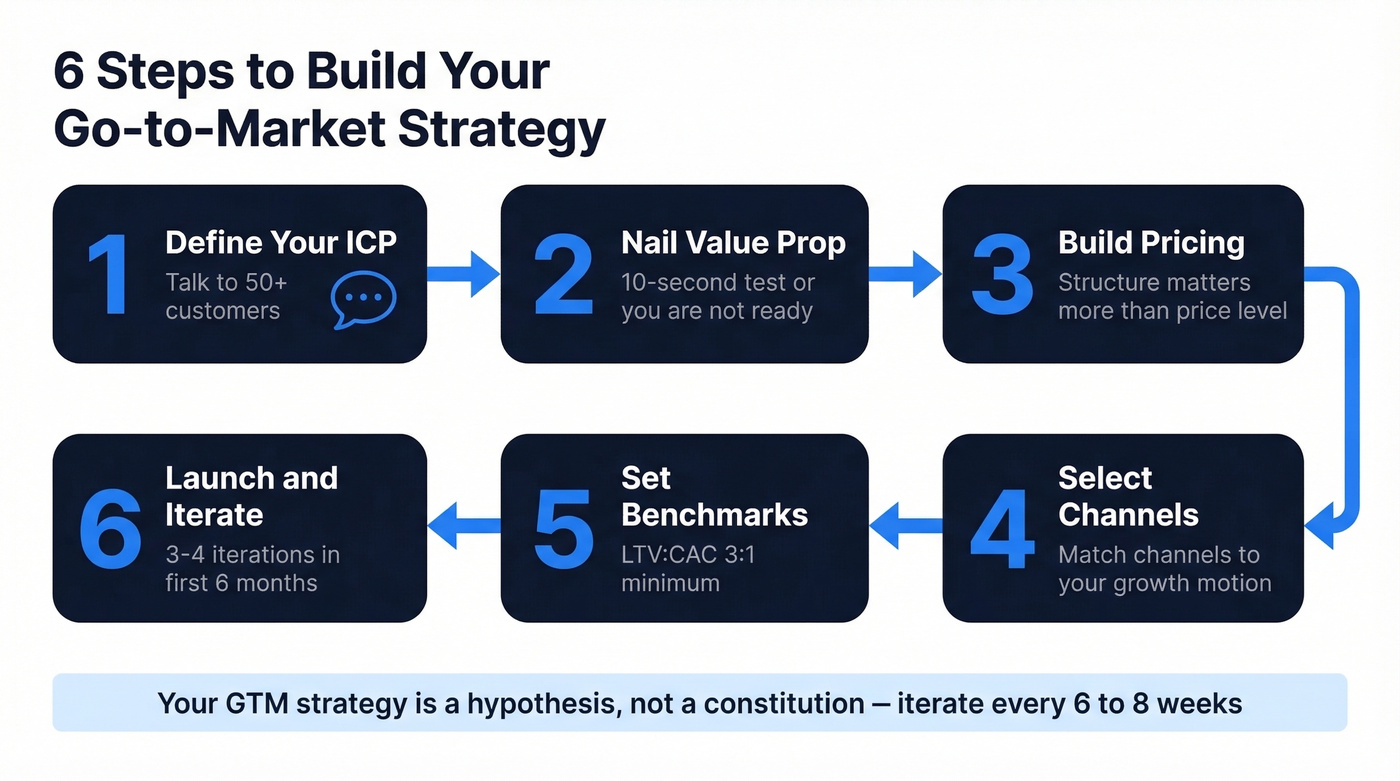
6 Steps to Build Your GTM Strategy
1. Define Your ICP From Conversations
Talk to 50+ potential customers before you launch. Include company size, industry, decision-maker titles, pain points, budget reality, and buying triggers. Then beta with 5-10 companies matching your ICP. This isn't optional - it's the difference between a hypothesis and a foundation. Skip it and you're guessing with other people's money.
2. Nail Your Value Proposition
Your value prop must answer three questions in under 10 seconds: What do you do? Who for? What problem do you solve that others don't? The Product Marketing Alliance framework breaks this into five elements: market definition, customers, distribution model, messaging/positioning, and price. If you can't pass the 10-second test, you're not ready to launch.
3. Build Your Pricing Architecture
Price structure - tiers, packaging, usage metrics - drives more revenue impact than price level. Most teams obsess over "$49 or $59?" when the real question is how to package value into tiers that expand naturally. Willingness-to-pay research is mainstream now. Run it. The Value Pricing Framework weighs four inputs: your costs, customer value, reference prices, and your value proposition. Refresh it regularly as market conditions shift, because they will.
4. Select Channels Based on Motion
PLG means self-serve signup, freemium, and viral loops. SLG means direct outreach, demos, and dedicated reps.
Don't try to run both from day one. Only 33% of the average martech stack actually gets used, so fewer tools deployed well beats a bloated stack every time. For teams running outbound as part of their SLG or hybrid motion, data quality is the channel - bad contact data doesn't just waste money, it torches your domain reputation and makes every subsequent email harder to deliver.
5. Set Benchmarks With Real Numbers
Without benchmarks, you're flying blind. Here's what good looks like:
| Metric | Benchmark | Why it matters |
|---|---|---|
| LTV:CAC | 3:1 minimum | Below this, you're buying revenue at a loss |
| AE quota attainment | 58% industry avg | Your GTM exists to beat this number |
| Trial-to-paid spike | Day 7 | Design onboarding around this window |
| Median CAC payback | $2.00 per $1 new ARR | Fourth-quartile companies spend $2.82 |
If you need a deeper CAC definition and calculation model, use this cost to acquire customer guide.
6. Launch, Then Iterate
Your GTM strategy is a hypothesis, not a constitution. Successful SaaS companies iterate 3-4 times in the first six months. Bain's research is clear: adaptability separates the 9% who sustain growth from everyone else. Samsung adapted its GTM system to the iPhone disruption and gained six points of market share. Nokia didn't, and lost six. Same market, opposite outcomes.

Bad contact data is the silent GTM killer. When CAC is up 222% and every outbound touch costs more, you can't afford bounced emails torching your domain. Prospeo delivers 98% email accuracy with a 7-day refresh cycle - so your reps reach real buyers, not dead inboxes.
Stop burning GTM budget on data that bounces.
CAC Benchmarks by Industry
These numbers are your reality check. If your CAC is wildly above these ranges, your GTM motion has a structural problem - not a "we just need more leads" problem.
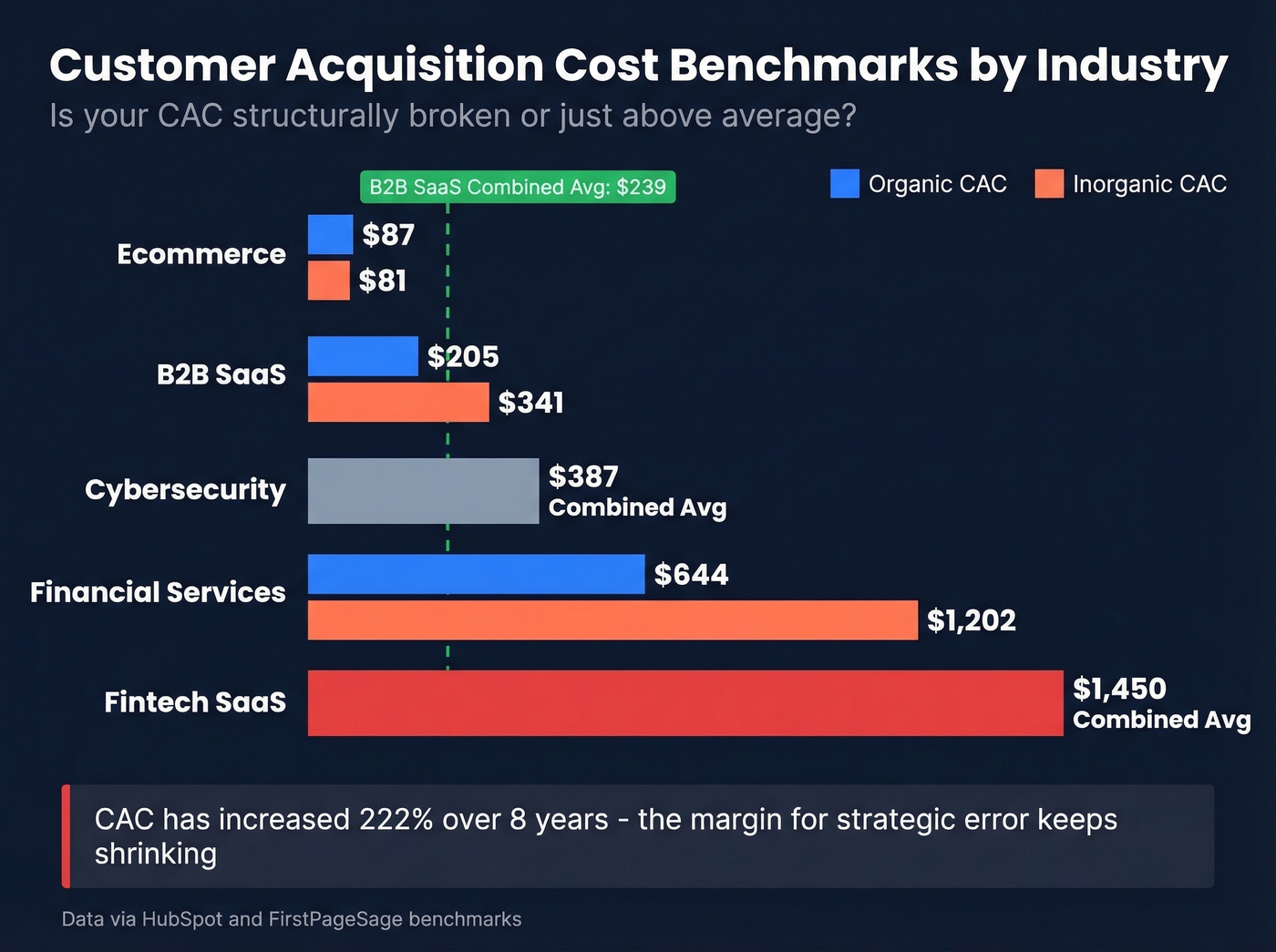
| Industry | Organic CAC | Inorganic CAC | Combined Avg |
|---|---|---|---|
| B2B SaaS | $205 | $341 | $239 |
| Ecommerce | $87 | $81 | $86 |
| Financial Svcs | $644 | $1,202 | $784 |
| Fintech SaaS | - | - | $1,450 |
| Cybersecurity | - | - | $387 |
Data via HubSpot/FirstPageSage benchmarks
Let's be honest: if your deal size sits below five figures, you probably don't need ZoomInfo-level data infrastructure or a 12-person SDR team. Most early-stage GTM failures come from overbuilding the stack, not under-investing in it.
Prospect Data Is GTM Infrastructure
Bad prospect data kills GTM execution before it starts. You build the strategy, define the ICP, pick the right growth motion - then send 5,000 emails and 1,750 bounce. Domain reputation destroyed. CAC inflates. The whole execution layer crumbles because the foundation was rotten.
Once bounce rates hit double digits, you have a data problem, not a messaging problem. We've seen teams waste months tweaking subject lines and CTAs when the real issue was 35% of their list hitting dead inboxes. Prospeo's 98% email accuracy and 7-day data refresh cycle exist specifically to prevent this - and the free tier lets you validate data quality before committing a dollar.
If you're diagnosing deliverability, start with email bounce rate benchmarks and an email deliverability guide that maps fixes to root causes.

Running an SLG or hybrid motion? Your channel strategy lives or dies on data quality. Prospeo gives you 300M+ profiles with 30+ filters - buyer intent, technographics, headcount growth, funding - so your ICP targeting matches reality, not guesswork. At $0.01 per email, scaling outbound doesn't blow your CAC benchmarks.
Build your ICP lists with data that actually connects.
GTM Case Studies That Worked
HubSpot: Category Creation
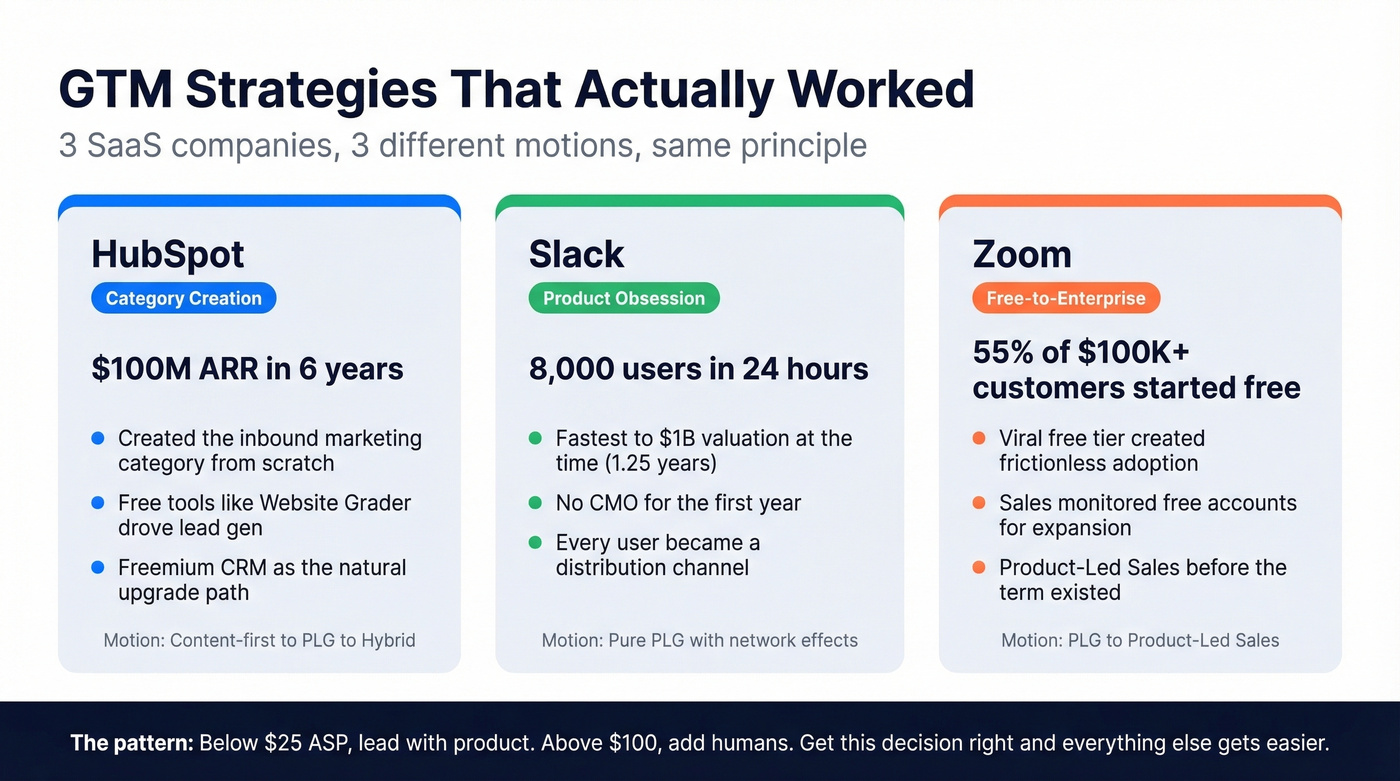
HubSpot reached $100M ARR in six years by creating the "inbound marketing" category entirely. Content-first approach, free tools like Website Grader for lead gen, then a freemium CRM as the upgrade path. They didn't enter a market - they defined one, and that's a fundamentally different GTM motion than competing in an existing space.
Slack: Product Obsession
8,000 users within 24 hours of launch. Hit $1B valuation in 1.25 years - the fastest to unicorn at the time. No CMO for the first year. The entire GTM strategy was product obsession and network effects through a freemium model. Every new user inside a company became a distribution channel.
Zoom: Free-to-Enterprise Pipeline
55% of customers contributing over $100K in revenue started with at least one free host. The viral free tier created frictionless adoption, and the sales team monitored free accounts for enterprise expansion opportunities. Classic Product-Led Sales before the term existed.
The pattern holds across every B2B SaaS launch we've analyzed: below $25 ASP, lead with product. Above $100, add humans. Get the growth motion decision right and everything else gets easier.
Bridging Strategy and Execution
The gap between a high-level go-to-market plan and day-to-day execution is where most plans die. Board decks full of TAM slides and positioning statements mean nothing if your SDRs don't know which accounts to prioritize on Monday morning.
Bridge the gap by translating every strategic pillar into a 90-day sprint with specific owners, metrics, and kill criteria. If a channel or motion isn't showing signal within two cycles, cut it and reallocate budget. Go-to-market strategy development never stops at the slide deck - it lives in the sprint board, the pipeline review, and the weekly retro where someone says "this isn't working" and the team actually pivots. If you want a more operational view of this handoff, map it to sales execution and a rep-ready 30-60-90 day plan.
GTM Strategy FAQ
Who owns the go-to-market strategy?
Product marketing typically owns GTM because it requires cross-functional coordination and deep product knowledge. Start with a core team of 7-9 people - product managers, demand-gen, data, content, and design - then expand strategically. Avoid the committee-of-30 approach that dilutes ownership and slows every decision to a crawl.
How long does GTM strategy development take?
Expect 4-8 weeks for initial development, then 3-4 iterations in the first six months. Top B2B SaaS companies reach 1,000 subscribers in 11 months; the median takes two years. Speed of iteration matters far more than perfection at launch.
What's the difference between GTM and marketing strategy?
GTM strategy focuses on bringing a specific product to a specific market - it's launch-oriented and time-bound. Marketing strategy is the ongoing plan for reaching your audience and delivering value over time. GTM is a sprint with a defined endpoint; marketing strategy is the marathon that follows.